
35 Carbamide Peroxide Tooth Whitening Gel Explained
Most advice about 35 carbamide peroxide tooth whitening gel starts with the wrong question: “Does the bigger percentage whiten faster?” A shopper sees 35% beside a familiar 10% formula and reasonably assumes the gel is more than three times as powerful. But carbamide peroxide chemistry makes that comparison misleading, and a stronger label can bring a less comfortable experience.
The useful question is more practical: when is the extra speed worth the added irritation risk? The answer depends on how carbamide peroxide releases hydrogen peroxide, what clinical evidence says about color change and sensitivity, and how carefully you control contact with your teeth and gums.
"Why 35 Percent Is Not What It Seems"
A reader browsing whitening gels online may see “35% carbamide peroxide” and treat the figure as a direct measure of bleaching power. That's understandable. Percentages look precise, and a larger number appears to promise a larger result. Yet the label describes the amount of carbamide peroxide, not the final amount of hydrogen peroxide doing most of the oxidizing work.
A 35% gel can still be a high-strength product, but it isn't “three and a half times” the practical strength of the classic 10% home formula. The carrier releases hydrogen peroxide gradually, while the rest of the formulation controls texture, moisture, flavor, and contact with the tooth surface. The number tells you something important, but it doesn't tell you everything you need to know about speed, comfort, or suitability.
The practical question: 35% may offer a faster route to visible change, but the benefit has to be weighed against concentration-related sensitivity and gum irritation.
That tradeoff matters because whitening isn't only about stain removal. Peroxide moves through the enamel and dentin, and some people feel a temporary zing when it reaches sensitive areas. A person with a comfortable whitening history may tolerate a short, controlled session, while someone with exposed roots or a history of sensitivity may regret choosing the strongest option first.
The rest of this guide separates the marketing number from the chemistry, then examines how the trusted home-use benchmark developed. You'll also see what laboratory and clinical evidence can, and cannot, tell us about high-strength gel. The goal isn't to label 35% as universally good or bad. It's to help you decide whether the potential speed justifies the additional irritation risk for your own teeth.
"Understanding the Chemistry of a 35 Percent Whitening Gel"
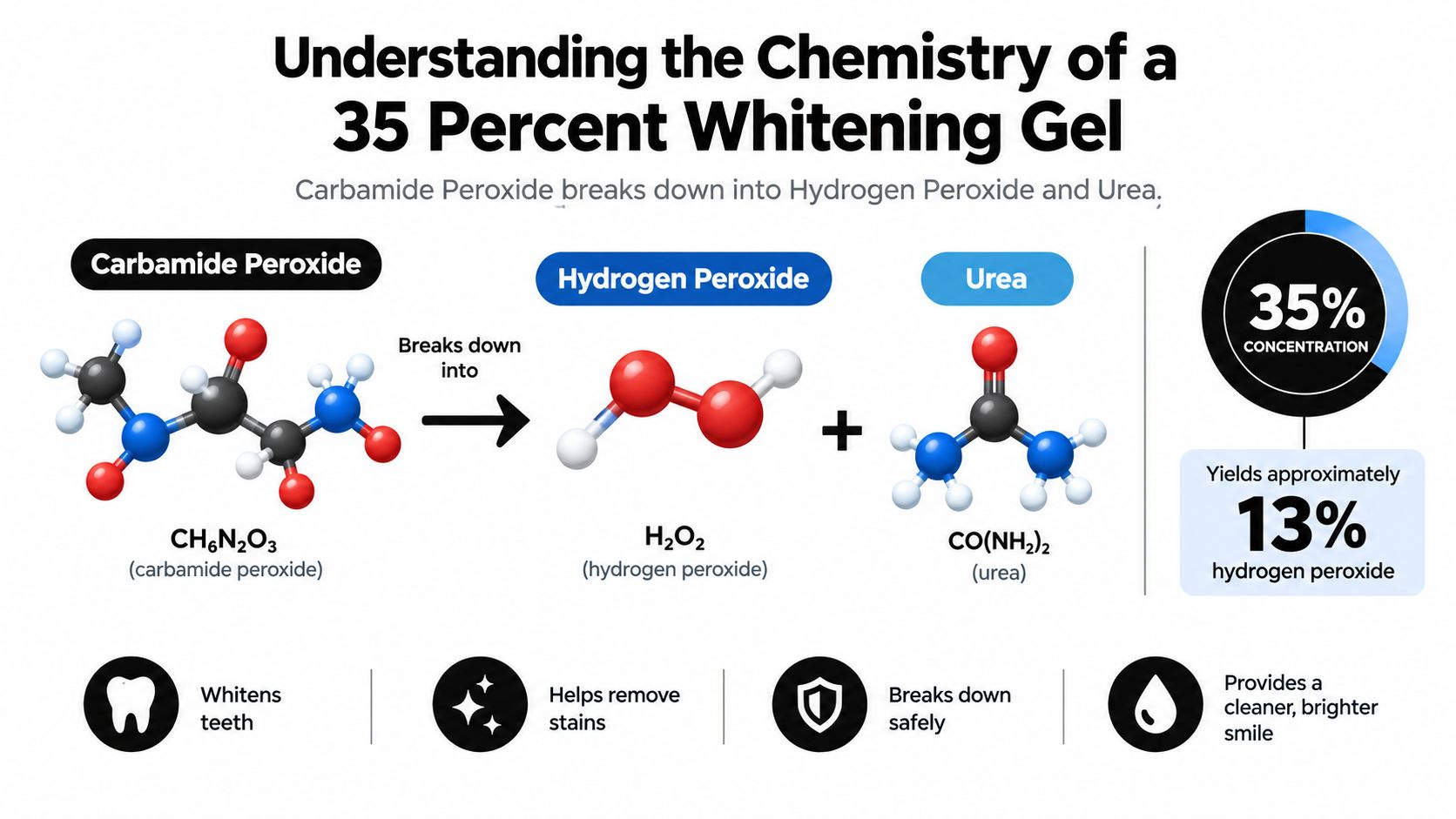
Carbamide peroxide works as a release system rather than as a direct one-to-one measure of hydrogen peroxide. When the gel contacts saliva and the tooth surface, carbamide peroxide breaks down into hydrogen peroxide and urea. Hydrogen peroxide then participates in the oxidation of colored molecules inside tooth structure, while urea contributes to the breakdown of the carrier.
A simple analogy is a two-part cleaning product stored in a stable package. The package makes the active ingredient easier to handle and keep in place, but the package percentage isn't identical to the amount of active cleaning agent ultimately released. That's why a 35% carbamide peroxide label sounds more dramatic than its hydrogen peroxide equivalent.
Reading a real product formula
Pola Day CP 35 provides a useful worked example. Its product instructions describe a high-viscosity, neutral-pH gel containing 35% carbamide peroxide, 40% water, 24.5% thickening agents, and 0.5% flavor. The same instructions list an 11.7% hydrogen peroxide equivalent, reflecting the fact that carbamide peroxide decomposes into hydrogen peroxide and urea. (Pola Day CP 35 product instructions)
The thickening agents aren't decorative ingredients. They help the gel stay where it was placed instead of immediately flowing away, while the water affects the consistency and delivery of the active compound. The neutral-pH formulation is also relevant to how the product is designed for contact with teeth, although pH alone doesn't determine whether an individual will experience sensitivity.
What happens inside the tooth
Enamel isn't a solid, sealed wall. It has microscopic pathways, and peroxide can move through those pathways toward stain molecules. The sponge-pore metaphor helps here: whitening temporarily allows the oxidizing agent to travel through tiny spaces and break apart darker compounds, much as a cleaning solution moves into the pores of a sponge. For a more detailed explanation of this process, see how carbamide peroxide whitens teeth.
The movement can also explain why sensitive teeth may react. If the peroxide reaches dentin or areas where the protective gum margin has receded, nerve responses may feel sharper. The formulation, tray fit, exposure time, existing tooth condition, and concentration all influence the experience.
Key takeaway: A 35% carbamide peroxide gel such as Pola Day CP 35 delivers roughly the strength of 12% hydrogen peroxide, because its listed hydrogen peroxide equivalent is 11.7%, not 35%. (Pola Day CP 35 product instructions)
That distinction doesn't make the gel mild. It makes the comparison more honest. You're evaluating a high-strength carbamide peroxide product whose active oxidizing equivalent is lower than the headline percentage, but still more concentrated than the classic home-use benchmark.
"How Home Whitening Concentrations Evolved"
Modern tray whitening has a clear starting point. In 1989, Haywood and Heymann introduced nightguard vital bleaching, using 10% carbamide peroxide in custom-fitted trays as a dentist-prescribed method for whitening at home. The technique gave patients a controlled way to keep gel against the teeth, and it became the foundation of modern tray-based whitening. (Historical review of carbamide peroxide whitening)
That history matters because it shows what “home whitening” originally meant. The method wasn't built around the highest available percentage. It paired a comparatively moderate gel with a fitted tray and a repeatable routine. The tray handled placement, while time and consistency allowed the peroxide to work without relying solely on maximum concentration.
The benchmark became mainstream
The American Dental Association later accepted tray-applied 10% ± 1% carbamide peroxide as safe and effective for at-home whitening in 2006, according to the same review literature. The accepted range helped move tray whitening from an experimental clinical approach into a mainstream dental practice. (Historical review of carbamide peroxide whitening)
In hydrogen peroxide terms, 10% carbamide peroxide is commonly described as equivalent to 3.6% hydrogen peroxide. (Historical review of carbamide peroxide whitening) That conversion gives shoppers a better mental scale. A 35% carbamide peroxide gel is therefore a professional-adjacent, high-strength choice rather than the ordinary starting point that established at-home tray whitening.
This doesn't mean every product outside the benchmark is unsuitable. Formulas differ, and a dentist may select a stronger product for a specific situation. The historical lesson is narrower and more useful: the most established home-use reference point is much lower than 35%.
A shopper who has never whitened before shouldn't assume that a higher label represents better judgment. Starting with a lower concentration gives you information about your teeth's tolerance, your tray fit, and the type of stains you're trying to change. If you later need more intensity, you can make that decision with experience rather than guesswork.
"How Effective Is 35 Percent Carbamide Peroxide"
The evidence doesn't support a simple “stronger always wins” conclusion. A clinical study using 37% carbamide peroxide reported sensitivity values close to zero, but it produced slightly less color change than 35% hydrogen peroxide in an in-office comparison. Reviews also report that 35% carbamide peroxide, used for about 1 hour over multiple days, didn't significantly increase enamel wear in brushing challenge models. (Clinical review of carbamide peroxide whitening)
Those findings are useful, but they answer different questions. Color change measures whitening performance, while the brushing model examines enamel wear under test conditions. Neither result proves that every person will experience the same comfort or that a high-strength product is appropriate without checking the mouth first.
A 2025 network meta-analysis concluded that 10% carbamide peroxide can achieve comparable bleaching efficacy with less tooth sensitivity than higher concentrations, although the certainty of that evidence was low. (University of Toronto report on whitening product effects) The practical implication is important: a lower-strength regimen may deliver a similar overall whitening outcome, even if it takes a different schedule or feels less dramatic at the start.
Carbamide peroxide strengths at a glance
| Concentration | Hydrogen Peroxide Equivalent | Typical Use | Evidence Highlight |
|---|---|---|---|
| 10% | 3.6% | Established at-home tray benchmark | Comparable efficacy with less sensitivity than higher concentrations in a low-certainty 2025 network meta-analysis |
| 35% | 11.7% in Pola Day CP 35 | High-strength, controlled whitening | Effective color change is reported, while sensitivity and exposure remain central tradeoffs |
| 37% | Not specified in the cited study | In-office comparative study | Sensitivity values were close to zero, with slightly less color change than 35% hydrogen peroxide |
The table isn't a promise of identical results. Tooth shade, stain type, enamel condition, tray coverage, and adherence all affect what a person sees. Someone who stops a high-strength routine because of sensitivity may achieve less practical whitening than someone who completes a gentler plan comfortably.
For readers comparing oral-care products across categories, a separate guide to find a skin lightening serum illustrates why product strength should always be interpreted alongside formulation and intended use. The same general shopping principle applies here: a headline concentration is only one part of the decision.
"Safety Considerations for High-Strength Gels"
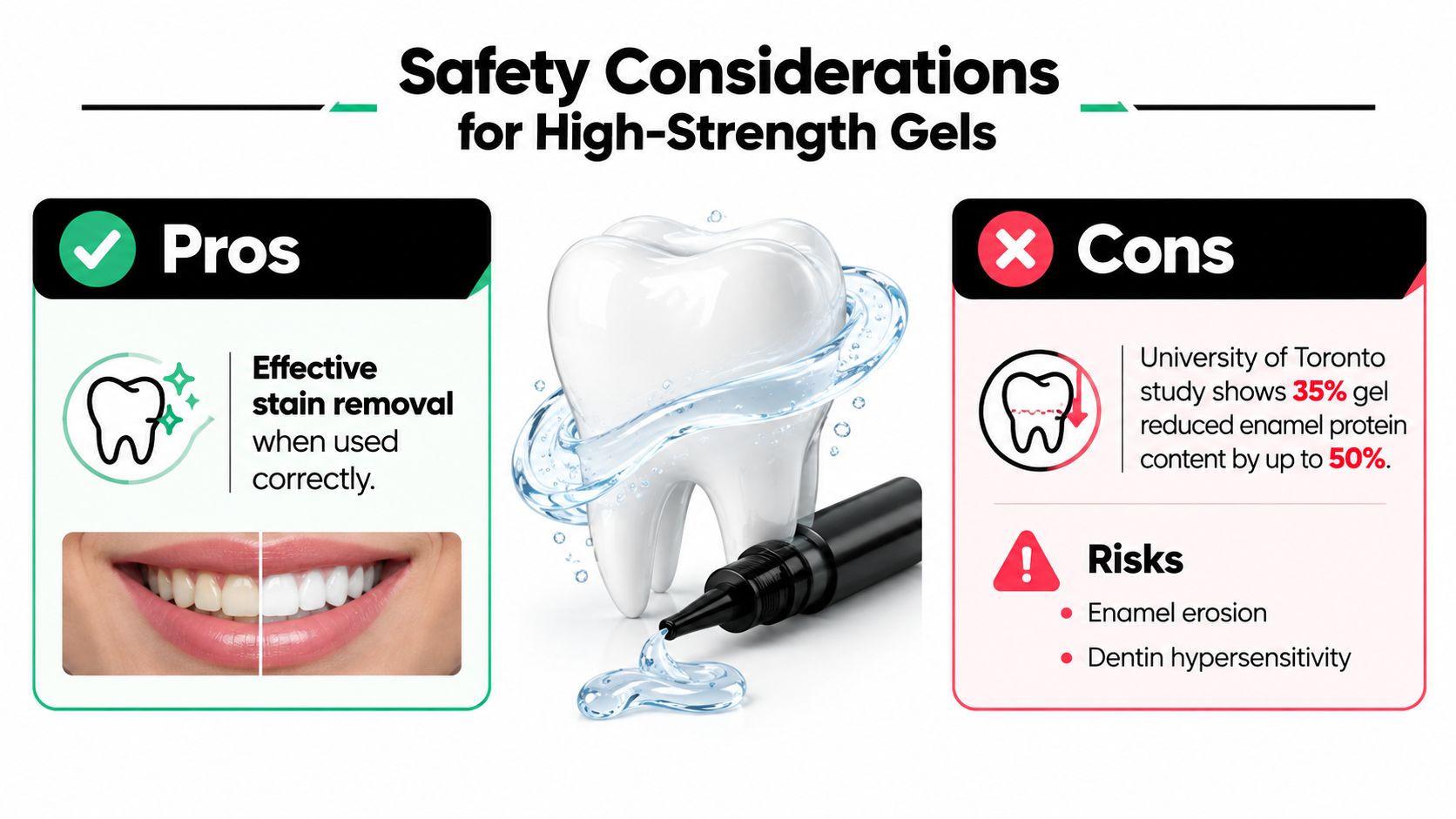
High-strength whitening deserves a candid risk discussion. A University of Toronto report stated that 35% carbamide peroxide gel sold online reduced enamel protein content by up to 50% in laboratory testing, and that dental pulp cells didn't survive exposure at around 35% carbamide peroxide concentrations in vitro. (University of Toronto report on whitening product effects)
Those results can sound alarming, but laboratory exposure isn't the same as carefully applied tray use in a real mouth. Test cells or enamel samples may receive direct, concentrated contact under conditions that don't reproduce saliva, tray design, rinsing, or a controlled clinical protocol. The findings still matter because they show why concentration and contact time deserve respect. They shouldn't be turned into a prediction that every correct use will produce the same damage.
What users commonly notice
Independent reviews and dental guidance identify temporary tooth sensitivity and gingival irritation as common peroxide-whitening effects. Those effects are generally transient, but they tend to increase as concentration and exposure time increase. (American Dental Association guidance on whitening)
The usual at-home range is described as 5% to 22% carbamide peroxide, while 35% sits well above that range. (American Dental Association guidance on whitening) That doesn't automatically make 35% unsafe in every supervised context, but it does make casual experimentation a poor idea, especially if gel reaches the gums or the user extends the session hoping to accelerate the result.
The tradeoff in plain language
| What high strength may offer | What it may cost |
|---|---|
| A more concentrated whitening approach for someone seeking faster visible change | Greater chance of temporary sensitivity |
| Effective stain oxidation when the product is used as directed | More noticeable gum irritation if gel touches soft tissue |
| A shorter, controlled routine for a peroxide-tolerant user | Less room for error with exposure time or tray fit |
The safer mindset is controlled intensity, not maximum intensity. A well-fitting tray, accurate timing, and clean application can reduce unnecessary tissue contact, but they can't eliminate individual differences in sensitivity or repair existing dental problems. Persistent pain, gum injury, or an uneven result is a reason to stop and seek dental advice.
For a plain-language explanation of the broader safety question, read is carbamide peroxide safe for teeth whitening. The central point is not that high-strength gel must be avoided. It's that the extra concentration buys convenience only when your teeth and routine can tolerate it.
"Using the Gel Correctly and Managing Sensitivity"
Application technique can determine whether a high-strength gel feels controlled or irritating. The aim is to place a small, even amount on the tooth-facing surfaces of a suitable tray, keep it away from the gumline, and stop the session at the product's instructed time. More gel doesn't compensate for poor coverage, and a longer session isn't a safe shortcut.
A 2026 umbrella review found that moderate hydrogen peroxide concentrations around 25% to 35% can achieve whitening outcomes comparable to higher concentrations while reducing sensitivity risk. (American Dental Association guidance on whitening) The same dose-related principle supports a restrained routine. If your teeth hurt, increasing exposure is the opposite of the adjustment you need.
A controlled-use routine
- Check the starting point. Don't begin over untreated decay, cracked teeth, inflamed gums, or unexplained pain. A whitening gel changes tooth color, but it doesn't repair the reason a tooth is sensitive.
- Prepare the tray carefully. Clean and dry it as instructed, then use only the amount recommended for the product. Excess gel can squeeze onto the gumline, where it may cause irritation.
- Protect the soft tissue. Wipe away visible overflow before the session starts. If the tray doesn't fit securely or repeatedly pushes gel onto your gums, stop using it until the fit is addressed.
- Use a timer. Follow the manufacturer's instructions exactly rather than extending the session. The supplied usage guidance for this product category may involve controlled periods, but the label for your specific gel takes priority.
- Rinse after removal. Remove the tray, rinse your mouth and the tray as directed, and avoid aggressive brushing immediately afterward. Don't combine the session with a routine that already stresses the enamel or gums.
- Pause at the first warning sign. Mild, brief sensitivity can occur, but sharp pain, persistent discomfort, or gum whitening and soreness means the routine needs to stop and be reviewed.
The infographic's checklist emphasizes protective barriers, limited sessions, exact instructions, and thorough rinsing. Those steps matter more with a high-strength product because small application errors can expose the gums to a larger peroxide load.
A sensitivity routine can include toothpaste formulated with potassium nitrate and a remineralizing paste, provided those products suit your oral-health needs. DentalHealth.com offers whitening gels alongside sensitivity toothpastes and remineralizing options such as MI Paste Plus, so shoppers can compare a whitening product with supportive care products in the same oral-care category. For a product-use overview, see how to use carbamide peroxide gel.
Avoid whitening on the same day as acidic foods or aggressive brushing if your mouth already feels irritated. A slower schedule is often the smarter adjustment. You aren't trying to prove that your teeth can endure the strongest possible treatment. You're trying to reach a shade you like without turning sensitivity into the reason you abandon whitening altogether.
"Deciding Whether 35 Percent Is Right for You"
The decision isn't really “Does 35% carbamide peroxide work?” Evidence supports effective whitening at high strength, but it also supports comparable results with lower concentrations and less sensitivity in some comparisons. The more useful question is whether the potential convenience of faster visible change outweighs the likelihood of irritation for your mouth.
A simple framework can help:
- Consider 35% only with professional-style caution if you've whitened before, generally tolerate peroxide well, and want a more concentrated routine. Use a well-fitting tray, keep sessions controlled, and follow the product instructions rather than improvising.
- Choose a lower concentration if you have a sensitivity history, exposed roots, irritated gums, or no previous whitening experience. A gentler multi-week approach may be easier to complete and can still produce a satisfying color change.
- Ask a dentist first if you have pain, untreated dental problems, restorations in the visible smile, or uncertainty about the source of discoloration. Whitening won't change the color of fillings, crowns, or other dental materials in the same way it changes natural enamel.
A lower-strength gel isn't a failed version of 35%. It may be the better match for someone who values comfort, consistency, and a finished routine over a quick first impression. Stepping down in concentration is a smart choice, not a compromise.
If you decide to try a high-strength gel, start with a clear plan, a timer, and a way to manage sensitivity before you begin. Stop if your mouth reacts badly, and let a dental professional help you distinguish normal temporary sensitivity from a problem that needs treatment.
DentalHealth.com offers professional-grade at-home whitening gels, sensitivity toothpastes, and remineralizing products from established dental-care brands. Visit DentalHealth.com to compare options and choose a whitening routine that matches your goals and tolerance.