
A1CNow Self Check Accuracy Explained
You're probably here because a small number just landed in your hand, and now it feels bigger than the device itself. A home A1C can do that. It looks simple, but the question underneath is serious, should you trust it enough to change what you eat, how you take medication, or whether you call your clinician?
A1CNow Self Check makes that moment easier to understand when you treat it as a guide, not a verdict. The most useful way to read it is as a trend-monitoring companion to lab testing, especially when the number sits near a decision point. That framing keeps you from overreacting to one reading and helps you decide when a repeat test or lab confirmation makes more sense.
The Moment a Home A1C Result Feels Too Important
You've washed your hands, waited for the display, and now the number is there in front of you. Maybe it looks reassuring. Maybe it looks higher than you hoped. Either way, the next thought is the same, “Can I act on this right now?”
That's the right question. A home A1C result can be useful, but it can also feel more decisive than it really is. The safer way to read it is the way a diabetes educator would, as one piece of a longer pattern, not a single sentence about your health.
A1CNow Self Check is most helpful when you already know what job it's doing. It can show direction, support a check-in between lab visits, and help you notice whether your numbers are drifting. It should not be used like a shortcut diagnosis or a replacement for the lab when the result sits near a boundary that matters.
Practical rule: if a result would change your next step, give it a second look before you act on it.
That is the lens for everything that follows. You'll see what the device measures, why the accuracy number needs context, which health situations can make the reading misleading, and how to turn one home result into a sensible conversation with your healthcare team. For readers comparing different at-home options, a broad at home diagnostic tests guide can also help put this kind of product in context.
What A1CNow Self Check Actually Measures
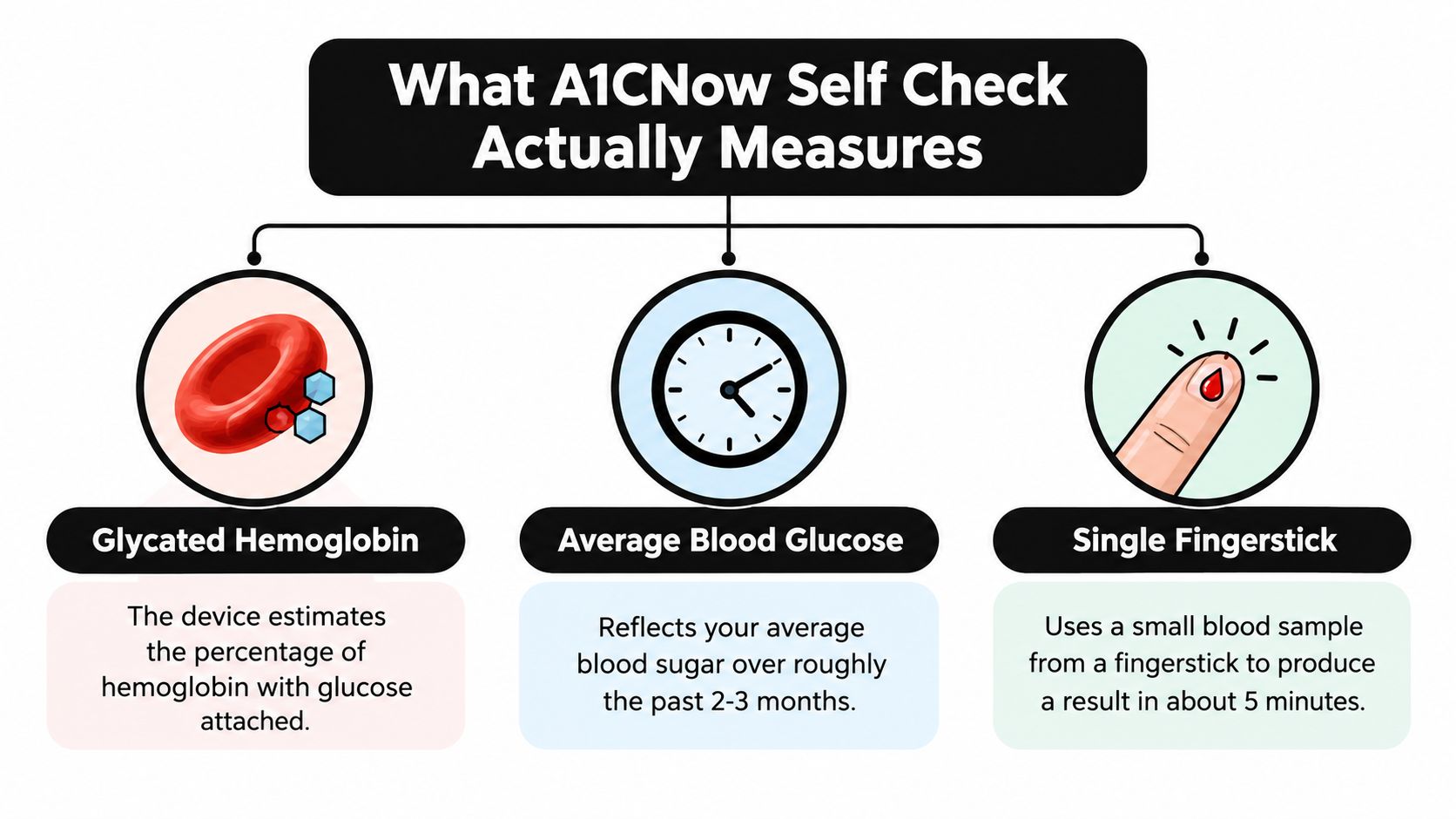
A1CNow Self Check measures glycated hemoglobin, a marker that reflects how much glucose has been attaching to hemoglobin over time. A finger-stick glucose meter gives you a snapshot. A1C gives you the longer pattern behind that snapshot.
A thermostat works better than a thermometer here. A thermometer shows the room right now, while a thermostat reflects the conditions the room has been running under. A1C does the same kind of job for glucose, reflecting average exposure over roughly 2 to 3 months, not what happened after breakfast.
The kit uses a small blood sample from a fingerstick and gives a result in about 5 minutes. No fasting is required, because the test is built to look at a longer pattern rather than one meal. Home testing fits into care best when each number type has its own job, and a broad at home diagnostic tests guide can help place that idea in context.
A home A1C answers a question about the past two to three months. A glucose meter answers a question about this minute. When you keep those jobs separate, the home result is easier to use as a trend check, a check-in between lab visits, and a way to notice whether your numbers are drifting in a useful direction.
A1C is a memory, not a moment.
Reading the Accuracy Number in Plain English
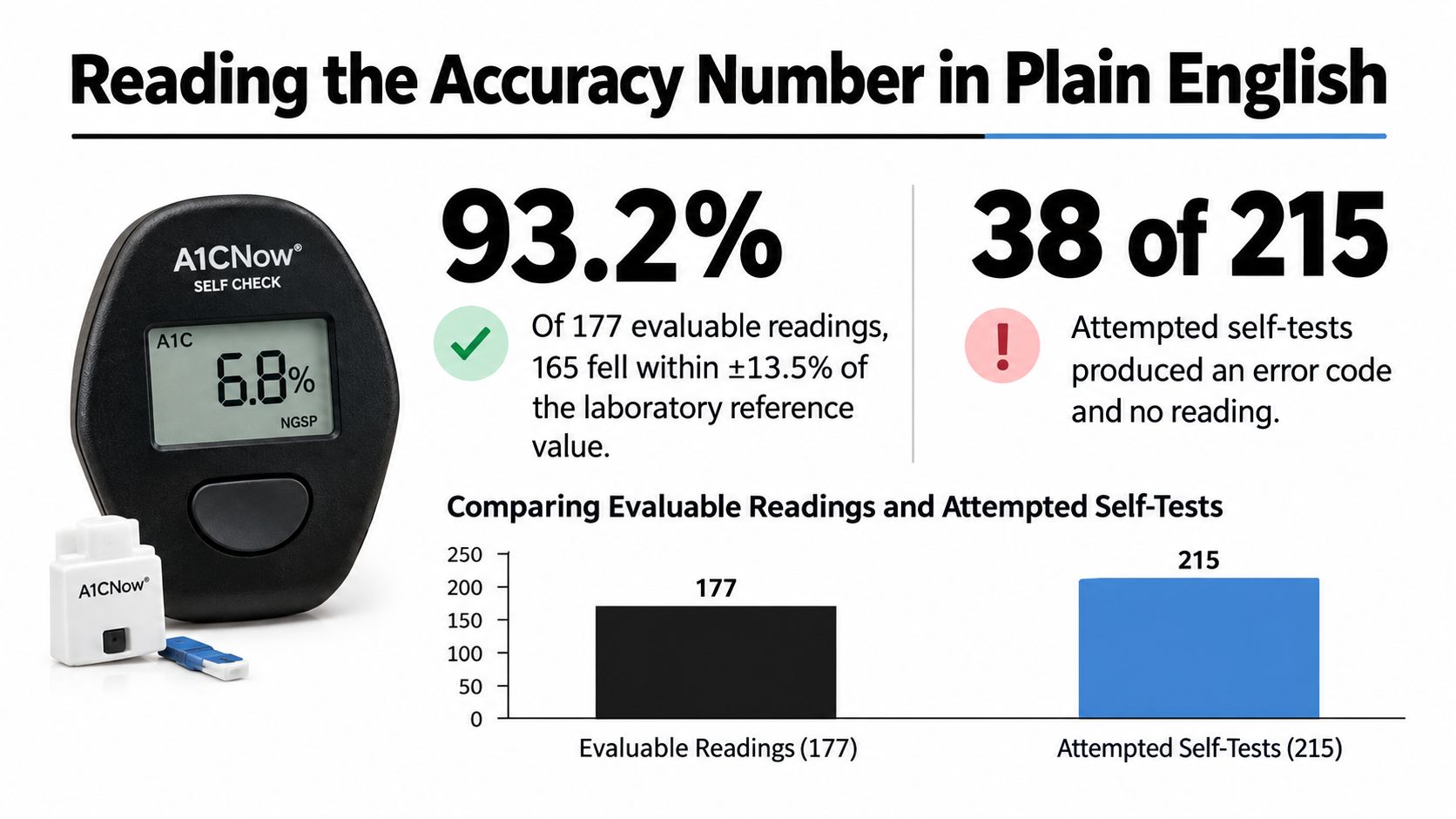
The number that matters most is also the easiest to misread. In the study summary, 165 of 177 evaluable readings, 93.2%, fell within ±13.5% of the laboratory reference value. That sounds precise, but the tolerance moves with the size of the A1C itself, so the same percentage means a wider absolute gap at higher readings. For the study details, see the manufacturer's accuracy documentation.
A lab A1C of 6.0% helps make that concrete. A ±13.5% range puts the home result at about 5.2% to 6.8%. That span crosses the commonly used prediabetes line at 5.7% and reaches close to the diabetes threshold at 6.5%, so one home number near that area can point in more than one direction. At 7.0%, the band is about 6.1% to 7.9%, which can straddle a zone where many clinicians would want a clearer follow-up conversation.
That is why 93.2% within range still needs context. The study also found 38 of 215 attempted self-tests produced an error code, no reading, or a failure-to-function result, so some attempts do not become a usable number. The kit can help you watch a trend between lab visits, but a result near a decision boundary should be treated like a street sign in fog, useful, yet not the only thing guiding the turn.
If you want a separate example of how point-of-care products are read in context, the CoaguChek XS PT test strips page shows that same habit of pairing the number with the setting around it.
For another angle on reading lab-style values carefully, the lab results explained for weight loss article reinforces the habit of checking what a number means before acting on it.
When the Number Should Not Be Trusted
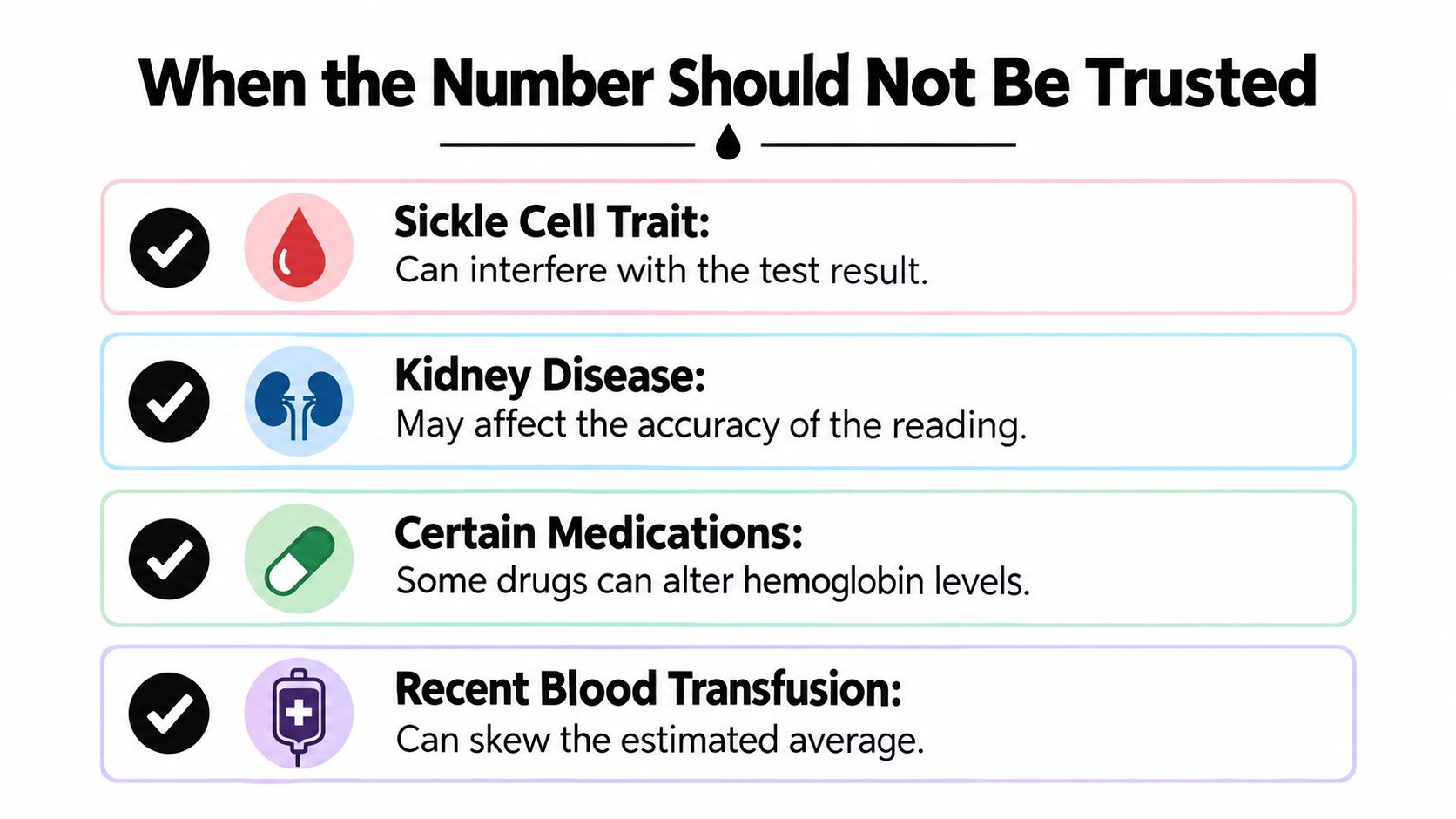
Some results are shaky because of biology, not technique. If you live with a condition that changes red blood cells or hemoglobin, the number can drift away from what a laboratory A1C would show even when you follow every step correctly.
The situations that deserve a pause
- Hemoglobin variants: Forms such as HbS or HbC can interfere with the reading.
- Anemia or blood loss: Anything that changes red-cell lifespan can skew the estimate.
- High fetal hemoglobin: This can also affect accuracy.
- Recent blood loss or transfusion: The number may no longer reflect the same time window.
- Rapidly changing glucose control: A1C lags behind recent medication changes or major illness.
The easiest way to think about it is this. If your blood chemistry is changing faster than the test can remember it, the result can look calm while your situation is still moving. That's why a home A1C should never be read the same way as a same-day glucose check.
Consumer instructions note that the test's accuracy may be affected by hemoglobin variants such as HbS or HbC, raised fetal hemoglobin, anemia, recent significant blood loss, and other conditions that alter red-cell lifespan. The same caution applies when glucose control has shifted recently, because A1C reflects exposure over time rather than the last few days.
If the number doesn't fit how you feel, don't force a conclusion from it alone.
Two Borderline Scenarios Worth Walking Through
A borderline result can feel more certain than it is. The screen shows one number, but the decision may still depend on context, timing, and a lab check.
A 6.0% result when you are wondering about diagnosis
A 52-year-old sees 6.0% at home and asks whether that means diabetes. Using the tolerance covered earlier, the lab value could land close enough to a boundary that the result may fall on either side of the 5.7% prediabetes line, and in some cases it may sit near the 6.5% diabetes threshold. That is why a home result like this works best as a nudge to order a laboratory A1C, not as a label by itself.
A confirmatory lab test gives the clinician a cleaner anchor, especially if the home result is the first sign that something may be changing. Until then, the home number is more like a sketch than a final portrait.
A 7.2% result when you are already in care
A 38-year-old already managing diabetes gets 7.2% at home and feels fine, so it is easy to shrug it off. The same built-in tolerance means a single reading can sit a bit above or below the number on the screen, which is why one check should not carry the whole decision. A clinician may ask for a repeat home test soon, or order a lab A1C if the result does not match the rest of the picture.
The follow-up depends on the situation. If medication changed recently, a repeat check can help show whether the trend is improving. If the home result seems out of step with recent lab history, a laboratory test gives a better basis for action.
If you keep a log, bring the context with you. Note medication changes, recent illness, and whether other readings are moving the same way. That makes the conversation about trends, not about one isolated display.
A Practical Framework for Treating A1CNow as a Trend Tool
A1CNow is most useful as a way to watch direction, while a lab A1C gives the cleaner reference point. That fits the manufacturer's instruction that the product is not intended for diabetes screening or diagnosis. It also fits the kind of follow-up described in a 2025 FDA adverse-event report, where a customer-reported difference between an A1CNow result and a laboratory result was noted as a reason to retest or seek more evaluation.
A practical rule is simple. Use the home number the way you would use a weather app before the actual forecast, it can warn you that conditions are shifting, but it should not replace the forecast.
A simple way to use it well
- Watch the pattern, not the panic. One reading matters less than several checks over time.
- Treat edge cases as prompts. If a result sits near a clinical decision boundary, ask for lab confirmation.
- Keep scheduled lab testing in the picture. Home testing works best beside professional testing, not instead of it.
That approach also fits the way people organize other long-running health markers, as shown in the guide for tracking key health markers. A simple log of dates, medication changes, illness, and recent readings makes it easier to see whether a home result is drifting, stable, or out of step with the rest of the story.
If you want to compare how the test is sold and described, the A1CNow Self Check HbA1c test kit collection page shows the product format used for repeat monitoring.
Getting a Clean Result and a Clean Decision
Technique matters more than people expect. Many failed or confusing readings start with a rushed routine, not a bad device.
Before and during the test
- Wash and dry your hands well. Residue on the skin can interfere with the sample.
- Warm the finger first. A warmer finger usually makes collection easier.
- Use the right sample size. A weak or partial sample can lead to an error.
- Run the test soon after opening the pouch. The kit instructions call for completing the test within 15 minutes.
- Read the display at the right time. Don't guess early and don't wait so long that you lose confidence in the result.
After the number appears, write it down with the date and the context. A reading makes more sense when you know whether you were sick, changing medication, or just checking a steady routine. If the value crosses a boundary that would change care, flag it for follow-up instead of trying to solve it alone.
The A1CNow Self Check HbA1c test kit 10-test box is one example of the product format people use for repeat monitoring, which is where this kind of routine matters most.
Why A1CNow Is a Companion, Not a Replacement
A1CNow Self Check has a clear use. It is convenient, it does not require fasting, and it can help you watch for patterns between lab visits. That makes it useful for trend tracking, like checking whether a road is generally rising or falling, even if it cannot tell you the exact mile marker.
The limits still matter. Its tolerance is wide enough that a borderline home result can fall on either side of a clinical cutoff, and some attempts do not produce a reading you can use. The manufacturer also says it is not for screening or diagnosis. Read together, those points place it beside the lab test, where it can add context, not replace a clinician's confirmation.
Used that way, it helps you notice change, prepare better questions, and avoid treating one borderline number as a final verdict. A home result can start the conversation; the laboratory result and your healthcare team close it.
DentalHealth.com offers professional-grade at-home care products and practical product information in one place, and that includes A1CNow Self Check through its online catalog. If you want to compare home testing options with clear product details, visit DentalHealth.com and use the site to match the test to your next conversation with your clinician.