
ACT Mouthwash Fluoride: A Practical Guide for 2026
You're standing at the bathroom sink, brushing your teeth while a bottle of ACT sits beside the faucet. The label says “anticavity,” but you may still wonder whether the minty rinse is doing anything beyond freshening your breath. The answer depends less on the brand name than on the fluoride concentration, your age, your cavity risk, and where the rinse fits into your routine.
ACT fluoride mouthwash is designed to add topical fluoride exposure after brushing and flossing. It isn't a substitute for fluoride toothpaste, cleaning between the teeth, or dental care. For someone with recurring cavities, exposed roots, dry mouth, orthodontic appliances, or another raised risk, that extra delivery route may make sense. For a low-risk adult with an effective routine, it may be useful but optional.
The most helpful way to judge ACT is to read the specific bottle rather than assume every ACT product has the same formula. The guide to fluoride mouthwash for cavities can provide broader context, but your product label remains the final authority for dose, age, frequency, and warnings.
Why ACT Fluoride Mouthwash Belongs in the Conversation
Fluoride works mainly at the tooth surface. After exposure, it can remain available in saliva and dental plaque, helping the enamel repair early mineral loss and become less vulnerable to acid attacks. That makes ACT a preventive product, not a treatment that removes an existing cavity or replaces a dental procedure.
The product label for ACT Restoring Anticavity Fluoride Cool Mint lists sodium fluoride at 0.05%, equivalent to 0.02% fluoride ion and approximately 0.2 milligrams of fluoride ion per milliliter. A labeled 10-milliliter dose provides about 2 milligrams of fluoride ion when the concentration is uniform, as described in the DailyMed ACT label.
Start with the problem you're trying to solve
A daily fluoride rinse has the clearest rationale when your mouth faces repeated challenges. That might mean a history of cavities, saliva reduction, frequent acidic or sugary exposures, exposed root surfaces, or areas that are difficult to clean around braces. The rinse gives fluoride another opportunity to contact those surfaces.
Practical rule: Choose a rinse because it matches a risk, not because the bottle promises a stronger feeling of freshness.
The order matters too. Brush twice daily with fluoride toothpaste and clean between your teeth. Use ACT only as an additional step, following the exact directions on your bottle. If you add a rinse automatically but brush too quickly, skip interdental cleaning, or swallow the product, you haven't improved the routine in a meaningful way.
Adults and children aged 6 years and older are included on the ACT Restoring label, but age eligibility doesn't mean every child needs fluoride mouthwash. A child must be able to spit reliably, and parents should consider the child's total fluoride exposure and cavity risk before adding another product.
Reading the ACT Label Like a Clinician
The percentage printed on an ACT bottle describes the amount of sodium fluoride, not the entire story of how much active fluoride reaches the mouth. The ACT Restoring label's 0.05% sodium fluoride corresponds to approximately 230 parts per million fluoride ion, commonly written as 230 ppm F. That conversion is important because fluoride-ion concentration allows a more useful comparison between products.
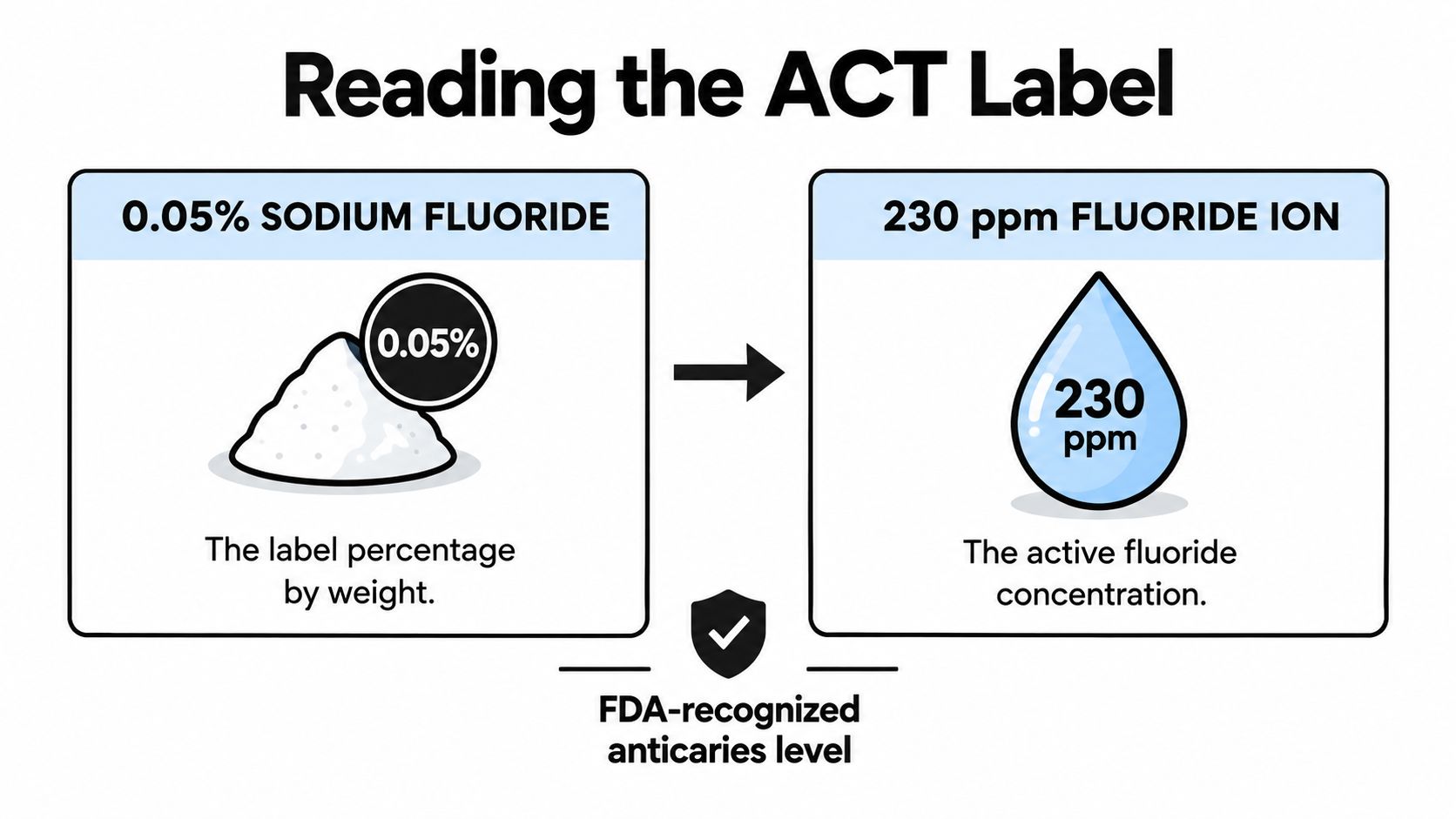
The FDA anticaries mouthrinse monograph recognizes near-neutral sodium fluoride mouthrinses at 0.02% or 0.05% sodium fluoride. The 0.05% formulation corresponds to the daily-rinse concentration commonly found in consumer products.
Concentration is only one part of exposure
A clinician looks at four label details together:
- Fluoride form: ACT products generally use sodium fluoride.
- Fluoride-ion concentration: The ACT Restoring formulation is about 230 ppm F.
- Volume: The labeled dose determines how much rinse contacts the teeth.
- Frequency: Daily and twice-daily products aren't interchangeable.
DailyMed records another ACT formulation at 0.02% sodium fluoride, equivalent to 0.009% fluoride ion, with directions for twice-daily use. That difference shows why you shouldn't apply the instructions from one ACT bottle to another. Flavor, packaging, and the word “care” don't tell you how often to use the product.
| Variant | Primary focus | Fluoride form | Best for |
|---|---|---|---|
| ACT Restoring Anticavity | Daily cavity prevention | Sodium fluoride | People following the specific daily-rinse label |
| ACT lower-concentration formulation | Cavity prevention with different directions | Sodium fluoride | Users who follow that bottle's twice-daily instructions |
| ACT specialty formulas | A targeted concern alongside cavity prevention | Check the product label | People whose main need is sensitivity, dry mouth, or another stated concern |
Fluoride doesn't need to stay in the mouth permanently to help. During and after rinsing, available fluoride can support remineralization and reduce acid-driven mineral dissolution. Still, a rinse provides a shorter exposure than brushing with fluoride toothpaste, so the two products serve different roles. For a closer ingredient-focused comparison, review what ACT mouth rinse ingredients do.
Matching the ACT Variant to Your Real Situation
A bathroom shelf often makes ACT choices look more complicated than they are. Start with the dominant problem in your mouth, then check whether the selected product's active ingredients and directions fit that problem. The color of the cap and the flavor should come last.

ACT Restoring Anticavity makes the most straightforward choice when your main goal is adding fluoride for cavity prevention. Read the label for the exact dose and frequency, especially because ACT products don't all share identical directions.
ACT Total Care may appeal to someone looking for a broader product message, but the name alone doesn't tell you whether its fluoride concentration and schedule match another ACT formula. Compare the active ingredient and instructions directly.
ACT Sensitive is aimed at people whose major complaint is sensitivity. A sensitivity formula may combine fluoride with a desensitizing ingredient, but fluoride and sensitivity relief aren't the same mechanism. A sharp response to cold can also reflect decay, a crack, gum recession, or another issue that needs examination.
ACT Dry Mouth is intended for people dealing with reduced saliva. Since saliva normally helps clear acids and support the mouth's protective environment, a dry-mouth routine needs more than a cavity label. Check the product's additional ingredients and consider the advice in this practical guide to ACT dry mouth products.
The Kids version should be treated as a supervised, age-appropriate product, not as a smaller adult bottle. A child's ability to spit, cavity history, other fluoride sources, and dental guidance all matter.
A product demonstration can help you recognize the packaging and intended use, but it doesn't replace the label or an individualized dental recommendation.
If your main concern is braces, an appliance can make plaque control harder around brackets and wires. That may increase the value of a fluoride rinse, but the decision still depends on your toothpaste use, cleaning technique, saliva flow, and history of cavities.
Putting ACT Into a Real Daily Routine
The simplest routine is the one you can repeat without improvising. Use fluoride toothpaste for brushing, clean between the teeth, and reserve ACT for the time and dose printed on the bottle. Don't pour an approximate amount from memory if the product supplies a measuring cap.
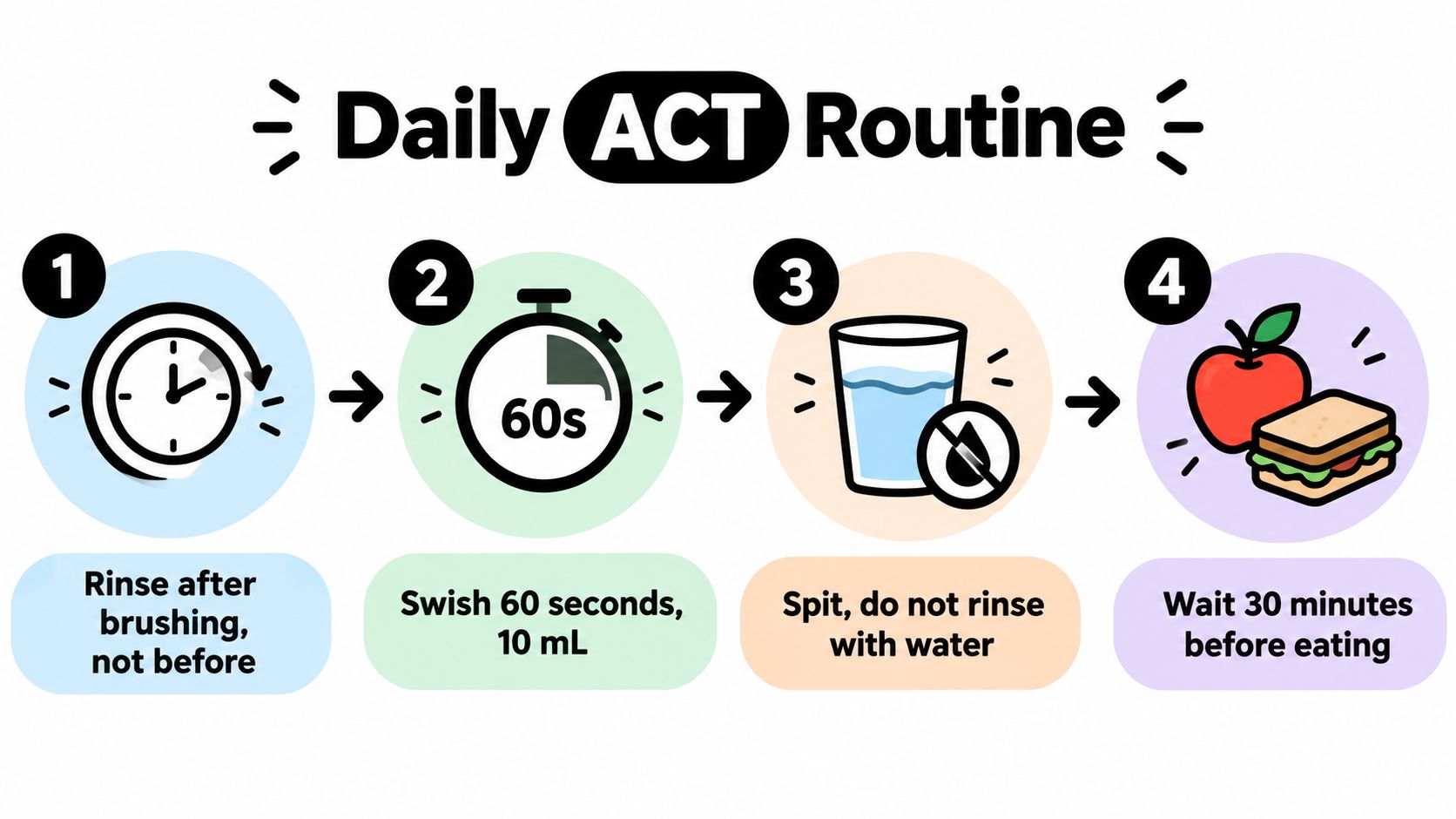
For the ACT Restoring product described earlier, the label directs adults and eligible children to rinse once daily after brushing, then spit out the rinse. Another ACT formulation has different concentration and twice-daily directions, so don't transfer one schedule to another.
A workable sequence
- Brush with fluoride toothpaste. Spend enough time cleaning every tooth surface, especially along the gumline.
- Clean between the teeth. Floss or use an interdental cleaner where a toothbrush can't reach.
- Separate the rinse from brushing when practical. Many dental professionals recommend using fluoride mouthwash at a different time from brushing so you don't immediately wash away toothpaste residue.
- Measure the labeled volume. For the ACT Restoring label, the relevant dose is 10 milliliters.
- Swish for the time stated on your bottle. The visual routine shows 60 seconds, but always follow the specific product label.
- Spit instead of swallowing. Don't treat mouthwash like a beverage.
- Avoid immediately rinsing with water. If the label advises waiting before eating or drinking, follow that instruction as well.
The timing doesn't need to become a complicated ritual. You might brush in the morning and use ACT later in the day, or brush at night and rinse at another suitable time. The aim is to give fluoride contact without using mouthwash as a quick substitute for careful brushing.
Who Actually Gets the Most Out of Adding ACT
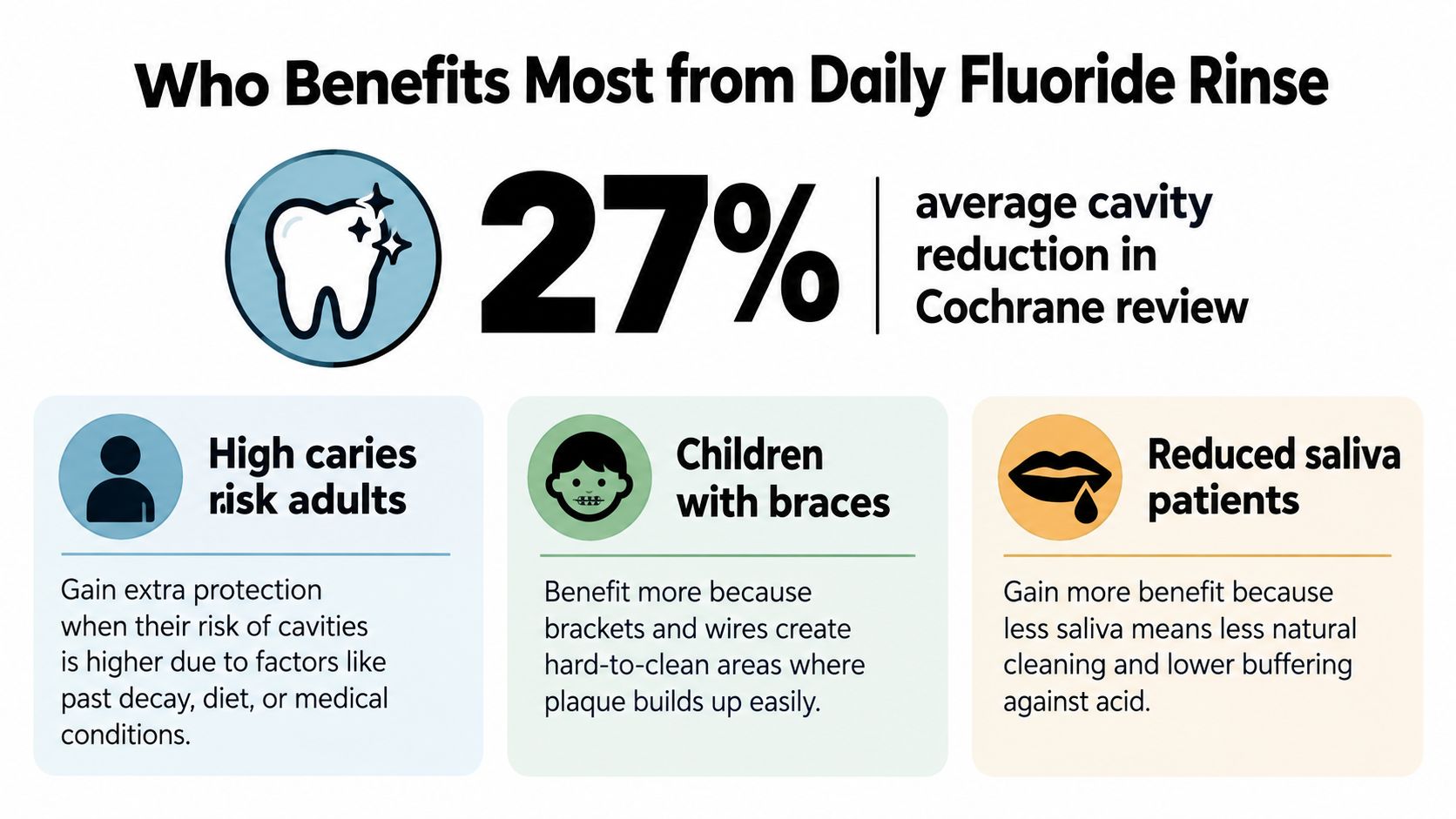
Fluoride mouthwash isn't a universal upgrade. It makes the most sense when your current routine leaves a known vulnerability, such as repeated cavities, reduced saliva, exposed roots, frequent sugar or acid exposure, or difficulty cleaning around orthodontic appliances.
A Cochrane review of 35 randomized trials found that regular, supervised fluoride-mouthrinse use reduced decayed, missing, and filled permanent-tooth surfaces by an average of 27% compared with placebo or no rinse. The evidence involved children and adolescents, and the regimens used different concentrations and schedules, so the finding shouldn't be converted into a promise for every adult or every ACT user.
Think in terms of incremental protection
You may have a stronger reason to ask your dentist about ACT if you:
- Have recurring cavities: Repeated decay suggests your current prevention plan needs review.
- Wear fixed braces: Brackets create additional areas where plaque can remain.
- Have dry mouth: Reduced saliva can remove one layer of natural protection.
- Have exposed roots: Root surfaces are more vulnerable than intact enamel.
- Snack or sip acidic products often: Frequent acid exposure can challenge the tooth surface.
- Have trouble reaching certain areas: A rinse can deliver fluoride beyond the exact path of a toothbrush.
For a low-risk adult who brushes carefully with fluoride toothpaste, cleans between the teeth, and has no special risk factors, ACT may be a reasonable optional addition rather than a dramatic change. Mouthwash and toothpaste can show broadly similar anticaries effects when compared directly, which reinforces the central point: mouthwash adds another route, but it doesn't justify brushing less often.
Kids, Fluorosis Risk, and Total Fluoride Exposure
Consider a parent with a teenager who has braces and a younger child who wants the same minty rinse. The teenager may be able to spit reliably and may have a dentist-directed reason to use fluoride mouthwash. The younger child may already use fluoridated toothpaste and drink fluoridated water, but still lack dependable swallowing control.
The American Dental Association's fluoride guidance advises against routine fluoride mouthrinse for children younger than 6 years because immature swallowing control can lead to repeated ingestion and increase fluorosis risk during tooth development. That doesn't mean every accidental taste causes harm. It means routine use should not be introduced casually during a period when repeated ingestion is a concern.
Ask five questions before adding a rinse
- How old is the child? Age affects whether routine use is appropriate.
- Can the child spit consistently? Supervision matters even when the child meets the labeled age.
- What toothpaste does the child use? Toothpaste already contributes to total fluoride exposure.
- What water does the child drink? Fluoridated water may add another source.
- What is the cavity history? A child with recurrent decay may need a professional prevention plan rather than another shelf product.
More fluoride isn't automatically better. Parents should store mouthwash out of reach, follow the product's warnings, and contact poison control or seek medical advice after a larger ingestion. For everyday prevention, dietary habits also matter, and a practical resource on low sugar treats for kids can help families think beyond the bathroom cabinet.
A dentist should guide routine fluoride-rinse use for children under 6, children who may swallow the product, and children already receiving professional fluoride treatments or other targeted preventive care.
A Practical Decision Checklist Before You Add ACT
Stand in front of the shelf or your bathroom cabinet and answer these questions before opening a bottle.
Identify the main reason
Is your priority cavity prevention, sensitivity, dry mouth, or cleaning around an appliance? If you can't name the problem, you may be buying based on flavor or packaging rather than need.
Match the label to your routine
Check the active ingredient, fluoride-ion information when provided, dose, frequency, age directions, and warnings. Put the rinse at a time you can maintain without replacing brushing or cleaning between your teeth.
Check for reasons to ask first
Talk with a dentist before self-directing fluoride mouthwash if you have persistent sensitivity, suspected decay, significant dry mouth, repeated cavities, swallowing concerns, or a child who may not spit reliably. Medication-related dry mouth and appliance-related risks also deserve individualized advice.
Keep the bottle closed and away from young children. Replace a bottle when its condition, labeling, or expiration information no longer gives you confidence, and don't assume a new ACT variant follows the directions of an older one.
The right decision may be “use it consistently,” “ask the dentist first,” or “keep the routine simpler.” All three can be sensible outcomes.
Common Questions About Using ACT Safely
Should I use ACT before or after brushing?
Follow your product label, but many dental professionals prefer using fluoride mouthwash at a different time from brushing. That approach avoids immediately rinsing away the toothpaste residue left on the teeth. If your bottle specifically directs a different schedule, use the bottle's instructions.
Do I need ACT if I drink fluoridated water?
Not automatically. Fluoridated water and fluoride toothpaste may already be part of your prevention routine, but people with increased cavity risk can still discuss an additional rinse with a dentist. Your risk history, saliva flow, diet, appliances, and cleaning habits matter more than one factor alone.
Will fluoride ACT work like sensitivity toothpaste?
Not necessarily. Fluoride supports cavity prevention and enamel repair, while desensitizing toothpaste uses ingredients intended to reduce the transmission of sensitivity signals. A sensitivity-labeled ACT product may address both concerns, but new, severe, localized, or persistent sensitivity needs a dental examination.
What counts as accidental ingestion?
Normal use means swishing and spitting, not swallowing. A small accidental taste isn't the same as repeatedly ingesting mouthwash, but a larger ingestion warrants prompt poison-control or medical advice. Store the product where young children can't access it.
ACT works best as a deliberate part of a routine, not as a random final step before bed. If you're unsure whether your specific bottle, age group, or risk profile fits, ask a dental professional and bring the product label with you.
DentalHealth.com offers ACT Anticavity Fluoride Rinse alongside professional-grade products for sensitivity, remineralization, whitening, and retainer care. Visit DentalHealth.com to compare product details and find practical oral-care guidance for your routine.