
Bad Breath Chewing Gum: What Works and What Doesn't
Does bad breath chewing gum remove the smell, or does it just give you something pleasant to do while the odor waits you out? Many people never ask, because the mint hits, the mouth feels clean, and the problem seems solved. An hour later the same stale taste is back.
That gap between fresh and fixed is where the useful information lives. Gum does real work in your mouth, but the work is narrow, short-lived, and far more dependent on what's inside the piece than on how cold the mint tastes. A few formulations have been tested against placebo and lowered the sulfur gases behind most bad breath. Plenty of others are candy with a marketing budget.
This guide separates the two. You'll see how odor forms, which ingredients have controlled evidence behind them, what xylitol does and doesn't do, and the specific signs that mean gum is the wrong tool and a dentist is the right one.
How Chewing Gum Fights Bad Breath
Gum helps bad breath through two routes. One is mechanical, because chewing starts saliva moving. The other is chemical, because a small set of ingredients neutralizes the sulfur compounds that carry the smell. Neither route touches the cause of persistent halitosis, which is why the effect fades once the piece is in the bin.
Saliva does most of the early work. Chewing increases salivary flow, and that flow dilutes and clears odor-producing material from the tongue and the rest of the oral cavity, as a systematic review of chewing gum for halitosis describes. Your mouth is a warm, wet space with a permanent bacterial population, and saliva is the rinse cycle it runs without being asked.
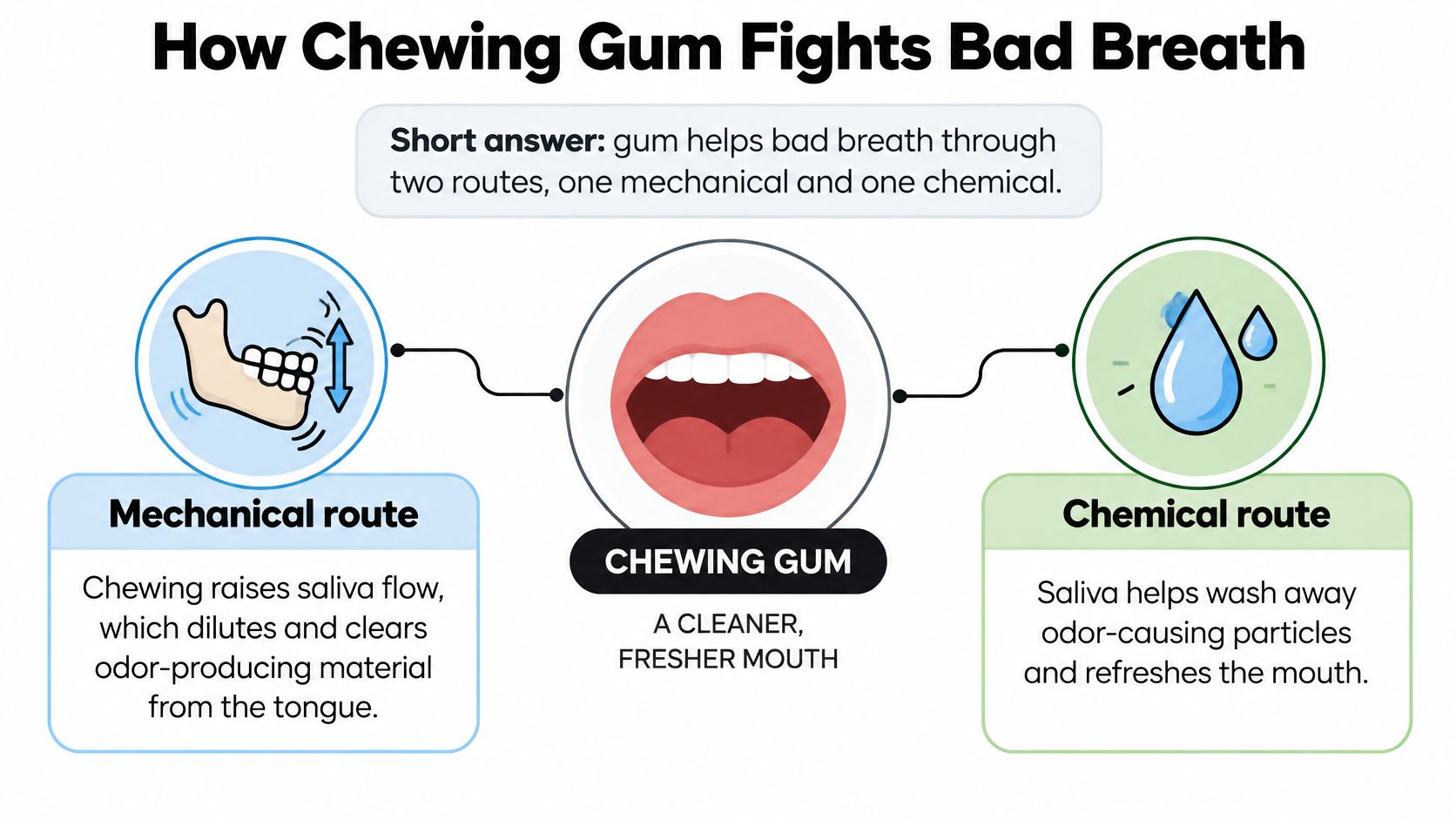
The gases behind most bad breath are volatile sulfur compounds (VSCs), mainly hydrogen sulfide and methyl mercaptan. Think of them as the sour smell in a drain. Running water dilutes that smell and carries it off, which is roughly what saliva does. A deodorizing block in the trap changes the smell at its source, which is closer to what a zinc salt does. Neither one clears a blocked pipe.
What the Controlled Studies Show
The same review looked at 10 controlled clinical studies and found that gums containing zinc acetate, magnolia bark extract, allyl isothiocyanate with zinc lactate, sodium bicarbonate, eucalyptus extract or probiotics produced significant improvements in at least some halitosis measures. That's several different formulations, ten trials, and more than one way of measuring odor. It's a real signal and a narrow one.
The evidence is heterogeneous and the studies were small. Ingredients changed from trial to trial, doses changed, and the outcome measures ran from instrument-read sulfur levels to a clinician's nose. What holds up across them is short-term adjunctive support, not a cure.
Gum earns its place while it's in your mouth. It doesn't earn a place as a substitute for cleaning your tongue or having a periodontal exam.
Be careful about what a piece buys you. The reviewed trials measured freshness over short windows and don't establish a reliable number of hours you can count on. If the odor comes back minutes after you spit the gum out, you've learned something specific about your mouth, and it's worth acting on.
Treat bad breath chewing gum as support, not treatment. The practical question was never whether to chew. It's what's in the piece.
Gum Ingredients That Reduce Odor
A mint flavor can make breath seem fresher without changing the compounds that cause odor. Ingredient lists help distinguish that temporary masking from ingredients studied for reducing volatile sulfur compounds (VSCs).
Gum Ingredients Compared by Odor Evidence
| Ingredient | Role in the Gum | Evidence From Controlled Studies |
|---|---|---|
| Zinc acetate | Binds sulfur compounds into less volatile zinc salts | Significant improvement; about 45% lower oral VSCs in an 11-person morning-breath study |
| Zinc lactate with allyl isothiocyanate | Zinc delivery plus a sulfur-binding active | Significant improvement in at least some halitosis measures |
| Magnolia bark extract | Plant extract used for odor control | Significant improvement in at least some halitosis measures |
| Eucalyptus extract | Plant extract used for odor control | Significant improvement in at least some halitosis measures |
| Probiotics | Live cultures aimed at odor-producing bacteria | Significant improvement in at least some halitosis measures |
| Sodium bicarbonate | Neutralizes acids and sulfur odor | Outperformed water rinsing in the reviewed trials |
| Xylitol with zinc citrate | Sweetener with a zinc comparator | Not shown as a proven halitosis treatment on its own; the zinc citrate pairing is what the trials tested |
Zinc shows up in three rows of this table, and the plant extracts and probiotics land in the same modest bucket: measurable improvement on at least some outcomes in small studies.
Why Zinc Keeps Showing Up
Zinc ions bind sulfur-containing compounds, forming relatively nonvolatile zinc salts. That leaves fewer compounds available to enter exhaled breath. In a clinical study of 11 participants with morning breath, gum containing zinc acetate produced approximately a 45% reduction in oral VSC levels; a mouthrinse delivering comparable zinc produced a similar drop, according to the clinical study of zinc acetate gum and oral VSCs. The similar results with two delivery methods point to the zinc, rather than mint flavor, as the likely source of the change.
For a sulfur-focused option, look for a named zinc salt, such as zinc acetate or zinc lactate. The effect is temporary, and gum does not treat periodontal disease, tongue-coating buildup, or dry mouth.
Label rule: If the ingredient list names no zinc salt, the gum may freshen breath through flavor and saliva flow, but it does not offer the same sulfur-binding mechanism.
What to Compare on Any Package
- Active ingredient. A named zinc salt, extract, bicarbonate, or specific probiotic strain gives you more information than “fresh mint.”
- Sugar status. Sugar-free gum avoids adding sugar that can contribute to tooth decay, but that alone does not show it controls odor.
- Measured duration. A claim that freshness lasts for hours needs supporting evidence; published data described here covers shorter periods.
- What was measured. Sulfur readings and clinician odor scores assess odor more directly than a subjective feeling of freshness.
The ingredient and the outcome measured matter more than a “natural” label or a strong mint taste.
Xylitol Dosing and Safety
Sugar-free does not mean proven. Xylitol is a useful sweetener with real dental benefits, and a xylitol callout on the label tells you almost nothing about whether that particular gum will change your breath.
The xylitol evidence is about bacteria, not odor. A systematic review of xylitol gum and halitosis reports that at least 6 g of xylitol daily for five weeks was needed to significantly reduce salivary mutans streptococci, which is a measure of cavity-causing bacteria. That's an antibacterial outcome, and it isn't the same thing as eliminating bad breath. Assuming that any xylitol gum is a halitosis treatment goes further than the evidence does.
The same review adds a wrinkle that breaks the usual natural-versus-artificial logic. Sucrose gum reduced VSCs more than xylitol with zinc citrate gum, but only for five minutes, which is exactly the kind of short window that makes simple ingredient rankings misleading. If you're weighing xylitol products specifically, our guide to xylitol gum and how it fits a breath routine digs into the product-level detail.
Do the Daily Math
Labels make dosing harder than it needs to be. A pack may state grams of xylitol per piece in small type, and almost nobody multiplies. Do it once: grams per piece times pieces per day. One gram per piece across six pieces gives 6 g. If you chew two pieces at a time, double the figure.
If the label lists xylitol only in the ingredient order without a gram amount, you can't total it, and that's a reason to pick a pack that gives you the number.
Who Needs Extra Care
Tolerance matters. Larger polyol intakes can cause bloating, gas or loose stools, so start with fewer pieces and stop if discomfort shows up. Children need supervision because they may swallow gum. Anyone with jaw pain or a joint problem should keep chewing sessions short rather than working through soreness.
Household rule: treat xylitol gum like medication. Closed container, high shelf, and nothing loose in a coat pocket or a car cupholder. Xylitol is highly toxic to dogs, so wrappers and used pieces need to go where a pet can't reach them.
Decide on the active ingredient first, then check the sweetener against your own tolerance and your household. The xylitol badge doesn't settle the purchase.
How to Chew Gum Within a Daily Breath Routine
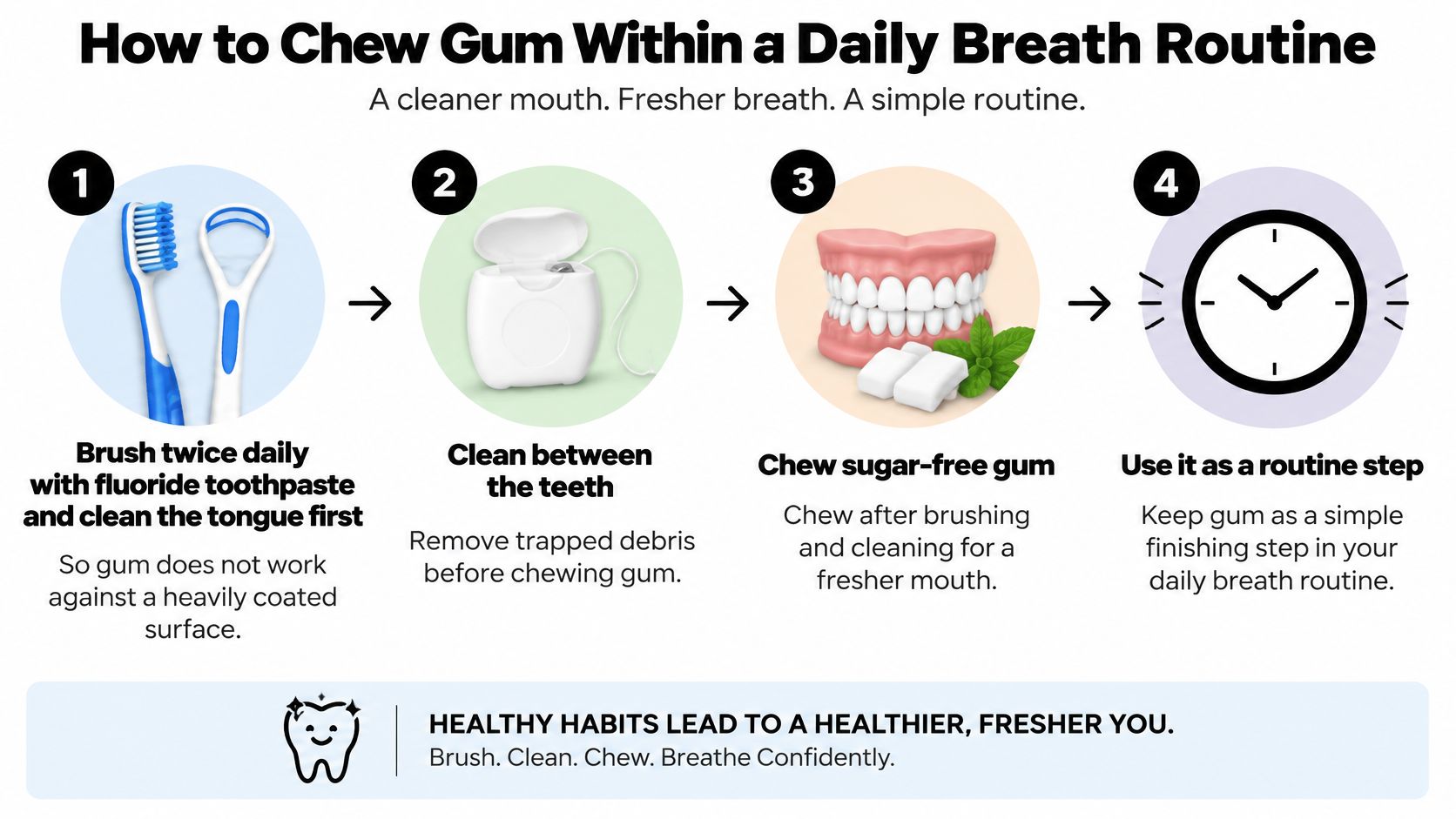
Gum belongs at the end of a routine, not the beginning. Chew it against a freshly cleaned mouth and it has something to work with. Chew it against a tongue carrying a night's worth of coating and you've bought mint, not freshness.
The Order That Makes Gum Worth It
Brush twice a day with fluoride toothpaste, and clean your tongue inside that session. A coated tongue is the most common home-grown source of sulfur odor, and no piece of gum outworks a scraper. Work from the back of the tongue forward, rinse, and don't scrub hard enough to gag or graze the tissue.
Clean between the teeth once a day, with floss or an interdental brush. Bristles can't reach the contact points where food and bacteria collect. Gum can't either, and it won't warn you when you've skipped the step.
- Pick a sugar-free gum with a named active. Zinc acetate or zinc lactate on the ingredient list is the version worth carrying. Peppermint with nothing else is a breath mint in slow motion.
- Chew after meals and at the moment odor appears. Chewing itself starts saliva flow, so timing does more than sheer volume. A common slip is chewing a strong piece immediately after brushing, which floods the mouth with mint and hides the fact that the tongue never got cleaned.
- Keep each session to about five minutes. That's long enough to get saliva moving. An hour adds jaw fatigue, not freshness.
- Don't make it an all-day habit. Sustained chewing tires the jaw muscles and the joint, especially in people who already clench or grind.
- Spit it out and drink water. Water clears residue and keeps saliva thin. Swallowing the flavor cleans nothing.
- Note how long the freshness holds. If it fades within minutes every single time, the problem isn't your brand. That pattern points to a cause gum can't reach.
Here's the sequence in motion, from the morning brush through the last piece of the day.
Three People, Three Outcomes
The morning-breath brusher. Brushes at seven, scrapes the tongue, chews a zinc gum on the commute, and by midday the taste is back. That isn't a gum failure. Odor that rebuilds within a few hours is pointing at something the gum can't reach, usually tongue coating regrowth, a dry mouth or periodontal pockets, and it deserves a dental exam rather than a stronger flavor.
The garlic-and-coffee bridge. Someone who had a pungent lunch and has a two o'clock meeting. Gum is a fair tool here. It moves saliva, takes the edge off, and holds the line until the next brush. It's a bridge between cleanings, not a replacement for one.
The dry-mouth office worker. Their real fixes are water, fewer dehydrating coffees, and a conversation with a dentist about why saliva flow dropped, since medications and mouth breathing both matter. Gum is a minor helper in that plan, not the plan itself.
For a full-day version of this, our guide to keeping breath fresh all day covers the timing between brushing sessions.
Judge the routine by your breath when you wake up, not by how the first piece tastes. Morning breath is the honest test, because nothing masks it overnight.
What Gum Cannot Fix and When to Get Checked
Does the odor return as soon as the gum's flavor fades? Chewing gum can temporarily change how much odor reaches your breath, but it does not remove the source. Halitosis is often linked to volatile sulfur compounds, including hydrogen sulfide, methyl mercaptan and dimethyl sulfide. Bacteria on the tongue or in periodontal disease can produce these compounds, as described in a review of gum formulations and halitosis outcomes.
Evidence comparing different chewing-gum concentrations is limited. Small samples and wide confidence intervals make it difficult to distinguish real differences between concentrations from random variation. A stronger flavor may mask odor, but it does not necessarily reduce the compounds causing it.
Decision line: If gum repeatedly masks odor without keeping it away, book a dental exam rather than switching to a stronger flavor.
Six Signs That Point Past Gum
| Sign | What It Often Points To | What to Do |
|---|---|---|
| Morning breath that persists after brushing and tongue cleaning | Tongue coating, dry mouth or gum disease | Book a dental exam and ask about periodontal assessment |
| Bleeding or swollen gums | Periodontal (gum) disease | Arrange a dental exam and professional cleaning |
| Persistent dry mouth | Reduced saliva flow | Drink water and ask a dentist about the cause |
| Thick white coating on the tongue | Bacteria and debris on the tongue | Clean the tongue daily; gum offers only short-term support |
| Odor that returns quickly after each piece | A cause that gum does not address | Seek a professional evaluation |
| Sore or ulcer that will not heal | Possible oral lesion or medical cause | Arrange a dental or medical evaluation |
These signs call for attention to the underlying cause. Gum cannot treat periodontal disease, remove tongue coating for good, restore saliva flow or heal a lesion.
If breath remains unpleasant after brushing, read about possible causes of bad breath even after brushing.
A dental exam can check the teeth and gums. Depending on the situation, the clinician may also ask about medications or nasal and sinus health. Finding the cause is more useful than relying on gum to cover the odor.
Pick a Gum and Routine You Can Keep
One gum, two weeks, one log. Choose a single sugar-free gum with a named zinc salt, use it as a timed add-on to brushing and tongue cleaning for fourteen days, and write down what your breath is like on waking each morning. That's the whole experiment, and it costs less than the pack you were going to buy anyway.
Choice isn't your problem. The global gum, mint and breath-freshener market was valued at $29.8 billion in 2025, with chewing gum accounting for 45.2% of it, according to a Dataintelo estimate of the gum and breath-freshener market. Most of that shelf is built to taste good. A small fraction is built to change sulfur chemistry.
A Two-Week Test You Can Actually Run
Keep the log to three lines. Note how your breath is on waking before you brush, how long the freshness lasts after the first piece, and whether anything new showed up, such as bleeding when you floss, a dry mouth that won't quit, or a coating you can't shift.
Then read your own results. Odor that clears and stays clear means the routine is working. Odor that returns within minutes means the gum is doing the only thing it can do and something else is driving the smell. Schedule the exam instead of buying a different pack.
If you'd rather build the routine around products, DentalHealth.com stocks fluoride toothpastes, sensitivity pastes and breath-freshening rinses that sit alongside gum rather than replacing the steps above. Our team can talk through options at +1-888-508-3375.
Persistent halitosis needs a dentist. In the meantime, gum is a short, dependable helper between brushing sessions, and that's a modest job worth doing well.
Bad breath chewing gum is a support tool, and DentalHealth.com is built for the rest of the routine that makes it work. Browse DentalHealth.com for fluoride toothpastes, tongue and breath-care products, and rinses that carry you between dental visits, then pair one sugar-free gum with a named zinc salt and a cleaning habit you'll keep. If you want help choosing, our team is a phone call away and orders ship free within the USA.