
Can You Over Whiten Your Teeth? Signs, Risks and Fixes
Yes, teeth can be over-whitened, with early signs including sensitivity, gum irritation and a glassy, translucent look rather than a permanently bad color. The risk depends on concentration, contact time and frequency, not just how white your teeth become.
The familiar advice to keep whitening until you reach your ideal shade misses the point. A bright smile isn't proof that a treatment is healthy, and discomfort isn't proof that it's working. Treat whitening as a dose you control, not a color target you must reach.
Yes, Teeth Can Be Over-Whitened
Whitening is a dose, not a race toward the lightest shade. The dose depends on the gel's concentration, how long it stays on your teeth, how often you repeat treatment and the product's acidity. Too much exposure can cause irritation even before your teeth look exceptionally white.
Sensitivity is a common, usually temporary side effect of early whitening, and it becomes more likely with higher peroxide concentration and longer contact time. A brief twinge does not by itself mean your enamel is damaged, but discomfort that keeps returning is a reason to pause.
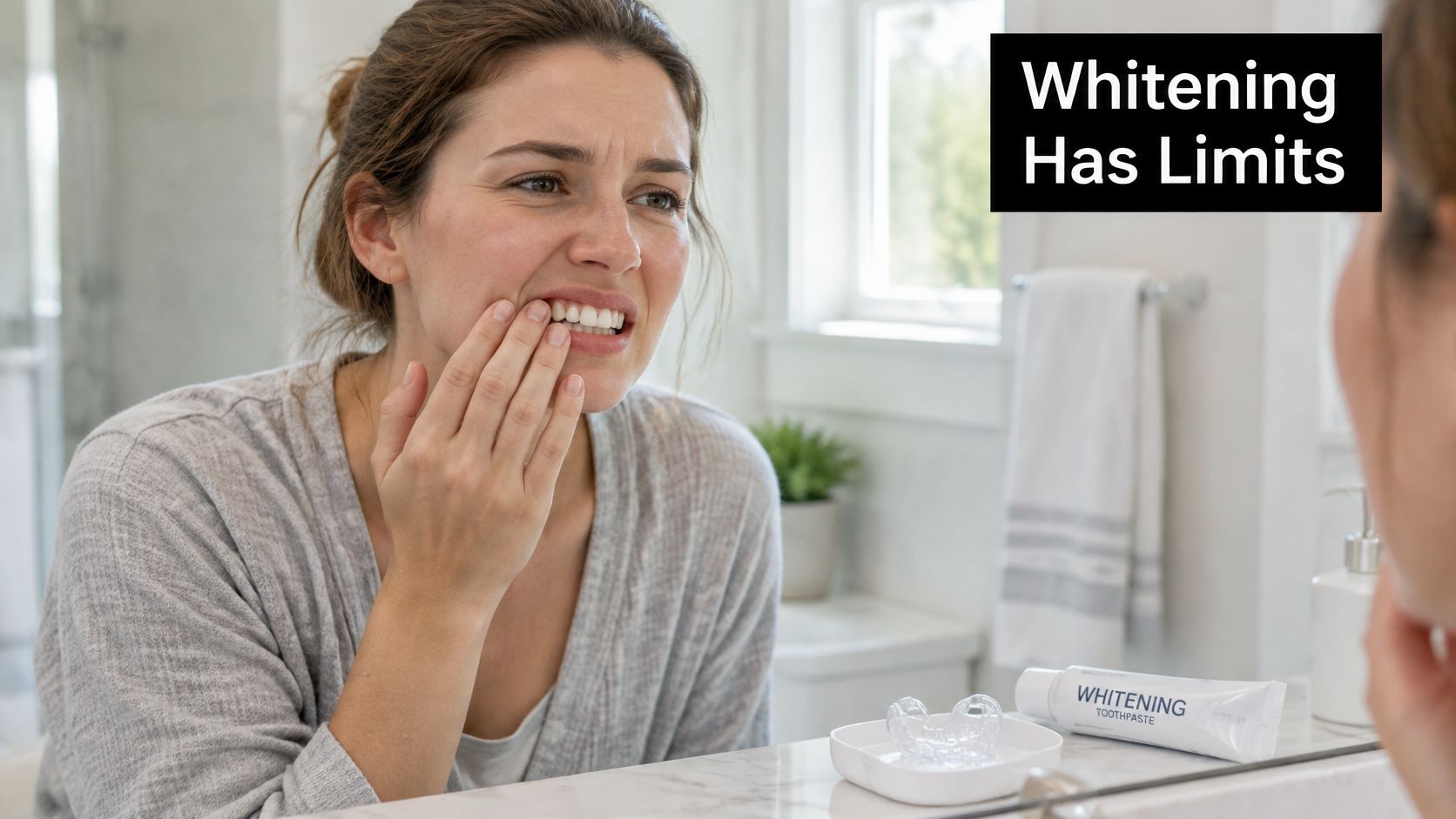
Brighter doesn't automatically mean healthier
Whitening is more like adjusting a dimmer than chasing a finish line: once you're happy with the shade, more treatment may add irritation without a meaningful cosmetic benefit. A bright result describes color, not the health of your teeth or gums.
Use a simple stop-and-check rule at home: pause whitening if sensitivity persists or gum irritation develops. Before resuming, check the gel strength, treatment time and interval between sessions against the product directions. Comfort and healthy-looking gums matter alongside the shade you see in the mirror.
What Over-Whitening Does to Your Teeth
Peroxide can travel through enamel and dentin toward the pulp, the living tissue inside the tooth. That helps explain why a tooth can feel sensitive even when its outer surface looks intact. Think of a tiled roof with porous grout: an apparently solid exterior isn't an impermeable barrier.
Sensitivity alone doesn't prove that enamel has worn away. Enamel hardness, gum irritation and changes in appearance are separate effects, and they don't all have the same recovery pattern.
Effects of over-whitening, with evidence and recoverability
| Effect | What It Looks Like | Evidence and Numbers | Usually Reversible? |
|---|---|---|---|
| Tooth sensitivity | Sharp discomfort with cold, sweets or air | A common response to peroxide exposure | Usually temporary after treatment stops |
| Enamel softening | Hardness changes that may not be visible at home | Measurable changes occur in some testing, especially with greater exposure | Recovery can't be assumed from appearance alone |
| Translucent or gray look | Glassy edges or underlying dentin becoming more noticeable | Associated with permeability and surface microstructure changes | Needs assessment if it persists |
| Gum irritation | White, burning or sore gum edges | Gel contacting soft tissue can irritate it | Usually settles after contact stops; persistent injury needs care |
| Uneven shade | Natural teeth lighter than crowns, veneers or fillings | Existing restorations don't bleach like natural teeth | More bleaching won't correct the restoration's shade |
A systematic review and meta-analysis associated a tenfold increase in exposure with an estimated 6.8% decrease in Knoop hardness, a laboratory measure of resistance to indentation. Much of this evidence concerns laboratory changes, so it doesn't establish that a comparable amount of enamel is lost in someone's mouth.
The controlled-use benchmark is reassuring: a meta-analysis of home bleaching evaluated 13 studies using 10% carbamide peroxide and found no significant enamel microhardness change after 7, 14 or 21 days. Neither finding supports unlimited treatment. Together, they distinguish a defined course from escalating exposure.
A darker appearance isn't an invitation to bleach harder
Excessive treatment may alter how enamel transmits light, making underlying dentin more visible. A glassy or grayish appearance therefore isn't necessarily a stain that needs stronger gel.
Likewise, surface softening isn't automatically the same as permanent enamel loss. Understanding what causes enamel loss on teeth can help you avoid confusing bleaching sensitivity with erosion or wear.
Don't try to diagnose either condition by scraping the surface or repeatedly testing it with cold water. A dentist can assess the tooth, its restorations and its response before you add another treatment.
Warning Signs That Whitening Has Gone Too Far
Temporary sensitivity has a recognizable pattern, but it's not a guarantee that every whitening-related pain is harmless. The American Dental Association's whitening guidance describes sensitivity typically beginning within 2–3 days of starting treatment and resolving around the fourth day after treatment stops.
Use that as a general recovery pattern, not permission to tolerate severe pain until a deadline. Symptoms that intensify, linger or affect a particular tooth deserve attention sooner.
Warning signs during whitening and what to do
| Warning Sign | What It May Mean | What to Do |
|---|---|---|
| Sensitivity continuing beyond the usual recovery period | Ongoing irritation or an underlying dental problem | Stop whitening and book a dental check |
| Persistent or throbbing pain | An irritated nerve or an underlying cavity | Stop and see a dentist |
| Gum burns or white, sore gum tissue | Gel contacting the gums | Stop, rinse with water and seek care if it persists |
| Chalky, translucent or rough enamel | A surface change that needs assessment | Pause and reassess with a dentist |
| Sensitivity that worsens each session | Your current exposure exceeds your tolerance | Stop and discuss a gentler approach |
| Discoloration that doesn't improve after recovery | A restoration, deeper stain or another cause | Get a dental evaluation before further treatment |
A brief cold-triggered twinge that fades isn't the same as spontaneous throbbing. Pain focused in a particular tooth may reveal a cavity, crack or another problem rather than reflect the gel's strength. You can't reliably separate those possibilities at home.
Gum symptoms deserve their own response. Remove the tray or strip, rinse away the gel with water and don't reapply it to sore tissue. A white patch on the gum isn't an extra-whitened area, and adding more gel can worsen the irritation.
Stop-and-check rule: Stop at the first symptom. If it persists after stopping, worsens or includes burns or visible surface changes, arrange a dental assessment before restarting.
Record what happened, not just how white you got
Keep the package and a short session log. Note the product, peroxide type, wear time, treatment dates, symptoms and whether they settled during the break.
That record helps a dentist distinguish an application problem from a tooth that needs treatment. A photograph can document a visible change, but don't use phone lighting or a filtered image to decide whether your enamel is healthy.
Concentration, Time and Frequency Raise the Risk
A gel's percentage is only part of the dose. Strength, contact time and repeated exposure work together, while product acidity and the condition of your mouth also influence tolerance.
Use the chart as a reminder to check the whole routine rather than choosing by the largest percentage on the box.
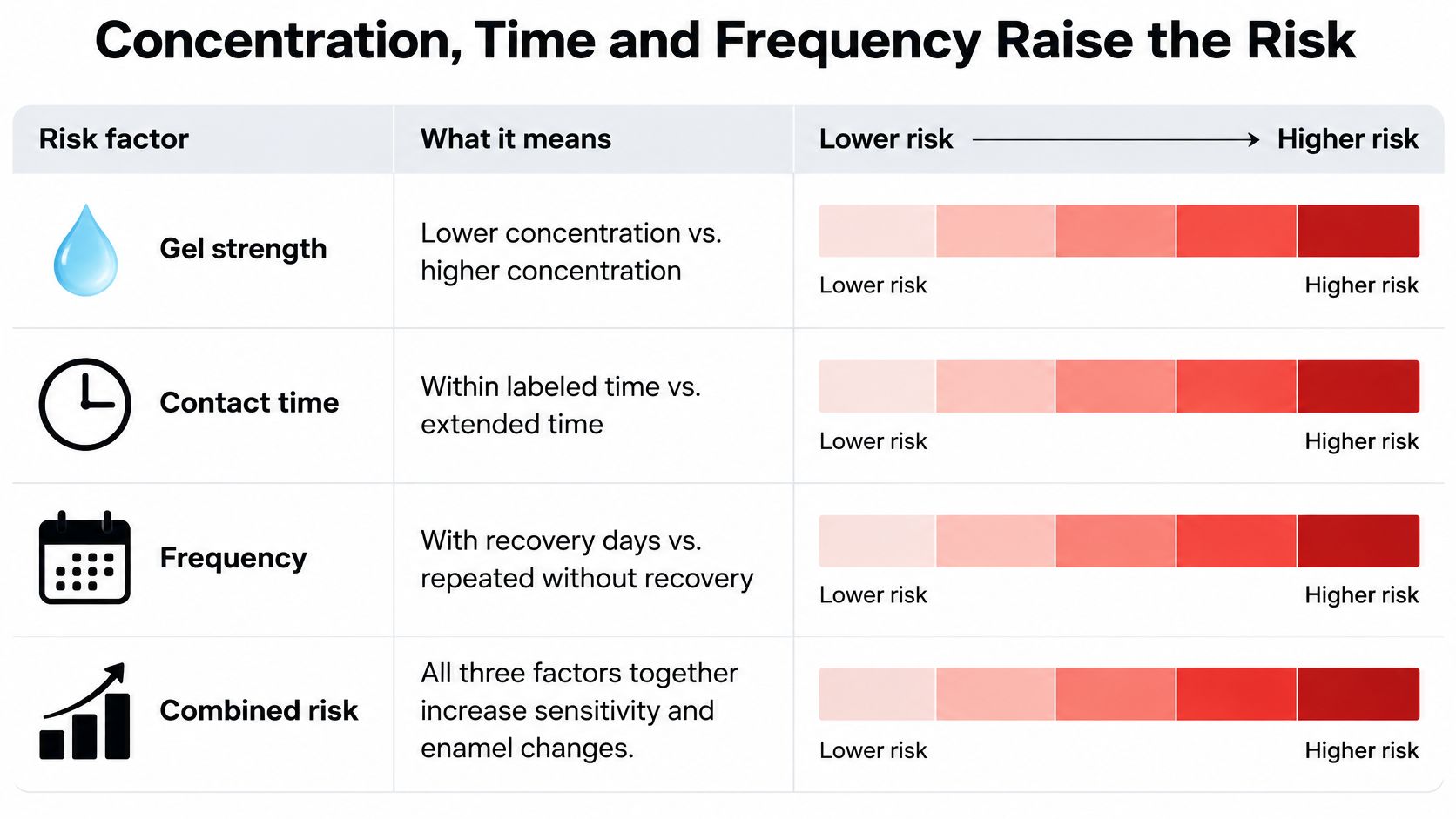
Sensitivity risk by peroxide type and concentration
A systematic review of at-home bleaching found that 20–22% carbamide peroxide carried about twice the sensitivity risk of 10–11%, while 14–16% hydrogen peroxide carried roughly 2.8–2.9 times the risk of 2–4%.
| Peroxide Type | Concentration | Relative Sensitivity Risk | Practical Note |
|---|---|---|---|
| Carbamide peroxide | 10–11% | 1.0x reference baseline | Lower-strength comparison group |
| Carbamide peroxide | 20–22% | About 2.0x | Follow the exact schedule and watch for sensitivity |
| Hydrogen peroxide | 2–4% | 1.0x reference baseline | Lower-strength comparison group |
| Hydrogen peroxide | 14–16% | About 2.8–2.9x | Seek professional guidance before use |
These comparisons apply within each peroxide type. Don't treat the separate baselines as evidence that the products are interchangeable. Average sensitivity was generally mild, and low-quality evidence and differing protocols limit how precisely these estimates predict your experience.
Longer isn't a reliable shortcut
A South African Dental Journal clinical-trial summary reported sensitivity risks of 58% for a 30-minute application, 76% for two 20-minute applications and 71% for one 40-minute application in the protocol examined. Those results aren't a universal risk calculator, but they show why changing application timing isn't a harmless adjustment.
For practical tray use, follow how to use carbamide peroxide gel alongside your specific product instructions. Don't borrow an overnight schedule from a different concentration or extend treatment because another person tolerated it.
Product acidity also matters. Acidic formulations may increase irritation and enamel-surface alteration, although findings aren't uniform. A percentage alone can't tell you everything about a gel's behavior.
Keep the same exposure checks in mind when watching whitening demonstrations.
Stronger and faster isn't necessarily more effective or safer. Choose a formulation and schedule suited to your teeth, rather than escalating strength to compensate for disappointing results.
How to Reduce Sensitivity While Whitening
Preventing sensitivity starts before you load a tray. Your aim is a tolerable, defined course, not the maximum exposure you can endure.
The basic choices are straightforward: use an appropriate strength, control contact time, allow recovery and respond promptly to symptoms.
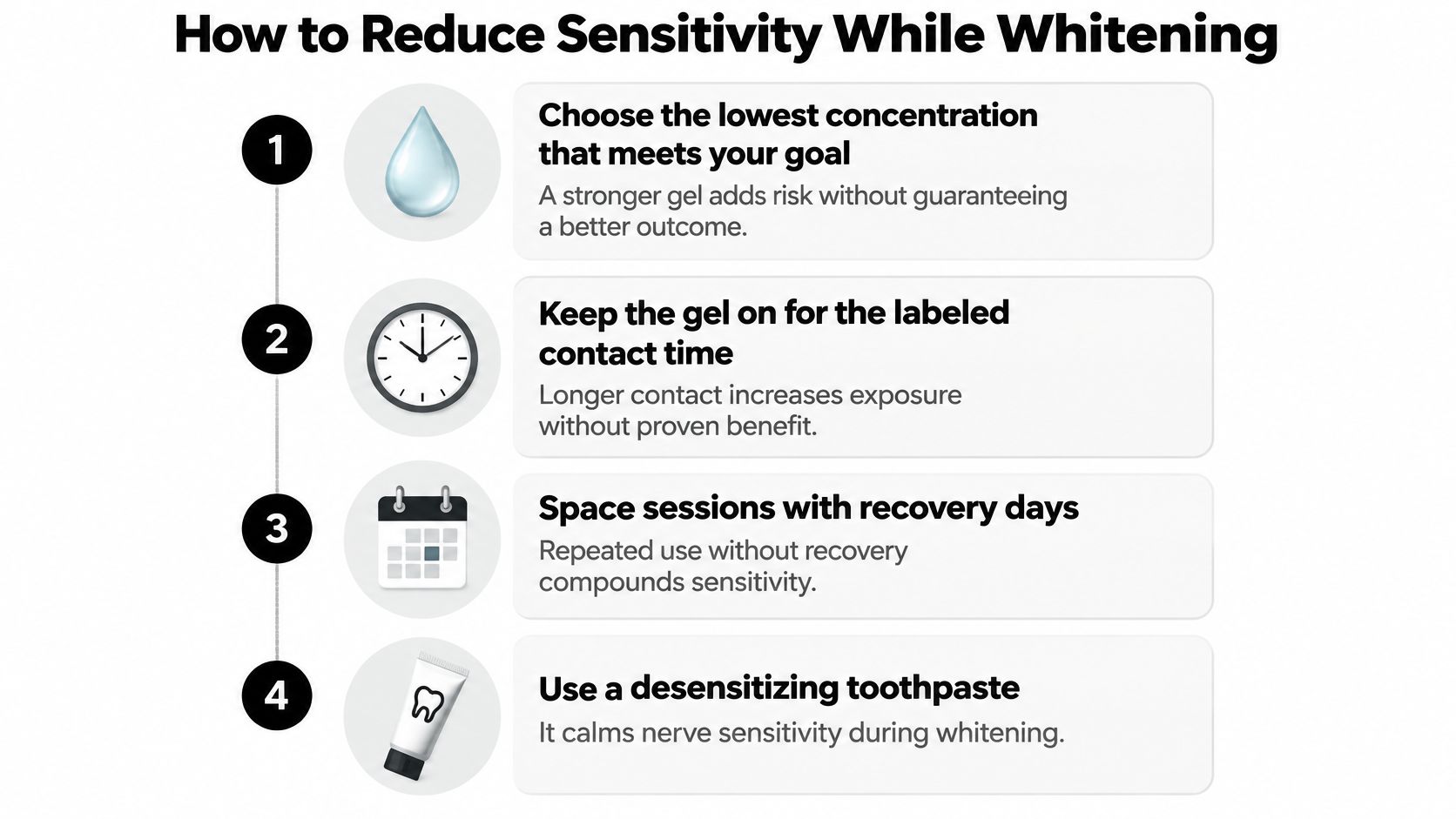
Build comfort into the application
- Choose the lowest suitable concentration. Ask your dentist which strength fits your sensitivity history and intended result. Don't increase it just because progress looks slower than expected.
- Keep to the prescribed wear time. Use a timer and remove the product when it finishes. Falling asleep in a product intended for short wear changes the dose.
- Protect soft tissue without overfilling trays. For our Lumibrite 22 bleaching sessions, rub petroleum jelly onto the lips and gums beforehand. Overloading trays or pushing gel firmly against the teeth isn't necessary and may irritate the gums.
- Use a cautious first exposure. If the instructions offer a shorter initial session, start there, or ask your dentist to adjust the schedule. Don't invent a longer wear time to make up for a shorter session.
- Plan recovery between courses. Don't stack kits, add extra sessions or continue indefinitely without reassessment. If symptoms appear, pause rather than treating the written schedule as an obligation to continue.
- Clean up gently. After treatment, rinse your mouth with tepid water and brush gently with a mild toothpaste. Rinse the trays and let them dry thoroughly before storing them.
- Address sensitivity instead of masking it. Pause whitening and use a desensitizing toothpaste as directed. The guidance on teeth whitening sensitivity can help you consider comfort measures, but persistent pain still needs a dental check.
Can you restart after sensitivity?
Only consider restarting once symptoms have fully settled and no warning signs remain. If the reaction was persistent, severe or recurrent, have a dentist assess it first and help select a lower exposure.
Don't use pain relief or desensitizing products as permission to keep bleaching through worsening symptoms.
A shorter, professionally adjusted restart may be reasonable after uncomplicated temporary sensitivity. Stop again if the symptoms return rather than repeatedly testing your tolerance.
When peroxide isn't a good fit
A systematic review of hydrogen-peroxide-free color-correctors found perceptible color improvement, no significant enamel erosion or dentin roughness changes, and sensitivity in fewer than 3% of subjects. Whitening efficacy was lower than with carbamide peroxide, so these products aren't equivalent replacements.
They may suit someone who prefers a modest cosmetic change to further peroxide exposure. Compare the intended effect, application schedule and suitability with your dentist, particularly if you have restorations or existing enamel concerns. Less dramatic whitening can still be the more appropriate result.
Set a Safe Whitening Routine Before You Buy
Make the decision before a new kit arrives, not while you're deciding whether to leave it on longer.
- Check your starting condition. Book a dental assessment if you have sensitivity, gum problems, enamel wear or visible restorations. Treating an underlying problem comes before cosmetic bleaching.
- Choose an appropriate strength. Start conservatively if you're unfamiliar with whitening, and don't assume a professional-grade product is suitable for unsupervised escalation.
- Write down the schedule. Record the approved wear time, course length and recovery plan. Avoid adding daily sessions or repeating courses outside the instructions.
- Set clear stop rules. Persistent pain, gum burns or an unfamiliar chalky or glassy appearance means stopping and reassessing, not buying stronger gel.
- Define a reasonable result. Aim for a change you can maintain comfortably. If peroxide doesn't suit you, accept that a peroxide-free option may offer a smaller improvement.
A healthy result doesn't require the brightest possible shade. Yes, teeth can be over-whitened, so control the exposure, not the shade.
We offer at-home whitening options from Opalescence, Zoom, PolaNight and PolaDay, alongside sensitivity-care products including Fluoridex and MI Paste. Visit DentalHealth.com to compare product descriptions and whitening guidance, then choose a routine that matches your dentist's advice and your teeth's tolerance.