
Cleaning Teeth Products That Actually Work
You're standing in the aisle with a cart full of uncertainty. One tube promises whitening, another says sensitivity relief, a third claims advanced plaque control, and the shelf tag still doesn't answer the question: which cleaning teeth products solve your problem without wasting time or making your gums worse?
| Category | Primary job | Best fit for | Key trade-off | Replacement cadence |
|---|---|---|---|---|
| Fluoride toothpaste | Deliver fluoride while brushing | Most people, every day | Doesn't clean between teeth by itself | Use daily, replace when empty |
| Manual toothbrush | Mechanical plaque removal | Good technique, tight budget | Depends on user skill and consistency | Replace worn bristles regularly |
| Powered toothbrush | Mechanical plaque removal with consistency support | People who struggle with technique or plaque control | Costs more up front and for heads | Replace heads regularly |
| Floss and interdental tools | Clean between teeth | Anyone with contact points to clean | Takes habit and sizing discipline | Use daily |
| Whitening products | Lift stains or lighten tooth color | Cosmetic goals, maintenance users | Sensitivity and fit issues | Follow treatment cycle |
| Sensitivity or remineralizing pastes | Calm sensitivity, support enamel | Sensitive teeth, early enamel wear | Slower and more targeted | Use as directed |
| Fluoride rinses | Add topical fluoride between brushings | Higher cavity risk, added protection | Not a substitute for brushing | Use regularly if advised |
What You Want From Teeth-Cleaning Products
You don't need a best-of list. You need the right tool for the job in front of you. A stain problem calls for a different product than bleeding gums, and both call for something different from a parent trying to build a simple routine for a teenager.
That is why shopping by brand is sloppy. Cleaning teeth products fall into four jobs: mechanical cleaning, chemical delivery, between-teeth access, and cosmetic or restorative support. A toothbrush scrubs. Toothpaste delivers active ingredients. Floss and interdental tools reach the spaces a brush misses. Whitening, sensitivity, and remineralizing products can change how teeth look or feel, but they do not replace daily cleaning.
Practical rule: start with the problem, not the packaging. A product can be good and still be wrong for your mouth.
The scale of the problem is real. The WHO oral health data portal describes oral disease as a major global burden and points to twice-daily brushing with fluoride toothpaste as a simple, low-cost way to deliver topical fluoride and help prevent decay. That is why the core routine matters more than the marketing around it.
People also compare products that do different work. That is like asking a water filter to do the job of a kettle. If you are trying to clean your mouth well, you usually need more than one tool. For a parallel household decision, the logic is the same, which is why it helps to find the right water filter by matching the product to the problem instead of chasing a buzzword.
Use three questions: what does the product do, who is it suited to, and what do you give up in time, money, or side effects? Keep that order straight, and the shelf gets easier to read.
The Core Routine and Where Each Product Fits
Start with the basics and stop treating every add-on as equal. The routine that holds up is built around fluoride toothpaste, a toothbrush, something for between the teeth, and, if needed, a rinse. Each product has a job. The trick is matching the product to the job, not to the packaging.
Toothpaste and brush do different work
Toothpaste mainly carries fluoride and other actives. The brush does the scrubbing. The American Dental Association notes that the first fluoride toothpastes were marketed in 1950, Crest launched in 1955, and the first ADA Seal of Acceptance for a fluoride toothpaste arrived in 1964 ADA dental history. That change made toothpaste more than a freshening paste. It became a preventive product.
For everyday use, stick with fluoride toothpaste in the 1,000 to 1,500 parts per million fluoride range and brush twice daily. The ADA's fluoride toothpaste guidance backs that basic setup. If you are not doing that, no premium product will compensate.
Bottom line: brush well, use fluoride toothpaste, and do not confuse shine with protection.
Between-teeth cleaning is not optional
Brushing leaves gaps untouched. Floss, interdental brushes, and water flossers exist to clean those spaces. If the contact points between teeth stay dirty, plaque stays in the routine. A rinse can support the process, but it does not replace physical cleaning.
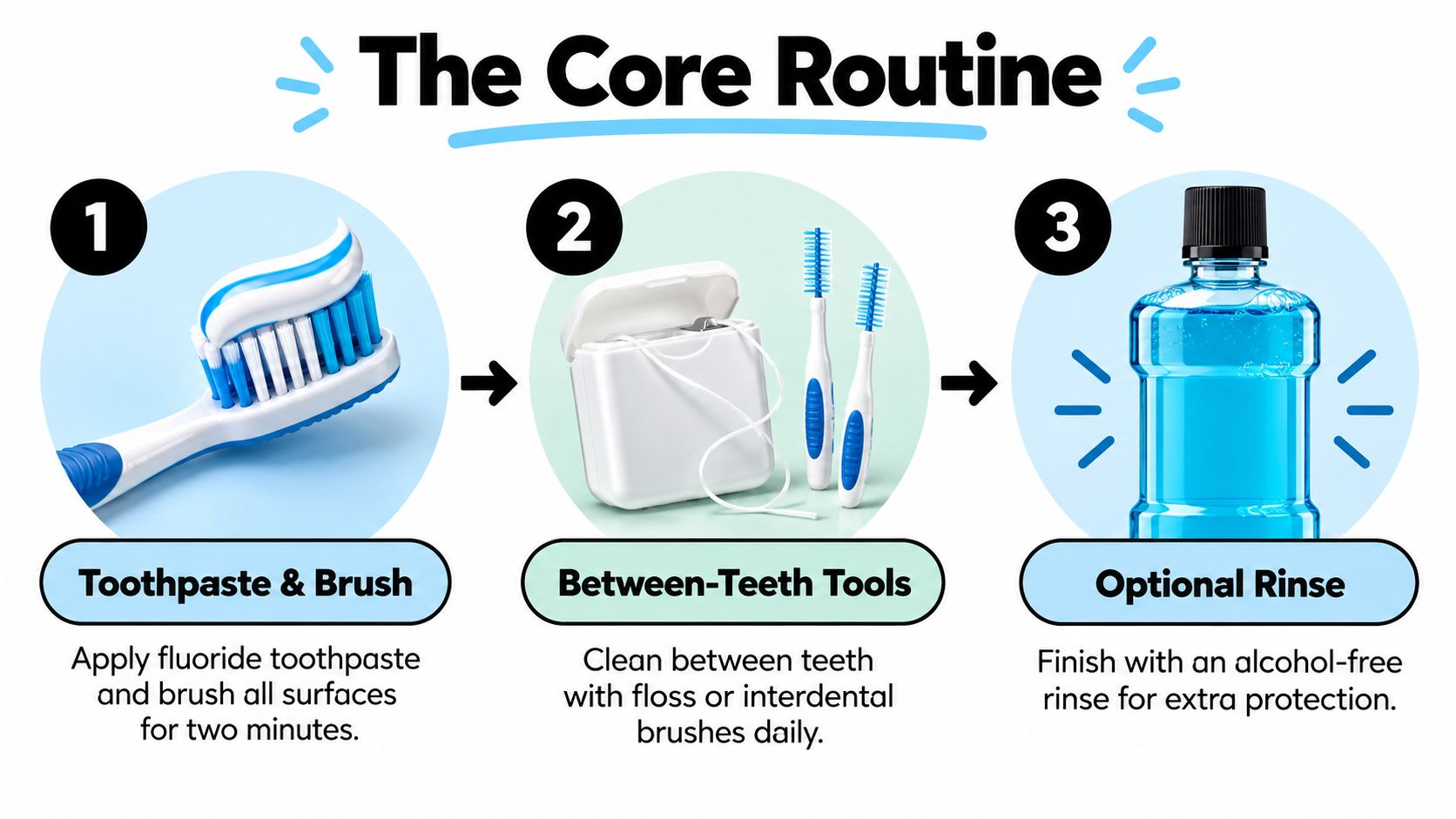
Treat each tool as part of one system. Brush with fluoride, clean between teeth, then decide whether a rinse adds anything for your mouth. If a product does not do one of those jobs, it is probably just taking up space in the bathroom.
Manual vs Powered Toothbrushes and What the Evidence Shows
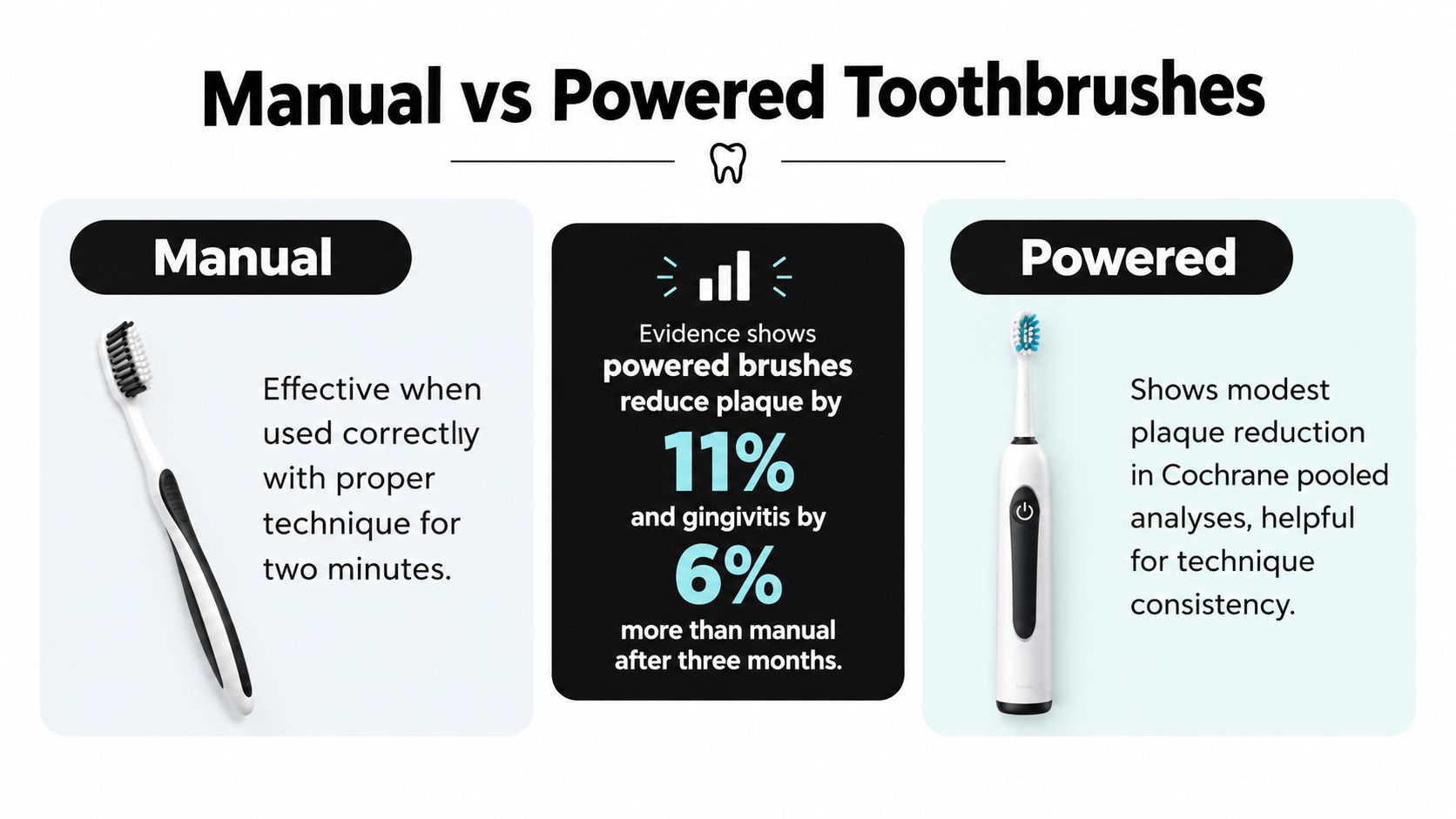
The question is not whether a brush looks advanced. It is whether it gets used well enough, every day, on the surfaces that matter. A manual brush can do the job if the user has solid technique and follows through. A powered brush helps people repeat better brushing when consistency, dexterity, or plaque control is the weak point.
What powered brushes buy you
The best pooled evidence favors powered brushes, but the benefit is practical, not dramatic. A Cochrane review covering 40 trials and 2,871 participants found lower plaque scores with powered brushes in the short term, with SMD −0.50, and in the long term, with SMD −0.47 across 14 trials and 978 participants. Gingivitis also improved, with SMD −0.43 short term across 44 trials and 3,345 participants, and SMD −0.21 long term across 16 trials and 1,645 participants.
That is enough to recommend a powered brush for people who:
- Miss areas with a manual brush
- Have limited hand movement or fatigue
- Need more consistent daily output
- Keep building plaque despite trying
A powered brush is not a cure-all. Head shape, pressure control, timer function, and replacement-head cost matter more than marketing claims. Motion count does not clean teeth by itself. The user still has to spend two minutes covering every surface.
Not every electric brush is equal
The strongest signal sits with rotation-oscillation designs. A Cochrane powered toothbrush types comparison of 17 trials and 1,369 participants found those brushes reduced plaque and gingivitis more than side-to-side powered brushes in the short term, but the difference was small and its clinical importance stayed uncertain.
Shop on evidence, not on the word “electric.” Buy the brush with tested plaque and gingivitis performance, a head that reaches the back teeth, and a timer you will follow. One useful product example is the Oral-B Pro Health line, which fits the logic of consistency over hype and makes sense for people who want a powered routine, not a novelty.
The choice is simple. If your manual brushing is solid and consistent, stay with it and spend your money elsewhere. If your technique is weak or plaque keeps returning, powered is the smarter buy.
Floss, Interdental Brushes, Water Flossers, and Picks Compared
Between-teeth cleaning gets treated like a lifestyle preference. It isn't. It's a fit problem. The right tool is the one that reaches your spaces without making you quit after three nights.
Tight contacts and larger gaps need different tools
Floss still makes sense where the contacts are tight. It can slip where a brush can't. If your teeth are close together, floss may be the only thing that physically fits without forcing the issue.
Interdental brushes are better when the gaps are wider, when gum recession opens space, or when you're cleaning around exposed roots. They do what floss can't do as efficiently in those spaces, and they're often easier to keep using once you get the sizing right.
Water flossers are the compliance tool. They're useful for people who won't floss daily, people with implants or fixed retainers, and people who want a gentler way to clean around gum tissue. If you want a practical consumer overview, the Water flosser benefits article from Inspire Dental Group gives a useful mainstream explanation of where they fit.
Pick the tool you'll use every day, not the one that looks most thorough on the box.
Use combinations when the mouth calls for it
A lot of mouths need a mix. Tight contacts can still get floss, while a water flosser handles hardware, bridges, or hard-to-reach zones. That same logic is why the Waterpik oral irrigators category gets so much attention in routine discussions, because it fits people who need coverage more than finesse.
The biggest mistake is skipping between-teeth cleaning entirely because it feels annoying. That shortcut saves thirty seconds and costs you later. If you want a cleaner mouth, use the tool matched to the gap, not the one with the smallest head or the prettiest packaging.
Comparing Whitening Products Without the Hype
Whitening is where shoppers get misled fastest. The label number is only part of the decision. Compare products by peroxide percentage alone and you miss the trade-offs, especially sensitivity and how long the gel stays in contact with the tooth.
Concentration matters, but it is not the whole story
A 2025 systematic review and network meta-analysis covering 77 studies found that higher-concentration at-home bleaching, especially carbamide peroxide 20 to 22% and hydrogen peroxide 14 to 16%, increased the risk of tooth sensitivity compared with lower-concentration options such as carbamide peroxide 10 to 11% PubMed review. Sensitivity was generally mild. If you are new to bleaching, start with a 10% carbamide peroxide gel before considering 20%+ options.
The American Dental Association says the most common side effects are temporary sensitivity and gum inflammation, and sensitivity can happen in up to two-thirds of users early in bleaching, usually fading within several days. Whitening is not automatically unsafe. It usually means faster regimens feel harsher and are harder to stick with.
pH and delivery method affect the result
A 2025 scoping review found that acidic bleaching gels were linked in some clinical trials to greater sensitivity, and laboratory studies consistently showed more enamel-surface alteration and hydrogen-peroxide diffusion at acidic pH, although clinical evidence was limited. pH matters, but it is not a stand-alone safety score.
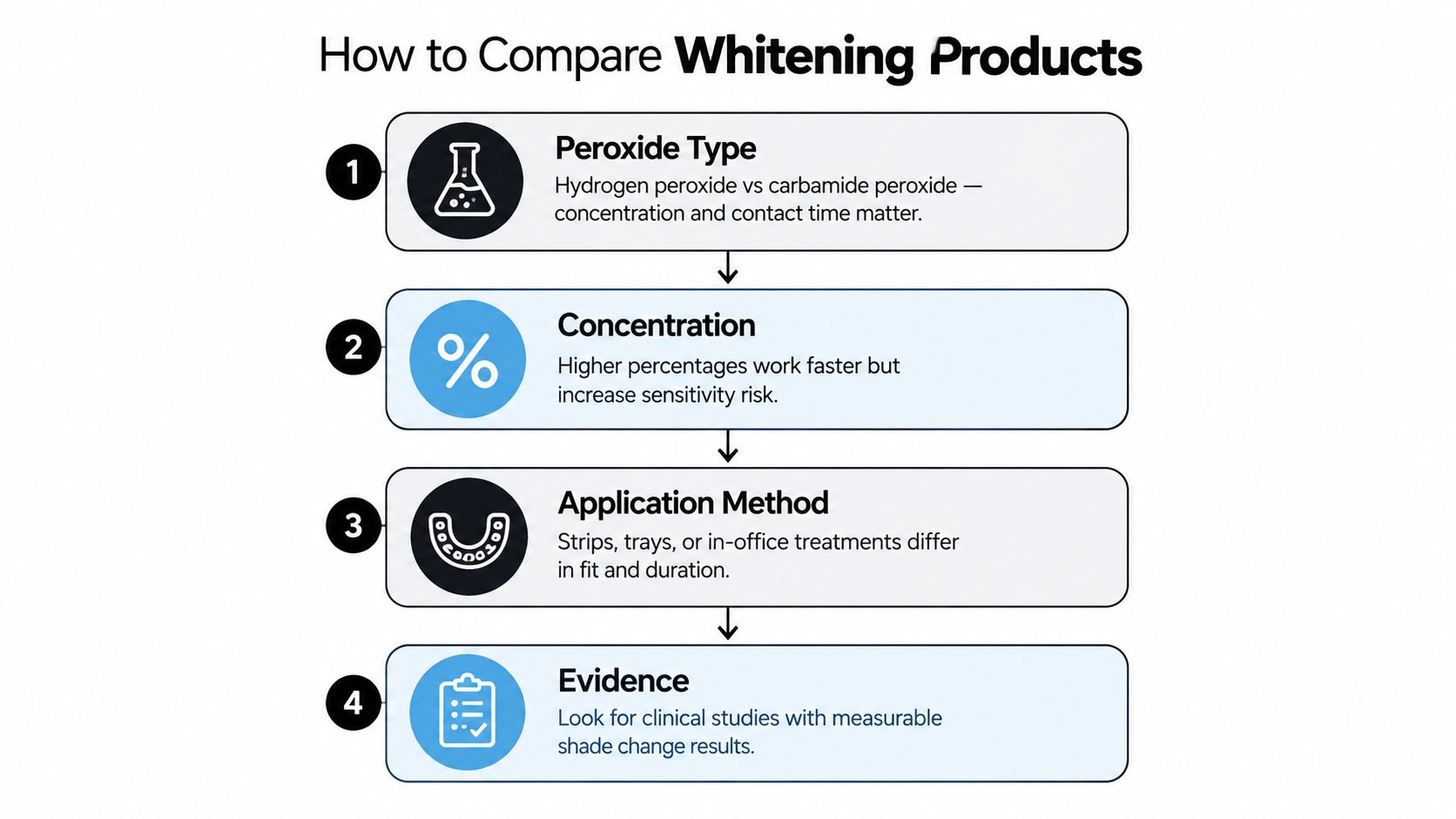
Use a simple shopping checklist:
- Peroxide type matters because hydrogen peroxide and carbamide peroxide behave differently.
- Concentration affects speed and sensitivity risk.
- Application method changes fit and contact time.
- Evidence quality matters more than packaging claims.
Skip self-treating if you have untreated decay, cracked teeth, active gum disease, exposed roots, or restorations that will not whiten like enamel. If you already know your teeth run sensitive, start lower and go slower. A weaker routine you can finish beats an aggressive one you quit on day three.
Sensitivity Toothpastes, Remineralizing Pastes, and Fluoride Rinses
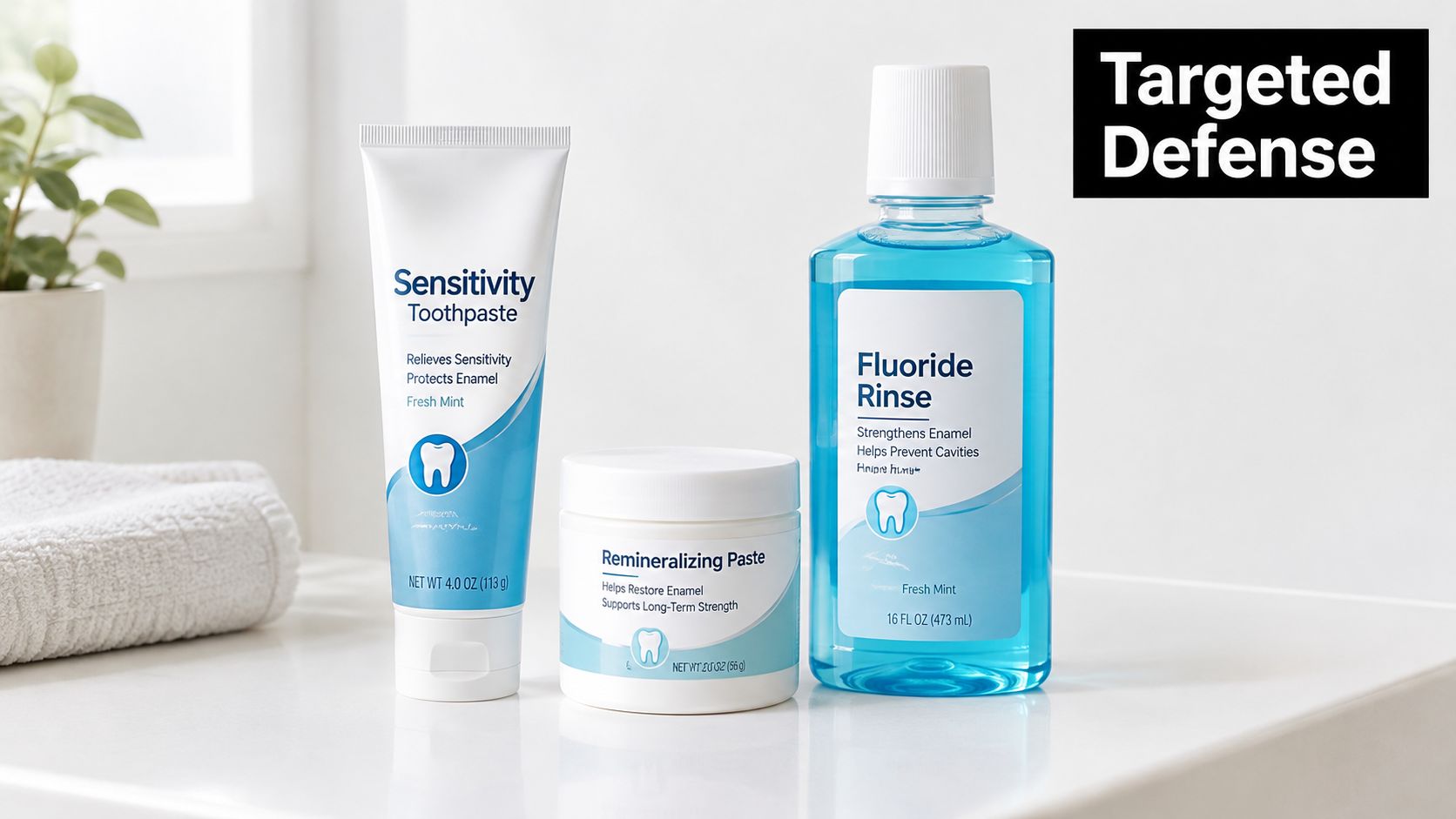
Use targeted products when brushing alone does not solve the problem. If cold air, whitening, or brushing makes your teeth sting, or if your cavity risk is high, these add-ons earn their shelf space. They are plain tools, but they can be the difference between a routine you keep and one you abandon.
Match the paste to the problem
Sensitivity toothpaste is the first choice for teeth that react to temperature or whitening. Ingredients such as potassium nitrate or stannous fluoride are used to reduce that discomfort over time. You do not need a crowded formula, you need one you can use consistently long enough to feel the benefit.
Remineralizing paste, such as MI Paste, is for people who want support when enamel is under stress or the mouth needs extra mineral help. It does not replace brushing or fluoride, and it does not erase damage. It fits best as a targeted add-on in a routine that already covers the basics.
Fluoride rinses are the simplest extra layer of topical protection between brushings. They make sense when a dentist wants more fluoride exposure, not when someone is stacking products at random. Add what your mouth needs, not what the label makes you worry you are missing.
DentalHealth.com carries products in this category, including Fluoridex and MI Paste Plus, which follow the same targeted-use logic.
Don't overbuild the routine
If you are whitening at the same time, sensitivity management needs a plan. A sensitivity paste at night and a fluoride rinse at another point in the day can work well. Too many products without a reason just waste money and make the routine harder to follow.
Use the product to solve the symptom you have:
- Cold sensitivity points to a sensitivity paste.
- Early enamel stress points to remineralizing support.
- High cavity risk points to more fluoride, not more novelty.
If the pain is sharp, persistent, or tied to a visible problem, stop self-treating and get examined. No paste fixes an untreated cavity or a cracked tooth.
Matching the Product Mix to Real Situations
The right setup depends on the job, not the aisle label. A person wearing aligners needs a different routine than someone trying to manage wine stains, and both need a different answer than someone with gum recession. Thoughtful product selection beats impulse buying.
Build the stack around the situation
If you wear aligners or retainers, use a fluoride toothpaste, a brush that reaches around attachments, and a cleaning solution for the appliance itself. If plaque keeps building around the hardware, a powered brush and a water flosser make more sense than buying a stronger toothpaste. Keep the appliance clean and keep the teeth under it protected.
If your problem is surface staining from coffee, tea, or wine, start with a whitening routine that you can tolerate. Lower-concentration options often make more sense than jumping to the strongest product on the shelf. If sensitivity shows up, back off and prioritize consistency over speed.
If you're dealing with gum recession or periodontal maintenance, choose tools that clean gently but thoroughly. Interdental brushes often fit better where roots are exposed, and a powered brush with pressure control may help reduce overbrushing. If gums are actively inflamed, that's dentist territory before product shopping.
If you're in post-whitening maintenance, keep the brush, fluoride toothpaste, and a lower-intensity whitening schedule. Don't restart an aggressive regimen just because a box says “touch-up.” Maintenance should preserve results, not create new sensitivity.
Buy for the year, not the box
The smart checklist is boring, and that's a good thing.
- Identify the problem first.
- Match the tool to the mouth, not the marketing.
- Price replacement heads or refill gels over time.
- Choose the routine you'll follow.
For mixed-age families, simplicity wins. A fluoride toothpaste, a brush that gets used twice a day, and the right between-teeth tool are enough for most homes. If someone in the family has special needs, sensitivity, or whitening goals, add a targeted product only where it solves something real.
If you want a straightforward place to compare fluoride products, sensitivity formulas, whitening gels, and cleaning tools without wandering through random claims, visit DentalHealth.com. It's built around practical oral-care categories, so you can match the product to the problem and move on with a routine that makes sense.