
Dental Floss on a Stick: A Practical Buyer's Guide
You're standing at the sink with toothpaste foam still at the corner of your mouth. The toothbrush is in one hand, and a long strand of floss is waiting beside it, already feeling like a chore. You know you should clean between your teeth, but winding floss around your fingers, keeping it tight, and reaching the back teeth takes more patience than you have tonight. A small floss pick sits nearby, ready to use, yet you may still wonder whether it's a proper substitute or just a shortcut.
That question misses the more useful point. Dental floss on a stick is a behavior-change tool. It can remove some of the handling problems that make string floss easy to postpone. The right choice depends on what you'll use correctly, how your teeth are shaped, and whether your priority is precision, convenience, hand control, or reduced waste. For more on alternatives that make interdental cleaning easier, see these soft picks and advanced interdental cleaning options.
Why a Stick Changes Everything
A floss pick lowers the number of small tasks between deciding to floss and doing it. You don't have to tear off a strand, wrap it around your fingers, adjust the tension, or find a fresh section for each contact. You pick up the handle and guide the short filament between your teeth.
That sounds minor until you've watched how people really floss. Someone with crowded front teeth may get the thread through one contact, struggle at the next, then abandon the process before reaching the molars. Someone with sore fingers or limited grip strength may understand the technique perfectly but find the finger-wrapping physically awkward. In both cases, the problem isn't necessarily motivation. The tool creates too much friction.
Practical rule: The best interdental cleaner is the one that makes correct daily use easier, not the one that wins an argument about tradition.
A floss pick doesn't automatically clean better. Its short, fixed strand can make access simpler, but its rigid frame also limits how far you can curve the filament around each tooth. String floss gives you more control over the shape and the section of floss you use, while a pick gives you a stable grip and consistent tension.
The useful questions are therefore practical:
- What is it? A short filament held in a rigid handle, often with a pointed tip at the other end.
- How does it compare with string floss? It's easier to handle, while string floss usually offers more freedom to wrap around tooth surfaces.
- When is it the smarter choice? When finger-threading is the reason floss stays unused, or when hand comfort and reach matter more than having maximum control.
Clinical guidance supports cleaning between teeth in addition to brushing, but it doesn't require one universal device. The American Dental Association looks for evidence of safety and efficacy in products seeking its Seal, while evidence summarized by Cochrane indicates that adding flossing to brushing may reduce gingivitis, with low certainty and inconsistent plaque outcomes. That makes consistent technique and regular use more important than product loyalty.
What Counts as Dental Floss on a Stick
A floss pick is a manual interdental cleaner made from three main parts:
- A rigid handle, usually a short molded stem that gives you something to hold.
- A tensioned filament, stretched across a small fork or frame.
- An optional pointed tip, often used as a toothpick-style aid for removing larger food particles.
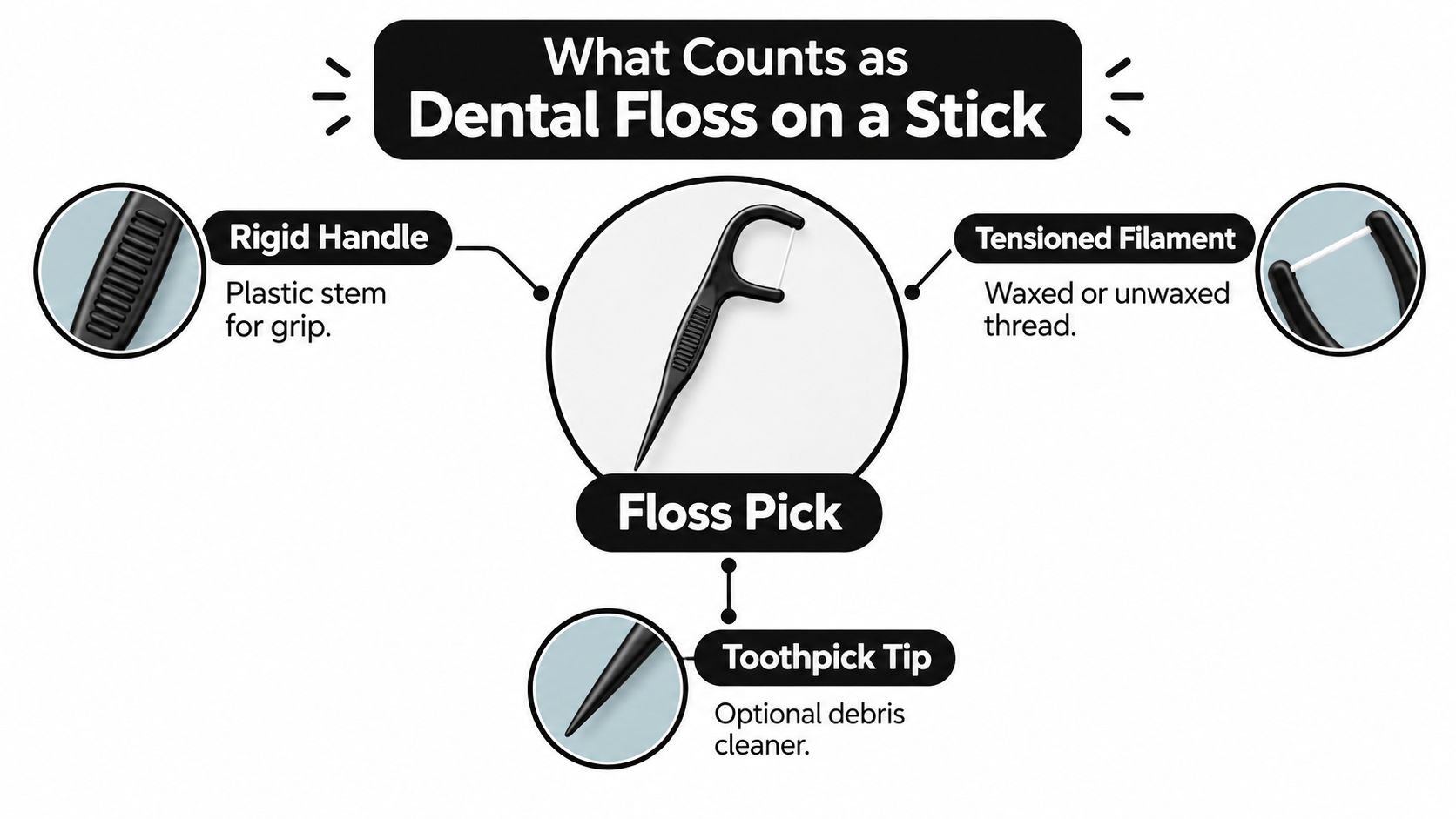
Think of the device as a tiny bowstring mounted on a Y-shaped or F-shaped frame. The frame keeps the filament taut, so your fingers never need to create or maintain the tension. That fixed arrangement is the main reason a pick feels easier to beginners.
The filament may be waxed or unwaxed, and its thickness varies. For tightly contacting teeth, a thinner strand is generally easier to guide through without force. The handle may be straight, angled, curved, or designed with a longer reach. Those details affect comfort, but they don't change the basic category.
What a floss pick isn't
A floss pick is not the same as an interdental brush. An interdental brush has bristles mounted on a wire or flexible stem and is designed to fill a space between teeth. It can be a better match for open embrasures, gum recession, or areas where a narrow filament passes through without touching enough of the surrounding surfaces.
It's also different from a wooden interdental stick. A wooden stick is rigid and doesn't carry a tensioned filament. It may help dislodge food, but it isn't a direct replacement for a floss pick or an appropriately sized interdental brush.
The frame helps, and it gets in the way
The rigid frame keeps the thread straight and makes the motion predictable. That's useful when you're learning or when wrapping string floss around your fingers feels impossible. The trade-off is geometry. A string can curve into a C-shape around a tooth, while the short filament on a pick generally remains more linear.
That matters because passing through the contact point is only the beginning. The filament needs to contact the proximal surfaces on both neighboring teeth. A pick can do that when you guide it deliberately, but just pushing it down and pulling it back out may leave plaque behind.
How Floss Picks Got Their Shape
The modern floss pick wasn't created in one dramatic leap. Its form grew through a long series of attempts to make interdental cleaning less cumbersome.
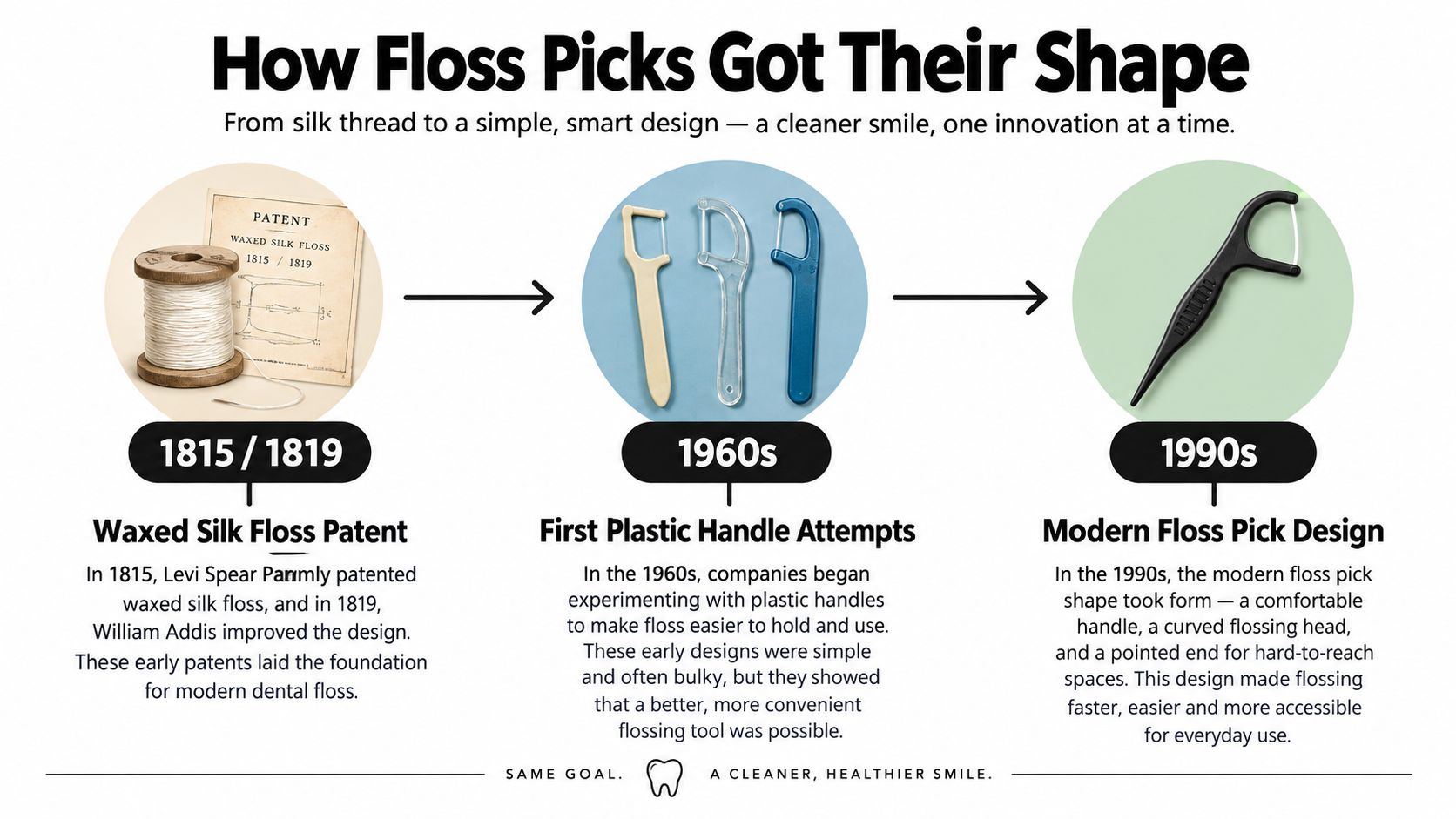
The broader history of dental floss reaches back to 1815, when New Orleans dentist Levi Spear Parmly promoted silk thread for cleaning between teeth. His 1819 book recommended flossing as protection against gum disease. Unwaxed silk floss entered commercial production in 1882, and a dental-floss patent followed in 1896. Those developments established the thread itself, but the stick format needed a separate line of invention.
From toothpick combinations to angled holders
In 1888, B. T. Mason described wrapping fibrous material around a toothpick and called it a “combination tooth pick.” The idea was simple but important. Instead of handling a loose strand alone, the user could combine interdental material with a familiar rigid object.
J. P. De L'eau patented a holder using two vertical poles in 1916. F. H. Doner developed a Y-shaped angled appliance in 1935, an important design ancestor of contemporary floss picks. These early forms addressed reach and handling, two problems that still determine whether a device feels usable.
The progression shows why the shape looks familiar today. Two posts create tension. An angled frame improves access. A handle transfers the work from the fingers to a rigid tool. The product became more convenient by solving one physical obstacle at a time.
The disposable era
The transition toward disposable molded plastic accelerated in the 1960s and 1970s. James B. Kirby patented a device resembling an early F-shaped pick in 1963. In 1972, Richard L. Wells developed a design attaching floss to one end of a pick, while Harry Selig Katz patented a disposable dental-floss toothpick in the same year. These inventions moved the category closer to the compact, single-use tools found in bathrooms today.
The patent record also shows that the category didn't stop evolving. U.S. Patent D610748, titled “Dental floss pick,” was filed on July 23, 2009, and granted on February 23, 2010. Other records describe designs involving bleeding control and hybrid concepts, including an interproximal brush floss-pick application filed in the United States in 2021 and published in 2024.
The enduring F and Y shapes aren't accidental. They remain useful because they hold a short strand under tension while giving the user a manageable path into the mouth.
Floss Picks Compared with String Floss
String floss remains the more adaptable tool. A long strand lets you create a C-shape, move to a clean section, and adjust the angle around each tooth. A floss pick gives up some of that freedom in exchange for a handle that's ready immediately.
| Criterion | Floss pick | String floss |
|---|---|---|
| Contact coverage | Can clean both proximal surfaces when guided carefully, but the rigid frame limits curvature | Allows a C-shape and more surface-by-surface control |
| Technique required | Easier grip and tension, but still requires deliberate movement along each tooth | More finger coordination, wrapping, tension, and repositioning |
| Cost per use | Usually a disposable, preassembled tool | Uses a strand cut from a spool or dispenser |
| Adherence in real life | Convenient for people who avoid finger-threading | Strong option for users comfortable with the technique |
| Beginner friendliness | Simple to hold and start, though the frame can block some angles | More difficult at first, especially around back teeth |
The cleaning difference isn't just “pick versus floss.” Contact and movement matter more than appearance. A person who pushes a pick straight between teeth and removes it immediately may not clean the tooth surfaces. A person who uses a pick gently, hugs each tooth, and reaches the back teeth may achieve useful interdental cleaning.
A 24-week study found that participants used rubber interdental picks regularly for an average of 12.61 weeks, compared with 4.96 weeks for dental floss, a statistically significant difference with p = 0.003 (PubMed study on interdental cleaning adherence). The study evaluated rubber interdental picks rather than every type of tensioned floss pick, so its result shouldn't be generalized to all floss-on-a-stick products. It does support a practical observation: convenience can improve consistency.
Where each format earns its place
String floss is the precision instrument. It's especially useful when you want to wrap around individual teeth, work beneath the gumline with control, or move carefully through varied contacts. It also creates less rigid plastic waste because the holder isn't discarded with every strand.
A floss pick is the adherence tool. It may be the better choice for someone who keeps string floss in a drawer, struggles with dexterity, or wants something quick after meals. Products such as deep-clean flossing tools and comparisons can help you understand how different designs approach reach and handling, but no product removes the need for gentle technique.
How to Use a Floss Pick the Right Way
Start with fit, not force. The filament should pass through the tightest contact with a gentle back-and-forth motion. If you have to push hard, choose a thinner filament or ask a dental professional whether that contact needs a different tool.
Hold the handle lightly, using a pinch grip rather than squeezing it in your fist. A relaxed grip gives you more control and reduces the temptation to force the pick into the gumline.
A gentle sequence
- Guide the filament into the contact. Use a soft sawing motion. Don't snap it down, especially when the contact is tight.
- Move below the contact point carefully. Stop if you meet resistance or pain.
- Hug the first tooth. Angle the filament so it touches the side of the tooth, not just the open space between the teeth.
- Clean with small strokes. Move up and down along the accessible surface.
- Repeat on the neighboring tooth. The same opening contains two tooth surfaces, and both need attention.
- Remove the pick gently. Don't yank it sideways against the gum.
A floss pick is not a tooth scraper. It should glide and clean, not saw aggressively into tender tissue.
Avoid the common shortcuts. Don't force a thick filament through a crowded contact, reuse a pick with a frayed or deformed strand, or stop after the easy front teeth. If the handle bends, the filament loosens, or the pick becomes visibly worn, replace it unless the manufacturer specifically says the design is reusable.
The device may need to change around dental work. Braces can require a threader-style flosser or orthodontic design. Bridges may need a specialized threader or another method that reaches beneath the appliance. Wide spaces and open embrasures often suit an interdental brush better than a narrow strand. If arthritis, injury, or limited hand strength makes a short handle difficult, try a longer-handled design or a Y-frame. For broader daily habits, these tips for a healthy dental routine offer useful context beyond flossing alone.
Here's a visual reminder of the motion and positioning:
If bleeding continues, becomes heavy, or appears alongside swelling, pain, or loose teeth, arrange a dental evaluation. A new cleaning routine can expose irritated gums, but persistent symptoms deserve professional attention.
The Environmental Trade-off Nobody Wants to Admit
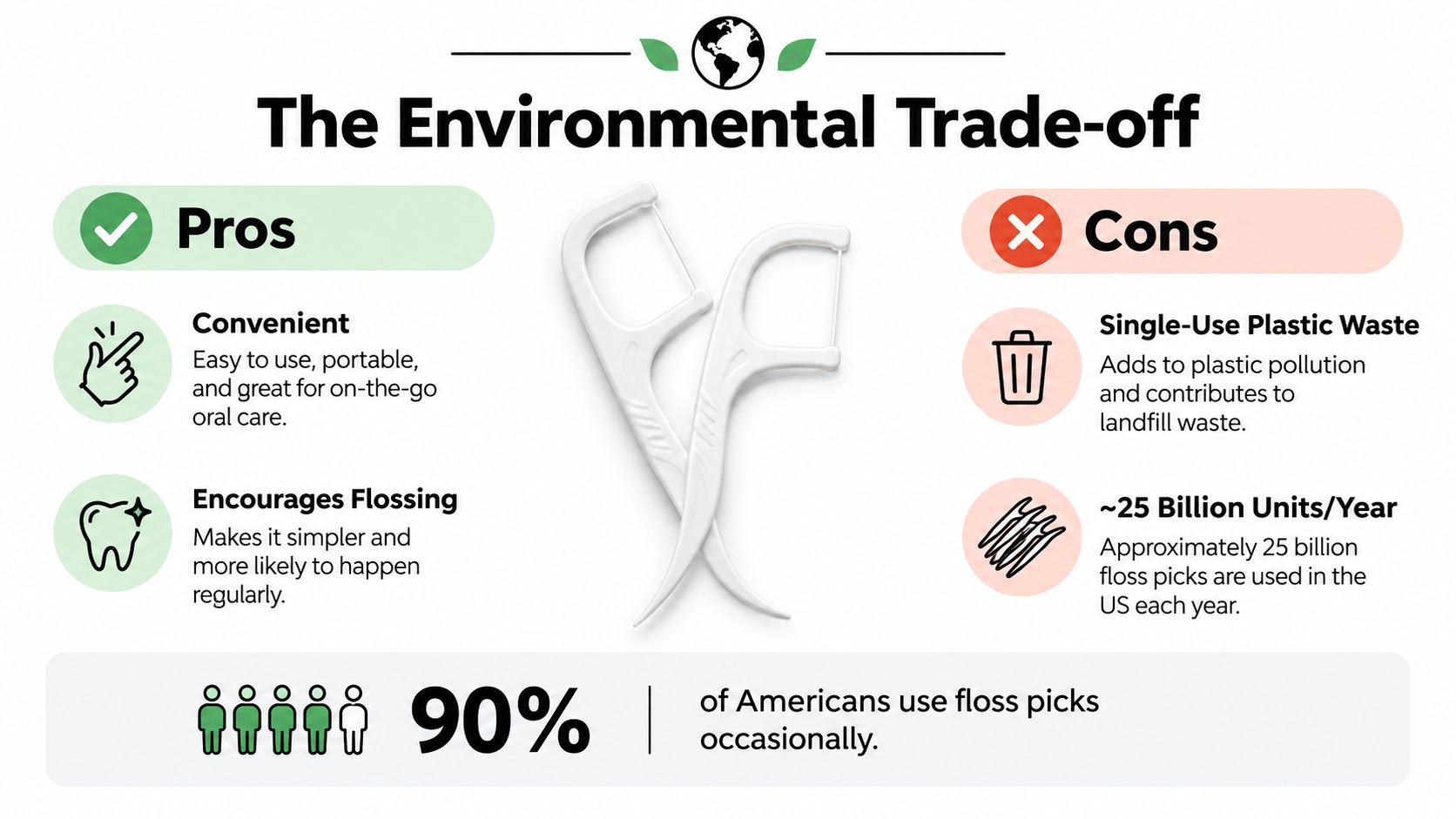
A floss pick can make daily cleaning more realistic, but the convenience often comes with a disposable handle. That creates a genuine environmental trade-off, not a minor detail to hide in the fine print.
A life-cycle study comparing eight interdental cleaning aids found that floss picks had the largest environmental impact in 13 of 16 categories, while regular floss, bamboo floss, replaceable-head interdental brushes, and bamboo interdental brushes performed better in different categories (life-cycle study of interdental cleaning aids). The finding doesn't prove that string floss is clinically superior, and it doesn't mean every user should abandon a tool they can manage consistently.
Waste and behavior are connected
The difficult question is this: Is a floss pick still the better choice if it's the only method you'll use consistently?
A low-waste product that stays untouched in a cabinet provides no cleaning benefit. A disposable pick used correctly every day may support better real-world behavior for someone who repeatedly gives up on string floss. That doesn't erase the waste. It means environmental impact and health behavior need to be considered together.
The honest comparison isn't “plastic versus perfect.” It's “which tool will you use, and what is the least wasteful version of that tool?”
You can reduce the trade-off without pretending it disappears:
- Consider replaceable heads. A refillable or replaceable-head flosser can preserve the rigid handle while limiting how much material you discard.
- Choose verified materials carefully. If a product claims biodegradable filament or components, look for clear manufacturer information rather than assuming “natural” means compostable in your local system.
- Use the device properly. A single pick can generally clean multiple contacts during one session. Don't throw it away after one insertion unless the product instructions say otherwise or the filament becomes damaged.
- Use the right category. If an interdental brush fits your open embrasure better, choosing it may improve both cleaning and material efficiency because the tool matches the anatomy.
Disposal also deserves common sense. Don't flush floss picks, handles, or wipes. Guidance about the safe use of flushable wipes explains why products marketed around flushing still require caution, and the same basic principle applies here: a bathroom product shouldn't automatically go down the toilet.
The most responsible choice is usually the one that balances correct use, daily consistency, anatomical fit, and avoidable waste. You don't need to defend every floss pick as environmentally harmless, and you don't need to reject a useful tool because it isn't perfect.
Choosing the Right Tool for Your Mouth
Choose according to the space you're trying to clean and the obstacle that keeps you from cleaning it.
For tight contacts, try a thin-filament floss pick or string floss. The filament should pass without force. If it catches, shreds, or causes repeated pain, ask a dental professional to assess the contact rather than just pushing harder.
For wider gaps or receding gums, an interdental brush may be more effective than a narrow strand. The brush fills the space and can contact surfaces that a taut filament crosses without adequately touching.
For braces, use an orthodontic flosser or threader-style tool that can pass around brackets and beneath wires. A standard floss pick often can't maneuver through the hardware well enough. For specialized options, learn how super floss works.
For bridges, follow the cleaning method recommended by your dentist or hygienist. You may need a threader, a specialized bridge flosser, or an interdental brush to reach beneath the replacement tooth.
For limited dexterity, the rigid handle may be the deciding feature. A longer handle, angled frame, or larger grip can make the difference between a routine you can perform and one that strains your fingers.
For sustainability priorities, look for replaceable-head designs, reusable handles, or appropriately sized interdental brushes. Patent activity, including an interproximal brush floss-pick application filed in the United States in 2021 and published in 2024, shows that manufacturers continue exploring hybrid formats for different spaces and functions (patent and floss-pick history).
The memorable answer is simple: the best interdental tool is the one you'll use correctly every day. A floss pick in your shower caddy beats a spool of floss in a drawer, but a properly sized interdental brush beats either one when your anatomy calls for it.
DentalHealth.com offers professional-grade at-home dental care products, trusted brands, and practical guidance for building a routine that fits your needs. Visit DentalHealth.com to browse oral-care options and find helpful product information for your next step.