
Do Teeth Whitening Trays Work: What Results to Expect
Yes, teeth whitening trays do lighten teeth more than placebo in clinical studies lasting 2 weeks to 6 months, but results depend on peroxide strength, daily wear time, tray fit and consistency. If a stronger gel were automatically better, why wouldn't everyone use the highest concentration?
The missing piece is how the whole treatment works together. A gel that fits your teeth, your schedule and your sensitivity tolerance can be a more sensible choice than a stronger product that you can't comfortably keep using.
The Short Answer on Whether Trays Work
Could a whitening tray change your tooth colour, rather than cover it? Yes. The gel in the tray can bleach natural teeth, though results depend on the type of discolouration and how the treatment is used.
The cause of the colour matters. Stains from drinks or tobacco are different from a tooth that has darkened after trauma. In the latter case, extra gel may not address the problem, so seek a dental assessment before whitening.
Whitening toothpaste works differently. It can polish away some surface stain, while peroxide gel in a tray bleaches tooth colour. The two approaches are not interchangeable.
A tray is the delivery method, not a guarantee of a particular result. The gel's strength, how long it stays in contact with the teeth, and how well the tray fits all affect the treatment. A stronger gel is not automatically better if the schedule is difficult to follow or the tray lets gel spread onto the gums. A dentist can help assess the cause of discolouration and whether bleaching is appropriate, including through professional teeth whitening in Wellingborough.
Typical Results and Timelines by Concentration
How long trays stay in place and how many days treatment lasts depend on the product and schedule. The table gives a practical range, not a promise that every concentration will produce the same result on the same timetable.
Carbamide peroxide strength, wear pattern and expected timeline
| Carbamide peroxide strength | Typical wear pattern | Typical timeline | Expected result |
|---|---|---|---|
| 10% | Daily use according to the prescribed system | Gradual change over repeated treatments | Lightening may suit people who prefer a lower-intensity approach |
| 10% to 16% in dentist-dispensed custom trays | Set by the dentist for the particular gel | Repeated use over days to weeks | Lightening of responsive natural teeth |
| Up to 22% | Daily wear can range from 2 to 10 hours | A course can run from 6 to 28 days | Effective bleaching is possible, with sensitivity a potential trade-off |
| Up to 38%, the upper ADA-reported range | Daily wear can range from 2 to 10 hours | A course can run from 6 to 28 days | A stronger gel does not guarantee a better final shade |
Those wear-time and course-length ranges describe home-bleaching treatments collectively. They are not a validated schedule for every gel strength, so use the product's directions or your dentist's instructions rather than applying the range to your own trays.
Judge progress against your own plan
Check for gradual change under similar lighting. Comparing a bathroom mirror with a dim photograph can make small differences hard to judge.
As treatment continues, ask whether the shade is still improving comfortably. Baseline colour and the type of stain affect what progress looks like, so a calendar date alone cannot show whether more treatment is appropriate.
Practical rule: A study's observation period is not a deadline by which your teeth must reach a particular shade.
If there is no visible improvement by the end of your prescribed course, do not extend wear or increase concentration on your own. Ask your dentist to reassess the treatment choice and how the trays contact your teeth.
Comfort matters too. Read about how long sensitivity can last after whitening to understand what to discuss before continuing.
What the Evidence Shows About Tray Whitening
The strongest practical distinction is between whether bleaching works and which bleaching protocol works best. Those are separate questions, and the evidence answers the first more confidently than the second.
The American Dental Association's whitening overview summarises a 2018 Cochrane review of 71 clinical trials involving 3,780 adults, which found that home chemical bleaching whitened teeth more than placebo during follow-up periods ranging from 2 weeks to 6 months. These treatments included gels delivered in trays, strips and other home systems, so the findings shouldn't be presented as a test of trays alone.
A placebo comparison helps separate the effect of the active bleaching ingredient from changes unrelated to that ingredient. It supports a meaningful conclusion: home chemical bleaching can lighten teeth. It doesn't establish that every retail tray and gel combination performs equally well.
Why the certainty rating matters
The review rated the overall certainty of evidence low to very low. Many comparisons relied on single, small studies with an unclear risk of bias, making it difficult to know how reliably an apparent advantage would carry over to another group of patients.
For a shopper, those limitations translate into concrete cautions:
- Formulation claims need context: A favourable result for one gel doesn't prove that every product with a similar label will behave identically.
- Wear-time comparisons aren't settled: The review couldn't reliably identify a universally superior application time or treatment duration.
- Concentration isn't a ranking system: The evidence didn't establish one strength as the best choice for everyone.
The ADA describes at-home systems containing approximately 10% to 38% carbamide peroxide, and summarises a systematic review with daily use ranging from 2 to 10 hours over 6 to 28 days. Those are broad treatment ranges, not permission to select any combination of strength and wear time.
Effective bleaching is supported. Identical results across all trays, gels and users are not.
The balanced answer to “Do teeth whitening trays work?” is therefore yes, with an important boundary: demonstrated short-term effectiveness doesn't justify a guaranteed shade change, a universal finishing date or a claim that one protocol always wins.
How Trays Carry Peroxide Into Enamel
Think of a whitening tray as a small reservoir. It holds the active ingredient near the tooth while the ingredient moves into the tooth structure, rather than merely scrubbing the outside.
A clear tray illustrates the close contact involved, although a dental aligner isn't automatically suitable for use as a whitening tray.
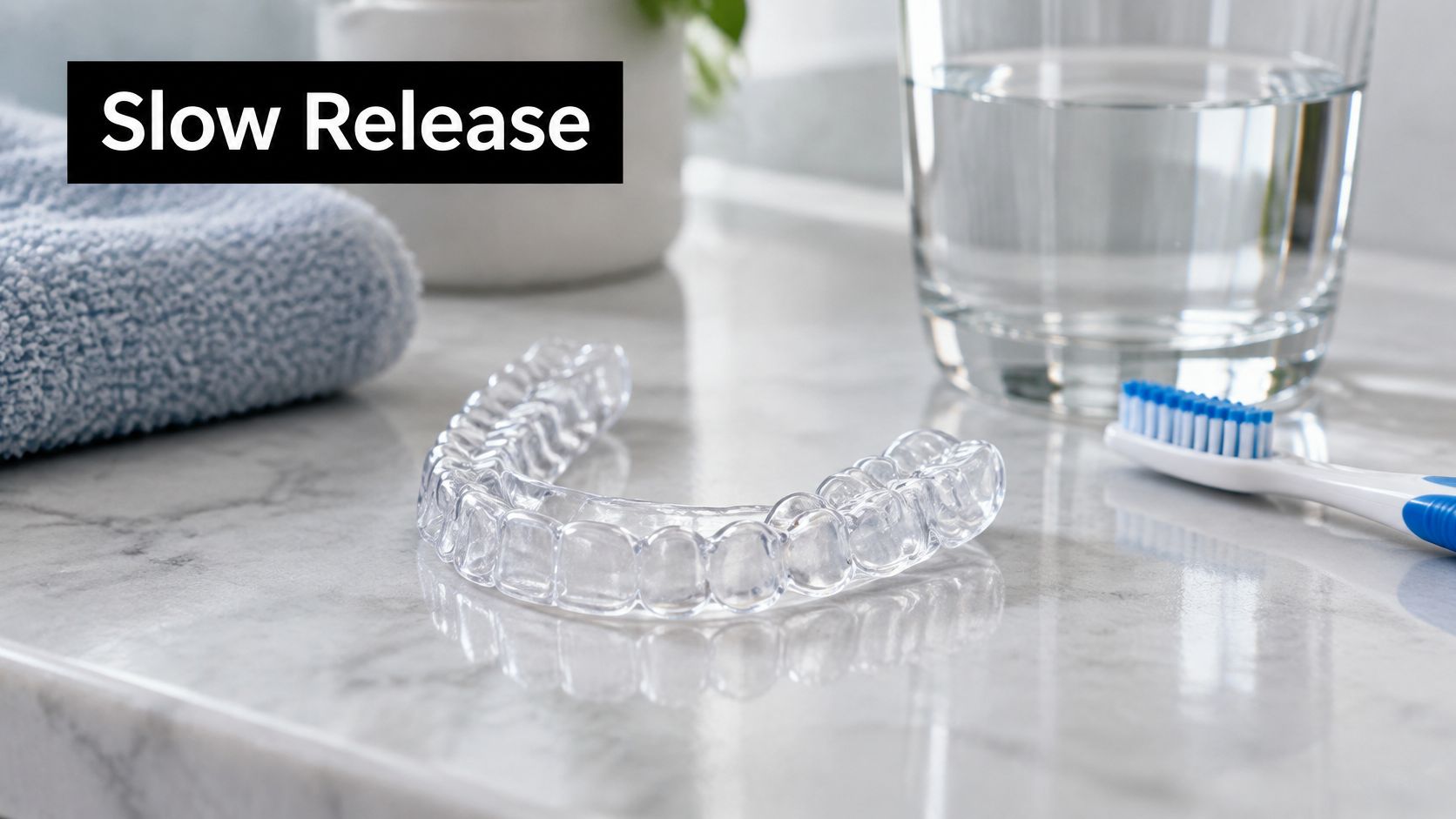
As explained in ADA News' overview of teeth-whitening options, peroxide diffuses through enamel and dentin, where oxidation breaks down colour-producing molecules; dentist-dispensed home trays commonly use approximately 10% to 16% carbamide peroxide. In plain language, bleaching changes the molecules responsible for the colour rather than removing a coloured layer of tooth.
Carbamide peroxide breaks down more gradually than hydrogen peroxide. That slower release supports extended bleaching and can mean less intense sensitivity, but the outcome still reflects the combination of concentration, contact time, frequency and fit.
Keep the gel against teeth, not gums
Custom trays can improve gel-to-tooth contact and reduce leakage onto gum tissue. That doesn't mean they should feel painfully tight or require forceful seating.
Our loading instructions distinguish between tray designs:
- Compartmented trays: Put a drop of gel into each tooth compartment.
- Simpler trays: Place a line of gel along the tray. In this loading method, half the syringe is used for the upper tray and half for the lower.
That syringe allocation belongs to the specified method, not every syringe size or whitening system. Don't transfer it to a different product without confirming its instructions.
This video provides an additional visual reference for tray use.
Overloading trays or pushing gel firmly into the teeth is unnecessary and may irritate gums. More gel isn't a substitute for accurate placement, and longer-than-directed wear increases soft-tissue exposure without a proportional improvement in results.
Choosing Strength and Who Should Check First
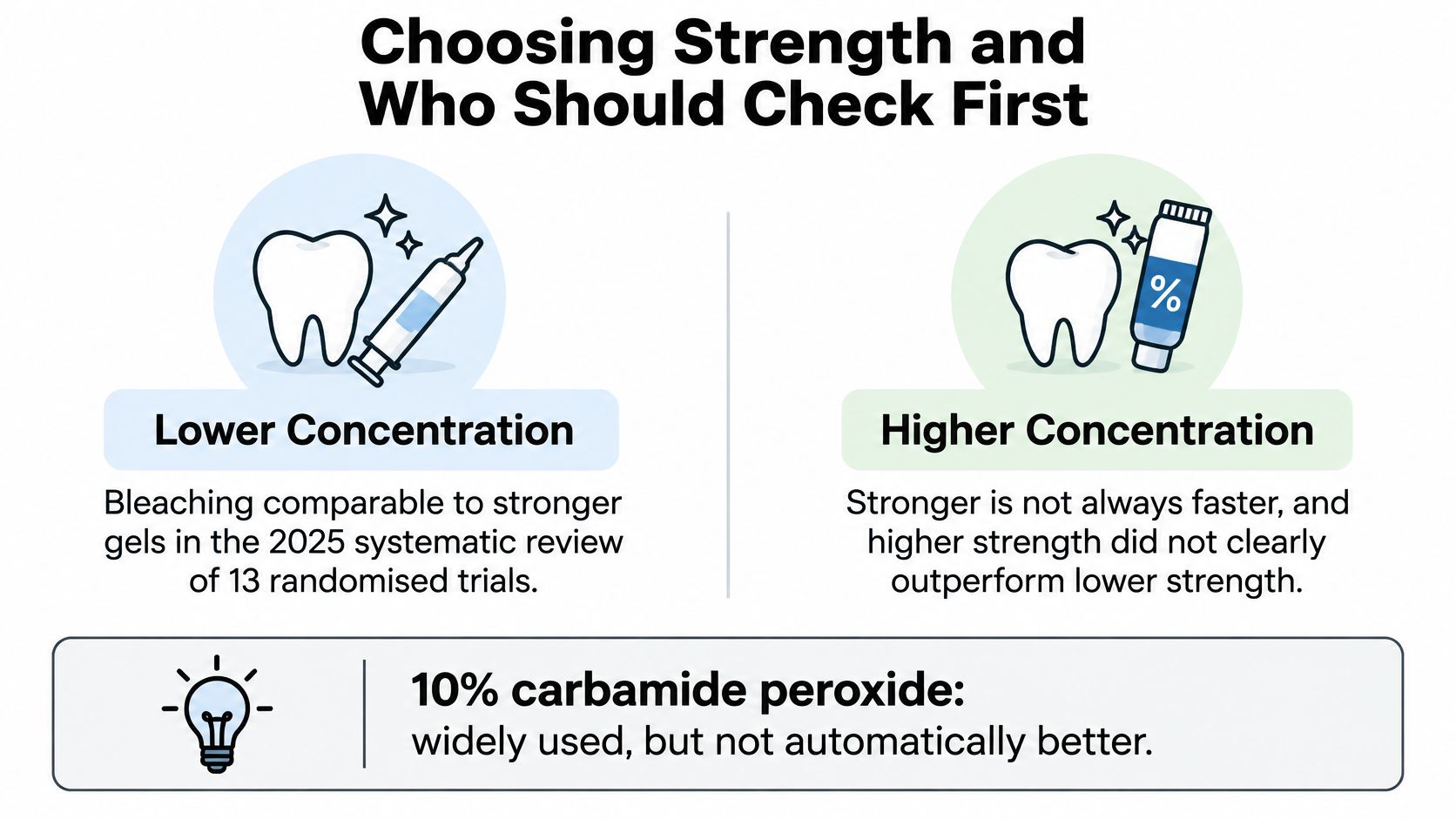
Stronger isn't automatically better, especially if the extra strength makes treatment uncomfortable enough that you keep interrupting it. The useful comparison is the final colour change alongside the burden of sensitivity, not the percentage printed most prominently on the packaging.
A 2025 systematic review of 13 randomised trials found comparable bleaching efficacy with lower and higher carbamide-peroxide concentrations, while 10% carbamide peroxide was associated with substantially less tooth sensitivity than 20% to 22% formulations. Most included trials had a high risk of bias, so the result supports discussing trade-offs rather than declaring a universal winner.
The comparison is easier to understand when efficacy and comfort are considered separately.
Decide whether to whiten before deciding how strongly
A darker tooth isn't always an ordinary cosmetic stain. If the colour change is unexplained, especially when it affects an isolated tooth, arrange an examination before trying to bleach it away.
Use these checks to guide the conversation:
- Treat existing problems first: Untreated decay, cracked or loose teeth, active gum disease and unexplained pain need assessment before elective whitening.
- Describe your sensitivity history: Tell the dentist about discomfort with cold drinks, previous bleaching reactions, gum recession or exposed roots.
- Set a realistic shade goal: Ask what improvement is plausible for your natural teeth rather than choosing a target from an edited photograph.
Existing dental work needs its own discussion. Fillings, crowns, implants and sealants don't change colour with whitening, so lightening adjacent natural teeth can make a mismatch more obvious.
Say your front tooth has a tooth-coloured filling that currently blends in. A lighter natural tooth surrounding that unchanged filling may leave you less satisfied, even though the bleaching itself has worked.
Choose a routine you can tolerate
Ask for the lowest suitable strength that can reasonably meet your goal, particularly if you already have sensitive teeth. That's a decision about your mouth and treatment plan, not a rule that everyone should buy the weakest available gel.
Our sensitivity guidance for PolaNight 10 is to try a two-hour treatment first and, if there are no adverse reactions, try overnight treatment the next time you whiten. That is product-specific guidance, not permission to wear an unfamiliar gel overnight.
Discomfort isn't a target to work through. Persistent pain is a reason to stop and contact a dentist.
A shorter session should also remain within the instructions for the chosen system. Don't invent a new schedule by combining advice from different gels.
If you're deciding how much professional involvement you need, our comparison of at-home teeth whitening versus professional whitening helps frame that choice. The central question isn't which option sounds strongest, but which offers an appropriate assessment, a workable routine and a clear response if problems develop.
Confirm Your Routine Before You Start Whitening
A good routine should be clear enough that you don't need to improvise with a loaded tray in your hand. Write down the product, amount of gel, session length and stopping instructions before starting.
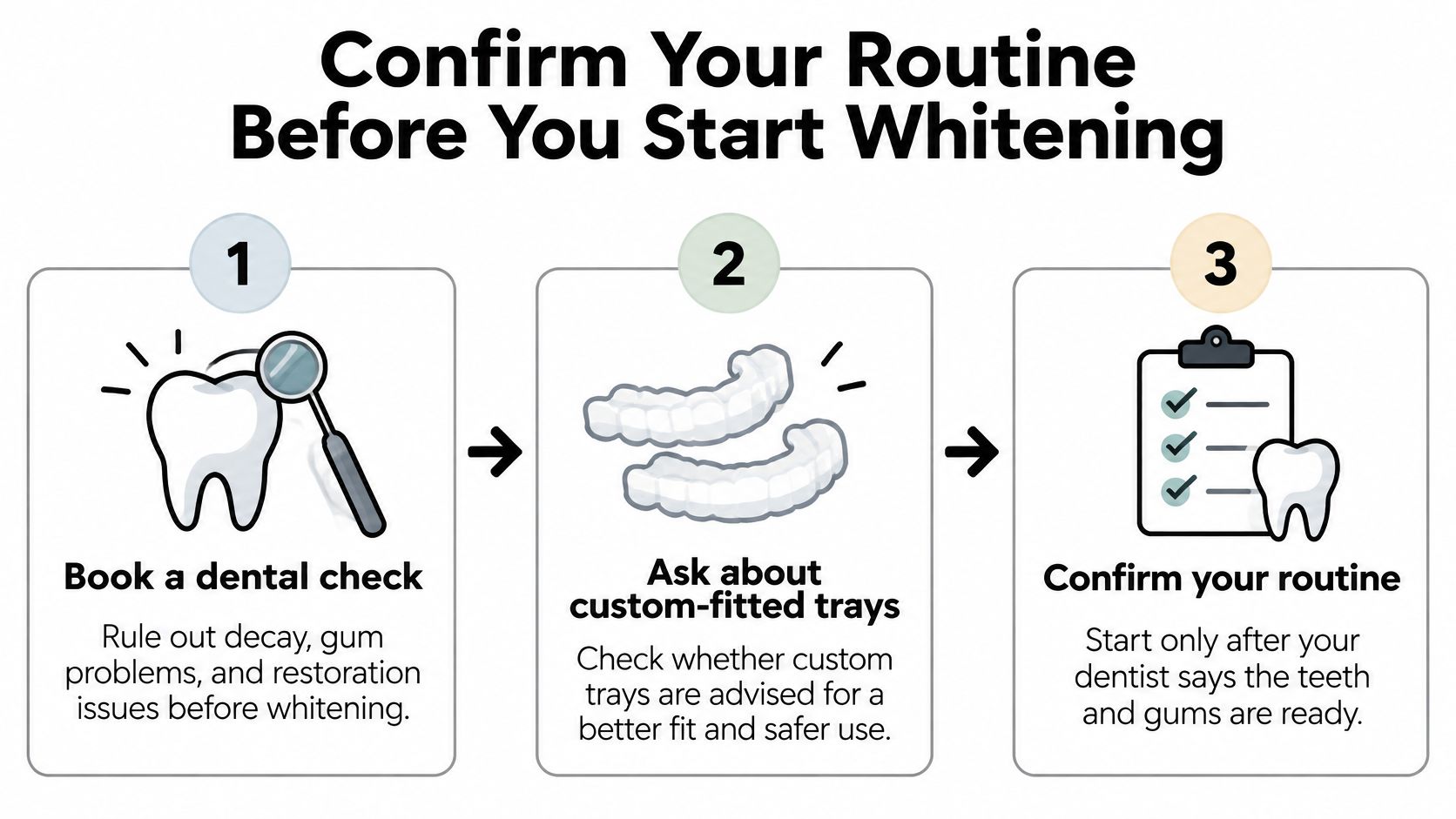
Use this consultation checklist to confirm that your teeth and gums are ready.
Make the instructions specific to your trays
- Book a dental check. Have decay, gum problems and restoration issues assessed, and ask whether custom-fitted trays are advised. Bring your existing trays if you have them, rather than assuming any clear appliance will suit the gel.
- Confirm the formulation and strength. Show the dentist the actual label, including the peroxide type. Ask for a schedule that takes your sensitivity history into account, rather than choosing the most intensive option available.
- Agree on the gel amount and placement. Establish whether your tray needs individual drops or a line of gel. After loading, tap or press each tray lightly so the gel contacts the teeth; firm pressure isn't needed.
- Set the session length in advance. Use the dentist's or product's specified timing, and set a timer when appropriate. Don't turn a short-session product into an overnight treatment because another gel permits overnight wear.
- Clean up gently after treatment. Our aftercare instructions are to rinse your mouth with tepid water, brush gently with a mild toothpaste, then rinse the trays and let them dry thoroughly before storing. Avoid packing away trays while they still contain residual gel.
- Record progress and respond to symptoms. Compare shade periodically under similar lighting and note any discomfort. Stop and contact the dentist if pain or gum irritation persists rather than changing the dose yourself.
Resolve restoration questions before buying refills
If you have visible dental work, decide what an acceptable finished result would look like before beginning. Our guide to teeth whitening with fillings can help you prepare questions about the appearance of the whole smile, not just individual natural teeth.
Keep the written routine with the product so you can check it each time. If the instructions on a replacement gel differ, resolve that difference before using it.
Your action today is to book the dental check and bring the product label and tray type to the appointment. Leave with a clear plan for use, review and what to do if treatment becomes uncomfortable.
DentalHealth.com offers professional-grade at-home whitening gels and kits, sensitivity-care products and practical guidance for comparing your options. Visit DentalHealth.com to review product descriptions and whitening advice, then match your purchase to the tray system and routine your dentist recommends.