
Fresh Breath Oral Care Water Additive Guide
You're halfway out the door, coffee in one hand and your toothbrush in the other, wondering whether a quick rinse can rescue your morning breath. A fresh breath oral care water additive sounds appealing because it fits into an existing habit: add the liquid to water, swish, and move on. But the result depends on more than convenience. The formula, water quality, dilution, contact with oral tissues, and your ability to use it consistently all influence what the product can achieve.
A water additive also isn't a substitute for brushing, flossing, or professional dental care. Its role is narrower and useful: it can help manage odor as part of a routine, especially when you understand how its ingredients interact with odor-producing bacteria and how household habits can weaken the formula.
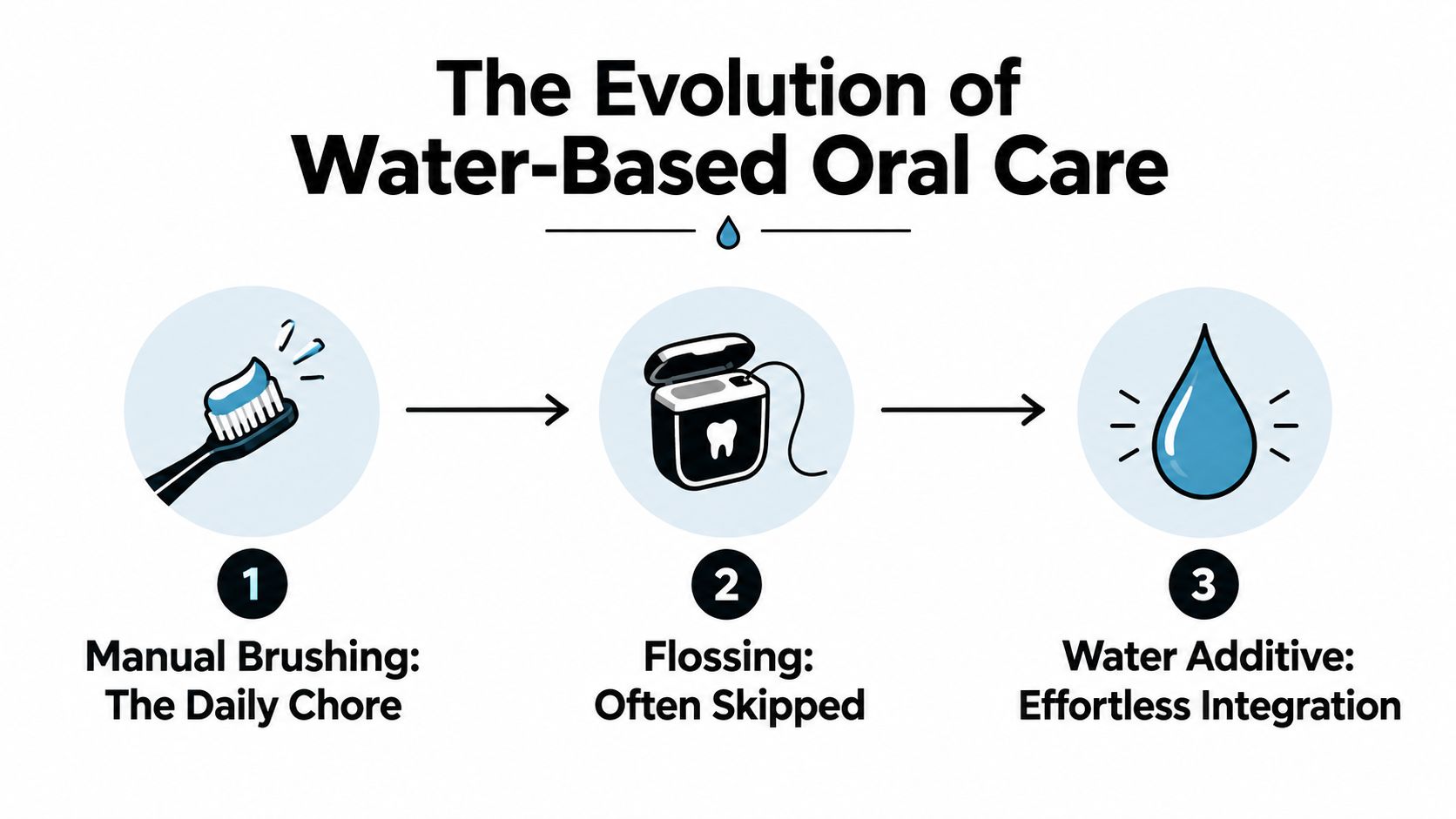
The Evolution of Water-Based Oral Care
In a rushed morning routine, brushing and flossing can feel like tasks to complete rather than habits to understand. A liquid product seems easier because it doesn't require the same hand movements, paste texture, or time at the sink. That convenience has a meaningful precedent in oral care. Public-health systems have long used water as a delivery medium for dissolved ingredients.
Community water fluoridation provides the key historical example. The first full-scale test began in Grand Rapids, Michigan, in 1945, and the U.S. Public Health Service later recommended fluoride concentrations in drinking water ranging from 0.7 to 1.2 parts per million before updating the modern community-system target to 0.7 mg/L. The CDC's history of community water fluoridation documents that progression.
Why the liquid format matters
The broader lesson isn't that a breath additive works exactly like fluoridated drinking water. The lesson is that water can distribute a low-dose ingredient across a large or repeated-use setting. In a bathroom product, the liquid base carries active and supportive ingredients around the mouth, including areas that a toothbrush may not contact easily.
Modern fresh-breath rinses commonly use a water base with ingredients such as sodium chlorite, sodium bicarbonate, xylitol, and flavor systems. These formulas are designed for easy daily use rather than abrasion. Toothpaste relies partly on brushing and polishing. A rinse relies on liquid movement, chemical interaction, and repeated exposure during the routine.
Practical rule: Treat a water additive as a delivery format, not as proof that every formula has the same effect.
That distinction helps explain why two products that look similar on a shelf can perform differently. One may focus on odor chemistry, another on plaque support, and another mainly on flavor. The bottle's convenience is only the starting point. The ingredient list and instructions determine what the liquid is intended to accomplish.
Decoding the Active Ingredients
A clear liquid can look simple while containing a carefully balanced system. Water usually provides the carrier, but the other ingredients determine how the product tastes, stays mixed, and interacts with odor compounds.
A prominent example is TheraBreath Fresh Breath. Its listed formula begins with water, followed by PEG-40 hydrogenated castor oil, sodium chlorite, sodium bicarbonate, flavor, and sodium hydroxide. This shows the common architecture of a water-based breath rinse: a liquid carrier, a solubilizer, an odor-focused ingredient, a buffering component, flavor, and a pH-adjusting ingredient. The 2026 review of oral-care products also identifies bad-breath management as a distinct purpose within cosmetic oral-care rinses, alongside goals such as whitening and dry-mouth relief.
What the common ingredients do
Sodium chlorite is associated with oxidation-based odor control. Bad breath often involves volatile sulfur compounds, which are responsible for the characteristic smell. An oxidation-oriented formula aims to change or neutralize odor-related chemistry rather than just cover it with a stronger flavor.
Sodium bicarbonate helps support the formula's chemical environment and contributes a mild alkaline character. It shouldn't be confused with the mechanical cleaning action of brushing with a toothpaste containing an abrasive system.
Xylitol, when included, can provide sweetness without functioning like ordinary fermentable sugar. Its presence may improve taste and user acceptance, but it doesn't turn a rinse into a replacement for mechanical plaque removal.
Flavor systems matter more than many people realize. If a product burns, tastes too strong, or leaves a dry sensation, users may shorten the rinse or stop using it. Compliance is part of product performance.
Alcohol-free and oxidation-based aren't interchangeable terms. An alcohol-free rinse may still contain active ingredients that affect odor chemistry, while an alcohol-containing product may create a strong sensory effect without addressing every cause of persistent halitosis. Before choosing a formula, compare the actual label and consider dry mouth, sensitivity, and your tolerance for flavor. For more context on choosing a rinse, see this guide to smart mouth rinse selection.
Targeting Odor Without Disrupting the Microbiome
Bad breath usually comes from the activity of particular oral bacteria, not from the mouth being universally “dirty.” Some anaerobic bacteria break down proteins and release volatile sulfur compounds. Those compounds can collect around the tongue, gumline, and other low-oxygen areas, producing odor even when the visible teeth look clean.
That makes the phrase “kills all germs” a poor way to judge a breath product. The mouth is an ecosystem, and broad disruption can affect organisms that aren't responsible for the smell. A more thoughtful formulation tries to reduce the activity of odor-producing organisms or alter the compounds they create while preserving much of the surrounding microbial community.
A 2025 in-vitro study of an alcohol-free halitosis rinse found selective antimicrobial activity against Fusobacterium nucleatum, Fusobacterium periodonticum, and Prevotella intermedia while preserving overall diversity in a saliva-derived community. The study on selective activity and oral microbial diversity supports a useful principle: breath control doesn't require indiscriminate elimination of oral bacteria.
Why formulation matters more than the front label
Different rinses can produce different biological results, even when they share a breath-freshening purpose. A separate study of TheraBreath rinses found antibacterial activity against Streptococcus mutans only for the Whitening Fresh Breath and Healthy Gums formulations among the products tested. The Fresh Breath formulation itself showed no significant antibacterial activity in that study, whose TheraBreath formulation analysis lists water, PEG-40 hydrogenated castor oil, sodium chlorite, tetrasodium EDTA, sodium benzoate, sodium bicarbonate, flavor, and sodium hydroxide.
That doesn't automatically make the Fresh Breath product useless. It means you should separate odor management from broad antibacterial claims. Sodium chlorite-based oxidation may be more relevant to breath chemistry than classic broad-spectrum antisepsis, and the intended benefit depends on the entire formula.
Persistent odor still deserves attention. Dry mouth, tongue coating, gum inflammation, decay, tonsil issues, and other conditions can contribute to halitosis. An additive can support a routine, but it shouldn't hide a symptom that continues despite sensible oral hygiene.
For readers considering biological approaches alongside rinses, DentalHealth.com also discusses oral probiotic lozenges. Use any product according to its own instructions rather than assuming that combining several oral-care products automatically improves the outcome.
Real-World Compliance and Filtration Pitfalls
The easiest routine isn't always the most dependable. A user can buy a well-designed fresh breath oral care water additive and still reduce its usefulness by running it through the wrong filter, adding an arbitrary amount, or leaving mixed water standing longer than the product instructions allow.
Carbon and charcoal filters deserve particular attention. Product guidance for oral-care water additives commonly warns that these filters may remove active ingredients from treated water. The TropiClean Fresh Breath Oral Care product guidance illustrates why users should check compatibility instead of assuming filtered water is neutral.
Four checks before you mix
- Read the dilution instruction: Use the measuring cap or another reliable measure. Too much may worsen taste or irritation, while too little may leave the active ingredient below the intended concentration.
- Check the water source: If you use a pitcher or faucet filter containing carbon or charcoal, ask the manufacturer whether it can remove the product's active ingredients.
- Mix what you'll use: Follow the label's storage and replacement directions for premixed water. Standing water can change the practical quality of the routine, particularly if the container isn't clean.
- Protect compliance: A harsh flavor or sensitivity can lead to shorter rinsing or skipped days. A milder product that you use correctly may be more useful than a stronger-tasting formula you avoid.
A reliable routine starts with the label, not the capful. The correct dose depends on the specific product and the amount of water named in its instructions.
Water additives also create special confusion in households that use pumps, reservoirs, or both pet and human oral-care products. A formulation made for one use shouldn't be transferred to another only because both products are liquids. Keep separate products clearly labeled, and don't assume that a shared water system preserves each formula's intended concentration.
The same principle applies to devices. If you're considering adding a rinse to an irrigator, review the equipment and product instructions first. DentalHealth.com addresses related questions in its guide on using mouthwash in a Waterpik, but device compatibility remains product-specific.
When to Choose a Liquid Additive Over Pastes and Gels
Toothpaste and a liquid additive do different jobs. Brushing physically disrupts plaque and deposits toothpaste ingredients across tooth surfaces. A rinse moves through the mouth, reaches the tongue and spaces around the gums, and can leave an active solution in contact with tissues after brushing.
That makes a water additive particularly useful when the main problem is breath freshness between mechanical-cleaning steps. It can also be easier for someone with a sensitive mouth, a temporary preference for non-foaming products, or a travel routine where carrying a toothbrush setup feels inconvenient. Those advantages don't mean the liquid removes plaque as effectively as brushing.
Choose by the job you need done
| Feature | Water Additives / Rinses | Whitening & Sensitivity Pastes |
|---|---|---|
| Primary action | Moves liquid around the mouth and targets breath-related chemistry | Delivers toothpaste ingredients while brushing physically cleans surfaces |
| Best fit | Breath management, tongue-area freshness, and routine convenience | Surface cleaning, whitening support, or sensitivity-focused care |
| Mechanical plaque removal | Limited, because the liquid doesn't scrub the teeth | Comes from brushing with the paste |
| Dry-mouth considerations | Depends on the formula, flavor, and alcohol content | Depends on the individual paste and how it feels during brushing |
| Use after brushing | Often used according to the product label after brushing and flossing | Used during brushing as directed |
| Main limitation | Doesn't replace brushing, interdental cleaning, or dental treatment | Doesn't necessarily address odor chemistry throughout the mouth |
A rinse may feel helpful after oral surgery or during a period when brushing a particular area is uncomfortable, but those situations need individualized dental advice. A liquid can support freshness without adding abrasive contact, yet it won't remove hardened tartar or diagnose the reason for pain.
DentalHealth.com's catalog includes breath-care products such as BreathRX alongside whitening and sensitivity products. That makes it possible to compare a breath-focused liquid with a paste or gel according to the problem you're trying to solve, rather than treating every oral-care product as interchangeable.
Building a Sustainable Daily Oral Care Routine
A useful routine should be simple enough to repeat and precise enough to preserve the formula. Start with the foundation: brush all tooth surfaces, clean between the teeth, and address the tongue gently if coating contributes to odor. Then use the additive according to its label, usually after brushing and flossing when the mouth has already received mechanical cleaning.
A practical daily sequence
- Prepare fresh water. Use the water type recommended by the product. If you rely on a carbon or charcoal filter, confirm compatibility first.
- Measure the additive. Don't estimate by eye. The intended concentration depends on the product's directions.
- Rinse as instructed. Keep the liquid in contact with the mouth for the stated time, and don't swallow a product unless its label specifically says it's suitable for that use.
- Track tolerance. Notice burning, dryness, sensitivity, or a flavor that makes you rush. Those signs can reduce adherence and may justify switching formulas or asking a dental professional for advice.
- Review persistent odor. If breath remains noticeably unpleasant despite consistent care, arrange a dental evaluation rather than continually increasing the amount of additive.
The strongest routine is the one you can maintain without compromising brushing or interdental cleaning. Think of the additive as a targeted support for breath chemistry and convenience, not a shortcut around the basics.
Fresh breath is a symptom to manage thoughtfully, not a problem to cover indefinitely.
Visit DentalHealth.com to compare breath-freshening options and read practical guidance on rinses, sensitivity care, and at-home dental products. Use the ingredient list and your own tolerance to choose a product that fits your routine, then ask your dentist or hygienist about persistent odor, pain, bleeding, or dry mouth.