
Non Antiseptic Mouthwash: A Gentle Oral Care Guide
The hottest mouthwash advice is usually the loudest one, not the smartest one. If you've been told a rinse has to burn to work, that is a marketing shortcut, not a dental truth. A non antiseptic mouthwash can be a better fit when your goal is cavity support, comfort, whitening maintenance, or keeping your routine gentle without trying to sterilize your mouth.
Your mouth is a complex ecosystem, not a sterile lab. The goal is balance, not total elimination. Oral rinsing for health is also far older than modern antiseptic products, with early records traced to Chinese medicine around 2700 BCE for gingivitis, and similar rinsing practices appearing in Ancient Egypt, Greece, and Rome, including Hippocrates' salt, alum, and vinegar rinse as noted in the historical overview of mouthwash.
That history matters because today's rinse choices are not one-size-fits-all. Some formulas are built to freshen breath, some to support fluoride use, and some to fit sensitive mouths that react badly to stronger antiseptic products. If cavity prevention is your main goal, a dedicated fluoride rinse may be the better match, as explained in this guide to fluoride mouthwash for cavities.
Beyond the Burn What Is Non Antiseptic Mouthwash
A lot of people hear “mouthwash” and picture a strong antibacterial swish that leaves the mouth feeling stripped clean. That is only one kind of rinse. Non antiseptic mouthwash is better understood as a rinse that supports oral care without being designed mainly to kill bacteria.
That difference matters because “clean” does not always mean “healthier.” Too much antibacterial force can disrupt your oral microbiome, the balance of helpful and harmful bacteria in your mouth. A more targeted rinse serves a narrower purpose, such as delivering fluoride, easing dryness, or freshening breath without trying to turn the mouth into a sterile space.
Practical rule: choose the rinse for the job you need, not for the strongest sensation on the label.
The history behind mouth rinsing helps explain why this matters. People were using mouth rinses for function long before commercial antiseptic products became common, as the historical record of mouthwash use shows. That older idea still fits today, because a rinse should match your needs instead of overwhelming them.
If your main goal is cavity support, a fluoride formula may be the better match, and this guide to fluoride mouthwash for cavities explains why that use case is different from a germ-killing rinse.
The Key Difference Antiseptic vs Non Antiseptic Rinses
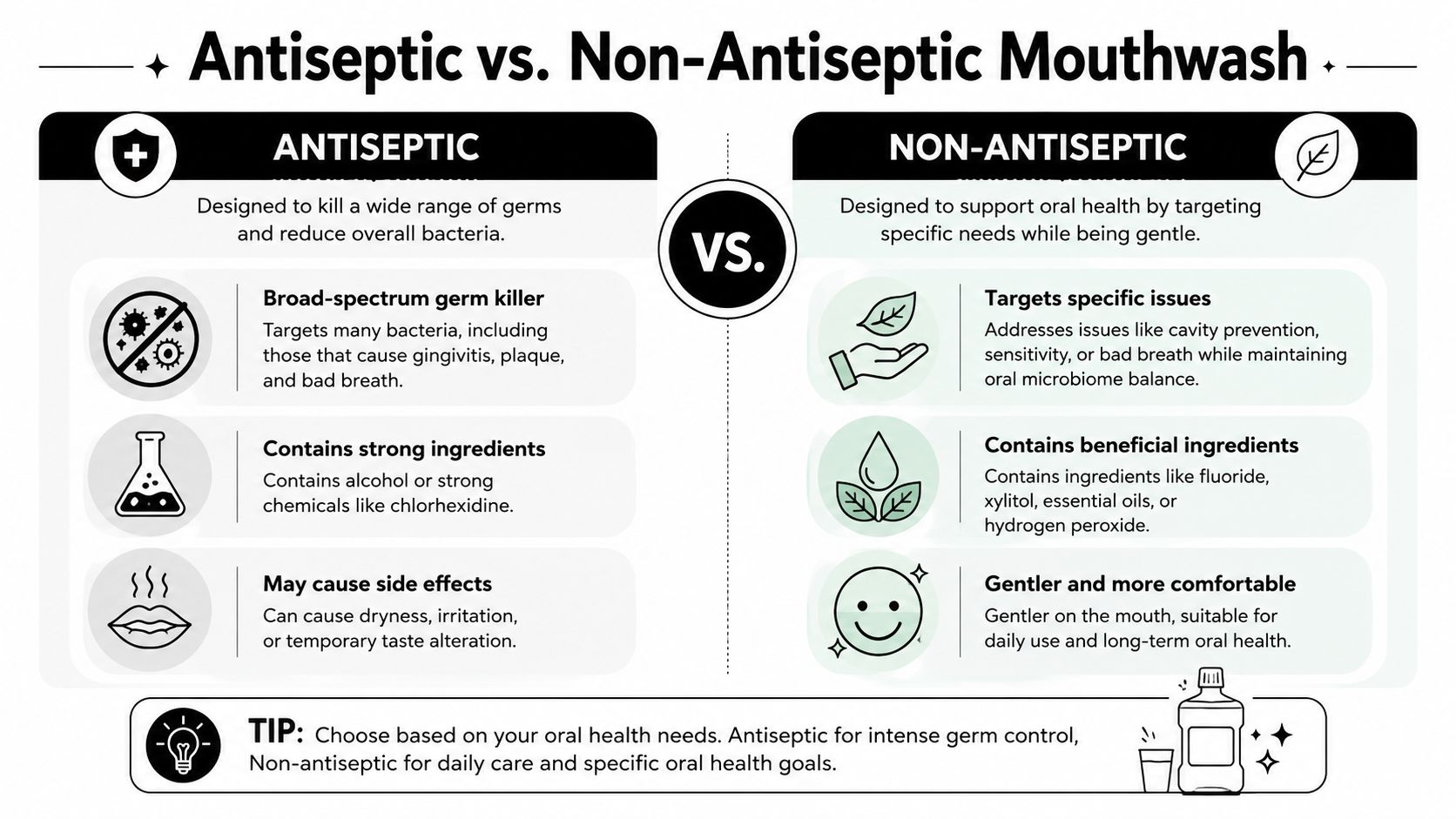
The simplest way to separate these products is by what job they are trying to do. An antiseptic rinse works broadly on bacteria in the mouth, while a non antiseptic rinse is built to support a specific goal without treating the whole mouth like a place that needs to be sterilized.
What antiseptic rinses are designed to do
Antimicrobial mouthwashes are formulated to suppress plaque bacteria according to the dental literature review on mouthwash use. That can be useful in certain therapeutic situations, but it is not the same as everyday maintenance. Stronger formulas can also create concerns with longer-term use, and some professional bodies discourage long-term use of ethanol-containing mouthwashes because of a possible link to oral cancer, as the ADA mouthrinse guidance explains.
What non antiseptic rinses are built to do
Non antiseptic formulas usually aim at a different result. Some are made for fluoride delivery, some for whitening support, and others for comfort or breath freshening rather than microbial suppression. The label should tell you what the product does, not just what it avoids, and that is the most useful way to read the bottle, as the ADA mouthrinse guidance explains.
A gentle rinse isn't weak. It is built for a different job.
The practical takeaway is straightforward. If your goal is to reduce plaque bacteria, an antiseptic formula fits that purpose. If your goal is cavity prevention, sensitivity-friendly daily care, or a rinse that feels less harsh, a non antiseptic option is often the better match. The best choice depends on the problem you are trying to solve, not on whether the mouthwash sounds more intense on the label.
Some situations call for a therapeutic rinse, such as oral ulcer care, where a more targeted antimicrobial approach may be discussed with a dentist or hygienist, as explained in this guide to antimicrobial mouthwash for ulcers. That is a different purpose from daily support, and it is useful to keep the two separate before picking a product.
Exploring Types of Non Antiseptic Mouthwash
Different non antiseptic rinses serve different needs, and that is where the shelf can become confusing. One formula may be built for enamel support, another for whitening maintenance, and another for a mouth that needs a softer, less drying feel. The right choice depends on what your mouth is asking for, not on which bottle sounds gentlest.
The main categories to know
A better way to sort the category is by active ingredient and goal. The NIH review of alternative rinses groups options such as saltwater, baking soda, coconut oil, charcoal, propolis, seaweeds, and probiotics in its review of alternative rinses. That range shows why labels matter so much, because “non antiseptic” covers several very different formulas.
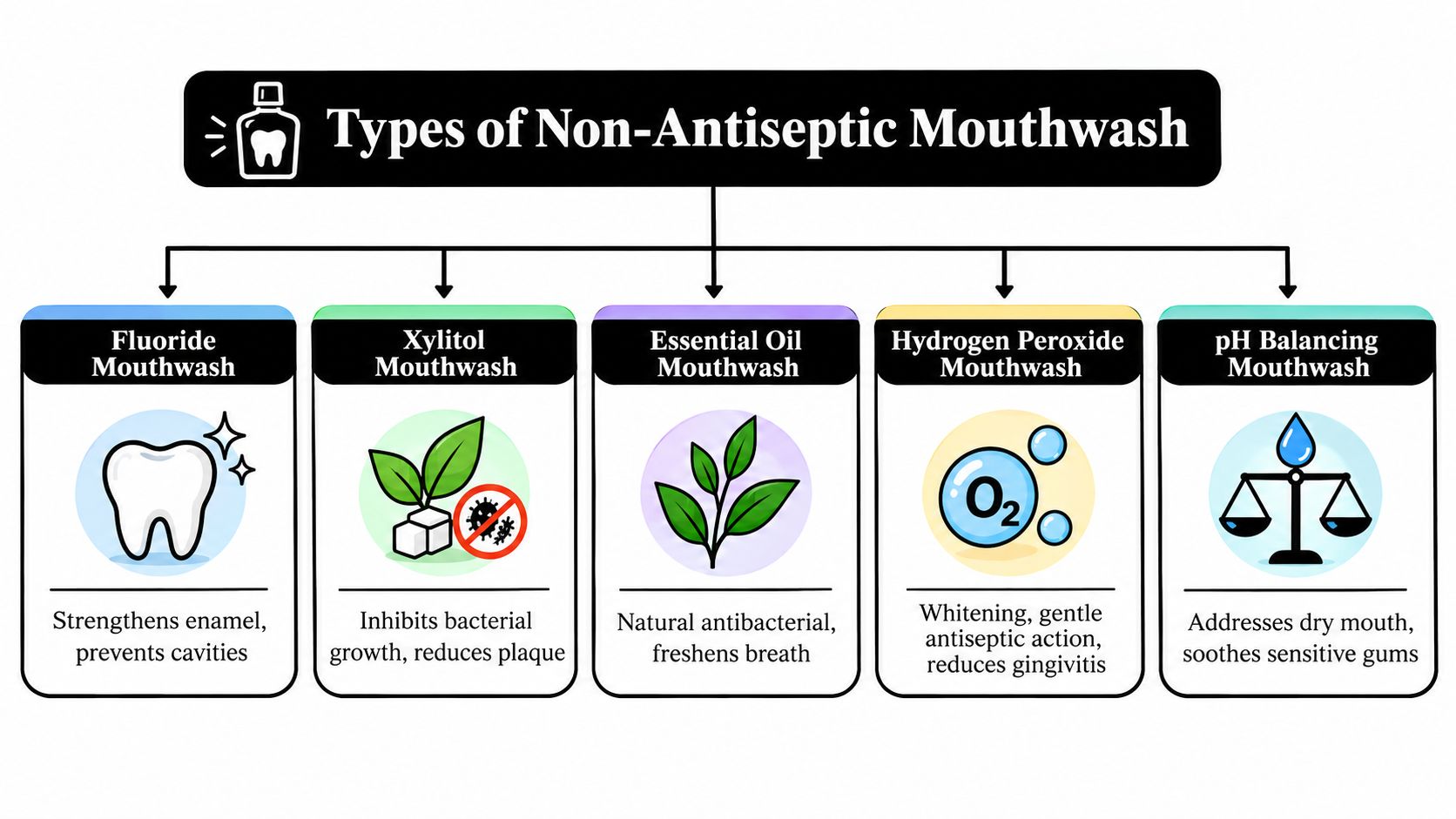
Here is the simplest way to sort the main groups:
- Fluoride mouthwash: This is the option to look at if your main concern is enamel support and cavity prevention. Fluoride is the most common active used for this purpose in mouthwash formulas, and it is the same reason many people choose a rinse that works more like daily insurance for the teeth than a breath refresher.
- Whitening rinse: These formulas often rely on peroxide. They are usually designed to support stain control and whitening maintenance, while still staying in the non antiseptic category, as summarized in the ADA mouthrinse guidance.
- Xylitol rinse: These are often chosen by people who want a milder daily routine that fits with plaque control without feeling harsh. If your mouth reacts easily, this style may feel closer to a light maintenance rinse than a corrective one.
- pH-balancing rinse: These can be useful when the mouth feels acidic or dry, because they are made to make the oral environment feel more comfortable rather than stripped.
- Gentle cosmetic rinse: These focus on breath and comfort. They can suit someone who wants a clean-feeling rinse without the stronger antimicrobial focus that some other products are built around.
Why the “inactive” ingredients still matter
A rinse can look simple on the front of the bottle and still feel very different once it is in your mouth. In a formulation survey, surfactants appeared in 92.5% of products, glycerine in 74.7%, propylene glycol in 42.7%, and ethanol in only 10.8%, with PEG-40 hydrogenated castor oil the most frequent surfactant from the formulation survey. That means the base formula, not just the headline ingredient, has a big say in texture, stability, and mouthfeel.
If one “gentle” rinse feels smooth and another feels slippery, sharp, or drying, the difference is usually in that base. Alcohol-free does not always mean comfortably mild, because solvents, surfactants, and humectants can change the way a product behaves in the mouth. For people who are comparing comfort-focused options, this guide to Biotene oral rinse for dry mouth is a useful example of how a formula can be built around dryness and everyday comfort.
The same logic applies to sensitivity. If your gums or teeth react easily, The Smile Spot for sensitive teeth is a helpful companion read, because it can help you sort out whether you need a softer rinse, a different ingredient profile, or a separate dental checkup.
Who Benefits Most from a Non Antiseptic Rinse
Some people need a rinse that does less, not more. That's especially true if your mouth already feels irritated, dry, or reactive. A non antiseptic mouthwash is often a better fit for these situations because it supports comfort without adding the sting many people are trying to avoid.
When gentleness matters most
If your gums sting when you swish, the first thing to check is the ingredient list. Alcohol and strong antiseptics can make a sensitive mouth feel more inflamed, especially when you're already dealing with dryness or recovery after treatment. The article on sensitive teeth from The Smile Spot is a helpful companion read if you're trying to sort out whether the problem is sensitivity, dryness, or a different oral issue altogether.
Dry mouth is another clear fit. An alcohol-free rinse can feel much more comfortable than a drying one, and comfort matters because a dry oral environment is harder to live with day after day. If you've ever woken up with that sticky, parched feeling, you know the difference a softer formula can make.
If a rinse leaves your mouth feeling tighter or more stripped, that's a sign to step back, not power through it.
People in whitening maintenance often benefit too. If you've already finished a whitening treatment, you may want to keep the routine stable without piling on another strong agent. In that case, a gentle rinse can help you maintain the habit of rinsing without adding extra irritation.
Daily use without overcorrecting
There's also a category of people who want to support their oral microbiome without daily disruption. That's a reasonable goal. The mouth works better as a balanced ecosystem than as a sterile space, and a rinse that respects that balance can be the more sustainable choice for everyday use.
A video can help with the practical side of that decision, especially if you're comparing how “gentle” appears in a routine.
The key is matching the rinse to the reason you want one. If the issue is sensitivity, dryness, or post-treatment comfort, a softer formula usually makes more sense than a broad antiseptic product. If you're trying to keep your mouth calm and predictable, that match matters more than a strong mint sensation.
How to Choose the Right Product and Use It Effectively
Start with the label and ask a simple question, what job is this rinse meant to do? If the answer is unclear, keep reading the bottle or choose another one. A good label should separate cavity prevention from whitening and make the product's purpose easy to spot, instead of hiding it behind marketing language ADA mouthrinse guidance.
A simple label check
The first thing to scan is the active ingredient. Look for fluoride if your main goal is enamel support, and peroxide if the rinse is meant for whitening maintenance ADA mouthrinse guidance. If sensitivity is part of the reason you're buying a rinse, an alcohol-free formula is usually easier to live with, especially if strong taste or a hot, stinging feel puts you off using it regularly.
Useful habit: buy for your symptom, not for the bottle design.
Then look at the supporting ingredients. The base of a rinse can change the whole experience, much like two gardens can look healthy while still feeling very different to walk through. One may feel soft and calm, another may feel stripped and sharp. If your mouth tends to feel dry or easily irritated, the humectants and surfactants in the formula matter just as much as the active ingredient, because they shape comfort and how long you can tolerate the rinse as shown in the formulation survey.
Using it the right way
Mouthwash works as a support step, not a substitute for brushing and flossing. Use it after your main cleaning routine if the directions on the bottle say to do so. After rinsing, leave some time before eating or drinking so the formula can stay in contact with the teeth and soft tissues long enough to do its job, especially with fluoride products ADA mouthrinse guidance.
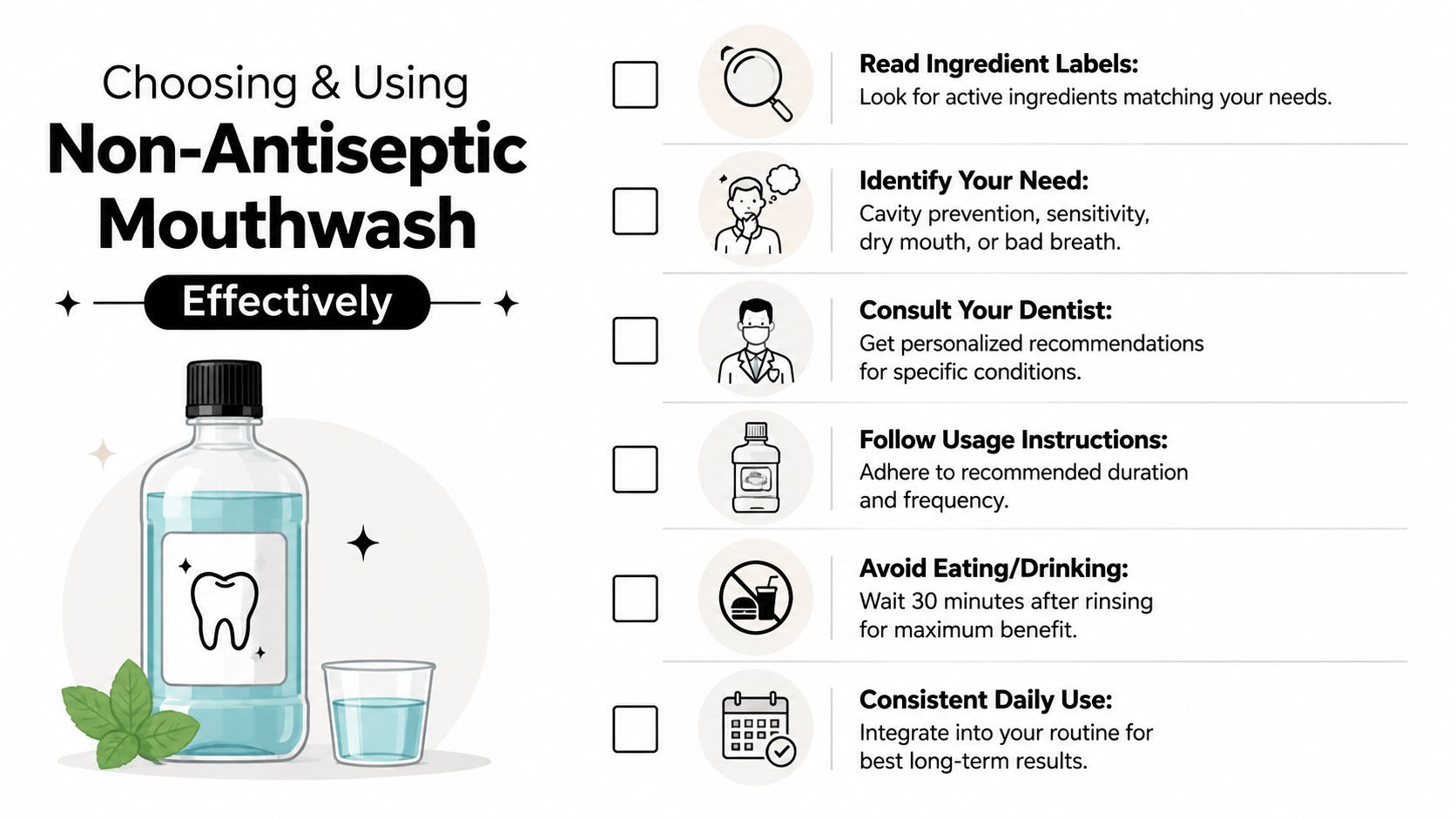
Try a new bottle for a few uses before judging it. Comfort, dryness, aftertaste, and whether you want to keep using it all matter. A rinse that fits your mouth, your sensitivity level, and your goal is the one you'll keep in the routine.
Common Questions About Non Antiseptic Mouthwash
People usually want three clear answers, can it help, can it be used every day, and what should they make of labels like “whitening” or “sensitive”? The short answer is that a non antiseptic mouthwash can be a very good fit, but only if the formula matches the reason you want to use it.
Does it fight bad breath as well as antiseptic rinse
Sometimes it does, but it gets there in a different way. A cosmetic or pH-balancing rinse can freshen breath without trying to reduce bacteria broadly, while an antiseptic rinse is aimed more directly at lowering microbial levels. If your breath concern comes from dry mouth or leftover food particles, a gentler rinse may feel better and still help with the symptom.
Can I use it every day
Usually, yes, if the product is made for routine use and your dentist has not told you to avoid it. The ADA's breakdown of rinses by active ingredient is useful here, because fluoride and peroxide products are meant for different jobs than antiseptic formulas. Daily use makes the most sense when the formula matches a long-term need, like cavity support or comfort. The mouth works a little like a garden, not a sterile lab, so the best rinse depends on whether you are trying to protect, refresh, or reduce irritation.
Will a fluoride rinse stain my teeth
Fluoride rinses are not staining agents. The better question is whether the rinse fits your goals and your sensitivity level. If you are worried about how your teeth look or feel after using a rinse, a dentist can help sort out whether the issue is the product, your technique, or something else.
What should I do if my mouth feels worse after rinsing
Stop using that product and read the label again. Alcohol, strong flavoring, or a base that does not suit your mouth can make a sensitive mouth feel worse instead of better. If the problem keeps coming back, switch to a gentler formula and ask a dental professional which ingredients are most likely to work for your situation.
Try a new bottle for a few uses before you judge it. Comfort, dryness, aftertaste, and whether you want to keep using it all matter. A rinse that fits your mouth, your sensitivity level, and your goal is the one that belongs in your routine.