
Peroxide Free Teeth Whitening: A Practical Guide for 2026
You want a brighter smile. You also remember the last time whitening left you with that sharp cold-air sting, or a gumline that felt irritated for days. That's the point where many people start looking for peroxide free teeth whitening instead of pushing through a method their mouth clearly doesn't like.
I talk people through this choice all the time, and the biggest source of confusion is simple: peroxide-free whitening is not just peroxide whitening with a gentler label. It often works in a different way, creates a different kind of color change, and suits a different kind of patient. If you understand that gap, it gets much easier to choose a product that fits your teeth instead of falling for packaging.
Starting Point for Anyone Whose Teeth Cannot Handle Peroxide
A common scenario goes like this. Someone has a wedding, job interview, reunion, or photo-heavy event coming up. They want their teeth to look fresher, but the minute they think about whitening trays or stronger gels, they remember the zing they felt last time. Sometimes it's tooth sensitivity. Sometimes it's gum irritation. Sometimes their dentist has already told them to be careful because of recession, worn enamel, or lots of bonding and crowns.
That's where peroxide free teeth whitening starts to make sense. It's often the practical lane for people who want a brighter-looking smile without repeating a bad experience. It also comes up for people who are trying to maintain a previous whitening result, people who mainly deal with coffee or tea staining, and people who want a lower-drama option for daily use.
When sensitivity changes the decision
If you've used peroxide before, you probably already know the difference between “this feels fine” and “I need to take this tray out right now.” Sensitive teeth don't always tolerate deep bleaching chemistry well. Some people can use it occasionally. Others can't use it comfortably at all.
That's why the first question I usually ask isn't, “How white do you want your teeth?” It's, “What happened the last time you tried whitening?” The answer tells you much more than the product category ever will.
For readers who know they need a gentler place to begin, this guide on the best teeth whitening for sensitive teeth that actually works can help frame the choices in a practical way.
Practical rule: If whitening has repeatedly made your teeth or gums flare up, your best next step usually isn't “use more carefully.” It's “use a different mechanism.”
What most people expect, and where they get tripped up
Many patients assume every whitening product is supposed to produce the same kind of result, just faster or slower. That's where disappointment starts. If your stains sit mostly on the surface, a peroxide-free product may be a very reasonable match. If your teeth have deeper age-related darkening, your expectations need to be more measured.
That doesn't make peroxide-free options useless. It means they work best when the problem and the product match.
What Peroxide Free Teeth Whitening Actually Does
The easiest way to understand peroxide free teeth whitening is to compare it to cleaning a stained mug.
If coffee has left a film on the inside of the mug, you can scrub that film off. That's a surface fix. If the material itself has changed color, that's a different job. Traditional peroxide whitening is aimed more at changing color from within. Peroxide-free methods usually work at or near the surface.
Some formulas lift outside stain. Some improve how light reflects off the tooth. Some deposit ingredients that make the enamel look smoother, brighter, or less yellow. The result can absolutely be visible, but the path is different.
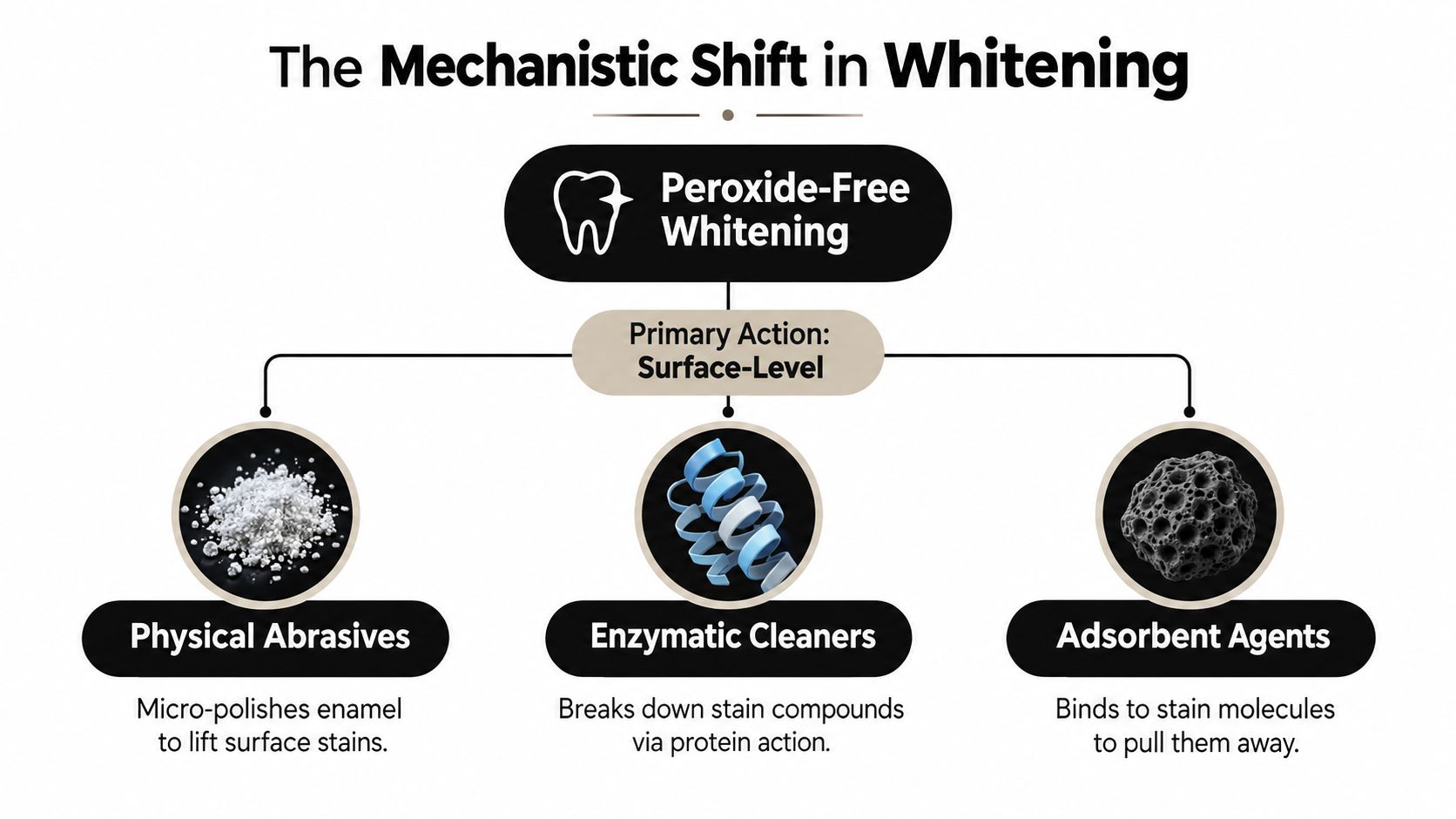
Surface action instead of deep bleaching
Peroxide-based whitening uses oxidation to break down color compounds associated with discoloration inside the tooth structure. Non-peroxide products often shift the focus to these kinds of actions:
- Stain removal: polishing away or loosening external stain from coffee, tea, red wine, or tobacco
- Optical masking: making teeth look less yellow through color correction
- Surface deposition: laying down minerals or brightening agents that alter how the tooth reflects light
- Texture improvement: reducing the look of tiny surface defects so enamel appears smoother and cleaner
If you've ever wondered why one “whitening” product seems to brighten instantly while another takes regular use, this is usually the reason.
Why this matters before you buy
A lot of label confusion disappears once you know what the product is trying to do. A purple corrector doesn't work the same way as a hydroxyapatite paste. A charcoal paste doesn't work the same way as a PAP-based gel. They may all sit in the whitening aisle, but they aren't solving the same problem.
If you want a simple ingredient-level primer, this explainer on what is in teeth whitening products helps decode the categories.
The big mindset shift is this. Non-peroxide whitening often improves appearance by changing the surface, not by deeply bleaching the tooth.
Realistic expectations
That difference affects what you should expect in the mirror. Peroxide-free products may do well with extrinsic stain, which means stain sitting on the outside of the tooth. They may also give a cleaner, brighter look by improving light reflection.
They are usually less convincing for deep internal darkening. If your teeth have yellowed gradually with age or because the inner tooth color shows through more strongly, a surface-based product has less to work with.
Main Non-Peroxide Whitening Methods and Ingredients
The peroxide-free category is broad. Some ingredients are designed to remove stain. Others are designed to change how the enamel looks. Others mostly create a cosmetic tone shift.
One useful historical note helps here. Non-peroxide whitening isn't a brand-new idea. A major review of tooth-bleaching procedures traces non-vital tooth bleaching back to 1848, when chloride of lime was used, and to 1864, when Truman introduced a technique using chlorine generated from calcium hypochlorite and acetic acid. The same review notes that sodium hypochlorite-based solutions later became commercial derivatives, showing that non-peroxide approaches have a long history well before modern gels and strips (historical review of tooth-bleaching procedures).
The main ingredient families
Here's the practical version of what you're likely to see:
| Ingredient | Proposed Mechanism | Typical Formats |
|---|---|---|
| PAP or PAP+ | Oxidative stain targeting without hydrogen peroxide | Pens, gels, strips, serums |
| Hydroxyapatite | Deposits a white opaque layer, supports surface repair, changes light reflection | Toothpaste, mouthrinse, serum |
| Activated charcoal | Adsorbs surface stain and relies on physical cleaning action | Toothpaste, powders |
| Baking soda | Mild polishing and stain removal from the surface | Toothpaste, paste blends |
| Purple color correctors | Masks yellow tones through color theory | Serums, foams, toothpastes |
How to think about each one
PAP and PAP+ products are often what people mean when they say “modern peroxide-free whitening.” These formulas aim for visible brightening without hydrogen peroxide. Different brands use different supporting ingredients, so one PAP product can feel very different from another.
Hydroxyapatite is less about aggressive stain attack and more about the surface. A remineralizing toothpaste without fluoride article can give you more context on why this ingredient shows up in sensitivity and enamel-support products. In whitening formulas, its value is that it can make enamel look smoother, more opaque, and brighter.
Charcoal gets attention because it feels dramatic. Black paste, white sink, instant-clean look. But from a hygiene perspective, I urge restraint. A product can make teeth feel polished without being the right tool for frequent use.
Baking soda is familiar and accessible. It can help with surface stain, but “natural” doesn't automatically mean ideal for repeated whitening use if the formula is rough or overused.
Purple correctors don't bleach the tooth. They visually reduce yellow tones. These are best understood as cosmetic toners, not deep whiteners.
What the Research Shows About Effectiveness
Peroxide-free whitening becomes more interesting, and readers need to stay careful. The evidence is promising in some areas, but it isn't equally strong across every ingredient or product style.
PAP-based evidence
A 2025 systematic review of hydrogen peroxide-free color correctors for tooth whitening identified a randomized controlled trial in the United States with 60 healthy adults. After a single 60-minute application, the peroxide-free group had a mean lab color difference of 2.1 versus 0.3 for placebo. The same review notes that peroxide-free formulas such as PAP+ have shown immediate shade improvements that can match or outperform low-concentration hydrogen peroxide gels in some settings (2025 systematic review of peroxide-free color correctors).
That's one of the clearest modern clinical signals that a non-peroxide formula can create a measurable whitening effect, at least in the short term.
Hydroxyapatite evidence
Hydroxyapatite has a different evidence story because it isn't framed as a classic bleach. A 2023 systematic review found that hydroxyapatite-containing oral care products can whiten teeth without oxidation, with in vitro and preliminary in vivo evidence showing statistically significant enamel whitening. The review concluded that the effect comes through deposition of a white opaque surface layer, plaque removal, and enamel defect repair, with minimal abrasion and preserved soft-tissue safety (2023 systematic review on hydroxyapatite whitening).
A separate 2023 clinical comparison of hydroxyapatite mouthrinses found that 50 nm hydroxyapatite produced significantly higher color-change values than 3 µm particles after a 6-month-equivalent use period with P=0.024. It also found that longer rinsing increased color change and lightness, which supports the idea that contact time and formulation matter (2023 clinical comparison of hydroxyapatite mouthrinses).
Evidence takeaway: Peroxide-free whitening can work, but the result is highly ingredient-specific and formula-specific.
What's still uncertain
Here's the honest part. We still need to be careful about assuming every peroxide-free product performs like the best-studied ones. The stronger evidence is centered on selected PAP+ and hydroxyapatite formulas. Charcoal, baking soda, and purple correctors are easier to understand mechanistically than they are to defend with strong clinical whitening data.
| Study / Year | Ingredient Tested | Study Type | Main Finding | Limitations |
|---|---|---|---|---|
| Systematic review / 2025 | Peroxide-free color correctors including PAP+ | Systematic review including randomized trial | Found a trial where peroxide-free treatment outperformed placebo after one application and noted strong short-term performance in some formulas | Product-specific evidence, short-term emphasis |
| Systematic review / 2023 | Hydroxyapatite | Systematic review | Whitening can occur without oxidation through surface deposition, plaque removal, and enamel repair effects | Includes preliminary evidence and mixed study types |
| Clinical comparison / 2023 | Hydroxyapatite mouthrinse particle sizes | Clinical comparison | Smaller particles and longer contact improved whitening-related color outcomes | Mouthrinse-specific, not a general rule for all products |
Peroxide Free Whitening Compared to Peroxide Based Whitening
If you put these two categories side by side, the fairest comparison isn't “which one is better?” It's “better for what?”
Peroxide-based whitening and peroxide free teeth whitening often suit different goals.
Where peroxide goes deeper
Peroxide can penetrate enamel and target deeper discoloration through oxidation. That's why it's usually the category people choose when they want the biggest possible shade shift from trays, strips, or professional whitening.
Peroxide-free options usually stay closer to the surface, whether they are polishing away stain, changing light reflection, or masking yellow tones. That often makes them more practical for maintenance, mild staining, or sensitivity-prone mouths.
| Factor | Peroxide Free | Peroxide Based |
|---|---|---|
| Whitening depth | Mostly surface-level or optical | Deeper bleaching within tooth structure |
| Time to visible change | Varies by mechanism, from same-day tone correction to gradual brightening | Often chosen when stronger shade change is the priority |
| Sensitivity risk | Often preferred by people who react poorly to peroxide | More likely to bother sensitive teeth or irritated gums |
| Restorations | Often a better cosmetic match for people with bonding, veneers, crowns, or fillings because the action is more surface-oriented | Can whiten natural teeth while restorations stay the same color |
Who usually prefers each approach
People drawn to peroxide-free products tend to say things like:
- “My teeth are sensitive.”
- “I only need a small refresh.”
- “I mainly have coffee or tea stains.”
- “I have bonding or crowns and don't want a dramatic mismatch.”
People drawn to peroxide-based methods more often say:
- “I want the biggest shade improvement I can get.”
- “My teeth look darker from age, not just staining.”
- “I've used bleach before and tolerated it well.”
The expectation gap that matters most
This is the part I wish every whitening box explained more clearly. If you use a peroxide-free product while expecting deep bleaching, you may think it failed when it did exactly what its mechanism allows. If you use peroxide when your mouth can't tolerate it, you may get shade change but hate the process.
The right fit is often less about which category sounds stronger and more about what kind of discoloration you have.
Safety and Who Should Choose a Peroxide Free Approach
Peroxide-free doesn't automatically mean risk-free. It usually means the risk profile is different.
Safety depends on the ingredient, not the marketing
A low-abrasion hydroxyapatite toothpaste raises different concerns than a gritty charcoal powder. A color-correcting serum raises different concerns than a harsh polishing paste. That's why I'm cautious whenever people use “natural,” “gentle,” and “non-peroxide” as if they all mean the same thing.
Charcoal and baking soda products deserve the most common-sense caution. If the product relies heavily on scrubbing, overuse can wear away enamel or roughen surfaces over time. A rougher surface can also pick up stain more easily later.
If a whitening product makes your teeth look cleaner but leaves them feeling rough, that's not a great trade.
Who's often a good candidate
A peroxide-free approach is often worth considering for:
- People with known peroxide sensitivity: especially if previous trays, strips, or gels caused discomfort
- Patients with many restorations: crowns, bonding, and veneers won't change color the way natural teeth do
- Those with mild surface stain: coffee, tea, or tobacco staining is often a better match than deep internal discoloration
- People who want maintenance, not a dramatic reset: daily or occasional brightening is a different goal from full bleaching
Who should talk with a dentist first
Skip self-experimenting and ask for guidance if you have active gum disease, visible enamel erosion, untreated cavities, cracked teeth, or major unexplained discoloration. A single dark tooth, for example, is not a “grab a whitening pen” situation.
Pregnant or nursing patients also tend to prefer the most conservative route, and that's a reasonable moment to ask a dental professional before starting any whitening routine.
Choosing the Right Peroxide Free Option for Your Smile
The simplest way to narrow the field is to filter by stain type, sensitivity, and timeline. Most bad whitening purchases happen because people shop by hype instead of by those three questions.
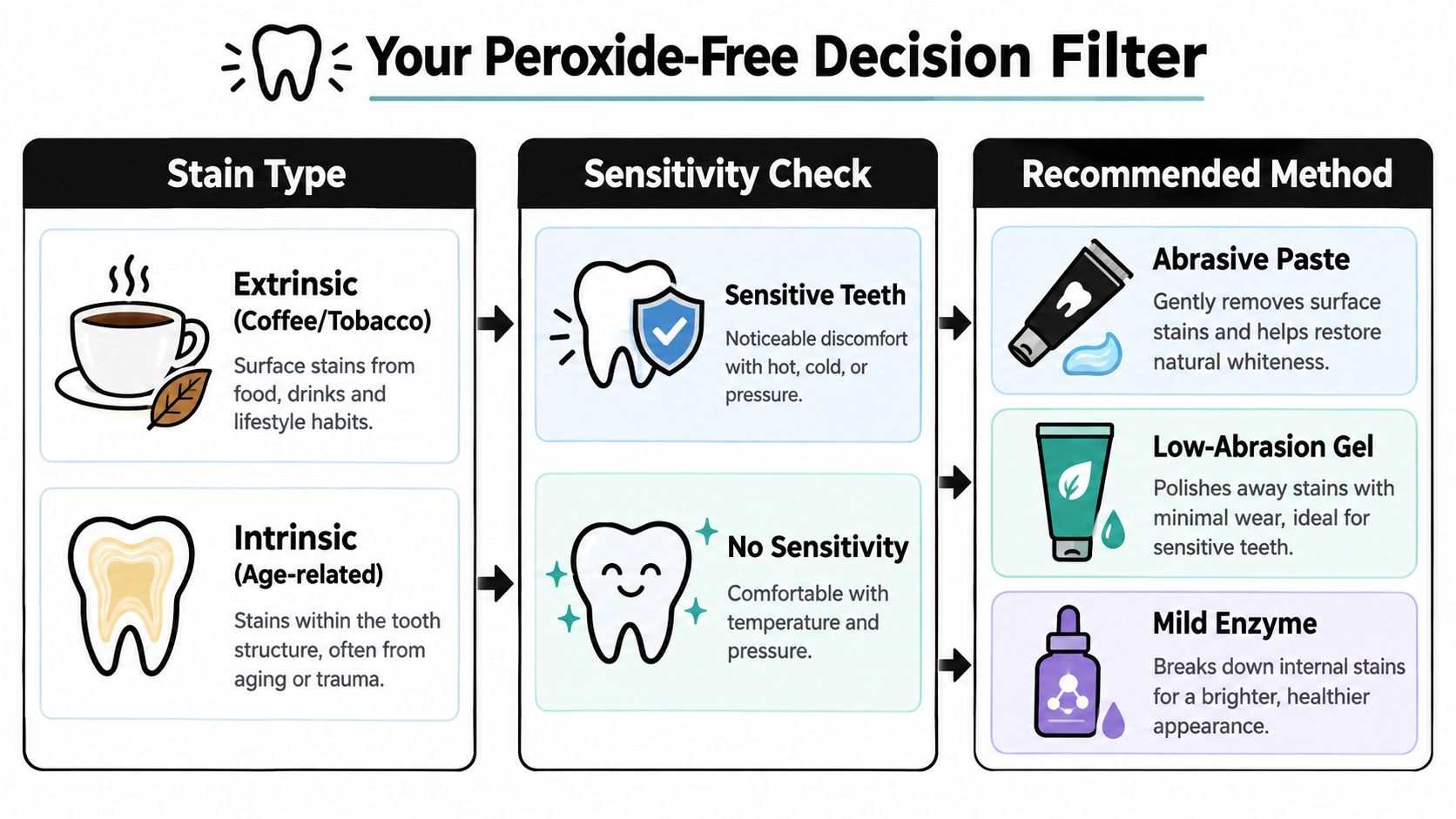
Start with the stain itself
If your teeth darken mostly from coffee, tea, red wine, or smoking, that usually points to extrinsic stain. Surface-focused options make more sense here. If your teeth look more yellow from age or internal color showing through, the result from non-peroxide products may be more modest.
A simple matching guide:
- Surface stain from drinks or smoking: consider low-abrasion whitening toothpaste, hydroxyapatite paste, or occasional polishing-style products
- Dull enamel and sensitivity together: hydroxyapatite-based products usually make the most sense
- Fast cosmetic brightening before an event: purple color-correcting products are often the most realistic same-day choice
- You want a peroxide-free gel or pen: PAP-based products are the category to look at first
Then check how reactive your teeth are
Some people can handle almost any toothpaste. Others know within one brushing whether something is too strong. If you already deal with cold sensitivity, recession, or enamel wear, choose the least aggressive route first.
The next visual may help you narrow the category before you buy:
A short decision checklist
Use this before you commit:
- What kind of stain do you have? Surface stain responds better than deeper internal yellowing.
- How sensitive are your teeth and gums? If they flare easily, prioritize low-abrasion and enamel-support options.
- How fast do you want to see a change? Cosmetic toners work differently from gradual whitening products.
- Do you have crowns, veneers, or bonding? Aim for methods that refresh the overall look without expecting restorations to whiten.
- Are you trying to maintain or transform? Maintenance and major color change are two separate goals.
Not everyone needs every peroxide-free tool. They need one that matches their mouth and one that matches their expectations.
Common Questions About Peroxide Free Whitening
Can I use peroxide-free products if I still whiten with peroxide sometimes
Yes, many people use peroxide-free products as maintenance between stronger whitening cycles. In real life, that might mean using a hydroxyapatite toothpaste daily, a color-correcting product before photos or events, and reserving peroxide for occasional touch-ups if their dentist says it's appropriate.
The key is not to stack too many active products at once. If your teeth are already reactive, alternating tends to go better than piling on.
How long does peroxide free teeth whitening take
That depends on the mechanism. Purple correctors can make teeth look brighter quickly because they are changing the visible tone rather than altering tooth color. Hydroxyapatite and PAP-based products usually call for repeated use before the effect becomes more noticeable.
The better question is, “What kind of result am I measuring?” Surface refresh, optical brightening, and deeper bleaching don't appear on the same timeline.
Will these products affect bonding, veneers, or crowns
They won't whiten restorations the way people often hope. But some products can still change the overall look of your smile by reducing stain on surrounding natural teeth or by improving surface brightness.
If you have a lot of visible dental work, hydroxyapatite-based options are often easier to live with than rougher stain-removal products. If a product leaves residue, film, or a cast on restorations, that's your cue to stop and switch.
How do I choose a safer product
A few practical filters help:
- Look for complete labeling: you should be able to identify the active approach, not just “whitening complex”
- Be cautious with unbranded powders: especially if abrasivity isn't explained
- Choose gentle formats first: toothpaste, rinse, or serum is usually easier to control than an aggressive powder
- Stop if your mouth objects: burning gums, lingering pain, or rough-feeling teeth are not signs to push through
Peroxide-free whitening works best when you treat it as a targeted cosmetic tool, not as a contest to get the fastest possible result.
DentalHealth.com offers professional-grade whitening, sensitivity relief, and enamel-support products from brands dentists commonly recommend, along with practical education for people sorting through choices like peroxide-free whitening. If you want help comparing at-home options without guessing from the label, visit DentalHealth.com.