
Pop White Prophy Paste Explained for Brighter Polishing
A patient finishes a routine hygiene appointment, looks in the mirror, and notices that the teeth seem brighter than they did when they arrived. The hygienist used a polishing cup and paste, not a tray of bleaching gel. That small difference explains why Pop White prophy paste often creates confusion. It's designed for professional polishing, with a whitening approach based on stain removal and color cancellation rather than peroxide bleaching.
The distinction matters. A polishing paste can help remove surface discoloration from foods, drinks, tobacco, and normal daily buildup. It can't produce the same kind of intrinsic color change associated with consumer whitening kits. Understanding the difference helps patients choose realistic treatment, ask better questions about grit and sensitivity, and avoid treating a professional dental material like an at-home cosmetic product.
Introduction to Pop White Prophy Paste and Modern Polishing
During a hygiene visit, polishing usually comes after the clinician has removed plaque, calculus, and other deposits. A rubber cup spins with a small amount of prophy paste, creating the smooth, clean feeling many patients associate with the end of a professional cleaning. POPWHITE Power of Purple prophy paste was publicly described in 2015 as a peroxide-free whitening prophy paste using patented POP Technology, presented as a form of complementary color-cancellation science. The product listing identifies it as a professional-use paste intended to whiten during routine prophylaxis.
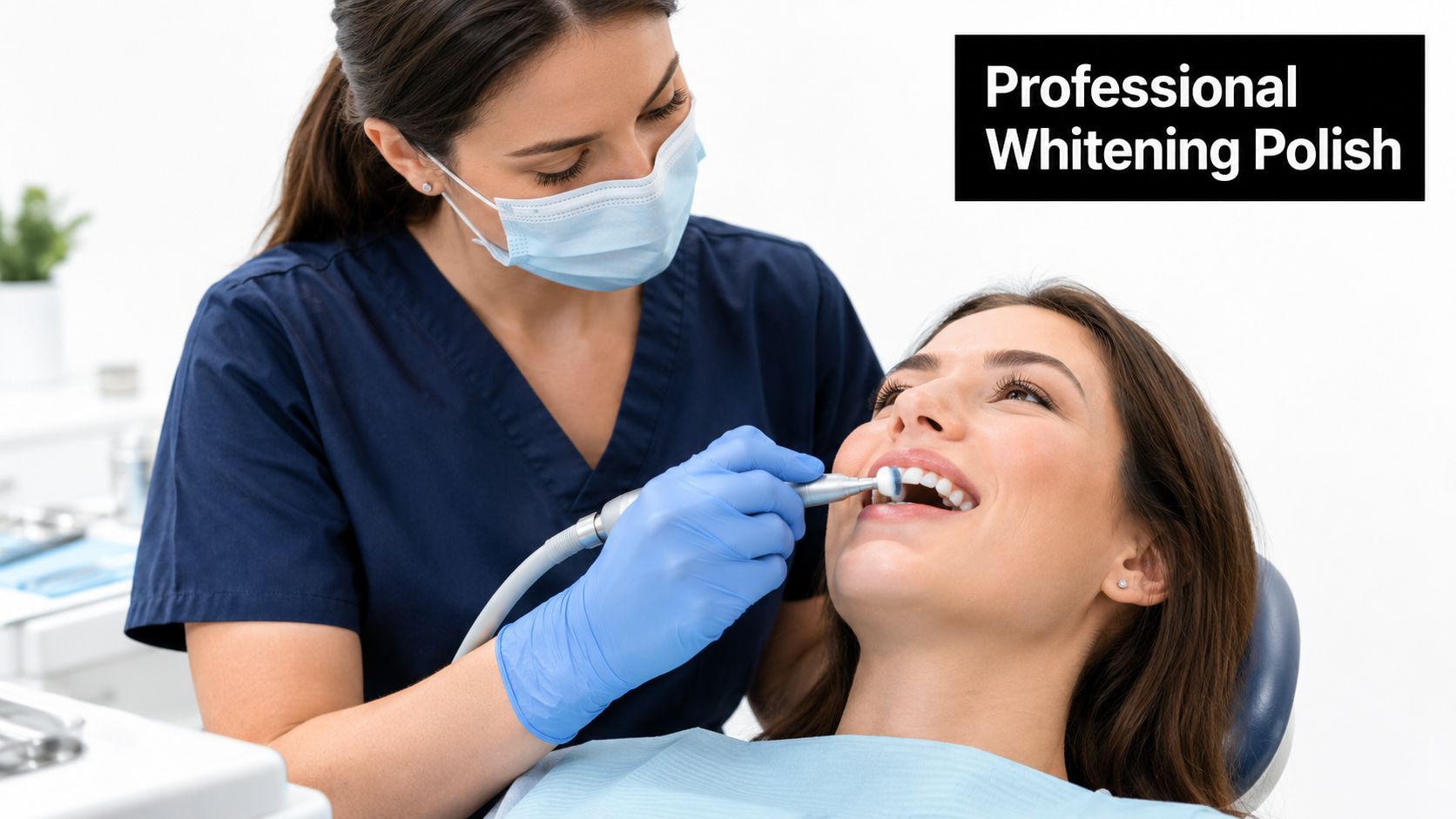
A useful analogy is the difference between cleaning a window and changing the color of the glass. Polishing addresses what sits on the tooth surface, while peroxide bleaching can act on discoloration within the tooth. Purple color-cancellation is intended to make yellow tones look less noticeable during or shortly after polishing. That visual effect belongs to the polishing experience, not to peroxide-driven bleaching.
By 2016, the product appeared in industry roundups of prophy pastes and was described as available in coarse, medium, and fine grits, with mint flavor, 200 unit-dose cups per box, 1.23% fluoride, and pumice, as documented in the product reference above. Those details establish its identity as a chairside hygiene consumable, not a consumer whitening kit.
The practical question patients should ask
If you want a brighter smile after a cleaning, Pop White may make sense as part of professional stain removal. If you want to change deeper tooth color, you'll need a conversation about bleaching, existing restorations, sensitivity, and the source of discoloration.
The rest of the decision comes down to formulation, abrasive level, clinical technique, and expectations. A hygienist can help determine whether a whitening polish is appropriate, especially if you have exposed root surfaces, enamel wear, restorations, or sensitivity.
What Prophylaxis Is and How Prophy Paste Works
Dental prophylaxis, often called a professional cleaning, is a controlled process for removing deposits that brushing can't reliably eliminate. The clinician uses instruments to remove hardened calculus and then polishes selected tooth surfaces to remove remaining soft deposits and external stains. Resources such as these teeth cleaning benefits from William M. Schneider, DDS, can help explain why professional cleaning is different from routine brushing at home.
Prophy paste contributes to the polishing stage. It contains abrasive particles suspended in a spreadable base. When the clinician places the paste in a rubber cup and works it over the tooth, the particles rub against the surface and help dislodge stain. The process is similar to using a gentle cleanser on a countertop, except the clinician controls the pressure, speed, contact time, and area being polished.
What happens during polishing
- The clinician evaluates the surfaces. Stain level, enamel condition, exposed dentin, gum recession, fillings, crowns, and other restorations all affect the polishing approach.
- The paste is applied in a controlled amount. The goal isn't to scrub aggressively. The clinician uses enough material to work efficiently while limiting unnecessary abrasion and splatter.
- The rubber cup moves across selected areas. Abrasive particles help break up external discoloration and leave the surface feeling smoother.
- The clinician rinses and checks the result. A smoother surface can feel cleaner because fewer deposits remain for the tongue to detect.
Independent dental literature shows why grit matters. Commercial prophylaxis pastes may contain pumice, zirconium silicate, volcanic glass, silica, or diatomaceous earth. Sharper or larger particles can remove stain faster, but they can also increase abrasion of enamel and dentin. Across older polishing studies, reported enamel loss ranged from under 1 micron to as much as 1 to 12 microns, depending on the protocol, and aggressive polishing may remove the fluoride-rich outer enamel layer. The West Virginia University dental literature provides the technical background for that concern.
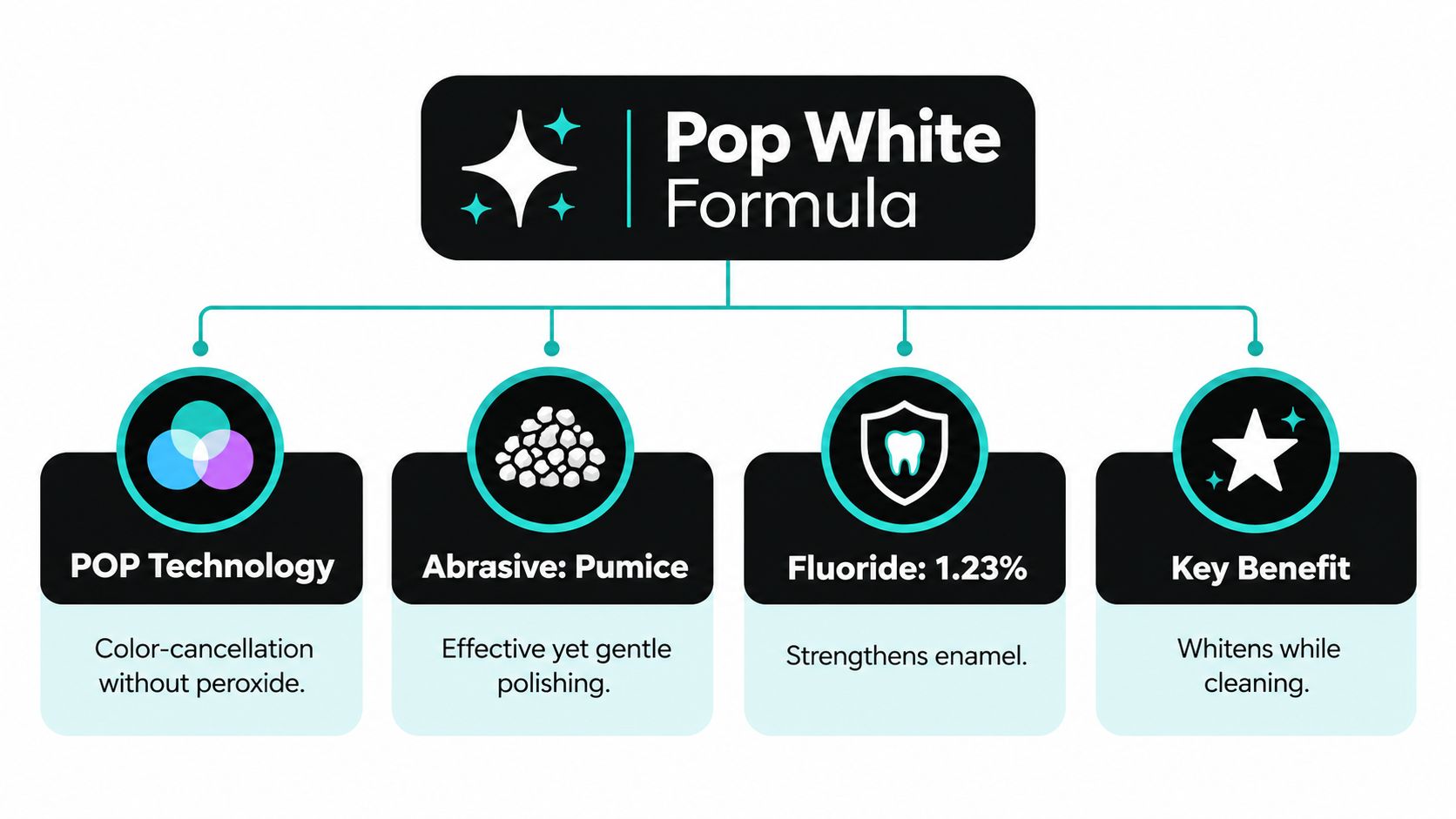
The main lesson is simple: polishing paste is a tool, not a bleaching treatment. Fluoride-containing formulations fit into routine professional hygiene workflows, while the abrasive system determines how the clinician approaches surface stain and tooth sensitivity.
For more general guidance on why these visits matter, you can also review the benefits of professional teeth cleaning.
Inside Pop White Formulation and Key Benefits
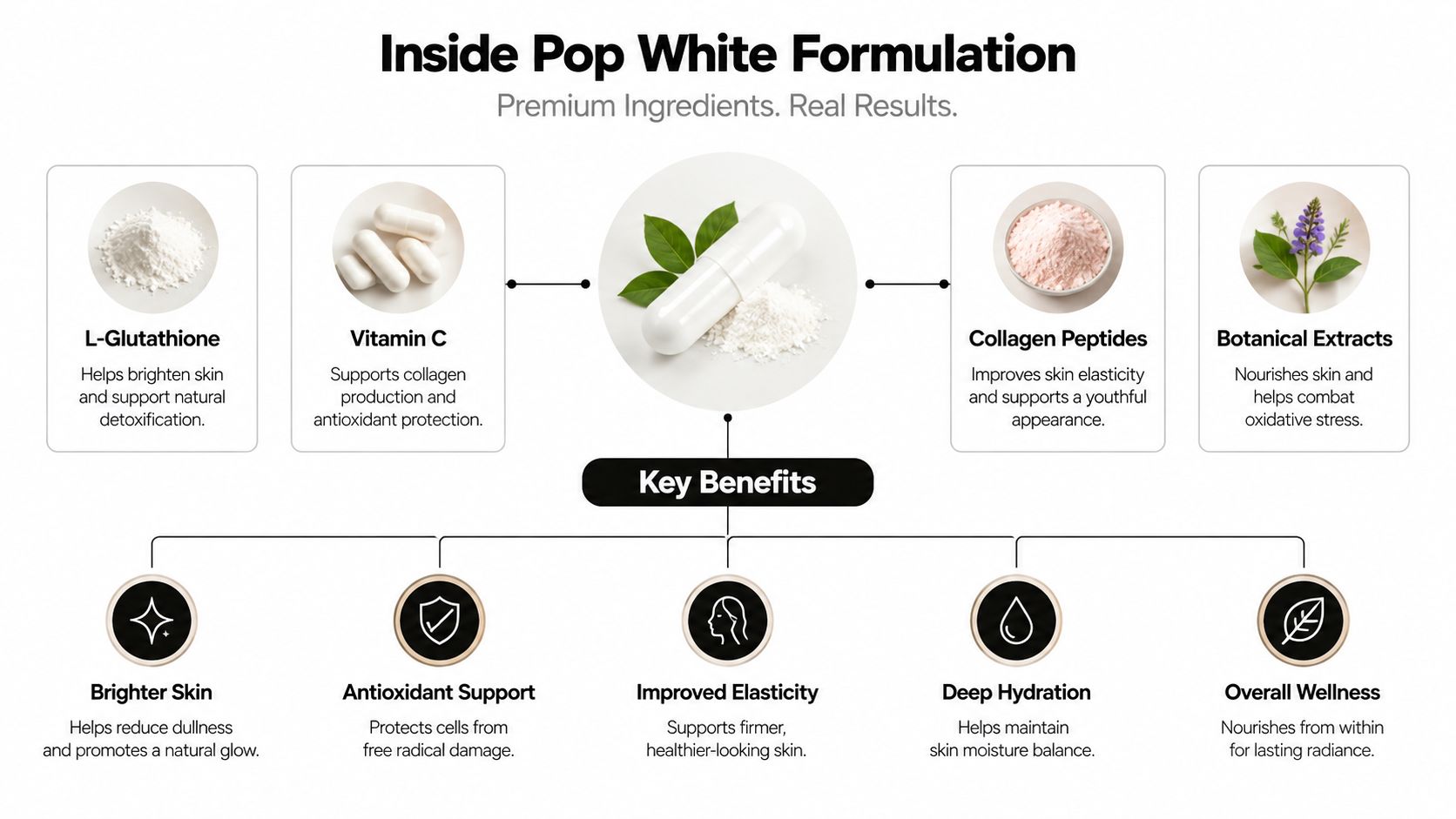
Pop White's identity rests on several formulation and packaging choices. The product was promoted as peroxide-free, using POP Technology for color cancellation rather than chemical bleaching. That makes it different from gels and strips that use peroxide to oxidize certain discoloring compounds.
The color-cancellation idea is easiest to understand with a visual analogy. Purple sits opposite yellow on a traditional color wheel, so a purple-toned product can make yellow tones appear less prominent while it's applied. This is an optical effect, not proof that the tooth has undergone a permanent internal color change.
What the formulation contributes
- Pumice abrasive: Pumice provides the physical polishing action. It helps the clinician address external stain, but the amount of abrasion still matters for enamel, dentin, and restorations.
- Fluoride: Published product details list 1.23% fluoride alongside pumice. That places the paste among fluoride-containing prophylaxis products used in routine cleaning workflows, although fluoride inclusion doesn't make aggressive polishing harmless.
- Mint flavor: Mint supports a familiar, fresh-feeling appointment experience. Flavor improves comfort and acceptability, but it doesn't determine stain-removal ability.
- Low-splatter positioning: Product listings highlight low splatter. In practice, handling characteristics matter because they can make chairside use more controlled and comfortable for both patient and clinician.
- Gluten-free positioning: Retail descriptions also identify gluten-free positioning. Patients with specific dietary or medical concerns should still discuss product ingredients with their dental professional rather than relying only on a marketing label.
- Unit-dose packaging: The product is sold in boxes of 200 unit-dose cups, according to the POPWHITE product reference. Single-use cups support consistent dispensing, organized storage, and professional infection-control routines. They also fit the purchasing pattern of dental offices that stock standardized consumables for repeated appointments.
The most important interpretation is that these features work together as a professional polishing system. The pumice addresses surface deposits, the purple color system supports a brighter visual impression, fluoride belongs to the preventive formulation profile, and unit doses support clinical workflow. None of those features turns the paste into a take-home bleaching gel.
Independent comparison remains limited. Much of the available coverage repeats claims such as instant whitening, low splatter, and no peroxide, while fewer sources compare Pop White directly with conventional pastes for stain removal, surface roughness, or lasting shade change. That evidence gap should shape how confidently anyone interprets the product's whitening language.
How Pop White Differs From Consumer Whitening Products
The clearest comparison is polishing versus bleaching. Pop White is used during professional prophylaxis to remove external stain and create a brighter appearance. Consumer whitening products, including peroxide gels and strips, are designed to remain in contact with the teeth so peroxide can act on discoloration within the tooth structure.
That doesn't make one approach universally better. A patient with coffee stain on an otherwise healthy enamel surface may notice a meaningful improvement from professional cleaning and polishing. A patient whose teeth have become darker internally may need a different plan, and restorations such as crowns or fillings won't necessarily respond like natural enamel.
| Feature | Pop White Prophy Paste | Consumer Whitening Kits |
|---|---|---|
| Primary mechanism | Professional polishing, external stain removal, and color cancellation | Peroxide-based bleaching of suitable tooth discoloration |
| Timing | Used during a hygiene appointment | Used at home according to product or provider instructions |
| Typical target | Surface stain and a temporarily brighter appearance | Deeper discoloration in natural tooth structure |
| Expected change | Often modest, with non-bleaching products commonly producing about one to two shades of change in the broader whitening evidence summarized by Focus on Prophy Paste | Can create a more substantial bleaching effect, but results vary by tooth condition and product |
| Clinical control | A hygienist selects the technique and polishing pressure | The patient manages application unless a dentist provides supervision |
| Best fit | Cleaning-related brightening and external stain | A planned whitening regimen for appropriate natural teeth |
A common mistake is to treat “instant whitening” as a promise of permanent bleaching. In a polishing context, instant usually describes the visible change after surface stain has been removed and color has been balanced. It doesn't mean the paste has chemically lightened every tooth layer.
Readers comparing professional and at-home options may find professional teeth whitening Tampa 2026 useful as a general example of how a dental practice frames whitening care. For ingredient context, what is in teeth whitening products offers another way to distinguish polishing materials from bleaching formulations.
Practical rule: Choose polishing when the problem looks like surface stain. Ask about bleaching when the concern is the underlying shade of natural teeth.
The best plan may combine both, but only after a dental professional checks for decay, gum inflammation, enamel wear, sensitivity, and restorations. A brighter polish can improve the starting point for a whitening conversation, yet it shouldn't be marketed as a substitute for that conversation.
Choosing Grits and Using Pop White Effectively
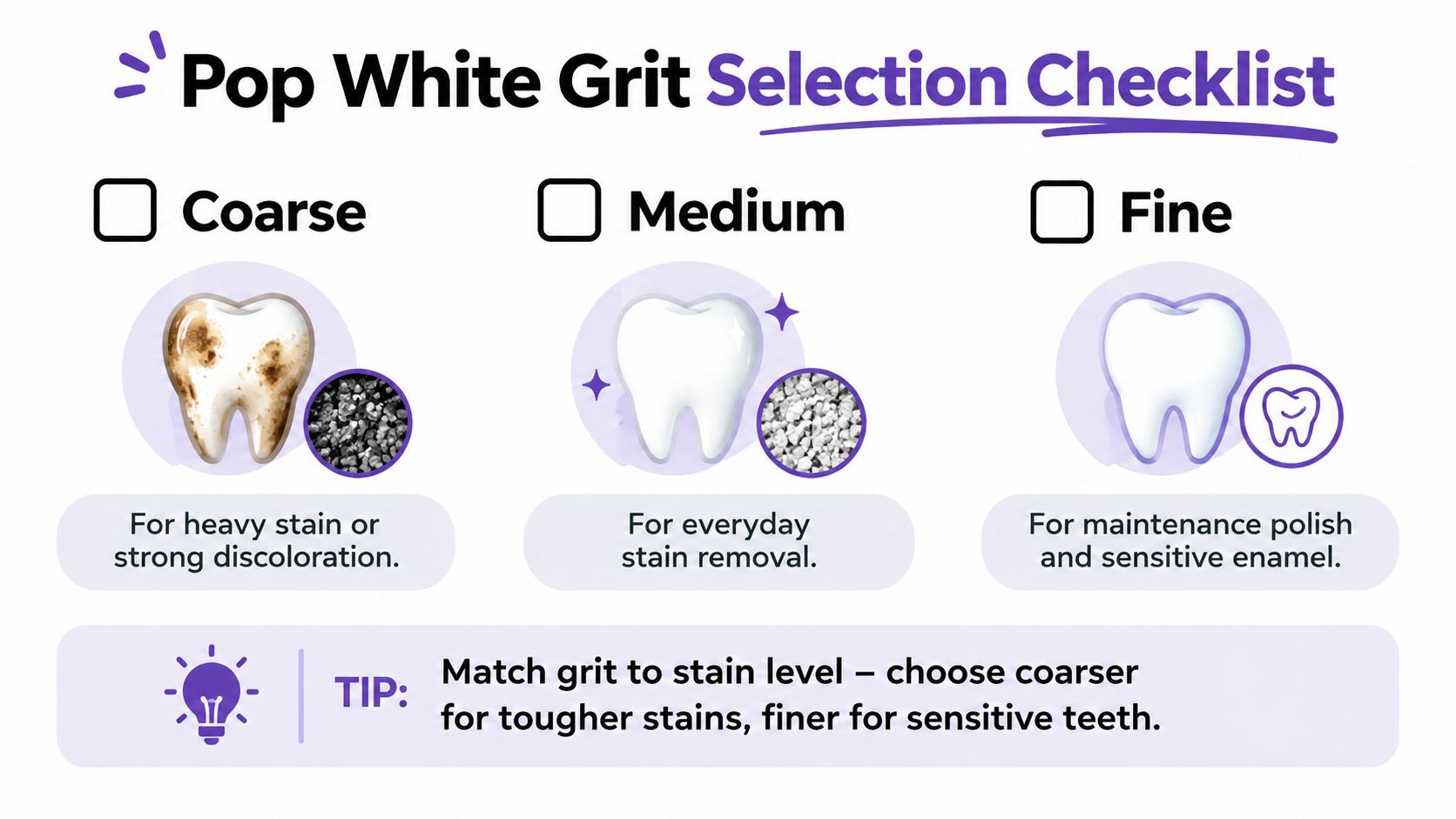
Pop White has been described in coarse, medium, and fine grits, giving the clinician options instead of forcing every patient into the same polishing intensity. Grit refers to the size and behavior of the abrasive particles. It isn't a ranking where coarse is automatically better and fine is automatically safer in every situation.
A practical way to think about grit
- Coarse: More useful when the clinician is addressing heavier external stain or stubborn discoloration. Because stronger abrasion can affect tooth surfaces, the clinician should use it selectively rather than treating every tooth the same way.
- Medium: A balanced choice for routine polishing when stain is present but doesn't require the most aggressive approach. The product's medium mint version is positioned for professional hygiene use.
- Fine: Better suited to maintenance polishing or situations where the clinician wants a less abrasive approach. Sensitive areas, exposed root surfaces, enamel wear, and certain restorations may call for particular caution.
The choice depends on more than stain color. A hygienist considers whether the surface is natural enamel, exposed dentin, composite, porcelain, or another restorative material. They also consider gum recession, sensitivity history, and whether the patient needs a brief maintenance polish or targeted stain removal.
What the appointment usually looks like
The clinician first completes the necessary cleaning and evaluates remaining stain. They place a controlled amount of paste into a unit-dose cup, select the appropriate grit, and polish specific surfaces with a rubber cup. The paste is then rinsed away so the clinician can inspect the result and confirm that the surfaces feel smooth.
Patients shouldn't buy prophy paste for household use or try to reproduce chairside polishing with a powered toothbrush. The professional controls pressure and exposure in ways that are difficult to duplicate safely at home. A paste that feels mild in a clinician's hands can become overly abrasive when used repeatedly or with excessive force.
Unit-dose packaging also has a practical role. A box of 200 cups supports predictable dispensing and office inventory, but the quantity doesn't tell you how often you personally need polishing. Your dental team should decide the timing based on oral health, stain pattern, and preventive needs.
Sensitivity Safety and What to Watch For
The absence of peroxide doesn't eliminate every sensitivity question. Pop White's whitening approach relies on polishing and color cancellation, so the relevant concerns include abrasive contact with enamel or exposed dentin, pressure on sensitive areas, and contact with irritated soft tissue.
Independent literature shows that prophylaxis pastes differ in abrasive particle type and size. Larger or sharper particles can remove stain efficiently while increasing abrasion risk, and aggressive polishing may affect the fluoride-rich outer enamel layer. That's why a hygienist shouldn't use the same grit, pressure, and duration for every patient.
Patients who should raise the issue first
Speak with your dental professional before polishing if you have:
- Exposed root surfaces: Dentin is more vulnerable to abrasion than intact enamel and may respond with discomfort.
- Enamel wear or erosion: A clinician may want to limit abrasive contact and investigate the cause of surface loss.
- Existing restorations: Crowns, veneers, fillings, and other materials may have different surface characteristics from natural enamel.
- Active gum irritation: Inflamed tissue can react poorly to unnecessary friction or product contact.
- A history of sensitivity: Your provider can consider a gentler grit, altered technique, or a separate sensitivity plan.
Evidence on desensitizing products is nuanced. A complete guide to tooth desensitizing gel can help readers understand the broader category, but no general guide can determine whether a particular polishing session is suitable for a particular mouth.
Research on whitening care also indicates that desensitizing toothpastes can reduce post-bleaching sensitivity in some regimens but not others, depending on peroxide concentration and treatment schedule. Newer literature has also described rare mucosal hypersensitivity associated with whitening formulations, as reported in this PubMed record. That evidence concerns whitening formulations broadly, not proof that Pop White causes the same reaction.
Stop and tell the clinician: Burning, persistent soreness, unusual gum irritation, or sharp discomfort after polishing deserves attention rather than repeated treatment.
Sensitivity isn't a reason to reject every whitening polish. It's a reason to individualize the procedure. Ask which grit will be used, whether the clinician sees exposed dentin or enamel wear, and what symptoms should prompt a follow-up.
Smart Buying and Next Steps for Brighter Care
Pop White should be evaluated as a professional dental-office polishing product, not as a replacement for an at-home whitening kit. Check that the product description identifies the intended professional format, the available grit, the formulation details, and the unit-dose packaging. The product references describe boxes containing 200 cups, which is a bulk office format rather than a personal-use tube.
Storage and handling matter too. Dental offices need organized inventory, intact packaging, and a clear understanding of which grit is appropriate for each patient. A patient considering professional polishing should focus less on buying the largest quantity and more on whether a qualified dental professional has recommended the product and technique.
A simple decision checklist
- Surface stain: Ask whether coffee, tea, tobacco, or other external deposits are the main concern.
- Underlying shade: Ask whether peroxide bleaching would be more appropriate for the color you want to change.
- Tooth condition: Mention sensitivity, recession, enamel wear, fillings, crowns, veneers, or gum irritation before polishing.
- Grit selection: Ask why the clinician chose coarse, medium, or fine paste.
- Maintenance: Pair professional cleaning with daily brushing, interdental cleaning, and any dentist-recommended fluoride or whitening product.
DentalHealth.com is an online retailer for professional-grade at-home dental care products, including whitening gels, kits, sensitivity products, and remineralizing pastes. It can be useful for comparing take-home options after you understand that Pop White belongs to the professional polishing category, while products such as peroxide gels serve a different purpose.
The right question isn't “Will Pop White whiten my teeth?” Ask, “Is my discoloration on the surface, or does it come from within the tooth?” That answer guides the choice between a brighter professional polish, a supervised bleaching plan, or routine preventive care without unnecessary abrasion.
If you're comparing professional polishing with at-home whitening, visit DentalHealth.com to review professional-grade gels, kits, sensitivity care, and practical dental education. Use the product information to prepare questions for your dentist or hygienist and choose care that matches your tooth condition and whitening goal.