
Spry Tooth Gel: What's Inside and Who Should Use It
If a gel tastes sweet and lists xylitol, does that mean it shields teeth the way fluoride toothpaste does? Plenty of parents and adult buyers treat those as the same promise. They aren't.
Spry Tooth Gel is a fluoride-free brushing gel built around xylitol, a sugar alcohol used as a sweetener in dental products. The label tells you what is in the tube. Research on xylitol tells a narrower story, and it is usually about other products, not this gel. Mixing those two stories is how a useful extra gets treated like a full cavity plan.
The pages below separate the ingredient list from the evidence, then map who can use the gel for brushing practice and who still needs fluoride as the daily base.
Spry Tooth Gel Specs at a Glance
Which details on a Spry Tooth Gel label help you choose? Start with the basics a shopper can confirm. Spry Tooth Gel is part of the Spry oral-care range built around xylitol and marketed by Xlear. Retailer listings describe a 2 fl oz (about 60 mL) gel, and kids versions use age-specific labels, including some marked for children as young as 3 months, on H-E-B's Spry listing. The wider Spry range also includes toothpaste, gum, and mints, so the gel is one product in a broader line.
The product listings give the size and age guidance. They do not publish a xylitol percentage for the gel. That gap matters because xylitol is the ingredient the line is known for, and shoppers often compare gels by sweetener content. A number from a toothpaste tube cannot stand in for the gel's formula. The label shows xylitol is present; it does not show how much, and it does not show cavity-prevention results.
| Attribute | Listed value | What it means for buyers |
|---|---|---|
| Format | 2 fl oz (about 60 mL) gel | Standard size in retailer listings |
| Fluoride | None listed | Not a fluoride toothpaste; ask a dentist whether fluoride is needed |
| Xylitol | Percentage not published for the gel | Do not assume the gel matches a toothpaste's xylitol strength |
| Calcium glycerophosphate | Listed as a formulation component | Supports a calcium-containing environment; not proof of enamel repair |
| Cellulose gum | Listed as the viscosity agent | Gives the gel its texture |
| Grapefruit seed extract | Listed as a preservative | Helps keep the formula stable |
| Age labeling | Kids versions with age-specific labels | Match the label to the child's age |
Practical rule: Before you make Spry Tooth Gel a daily product, check the tube against these rows.
When xylitol percentage is not published, you cannot treat the gel as a measured match for another xylitol product. No fluoride on the ingredient list means this is not a fluoride toothpaste. For a child or adult who needs fluoride, that absence is the first fact to discuss with a dentist.
How Xylitol Works Against Cavity Bacteria
Think of table sugar as fuel. Plaque bacteria burn it and leave acid behind. Xylitol is the sweet snack they can't digest the same way.
Hy-Vee's kids gel listing describes Spry Tooth Gel as a fluoride-free, water-based formula whose listed active-style ingredients are xylitol and calcium glycerophosphate. Cellulose gum supplies viscosity, and grapefruit seed extract is listed as a preservative. The same core shows up on the standard 2 fl oz product across listings. Xylitol is a non-fermentable sweetener, so oral bacteria can't metabolize it in the same acid-producing manner as fermentable sugars.
Say a child finishes juice, then brushes. Sugar from the drink reaches plaque, bacteria ferment it, acid forms, and that acid softens enamel. Xylitol offers sweetness without handing those bacteria the same fuel. Less usable fuel means less of that acid step. It doesn't erase sugar already eaten, and it doesn't rebuild enamel on its own.
Those listings don't give the gel's xylitol concentration, pH, abrasivity, or clinical caries-prevention endpoints. Calcium glycerophosphate is best read as a calcium-containing part of the formula. It supports the oral environment. It isn't published proof of enamel repair.
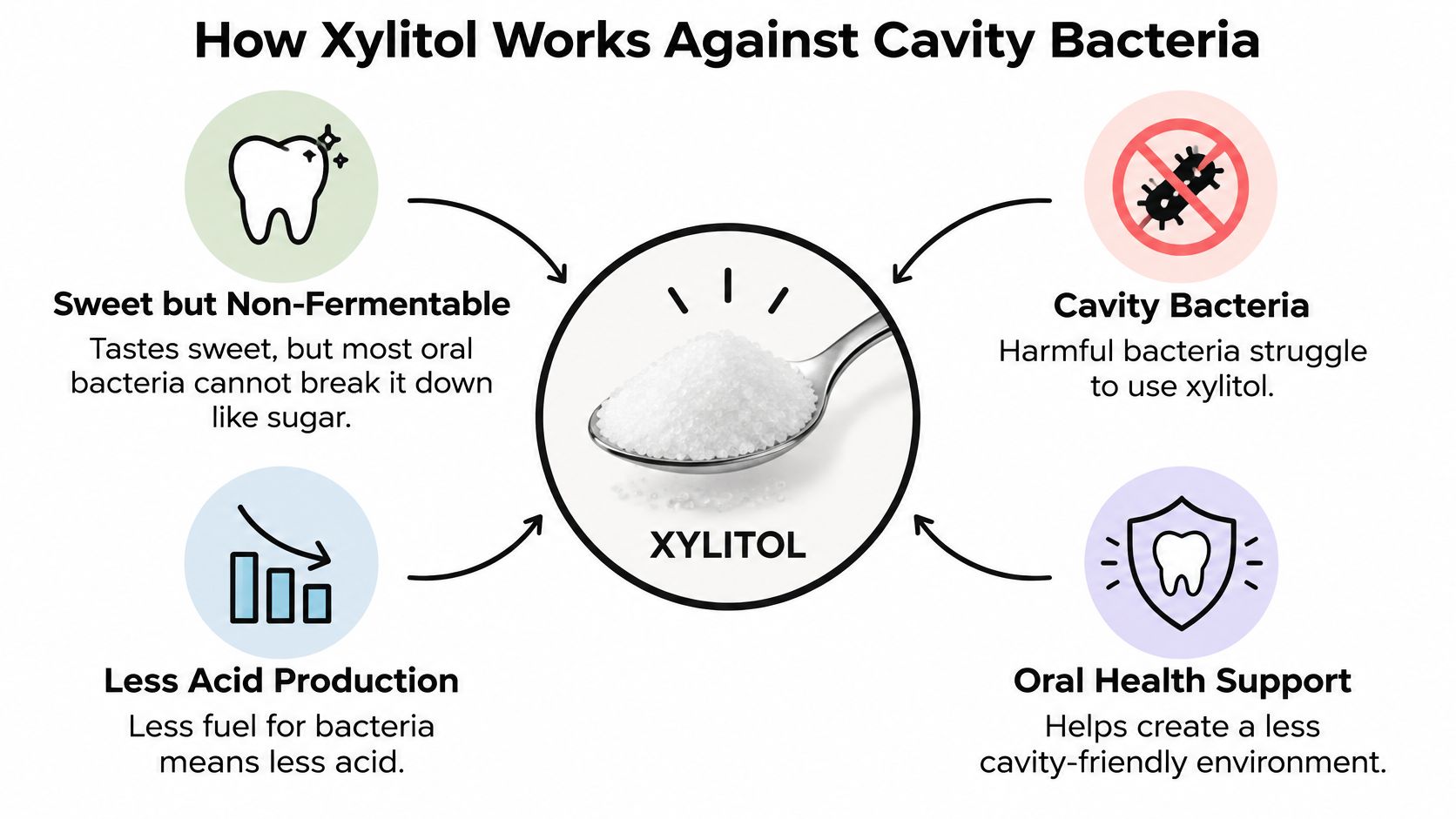
Any effect also depends on how often the gel is used and what else is in the routine. No gel-specific clinical outcome is on those listings. Treat xylitol as a supportive ingredient beside brushing and fewer sugary snacks. A clear primer on xylitol in your brushing routine from Mouthology is useful background, and it still doesn't turn this gel into a stand-in for fluoride toothpaste.
What the Xylitol Studies Really Show
The strongest number attached to xylitol toothpaste is modest, and it isn't a gel result. A Cochrane review reported that, over 2.5 to 3 years, fluoride toothpaste containing 10% xylitol reduced caries by 13% compared with fluoride-only toothpaste among 4,216 children, as summarized in a 2022 review on PubMed Central. The prevented fraction was -0.13, with a 95% confidence interval from -0.18 to -0.08. The review rated that evidence low quality, so it is suggestive, not proof that every xylitol gel does the same thing.
A separate 2022 meta-analysis in that same review found preventive fractions across xylitol caries studies from 5% to 75%, with an overall estimate of 17%. Formulation, dose, population, and study design move the result a lot.
What each source actually tested
| Evidence | What was studied | Result | Quality note |
|---|---|---|---|
| Cochrane review | Fluoride toothpaste with 10% xylitol vs fluoride-only toothpaste; 4,216 children over 2.5 to 3 years | 13% fewer caries | Rated low quality; suggestive |
| 2022 meta-analysis | Xylitol caries studies across formulations and populations | Preventive fraction 5% to 75%, overall 17% | Wide variation by formulation and dose |
| Spry Tooth Gel trial | The gel itself | None found in the research | Product-level benefit unproven |
The Cochrane comparison put xylitol inside a fluoride toothpaste. It didn't test a fluoride-free gel used alone. No product-specific trial of Spry Tooth Gel turned up in that research, so a benefit for this tube stays unproven. Xylitol gum is a different format again. Our note on xylitol gum as an extra covers that habit, not this gel.
Promising averages don't transfer from one formula to another. Dose, fluoride, and who was studied all change the outcome.
Why Spry Cannot Fully Replace Fluoride Toothpaste
Spry Tooth Gel is a fluoride-free adjunct, not a replacement for fluoride toothpaste. Fluoride and xylitol work on different problems in the mouth.
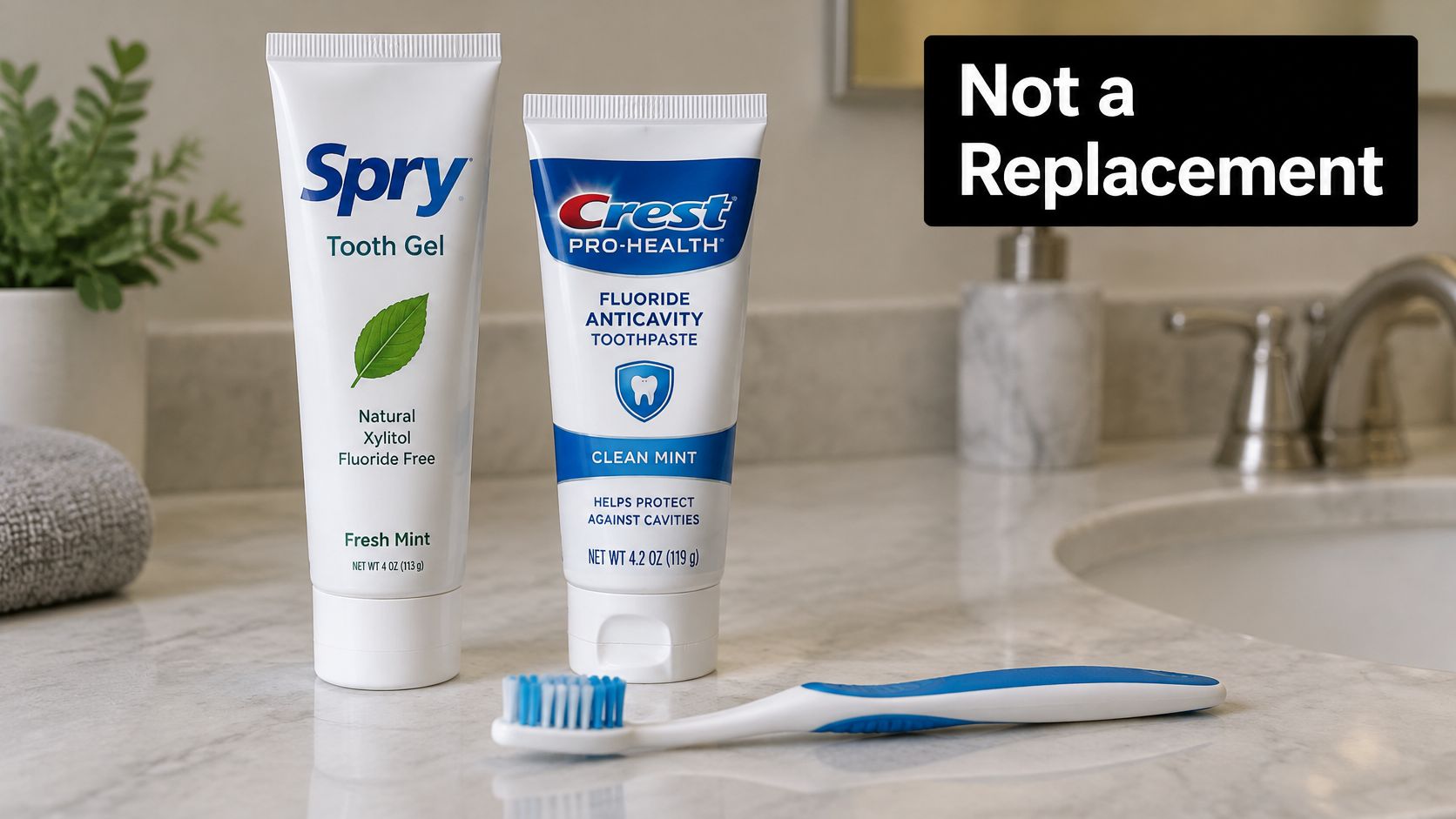
Fluoride's established job is enamel remineralization, the repair of early mineral loss in the tooth surface. Xylitol's role in the research is different. It changes what cavity bacteria can use as fuel. Fluoride acts like a repair crew for enamel. Xylitol acts more like a change in the bacteria's food supply. Words on a carton such as natural, safe to swallow, or xylitol-containing do not mean cavity protection equal to fluoride.
Hy-Vee's Spry Tooth Gel listing shows xylitol and calcium glycerophosphate, no fluoride, and a label that says the gel may be swallowed. That information explains what is in the tube. It does not spell out the trade-off for a child at higher caries risk. Reviews of xylitol chewing gum suggest it may reduce caries in children at higher risk, but those reviews still put dietary changes and fluoride toothpaste first. Study designs vary enough that a firm anticaries effect for xylitol products has not been confirmed.
A fluoride-free gel can ease worry about swallowed fluoride while a young child is still learning to spit. That choice also sets aside the mineral with the strongest established record for early enamel repair. The case for fluoride toothpaste helping prevent tooth decay rests on that repair role. Use Spry Tooth Gel as an extra, and ask a dentist whether an age-appropriate fluoride toothpaste should stay as the main daily product.
What to Check on the Label Before You Buy
Buy the tube you meant to buy. Spry sells gel, toothpaste, gum, and mints, and those aren't interchangeable.
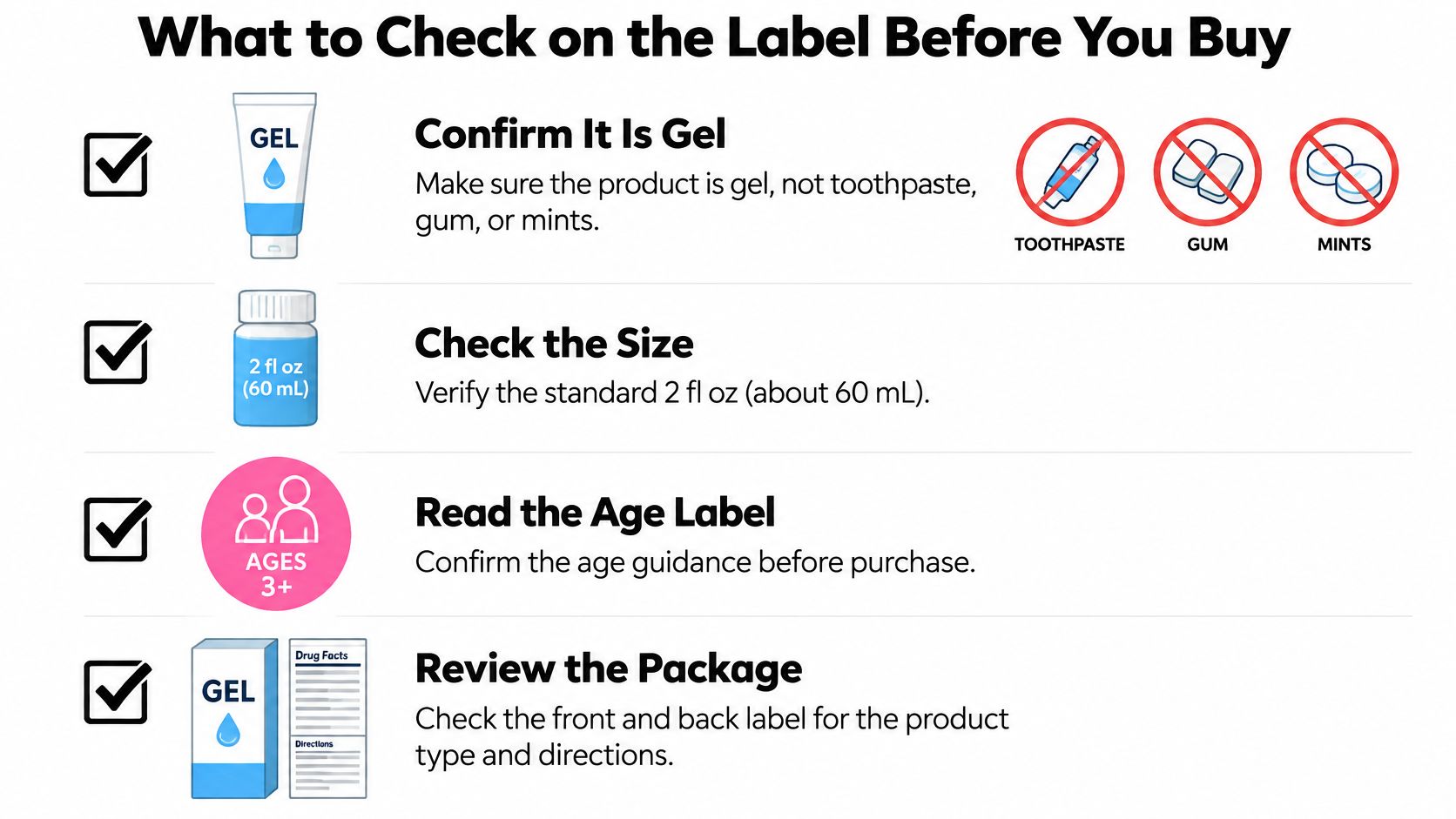
- Confirm it is gel. The front panel should say tooth gel, not toothpaste, gum, or mints.
- Check the size. Look for the standard small tube, about 2 fl oz (about 60 mL), so you aren't comparing a travel size with a family tube by price alone.
- Read the age label. A parent who grabs adult gel for a toddler has the wrong age product, even if the brand name matches.
- Review the actives. Xylitol and calcium glycerophosphate should be listed, and fluoride should be absent if a fluoride-free option is the goal.
- Scan the preservative. Grapefruit seed extract and the rest of the list matter if anyone in the house has a sensitivity.
- Find the date. An expiry date or batch code tells you the tube is still in its labeled life.
- Confirm returns. Check the seller's return policy before you order, in case the flavor or age version is wrong.
Ingredient panels don't state the gel's xylitol concentration. The package and the retailer's listing are what you can verify. Keep a photo of the front and back to show a dentist.
How to Use and Store Spry Tooth Gel
A small, supervised amount matters more than a heavy ribbon of gel.
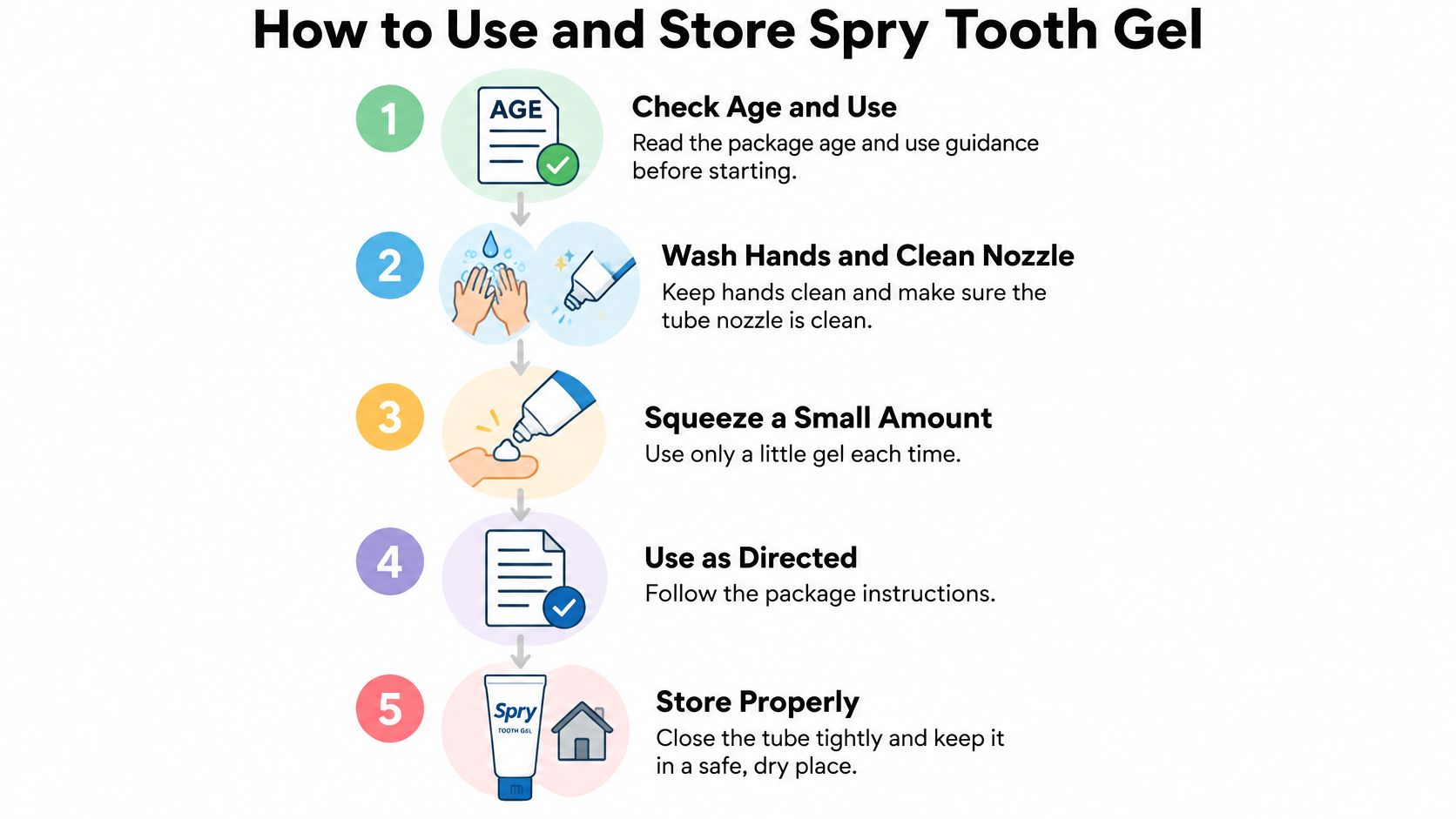
- Check age and use. Read the package before the first brush so a kids tube and an adult tube don't get swapped.
- Wash hands and clear the nozzle. A clean tip keeps the next squeeze from picking up dried gel or bathroom dust.
- Squeeze a small amount onto a dry brush, as the label directs. Young children swallow much of what goes on the brush, so less gel means less swallowed gel.
- Brush gently for about two minutes. Firm pressure doesn't clean better, and it can irritate gums.
- Spit and rinse with water. If a dentist has prescribed fluoride toothpaste, that stays the main product and this gel stays the extra.
- Wipe the nozzle and close the cap. A closed tube keeps the gel from drying at the tip.
Storage do and don't
- Do keep the tube closed at room temperature, away from heat and direct sun.
- Don't leave it in a hot car or on a sunny windowsill.
- Do throw it out if the texture separates, the smell changes, or the package date has passed.
A clean nozzle and a fully closed cap after every use is the habit that keeps the tube usable.
Who Can Use Spry Tooth Gel and Who Needs Fluoride
Ask two questions before you switch. Does a dentist, or the label, say fluoride is needed? Is caries risk raised? If either answer is yes, keep fluoride toothpaste as the base and add Spry Tooth Gel only as directed. If both are no, the gel can serve as a fluoride-free option for brushing practice, after a dentist confirms that plan.
| Situation | Spry Tooth Gel fit | Sensible next step |
|---|---|---|
| Young children | Kids versions labeled by age; fluoride-free | Small amount, supervised brushing; ask a dentist when to add fluoride toothpaste |
| Children with elevated caries risk | Not suitable as the sole toothpaste | Use age-appropriate fluoride toothpaste and follow dentist advice |
| Adults with recurrent decay | Adjunct only | Keep fluoride toothpaste and ask for a prevention plan |
| Dry mouth | Possible comfort adjunct | Check with a dentist about extra prevention |
| Orthodontic appliances | Adjunct around brackets or aligners | Keep fluoride central; confirm with the orthodontist |
| Sensitivity | No desensitizing agent listed | Use a product designed for sensitivity |
| Limited dental access | Extra alongside fluoride toothpaste | Keep fluoride toothpaste as the baseline |
Young children need a pea-or-smaller amount and an adult nearby. Kids with lots of new cavities shouldn't rely on this gel alone. Adults with repeat decay, dry mouth, or braces can use it around the main plan, not instead of it. For hot and cold sensitivity, our tooth-sensitivity line includes Fluoridex and MI Paste, which are built for that problem, while Spry Tooth Gel lists no desensitizing agent.
Parents comparing swallowed fluoride with a fluoride-free practice gel can read understanding fluoride ingestion safety from Ultra Smile DentalSpa, then still match the product to the child's risk. A pediatric dentist recommended toothpaste guide helps when you're choosing that fluoride base. Book a dental check-up before you drop fluoride. When caries risk is high, or a dental condition is already present, the dentist chooses the product, not the front of the tube.
DentalHealth.com carries professional at-home oral-care products, including whitening gels, sensitivity pastes, and retainer care, so you can pair a fluoride plan with the extras your dentist recommends. If you're sorting Spry Tooth Gel against a fluoride toothpaste or a sensitivity product, browse the category that matches that plan. Visit DentalHealth.com to see current options, shipping, and returns before you order.