
Squigle Tooth Builder Toothpaste: A Complete Guide
You're standing at the sink, ready to brush, but room-temperature water sends a sharp twinge through one tooth. Maybe a whitening toothpaste has left your cheeks sore, or recurring canker sores make every brushing session feel like a small chore. In that situation, switching from one mainstream toothpaste to another may not solve the underlying problem.
Squigle Tooth Builder toothpaste is designed for that narrower audience. It's a fluoride-free, SLS-free formula built around 36% xylitol and about 18.5% nanocalcite, with an emphasis on sensitive teeth and irritation-prone mouths rather than aggressive whitening. The important question isn't whether it's universally “better.” It's whether its formula fits your symptoms, and whether you still need a separate source of fluoride.
A Sensitivity Problem Worth Solving Differently
A cold-water rinse can cause a sharp jolt when a tooth root is exposed. For someone prone to mouth ulcers, a strongly flavored, foaming toothpaste may make a tender spot feel worse. Dry mouth can create another problem, with the clean mint sensation giving way to tight, uncomfortable tissue.
These reactions can make ordinary toothpaste feel unsuitable, even though regular brushing still matters. A toothpaste can clean teeth effectively and still be a poor match for sensitive soft tissues. Sodium lauryl sulfate, or SLS, produces foam. Some shoppers avoid it because foaming formulas seem irritating in their mouths. Strong flavors, dyes, and other ingredients may also be difficult to tolerate when oral tissues react easily.
Squigle Tooth Builder serves a narrower purpose. Squigle presents it as a gentle specialty formula for sensitivity, mouth sores, dry mouth, and chemical sensitivity. That positioning makes it a routine option for a specific problem, rather than a universal answer for every brushing need.
The practical distinction: Tooth Builder is a targeted comfort and sensitivity option, and cavity prevention needs to be planned as its own part of the routine.
Its formula centers on unusually concentrated active ingredients. A product listing identifies 36% xylitol and 18.5% nanocalcite, while the company describes the toothpaste as fluoride-free and SLS-free in its Tooth Builder ingredient information. Xylitol is intended to support a less plaque-friendly environment. Nanocalcite is positioned to help address exposed dentin and sensitivity. These ingredients give the paste a different role from a conventional fluoride toothpaste, so shoppers should consider whether they need a separate fluoride product in their routine.
That combination may suit someone who has tried standard sensitive-toothpaste formulas and disliked their flavor, foam, or ingredient profile. Tooth Builder cannot address every cause of dental pain. Persistent sensitivity, spontaneous toothache, swelling, or pain that lingers after hot or cold exposure calls for professional assessment. Toothpaste cannot repair decay, a cracked tooth, or an inflamed nerve.
What Squigle Tooth Builder Toothpaste Is
If a shopper wants gentler brushing but still needs to consider cavity protection, Tooth Builder presents a practical routine question: which job should this toothpaste handle, and which job may require a separate product?
The simplest description is this: Squigle Tooth Builder is a fluoride-free, SLS-free toothpaste for people seeking low-irritation cleaning with a sensitivity-focused formula. It is made by SQUIGLE, Inc., which says it has produced Squigle toothpaste since 1998. That product history helps explain why older and newer names can appear across retail listings.
Tooth Builder has also been sold under the Enamel Saver name before returning to the Tooth Builder name. If an online listing looks inconsistent, compare the ingredient panel, manufacturer details, and product description instead of relying on the title alone. Specialty products can collect naming variations as they pass through different retail channels.
Where it fits in the toothpaste aisle
Tooth Builder is designed as a specialty toothpaste, not a typical family formula built around fluoride, heavy foaming, and broadly marketed flavoring. Its intended audience may include people concerned about sensitivity, dry mouth, ingredient avoidance, or enamel support.
Its formula takes a different route from fluoride toothpaste. Fluoride supports enamel strength and cavity prevention, while Tooth Builder centers on xylitol and nanocalcite. Nanocalcite refers to very fine calcium carbonate particles. The concept is comparable to using small mineral particles to cover or fill microscopic pathways linked with exposed dentin.
The company's Tooth Builder routine guidance states, “If you also need fluoride, brush with Squigle Enamel Saver once daily.” That instruction clarifies the product's place in a routine. Tooth Builder can complement mainstream fluoride toothpaste rather than automatically replace it.
A fluoride-free toothpaste may suit a personal preference or an adult with low cavity risk who has discussed the choice with a dental professional. It may not provide enough protection by itself for a child, someone with frequent cavities, a person with braces, or anyone using prescription fluoride. The right choice depends on the full brushing routine, not only the tube.
Key Ingredients and Why the Levels Matter
The formula assigns each ingredient a distinct job. Xylitol helps shape the environment around the teeth, nanocalcite supplies the mineral-based sensitivity approach, and the absence of SLS supports a lower-foaming experience for some irritation-prone users. These features explain why Tooth Builder works best as a specialty option within a routine, rather than as an automatic substitute for every fluoride toothpaste.
Xylitol at a substantial concentration
Tooth Builder is listed with 36% xylitol (product listing details). This is more than a small sweetener addition. The product's positioning links xylitol with plaque inhibition and acid management, making it a central part of the formula's design.
Plaque bacteria ferment ordinary sugars for energy, but they cannot metabolize xylitol in the same way. At a 36% concentration, the sugar substitute remains dominant around the teeth. Xylitol still does not replace brushing or flossing, and it cannot guarantee protection from cavities. Its role is supportive: it helps create a less favorable setting for plaque while the toothbrush removes deposits mechanically.
Nanocalcite as a tubule-occluding mineral
The formula also contains about 18.5% nanocalcite, described elsewhere as calcite or calcium carbonate (technical ingredient description). These fine particles are intended to plug exposed dentinal tubules, the microscopic channels that can carry temperature and touch sensations toward the tooth's nerve.
That approach differs from a fluoride-centered formula. Fluoride supports chemical changes that strengthen enamel, while Tooth Builder's nanocalcite strategy emphasizes physical coverage and mild polishing. Squigle's sensitivity guidance describes the abrasive action as mild enough to remove stain and plaque while leaving enamel intact (Squigle's sensitivity guidance).
What the formula leaves out
The product is described as SLS-free and fluoride-free. This may appeal to shoppers who dislike foaming surfactants or have experienced irritation with conventional toothpaste. It is also marketed for people concerned about mouth ulcers, dry mouth, and chemical sensitivity.
The ingredient profile includes water, glycerin, poloxamer, cellulose gum, Methocel, and potassium sorbate, alongside xylitol and calcite. Read the current packaging if you have a diagnosed allergy or a history of contact reactions, since formulations and labeling can change.
| Ingredient | Amount / Status | Role in the Formula |
|---|---|---|
| Xylitol | 36% | Supports plaque-inhibition positioning and provides sweetness |
| Nanocalcite, or calcite | About 18.5% | Mineral-based polishing and intended dentin-tubule occlusion |
| Fluoride | Absent | Means cavity protection must be considered separately when risk is elevated |
| SLS | Absent | Provides a non-SLS, low-foaming profile |
| Supporting ingredients | Present | Provide texture, moisture, stability, and preservation |
For a broader explanation of active ingredients used in sensitivity formulas, see this guide to sensitive-teeth toothpaste active ingredients. Tooth Builder may suit an irritation-prone mouth, but its lack of fluoride remains a routine decision, not a minor label detail.
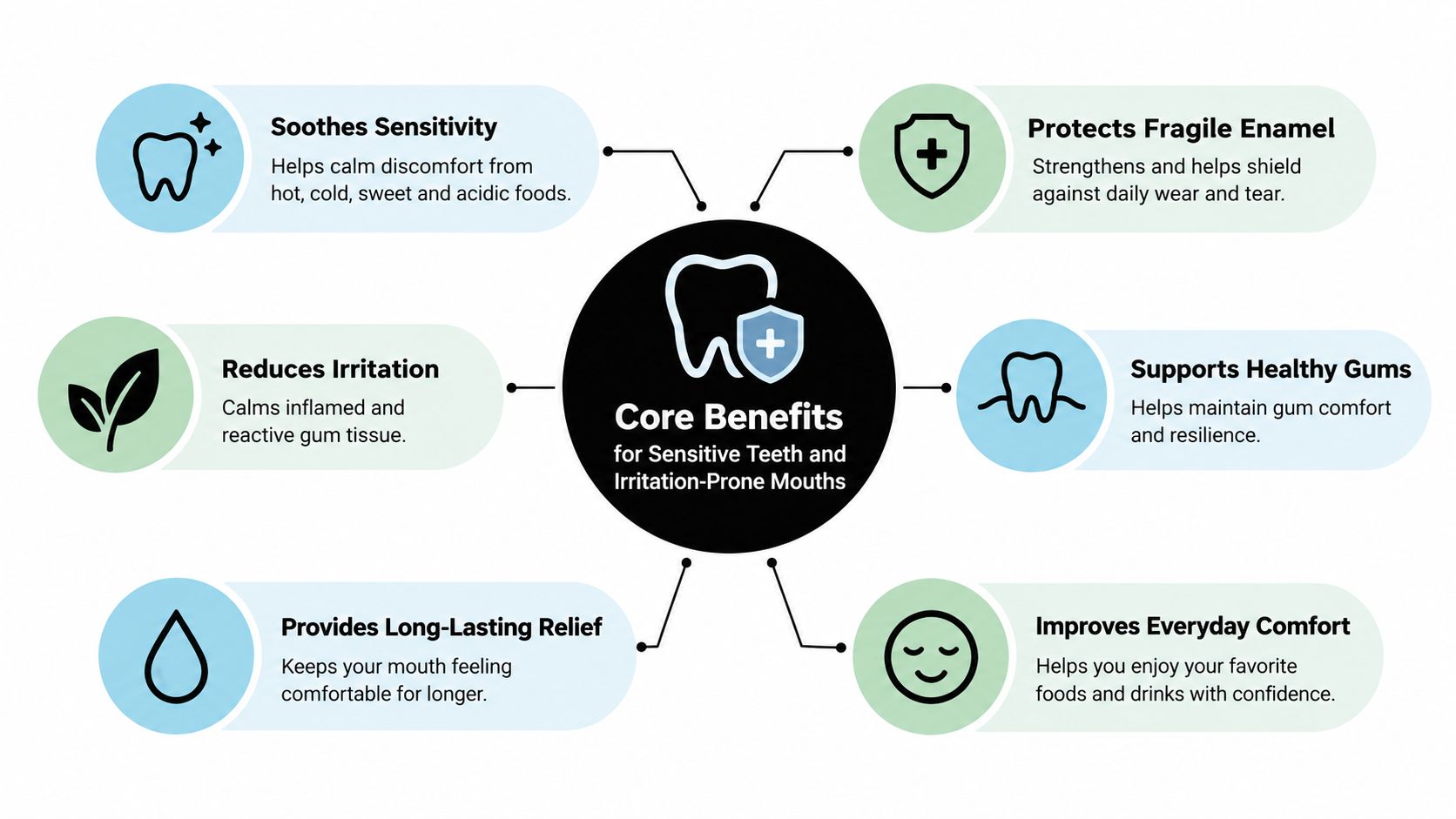
Core Benefits for Sensitive Teeth and Irritation-Prone Mouths
A cold drink may trigger one person, while foaming toothpaste may aggravate another's mouth sores. Tooth Builder's potential benefits therefore depend on the problem you are trying to address. It is best viewed as a complement to a mainstream fluoride toothpaste routine when cavity protection is a priority, not as a universal replacement.
Sensitivity support
The nanocalcite concept is easiest to understand as covering microscopic openings in exposed dentin. When gum recession exposes a root surface, temperature changes can travel through tiny channels called tubules and produce a quick, sharp sensation. A paste designed to block those pathways aims to reduce the trigger at its source, rather than creating a numbing feeling.
That approach fits sensitivity linked with exposed dentin, abrasion, or irritation. It does not explain every type of tooth pain. Decay, a cracked tooth, or persistent pain calls for dental assessment, even if a sensitivity toothpaste feels comfortable.
A gentler cleaning experience
The SLS-free and fluoride-free profile may suit shoppers who prefer less foam or who find conventional toothpaste irritating. Someone with recurring canker sores may value that simpler sensory experience, although personal triggers differ.
Retailers have marketed it as “the world's first hypoallergenic toothpaste,” but that is a marketing claim. Anyone with a known allergy should review the full current ingredient list and stop using the product if symptoms develop.
Plaque-focused support
Its high xylitol content gives Tooth Builder a plaque-management angle alongside its sensitivity focus. The paste can support a cleaner-feeling routine, but it does not replace brushing along the gumline, cleaning between teeth, or professional dental care.
The brand recommends brushing for 2 minutes, 2–3 times daily (brushing guidance from Squigle). That recommendation illustrates the practical role of the product: ingredients support the routine, while consistent mechanical cleaning does the main plaque-removal work.
Use it for the problem it's designed to address. Tooth Builder may add comfort for an irritation-prone mouth, while a fluoride toothpaste may still have a separate place in a cavity-prevention routine.
For a visual overview, the accompanying video offers another way to consider the product's role:
Compatibility With Whitening Trays, Aligners, and Dry Mouth
Tooth Builder makes the most sense as part of a routine that includes other dental products. Its low-irritation profile may be useful alongside whitening or orthodontic appliances, but compatibility doesn't mean every user should abandon fluoride.
After whitening trays
Whitening gels can leave teeth temporarily sensitive, and peroxide gel can irritate soft tissue when trays don't fit well or excess gel escapes. A mild, low-abrasion toothpaste may be a comfortable choice after removing trays, especially for someone who finds conventional whitening toothpaste too harsh.
The product's nanocalcite approach is not the same as a whitening treatment. It won't replace peroxide gel, and it shouldn't be chosen for strong stain removal. For practical tray hygiene and timing, use a dedicated guide to dental whitening trays.
With aligners and retainers
Clear aligners create a closed, humid space around teeth, so careful cleaning matters. Brush teeth before putting trays back in, and clean the appliance according to the manufacturer's instructions. Tooth Builder can serve as a non-foaming toothpaste option, but don't assume that brushing the appliance with toothpaste is always appropriate, because some appliance materials can scratch.
Retainers and night guards should generally be cleaned outside the mouth. A fluoride-free paste may be acceptable for tooth brushing when the appliance is removed, but the appliance itself still needs an appropriate cleaning method.
For dry mouth
People with xerostomia often dislike toothpaste that leaves the mouth feeling stripped or tight. A non-SLS formula may feel more comfortable, while xylitol is included in Tooth Builder's design for plaque support and is commonly associated with saliva-friendly oral-care routines.
Dry mouth also raises the importance of cavity prevention. Reduced saliva means less natural buffering and cleansing, so a fluoride-free paste shouldn't automatically become the only product in the routine.
| Treatment or concern | Compatibility | Key consideration |
|---|---|---|
| Whitening trays | Generally compatible as a gentle brushing companion | It doesn't replace whitening gel or resolve poor tray fit |
| Clear aligners | Suitable for tooth brushing when used as directed | Clean aligners separately and follow appliance instructions |
| Retainers and night guards | Compatible with appliance removal | Use a material-safe appliance cleaner when needed |
| Dry mouth | May offer a less tight-feeling experience | Fluoride protection may still be important |
| High cavity risk | Requires caution as a sole toothpaste | Discuss a fluoride routine with a dental professional |
The brand's own recommendation answers the central trade-off: if you need fluoride, add a fluoride toothpaste such as its Enamel Saver rather than assuming Tooth Builder provides the same protection. That makes Tooth Builder a complement for many users, not an automatic substitute.
How Squigle Tooth Builder Compares to Similar Toothpastes
The right comparison depends on the problem you're trying to solve. Tooth Builder, Fluoridex, and MI Paste represent different formulation philosophies, so choosing among them is less like selecting a winner and more like selecting the correct tool.
Tooth Builder and Fluoridex
Fluoridex and other high-fluoride sensitivity products prioritize fluoride exposure for enamel support and cavity prevention. Tooth Builder prioritizes nanocalcite-based tubule coverage, xylitol, and an SLS-free, fluoride-free profile.
That difference becomes important for people with high caries risk. A person who frequently develops cavities, has braces, experiences dry mouth, or has been prescribed fluoride shouldn't replace that plan casually with a fluoride-free product. Someone whose main issue is irritation from conventional paste may value Tooth Builder's restrictions more than a high-fluoride formula's conventional cavity-protection strategy.
Tooth Builder and MI Paste
MI Paste products use a milk-derived casein phosphopeptide and amorphous calcium phosphate approach. Tooth Builder instead uses nanocalcite, so the ingredient source and mechanism differ.
That distinction may matter to someone avoiding dairy-derived ingredients or looking for a formula without casein. It also means the products shouldn't be described as interchangeable. A dental professional may recommend one, the other, or a combination based on sensitivity, enamel concerns, allergies, and decay risk.
| Product | Active approach | Best for |
|---|---|---|
| Tooth Builder | Xylitol support plus nanocalcite-based tubule occlusion | Irritation-prone mouths and sensitivity users seeking fluoride-free, SLS-free care |
| Fluoridex | Fluoride-centered enamel and cavity protection | People with elevated decay risk or a fluoride recommendation |
| MI Paste | Casein-derived calcium and phosphate delivery | Users seeking remineralization support who can tolerate dairy-derived ingredients |
For a wider look at ingredient restrictions and sensitivity options, compare sensitive toothpaste brands. The practical takeaway is that active mechanism, ingredient tolerance, and cavity risk should guide the choice, not the product's marketing category alone.
Who Should Use Squigle Tooth Builder Toothpaste
Tooth Builder is most compelling for adults and children whose mouths react to ordinary toothpaste, particularly people who report problems with SLS, strong foaming, or certain flavors. It may also suit shoppers with sensitive teeth, dry mouth, recurrent mouth sores, or a deliberate preference for fluoride-free oral care.
The routine decision is more important than the purchase decision:
- Consider it as a primary paste if you're a low-caries-risk adult and your dentist agrees that a fluoride-free routine fits your needs.
- Pair it with fluoride if you're cavity-prone, have dry mouth, wear orthodontic appliances, care for a child's teeth, or have been told to use prescription fluoride.
- Choose another product or add a separate product if your main need is strong whitening, intensive cavity protection, or a dentist-prescribed high-fluoride regimen.
- Check the label carefully if you have food allergies, contact sensitivity, or a history of reactions to oral-care ingredients.
A sensible trial means using the product consistently according to its directions and observing whether sensitivity or irritation changes. If pain persists, worsens, or appears without an obvious trigger, book a dental examination rather than extending the toothpaste trial indefinitely.
Tooth Builder's strongest position is as a specialty complement. It can make daily brushing more comfortable for the right user, but comfort, plaque control, and fluoride-based cavity prevention are separate goals that may require more than one product.
Explore DentalHealth.com for professional-grade sensitivity toothpastes, remineralizing products, whitening systems, and practical guidance for building a routine around your symptoms. If you're deciding between a fluoride formula, MI Paste, or a gentler companion for whitening and sensitivity, browse the product information and choose the combination that best matches your dental needs.