
Supersmile Professional Teeth Whitening Toothpaste
Supersmile Professional Whitening Toothpaste is mainly a surface-stain remover, not a substitute for peroxide bleaching. Its brand-reported system claim is up to 6 VITA shade improvements after 5 days when used with the Whitening Accelerator, while its core technology is designed to dissolve the protein pellicle that holds stains rather than aggressively scrub enamel.
That distinction matters. A patient with coffee or tea staining may see a noticeably cleaner, brighter smile from daily use, but someone with tetracycline discoloration, fluorosis, trauma-related darkening, or naturally deeper tooth color may need professionally supervised peroxide treatment. Whitening toothpaste can restore some of the brightness that stains have covered. It generally can't change the underlying color of the tooth in the way true bleaching can.
The Science Behind Supersmile Whitening
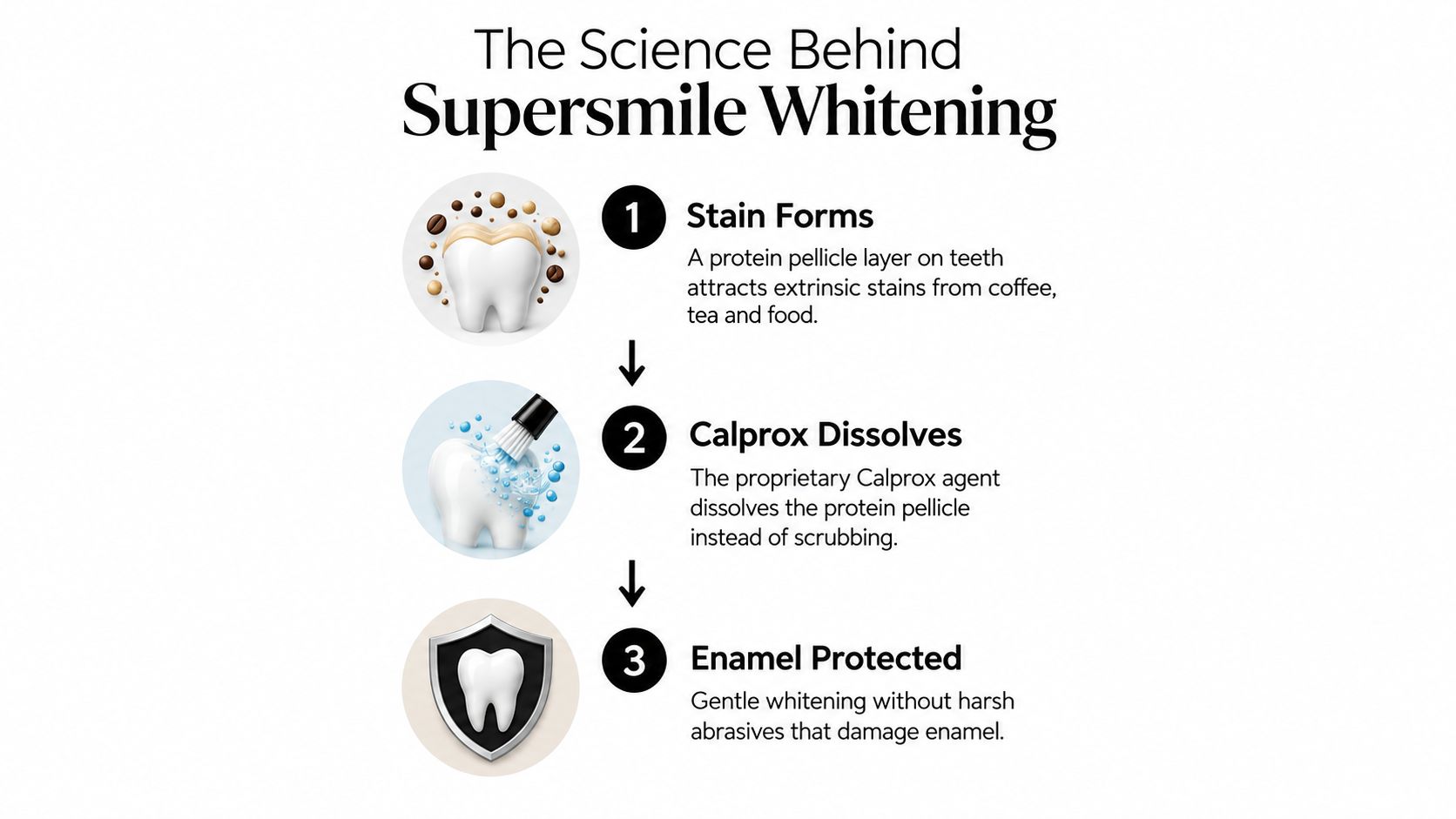
A coffee drinker may brush faithfully and still notice yellow-brown areas near the gumline, between the front teeth, or along rough enamel. Those marks often sit in the acquired protein pellicle, a thin saliva-derived layer that forms over the tooth surface and attracts pigments from coffee, tea, wine, and food. The stain is external, even though it can look like the tooth itself has darkened.
Supersmile's approach is built around Calprox, a calcium-peroxide-based whitening technology positioned to dissolve the protein pellicle that binds extrinsic stains to tooth surfaces. The intended mechanism is different from relying primarily on aggressive mechanical scrubbing, as described in this review of Supersmile's formulation and development.
Why harder scrubbing isn't the answer
A whitening paste can make teeth appear brighter by polishing or loosening deposits, but more force isn't automatically better. Patients who brush aggressively, use a hard-bristled brush, or chase stains with harsh products can irritate the gums and wear dental surfaces over time. The practical objective is to remove the stain layer while preserving the enamel and the smooth finish of any dental work.
Calprox's chemical positioning is therefore the product's central proposition. It targets the material that helps stains adhere, rather than treating every dark mark as something that must be scraped away. That makes the formula particularly relevant for people who want daily stain maintenance without turning each brushing session into a polishing treatment.
Clinical perspective: If the color is sitting on the surface, changing the cleaning mechanism can help. If the color originates inside the tooth, a different treatment is required.
The same principle applies when evaluating oral-care information more broadly. A well-organized resource, supported by white-glove AI support, can help teams separate a product's mechanism from its marketing language. For consumers, the important question remains simple: is the product removing deposits, or changing the tooth's internal color?
Active Ingredients and Fluoride Protection
Supersmile Professional Whitening Toothpaste isn't only a cosmetic dentifrice. Its U.S. Drug Facts labeling identifies it as an anticavity product, with sodium monofluorophosphate as the active ingredient and 0.14% fluoride ion, approximately 1,400 ppm fluoride by the label's concentration, documented in the DailyMed product labeling.
Fluoride matters because whitening routines shouldn't displace basic decay prevention. Sodium monofluorophosphate supplies fluoride during brushing, while calcium- and phosphate-containing ingredients, including dicalcium phosphate dihydrate and calcium carbonate, form part of the paste's broader mineral and cleaning profile.
What each component contributes
Calprox is the proprietary whitening component. It's described as calcium-peroxide-based and is intended to act on the protein pellicle where external stains attach. That gives the product a chemically assisted stain-management role, rather than making abrasion the only route to a brighter appearance.
Sodium bicarbonate and calcium carbonate contribute to cleaning and surface stain control. The formula also includes dicalcium phosphate dihydrate. These ingredients don't turn the toothpaste into an in-office bleaching gel, but they support the daily removal of deposits that make natural teeth look dull.
Sodium monofluorophosphate provides the anticavity function. Brush with fluoride toothpaste twice daily, spit rather than swallowing a substantial amount, and follow the product label. People who want a broader explanation of how fluoride fits into daily routines can review this guide to fluoride toothpaste and mouthwash.
The useful clinical distinction is that fluoride protection and cosmetic stain management can coexist. A whitening toothpaste doesn't have to sacrifice anticavity care, but it also shouldn't be presented as a replacement for professionally supervised bleaching when the concern is intrinsic discoloration.
From Dr. Smigel to the Modern Formula
Supersmile's history begins with dentist Dr. Irwin Smigel, who founded the brand in 1987 and is often described as a pioneer of aesthetic dentistry. That background helps explain why the product has always been presented as more than a conventional mint paste with a whitening label. Its identity developed at the intersection of restorative care, cosmetic dentistry, and daily maintenance.
Longevity doesn't prove that every marketing claim applies equally to every patient, but it does provide useful context. Supersmile is a longstanding premium whitening-dentifrice brand whose proposition combines cosmetic stain removal with conventional fluoride protection, rather than treating whitening as a purely aesthetic product category.
Why brand history still needs clinical judgment
Patients often assume that a product with a long development history must deliver bleaching-level results. That's an understandable mistake. A brand can refine a stain-removal system for years while still working primarily on external deposits, not on the internal chromogens responsible for deeper discoloration.
This is why I separate product credibility from treatment suitability. Supersmile's history and Calprox positioning may make it a reasonable daily maintenance choice, particularly for visible surface staining. They don't eliminate the need to diagnose the source of a dark tooth, assess cavities or gum disease, or plan around existing restorations.
Readers who want to understand how a dentist distinguishes routine products from professional teeth whitening should focus on the agent, contact time, supervision, and target tissue. Those factors tell you much more than the word “professional” on a package.
The modern formula's strongest position is therefore practical. It offers a premium daily toothpaste built around a distinctive stain-removal concept, with fluoride retained as part of routine oral care. Its limitations are just as important as its origin story.
Clinical Results Compared to Leading Brands
A reported university-based comparison tested three dentifrices after three supervised brushings. The study involved 47 participants, with 16 using Supersmile, 16 using Crest, and 15 using Topol. Three dentists independently scored visible color change on a 0 to 3 scale, where higher scores represented greater visible brightening.
| Product | Mean Score |
|---|---|
| Supersmile | 3.375 |
| Crest | 1.25 |
| Topol | 0.80 |
The reported analysis found statistically significant differences between groups at the 0.01 significance level, as detailed in the reported dentifrice comparison. On the narrow question of short-term visible brightening after supervised brushing, Supersmile produced the highest reported mean score among the three products.
What the comparison does show
The result supports the idea that Supersmile can be effective at disrupting or removing extrinsic deposits. It also gives the product more substance than an unsupported claim based only on consumer impressions. A dentist grading visible color change independently is more informative than asking participants whether their smiles “felt whiter.”
That said, the comparison doesn't establish a guaranteed result for an individual user. It measured a short-term visual outcome after a limited number of uses, not long-term bleaching, modern standardized shade-guide change, or treatment of intrinsic discoloration.
What it doesn't show
The comparison shouldn't be used to promise that every patient will achieve a fixed shade improvement. It also shouldn't be read as proof that Supersmile bleaches the internal structure of a tooth or outperforms every whitening method in every clinical situation.
| Question | What the comparison supports |
|---|---|
| Surface stain removal | A meaningful short-term brightening signal |
| Intrinsic discoloration | Not established by this comparison |
| Long-term maintenance | Not measured |
| Individual prediction | Not guaranteed |
For shoppers comparing teeth-whitening gel brands, the key issue is treatment category. A dentifrice can be useful for daily stain control, while a peroxide gel is designed to alter tooth color more intensively. They aren't interchangeable products, even when both use the word “whitening.”
How to Use for Best Results
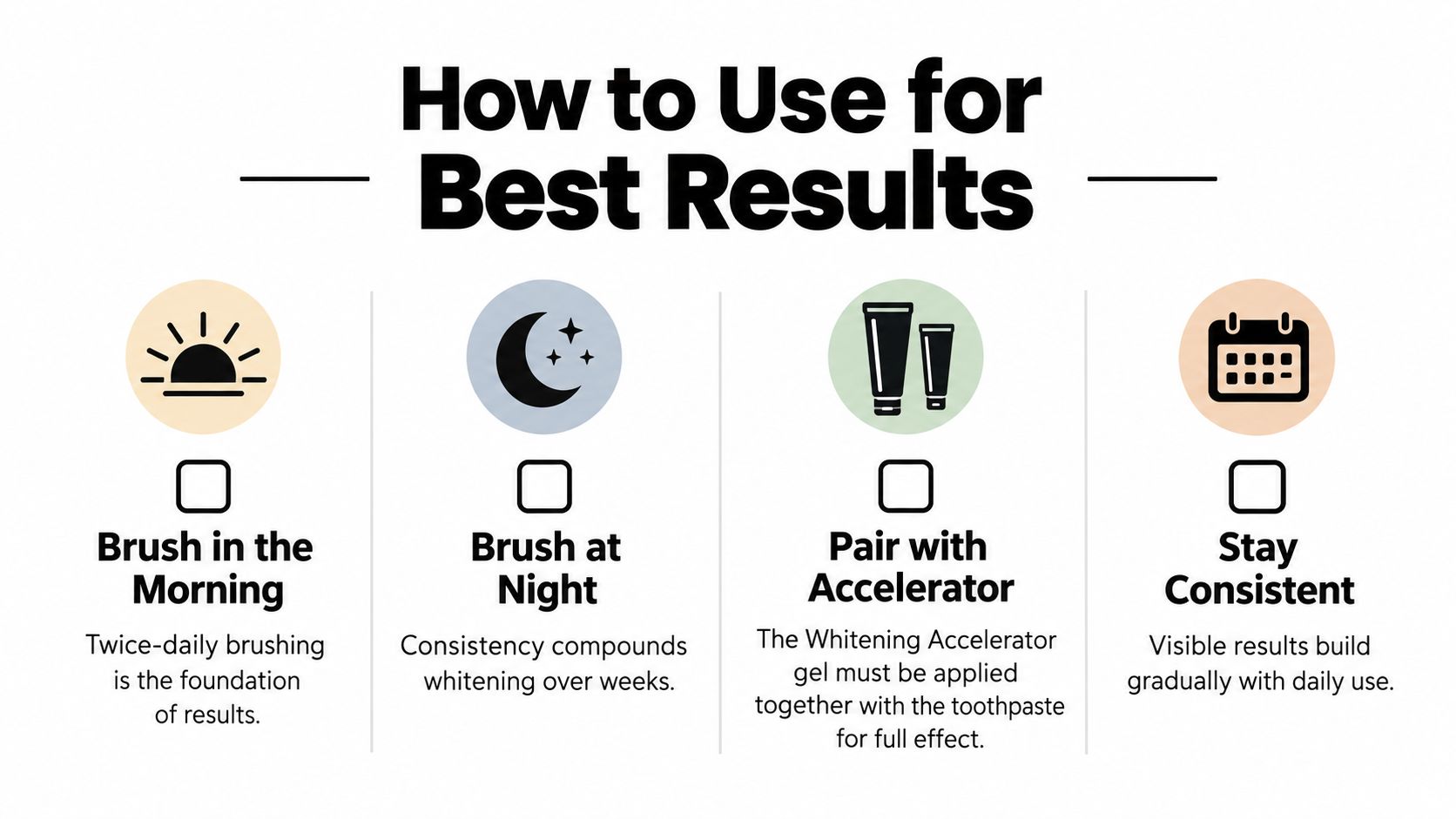
The routine is straightforward, but the product's advertised strongest result is associated with the Professional Whitening Toothpaste used with the accompanying Whitening Accelerator, not necessarily with toothpaste used alone. That distinction should shape your expectations before you start.
Build the routine first
Use the toothpaste as part of normal fluoride-toothpaste practice. Brush twice daily, cover all tooth surfaces without scrubbing forcefully, and spit after brushing rather than swallowing substantial quantities.
The morning session addresses deposits accumulated during the day and night. The evening session is especially important because it removes the day's food and drink residue before sleep. Consistency supports maintenance, while sporadic brushing makes it difficult to judge whether the product is helping.
Use the system as directed
If you're pursuing the brand's whitening-system claim, pair the toothpaste with the Whitening Accelerator according to the product instructions. The reported up to 6 VITA shade improvements after 5 days applies to that combined system and is a brand-reported clinical claim, not an independently verified outcome for the general population.
Keep these practical rules in mind:
- Start with clean teeth: Remove food debris and plaque with careful brushing rather than increasing pressure.
- Follow the Accelerator directions: Don't assume that adding more product will create faster or better whitening.
- Watch the target: Judge changes in surface staining, not only the overall natural color of the tooth.
- Stop chasing a resistant tooth: A single dark tooth, new gray area, pain, or bleeding deserves dental assessment rather than repeated whitening.
The product should be treated as a surface-stain maintenance tool. It shouldn't replace a dental examination, professional bleaching when appropriate, or treatment for decay, trauma, gum disease, or defective restorations.
Use this video as a visual supplement to the written directions:
Stain Removal Versus True Bleaching
The most important question about Supersmile is also the one many reviews skip: is it bleaching teeth, or mainly removing surface stains? The answer is mainly surface stain removal. The product may make natural teeth look substantially brighter when coffee, tea, tobacco, wine, and food pigments have accumulated on the pellicle, but that doesn't mean it changes the deeper color of the tooth.
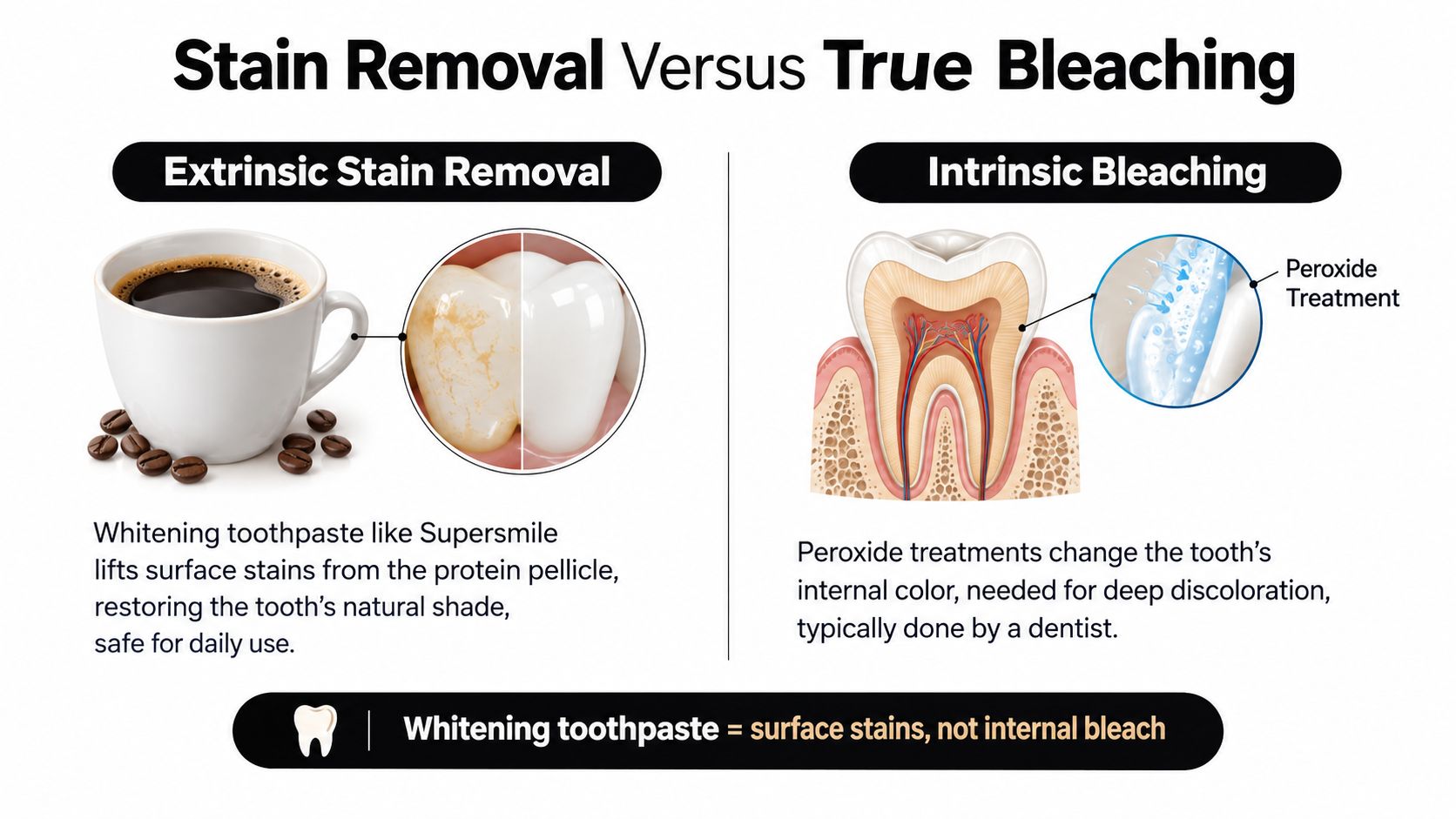
The official product information lists sodium bicarbonate, calcium carbonate, dicalcium phosphate, and Calprox, while the FDA-listed active anticavity ingredient is sodium monofluorophosphate providing 0.14% fluoride ion. The product information doesn't identify hydrogen peroxide or carbamide peroxide as active bleaching agents, as shown in the official Professional Whitening Toothpaste ingredient information.
Use this decision rule
| Your discoloration | More realistic expectation |
|---|---|
| Coffee, tea, wine, food, or tobacco deposits | Supersmile may reduce visible external staining |
| Aging-related deeper color | Toothpaste may improve the surface, but won't predictably bleach the underlying shade |
| Fluorosis or tetracycline discoloration | A dental consultation is more appropriate than relying on toothpaste |
| Trauma-related darkening | Seek evaluation before whitening |
| Crowns, veneers, or bonding | Whitening toothpaste generally can't change the restoration's internal color |
Peroxide-based treatment is the category associated with intrinsic whitening because peroxide can act on chromogenic compounds within the tooth. Supersmile's formula is better understood as a daily maintenance option that helps restore the natural appearance hidden by deposits.
This distinction is useful beyond human cosmetic care. Even a general dental hygiene guide for pets reinforces the broader principle that routine cleaning and treatment of underlying disease are different tasks. For people, the same logic prevents disappointment: surface cleaning can be valuable without being true bleaching.
Suitability for Sensitivity and Restorations
Sensitivity changes the buying decision, but it doesn't automatically make Supersmile the right answer. The formula supplies fluoride for anticavity care and uses a Calprox-centered stain-removal approach, yet the available information doesn't establish that it will prevent sensitivity for every user. A sensitive tooth may have exposed dentin, decay, a cracked filling, gum recession, or another problem that whitening products won't correct.
Patients with mild sensitivity may prefer a non-peroxide daily maintenance paste, especially when the concern is external staining rather than a dramatic color change. If brushing causes sharp pain, lingering discomfort, or sensitivity in one specific tooth, pause the cosmetic routine and arrange an examination.
Restorations create a color boundary
Whitening toothpaste generally can't lighten the internal shade of porcelain crowns, veneers, composite bonding, or fillings. It can clean deposits from their surfaces, but it won't make an existing restoration change color in the same way natural tooth structure may change during bleaching.
That creates a planning issue. If a restoration already matches your natural teeth, maintenance stain removal may help preserve the appearance. If the restoration is darker or lighter than the surrounding teeth, repeated use of whitening toothpaste won't reliably correct the mismatch. A dentist may need to assess whether the natural teeth, the restoration, or both require a coordinated cosmetic plan.
Decision point: Choose Supersmile when your goal is daily control of external staining with fluoride protection. Choose a dental consultation when you want internal color change, have significant sensitivity, or need restorations to match.
Supersmile Professional Whitening Toothpaste is best viewed as a premium surface-stain maintenance product, not a universal bleaching solution. Its reported clinical comparison and Calprox positioning support a useful role for visible deposits, while the limits of toothpaste remain clear for intrinsic discoloration and dental work.
DentalHealth.com offers professional-grade at-home whitening products, sensitivity care, remineralizing formulas, and practical guidance for choosing between daily maintenance and peroxide treatment. Visit DentalHealth.com to compare dentist-oriented options and find a routine that matches your staining pattern, sensitivity concerns, and existing dental work.