
Teeth Whitening Gel Online: A Smart Buyer's Guide
The most common advice about buying teeth whitening gel online is also the least useful: choose the highest percentage you can find. That approach treats peroxide strength as the whole product. It ignores tray fit, wear time, formulation, gum exposure, sensitivity history, and whether the listing contains genuine, traceable stock.
A smarter purchase starts with fit rather than force. The global teeth whitening market is projected to grow from USD 9.37 billion in 2026 to USD 14.31 billion by 2034, at a projected 5.44% CAGR, according to Fortune Business Insights' teeth whitening market forecast. That scale means online shoppers have plenty of choice, but it also gives sellers room to hide weak product information behind aggressive “professional strength” language.
The right buying decision comes down to four checks: concentration, formulation, seller verification, and aftercare. Get those right, and a moderate gel in a well-fitting tray can be a better purchase than a stronger syringe that leaves your teeth too sensitive to use consistently.
Why the Highest Percentage Is Not the Best Buy
A high peroxide percentage can look impressive on a product page. It isn't automatically a better match for your teeth.
Clinical evidence comparing 10% and 16% carbamide peroxide found similar whitening outcomes when both were used once daily for three weeks in custom trays, with both concentrations well tolerated. The randomized trial published in Operative Dentistry supports a practical point that online listings often bury: more active ingredient doesn't guarantee a better result.
Strength affects comfort and consistency
Strong gels may produce a more forceful treatment experience, but that can come with more sensitivity, shorter tolerable sessions, and gum irritation when the tray leaks. A user who buys an unnecessarily strong gel may reduce wear time, skip sessions, or abandon the course after sharp “zingers.” A less aggressive gel used according to a realistic schedule can deliver a more usable routine.
That matters because whitening is a contact problem. The gel has to reach stained enamel evenly, while staying away from the gums and areas of exposed root. A high percentage cannot compensate for a loose tray, excessive gel, untreated decay, or a buyer who keeps extending sessions to chase a faster shade change.
Practical rule: Buy the concentration your teeth can tolerate for the intended wear schedule, not the number that looks most dramatic in a listing title.
The market is established, but choice creates confusion
Whitening has moved well beyond the dental office. Market data place the global category at USD 7.72 billion in 2025 and USD 8.01 billion in 2026, while another estimate places the 2025 market at USD 8.52 billion and projects growth to USD 12.77 billion by 2032. The Mordor Intelligence market overview also identifies Asia Pacific as holding 33.80% of global share in that outlook.
That growth has normalized at-home buying, but it hasn't made every online listing reliable. Treat the percentage as one specification among several. Then check the peroxide type, tray compatibility, sensitivity ingredients, batch information, expiry date, manufacturer, and seller support.
Reading Concentration Labels the Right Way
Online shoppers usually encounter two active ingredients, carbamide peroxide, or CP, and hydrogen peroxide, or HP. They aren't interchangeable labels, and comparing them without translation can make a weaker gel appear stronger or a shorter-wear product appear more efficient than it really is.
Carbamide peroxide breaks down into hydrogen peroxide and urea. Independent clinical summaries commonly equate 10% carbamide peroxide with about 3.6% hydrogen peroxide, as described in the European Commission's scientific opinion on tooth whitening products. Use that conversion as a rough comparison, not as a promise that two products will perform identically. Base ingredients, pH, tray contact, storage, and wear schedule also affect the experience.
Use this four-step label check
- Identify the active ingredient. Confirm whether the product lists CP or HP. A product that says only “professional strength” without a number hasn't given you enough information to make a responsible comparison.
- Translate CP into an approximate HP equivalent. A 16% CP gel is roughly comparable to about 5.8% HP, using the same approximate relationship. A 22% CP gel is roughly comparable to about 7.9% HP. These are conversions, not guaranteed whitening equivalents.
- Match the percentage to the wear instruction. Lower CP products are commonly designed for longer tray contact, while higher CP products are generally used for shorter sessions. Follow the manufacturer's instructions rather than borrowing timing from another brand.
- Check whether the label separates CP and HP clearly. Some product pages use the words loosely, which makes comparison unreliable. If the active ingredient and concentration aren't printed clearly on the packaging or syringe, leave the listing.
For a practical ingredient overview, read this guide to whitening gel ingredients before comparing product pages.
Concentration and wear time reference
| Carbamide Peroxide | Equivalent HP | Typical Wear Time | Best Fit |
|---|---|---|---|
| 10% to 16% CP | Approximately 3.6% to 5.8% HP | 30 to 60 minutes, or according to product directions | Sensitive users, longer routines, custom trays |
| 20% to 22% CP | Approximately 7.2% to 7.9% HP | 15 to 30 minutes, or according to product directions | Users wanting shorter sessions and reliable tray fit |
| 35%+ CP | Higher equivalent strength | Short wear or professional-directed use | Experienced users following specific instructions |
The table is a buying reference, not permission to extend or shorten a manufacturer's schedule. Gel percentage describes active ingredient strength, not whitening speed by itself. A well-made lower-concentration gel with an accurate tray can be more useful than a strong product that causes discomfort.
Comparing the Leading Whitening Gel Brands
Brand names help, but they don't tell you everything. The meaningful differences sit in concentration range, base, flavour, delivery format, and sensitivity support. Before buying, confirm the exact product variant because one brand can sell several gels with different strengths and instructions.
Opalescence PF is built around tray-based at-home use and is the obvious option for shoppers who prioritize sensitivity management. Its formulation cues include potassium nitrate and fluoride, while its gel format suits users with custom or compatible bleaching trays. It's a better fit for someone who wants a controlled routine rather than the most aggressive label.
Pola Day targets daytime use and shorter sessions. Its appeal is practical, especially for buyers who don't want to sleep in trays. Pola Night, by contrast, is designed around night wear and is available in higher carbamide peroxide strengths, including 22% and other variants depending on the market and product line.
Boutique Whitening is associated with night-use protocols and higher CP options. Buyers should pay close attention to the specific strength and wear instruction because “Boutique” alone doesn't tell you whether you're looking at a mild, moderate, or high-concentration formula.
Zoom occupies the professional take-home end of the category. Zoom-branded gels are commonly supplied for tray delivery, and the right choice depends on whether the product is intended for dentist-provided treatment, take-home use, or a particular tray system.
Hello is positioned as an entry-level option, with fluoride as a notable formulation cue. It may suit shoppers who want a straightforward introduction to home whitening rather than a high-strength professional protocol.
For a broader product comparison, use this guide to teeth whitening gel brands. For general advice on evaluating products that claim to work, bright smile tips from Inspire Dental provide useful context without reducing the decision to percentage alone.
Leading whitening gel brands at a glance
| Brand | Concentration Range | Key Formulation Cue | Wear Style | Best Suited To |
|---|---|---|---|---|
| Opalescence PF | Commonly lower to moderate CP options | Potassium nitrate and fluoride | Tray-based home wear | Users concerned about sensitivity |
| Pola Day | Day-use CP options | Daytime-focused formulation | Short daytime sessions | Buyers who dislike overnight trays |
| Boutique Whitening | Moderate to higher CP options | Night-use product variants | Overnight or extended wear, as directed | Users comfortable with night routines |
| Zoom | Professional take-home options | Brand-specific tray gel systems | Tray-based home treatment | Buyers seeking a dentist-linked system |
| Hello | Entry-level whitening options | Fluoride-fortified positioning | Product-specific home use | First-time or budget-conscious users |
Don't choose on flavour or colour claims alone. Potassium nitrate, fluoride, pH, water or glycerin base, and delivery format affect whether a product feels manageable in real use. The best gel is the one whose formulation and schedule you'll follow without irritating your gums.
Spotting Authentic Listings and Red Flags
A credible online checkout should feel slightly boring. The product page should answer basic questions before you enter payment details, and the packaging should provide enough information to trace what you're receiving.
Start with the product images. Look for a clear view of the syringe or box, not only a polished stock photograph. You should be able to find the concentration in digits, the ingredient list, batch number, expiry date, manufacturer name, physical address, country of origin, and a customer service contact that belongs to a real business.
The seven checks I expect before purchase
- Concentration: The listing states the exact CP or HP percentage, not merely “professional strength.”
- Ingredients: The page or packaging shows a complete ingredient list, including relevant desensitizing or fluoride components.
- Traceability: Batch information and expiry details appear on the product or packaging images.
- Manufacturer identity: The manufacturer's name and physical address are visible.
- Origin: The country of origin is disclosed instead of being left to guesswork.
- Customer support: The seller provides a proper business contact, not a disposable Gmail address.
- Returns: The policy clearly explains returns for unopened product.
A listing that hides these details shifts the verification burden onto you after payment. That's unacceptable for peroxide gel.
Red flags deserve a closed tab
Walk away from recycled stock photos used across unrelated listings. Avoid vague claims such as “dentist formula” when no concentration appears. No batch documentation, an implausibly low price for the claimed strength, a seller with no relevant history, or a business that has suddenly switched from unrelated products to dental supplies should all raise concern.
Safety data sheets are another useful check. Their absence doesn't prove a product is counterfeit, but a seller who can't provide meaningful product documentation is asking you to accept unnecessary uncertainty. Counterfeit gel and relabelled expired stock are risks of buying online, so verification is part of the price, not an optional extra.
Shipping, Storage, and Regulatory Basics
Peroxide gel isn't an ordinary bathroom accessory. Concentration, formulation, package size, and destination can affect how a courier handles the parcel, whether the seller can ship it directly, and how long delivery takes.
Carbamide peroxide and hydrogen peroxide products above certain thresholds may fall under restricted or hazardous-substance shipping rules. That can change the courier, packaging, paperwork, and delivery window. A responsible retailer should explain delays or restrictions rather than allowing an order to stall in transit without explanation.
Protect the gel between warehouse and bathroom
Most whitening gels are designed for ordinary distribution, but prolonged exposure to heat can undermine product stability. A parcel sitting in a hot delivery vehicle or on a freezing doorstep isn't receiving the same treatment as stock stored correctly in a warehouse.
Choose delivery days when someone can bring the parcel indoors. Once received, keep the syringes sealed, cool, and dark, and follow the storage instructions printed by the manufacturer. Don't transfer gel into an unlabelled container, and don't keep using it after the printed expiry date. This expiration-date guide for whitening gel explains why the date matters rather than treating it as decorative packaging.
Regional access isn't uniform
Rules differ across the UK, EU, US, and Australia. Some jurisdictions restrict direct-to-consumer access to stronger peroxide products, while others allow broader retail access or expect dental involvement. A product legally sold in one country may be restricted in another.
| Region | Max OTC Concentration | Consumer Access | Notes |
|---|---|---|---|
| UK | Varies by applicable peroxide rules | Lower-strength products may be available directly | Stronger products may involve dental professionals |
| EU | Varies by EU and national requirements | Access depends on product classification and concentration | Labelling and professional involvement can differ |
| US | Varies by product and state requirements | Online access is broad but not uniform | Seller, product, and state rules all matter |
| Australia | Varies by applicable dental and consumer rules | Access depends on concentration and delivery model | Check local requirements before importing |
Treat cross-border buying as a compliance question, not just a shipping question. Customs can add duties, extend transit, or hold and return a parcel. Confirm that the seller ships legally to your address before ordering, and keep the original packaging and invoice.
Matching the Gel to Your Teeth and Sensitivity
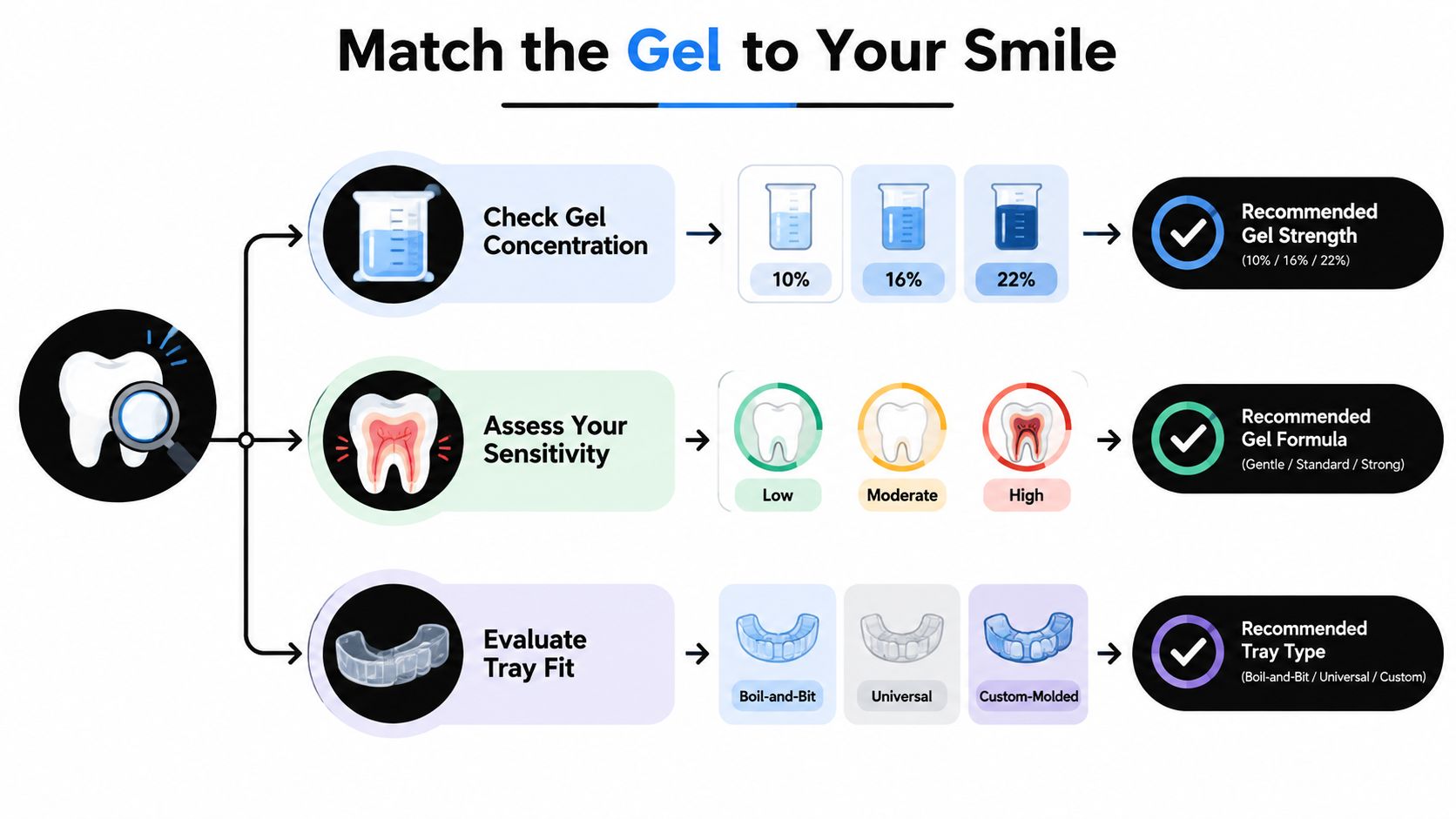
The right gel depends on the condition of your teeth, your tolerance for sensitivity, and the way your tray sits. Percentage alone can't answer those questions.
Clinical reviews report dentine sensitivity in roughly 15% to 65% of patients using 10% carbamide peroxide, usually mild to moderate and temporary, according to the European Commission scientific review. A classic home-whitening study also linked sensitivity strongly with gingival recession and reported different levels of sensitivity among users, including mild sensitivity in about half of participants, moderate sensitivity in 10%, and severe sensitivity in 4%, as summarized in the PubMed record for the study.
A newer study found that an 8% carbamide peroxide gel produced statistically lower tooth sensitivity than a hydrogen-peroxide comparator, while both groups reported only mild sensitivity. The 2025 clinical study in BMC Oral Health reinforces the point that the lowest sensible strength may be the better choice for comfort-focused users.
Start with your sensitivity profile
Low sensitivity means you rarely experience twinges and haven't recently dealt with dental work or cold sensitivity. A moderate CP product may be reasonable, provided the tray fits well and you follow the stated schedule.
Moderate sensitivity includes cold sensitivity, mild gum recession, or occasional sharp sensations during whitening. Lower or mid-range CP, such as 10% to 16%, generally makes more practical sense over a longer routine than jumping straight to a stronger formula.
High sensitivity includes exposed roots, known peroxide sensitivity, or discomfort that persists after previous whitening. Consider a lower concentration, such as 5% to 10% CP, shorter sessions, or a dental assessment before purchasing. Potassium nitrate and fluoride may help support comfort, but they don't make an unsuitable tray or untreated dental problem safe.
Wear time changes the whole decision
A 10% CP gel worn overnight creates a different treatment experience from a 22% CP gel worn for 30 minutes. The first emphasizes longer, lower-intensity contact. The second emphasizes shorter contact at a higher concentration. Never compare the percentages without comparing the instructions.
Tray fit is just as important. A loose stock tray can push gel onto the gums and create uneven contact. A boil-and-bite tray offers more control than a generic one-size tray, while a custom-moulded tray provides the most predictable fit and gel placement. The price difference is a cost-versus-control decision, not a minor accessory choice.
Use this checklist before ordering:
- Current sensitivity, especially cold sensitivity or exposed roots.
- Existing fillings, crowns, cracks, cavities, or gum concerns.
- Desired speed, balanced against your tolerance for discomfort.
- Whether you can follow short daily sessions or prefer a longer routine.
- Whether your tray seals evenly without pressing gel onto the gums.
Why a Specialist Retailer Beats a General Marketplace
A general marketplace is optimized to complete a transaction. A dental specialist is better positioned to answer the questions that come before the transaction, such as whether 16% CP makes more sense than 35% CP, whether a product needs a custom tray, and what to do when sensitivity appears.
The biggest difference is traceability. A specialist retailer should know where its stock came from, maintain batch and expiry records, retain safety documentation, and explain any regional restrictions. It should also give you a real route to support after delivery. A marketplace listing may offer a lower price, but a seller can disappear after a dispute, ship an unmarked syringe, or present grey-market stock as domestic inventory.
Service differences show up after checkout
A specialist site may verify dentist registration where the product or jurisdiction requires it, offer returns for unopened tubes, and keep material safety data sheets on file. Those practices don't guarantee that every product suits every mouth, but they give the buyer a better chance of receiving genuine, correctly labelled stock.
DentalHealth.com sells professional-grade at-home dental care products, including whitening gels and kits from brands such as Opalescence, Zoom, and Pola, alongside sensitivity and remineralizing products. Its store provides product information, phone support, secure checkout, and shipping within the United States.
| Factor | Specialist Dental Retailer | General Marketplace Seller |
|---|---|---|
| Authenticity checks | Batch-traceable stock and identifiable suppliers | Varies by individual seller |
| Returns | Clear policy for unopened products | Policy may depend on seller and platform |
| Support | Staff familiar with gel strengths and tray use | Often limited to order support |
| Compliance | Product and regional requirements are more likely to be addressed | Buyer may need to investigate independently |
| Stock transparency | Expiry and product details can be documented | Images and descriptions may be incomplete |
The marketplace isn't automatically unusable. It's a place where the buyer must perform more of the verification work. For peroxide gel, that work includes checking the exact active ingredient, confirming expiry, examining packaging, and ensuring the seller can answer basic product questions.
Buying principle: Save money on unnecessary strength, not on authenticity checks.
A credible specialist retailer should make comparison easier, not pressure you toward the strongest syringe. Choose the seller that can explain the product, document the stock, and stand behind an unopened return.
DentalHealth.com offers professional-grade at-home whitening gels, trays, sensitivity products, and established brands with product details and customer support. Visit DentalHealth.com to compare gel strengths and choose a whitening setup based on your concentration, tray, and comfort needs.