
Teeth Whitening Gel Price: What You'll Actually Pay
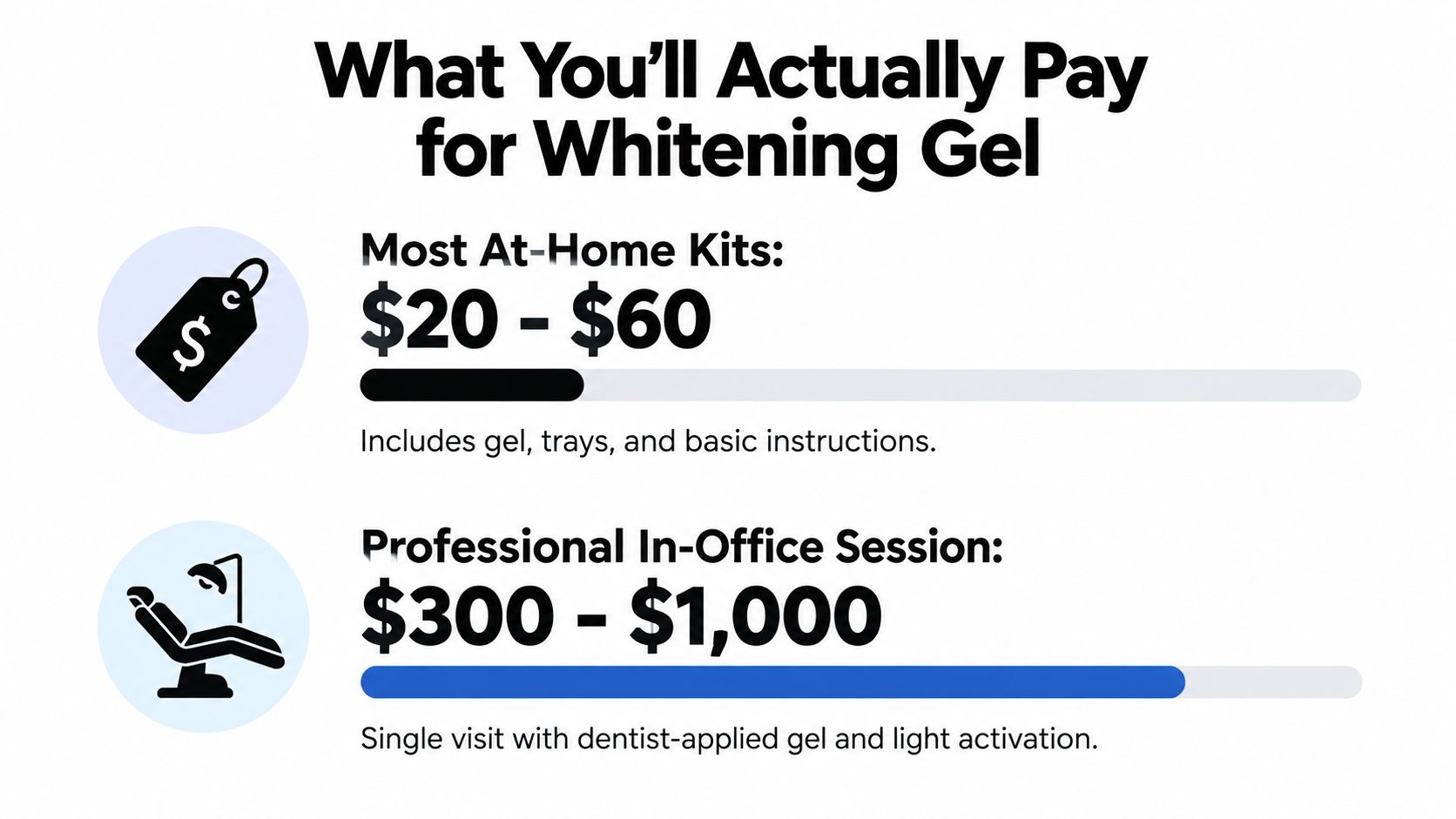
At-home whitening gels typically run $20 to $60 per kit, while professional in-office whitening usually costs $300 to $1,000 per session. The figure that matters is cost per treatment, because a cheaper-looking kit can deliver fewer applications and cost more each time you use it.
That's the counterintuitive part of the teeth whitening gel price conversation. The box price is only the entry fee. Shipping, syringe volume, peroxide concentration, tray design, and refill availability decide what you'll really spend.
A 2023 peer-reviewed analysis found advertised at-home whitening prices ranging from $10.80 to $85.20, with a mean of $26.90, while shipping ranged from $0 to $17.30 and could add as much as 42.5% to the purchase price. The market isn't organized around one reliable standard price, so shoppers need a better yardstick than the number printed beside the product photo.
The True Cost of Whitening Gel
The sticker price is a poor buying guide. At-home whitening gel kits commonly cost $20 to $60, while professional dental whitening generally runs $300 to $1,000 for one session. Market coverage documents this at-home versus professional whitening price gap, but the gap alone does not prove that a cheaper kit offers better value.
Start with the number of complete treatments in the box. A $25 kit lasting only a few uses can cost more per session than a $55 kit with enough gel for a longer cycle. Starter packages may also include trays, an LED device, or other accessories. Those extras raise the upfront price, yet they may reduce separate purchases later.
Start with the treatment count
Check the total syringe count, the gel volume in each syringe, and the stated application instructions. Divide the purchase price by the number of realistic treatments, not by the number of days used in the marketing copy.
A consumer listing analysis found many products clustered in the $20 to $50 range, with an average listing price of $46.31. That figure still says little about how long a kit lasts. The consumer listing analysis reinforces the useful comparison: calculate cost per use before judging the headline price.
Practical rule: Treat the box price as a starting point. Treat the number of usable applications as the true price tag.
Separate product tiers from dental services
At-home gel is a product you apply repeatedly. In-office whitening is a supervised dental service. The payment covers different inputs, including gel volume, application control, trays, professional oversight, and speed.
Before buying, record four details:
- Total gel volume
- Peroxide concentration
- Included trays and accessories
- Expected treatments per kit
For more detail on the purchase factors behind a kit, review this guide to teeth whitening kit price. Choose the lowest credible cost per treatment that fits your sensitivity and whitening goal, rather than the lowest number on the product page.
What Drives the Price Tag
Four variables control most of the price difference between whitening gels. Peroxide concentration matters, but it isn't the only reason a kit costs more. Packaging, brand positioning, syringe size, and included equipment can move the final price just as sharply.
Peroxide concentration
Stronger formulas generally command more because they require more careful stabilization, packaging, and usage instructions. A higher concentration can also reduce the amount of gel needed for a treatment cycle, but stronger isn't automatically better for every shopper. Sensitivity tolerance and tray fit matter just as much.
The key point is to compare products within similar concentration and format categories. A low-priced refill shouldn't be compared directly with a dentist-oriented kit that includes custom-tray compatibility and professional packaging.
Brand positioning
Dentist-distributed brands often cost more than unfamiliar marketplace labels. That premium may reflect formulation consistency, packaging, instructions, support, and distribution costs. It can also reflect brand recognition, so don't assume every extra dollar buys a stronger result.
A product page should tell you what active ingredient it uses, its concentration, the amount supplied, and how it's intended to be applied. If the listing hides those details, the low price isn't enough reason to trust it.
Syringe volume and pack size
Larger packs typically lower the cost per syringe. An independent review documented a professional-style kit containing 10 syringes of 22% carbamide peroxide for under $25, or about $2.50 per syringe. The review of multi-syringe whitening gel economics shows why bulk packaging can change the calculation substantially.
Still, buying more only saves money if you'll use the gel before it becomes unusable or you lose interest in the routine. Unused product is not a discount.
Accessories and presentation
Trays, storage cases, sensitivity products, and LED attachments can raise the price. Some accessories are useful, while others mainly make a kit look more complete.
| Factor | Low-End Impact | High-End Impact |
|---|---|---|
| Peroxide concentration | Lower entry price and gentler positioning | Higher price for stronger or professional-style formulas |
| Brand positioning | Marketplace or lesser-known label | Dentist-distributed or established professional brand |
| Syringe volume | Smaller pack with higher refill frequency | Multi-syringe kit with lower unit cost |
| Included accessories | Gel-only or basic tray | Custom-tray compatibility, storage, sensitivity care, or LED device |
My view is blunt: pay for clear formulation details and usable volume before paying for decorative extras. An LED attachment shouldn't distract you from a poor-fitting tray or an unclear treatment count.
Price Tiers From Budget to Professional Strength
Sticker price is a poor guide to whitening value. Sort gels by intended use, formulation, tray fit, and realistic treatment coverage. The same tier can serve very different buyers, so judge the product by what it can do and how consistently you will use it.
| Tier | Price Range | Peroxide Strength | Typical Outcomes |
|---|---|---|---|
| Consumer | $15 to $30 | Lower-strength formulas | Mainly surface-stain improvement |
| Mid-tier | $35 to $75 | Moderate to stronger at-home formulas | More substantial treatment cycles |
| Professional-strength at home | $80 to $150 | Higher-strength or dentist-formulated gels | Intensive at-home whitening with suitable trays |
Consumer gels are the simplest entry point. Choose this tier for occasional maintenance, mild surface discoloration, or a small trial before committing to a longer routine. The low upfront cost comes with limits. A small package may provide too little gel for a full course, and a basic tray can waste product or spread it unevenly.
Mid-tier kits
Mid-tier kits usually offer the clearest balance between gel volume, tray quality, and treatment guidance. They suit buyers who want to complete a planned cycle rather than test whitening for only a few applications.
Check the practical details before paying for branding. Confirm the amount of gel included, the application instructions, the tray's ability to distribute gel evenly, and the availability of replacement refills. A familiar label does not compensate for poor fit or an unclear treatment count.
Professional-strength home systems
Professional-style home systems cost more because they may use stronger formulas, provide more structured instructions, or work with better-fitting trays. This tier makes sense for regular maintenance when you will use the supplied gel instead of letting it sit unused.
The concentration also changes the buying decision. A stronger formula may require fewer applications, while a lower-strength gel may suit shoppers who prefer a gentler routine. Compare the expected treatment cycle, not just the syringe count or the number printed on the peroxide label.
A premium gel is still poor value if the tray leaks, the directions are vague, or the kit contains more product than you can use. My recommendation is direct: pay for a clear formula, reliable tray compatibility, and a realistic course length before paying for presentation or extras.
Cost Per Treatment The Number That Matters
Cost-per-treatment math is simple, but retailers rarely put it in the headline. Take the total price and divide it by the number of applications the supplied volume can realistically support.
The verified multi-syringe example is useful here. A kit with 10 syringes of 22% carbamide peroxide priced under $25 works out to roughly $2.50 per syringe, before accounting for how much gel you use in each tray. The same review estimates about $1.25 to $2.50 per treatment, depending on tray design and dose usage, as documented in the whitening gel cost-per-use review.
Use this calculation
- Find the total kit price.
- Find the total gel volume.
- Estimate the amount used per application from the product instructions.
- Divide total volume by gel used per application.
- Divide the kit price by the resulting number of treatments.
For example, if a product contains 12 milliliters and the instructions call for 0.4 milliliters per application, the theoretical treatment count is 30 applications. That is only a planning estimate. Tray design, waste, uneven dispensing, and the user's technique can reduce the practical number.
Cost-per-use beats cost-per-syringe. A large syringe isn't automatically economical if the tray requires more gel or leaves product unused.
| Kit Example | Total Volume | Est. Sessions | Total Price | Cost Per Treatment |
|---|---|---|---|---|
| Multi-syringe 22% carbamide peroxide kit | Not specified in source | Varies by dose and tray | Under $25 | About $1.25 to $2.50 |
| Small refill | Check product label | Divide volume by application dose | Check listing | Price divided by realistic sessions |
| Larger refill pack | Check product label | Divide volume by application dose | Check listing | Usually lower when the gel is used fully |
Don't copy a retailer's “up to” treatment count without checking the application amount. Use the manufacturer's dose guidance, then add the actual shipping charge before dividing. A low sticker price with expensive delivery can lose to a slightly higher-priced kit shipped at no extra cost.
At-Home Gel vs In-Office Whitening
At-home gel costs less per purchase, while in-office whitening charges for speed, supervision, and convenience. Compare the treatment pattern and realistic cost per use, not just the checkout total. The better choice depends on how quickly you need a visible change and how consistently you will follow a routine.
| Factor | At-Home Gel | In-Office Whitening |
|---|---|---|
| Upfront cost | Lower product purchase | Higher service fee |
| Treatment pattern | Repeated applications over a treatment cycle | Single supervised appointment |
| Speed | Gradual shade change | Faster visible change |
| Main value driver | Gel volume and cost per use | Professional application and convenience |
| Best fit | Budget-conscious maintenance and gradual whitening | Time-sensitive or intensive whitening goals |
At-home gel works best when you can follow the instructions over a treatment cycle. The lower price only holds if the tray fits properly, the gel is used at the recommended dose, and the product remains available for future applications. Refills and replacement trays can change the practical cost.
In-office whitening costs more because you are paying for a dental visit as well as the whitening process. The fee covers professional application, gum protection, and decisions made during the appointment. That premium makes sense when timing matters or when you want supervision rather than a repeatable home routine.
Choose by time, not just budget
A low cost per treatment does not compensate for a schedule that requires results quickly. Home whitening may require repeated applications, while an office appointment concentrates the process into a supervised visit. Choose the office route for a deadline. Choose home gel when gradual progress and maintenance matter more.
Routine also affects value. A kit used consistently can spread its cost across multiple applications. A kit left unused is expensive regardless of its sticker price. In-office treatment can be wasteful for someone maintaining an already bright smile, but useful for someone starting with a specific event or a strong preference for professional oversight.
A practical plan combines both options. Some shoppers use professional whitening for the initial change, then maintain the shade with a compatible home system. Others skip the office and accept slower progress. In either case, calculate the home option by realistic treatments, not syringe count.
For a separate explanation of the dental-service side of the calculation, see professional teeth whitening price. Do not compare a complete home kit with an office session as identical products. One is a reusable treatment supply. The other is a supervised service with a different convenience premium.
Hidden Costs Most Comparisons Miss
The headline price often leaves out the items that determine whether the kit remains affordable. Shipping is one of the clearest examples. The 2023 analysis found shipping charges from $0 to $17.30, with delivery adding as much as 42.5% to the listed product price in some cases, according to the peer-reviewed analysis of whitening product marketing and shipping.
A small order can look cheap until delivery is added at checkout. Internationally shipped refills and starter kits deserve especially close scrutiny because shipping may change the final cost more than the gel itself.
The costs that change the calculation
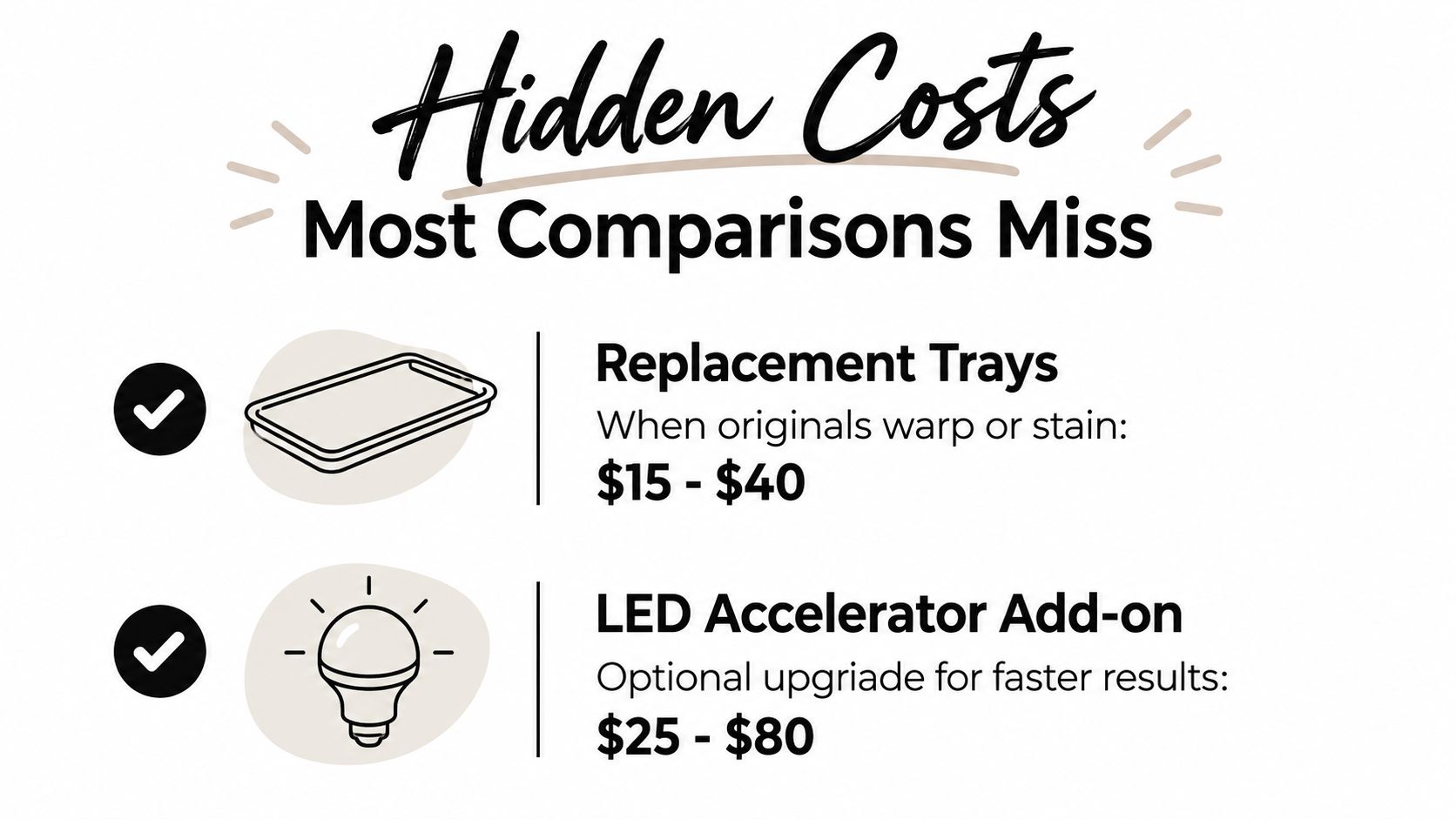
- Replacement trays: A warped, stained, or poorly fitting tray can force a second purchase. A new tray also changes how much gel you use.
- Sensitivity care: If whitening causes discomfort, you may need a desensitizing product before continuing. That's a real cost, not an optional luxury for every user.
- Refills: A kit may be inexpensive initially but costly to maintain if refills come in small quantities or carry higher delivery charges.
- Unused accessories: An LED device or storage case adds value only if you'll use it. Don't count an accessory as savings when it doesn't affect your routine.
- Poor fit: A generic tray that leaks can waste gel and irritate the gums, turning a low-cost kit into an expensive replacement cycle.
Sensitivity and irritation deserve their own safety review, especially if you're tempted to use more gel to speed up results. DentalHealth.com's discussion of teeth whitening gel side effects is relevant before you compare formulas.
My recommendation is practical: calculate the delivered price, estimate realistic treatments, and leave room for replacement or sensitivity products. The cheapest responsible purchase is the one you can use correctly without immediately buying missing components.
Matching the Right Price to Your Goals
Your goal should determine the tier, not the other way around. Buying the strongest available gel because it appears more powerful is poor retail judgment if you're sensitive, need only occasional touch-ups, or don't have trays that fit properly.
| Your Situation | Recommended Price Tier | Carbamide Peroxide | Target Cost Per Treatment |
|---|---|---|---|
| Occasional touch-ups | Budget | Lower-strength formula | Keep it low by buying only the volume you'll use |
| First whitening course | Mid-tier | Moderate-strength formula | Compare total price with realistic session count |
| Persistent or severe discoloration | Professional-strength home or in-office | Higher-strength professional-style formula | Prioritize predictable use and suitable supervision |
Occasional maintenance
If you're touching up mild staining, a smaller kit can be the sensible choice. You avoid paying for excess gel and reduce the chance that the product sits unused. Focus on a straightforward formula, a usable tray, and transparent instructions.
First-time buyers
For a first full course, the mid-tier usually offers the best balance. You're more likely to get enough gel for consistent use, better application equipment, and a clearer understanding of what the routine involves. Don't pay extra for an LED feature unless the rest of the kit makes sense without it.
Difficult discoloration
Severe or intrinsic discoloration may not respond predictably to an inexpensive consumer gel. A professional-strength take-home system or an in-office consultation is the more rational path, particularly when restorations, sensitivity, or an uneven starting shade are involved.
Before you buy, check three things:
- Concentration and comfort: Match the formula to your sensitivity tolerance and follow the product's instructions.
- Treatment count: Divide the total price by the realistic number of applications, not the marketing maximum.
- Included equipment: Confirm whether the kit includes trays, storage, and any sensitivity support you need.
For shoppers comparing professional-grade at-home options, DentalHealth.com offers whitening gels and related oral-care products from brands such as Opalescence, Zoom, PolaNight, and PolaDay, with product listings that let you compare gel format and price before checkout. Visit the site, calculate the delivered cost per treatment for the kits you're considering, and choose the option that fits your goal rather than the loudest claim on the package.