
Teeth Whitening Trays Dentist: Choosing the Right Fit
A patient will often sit up in the chair, hold a drugstore whitening kit in one hand and a brochure for custom trays in the other, and ask the same question in different words: which one works?
That's usually the wrong starting question.
The better question is which tray fits your mouth, your sensitivity history, and your habits. I've seen people do beautifully with simple tray systems, and I've seen others waste money on products that were never going to fit well enough to work comfortably. Teeth whitening trays from a dentist aren't automatically the right answer for everyone, but they are often the most predictable answer for the right patient.
Meeting Patients at the Whitening Crossroads
Individuals shopping for whitening trays think they're choosing between expensive and cheap. In practice, they're choosing between precision, tolerance, and follow-through.
A patient with straight teeth, no old bonding on the front teeth, and no history of sensitivity can sometimes do fine with a simpler option. Another patient with crowding, recession, or one front tooth with composite near the gumline needs much tighter control. Put the same whitening gel in both mouths and the experience won't be the same.
The tray isn't the whole story
When I look at whitening candidacy, I'm usually sorting patients into three broad groups:
- Dentist-made custom trays for people who need close adaptation to each tooth and better gel control
- OTC custom-fit trays for people who want a middle ground and are willing to mold the tray carefully at home
- Boil-and-bite trays for people who want the lowest barrier to entry and understand the trade-offs
Those trade-offs are practical, not theoretical. Fit changes how evenly the gel sits. Gel control changes how much reaches the gums. Comfort changes whether you'll wear the trays long enough to finish the treatment.
Chairside rule: the “best” whitening tray is the one a patient can wear correctly, consistently, and without enough irritation to quit halfway through.
Matching matters more than marketing
Brand names tend to dominate online searches, but whitening results depend more on tooth shape, previous sensitivity, restorations, schedule, and budget than on package claims. That's also why people who run a patient-facing practice often find that education matters as much as treatment. If you're working on better communication around cosmetic services, resources like Google review scripts for dentists can help a team explain options more clearly before the patient ever sits down.
For a basic overview of in-office versus take-home approaches, professional teeth whitening basics gives useful background. The decision, though, comes down to fit.
| Feature | Dentist-Made Custom | OTC Custom-Fit | Boil-and-Bite |
|---|---|---|---|
| Fit precision | High | Moderate | Low to moderate |
| Comfort | Usually best | Variable | Often bulky |
| Gel control | Strong | Fair | Weak |
| Gum exposure risk | Lower when trimmed well | Moderate | Higher |
| Reusability | High | Moderate | Lower |
| Best for | Sensitive, crowded, restoration-heavy cases | Straightforward mild cases | Occasional short-term use |
How Whitening Trays Actually Work
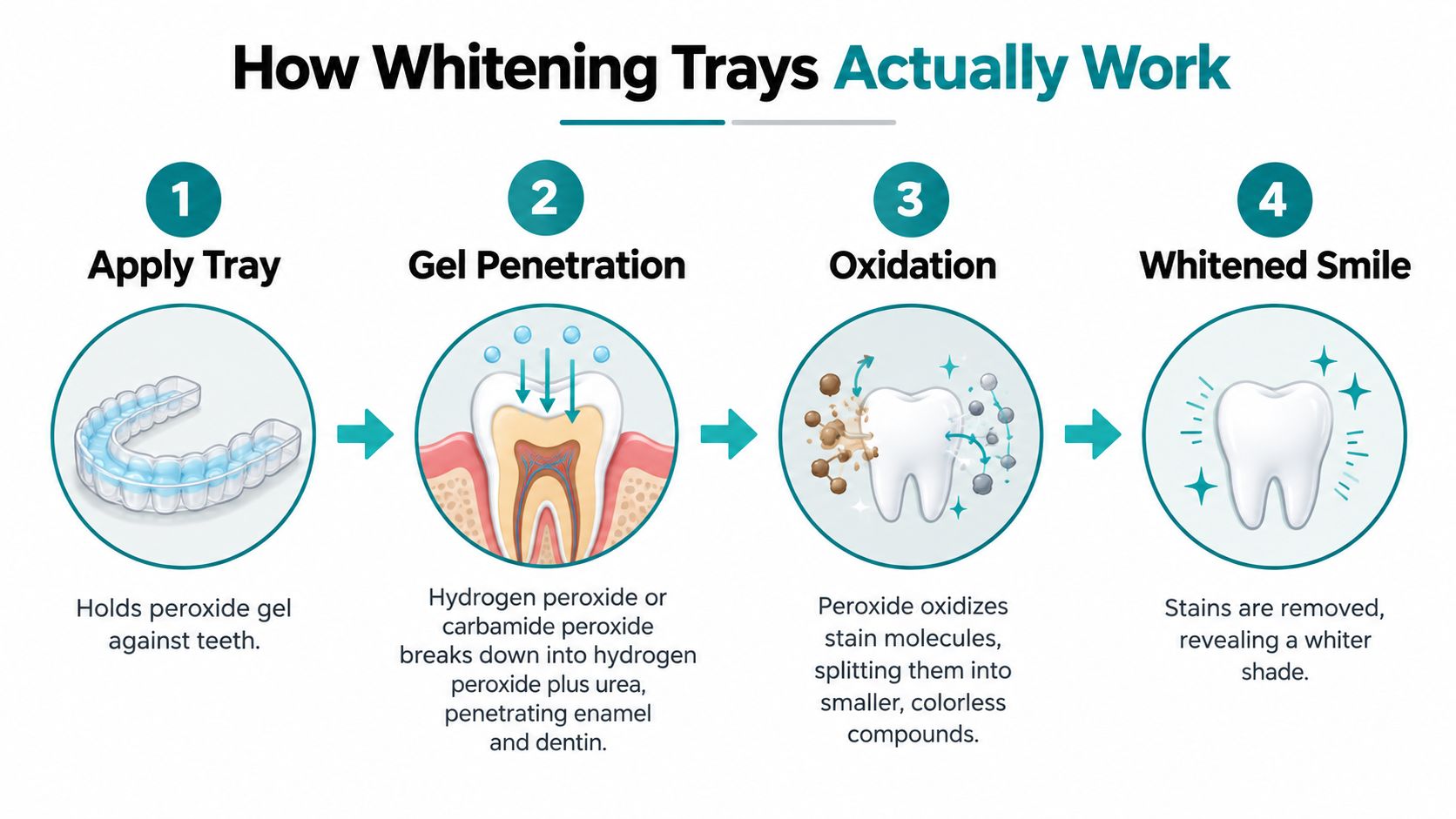
Whitening trays work because they keep peroxide gel in steady contact with the enamel long enough to do useful work. That contact time is what separates trays from many paint-on products that disappear quickly in saliva.
What the gel is doing
Most tray systems use carbamide peroxide or hydrogen peroxide. Carbamide peroxide breaks down into hydrogen peroxide plus urea. The peroxide then moves through enamel and into dentin, where it oxidizes stain molecules trapped within the tooth structure.
That matters because many stains aren't just sitting on the outer surface waiting to be scrubbed off. Coffee, tea, wine, tobacco, and age-related yellowing often sit deeper than people expect. If you want a more detailed chemistry overview, how carbamide peroxide whitens teeth explains the breakdown process clearly.
Why tray delivery changes the outcome
A tray holds a thin film of gel against the teeth across a longer wear window. That does two things well:
- It limits washout by saliva
- It improves coverage across the tooth surface
Dentist-supervised at-home bleaching has a long clinical history, and a review of the evidence found no difference in color change outcomes between at-home and in-office bleaching (p = 0.95) and no difference in post-treatment sensitivity (p = 0.85), with low- and high-concentration products in the ranges of 5% to 15% carbamide peroxide and 5.5% to 6% hydrogen peroxide similarly effective overall (umbrella review summary).
Fit drives both comfort and performance
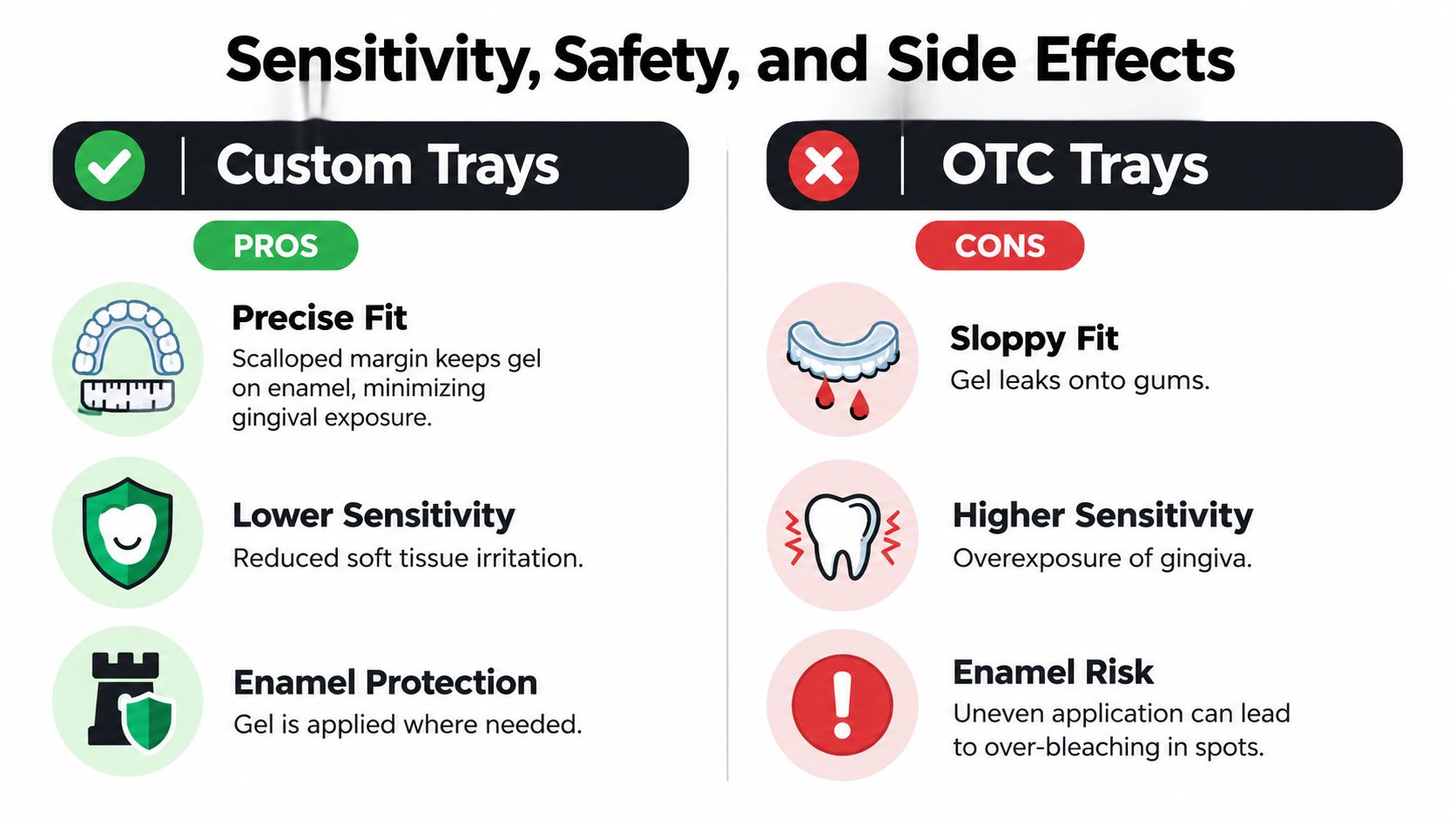
Poorly fitting trays don't just feel awkward. They leak. Once gel spills onto the gingiva, patients often get that white, irritated gum look and assume whitening “isn't for them,” when problem is tray control.
Reservoir design gets a lot of attention, but fit is the bigger issue in day-to-day use. A tray that hugs the arch well usually matters more than marketing language about special features.
Comparing the Three Main Tray Types
If you strip away packaging, there are three common tray paths people consider. Their differences show up fast once you look at fit, edge seal, and how repeatable the experience is.
Side by side in the operatory
Dentist-made custom trays are fabricated from an impression or scan. They adapt tooth by tooth, can be trimmed with more precision, and usually feel thinner than over-the-counter versions. Some are scalloped around the gumline, while others are cut straighter depending on the case and product preference.
OTC custom-fit trays use thermoplastic material that the patient softens and molds at home. They can work decently for mild cases, but the molding quality depends on how well the person follows instructions. If they overheat, under-seat, or distort the tray during molding, the fit drops off fast.
Boil-and-bite trays are the roughest option. They tend to feel thicker, they can bunch in the back, and they often lose shape after repeated handling. Patients who gag easily or clench at night usually dislike them almost immediately.
| Feature | Dentist-Made Custom | OTC Custom-Fit | Boil-and-Bite |
|---|---|---|---|
| Fit | Precise, tooth-by-tooth | Depends on home molding | Broad, less exact |
| Comfort | Usually thin and stable | Mixed | Often bulky |
| Gingival seal | Better control | Acceptable if molded well | More likely to leak |
| Durability | Long-term reusable | Moderate | Can warp sooner |
| Ease of use | Easy after fabrication | Learning curve at setup | Simple to start, less refined later |
The details patients feel right away
A custom tray from a dentist usually wins on these practical points:
- Margin control helps keep gel where it belongs
- Less bulk makes speech and swallowing easier
- Repeatability matters if you want touch-ups later
OTC custom-fit trays can be a smart middle option for someone with a fairly even arch and modest expectations. They're less forgiving in mouths with crowding or recession because gaps form where the tray doesn't adapt closely.
Boil-and-bite trays are the most likely to create pooled gel spots. That often means one area gets too much contact while another barely gets enough.
A tray can be inexpensive and still be the wrong fit. Most whitening failures I see are fit failures first, chemistry failures second.
One old question that matters less than people think
Patients sometimes ask whether a tray needs reservoirs to work well. Clinical evidence reported that reservoirs in bleaching trays did not change color improvement, tooth sensitivity, or gingival irritation during dentist-supervised home bleaching, according to the review and trial discussion in the Brazilian Oral Research review article. In real use, I care more about tray adaptation and patient compliance than whether there's a built-in gel pocket.
Effectiveness and Shade Stability
Patients usually want a simple ranking of which tray whitens the most. Real life is messier. The tray that performs best is the tray that keeps gel where it should be and gets worn as directed long enough to finish the process.
What custom trays do well
Dentist-supervised tray whitening has strong benchmark status around 10% carbamide peroxide, which has historically been the American Dental Association accepted at-home tray regimen. Controlled evidence found similar shade improvement across 10% and 16% carbamide peroxide trays and even 37% in-office peroxide, showing that concentration alone doesn't linearly create better final whitening within common clinical ranges. In the same randomized clinical trial, all tray groups improved by more than 1 unit on key color metrics after 14 days, while the 15% and 20% carbamide peroxide groups showed 17% and 68% greater yellow reduction than the 10% group (clinical trial summary).
That's a useful point for patients. A stronger gel can reduce yellowness more aggressively, but that doesn't mean every person needs the strongest option.
| Tray Type | Avg. Shade Improvement | Peroxide Concentration | Typical Treatment Time | Shade Stability |
|---|---|---|---|---|
| Dentist-made custom | Strong, predictable | Commonly lower to moderate professional strengths | Days to weeks depending on regimen | Good, easy to maintain |
| OTC custom-fit | Moderate | Usually lower consumer strengths | Days to weeks | Moderate |
| Boil-and-bite | Less predictable | Varies | Often inconsistent due to fit | Lower, often harder to maintain |
Stability matters after the first whitening cycle
Independent long-term clinical data showed that individualized dentist-made trays with 16% carbamide peroxide used for 90 minutes daily over 4 weeks produced whitening that remained stable for 42 months. A systematic review and meta-analysis also found a small but statistically significant advantage for tray-delivered carbamide peroxide in overall color change, with ΔE standardized mean difference -0.45, 95% CI -0.69 to -0.21, while tooth sensitivity and gingival irritation were not significantly different between tray carbamide peroxide and hydrogen peroxide systems (long-term and meta-analysis findings).
What doesn't respond well
No tray type is magic for every stain. Gray intrinsic discoloration, tetracycline staining, trauma-darkened teeth, and teeth with visible anterior restorations are often where expectations need adjusting.
In those cases, a better tray helps with control. It doesn't change the biology of the stain.
Sensitivity, Safety, and Side Effects
Patients can tolerate whitening. The bigger issue is whether they can tolerate it well enough to stay consistent without overdoing it, skipping days randomly, or quitting after the first sharp zing.
The side effect patients notice first
The American Dental Association notes that sensitivity can occur in up to two-thirds of users during early bleaching and is usually temporary. Evidence also shows that 10% carbamide peroxide at-home whitening produced the lowest sensitivity while still achieving color change efficacy similar to higher-concentration options, and another review found at-home bleaching had a similar sensitivity incidence to in-office bleaching but lower average intensity (clinical summary of take-home gel safety and efficacy).
That lines up with what many patients report clinically. The lowest concentration that gets the job done is often the concentration they'll finish.
Where tray type affects safety
Fit is the biggest variable I watch. A precise tray usually reduces soft tissue exposure because less gel escapes onto the gums. Loose trays are the ones that create whitening burns, patchy overexposure, and patient frustration.
If you want a practical overview of common reactions, teeth whitening gel side effects covers the usual symptoms and when to pause treatment.
Patients at higher risk of discomfort include those with:
- Gum recession that exposes root surfaces
- Cracked teeth that already react to temperature
- Untreated decay where peroxide can aggravate the tooth
- Heavy clenching or grinding because those teeth are often already touchy
- Large visible fillings or bonding that won't whiten with the surrounding enamel
Ways to reduce problems
You don't always need to stop whitening. Often you need a different protocol.
- Use shorter wear times if sharp cold sensitivity starts
- Take rest days instead of forcing daily use through pain
- Switch to a lower concentration rather than chasing speed
- Add desensitizing support such as potassium nitrate and fluoride products if your dentist recommends them
If a patient tells me, “I can whiten, but I can't whiten two days in a row,” that's still workable. We adjust the schedule before we abandon the treatment.
Which Patient Profile Fits Each Tray
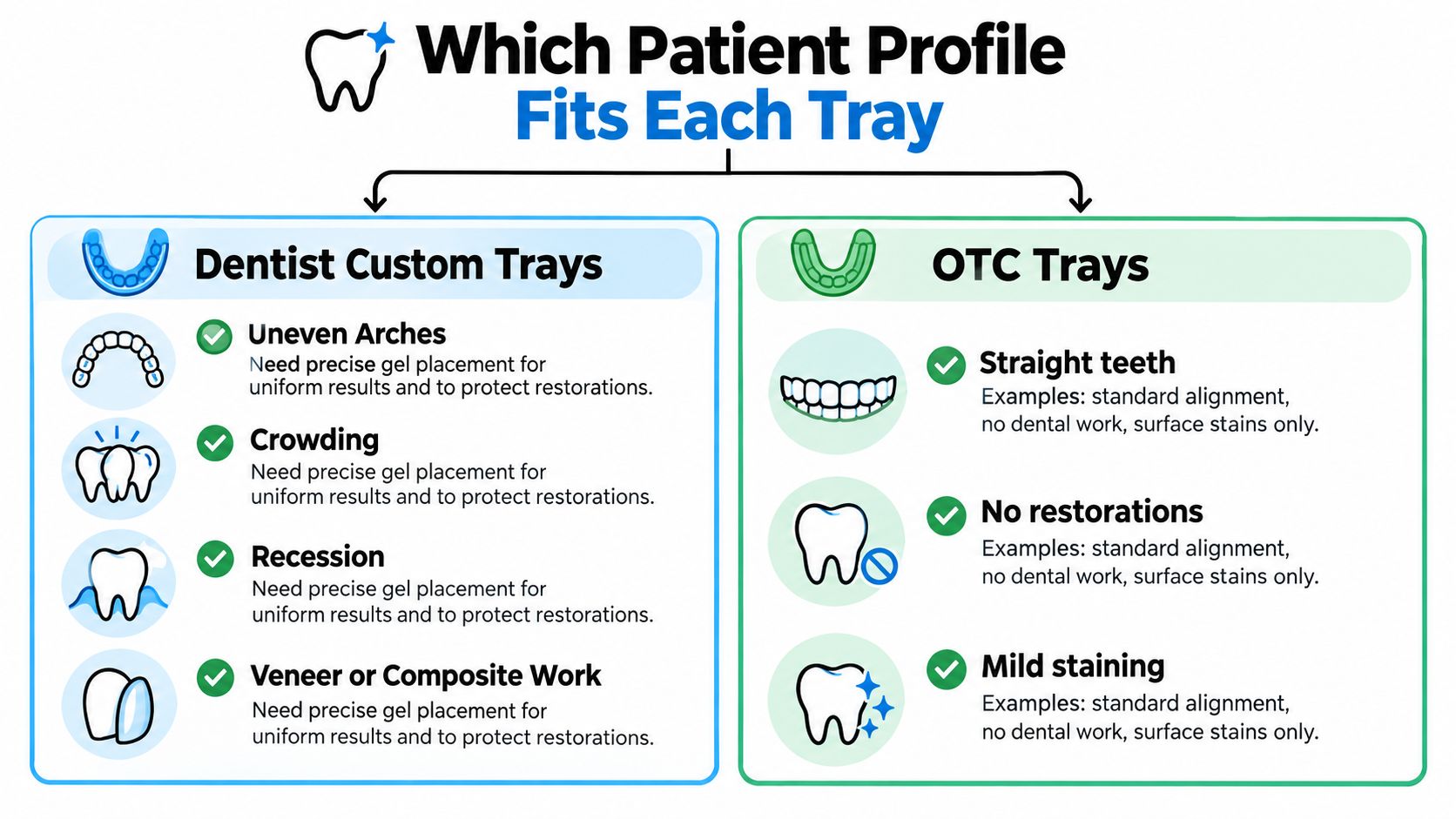
The most useful way to choose teeth whitening trays from a dentist versus store-bought trays is to stop ranking products and start matching patient profiles.
Good matches for dentist-made custom trays
Custom trays make the most sense when the mouth itself creates a placement problem.
That includes patients with uneven arches, crowding, recession, short clinical crowns, or visible veneer and composite work. In these cases, precise gel placement matters because you're not just trying to whiten. You're trying to avoid the gums, avoid flooding around restorations, and keep the treatment visually even.
When OTC custom-fit trays are reasonable
OTC custom-fit trays are often fine for adults with relatively straight teeth, mild generalized staining, and no strong history of sensitivity. They also fit people who don't want an impression or scan and are comfortable following molding instructions carefully at home.
These patients usually do best when they keep expectations moderate. They want a cleaner, brighter look, not a highly managed cosmetic plan.
A newer clinical discussion around tray format and comfort also suggests the delivery system itself changes how whitening feels. A 2025 clinical trial of prefilled or custom whitening trays reported little to no sensitivity overall but also measurable subject-reported sensitivity during the first two weeks, and newer low-concentration home bleaching data showed both tested gels produced only mild sensitivity with statistically significant differences between formulations, as summarized in this discussion of professional whitening versus OTC strips.
Who should skip at-home whitening for now
Some people need treatment before whitening is even worth discussing.
- Active cavities need to be restored first
- Periodontal inflammation should be stabilized first
- Severe baseline sensitivity needs evaluation
- Pregnant patients are commonly advised to postpone elective whitening
- Extensive front-tooth restorations may need a cosmetic plan, not bleaching alone
This short video gives a helpful visual overview of how professionals think through whitening options in actual cases.
Compliance changes the right answer
A forgetful patient may do better with a simpler system they'll use. A motivated patient who likes maintenance routines gets more long-term value from reusable custom trays.
That's why I rarely present whitening as a straight price ladder. It's a fit problem first, then a product decision.
Cost Breakdown Beyond the Sticker Price
The cheapest tray isn't always the least expensive option over time. Whitening has an upfront cost, but it also has a maintenance pattern.
What you're really paying for
With dentist custom trays, the larger upfront cost usually buys precision, reuse, and easier touch-ups later. Once the trays fit well, future whitening often means replacing only the gel, not the whole system.
With OTC custom-fit trays, the lower initial cost can make sense for one whitening cycle. The trade-off is that you may end up remolding, replacing, or abandoning the trays if comfort is poor.
With boil-and-bite trays, the entry point is low, but the material often feels less stable over repeated use. Patients who want to whiten more than once frequently end up buying again.
| Cost Factor | Dentist Custom | OTC Custom-Fit | Boil-and-Bite |
|---|---|---|---|
| Upfront investment | Higher | Moderate | Lower |
| Reuse potential | Strong | Fair | Limited |
| Refill efficiency | Usually better | Variable | Variable |
| Replacement frequency | Lower | Moderate | Higher |
| Value for repeat users | High | Moderate | Lower |
Hidden costs patients miss
People often compare only the first receipt. They miss the indirect costs:
- Sensitivity management products if a poorly fitting tray makes whitening harder to tolerate
- Replacement after dental work if new bonding, crowns, or contour changes alter the fit
- Abandoned kits that looked cheaper but never got finished
- Repeat purchases when a disposable system can't be touched up easily
Practical buying rule: if you expect to whiten more than once, the reusable tray matters almost as much as the gel.
One body option worth knowing
If you want a simple prefilled alternative rather than a tray that needs hand-loading, products sold through retailers such as DentalHealth.com include Opalescence Go style disposable trays and tray-compatible gels like PolaNight 16% and PolaDay 9.5%. That doesn't replace professional evaluation, but it does give people a clearer sense of the formats available once they know which category fits them.
Recommendations and Next Steps
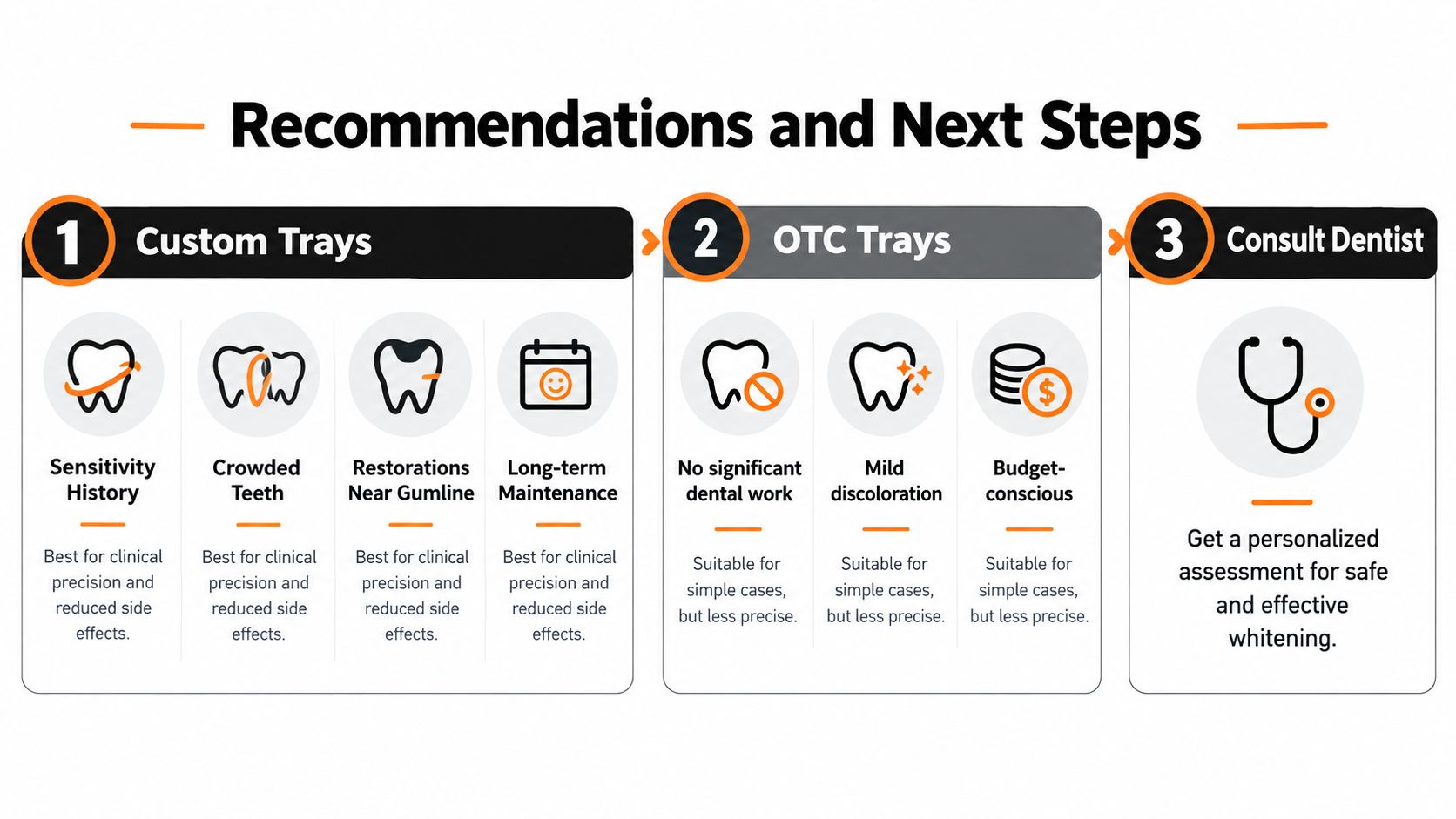
If you have a history of sensitivity, crowded teeth, recession, or restorations near the gumline, I'd lean toward dentist-made custom trays. They give the best chance of controlled gel placement and fewer avoidable side effects.
If your teeth are fairly straight, your staining is mild, and you want a practical middle option, OTC custom-fit trays can be reasonable. They're not as exact, but they can work well enough in uncomplicated mouths.
A simple decision checklist
Before you buy anything, sort yourself into these questions:
- Tooth shape: Are your teeth aligned cleanly, or do they overlap and twist?
- Sensitivity history: Have whitening strips or cold drinks bothered you before?
- Restorations: Do you have visible bonding, crowns, or veneers on the front teeth?
- Schedule: Will you reliably wear trays on repeated days, or do you need the simplest possible routine?
- Maintenance plan: Are you looking for a one-time brightening or something you can keep up over time?
What I'd tell a patient at checkout
Start with a whitening consult if there's any question about decay, recession, cracks, or visible restorations. Decide whether overnight wear or shorter sessions fit your routine better. If you know you're sensitivity-prone, begin a desensitizing toothpaste before treatment instead of waiting for the zingers to start.
For practices trying to explain these decisions better online, a technical content resource like the Melbourne dental SEO guide is useful because cosmetic patients often judge a clinic's clarity long before they book.
Boil-and-bite trays still have a place. I see them as a low-commitment entry point, not a long-term precision option. They can help someone test peroxide tolerance, but they're rarely the tray I'd choose for a sensitive mouth or for anyone who wants predictable repeat results.
DentalHealth.com carries professional-grade whitening gels, tray options, and sensitivity-support products that fit many of the situations discussed here, especially for patients maintaining results at home or replacing a simpler kit with a more targeted routine. If you want to compare tray-compatible gels, prefilled systems, and desensitizing products in one place, visit DentalHealth.com.