
Teeth Whitening with Crowns: What Works and What Doesn't
A crown doesn't lighten with peroxide gel. Only natural enamel and dentin do, so whitening can push your natural teeth past the 3.7 ΔE color-difference threshold that separates a matched smile from a visibly mismatched one, while the crown stays at exactly the shade it was cemented in.
Which raises a question the usual advice never answers: if whitening improves a smile, how can it make one tooth in that smile look worse?
Because the crown isn't a tooth that darkens on its own. It's a fixed object sitting beside teeth that change. Many patients arrive at teeth whitening with crowns looking for a gel strong enough to lift a restoration, and that product doesn't exist at any concentration or price. What exists is a plan, and the plan runs in one direction: settle the natural shade first, then choose the crown's shade against it.
Get that order right and whitening is simple. Get it wrong and you spend money brightening eight teeth while one of them stays a shade behind.
Do Crowns Respond to Whitening Gel?
No. A porcelain, ceramic, zirconia or porcelain-fused-to-metal crown holds the shade the lab built into it, while the enamel and dentin around it can brighten over a few weeks of gel wear. The Colgate guide to whitening a crown states the rule plainly: bleaching treatments do not change the intrinsic color of crown materials, and while whitening may remove some surface staining, a crown cannot become lighter than the shade selected when it was placed.
Surface stain and intrinsic shade are two separate outcomes. Peroxide can strip the film of coffee, tea and tobacco that sits on top of a glazed surface. It can't travel into a material that has no porous dentin to oxidize, so a crown can come out of a whitening course looking cleaner and still looking darker than its neighbors.
| Restoration | Responds to peroxide? | What whitening can change | Practical action |
|---|---|---|---|
| Natural enamel and dentin | Yes, lightens | Intrinsic shade and surface stain | Whiten first, then choose crown shade |
| Porcelain or ceramic crown | No | Surface stain only; shade stays fixed | Match new shade to whitened teeth |
| Zirconia crown | No | Surface stain only; shade stays fixed | Match new shade to whitened teeth |
| Porcelain-fused-to-metal crown | No, porcelain layer stays fixed | Surface stain only | Match new shade to whitened teeth |
| Composite resin crown or veneer | Limited | Surface stain; slight color drift over years | Polish, or replace if mismatch persists |
The consequence is a directional mismatch. Whiten the natural teeth after a crown is placed and the teeth get brighter while the restoration doesn't, which makes the crown read as darker and more yellow than it did a month earlier. On a front tooth, that shift is noticeable in photographs and in conversation. On a second molar, almost nobody sees it.
Three things to establish before you buy anything
- The material. Porcelain and zirconia behave differently from composite resin, which picks up surface stain and can drift slightly over the years. Composite can sometimes be polished back; ceramic can't be lightened at all.
- The age. An older crown has had years to collect surface stain and to sit beside natural teeth that have darkened on their own.
- The position. A central incisor sits in the smile line and any gap shows. A back tooth rarely does, which changes what's worth doing about it.
The answer to whitening around restorations isn't a product choice. It's a shade plan. The same logic applies to fillings, as our guide to teeth whitening with fillings sets out.
Why Crown Shade and Natural Teeth Drift Apart
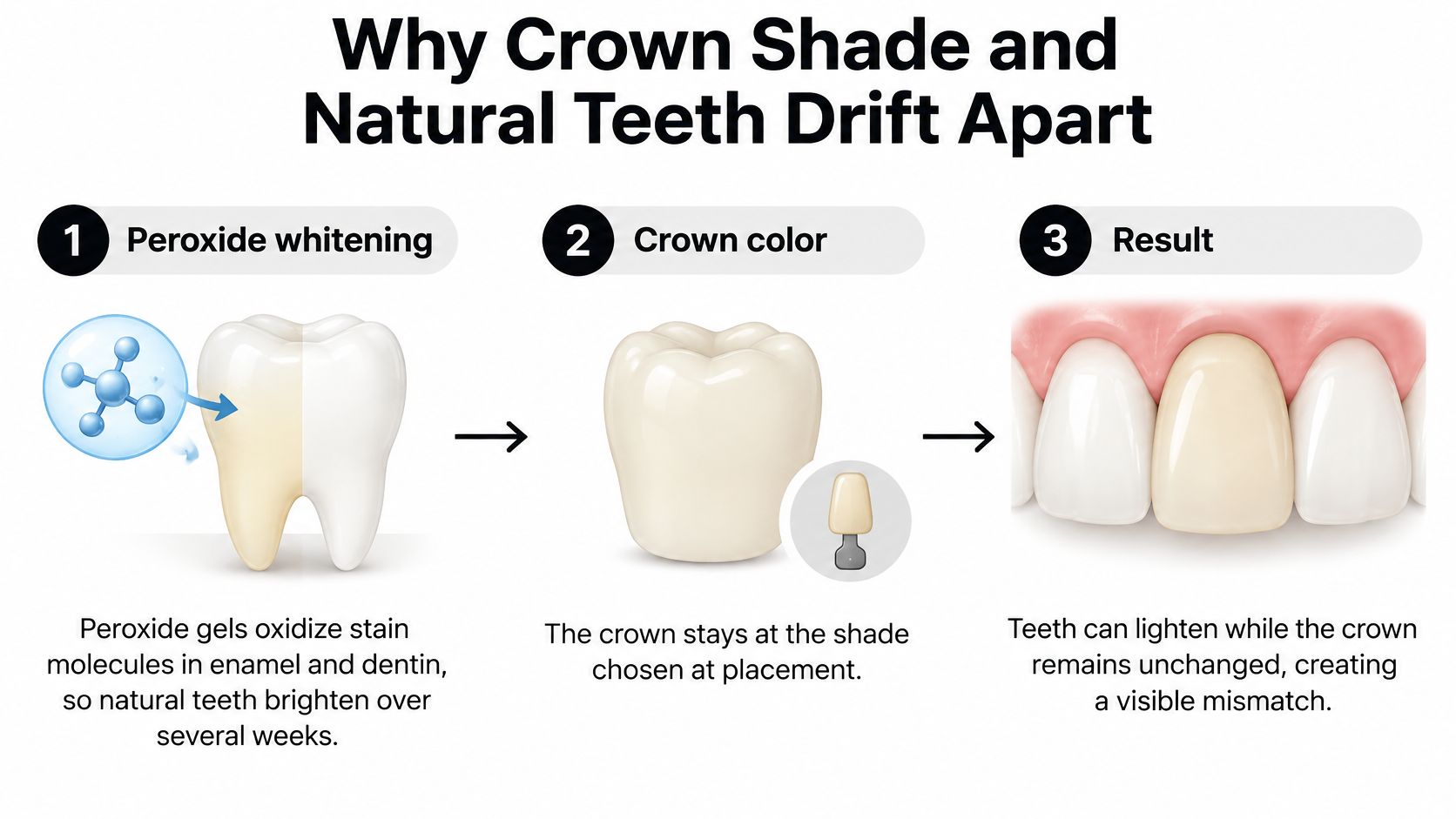
Peroxide gels work by oxidizing the organic stain molecules held inside enamel and dentin. Those molecules break apart over a series of sessions, so the natural tooth brightens gradually across several weeks. The crown has no such molecules to break, which is why its color never moves, no matter how long the gel stays in the tray.
That leaves a measurable gap between the restoration and the tooth next to it. Clinicians express the gap as ΔE, a single number that rolls up differences in lightness and hue. Small numbers mean the two look alike. Large numbers mean a patient can pick out the crown across a room.
What the color numbers look like in practice
In a 2021 clinical study of 45 patients receiving ceramic crowns, researchers compared shade-matching methods and measured the resulting color difference between the cemented crown and the adjacent tooth. Visual shade selection averaged ΔE 5.32, a digital camera averaged ΔE 2.75, and a smartphone with a light-correcting device averaged ΔE 2.34, all against a ΔE 3.7 threshold for acceptable color difference reported in the study indexed on PubMed.
| Shade selection method | Mean color difference (ΔE) | Against ΔE 3.7 threshold |
|---|---|---|
| Visual shade selection | 5.32 | Above threshold, visible gap |
| Digital camera | 2.75 | Below threshold, acceptable |
| Smartphone with light-correcting device | 2.34 | Below threshold, acceptable |
Read that table as a hierarchy of reliability. Matching by eye alone sat above the acceptability line, on average. Both digital methods sat below it. The study doesn't claim whitening changes a crown, because it doesn't; it shows that how the shade was recorded decides how close the match comes out.
Why timing moves the gap
The gap widens or narrows depending on order. Whiten after a crown is made and the natural tooth travels away from a color that can't follow, so a match that was acceptable on day one can drift into visible territory within weeks. Whiten before and the dentist is aiming at a target that has already stopped moving, which is the whole reason the sequencing question matters more than the percentage on the gel label.
When you next sit in the chair, ask two specific things: whether the shade was recorded digitally rather than by eye, and whether it was recorded under controlled lighting before the crown was fabricated.
A question worth asking early: ask whether your crown shade was recorded with a digital camera, and whether that record is kept in your chart. A practice that can't answer has no baseline to work from.
How to Sequence Whitening and Crown Shade Selection
The order below is the one that holds up, whether you're planning a new crown, replacing an old one, or whitening around a restoration you intend to keep.
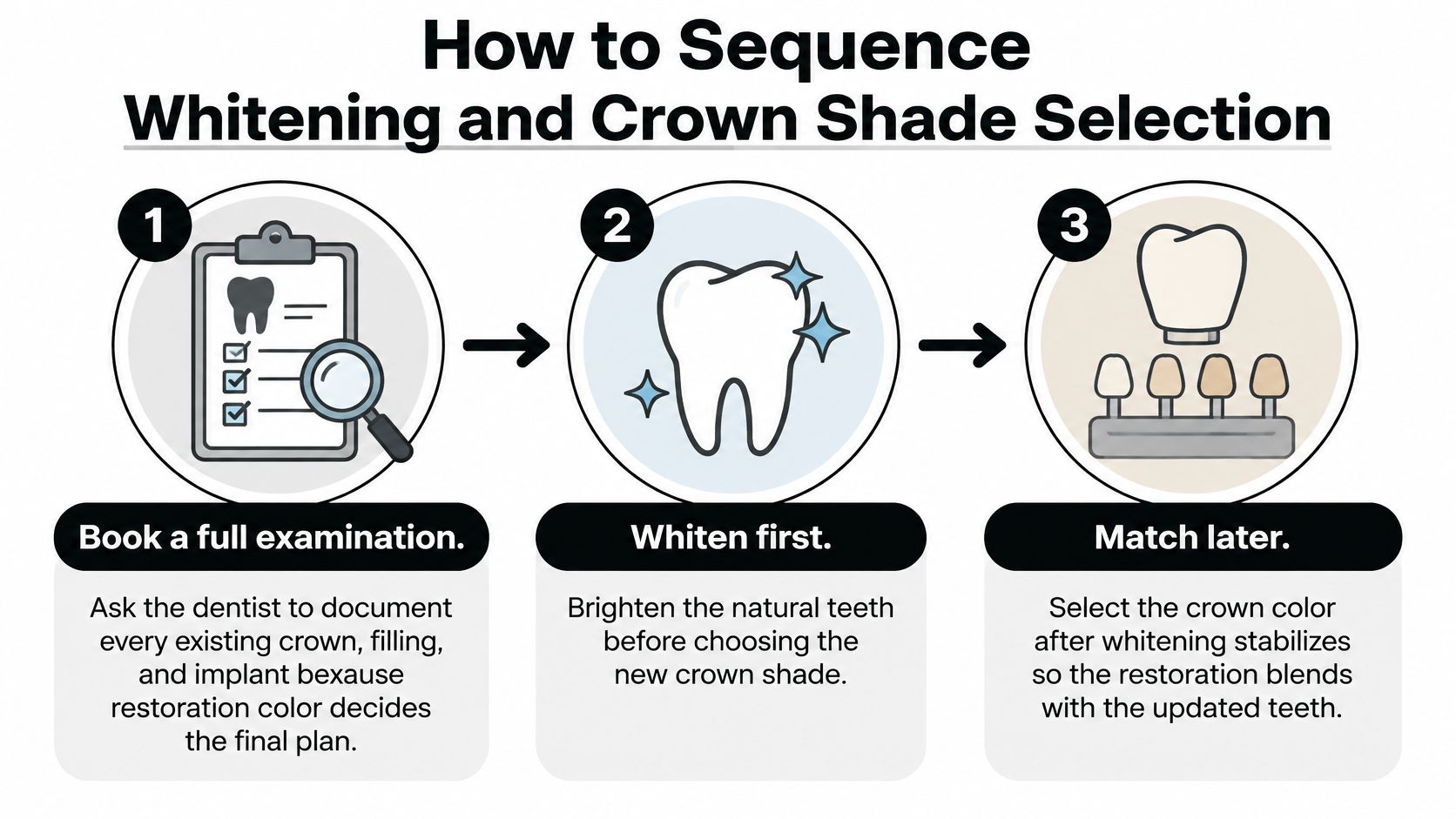
- Book a full examination and get every restoration documented. The American Dental Association's whitening guidance recommends recording existing crowns, implants and fillings during the exam, because restoration color is a key determinant of the final esthetic result. Slip to avoid: mentioning the one crown you're worried about and forgetting the composite filling on the tooth beside it, which has the same problem.
- Clear decay, gum inflammation and exposed root first. Bleaching over active disease or a failing margin produces sensitivity and hides a problem that needs fixing anyway. The ADA advises addressing oral disease and evaluating existing restorations before any bleaching starts.
- Whiten the natural teeth, then let the shade settle. Color keeps moving for a short while after the last session. Record the shade only once it has stopped, or the crown gets matched to a temporary color.
- Record the settled shade properly. That means a digital camera or a smartphone with a light-correcting device, in standardized light, not a glance in the hallway.
- Fabricate or replace the crown to the recorded shade. Now the restoration is chasing a fixed target instead of the other way around.
- Look after the trays between sessions. After treatment, rinse with tepid water and brush gently with a mild toothpaste, then rinse the trays and let them dry thoroughly before storing.
The two slips that undo the plan
The first is whitening after the crown is already cemented, which is the mistake this whole article exists to prevent. The second is subtler: matching by eye in a dim operatory late in the day. The numbers above show what eye matching averages out to, and it isn't a match.
Some readers want a rough sense of how far their shade can move before committing to a crown. Our whitening shade guide walks through how the shade scales are read, which makes the conversation at the consultation far more concrete.
How you know it worked
Two checks, both simple. Take a photo of the teeth in daylight, with the crown and its neighbors in the same frame, and look for a seam you can spot without hunting. Then ask the dentist to state the recorded shade out loud and put it in the chart, so the number exists for the next restoration and for any whitening top-up later.
Why Stronger Gel Will Not Fix a Crown
The instinct when a crown looks dark is to reach for more peroxide. That instinct fails for two reasons, one chemical and one clinical, and the clinical one is where people get hurt.
A randomized clinical trial summarized by the American Dental Association's esthetic dentistry scan compared 4% and 10% hydrogen peroxide home bleaching. Both produced effective color change. The 10% regimen caused significantly greater risk and intensity of tooth sensitivity, and its early whitening advantage was no longer significantly different after one month.
Read that as a trade with no upside for a crown patient. The stronger gel bought a faster start and a month of sensitivity, and by the one-month mark the two concentrations had converged. Meanwhile the crown stayed exactly the shade it always was.
What the dentist checks before prescribing anything
- Caries. Active decay under a bleaching tray is a bad combination.
- Gingival health. Inflamed gums plus peroxide equals burning and recession risk.
- Exposed dentin. A receding gum line or a worn edge lets gel into the sensitive part of the tooth.
- Defective crown margins. A gap at the margin traps gel and lets it reach the tooth underneath.
- Restoration position. A crown at the front changes the acceptable endpoint for the whole case.
The practical rules are short. Follow the prescribed concentration and wear time exactly. Don't extend a session or add days to compensate for a restoration that will never lighten. Reassess the shade under controlled lighting after the course ends, not in the bathroom mirror at night, because that's how people talk themselves into another month of gel.
Stop rule: if sensitivity outlasts a session or wakes you up, stop and call the dentist. Pain is not a sign the gel is working harder on the crown.
Once the natural shade has settled and the mismatch is still there, the predictable fix is an esthetic assessment of the restoration itself, not a stronger formula. That's the fork in the road, and it leads into the options below.
Choosing Between Polishing, Accepting and Replacing
Dental guidance from MD.co.uk on whitening around an existing crown makes a point most consumer articles skip: porcelain, ceramic and zirconia crowns keep their original shade while natural teeth lighten, so the mismatch shows up most in visible teeth, but replacement isn't automatically required. Accepting a modest difference, limiting the whitening endpoint, polishing where appropriate, or reassessing once the natural shade stabilizes are all legitimate routes.
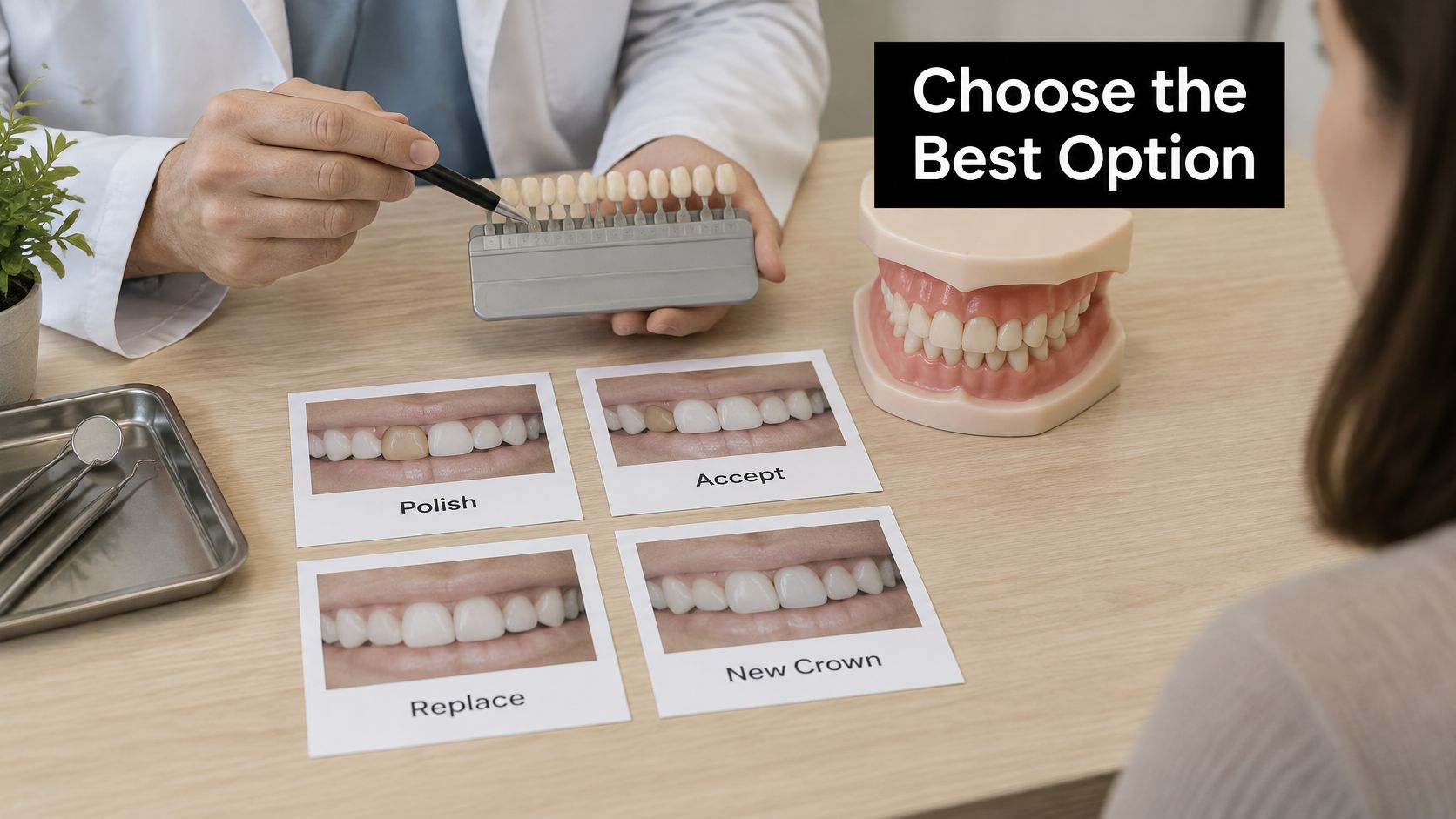
| Option | Best when | What it changes | Trade-off |
|---|---|---|---|
| Accept the small difference | Gap is minor and the tooth is out of view | Nothing | No cost or procedure, gap remains |
| Stop whitening at a set shade | Visible front crown next to natural teeth | Limits how bright natural teeth become | Teeth stay less bright than possible |
| Polish or professionally clean | Surface stain on composite or an aged restoration | Surface stain only | Does not change the underlying shade |
| Replace the crown | Clear mismatch that persists after shade assessment | New crown matched to current teeth | Invasive, costlier, needs its own shade plan |
A front tooth and a back tooth, side by side
Say a central incisor crown ends up next to natural teeth that whitened two shades. That tooth is in the smile line, it's in every photograph, and the mismatch sits where people look first. Replacing the crown is worth discussing seriously, because the cosmetic gain is visible every day.
Now move the same scenario to a second premolar. The crown is a shade off, nobody sees it when you talk, and the tooth is clinically sound. Accepting it, or asking for a polish if the stain is on the surface, is the sensible call. Replacing a healthy restoration to fix a difference only a dentist can spot trades real risk for invisible gain.
What polishing can and can't do
Polishing lifts surface stain from composite resin and from older restorations whose glaze has dulled. It's cheap, non-invasive, and often the entire fix when the complaint is a yellow film rather than a shade difference. It does nothing for ceramic, because the color is baked through the material rather than sitting on top of it. If a polish changes nothing, that tells you the problem is intrinsic and the options narrow to acceptance or replacement.
Whitening only as far as the crown's shade
Yes, you can whiten to a target instead of to the brightest possible result, and for some patients that's the smartest version of this treatment. Whiten in steps, let the shade settle between them, and recheck under standardized light each time. Stop when the measured difference drops below the acceptability threshold your dentist is working to. A stronger gel adds nothing at that point except sensitivity.
The question to hold onto before agreeing to any replacement is this one, and it's worth asking out loud.
"Is the cosmetic gain from a new crown worth the cost and risk of redoing a restoration that's still clinically sound?" If the honest answer is no, stop whitening at the shade you have.
Our article on why professional teeth whitening sometimes appears not to work covers the nearby cases where the gel is fine and the expectation needs adjusting.
Confirm Your Whitening Plan With Your Dentist
Bring a short list of questions and the appointment gets much more productive. What material is this crown made of? Should I whiten before any crown work is planned? Can you record my shade digitally before whitening starts? At what difference would you recommend replacement rather than acceptance? Is my gum and tooth health ready for bleaching?
The answers depend on three things: whether the crown is visible when you smile, what it's made of, and how far the natural shade has already moved. A zirconia molar and a porcelain central incisor are different problems with different answers.
Once a dentist has approved a plan, the product choice becomes simple, and that's the right order. Professional-grade at-home gels such as PolaDay and Opalescence are sold through DentalHealth.com, so the purchase follows the professional decision instead of trying to substitute for it.
The logic stays the same from the first appointment to the last: a crown can't whiten, so whiten the natural teeth first, match the crown second, and replace only when a visible mismatch survives a proper shade assessment.
If you're whitening around crowns, start with a plan your dentist signs off on, then buy the gel that fits it. DentalHealth.com stocks professional-grade at-home whitening from Opalescence, Zoom and PolaNight, along with sensitivity products like Fluoridex and MI Paste for the days when your teeth complain, and every USA order ships free. Browse the whitening gels and kits at DentalHealth.com once you know your target shade, and keep the trays, the timer and the stop rule in the same place.