
Waxed Dental Floss Picks: Your Guide to Optimal Oral Health
You feel it right away. The floss catches between two teeth, starts to fray, then snaps against the gums. By the time you finish, your mouth doesn't feel cleaner. It feels irritated.
That's the point where many people stop flossing consistently, not because they don't care, but because the tool they're using fights them. Waxed dental floss picks exist for exactly that problem. They're built for people with tight contacts, crowded teeth, dental work that tends to snag floss, or anyone who wants a simpler routine they'll stick with.
They've also become a mainstream choice, not a niche one. The global floss picks market was valued at approximately USD 632.9 million in 2025 and is projected to grow at a CAGR of 3.5% from 2025 to 2033, reflecting a strong shift toward more convenient flossing tools, according to Archive Market Research on the floss picks market.
Why Your Floss Might Be Working Against You
A common pattern in the operatory is simple. Someone brushes well, tries to floss, gets discouraged by shredding, and starts skipping the spaces that are hardest to reach. Those are usually the exact areas that need the most attention.
Tight contacts are the usual culprit. So are rough margins around restorations, crowded lower front teeth, and back molars that are awkward to reach with string floss. If floss keeps sticking, you tend to use more force. More force usually means the floss snaps through the contact and hits the gum tissue. That's when flossing starts to feel like punishment.
Waxed picks help because they remove friction from the equation. The handle offers greater control, and the coated floss usually passes through stubborn contacts more smoothly than bare string. For many patients, that means less hesitation and better daily compliance.
Most flossing failures aren't about motivation. They're about using a tool that doesn't match the spacing and shape of your teeth.
If you've already tried other ways to clean hard-to-reach areas, tools like oral irrigators for between-teeth cleaning can also help. But they don't make floss picks unnecessary. Mechanical contact against the tooth surface still matters.
What tends to go wrong
- Floss shreds: This often happens in tight spaces or around rough dental work.
- Floss snaps into the gums: Usually a technique problem, but friction makes it worse.
- You skip the back teeth: Picks often improve access because the handle does the reaching.
- You reuse one pass too many: With picks, people often keep using the same segment after it's already picked up debris.
A good waxed floss pick won't fix every problem. If one spot always snags, a dentist should check it. But when the issue is mostly tight spacing and routine frustration, waxed picks are often the difference between “I should floss” and “I do.”
The Science Behind the Smooth Glide
The key feature is simple. A light wax coating reduces surface friction, so the floss can move through narrow contacts with less resistance.
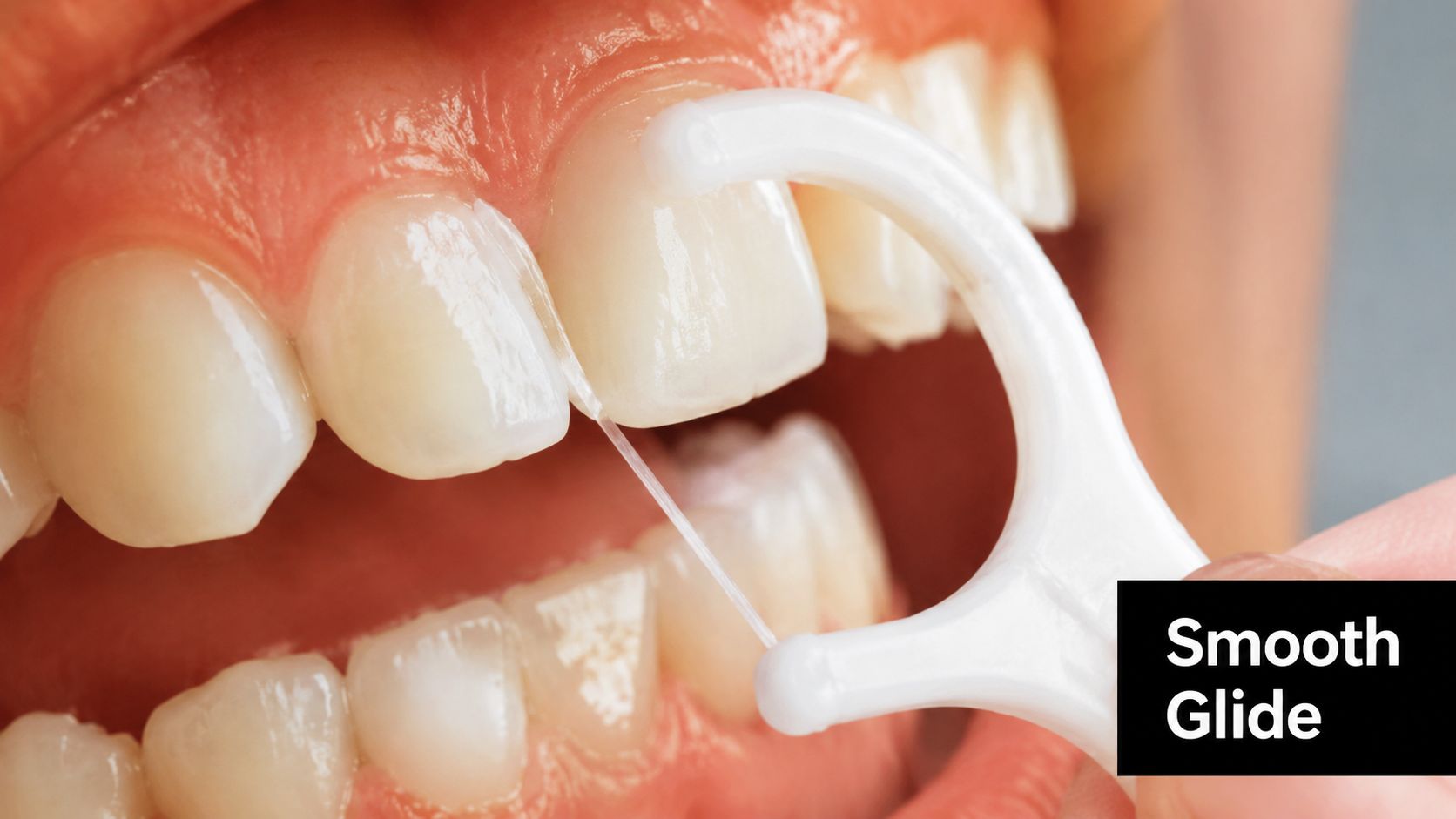
According to Pickaroo's product detail on waxed floss pick construction, the coating helps floss picks glide through tight interproximal contacts with less than 0.1 mm clearance without shredding. That matters most in mouths where the teeth fit together very closely.
Think of wax like a low-friction layer
If you've ever waxed skis or applied lip balm to prevent cracking, the idea is similar. The coating creates a smoother interface. It doesn't make the floss bulky if it's applied properly. It makes it more cooperative.
That smoother passage does two things at once:
- It reduces snagging in tight contacts.
- It helps the floss stay intact instead of fraying apart mid-use.
Why some picks work better than others
Not every waxed pick feels the same because the floss itself still matters. The most comfortable ones usually combine a thin filament with a light coating. If the floss is too thick, it can still feel tight. If the coating is too heavy, it may not enter narrow spaces easily. If the strand is weak, waxing won't save it from shredding around rough edges.
Practical rule: The best waxed pick is the one that slides in without force, stays intact, and lets you clean under the gumline without feeling like you're sawing through a contact.
People with crowded teeth, bonded retainers, crowns, or narrow posterior contacts usually notice the difference fastest. The glide isn't just about comfort. It's what makes regular use realistic.
Waxed Versus Unwaxed Floss Picks
Choosing between waxed and unwaxed floss picks isn't about picking a universal winner. It's about matching the tool to your mouth.
Waxed picks usually work better for tight contacts, sensitive gums, and people who struggle with shredding. Unwaxed picks can appeal to people who like a little more grip on the tooth surface or who want to avoid certain coatings. Both can clean effectively when used well. The trade-off is how they get there.
According to White Hart Hotel Islay's discussion of waxed floss performance, the lubricity of waxed floss can reduce insertion force by up to 40% compared to unwaxed floss, which can lower gum trauma risk for people with delicate periodontal tissues.
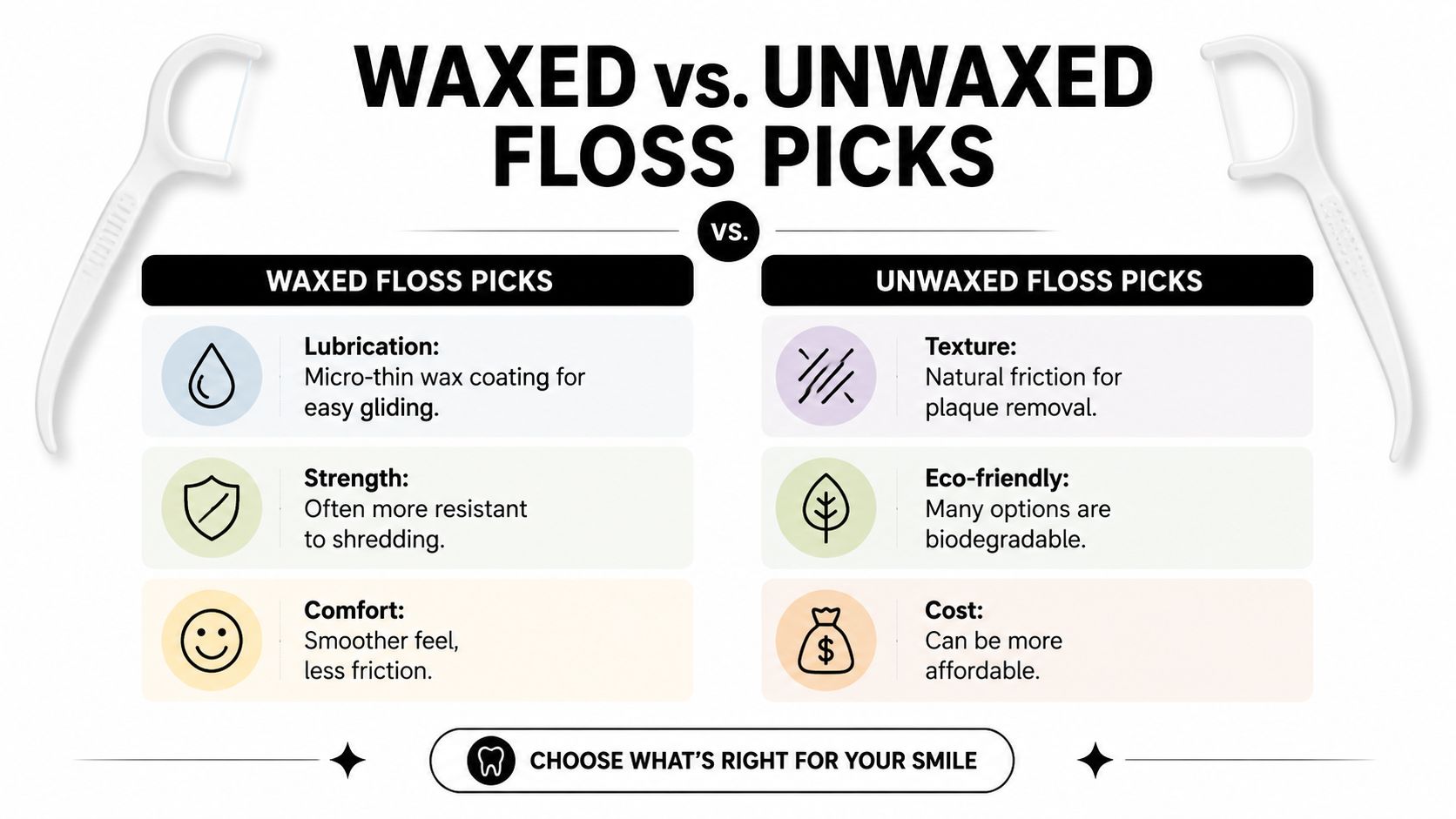
Side-by-side differences
| Criteria | Waxed floss picks | Unwaxed floss picks |
|---|---|---|
| Feel between tight teeth | Smoother entry | More drag |
| Shred resistance | Usually better | More likely to fray in stubborn contacts |
| Gum comfort | Often gentler if you have to work through narrow spaces | Can feel harsher if you force it |
| Surface grip | Slightly slicker | More natural friction |
| Best fit | Tight teeth, crowded contacts, sensitive gums | Wider spaces, users who prefer more texture |
Who usually does better with waxed picks
If any of these sound familiar, waxed is often the smarter starting point:
- Your floss keeps shredding: That usually means friction is too high for the floss you're using.
- You have tight lower front teeth: These areas often punish unwaxed floss.
- Your gums get sore after flossing: Less insertion force can make a real difference.
- You need a simpler routine: Picks are convenient, and the wax makes them easier to tolerate.
When unwaxed may still make sense
Unwaxed isn't obsolete. Some people prefer it because it feels less slippery and gives them more tactile feedback on the tooth surface. If your contacts are open enough and you don't deal with snagging, it can work well.
There's also a materials conversation. If you're concerned about coatings and want fewer additives, unwaxed may be worth considering. That said, for very tight spacing, avoiding wax can make flossing harder to sustain.
For some patients, a hybrid approach works best. Use waxed picks for the tightest contacts and another between-teeth cleaner where space allows, such as soft picks for wider embrasures and gumline cleaning.
If flossing hurts, you won't keep doing it. Comfort isn't a luxury feature. It's part of adherence.
A Step-by-Step Guide to Proper Flossing
Technique matters more than the package label. A waxed pick can still irritate your gums if you snap it through the contact and move on.
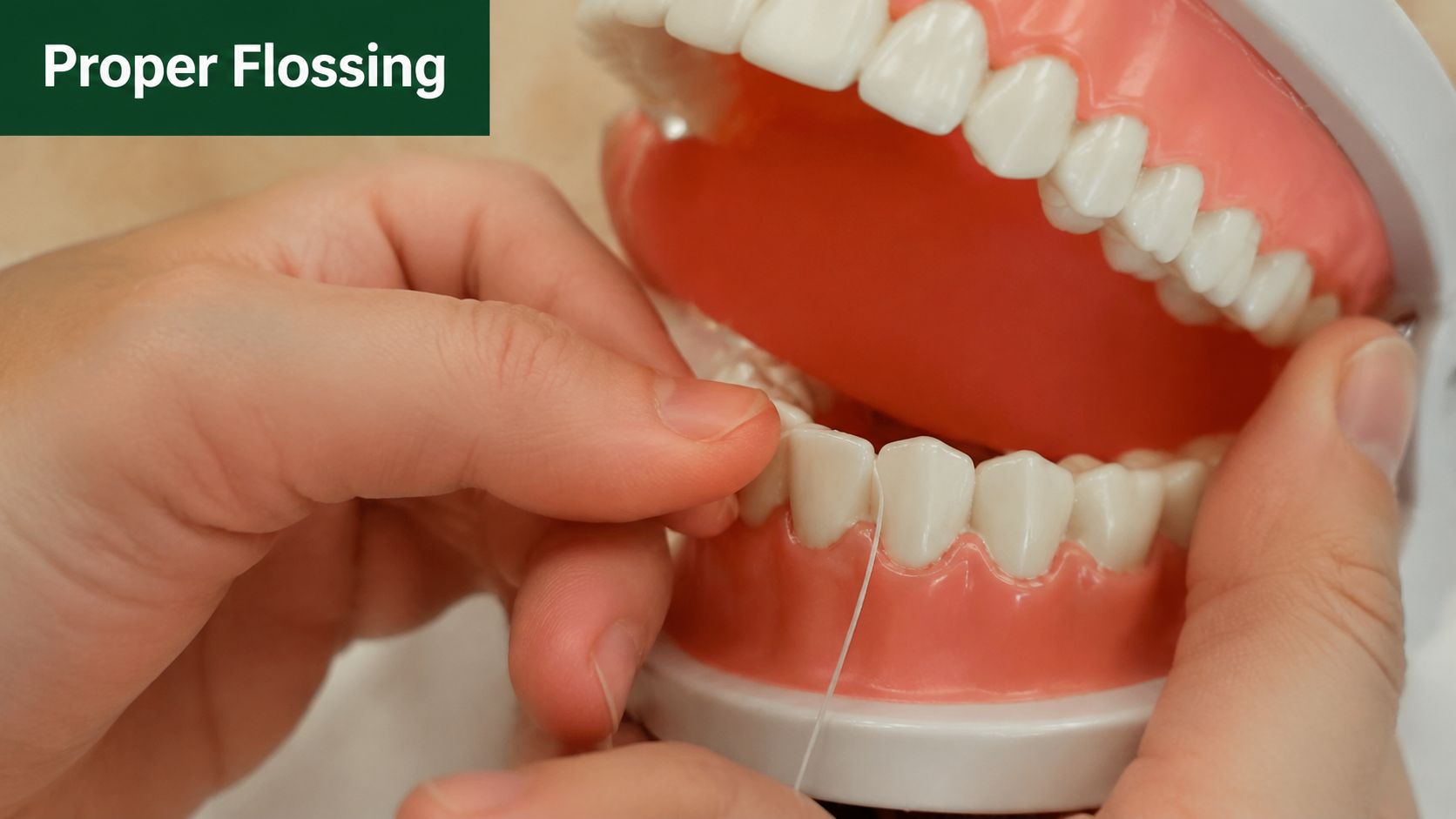
Hold the pick firmly, but don't choke up so close to the floss that you lose angle control. Approach the contact gently. A small back-and-forth motion helps the floss slide between the teeth without popping through.
The method that actually cleans
Once the floss passes the contact, hug one tooth surface with it. That curved contact is what people mean by a C-shape. Then move the floss up and down along the side of the tooth and just under the gumline.
Repeat on the neighboring tooth before removing the pick.
- Guide, don't jab. Use a gentle sawing motion if the contact is tight.
- Curve around the tooth. Straight up-and-down passes in the middle of the gap miss plaque on the root surface.
- Go slightly below the gumline. Be gentle. You're sweeping plaque away, not digging.
- Clean both sides of the space. Each gap has two tooth surfaces.
- Move methodically to the back. Molars need the same attention, even if they take a little repositioning.
Common mistakes with floss picks
- Snapping through the contact: This is the fastest way to make gums bleed.
- Only cleaning the easy spots: Front teeth don't need all the attention.
- Using the same dirty segment too long: Picks are convenient, but debris builds up fast.
- Flossing too shallow: If you never adapt under the gumline, you leave plaque behind.
A handled aid can help if finger floss is hard to manage. Patients with limited dexterity often do better with devices built for control, such as a floss handle designed to improve reach and grip.
A quick visual can help lock in the motion:
When to stop and ask for help
If one area always tears floss, always hurts, or always traps the pick, don't keep forcing it. That can point to a rough filling edge, tartar, or another local issue that needs professional attention.
Health and Environmental Factors to Consider
Performance is only part of the buying decision. Materials matter too, especially if you're using floss picks every day.
The biggest overlooked issue is PFAS. According to this discussion of PFAS concerns in floss products, up to 33% of tested floss products contain PFAS, while floss pick ingredient lists often don't clearly disclose what coating was used. That makes shopping harder than it should be.
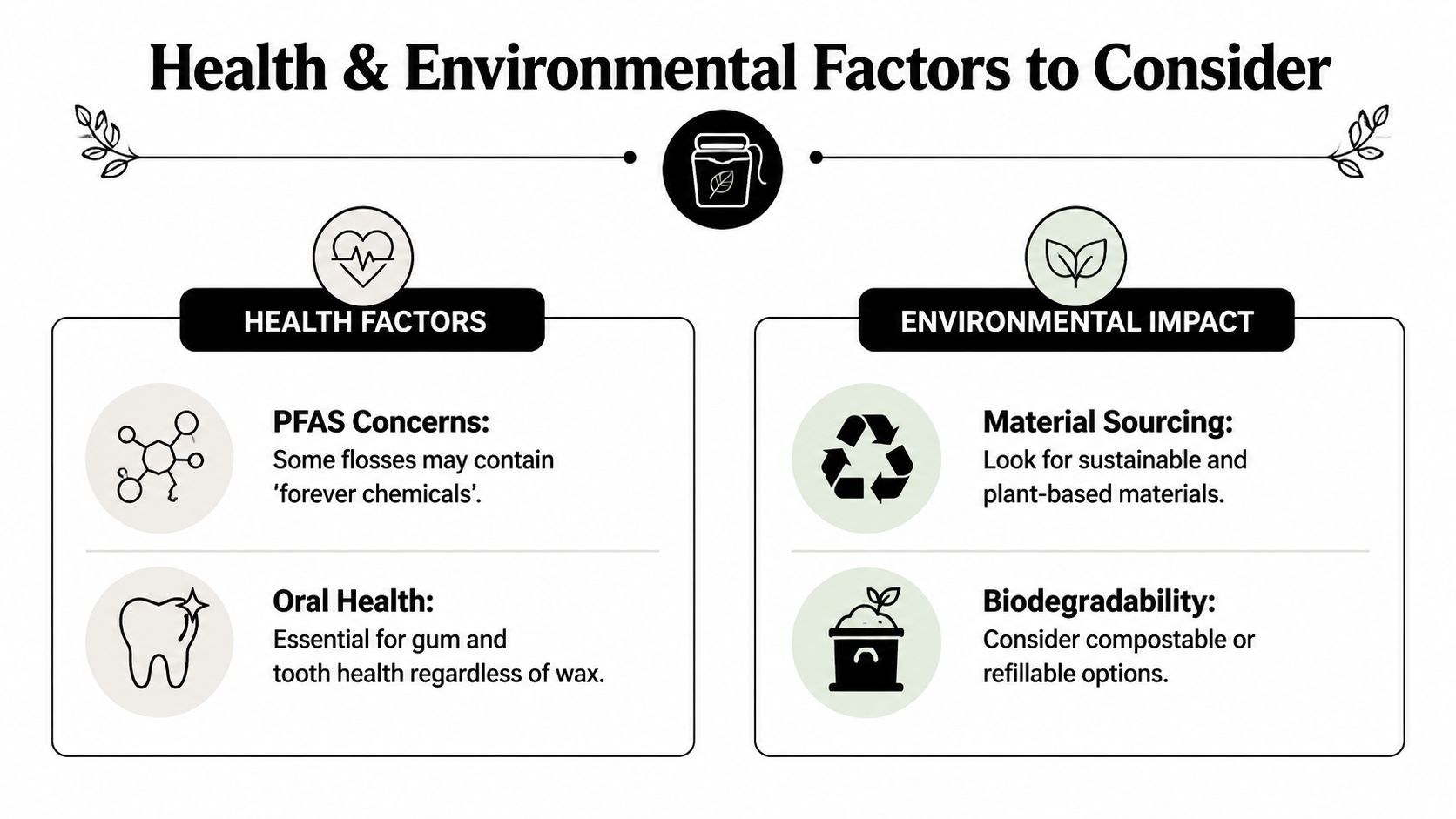
PFAS and wax type
Many shoppers assume “waxed” just means smoother. It may also raise questions about what that coating contains. If a brand doesn't explain its materials, you're left guessing whether the wax is plant-based, petroleum-based, or paired with other surface treatments.
That doesn't mean every waxed pick is a bad choice. It means transparency matters. When a company clearly identifies plant-based waxes such as beeswax or similar alternatives, that gives you more to work with than vague marketing claims.
Allergy and irritation concerns
Another issue doesn't get enough attention. Picks reuse the same short floss segment from space to space. If the coating includes flavoring agents or waxes you're sensitive to, repeated contact may increase irritation for some users.
The American Dental Association notes that there are rare case reports of contact hypersensitivity to waxed floss in its oral health topic page on floss. Rare doesn't mean impossible.
Watch for these signs:
- Itching or burning after flossing
- Localized swelling
- Persistent gum irritation with one specific product
- Problems that start after switching to a flavored or heavily coated pick
If a floss pick makes your mouth feel worse every time you use it, stop using that brand. “Mild irritation” is not something you need to push through.
Environmental trade-offs
Disposable picks create more waste than a spool of floss. That's the convenience cost. If that bothers you, look for products that use plant-based materials, biodegradable fibers, or reduced-plastic packaging. Some consumers keep picks for travel and work, then use another interdental tool at home to cut down on disposables.
A practical shopping filter
When you're comparing products, ask four simple questions:
- Does the brand disclose the floss material?
- Does it identify the wax source clearly?
- Is the product flavored, and if so, with what?
- Does the packaging mention biodegradable or plant-based components?
You don't need perfect answers from every product. But the less a company tells you, the harder it is to make an informed choice.
Finding Your Perfect Waxed Floss Pick
The right pick should fit your teeth, your gums, and your comfort level with the materials used. Start with tightness of contacts. If floss usually catches or shreds, waxed picks are often the better first choice. Then look at the handle. A rigid pick with a comfortable grip is easier to control around molars than a flimsy one.
If you have sensitivity, choose a lightly coated, unaggressively flavored option. If you have allergy concerns, favor brands that clearly disclose wax and flavor ingredients. If sustainability matters, look for plant-based or biodegradable components rather than assuming all picks are basically the same.
North America remains the leading market for advanced floss pick formats because of strong consumer awareness of preventive dental care, according to Straits Research on the dental floss market. That gives shoppers a broad range of choices, but more choice only helps if you know what to screen for.
DentalHealth.com makes it easier to build a professional-grade home care routine with dentist-trusted oral care products, fast U.S. shipping, and practical guidance for everyday concerns like sensitivity, whitening, and maintenance. Explore the full selection at DentalHealth.com.