
Zoom Whitening Gel Reviews: What the Evidence Shows
Sensitivity occurred in 37–90% of at-home users in studies of carbamide peroxide bleaching summarized in a narrative review of home and in-office whitening. That range isn't a Zoom-specific risk estimate, but it reframes the buying decision: brighter teeth and a comfortable treatment aren't the same outcome.
Useful Zoom whitening gel reviews need to report both. A glowing recommendation without the gel strength, application schedule, and side effects can't tell you whether the reviewer used a protocol you'd tolerate. The right question isn't whether Zoom whitens teeth. It's whether the exact product and exposure schedule offer a worthwhile result for your teeth, sensitivity history, and existing dental work.
Zoom Whitening Gel Reviews at a Glance
A star rating doesn't identify the treatment behind the result. A review labeled Zoom may describe a take-home tray gel or a supervised in-office procedure. Even within a take-home range, the product name alone doesn't establish the active ingredient, contact time, or treatment schedule.
Strength is therefore a starting point, not a ranking. Before comparing reviews, match the full product name on the review to the package you're considering. Don't transfer a reported result from a different formulation merely because both carry the Zoom name.
Zoom gel options and what can be verified
| Option | Stated concentration | Price on DentalHealth.com | Evidence available for comparison |
|---|---|---|---|
| Philips Zoom 14% DayWhite | 14%; peroxide type not established by the available product information | $27.99 | Retail product information; no independent trial for this exact formulation identified in the cited literature |
| Zoom in-office gel | Exact formulation and strength not established | Not established | General in-office hydrogen peroxide evidence, not confirmation of this Zoom formulation |
| Zoom NiteWhite tray gel | Exact formulation and strength not established | Not established | General home-tray carbamide peroxide evidence, not a product-specific NiteWhite result |
What the gaps mean for a buyer
We list Philips Zoom 14% DayWhite at the price shown above. That commercial information identifies an option to investigate; it doesn't establish an independently measured shade change or sensitivity rate.
For the in-office option, ask the treating dentist to identify the actual gel and protocol. For NiteWhite, check the syringe label and prescribed tray schedule rather than assuming every review describes the same strength.
The cited literature supplies category benchmarks, but it doesn't justify a head-to-head ranking of these particular Zoom products. Nor does it establish what proportion of online Zoom reviews disclose enough detail to support a comparison.
Buying rule: Keep the peroxide concentration and total exposure time beside every review you save. Without both, a brighter after-photo is an incomplete result.
A positive review can still help you understand convenience or application experience. Treat its whitening claim more cautiously when the reviewer doesn't say what they used, how often they used it, or whether discomfort changed the schedule.
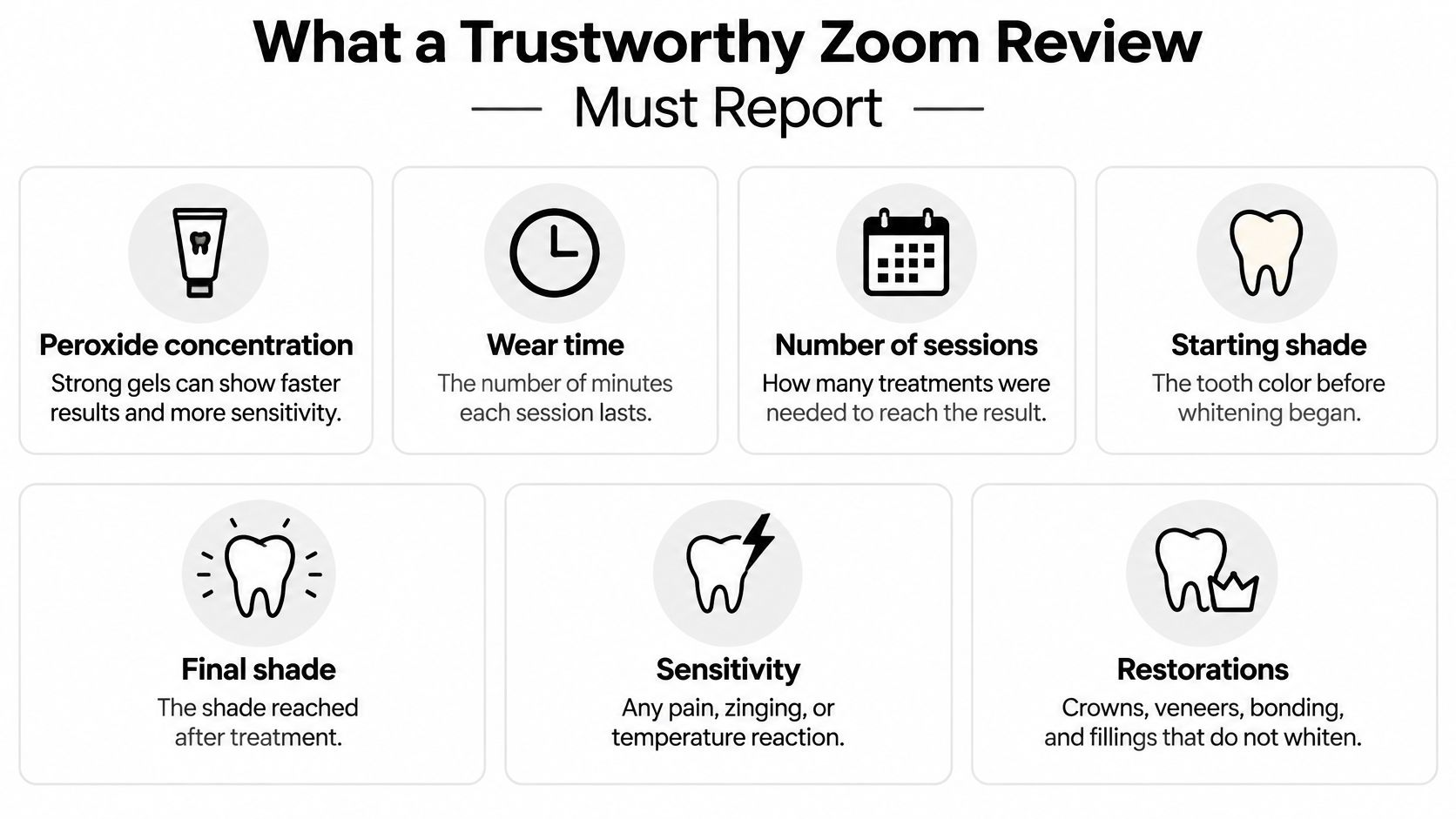
What a Trustworthy Zoom Review Must Report
A useful review describes a treatment you can identify and an outcome you can interpret. The following checklist separates an informative account from a before-and-after anecdote.
- Peroxide concentration. Record the strength printed on the syringe, not just the brand. Otherwise, you're comparing unidentified exposures.
- Active ingredient. Specify hydrogen peroxide or carbamide peroxide. Percentages are not interchangeable across these different chemicals.
- Applications and contact time. Include session length, frequency, and completed applications. Intended treatment and actual treatment may differ.
- Starting and final shade. Use the same shade guide, lighting, camera position, and image settings where possible. Different illumination makes photographs difficult to compare.
- Sensitivity and gum irritation separately. Describe tooth discomfort apart from sore or irritated gums, including when each began and how long it lasted.
- Interrupted treatment. Say whether discomfort caused shorter sessions, missed applications, or stopping. The result belongs to the schedule completed.
- Shade after stopping. Record a follow-up observation rather than relying solely on an immediate after-photo.
The visual checklist also highlights dental work that can affect how readers interpret the result.
Why the protocol matters more than the presentation
An independent review of tooth-whitening evidence describes a randomized trial involving 90 patients in which home trays containing 10% carbamide peroxide and in-office treatment using 35% hydrogen peroxide produced similar bleaching results; adding light or combining home and office treatment didn't improve the outcome.
Those findings don't establish equivalence between every home and office product. They show why a high concentration, an elaborate appointment, or a lamp isn't sufficient evidence of a superior result.
The review also associates side-effect severity with concentration, treatment duration, and non-bleaching ingredients. A consumer account can't reproduce a controlled trial, but it can disclose the variables needed to understand what happened.
Copy this review log: Product and ingredient; concentration; completed schedule; starting shade; final shade; tooth symptoms; gum symptoms; interruptions; follow-up shade. Leave an empty field marked not reported, rather than filling it with an assumption.
Concentration and Sensitivity Trade-Offs
Concentration is a performance–tolerability trade-off, not a quality score. A stronger gel may produce a greater color change under a particular schedule. That doesn't automatically mean a better final result for someone who has to interrupt treatment because it hurts.
The clinical benchmarks below aren't a ranking of Zoom gels. They involve different delivery methods, populations, and protocols. Their value is in showing which measurements a product review needs, and which comparisons the evidence doesn't support.
What the clinical benchmarks actually measure
The American Dental Association's whitening overview describes a 28-day study of 37 adults in which hydrogen peroxide strips containing 1.8%, 3.3%, or 5.3% produced statistically significant color improvement by Day 7, with greater reductions in yellowness and greater lightness improvement at higher concentrations.
That is evidence of a concentration response within the tested strip protocols. It isn't proof that a tray gel with a larger label percentage will outperform another gel used for a different period.
For adverse effects, the European Commission's scientific summary on tooth whiteners reports 44% tooth sensitivity with 6% hydrogen peroxide strips, compared with 59% with 9.5% strips, and 6% oral soft-tissue effects in both groups. Its additional study summaries, alongside the other clinical benchmarks discussed here, are distinguished in the table so unlike outcomes aren't mistaken for equivalent measurements.
Peroxide strength, whitening and sensitivity benchmarks
| Format or study | Peroxide and concentration | Whitening outcome | Sensitivity or irritation | Duration or resolution |
|---|---|---|---|---|
| Home-tray randomized comparison | Carbamide peroxide, home-tray protocol | Similar to the in-office comparator | Not separately quantified in the cited summary | Not specified for this comparison |
| In-office randomized comparison | Hydrogen peroxide, office protocol | Similar to home trays; light and combined treatment added no benefit | Not separately quantified in the cited summary | Not specified for this comparison |
| Six-month study in the European Commission summary | Carbamide peroxide 10% | Not specified in the safety summary | 80% experienced adverse events | Symptom duration not reported |
| Strip concentration study summarized by the ADA | Hydrogen peroxide 1.8%, 3.3%, 5.3% | Significant improvement by Day 7; higher concentrations produced greater color improvement | Not quantified in the available study summary | Study lasted 28 days; symptom resolution not specified |
| Lower-strength strip safety comparison | Hydrogen peroxide 6% | Not specified in the safety summary | 44% tooth sensitivity; 6% soft-tissue effects | Not specified |
| Higher-strength strip safety comparison | Hydrogen peroxide 9.5% | Not specified in the safety summary | 59% tooth sensitivity; 6% soft-tissue effects; one severe sensitivity event | Not specified |
| Clinical subjects in the European Commission summary | Concentration not specified in the cited passage | Not specified | 67% experienced sensitivity or gingival irritation | Symptoms gone 24 hours after treatment in that study |
| At-home narrative review | Carbamide peroxide protocols | Comparable whitening improvements to in-office treatment | Broad sensitivity range, as described in the opening | Generally milder than in-office symptoms; could recur with repeated use |
| ADA guidance on tray bleaching | Multiple tray protocols | Not a product-specific efficacy estimate | Temporary sensitivity is a common adverse effect | Timing depends on the protocol and individual response |
Read from lower exposure toward higher exposure
The strip concentration study offers the cleanest comparison because the investigators tested related concentrations within one study design. Even there, the outcome was measured color improvement, not a promise that every participant reached the same final shade.
The home-tray and office comparison answers a different question. It shows that a slower delivery method can achieve a result comparable to a more concentrated supervised treatment. It doesn't supply a conversion formula between carbamide peroxide and hydrogen peroxide, or between overnight wear and a chairside application.
Don't arrange every row into a universal ladder from weakest to strongest. Peroxide type, delivery method, and contact time must stay attached to concentration. A low percentage worn for a long period isn't the same treatment as brief contact with a high percentage.
The safety results also need careful reading. Tooth sensitivity, gingival irritation, and the broader category of adverse events aren't interchangeable. A study counting any adverse event may capture experiences that a study recording only tooth sensitivity doesn't include.
Frequent doesn't necessarily mean severe. Temporary doesn't mean comfortable enough to finish treatment.
The higher-strength strip comparison included a severe sensitivity event, but that finding doesn't establish a severe-event rate for Zoom. Likewise, a study in which symptoms resolved quickly doesn't establish a deadline by which every person's discomfort must disappear.
What little to no sensitivity leaves unanswered
A review that reports no discomfort is useful as an individual experience. It doesn't establish how often other users will experience symptoms, how intense those symptoms might be, or whether people with existing sensitivity were represented.
Look for the distinction between incidence, severity, duration, and treatment interruption. A brief reaction to cold and pain that prevents normal eating shouldn't be collapsed into the same unqualified description. Neither should a review omit the sessions the person abandoned.
Repeated maintenance deserves separate scrutiny. A short initial course doesn't establish that frequent ongoing applications will remain equally tolerable. Keep a record of each maintenance cycle rather than assuming your earlier response guarantees the next one.
Our guide to teeth-whitening gel side effects can help you separate the symptoms you're tracking. We also carry Zen CP+ Desensitizing Gel, formulated with desensitizing agents to block sensitivity caused by hot or cold temperatures, acidic foods, or gum recession. That formulation claim isn't evidence that it prevents every whitening reaction or makes continued treatment appropriate when pain persists.
A lower-concentration option may offer a better practical outcome for a sensitivity-prone user, even if improvement develops more slowly. The important endpoint is a tolerable, completed treatment with an acceptable color change, not the strongest gel you can endure briefly.
Zoom Compared With Competing Whitening Gels
Hydrogen peroxide acts faster, while carbamide peroxide releases peroxide more gradually and may reduce sensitivity risk, according to the ADA's discussion of whitening options. The same discussion notes that tray-delivered systems using either chemistry can produce broadly similar sensitivity and gum-irritation levels, so chemistry alone doesn't determine comfort.
A fair comparison therefore needs the ingredient, concentration, prescribed contact time, and provisions for managing sensitivity. Retail price is useful for budgeting, but it doesn't answer those clinical questions.
Zoom and competing gels on the same criteria
| Gel | Stated concentration | Treatment time or wear | Price on DentalHealth.com |
|---|---|---|---|
| Philips Zoom 14% DayWhite | 14%; ingredient not established here | Not established in the available product facts | $27.99 |
| Lumibrite 22% | 22% carbamide peroxide | Not established in the available product facts | $19.99 |
| Lumibrite 32% | 32%; ingredient not established here | Not established in the available product facts | $17.99 |
| PolaNight 10 | 10%; ingredient not established here | Can show a difference in as little as two hours; overnight tray wear is also described | Not established |
| PolaNight 22% | 22%; ingredient not established here | One 45-minute treatment; one syringe per session with dentist-made trays | Not established |
| PolaDay 9.5 | 9.5%; ingredient not established here | One 30-minute session or two 15-minute sessions | Not established |
What the retail comparison can establish
These are commercial product details, not results from an independent head-to-head trial. The table doesn't establish that the less expensive Lumibrite option produces a comparable result, or that a higher stated strength offers better value.
It also doesn't establish cost per completed course. Without comparable package quantities, gel use, and prescribed schedules, a lower purchase price isn't a demonstrated saving per result.
Our PolaNight whitening guide provides additional context for that range. For PolaNight 10, our sensitivity guidance is to try the shorter treatment first and consider overnight use only if there are no adverse reactions. Don't borrow that schedule for a Zoom product.
Compare the outcome, not just the purchase
Distinguish bleaching natural tooth color from removing external surface stains. Also note whether the reviewer used a professional cleaning, another whitening product, or a changed routine alongside the gel, because that makes attribution less certain.
Scrutinize reviews that praise frequent extra applications. The ADA discussion links overuse with sensitivity, gum effects, increased enamel permeability, and possible erosion. An aggressive schedule isn't a sensible tie-breaker between brands.
A cheaper syringe isn't automatically a cheaper successful treatment, and a stronger syringe isn't automatically a better one.
Choose between products only after their actual instructions are clear. Where the ingredient or wear schedule remains unknown, the appropriate conclusion is comparison incomplete, not presumed equivalence.
Who Should Skip Zoom or Get Care First
A brighter result can still produce a less even smile. Crowns, veneers, bonding, bridges, and tooth-colored fillings generally don't whiten like natural teeth, so bleaching surrounding enamel can leave visible dental work looking darker by comparison, according to WebMD's teeth-whitening guidance.
A dental examination helps identify those limits before you commit to a target shade.
When whitening isn't the first treatment
Untreated cavities, worn enamel, exposed roots, and gum disease can increase discomfort or make bleaching inappropriate. If you already have pain or bleeding gums, a product review can't determine whether whitening is suitable.
Discoloration associated with trauma, medication, or deep internal staining also needs an assessment. A stronger gel may add discomfort without correcting the color problem you want to solve.
For visible dental work, our guide to teeth whitening with fillings can help you prepare questions. Whitening is generally best planned before new restorations are shade-matched, with any replacement bonding or veneers considered after the natural tooth shade is established.
Use this appointment explainer to prepare for a discussion with your dentist, not to select a protocol independently.
Make the cosmetic plan explicit
- Identify visible restorations. Ask which front-tooth surfaces are natural enamel and which are restorative materials.
- Define the mismatch risk. Discuss whether lightening surrounding teeth would improve or worsen the overall appearance.
- Separate health care from cosmetic care. Resolve disease and unexplained symptoms before selecting a bleaching schedule.
Having restorations doesn't automatically rule out whitening. It changes the decision from buying a gel to planning the appearance of the whole smile.
Choose Your Zoom Gel and Set a Stop Rule
Choose the protocol before opening the syringe, and decide when you'll stop before discomfort makes the decision harder. You don't need to complete an uncomfortable course just because you've purchased it.
Use this sequence to organize the decision.
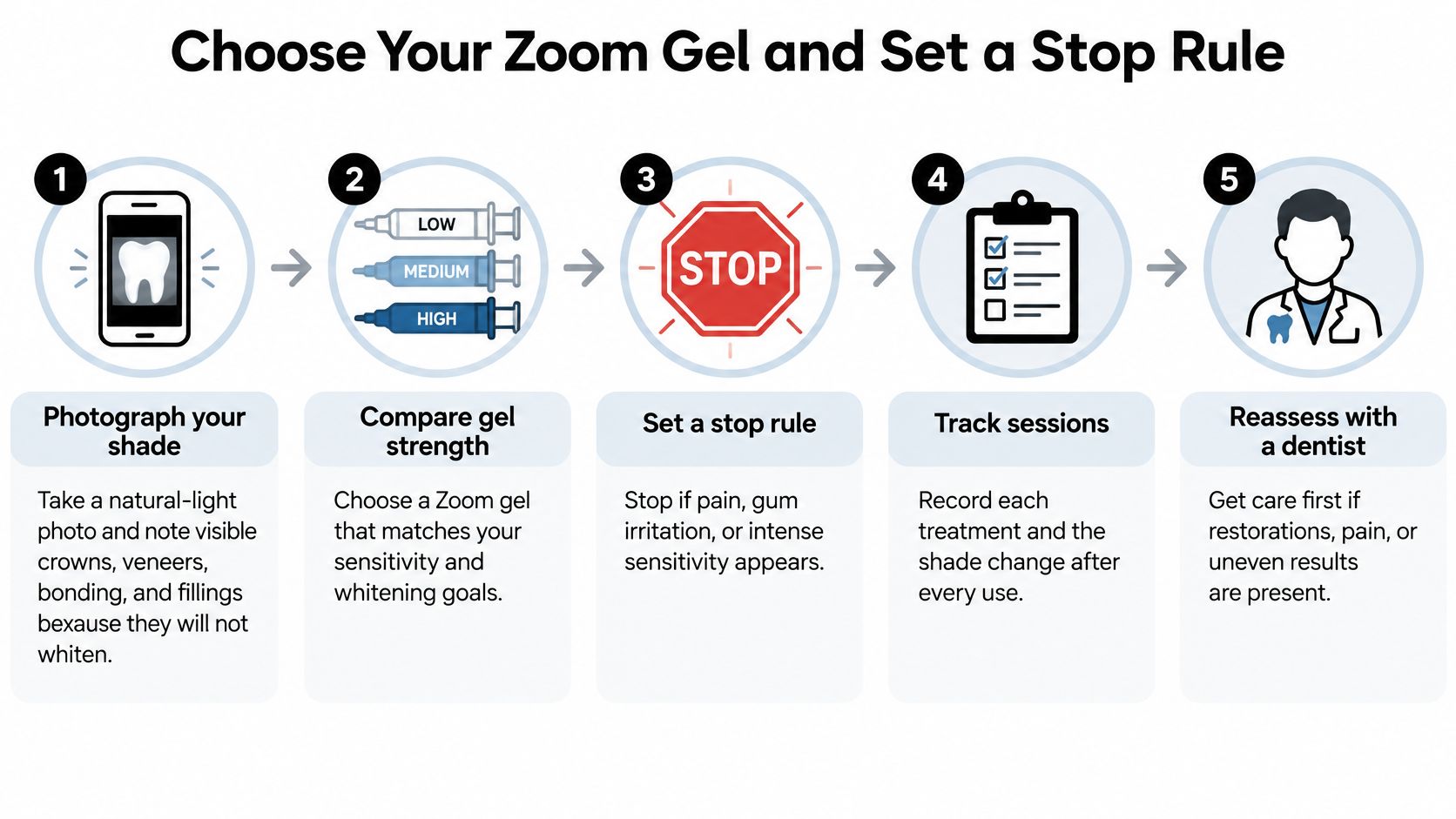
Put the decision into practice
- Create a starting record. Photograph your smile in natural light without a whitening filter. Note visible dental work and the areas whose color concerns you.
- Clear the health questions. Arrange a dental examination if you have pain, suspected decay, gum problems, or extensive restorations. Bring the exact product name you're considering.
- Match the protocol to your history. Discuss a lower-strength option if previous bleaching caused sensitivity. Use the shortest permitted contact time for that specific formulation, not a schedule borrowed from another brand.
- Load the trays carefully. Overloading trays or pushing gel firmly into teeth isn't necessary and may irritate gums. If gel escapes onto your gums, remove the excess and reassess the amount and tray fit before continuing.
- Log the actual treatment. Record completed sessions, symptoms, missed applications, and photographs taken under consistent conditions. Don't record only the applications you planned.
- Stop rather than push through pain. Pause for intense sensitivity, pain, or gum irritation. Seek dental advice promptly for severe symptoms and for discomfort that persists after stopping; don't increase strength to compensate for missed sessions.
Keep protection instructions product-specific
Our Lumibrite 22 instructions include rubbing petroleum jelly onto the lips and gums before each bleaching session. That isn't a universal Zoom preparation instruction, and it shouldn't replace the directions for the formulation you're using.
The verdict: Zoom is a reasonable option to consider when your oral health, whitening goal, and sensitivity history fit the chosen protocol. Extensive restorations, unexplained pain, or uncertain stain causes make a dentist the starting point, not a stronger syringe.
DentalHealth.com offers Zoom whitening gels, alternative at-home whitening products, and sensitivity-care options, with product descriptions and practical buying guides. Visit DentalHealth.com to compare the exact formulation you're considering, then take its ingredient, strength, and wear instructions to your dentist before starting.