
Arc After Brushing Whitening Booster: What It Actually Does
You've finished brushing, but your teeth still don't look as bright as you'd like. Now you're holding a tube of ARC After Brushing Whitening Booster, wondering whether it's the missing step or another whitening product that promises more than it delivers.
The useful answer sits between those extremes. ARC deserves to be evaluated by what its documented formula can do, not just by the word whitening on the packaging.
Where ARC Fits in Your Brushing Routine
Think of ARC as an optional finishing step, not the foundation of your oral care. Its intended place is after your normal brushing routine, when you're considering an extra product for cosmetic stain maintenance.
That distinction matters because a brighter-looking tooth and a well-protected tooth aren't necessarily the same thing. A cosmetic booster shouldn't displace the toothpaste you use for everyday cavity protection, even if both products sit beside the same toothbrush.
Keep the products' jobs separate
ARC's broader range can make this confusing. The DailyMed label for ARC After Whitening Rinse identifies sodium fluoride at 0.02%, equivalent to 0.01% fluoride ion, as its active anticavity ingredient. That record belongs to the rinse, not the After Brushing Whitening Booster.
Don't transfer a benefit from one ARC product to another because the packaging shares a brand name. Your toothpaste, a fluoride rinse, and a cosmetic booster can have different purposes.
- Keep your regular care in place. Treat brushing and cleaning between teeth as your usual routine, not steps that a whitening purchase lets you skip.
- Identify the cosmetic goal. Are you trying to remove visible staining, or do you want your natural tooth color to become lighter?
- Check the exact tube. Product names can be similar, and an older public ingredient record isn't a substitute for the directions on the package you're buying.
Practical rule: Add a booster only when you can name the job you expect it to do.
A useful way to approach ARC is to separate three questions: what's inside, which discoloration matches that formula, and whether your mouth tolerates the application. A fresh taste or polished feeling can make a product pleasant to use, but neither proves a meaningful change in tooth shade.
If your usual brushing already keeps visible staining under control, another product may add little value. If discoloration persists, identifying its cause is more useful than automatically adding another step.
Reading the ARC Ingredient List Like a Pro
An ingredient list helps you distinguish the cleaning system from the ingredients that make a gel spread, taste, and store well. It doesn't, by itself, tell you how much improvement you'll see.
The EWG Skin Deep record for ARC's Cool Mint formulation documents eleven ingredients: water, glycerin, disodium pyrophosphate, carbomer, sodium hydroxide, flavor, sodium benzoate, sodium saccharin, sodium lauryl sulfate, hydrated silica, and sucralose. It identifies a 2020 formulation, with product data last updated in July 2020 and the database updated on September 7, 2024.
The ingredient map below separates the formula's supporting ingredients from its cleaning components.
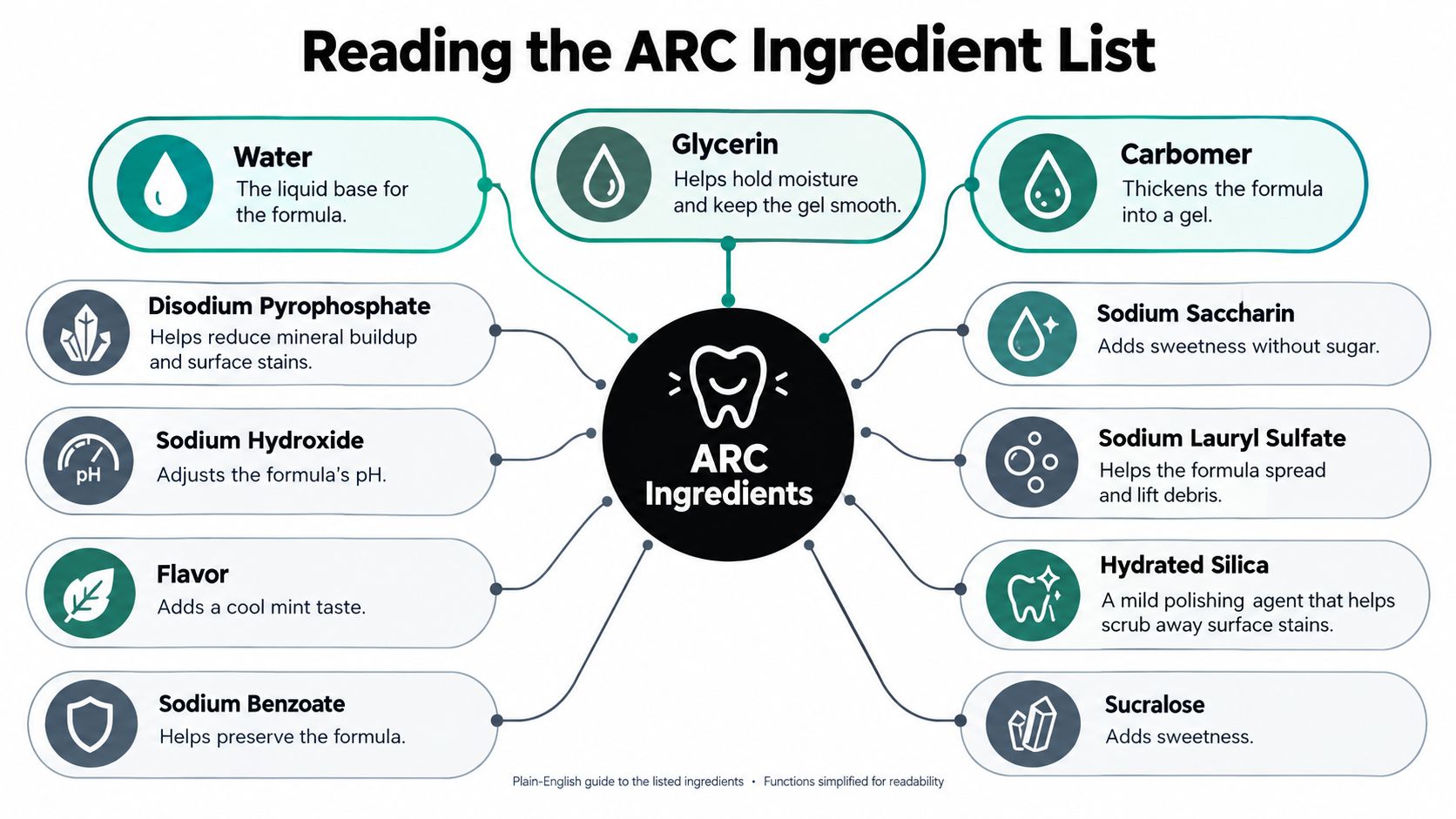
What the supporting ingredients contribute
Read these as plain-language descriptions of formulation roles, not proof of ARC-specific performance. An ingredient can serve a familiar purpose without telling you its concentration or the finished product's behavior.
| Ingredient | Plain-language role |
|---|---|
| Water | Provides the liquid base |
| Glycerin | Helps retain moisture and contributes to texture |
| Carbomer | Helps thicken the gel |
| Sodium hydroxide | Can be used to adjust pH |
| Flavor | Supplies the taste |
| Sodium benzoate | Serves a preservative role |
| Sodium saccharin | Adds sweetness |
| Sucralose | Adds sweetness |
| Sodium lauryl sulfate | Provides surfactant and foaming functions |
Don't judge an ingredient by its name alone. For example, seeing sodium hydroxide doesn't reveal the finished gel's pH, just as seeing a sweetener doesn't establish a whitening effect.
The ingredients most relevant to stains
Hydrated silica is the abrasive cleaning component. In plain English, it supports physical cleaning rather than acting as a bleaching agent.
Disodium pyrophosphate is associated with managing deposits and staining. Its presence supports the interpretation of ARC as a stain-maintenance product, but it doesn't establish how much stain an individual user will remove.
Two important names are absent from the documented list: hydrogen peroxide and carbamide peroxide. That absence is central to understanding the product, although the package in your hand should always be checked for formulation changes.
For a broader label-reading framework, the guide to whitening gel ingredients is a useful companion. Focus on the ingredient that performs the whitening or cleaning work, then distinguish it from the ingredients that make the product comfortable to apply.
Surface Stain Removal Versus Real Whitening
The word whitening can describe different outcomes. Removing discoloration from a tooth's surface can make it look brighter without changing the color within the tooth.
That's not fake whitening, but it isn't the same as peroxide bleaching. The distinction matters when you're deciding whether a product matches the reason your teeth look darker.
Start with the location of the discoloration
Extrinsic stains are on the outside of the tooth. Intrinsic discoloration involves color within the tooth structure, where a surface-cleaning approach isn't the same treatment.
The public ARC booster product listing, considered alongside the ingredient record, supports a surface-stain interpretation rather than treating ARC as a peroxide bleaching gel. Its intended claim is removal and prevention of surface stains, not chemical bleaching of internal tooth structure.
This comparison shows why the same word on different packages can lead to different expectations.
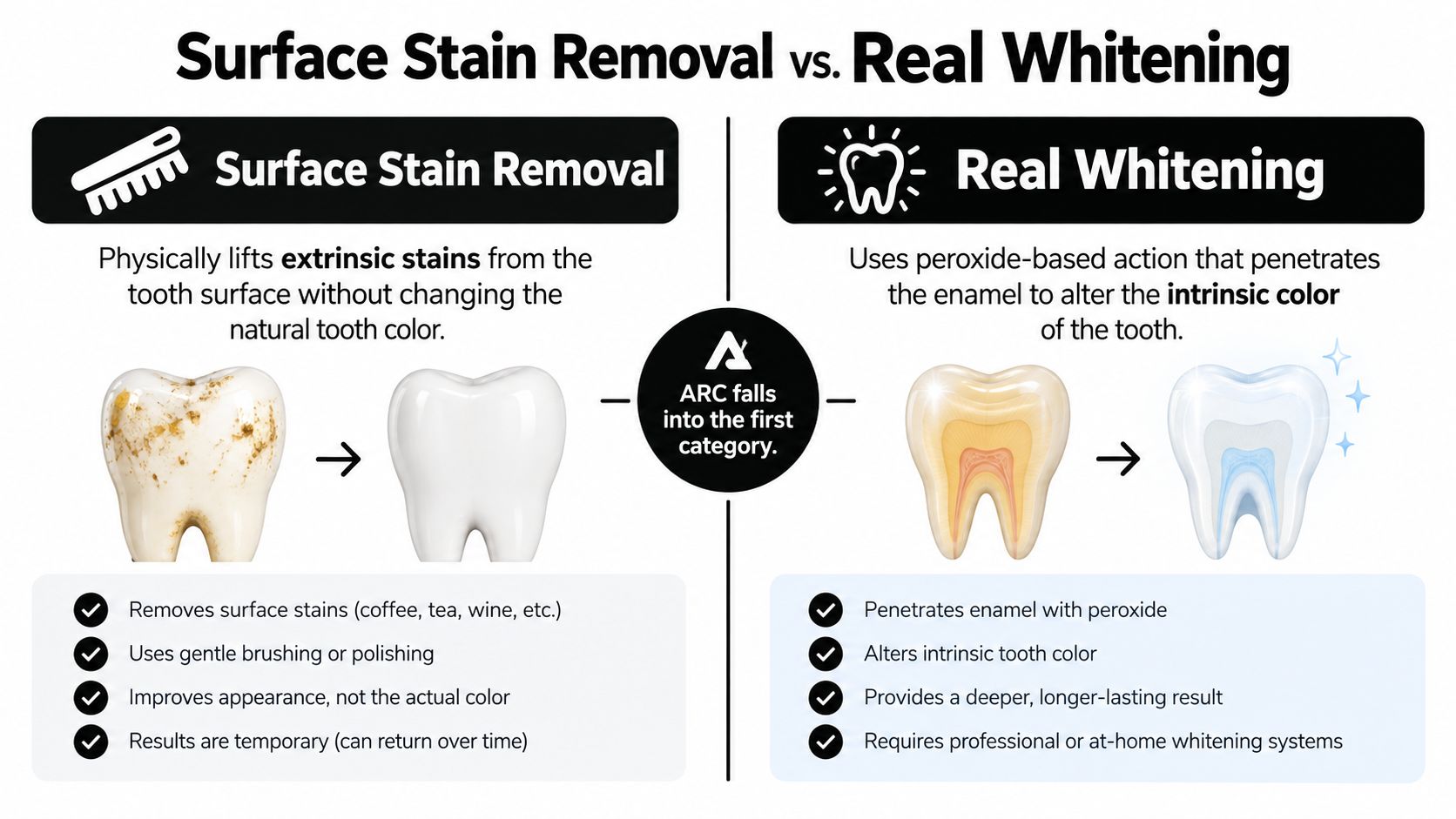
- Coffee, tea, wine, or tobacco staining: Surface discoloration associated with these exposures is a plausible target. That doesn't mean every dark area will respond, or that ARC has demonstrated a specific result for each stain.
- Natural yellow dentin: Don't expect surface cleaning to change the underlying color that contributes to your tooth's appearance.
- Tetracycline discoloration or fluorosis: These aren't appropriate targets for interpreting ARC as a corrective treatment. A dentist should assess the discoloration and discuss suitable options.
- Crowns, veneers, and fillings: Removing an external stain, where possible, is different from changing the restoration's own shade.
Brighter doesn't always mean bleached
Suppose a tooth looks dull because of a removable surface film. Cleaning that film may reveal a brighter-looking surface, even though the tooth's underlying color hasn't changed.
By contrast, a clean tooth that looks uniformly yellow presents a different question. Adding more surface cleaning doesn't automatically solve it.
The guide to professional stain removal can help you frame that distinction before choosing another product. Match the treatment to the source of the color, rather than treating every discoloration as the same problem.
How ARC Compares to Toothpaste, Strips, and Peroxide Gels
Choose a whitening product by its approach, not just its format. A gel can be a surface-cleaning product or a peroxide treatment, and those aren't interchangeable because both come from a tube.
ARC's position after brushing doesn't establish that it works better than a whitening toothpaste. The public records discussed here don't provide a direct comparison showing an added benefit over your existing brushing routine.
Whitening Product Types at a Glance
| Product type | Active approach | Typical contact time | Best at addressing |
|---|---|---|---|
| ARC After Brushing Whitening Booster | Documented surface-cleaning and stain-maintenance approach | Follow the exact booster label | Removable external staining |
| Whitening toothpaste | Cleaning approach varies by formula | During brushing, as directed | Surface staining within routine brushing |
| Peroxide whitening strips | Peroxide bleaching, when listed in the formula | Product-specific wear time | Tooth-color changes appropriate for bleaching |
| Peroxide gels with trays | Peroxide bleaching delivered through a tray | Formula- and tray-specific instructions | Bleaching goals assessed for the individual user |
Contact time isn't a useful shortcut for ranking these categories. You can't assume that leaving a cleaning product on longer turns it into a bleaching treatment, or borrow a tray's schedule for a different gel.
Decide whether you're adding value or duplication
If you already use whitening toothpaste, ask what ARC would contribute beyond another cleaning step. It may appeal as a maintenance product, but the documented composition doesn't prove that everyone needs both.
If you're considering strips or tray gels, your decision is different. You're evaluating a bleaching system, including its directions, suitability, and how it fits around existing dental work.
More products don't necessarily make a better routine. Each product should have a distinct purpose.
Avoid building a routine around every product category in the table. A complicated setup can make it harder to identify which product caused discomfort or whether any particular addition helped.
The most useful comparison is personal: your current care, the discoloration you want to address, and the outcome you expect. If the desired outcome requires a different approach, swapping or adding products without understanding that difference is unlikely to resolve the mismatch.
How to Use ARC After Brushing
Use the directions on your exact package as the authority. The public ingredient record establishes composition and intended placement in the routine, but it doesn't provide a complete, current instruction sheet for every tube.
The process graphic offers an orientation to an after-brushing application. Confirm its placement and timing details against your label before following them.
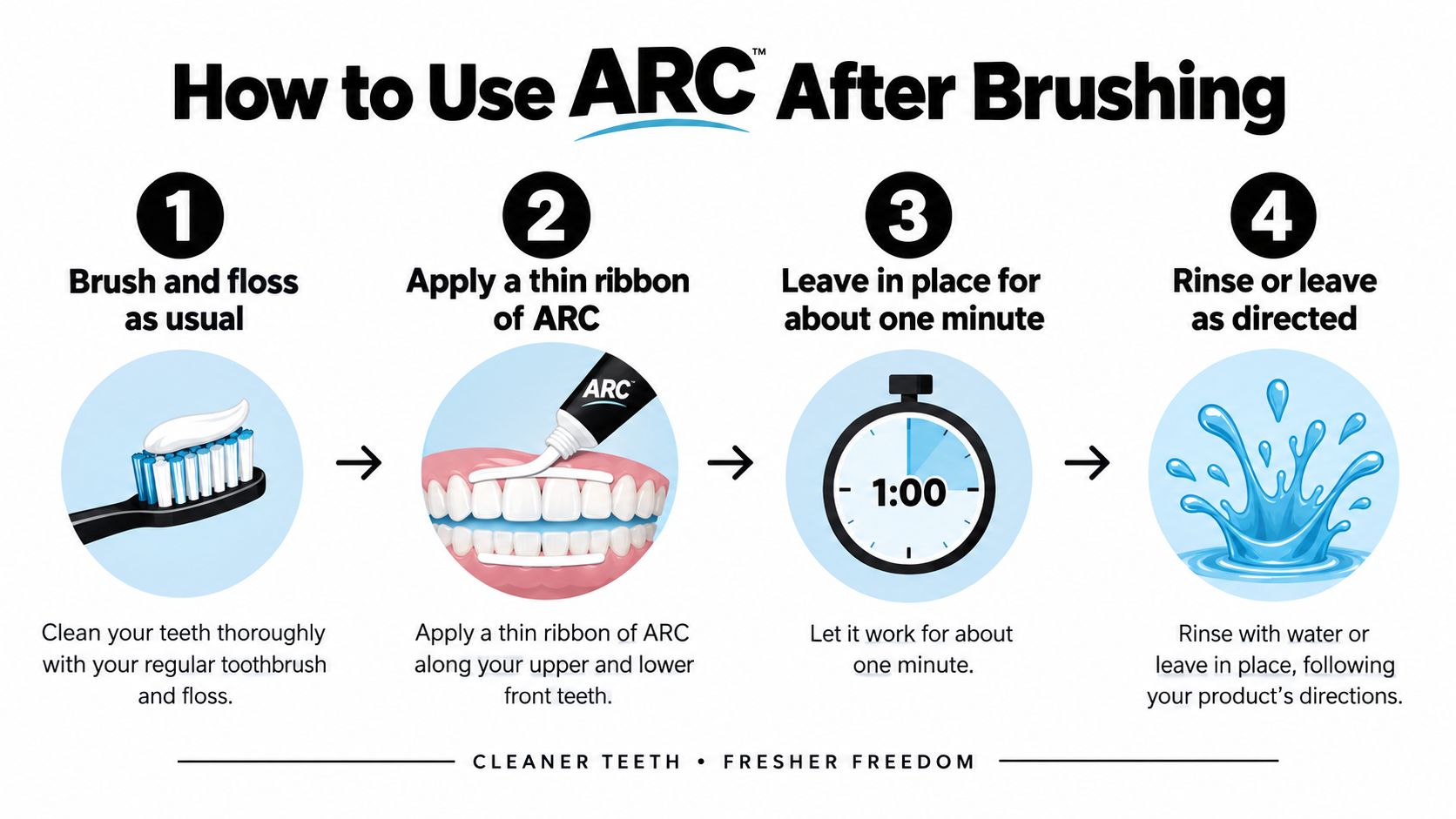
Check the instructions before applying
- Complete your usual care. Don't shorten brushing or skip cleaning between teeth because you're adding a cosmetic product afterward.
- Confirm the application method. Follow the package's directions for the amount, placement, and whether application involves brushing.
- Use the stated contact time. Don't extend it because you want a stronger effect.
- Check the finishing step. Follow the label on rinsing, spitting, and any restrictions on food or drink.
- Keep the labeled frequency. Don't invent a nightly or alternate-day schedule based on how much coffee you drink.
There isn't enough documented information to give a reliable tube lifespan or a universal waiting period after application. Those details depend on the package size and actual directions, so a precise estimate would create false confidence.
A comfortable evening routine may be convenient, but convenience isn't evidence that nighttime application performs better. Choose a time when you can follow the instructions without rushing.
The video below provides another visual reference. Compare any demonstrated technique with the directions on your own tube rather than treating a demonstration as a replacement for them.
If the package is unclear or differs from online instructions, pause and ask the manufacturer or your dentist. Don't resolve uncertainty by using more product.
Setting Realistic Expectations for Results
There's no supported ARC shade-change timeline in the public records discussed here. They don't establish a quantified shade improvement or an independently verified clinical whitening percentage.
That means neither a dramatic promise nor a guaranteed gradual result is justified. A product can have a plausible cleaning mechanism without having published evidence that predicts your outcome.
Measure the right outcome
For ARC, the useful question is whether visible surface staining becomes less noticeable under comparable conditions. Don't judge it against a bleaching goal that its documented formula wasn't designed to meet.
If you take comparison photos, control the conditions as carefully as you can.
- Use consistent lighting. A change in brightness or color temperature can alter how teeth appear.
- Keep the camera setup similar. Use the same device, distance, and settings where possible.
- Match your expression. Lip position and the amount of tooth showing can make comparisons misleading.
- Record other changes. A dental cleaning or another whitening treatment makes it harder to isolate ARC's contribution.
Treat testimonials as personal experiences
A before-and-after photograph can show that someone's smile looked different. It doesn't establish the cause, demonstrate a predictable result, or tell you whether the person had the same kind of discoloration as you.
Be cautious with claims of a specific shade change in a specific period unless independently verifiable clinical evidence accompanies them. The evidence needs to apply to the actual formulation, not merely to whitening products as a category.
Expectation check: If the visible result stops changing, reassess the target rather than increasing the dose.
An unchanged result may mean the remaining color isn't something this approach can address. That's a reason to ask for an assessment, not to keep escalating use.
Sensitivity, Safety, and When to Talk to a Dentist
Peroxide-free doesn't mean irritation-free. The documented ingredients give you a basis for checking your own tolerability, but they don't establish an ARC-specific rate of sensitivity or other adverse reactions.
Don't interpret tingling, burning, or soreness as proof that the product is working. Comfort is a separate consideration from cosmetic benefit.
The familiar appearance of a whitening product shouldn't make its instructions optional.
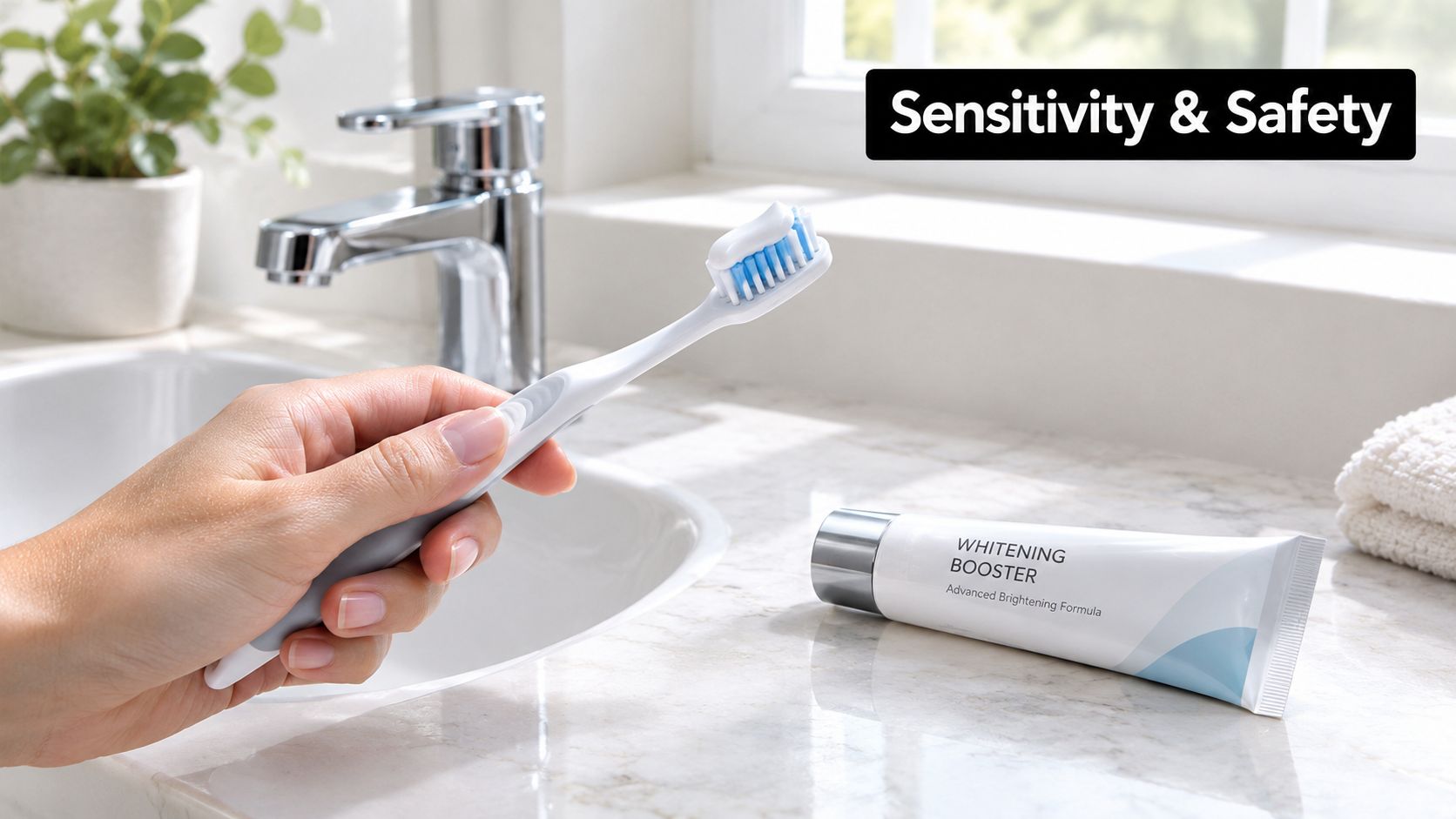
Let your dental history guide caution
If you've previously reacted to flavored or foaming oral-care products, review the label before trying ARC. Mention any known ingredient intolerance to your dentist rather than assuming a different brand will avoid it.
Ask for guidance first if you have active mouth sores, recent dental work, existing sensitivity, or concerns about worn enamel. The ingredient list alone can't determine whether this product is suitable for your mouth.
- Pause for new discomfort. Stop using the booster if you notice burning, painful gums, or new tooth sensitivity.
- Get persistent symptoms assessed. Lingering pain, sharp cold sensitivity, or new white patches on the gums shouldn't be managed by adding more whitening.
- Seek prompt help for severe symptoms. Significant swelling, worsening pain, or difficulty swallowing calls for professional attention.
Choose information that supports a discussion
For additional reading, Yoyime Clinic sensitive teeth whitening offers a resource to consult before discussing whitening with a clinician. The guide to whitening options for sensitive teeth can also help you organize your questions.
Neither resource replaces an examination. If discomfort begins after application, keep the tube so your dentist can review the formulation and directions with you.
Building a Complete Whitening Routine Around ARC
ARC belongs in a routine only if its maintenance role matches your goal. It doesn't need to be the main event, and you don't need to add it just because you're interested in a brighter smile.
Before buying, use this checklist:
- Name the target. Are you addressing removable staining or asking for a substantial color change?
- Review what you already use. Avoid adding a product that merely duplicates another step without a clear reason.
- Read the current package. Confirm ingredients, directions, and warnings.
- Set a stopping point. Reassess if you see no useful change or experience discomfort.
Keep routine oral care as your base. If sensitivity is already an issue, discuss suitable toothpaste and whitening choices with your dentist before adding another product.
For a significant shade-change goal, ask about professionally supervised options rather than expecting extra ARC applications to close the gap. A well-chosen routine starts with the right diagnosis, not the fullest bathroom shelf.
DentalHealth.com offers professional-grade at-home whitening gels and kits, sensitivity-care products, and practical guides for comparing your options. Visit DentalHealth.com to review product descriptions and find an approach that matches your stain-removal or whitening goal, with your dentist's guidance where needed.