
Carbamide Peroxide Hydrogen Peroxide: Which to Choose
The most popular advice on carbamide peroxide hydrogen peroxide products is also the most misleading: pick the higher percentage if you want whiter teeth faster. That shortcut fails because the two percentages don't measure the same thing. A sensible choice starts with delivered peroxide exposure, not the headline number. Convert the label first, then weigh wear time, tray fit, and your sensitivity history.
Carbamide Peroxide and Hydrogen Peroxide Side by Side
Carbamide peroxide is a source of hydrogen peroxide that releases its active peroxide slowly, so it usually whitens over days or weeks, while hydrogen peroxide acts faster at a lower headline strength. Which agent suits your teeth depends on how quickly you need a change and how much sensitivity you can tolerate. The two labels can't be read side by side as if they were a ranking.
The Core Comparison
| Factor | Carbamide peroxide | Hydrogen peroxide |
|---|---|---|
| Breakdown product | Hydrogen peroxide plus urea | Hydrogen peroxide (active agent) |
| Typical at-home strength | 10% to 38% (American Dental Association overview of whitening options) | About 3% to 6% peroxide equivalent |
| Typical in-office strength | 37% used in a professional trial | 35% tested against it in the same trial |
| Typical treatment schedule | Several hours of daily tray wear over several weeks | Short supervised sessions; home rinses need weeks |
| Speed of visible change | Gradual, over days to weeks | Fast; visible change possible in one in-office visit |
| Sensitivity pattern | Usually milder during treatment | Greater immediate sensitivity in trials |
| Best fit | Longer, supervised tray wear at home | Short, dentist-supervised sessions |
Read the strength row and the schedule row together. An overnight carbamide tray meters peroxide across the whole session, so a lower headline number can still add up to substantial total exposure. Delivered peroxide exposure, meaning how much active peroxide reaches enamel and for how long, is the figure that really deserves comparing between products.
In both cases, hydrogen peroxide does the whitening work. Carbamide peroxide is a delivery form that meters that peroxide out over a longer session, which is why tray systems built around brands like Opalescence and PolaNight are structured around repeated wear rather than a single application.
What Head to Head Testing Shows
At professional strength, the comfort gap becomes clearer than the shade gap. In a 6-month randomized, double-blind, split-mouth trial involving 45 volunteers, 37% carbamide peroxide and 35% hydrogen peroxide produced statistically similar tooth-shade outcomes immediately after treatment and at 3- and 6-month follow-ups, while hydrogen peroxide caused significantly greater immediate sensitivity, according to the PubMed record for the split-mouth trial. Carbamide peroxide produced lower sensitivity during treatment and for the following two days.
That result reframes the buying decision. If two professional strengths can reach a similar shade, picking by percentage alone tells you almost nothing about comfort, durability, or how the peroxide reaches the tooth. It also sets a boundary I would not cross at home without supervision. Both of those trial strengths are in-office level and call for gum isolation and a check of the teeth first.
Don't rank two gels until you've converted one of them. Until then, you're comparing a container with its contents.
Use the table as your starting point, not your verdict. Each row hides a practical detail that changes the recommendation: how the percentage converts, how long the gel stays in contact with enamel, and whether the tray seals well enough to keep gel on teeth rather than gums. A loose tray lowers delivered exposure and raises irritation at the same time, which is why fit can outweigh the number on the box.
Why Label Percentages Do Not Compare Directly
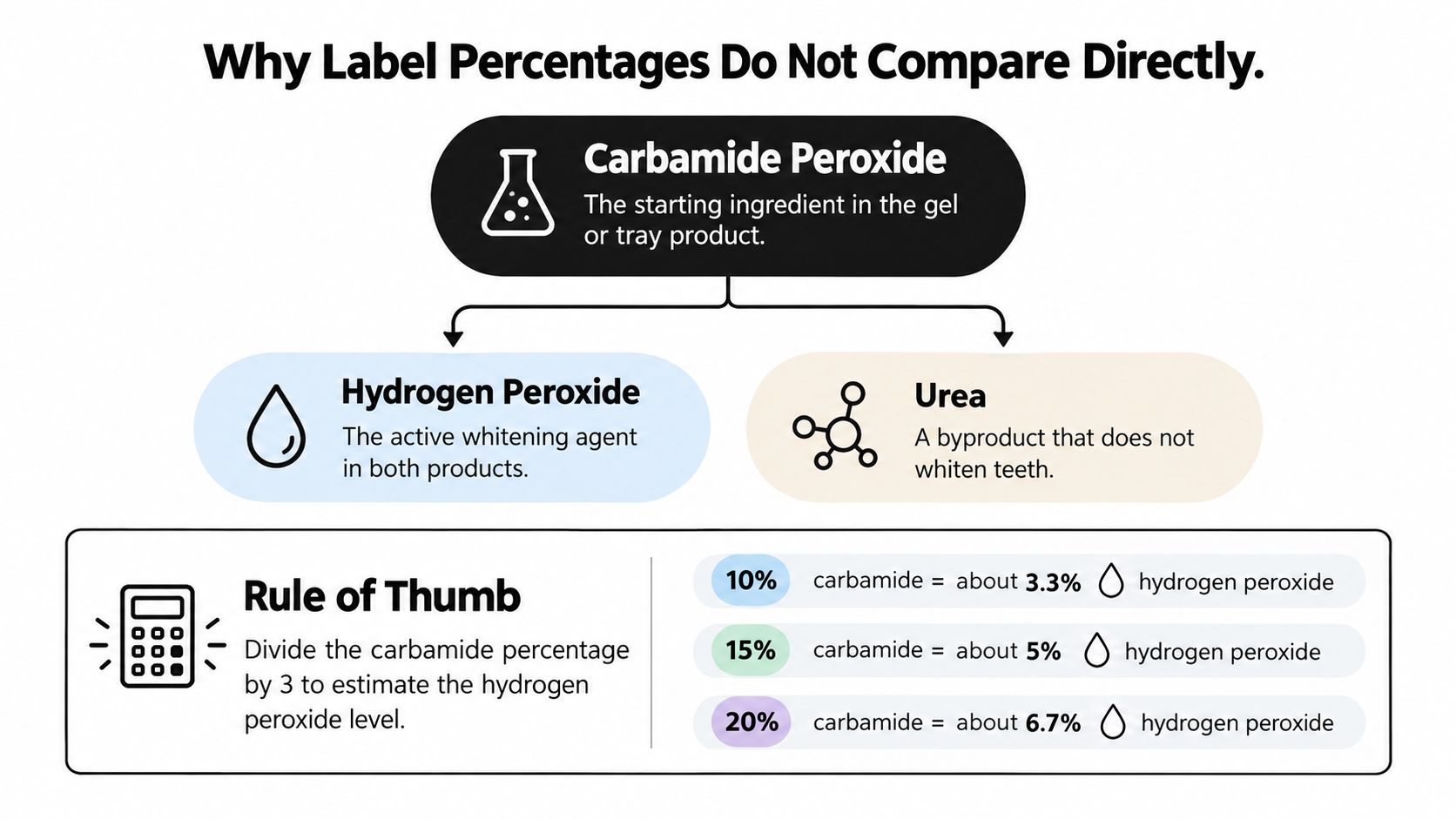
Carbamide peroxide breaks down into hydrogen peroxide and urea on contact with moisture in your mouth. The urea does not whiten. Hydrogen peroxide is the active whitening agent in both products, so a carbamide peroxide label always overstates the peroxide you end up with if you read it against a hydrogen peroxide label.
The American Dental Association overview of teeth whitening options gives the commonly used approximation that one-third of a carbamide peroxide concentration corresponds to hydrogen peroxide strength, which puts 18% carbamide peroxide at roughly 6% hydrogen peroxide, and places common at-home systems at 10% to 38% carbamide peroxide. At-home hydrogen peroxide products span a wide spread of strengths, so convert each label to its peroxide equivalent before you compare it with anything else.
A Label Lookup for Home Strengths
| Carbamide peroxide label | Approximate hydrogen peroxide equivalent | What it signals |
|---|---|---|
| 10% | About 3.3% | Lower end of at-home range; slower visible change |
| 16% | About 5.3% | Mid-range at-home; gradual course |
| 18% | About 6% | Commonly cited example of the one-third rule |
| 22% | About 7.3% | Higher at-home range; sensitivity exposure climbs with strength |
Read the lookup as a translation, not a promise. A 22% carbamide peroxide syringe, such as the strength sold in PolaNight 22, is not automatically stronger than every hydrogen peroxide product carrying a single-digit label. Once converted, both sit in the same conversation, and wear time plus tray fit decide how much of that peroxide reaches enamel. When a product expresses strength in volume rather than percentage, our explainer on what 20 volume hydrogen peroxide means shows how to read that figure before comparing it with a dental gel label.
Where the Rule Breaks
The one-third rule is a rough guide for home strengths. It stops working as a straight ranking at professional strengths, where trial results show high carbamide peroxide and high hydrogen peroxide gels reaching similar shades even when the label numbers look close together. Formulation, pH, how long the gel stays active in the tray, and how well the tray seals at the gumline all shift real exposure. A tray that fits loosely sends gel onto the gums, where it irritates tissue without touching the stains you paid to remove.
Release rate is the other half of the difference. Carbamide peroxide breaks down gradually, so peroxide spreads across a full tray session. Hydrogen peroxide peaks quickly, works in a shorter window, and fades, which means extending a hydrogen peroxide session past the directed time mostly buys sensitivity rather than extra whitening.
Practical rule: When two products show different percentages, compare the peroxide equivalent together with the wear time and tray fit on the instructions.
How Fast Each Peroxide Whitens Teeth
Speed claims are where marketing gets ahead of evidence, so start with the broadest review available. The Cochrane review of home-based chemical bleaching included 71 randomized or controlled trials involving 3,780 adults and found treatments generally lightened teeth compared with placebo over periods ranging from 2 weeks to 6 months. The review rated the certainty of evidence as low to very low because many comparisons came from single studies with small samples.
That rating sets your expectations. Both peroxides whiten. No single formula, concentration, or schedule has been established as universally superior, and anyone promising a specific shade jump by a specific date is going beyond what the evidence supports.
Two Benchmarks Worth Knowing
- Low-strength rinse: Dilute hydrogen-peroxide mouthrinses do produce measurable whitening in trials, but the effect builds slowly. A rinse touches enamel for a short window, gets diluted by saliva, and washes away, so peroxide exposure per session stays small.
- Rinse versus tray gel: Low-strength rinses generally need a much longer course of daily use than tray gels to reach a similar visible change, which is why rinses get positioned as maintenance products rather than primary whitening treatments.
Those two points explain the core trade-off in carbamide peroxide hydrogen peroxide choices. A tray holds gel against enamel for an extended session, so the same chemistry accumulates faster than anything a rinse can deliver in a 30-second swish.
Three Speed Tiers
- Single-visit in-office hydrogen peroxide, where professionally supervised procedures can produce visible changes after one appointment.
- Tray-based carbamide peroxide courses, which run for weeks and outpace rinses because the gel maintains contact with enamel the whole session.
- Low-strength hydrogen peroxide rinses, the slowest route, suited to gradual maintenance rather than a deadline.
Whitening also plateaus. Teeth lighten quickly at first, then the shade movement slows even if you keep applying gel. Judge progress with a shade guide under the same lighting each week, and stop when the shade stops moving. Pushing past the plateau adds exposure without adding color change, and temporary sensitivity is the usual price.
Faster almost always means more peroxide in less time, not a better final shade.
Sensitivity Risk by Concentration and Wear Time
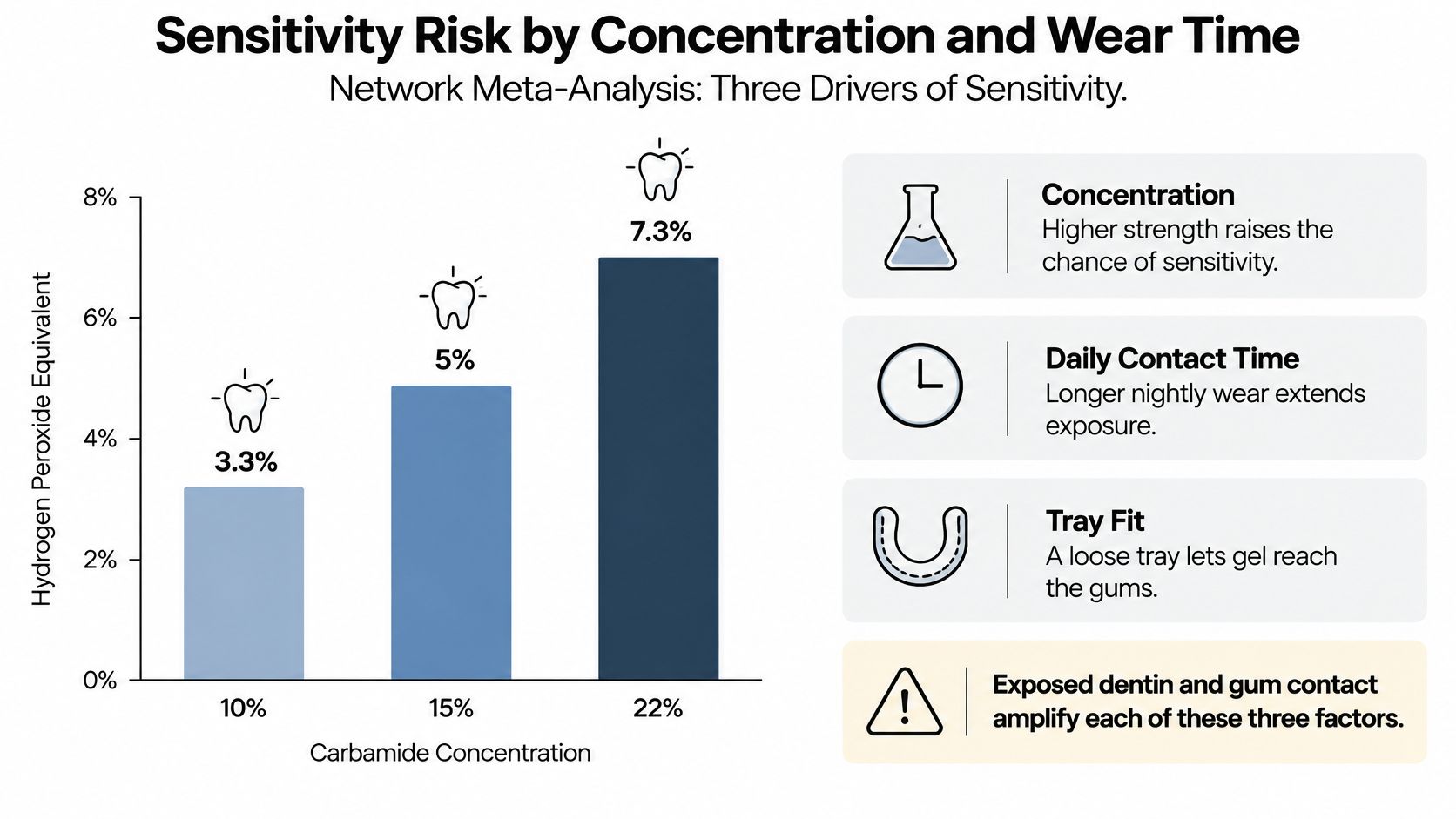
A stronger label does not guarantee a proportionally stronger sting. Sensitivity is driven by concentration, daily contact time, and tray fit, and exposed dentin or gel sitting on the gums amplifies each one. A moderate gel worn too long in a loose tray can bother you more than a stronger gel used briefly in a tray that seals well.
The PubMed record for the at-home peroxide sensitivity analysis describes a network meta-analysis that found higher at-home concentrations, carbamide peroxide 20% to 22% and hydrogen peroxide 14% to 16%, increased sensitivity risk versus lower regimens such as carbamide peroxide 10% to 11% or hydrogen peroxide 2% to 4%, with average sensitivity generally mild. A randomized clinical trial covered in the same record found 3% hydrogen peroxide used for two weeks produced a greater color change than 8% carbamide peroxide, with mean color differences of approximately ΔE00 5.39 and 4.75 respectively, and both exceeded the cited clinical acceptability threshold of ΔE00 greater than 1.8.
Sensitivity and Color Change by Regimen
| Regimen | Concentration | Sensitivity pattern | Color change evidence |
|---|---|---|---|
| Carbamide peroxide, lower regimen | 10% to 11% | Lower sensitivity risk | Lightening over a longer course |
| Carbamide peroxide, higher regimen | 20% to 22% | Higher risk, generally mild | Faster change than lower regimens |
| Hydrogen peroxide, lower regimen | 2% to 4% | Lower sensitivity risk | Gradual lightening with repeated use |
| Hydrogen peroxide, higher regimen | 14% to 16% | Higher risk, generally mild | Faster change, shorter sessions |
| Carbamide peroxide, 2 weeks | 8% | Generally mild | ΔE00 4.75 |
| Hydrogen peroxide, 2 weeks | 3% | Generally mild | ΔE00 5.39 |
Read the last two rows together. Both sit inside the lower-concentration band where sensitivity stayed generally mild, so the practical difference is the color change each regimen delivered over the same two weeks. The 3% hydrogen peroxide regimen moved shade further, while 8% carbamide peroxide still cleared the acceptability threshold. For a sensitivity-prone user, knowing where a regimen falls within that band matters more than which label percentage looks smaller. Our guide to teeth whitening gel side effects explains what normal, temporary sensitivity feels like versus symptoms that need attention.
Time Is a Dose
A short daily wear and an overnight wear are different exposures even at the same percentage. Peroxide keeps diffusing through enamel toward the nerve while the tray is seated, so wear time functions as part of the dose alongside concentration. If sensitivity shows up, shorten the session or space sessions a day apart before changing products. Switching brands at the same strength changes little.
Start at the lower end of the range, check that the tray does not overflow onto the gums, and wipe away excess gel with a cotton swab after seating it. Use a desensitizing toothpaste with potassium nitrate between sessions, and pause when sensitivity appears rather than pushing through it. DentalHealth.com stocks sensitivity toothpastes and rinses alongside its whitening gels, so managing the comfort side of a regimen does not require a separate errand.
What Your Dentist Checks Before You Whiten
A dentist's first job before whitening isn't choosing a gel. It's deciding whether you should whiten at all right now. The checklist below shows the conditions that usually mean treatment gets postponed until the underlying problem is fixed.
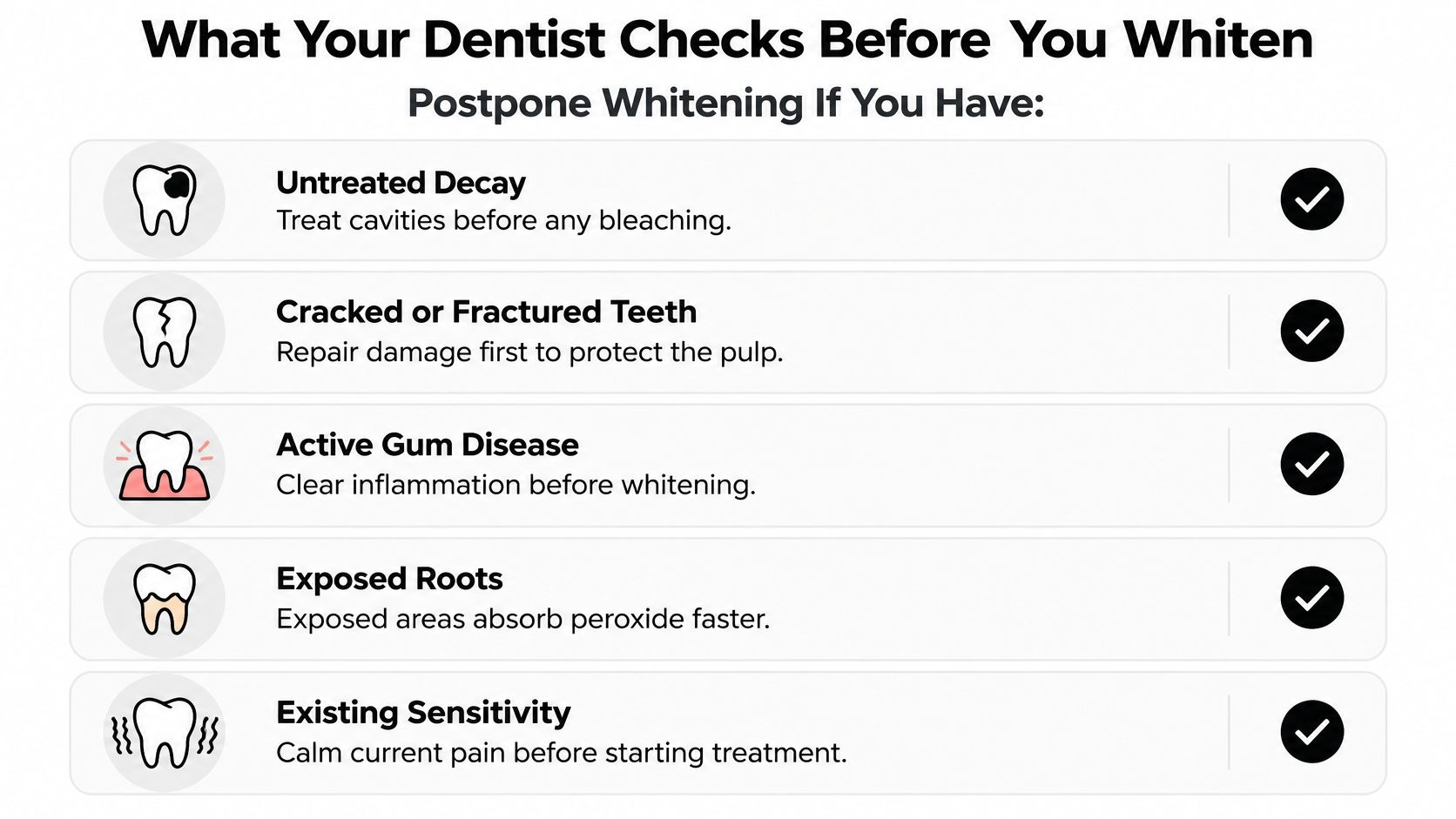
Postpone whitening if you have untreated decay, a cracked or fractured tooth, active gum disease, exposed roots, or existing sensitivity that hasn't settled. Peroxide travels through enamel and dentin, so a cavity or crack gives it a shortcut to the nerve. Inflamed gums also react more strongly to gel contact, and exposed root surfaces lack enamel protection entirely.
The ADA oral health topic page on whitening notes that peroxide products may react with ceramic crowns, sealants, and other restorations, and it recommends dental consultation for people who already have sensitivity or other dental issues. Bleaching doesn't whiten crowns, veneers, or fillings. If you lighten the natural teeth around an old front filling, that filling stays its original shade and often looks more noticeable afterward, which sometimes means budgeting for a replacement restoration. If you're weighing that against doing nothing, our roundup of dentist recommended teeth whitening options explains how dentists sequence whitening and restoration work.
The Stain Type Decides Whether Bleaching Works
- Surface stains from coffee, tea, and tobacco respond well to peroxide and to a professional cleaning first.
- Intrinsic discoloration from age or medication sits deeper and lightens more slowly, sometimes unevenly.
- Fluorosis can look mottled, and bleaching may make white spots stand out before the surrounding enamel catches up.
- Trauma-related darkening in a single tooth often signals nerve damage, which needs diagnosis before any cosmetic work.
- Restoration mismatch isn't a stain at all, and no gel will fix it.
The short video below walks through what a pre-whitening examination looks for, which is the same set of problems that turns a routine whitening course into a painful one.
Carbamide peroxide isn't automatically the safer choice just because it releases peroxide slowly. Your outcome still depends on the condition of your teeth when you start. End every course with these stop rules.
- Sharp pain during or after a session
- Sensitivity that persists after treatment ends instead of fading
- Gum blanching, where tissue turns white where gel touched it
- Uneven whitening, with patches or one tooth resisting while others lighten
Which Peroxide Fits Your Situation
Abstract pros and cons don't help at the checkout. Your schedule, your sensitivity history, and your deadline do. Match yourself to one of these five situations and you'll land on a defensible choice.
The First-Time Whitener Who Wants a Gentle Result
Say you've never bleached, your teeth twinge with cold drinks, and you'd be happy with a modest improvement over several weeks. I'd start you on lower-to-moderate carbamide peroxide in trays with shorter daily sessions, because the slow release gives you room to stop early on a bad day without wasting the session. Avoid jumping to the strongest syringe in the kit because it was included. Expect gradual lightening you notice in photos before you notice it in the mirror, and expect to finish without dreading the next application.
The Person With an Event in a Few Days
Weddings and job interviews don't wait for a tray course. If you need a visible change within days, dentist-supervised in-office hydrogen peroxide is the documented path to speed, since a single supervised appointment can produce a visible change. What you give up is control over pacing. The exposure is concentrated, sensitivity afterward is more likely, and you'll want soft foods and lukewarm drinks for a day or two. Don't try to replicate this at home by wearing a strong gel longer. That gives you the sensitivity without the gum protection the office provides.
The Busy Professional Who Can Wear a Tray Overnight
If your evenings are spoken for but you sleep fine with a tray in, carbamide peroxide fits your life. Its multi-week schedule suits extended wear, and products like PolaNight and Opalescence tray gels are built around exactly that pattern. The catch is compliance over weeks, not days. Miss every third night and your course stretches, which is fine as long as you track total sessions rather than calendar days. Avoid napping in a hydrogen peroxide gel meant for short sessions, since the directed wear time assumes you're awake to remove it.
The Person With a History of Sensitivity Who Still Wants Results
You aren't disqualified from whitening, but you don't get to self-prescribe. A lower carbamide peroxide strength after a dentist consultation is the practical route, paired with a desensitizing toothpaste before you start and rest days between sessions. Your dentist may also check for recession or worn enamel that's causing the sensitivity in the first place, since bleaching over an undiagnosed cause tends to end badly. Expect a slower, smaller shade change, and treat that as success rather than a reason to escalate strength mid-course.
The Person Whose Real Goal Is Maintenance
If your teeth are already the shade you want and you're fighting coffee stains, a gel course is the wrong tool. Use a whitening or sensitivity toothpaste as your everyday product, keep up with professional cleanings, and save peroxide for an occasional short touch-up course. Running full bleaching cycles to maintain a shade you've already reached only stacks up sensitivity. A remineralizing product such as MI Paste Plus after a touch-up is a more useful purchase than a stronger gel.
Confirm the Peroxide Choice Before You Buy
Work through this sequence in order. Each step narrows the next one, so you end up shopping for a confirmed strength and schedule instead of browsing percentages.
The Five-Step Check
- Pick the goal first. A fast visible change under supervision points to in-office hydrogen peroxide. A longer, controlled course at home points to carbamide peroxide trays. If you're sensitivity-prone, start with the lowest effective carbamide peroxide strength regardless of your timeline.
- Convert the label. Use the one-third rule for home strengths only, reading 18% carbamide peroxide as about 6% hydrogen peroxide, then check the directed wear time against how the tray fits. A converted strength in a tray that floods your gums isn't the exposure you calculated.
- Book a dentist check before using anything at 35% or higher. Those strengths are intended for professional oversight. A product like PolaDay CP 35 belongs in a plan your dentist has agreed to, with tray fit verified and restorations checked, not in a first experiment.
- Shop only for the confirmed strength. Once you know your agent, strength, and session length, browse product options matched to that specification. DentalHealth.com stocks tray gels from brands such as Opalescence and PolaNight alongside sensitivity toothpastes, which makes it one place to compare formats at the strength you've already settled on.
- Keep a simple log. Record wear time, sensitivity level, and shade each week in a phone note. If any stop-rule symptom appears, sharp pain, persistent sensitivity, gum blanching, or uneven whitening, stop and return to the dentist instead of extending wear to compensate.
Notice what this sequence does to the carbamide peroxide hydrogen peroxide decision. By step four, the brand and syringe size are almost clerical details, because the chemistry, dose, and schedule are already fixed. That's the opposite of how many shoppers buy, and it's why most complaints about whitening trace back to a strength chosen in a store aisle rather than a schedule chosen on purpose.
Confirm the strength before you shop, and every product page becomes easier to read.
Your single action this week is one of two things. Either book the pre-whitening check if anything in your mouth hurts, looks damaged, or includes visible front-tooth restorations, or write down the converted peroxide equivalent and directed wear time for the product you're considering. Do that before you spend anything.
Ready to act on the strength you've confirmed? DentalHealth.com carries professional-grade carbamide peroxide tray gels, whitening kits, and sensitivity toothpastes from the brands dentists recommend, with detailed product descriptions so you can match the label to your plan. Visit today to compare options at your chosen strength and order with fast U.S. shipping.