
Carbamide Peroxide Price: What You Really Pay Per Treatment
The highest observed carbamide peroxide listing cost nearly 5.9 times the lowest in Flapen's analysis of the U.S. Amazon category. That doesn't mean the expensive product delivers better whitening. It means a carbamide peroxide price tag tells you very little until you know how much usable gel you're buying and what a completed whitening course requires.
The useful comparison is price per completed treatment course, not price per tube. Start with the pack, work out its usable applications, and include trays and any additional gel you'll need before deciding which option costs less.
Carbamide Peroxide Price Ranges at a Glance
U.S. online listings in the marketplace analysis averaged $21.70, with observed prices from $7.77 to $45.84. Those figures describe retail listings rather than wholesale chemical prices or a fixed quantity of whitening gel.
The spread becomes easier to read once you separate the product from the package. A single refill syringe, a multi-syringe pack, and a kit bundled with application trays are different purchases wearing similar labels. PolaNight 22% shows this inside one product line: the 8-syringe pack lists at $39.99 and the 4-syringe pack at $24.99, so the larger option costs more at checkout while charging less per syringe.
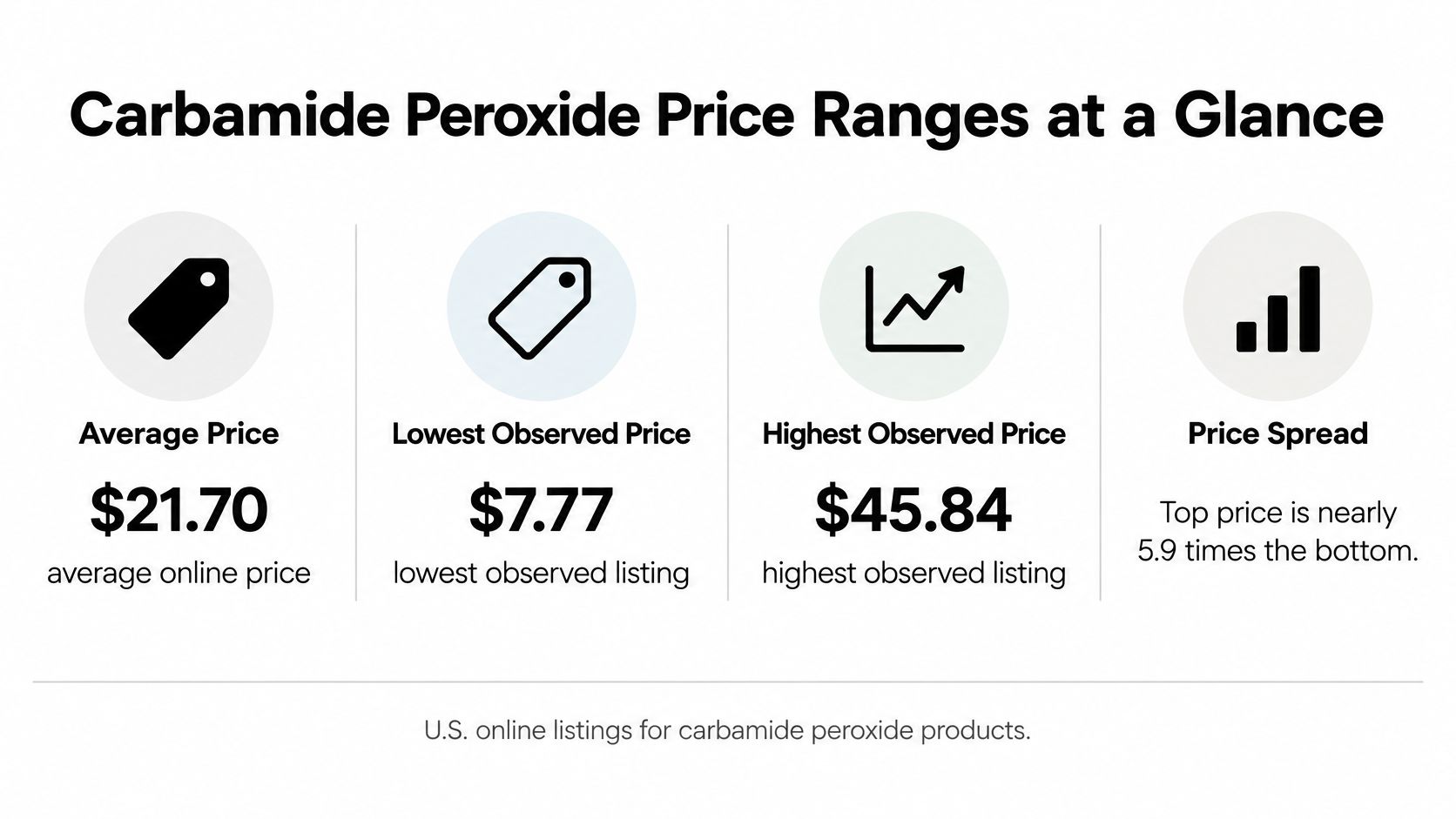
Carbamide peroxide price snapshot
The listings below show why concentration alone won't explain a checkout total. Where a pack count isn't given, confirm it before judging value.
| Product or benchmark | Concentration | Listed price | Pack or basis |
|---|---|---|---|
| U.S. marketplace average, Amazon category | Mixed | $21.70 | Average listing price |
| U.S. marketplace range | Mixed | $7.77 to $45.84 | Lowest to highest observed listing |
| PolaDay CP 35% | 35% | $24.99 | 4 syringes |
| PolaNight 22% | 22% | $39.99 | 8 syringes |
| PolaNight 22% | 22% | $24.99 | 4 syringes |
| PolaNight 10% | 10% | $24.99 | Confirm syringe count |
| Lumibrite 22% | 22% | $19.99 | Confirm syringe count |
| Lumibrite 32% | 32% | $17.99 | Confirm syringe count |
| Philips Zoom 14% DayWhite | 14% | $27.99 | Confirm active ingredient and pack contents |
| Typical home-use kits, per Dataintelo's carbamide peroxide market estimate | Product-specific | $25 to $150 | Per kit |
| Typical in-office bleaching, same market estimate | Clinician-selected | $300 to $800 | Per professional session |
Three of these listings share an identical sticker price. PolaDay CP 35%, PolaNight 10%, and the 4-syringe PolaNight 22% each list at $24.99, yet the money buys different concentrations and different amounts of gel.
Lumibrite 32% costs less than Lumibrite 22% in these listings, $17.99 against $19.99. Higher concentration does not guarantee a higher price. Without matching pack contents and application requirements, neither listing establishes the cheaper finished course.
Practical rule: Don't compare two sticker prices until you know the active ingredient, concentration, usable quantity, and product type.
A marketplace average helps you recognize the general shopping range. What it can't tell you is whether a particular pack covers your dentist's recommended schedule, which is why the lowest sticker on the shelf can still produce the more expensive course.
Cost per Treatment and Full Course Budget
Start by distinguishing a session from a course. A session is a single application; a course is the full sequence your product's directions or your dentist prescribes. Sellers sometimes use "treatment" to mean either, so define the unit before doing the arithmetic.
A syringe isn't automatically a session. Its usable applications depend on its volume, the required dose, and whether you're whitening the upper teeth, lower teeth, or both.
Calculate the usable application cost
Keep the product description and instructions open beside your calculator, then work through this sequence:
- Find the pack price. Use the actual purchase price, then account for any checkout charges.
- Count the syringes. Check that the package you select matches the quantity in the description.
- Divide price by syringe count. The result is a reliable packaging comparison, not yet a clinical treatment cost.
- Confirm the dose per session. Only call the figure a cost per session if the instructions establish that each syringe provides one.
- Add required equipment. Include trays or replacements you don't already have in suitable condition. PolaNight 22%, for instance, is designed for use with customized trays from your dentist, so a first-time buyer budgets for those separately.
Our guide to how to use carbamide peroxide gel shows which application details to check. The product's directions and your dentist's advice set the dose; stretching the gel thinner to make a pack last longer changes the protocol, not the price.
Cost per treatment for listed whitening kits
The table below separates cost per syringe from cost per treatment. The first can be calculated from the package; the second needs dosing information.
In its 2025 listing, Net32 priced an Opalescence PF 35% Mint patient kit containing eight 1.2 mL syringes at $41.95, equivalent to approximately $5.24 per syringe.
| Product | Pack price | Syringes per pack | Calculated cost per syringe |
|---|---|---|---|
| PolaNight 22%, larger pack | $39.99 | 8 | $5.00 |
| PolaNight 22%, smaller pack | $24.99 | 4 | $6.25 |
| PolaDay CP 35% | $24.99 | 4 | $6.25 |
| Opalescence PF 35% Mint, Net32 listing | $41.95 | 8 | $5.24 |
| Captivate by Nupro, smaller pack | $22.99 | 2 | $11.50 |
| Captivate by Nupro, larger pack | $41.99 | 4 | $10.50 |
All figures are rounded to the nearest cent, and none of them establish that the syringes hold equal volumes or cover equal numbers of applications.
Two more listings, Lumibrite 22% at $19.99 and Zen CP+ at $14.99, can't enter this comparison until you confirm the syringe count on the product page. A low sticker price only converts into a low per-syringe cost if the pack holds enough gel.
Within the same product line, larger packs lower the per-syringe cost: PolaNight 22% drops from $6.25 to $5.00, and Captivate by Nupro falls from $11.50 to $10.50. Across different brands, add one more check: how much gel does each syringe contain, and how much does the protocol use per application?
A cheaper syringe can be worse value if it holds less usable gel. A more expensive syringe can cover additional applications. Neither outcome follows from the brand name or the package photo.
Budget the course rather than the next refill
Write down the planned applications first, then count how many whole packs cover them. Multiplying a rounded unit price by sessions gives a tidy number on paper; your checkout total moves in pack-sized steps.
Include these budget items:
- Required gel: enough for the directed course at the correct dose.
- Whole-pack purchases: unused syringes still count toward what you spend.
- Tray costs: new custom trays or replacement trays, when needed.
- Unexpected replacement: a lost or damaged syringe can force another purchase.
- Usable shelf life: spare gel only holds value if you can store and use it within the product's requirements.
Sensitivity pauses don't automatically consume extra gel. They can stretch the calendar without changing the application count, so don't pad the gel budget with an arbitrary percentage.
A worked pack-size comparison
Suppose your dentist recommends a course requiring 14 syringes. This is a purchasing example, not a treatment schedule or a claim that each session empties a syringe.
Using our PolaNight 22% prices, two 8-syringe packs cost $79.98 while four 4-syringe packs cost $99.96. Both supply 16 syringes, so the larger-pack route saves $19.98 on the same purchased quantity and leaves two syringes spare. Spread over the 14 syringes the course uses, that works out to about $5.71 per syringe used against $7.14 for the smaller packs.
The distinction that matters is between gel used and money spent. No unit-price shortcut captures the cost of buying whole packs.
Session format can change consumption too. Our PolaDay 9.5 pack contains 4 syringes, each holding enough gel for one whitening session; its 30-minute treatment can run as two 15-minute sessions, though splitting it uses more product. That example sits apart from the table above because PolaDay 9.5 contains hydrogen peroxide, not carbamide peroxide.
How Concentration Changes What You Pay
Concentration works like the strength of a cleaning solution: a stronger mixture doesn't necessarily produce a proportionally better finished result. With whitening gel, strength is only part of the protocol. Wear time, application frequency, and the total course matter too.
A randomized clinical trial published in Operative Dentistry found that 10% and 16% carbamide peroxide gels both produced statistically significant whitening in the evaluated at-home protocol, and were comparable on effectiveness and safety. That finding supports comparing complete protocols rather than assuming the higher percentage must deliver a better final shade.
It doesn't establish that every commercial product at those concentrations performs identically. The formulation, directions, and person using it still matter.
Concentration tiers and what their prices buy
| Concentration tier | Example product | Listed price | What the price buys |
|---|---|---|---|
| 10% | PolaNight 10% | $24.99 | Lowest concentration in the PolaNight line; confirm pack contents and directed schedule |
| 16% | PolaNight 16% | Intermediate PolaNight strength; compare its complete protocol | Sits between the 10% and 22% strengths in the same line |
| 22% | PolaNight 22%, 4 or 8 syringes | $24.99 or $39.99 | Product designed for a 45-minute treatment |
| 35% | PolaDay CP 35%, 4 syringes | $24.99 | Highest concentration in this comparison; assess the directed course rather than percentage alone |
Notice what the table shows. Three of the four tiers share a $24.99 entry price, so concentration alone barely moves the sticker. What separates them is the protocol behind each percentage, which is where cost per completed treatment is decided.
PolaNight 22% is the highest concentration in our professional-grade PolaNight line. That describes its position within the range, not a guarantee that it's the best choice for every shopper.
Shorter wear time and fewer applications are different benefits. A shorter application may fit your evening more easily without reducing the amount of gel you buy. Fewer required applications may reduce your course cost, but only if the product's actual protocol supports that comparison. The way to test it: divide what you'll spend on the full directed course by the number of treatments that course delivers. The percentage on the label never enters that arithmetic directly.
Put a value on convenience without confusing it with savings
Say you're choosing between a longer-wear gel and a shorter-wear alternative. First establish whether both are appropriate for you. Then compare the amount you'll purchase for the directed course and consider how manageable each schedule feels.
If the faster option costs more but helps you follow the schedule consistently, you may reasonably value that convenience. Call it a convenience premium, not proof of a cheaper course.
Pay for a stronger gel because its appropriate protocol suits you, not because the percentage looks like more whitening for the money.
For sensitivity-conscious shoppers, a lower-strength option is worth discussing with a dentist. Don't compensate for a lower concentration by increasing the dose or improvising the wear time.
Why Same-Strength Products Cost Different Amounts
Identical concentration percentages don't make two whitening gels equivalent. Manufacturers can use different gel bases, packaging, storage requirements, and dosing systems, all of which affect what you can use from the purchase.
A review available through PubMed Central describes how formulation, exposure, and concentration influence whitening performance and biological effects, including laboratory findings of greater oxidative stress and reduced cell viability with prolonged or high-concentration exposure. Laboratory findings don't predict an individual shopper's outcome, but they reinforce why price comparisons shouldn't ignore safe use.
Formulation and packaging
Formulation includes more than the active ingredient. Check whether the product includes desensitizing ingredients, what storage it requires, and whether its directions suit the treatment your dentist recommends.
Packaging affects dose control and protection of the remaining gel. Compare the labeled volume, closure, expiry information, and storage instructions rather than assuming a professional-looking syringe justifies a premium.
The package format is visible; the usable dose still needs confirmation.
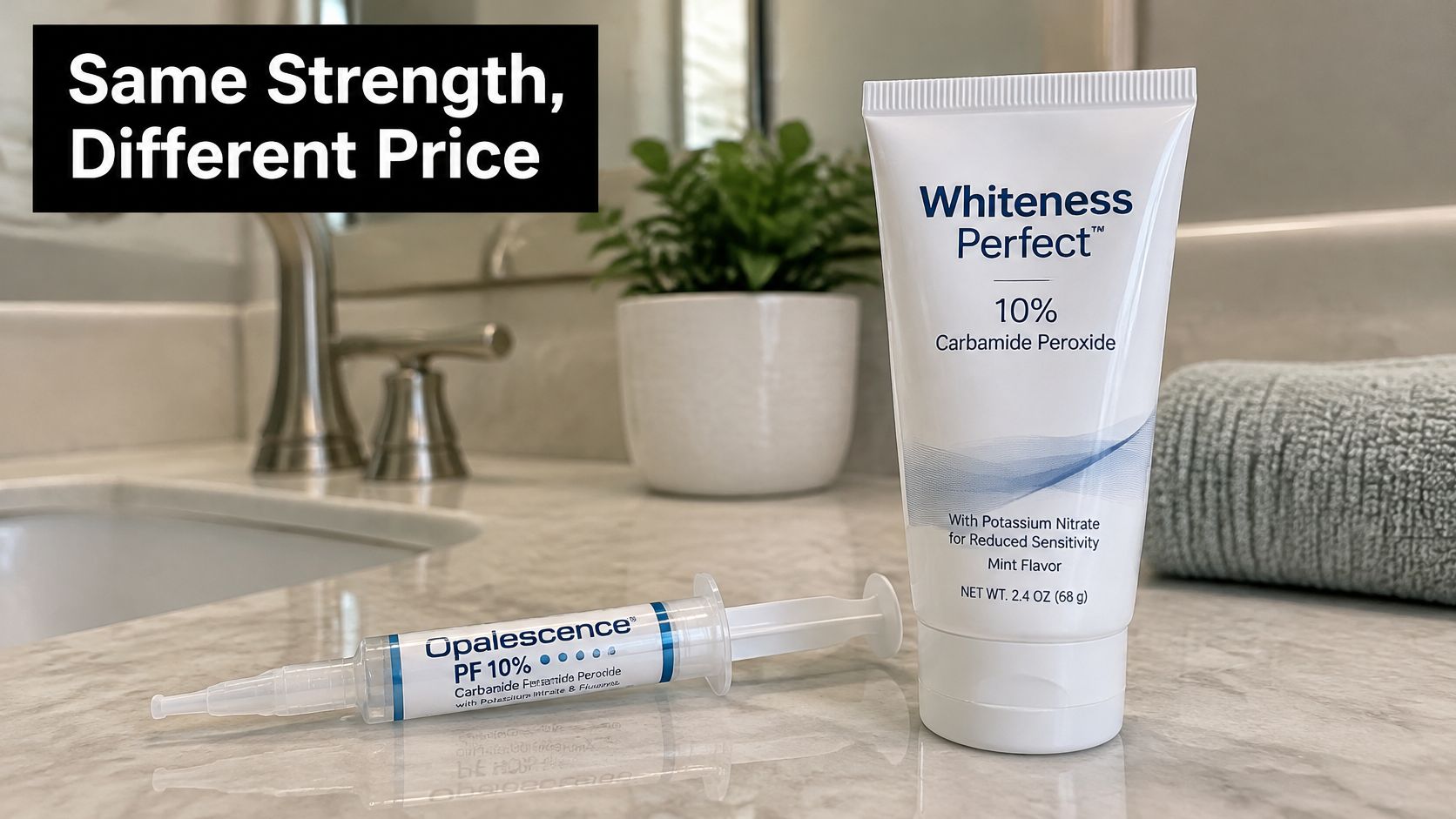
Product type also matters. Lumibrite is an at-home tooth whitening system made by Den-Mat. A system name alone doesn't establish which accessories are included in a particular listing, so read the selected package description.
Tray compatibility can change your starting budget. Our PolaNight 22% is designed for customized trays obtained from your dentist. Its gel price doesn't establish the cost of those trays.
Low-price traps to check
A low sticker price isn't necessarily a problem. An incomplete comparison is.
- Unconfirmed volume: A syringe count without its contents may conceal a smaller usable quantity.
- Unclear dosing: You can't calculate application cost when the required dose is missing.
- Poor tray fit: Leaking gel or a tray that needs replacement can undermine the purchase.
- Unsuitable pack size: Leftovers have limited value when they won't be used appropriately.
- Missing identification: An unclear active ingredient or concentration prevents a meaningful comparison.
- Improvised exposure: Extending wear to make a cheap gel work harder isn't a sound value strategy.
Our Zen CP+ regular price is $14.99, but its syringe count and concentration need confirmation before making a per-treatment claim. A customer's observation that it costs less than gel from her dentist's office is a shopping comparison, not a dose-matched course calculation.
Keep hydrogen peroxide separate. PolaDay 9.5 contains 9.5% hydrogen peroxide. Its percentage shouldn't be placed beside carbamide peroxide percentages as though they measure equivalent formulations or interchangeable wear times.
Our broader guide to teeth whitening gel prices helps frame those product-category differences. Before buying, identify the active ingredient, required tray, storage conditions, and whether the intended protocol requires professional supervision.
In-Office Versus At-Home Cost
A Dataintelo market estimate places typical in-office bleaching at $300–$800 per session, compared with approximately $25–$150 for home-use kits. These are directional market benchmarks, not local quotes or proof that either purchase completes your whitening course.
Professional treatment and a home kit also buy different things. A clinic quote may include assessment, treatment delivery, and monitoring, while a retail gel purchase may cover only the consumable product.
Compare what the quote includes
| Cost question | At-home option | In-office option |
|---|---|---|
| What am I purchasing? | Gel, kit, or refill | A defined professional service |
| What equipment is separate? | Confirm tray requirements | Ask what the quoted service includes |
| Who applies the product? | You, following the directed protocol | Dental professional |
| What establishes the final budget? | Required packs and equipment | Written course quote and any additional fees |
A home course requires time and careful self-application. Professional care may offer help with tray fit, suitability, and sensitivity management, but you should ask which services are included rather than assuming they come with every appointment.
For a fair comparison:
- Request a written course quote. Establish whether the clinic price covers an appointment or the anticipated full course.
- Identify separate charges. Ask about trays, take-home gel, follow-up care, and additional visits.
- Price the home purchase completely. Include the packs and equipment you'll need.
- Compare responsibilities. Consider self-application time alongside the financial total.
Our guide to professional teeth whitening prices provides context for evaluating the clinic option.
Budget checkpoint: Compare a complete home purchase with a complete professional quote, not a refill syringe with a clinic appointment.
The dentist's actual quote should drive the final decision. A market range can orient you, but it can't establish your clinical needs or local cost.
Pick the Lowest Total Cost Option Before You Buy
Choose the lowest-cost appropriate course, not the lowest-priced pack. A larger package can reduce unit cost, but only when its contents suit your protocol and you can use them appropriately.
Within the confirmed pack-count comparisons, the larger PolaNight package offers a lower syringe cost than its smaller counterpart. That's a useful purchasing advantage, not evidence that it's the cheapest completed treatment for every person.
Make the purchase decision in this order
- Establish suitability: Confirm the active ingredient, concentration, and whether your teeth and gums are ready for whitening.
- Define the protocol: Use the product's directions and your dentist's recommendation to establish applications and dosing.
- Calculate the actual purchase: Count whole packs, not just the gel you expect to consume.
- Include equipment: Add dentist-made trays when choosing PolaNight 22%.
- Resolve missing details: Confirm the PolaNight 16% price and any unlisted syringe counts before comparing totals.
- Recheck before ordering: Verify the selected pack, current price, storage requirements, and expiry information.
Our PolaNight 10% is the lower-strength option in that product line. If sensitivity concerns you, discuss whether it's appropriate rather than choosing a stronger product solely for a shorter application.
The final test is practical: can you identify what you'll use, what you'll purchase, and what remains outside the gel price? If any of those answers is unclear, resolve it before ordering. Then compare that complete total with a dentist-supervised option.
DentalHealth.com offers professional-grade at-home whitening gels and kits, along with sensitivity-care products and practical product guides. Visit DentalHealth.com to compare available strengths and pack sizes, check the application details, and calculate your full-course budget before you buy.