
Coconut Teeth Whitening: What the Evidence Actually Shows
Coconut oil pulling has not been shown to whiten teeth in clinical research, and the strongest evidence only points to short term reductions in some oral bacteria. If you've seen coconut teeth whitening praised as a natural shortcut to a brighter smile, you're not alone, but natural doesn't automatically mean effective for changing tooth color. A cleaner feeling after swishing oil can be real without any bleaching taking place. The useful question isn't whether coconut oil is good or bad. It's what it does in your mouth, what it can't do inside a tooth, and when you're wasting time that could go toward a method that changes shade.
Why Coconut Oil Whitening Has Become So Popular
The popular advice sounds reassuring. Swish a spoonful of oil, skip the chemicals, and watch stains lift. That message travels well because it's simple, inexpensive, and easy to film. A short video can show teeth looking glossy under bathroom light, but it can't show whether enamel shade changed, whether lighting changed, or whether the person also brushed, flossed, or had a professional cleaning.
There's also a reasonable frustration behind the trend. Many people worry about sensitivity from whitening gels, dislike strips that slip, or prefer products they can pronounce. Coconut oil feels familiar because it's already in kitchens and skin care routines. That familiarity can make a health claim feel settled before anyone asks how it was tested.
What Anecdotes Can't Tell You
Before and after photos rarely control for the basics. Coffee intake, camera exposure, lip color, dryness of the teeth, and recent brushing all shift appearance. Teeth also look lighter when they're clean and wet with saliva, even if their underlying color hasn't moved. That's why personal reports can be sincere and still misleading about coconut teeth whitening.
Controlled research asks a narrower question. Did researchers measure tooth color, or did they measure something nearby, like plaque or bacteria in saliva? For coconut oil, the answer matters a lot. A 2020 systematic review searched 42 potentially eligible studies but found only 4 randomized controlled trials specifically evaluating coconut oil pulling, comprising 182 participants. That's a small evidence base for a big cosmetic claim.
If a method makes your mouth feel cleaner, don't assume it bleached your teeth. Cleanliness and color change are different outcomes.
That distinction doesn't make you foolish for being curious. It gives you a better test for every claim you see. Ask what changed, how researchers measured it, and whether the change would still matter weeks later. Once you ask that, coconut oil stops looking like a secret whitening treatment and starts looking like what it is, a swishing practice with limited, specific effects.
What Oil Pulling Is and How It Works
Oil pulling is a traditional Ayurvedic practice from India in which a person swishes oil around the mouth and then spits it out. People commonly use coconut oil because it tastes milder than some other oils and turns liquid quickly at mouth temperature. It's a rinse like technique, not a gel you leave on teeth and not a bleaching agent.
The visual below lays out the basic sequence people follow.
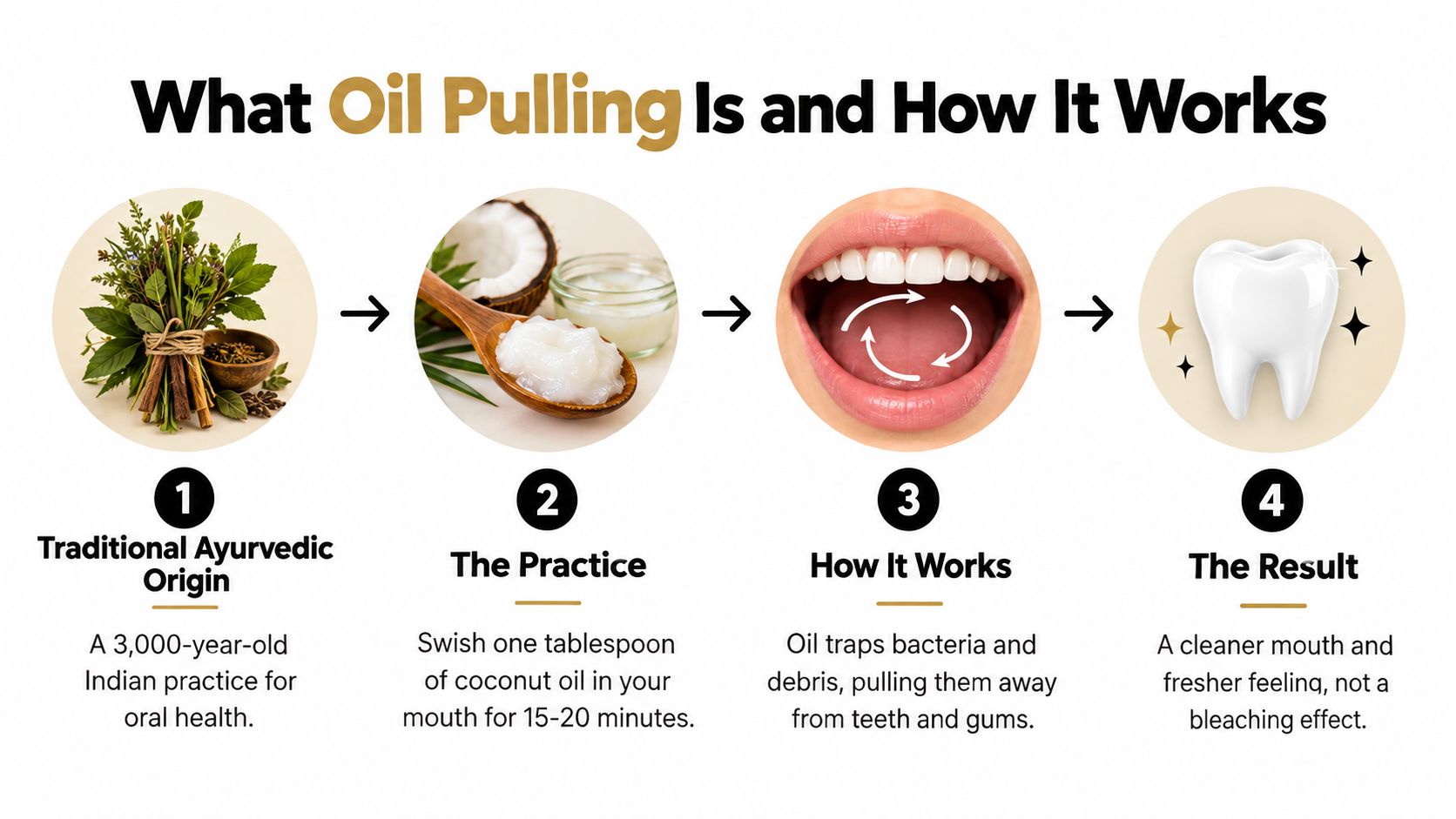
In practice, the routine is straightforward. You place oil in your mouth, move it gently around your teeth and gums, and keep it moving without swallowing. When you're done, you spit it into the trash rather than the sink, rinse with water, and continue with your normal oral care. Many people do it in the morning because that's when the habit is easiest to remember.
What Happens While You Swish
As you swish, oil mixes with saliva and coats oral surfaces. That movement may loosen loose food debris and some soft deposits, which then leave the mouth when you spit. Your teeth can feel smooth afterward for the same reason they feel smooth after a thorough rinse and brush. Nothing in that process requires a chemical reaction inside enamel.
Bleaching works differently. Peroxide based products release oxygen molecules that break down colored compounds within enamel and the dentin beneath it. Coconut oil doesn't oxidize those pigments. It stays on surfaces, moves material around, and exits when you spit.
- Mechanical action: Swishing moves oil across teeth and may dislodge loose debris.
- Coating effect: Oil leaves a slick feeling that people often interpret as smoothness or shine.
- No pigment reaction: Coconut oil doesn't break apart internal tooth color the way peroxide does.
Keep that mechanical picture in mind. A method can help remove what's sitting on a tooth without changing the tooth itself.
What the Research Actually Measures
Most coconut oil studies don't start with a shade guide. They count bacteria in saliva, score visible plaque, or rate gum inflammation. Those outcomes can matter for oral health, but they don't answer whether a tooth moved from one shade to another. Confusing those measures is how modest findings turn into whitening headlines.
The trials behind the 2020 review lasted just 7 to 14 days, a short window for judging durable color change, and the review described mixed study quality and high risk of bias in the systematic review evidence on coconut oil pulling. Some included results showed statistically significant reductions in salivary bacterial colony counts and plaque index scores, yet those are measures of bacteria and plaque, not intrinsic whiteness. Even a favorable plaque score leaves the central cosmetic question unanswered.
A broader look didn't strengthen the whitening case. A 2022 meta analysis combined 9 randomized controlled trials involving 344 participants and found a significant reduction in salivary bacterial counts versus control groups, with a mean difference of 17.55 (95% CI 2.56 to 32.55), but no significant changes in plaque or gingival index. That pattern suggests a possible short term effect on bacteria in saliva, without a consistent effect on plaque or gums, and still without a validated shade outcome.
A Quick Way to Read the Findings
| Outcome | Measured in Trials | Evidence Strength | Equals Whitening |
|---|---|---|---|
| Salivary bacteria | Yes, in several trials | Limited and short term | No |
| Plaque index | Yes, with mixed results | Mixed quality, high bias risk | No |
| Gingival index | Yes, in the broader analysis | No significant change there | No |
| Tooth shade | Not the focus of these trials | No robust clinical support | That would be the test |
Reading rule: If a study didn't measure shade, it can't prove whitening, no matter how promising its bacteria counts look.
That's the core limitation. Researchers have mainly asked whether oil pulling changes the oral environment for a brief period. Consumers are asking whether it makes teeth visibly whiter over time. Those aren't the same study, and the first can't substitute for the second.
Surface Stain Removal Versus True Bleaching
Think about a dusty window. Wiping the glass makes the room look brighter because light passes through more cleanly. Repainting the wall behind the window changes the color itself. Coconut oil, at best, belongs in the wiping category. Peroxide belongs in the repainting category, though dentists would describe it as breaking down pigment rather than adding paint.
This comparison shows where cleaning ends and bleaching begins.
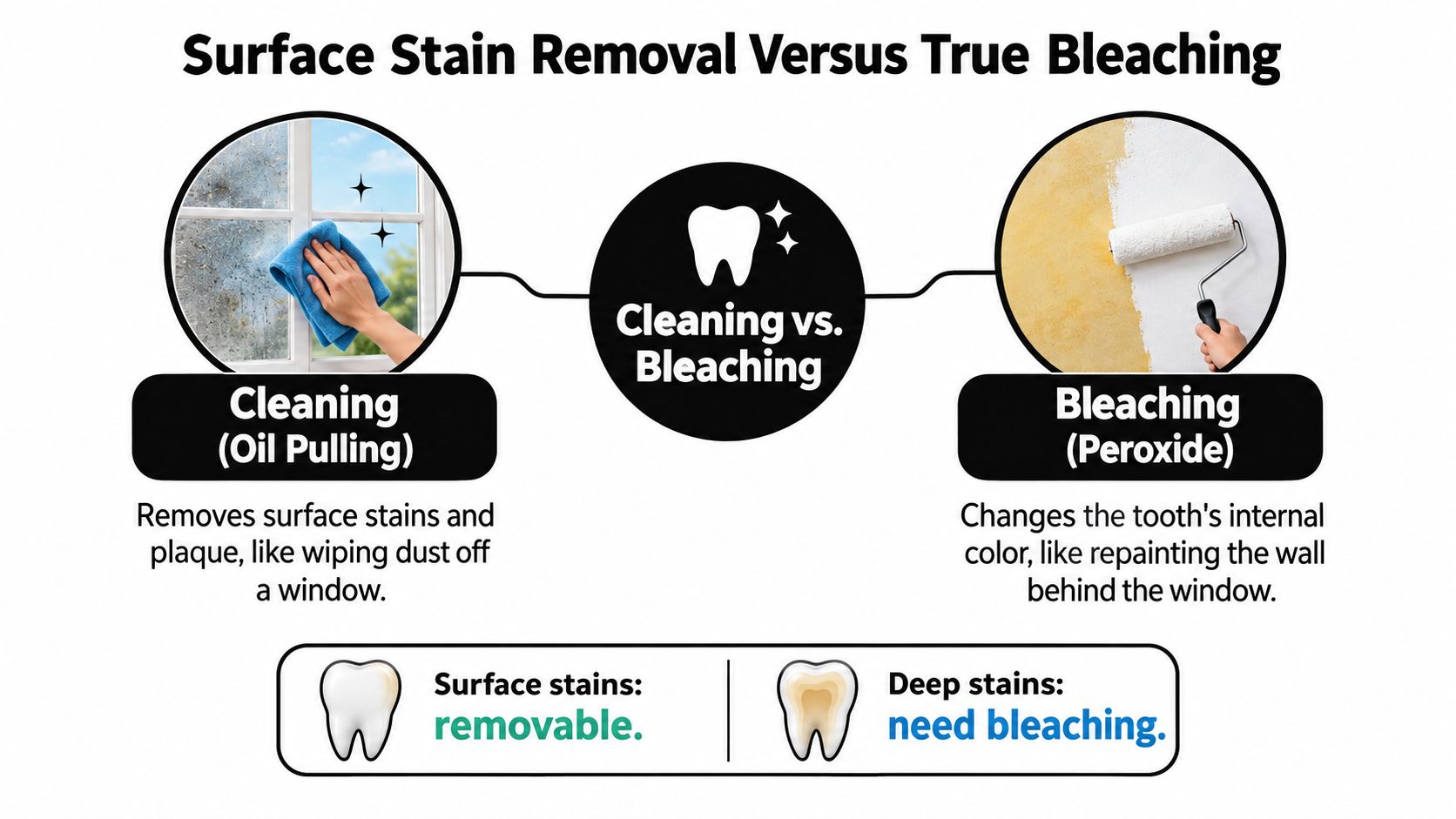
Extrinsic stains sit on or near the enamel surface. Coffee, tea, red wine, and tobacco can leave colored deposits that brushing, professional polishing, and general cleaning may reduce. If oil swishing loosens some soft film, your natural tooth color may show through more clearly and look a touch brighter. For deposits that won't brush away, professional stain removal targets the surface problem directly.
Intrinsic discoloration is different. It involves color within the tooth structure and can relate to aging, fluorosis, trauma, or tetracycline exposure. Oil on the surface can't reasonably reach and alter that internal color. That's why someone can say, my teeth feel cleaner, while seeing no true shade change in consistent light.
Laboratory evidence fits that explanation. An in vitro study found no shade change after coconut oil treatment, and its authors reported no evidence that oil pulling produces tooth whitening. Teeth outside the body don't capture every real world factor, but a direct shade test with no change is more relevant to whitening than a saliva bacteria count.
The short video below helps separate surface appearance from deeper color.
If your concern is a dull film after coffee, cleaning may help appearance. If your concern is yellow dentin showing through thinner enamel, or one tooth that darkened after injury, cleaning isn't the right tool.
Risks, Safety, and Who Should Be Careful
Natural doesn't settle the safety question. What matters is how a practice fits into your routine, how your body responds, and what you might skip because you believe the rinse is doing more than it is. For most healthy adults, the immediate issues are practical rather than dramatic. The bigger risk is substitution.
This checklist covers the precautions worth knowing before you try it.
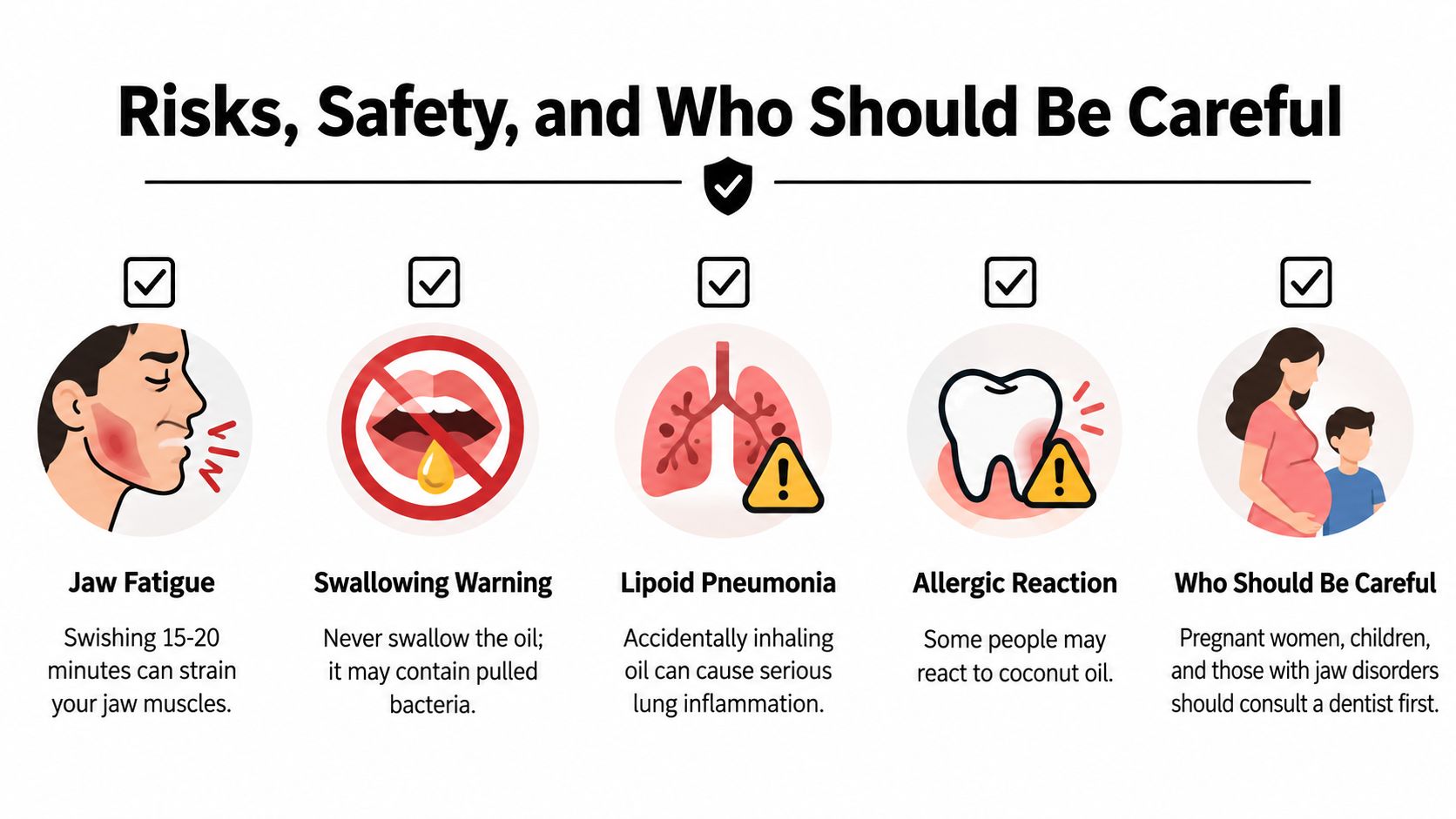
Long swishing can tire your jaw, especially if you have jaw pain or you force the motion. Don't swallow the oil after swishing, and stop if you notice irritation, nausea, or soreness. Inhaling oil is a concern because oil entering the lungs can cause lipoid pneumonia, so anyone who can't swish and spit reliably shouldn't experiment casually. Children need particular caution for that reason.
What Oil Pulling Cannot Replace
The American Dental Association position noted earlier is clear in practical terms. Reliable scientific evidence hasn't shown oil pulling to whiten teeth, and it shouldn't replace brushing with fluoride toothpaste and flossing. Fluoride helps protect enamel against decay in a way coconut oil doesn't. Interdental cleaning reaches plaque between teeth that a swishing oil can't be counted on to remove.
Be more careful if you have braces, new restorations, dry mouth, frequent cavities, bleeding gums, or persistent sores. Those situations call for personal dental advice, not a generic home ritual. You can read about professional teeth whitening side effects separately, but don't assume avoiding peroxide automatically removes all risk.
- Keep fluoride: Brush as your dentist recommends even if you oil pull first.
- Watch symptoms: Bleeding, pain, swelling, or a lesion that persists needs professional care.
- Protect your jaw: Shorter, gentle sessions are safer than forcing a long session.
Used as an extra step, oil pulling is one choice. Used as a replacement, it creates the problem.
Dentist-Recommended Alternatives That Actually Whiten
If your goal is a measurable shade change, dentists turn to peroxide because it can reach pigment within the tooth. Two forms come up often. Hydrogen peroxide acts directly, while carbamide peroxide breaks down into hydrogen peroxide and urea, releasing its effect more gradually. That chemistry is the reason these products can do what coconut oil can't.
The options below differ mainly in supervision, contact time, and how evenly the gel covers your teeth.
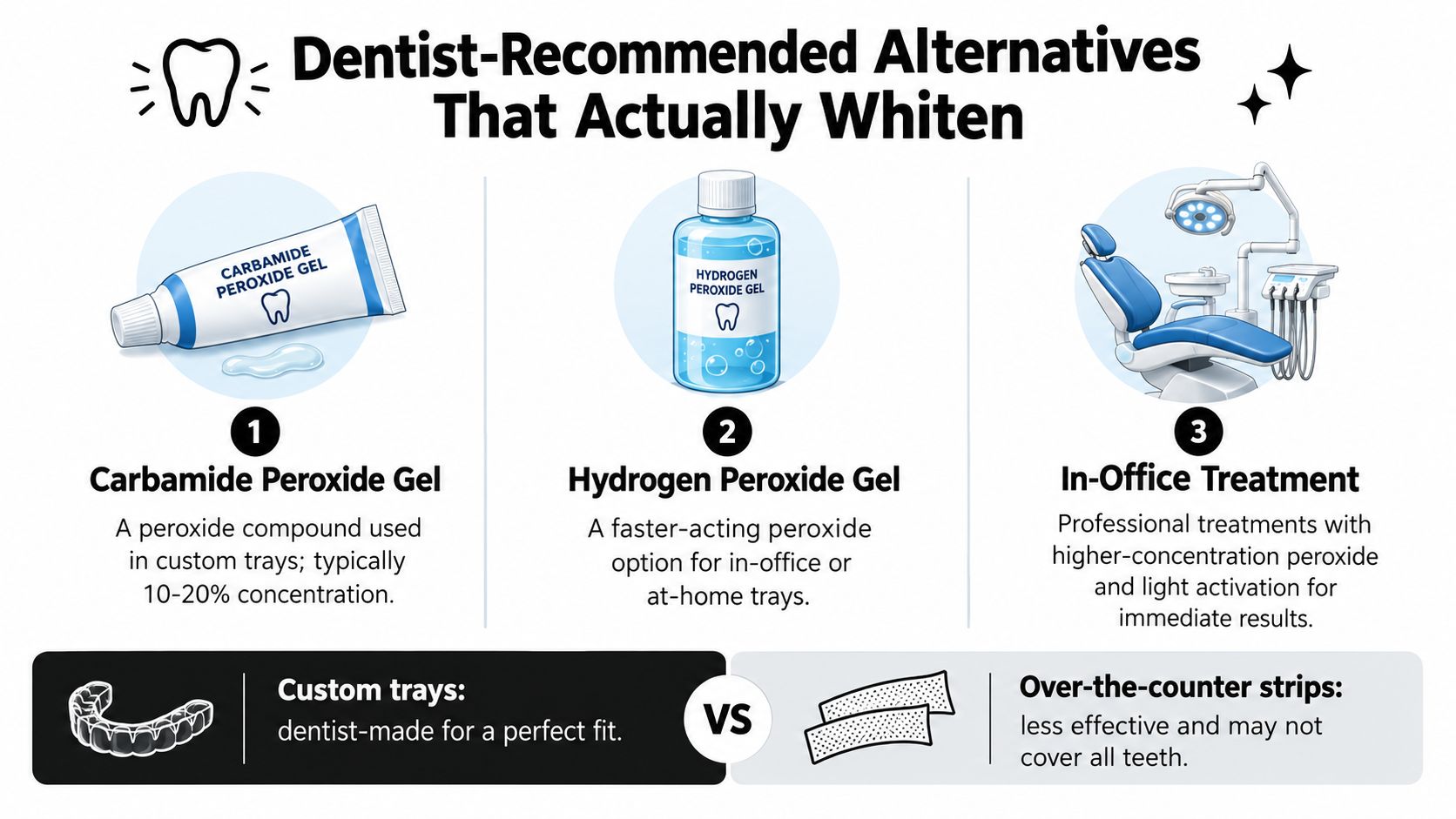
Custom trays made by a dental office hold gel close to tooth surfaces and help limit contact with gums. Products in this category include Opalescence and PolaNight or PolaDay gels, which people use at home under professional guidance. In office systems such as Zoom let the dental team isolate soft tissues, apply stronger treatment under supervision, and check existing fillings or crowns that won't lighten like natural enamel. DentalHealth.com sells professional grade at home whitening gels and related sensitivity products, and its guide to dentist recommended teeth whitening explains how those options are typically selected.
Managing Sensitivity Without Guessing
Sensitivity doesn't mean you must settle for oil pulling and hope. Dentists may adjust wear time, choose a different gel, or pause treatment. Fluoridex toothpastes with potassium nitrate are used for sensitivity support in some routines, while MI Paste products are used to support remineralization. Your dentist can tell you whether either fits your cavity risk and whitening plan.
Peroxide isn't magic either. It works when the diagnosis is right, the gel contacts natural tooth structure properly, and existing dental work is accounted for.
Over the counter strips can be convenient, but fit varies and back teeth may get uneven coverage. A professional assessment also catches decay, leaking fillings, gum recession, and single tooth discoloration before you bleach. That screening is part of the value, not an upsell. Whitening a tooth that hurts or has untreated decay can make sensitivity worse and delay needed treatment.
Cost and speed vary by method and by the starting shade. What doesn't vary is the mechanism. For visible internal color change, you need an agent that chemically alters pigment, used in a way that protects gums and enamel.
How to Decide What to Do for Your Smile
Start with what you want to see in the mirror. Vague goals lead to vague routines. If you can name the problem as surface dullness, overall yellowing, or one dark tooth, the right next step becomes much clearer.
Three Paths Based on Your Goal
Path one, a fresher feeling mouth. If you enjoy oil pulling, it doesn't irritate your jaw, and you still brush with fluoride toothpaste and clean between your teeth, you can treat it as an adjunct. Judge it by comfort and cleanliness, not by promised shade jumps. Spit the oil into the trash, rinse, and don't let the ritual crowd out proven care.
Path two, a visible shade change. If you're preparing for photos, comparing your teeth to a shade guide, or noticing age related yellowing, coconut oil is likely wasted effort. Ask a dentist about supervised carbamide peroxide or hydrogen peroxide in custom trays, or an in office treatment if your teeth and gums are suitable. Bring a list of restorations, sensitivity history, and any tooth that looks different from the rest.
Path three, a warning sign. Book an exam first if one tooth darkened suddenly, a spot is growing, your gums bleed often, or you have pain. Discoloration after trauma can signal changes inside the tooth. Whitening won't diagnose that, and delaying care can narrow your options.
Useful questions for your appointment are simple. Is my discoloration mostly extrinsic or intrinsic? Will my crowns, veneers, or fillings match after whitening? How should I handle sensitivity if it starts? Those answers turn a shopping decision into a treatment plan.
The Bottom Line on Coconut Teeth Whitening
Carry one mental model with you. Cleaning changes what sits on the tooth. Bleaching changes color within the tooth. Coconut oil pulling belongs, at most, in the first category. It may leave your mouth feeling fresher and your teeth looking slightly clearer if surface film was dulling them, but it hasn't been shown to produce reliable shade change.
That doesn't require you to mock the practice or swear it off. It requires honest expectations. Keep fluoride brushing, interdental cleaning, and professional checkups at the center of your routine. If you want whiter teeth in a way you can measure, choose a peroxide based approach matched to your enamel, restorations, and sensitivity. If discoloration is uneven, sudden, or tied to pain, get examined before you treat color.
Apply the same test to the next natural remedy you encounter. What outcome was measured, for how long, and does that outcome match the promise being sold? You'll waste less money, protect your teeth better, and know when a simple habit is enough.
If you're ready to move from surface cleaning to a whitening approach built around peroxide gels, custom tray compatible products, and sensitivity support, browse the professional grade options at DentalHealth.com. You'll find dentist recommended brands for at home whitening and daily care, with product guidance to help you choose a routine that fits your teeth and your goals.