
Fluoride Toothpaste for Cavities: Best Picks for 2026
You're standing in the oral-care aisle, comparing fluoride-free, herbal, whitening, sensitive-teeth, and children's toothpastes. The labels promise plenty, but the question is simpler: which toothpaste gives the person brushing the strongest practical protection against cavities?
Typically, the answer begins with fluoride, then depends on concentration, age, cavity risk, and brushing habits. A toddler, an adult with healthy teeth, and an older adult with exposed roots shouldn't necessarily use the same formula or amount.
Why Fluoride Toothpaste Matters for Cavities
A parent may notice a white mark on a child's tooth, or an adult may feel nothing at all while decay develops below the surface. A cavity starts before a visible hole appears. Plaque bacteria use sugars from food and drinks to make acids, which gradually remove minerals from enamel. Brushing clears away plaque, while fluoride adds mineral support to areas that have begun to weaken.
Fluoride toothpaste serves two purposes at once. Its cleaning action helps remove daily buildup, and its fluoride helps saliva strengthen early damaged enamel and improve resistance to later acid attacks. That combination explains why fluoride remains the foundation of evidence-based fluoride toothpaste for cavities.
What the evidence means for your teeth
A meta-analysis covering 74 studies, including 70 trials and 42,300 children, found that fluoride toothpaste produced a pooled 24% reduction in caries experience compared with non-fluoride toothpaste. The review also estimated that 1.6 children would need to brush with fluoride toothpaste for three years to prevent one decayed, missing, or filled tooth surface in a population with a moderate annual caries increment. You can review the findings in this meta-analysis of fluoride toothpaste studies.
A separate systematic review found a 31% reduction in caries at the tooth-surface level with standard fluoride toothpaste compared with placebo or no intervention. In practical terms, regular fluoride brushing can mean fewer new lesions, fewer fillings, and less treatment over time.
Practical rule: Brushing removes daily buildup. Fluoride helps repair early mineral loss that brushing alone cannot reverse.
Fluoride-free toothpaste can freshen breath, polish teeth, and help remove plaque through abrasive ingredients. It does not provide the same established cavity-prevention benefit. If preventing decay is your main goal, choose a product that clearly lists its fluoride ingredient and concentration. That label matters because the right strength and brushing routine depend on whether the user is a young child, an adult, or someone at higher risk of cavities.
The modern toothpaste category expanded after researchers demonstrated fluoride's cavity-prevention value. Crest was marketed in the United States in the mid-20th century after research found that stannous fluoride reduced cavities. In 1960, it became the first toothpaste recognized by the American Dental Association for cavity prevention, according to the American Chemical Society's history of Crest.
How Fluoride Actually Stops Cavities
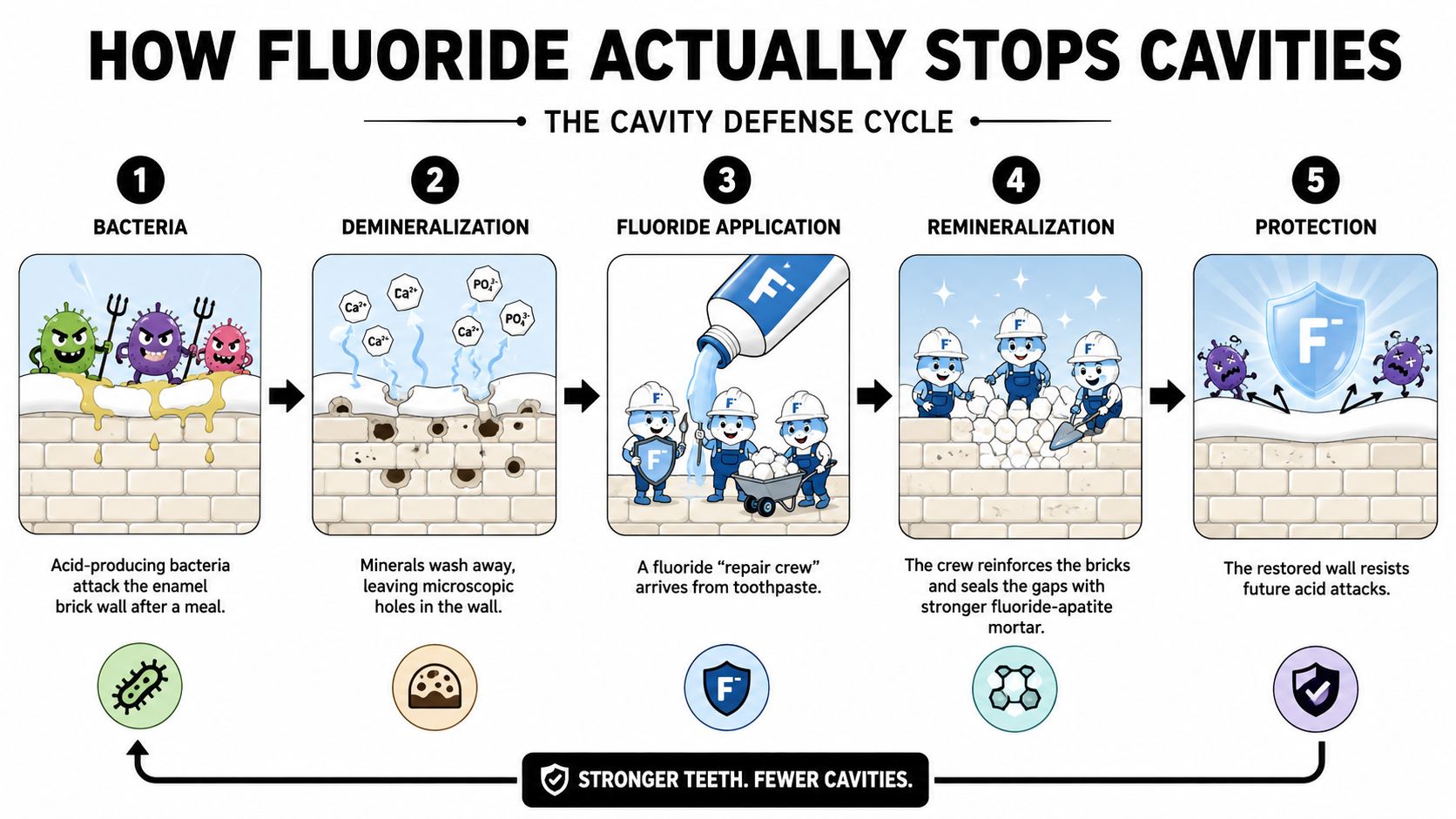
Think of enamel as a brick wall. Each tooth has a hard outer surface built from mineral crystals, but the wall faces repeated acid attacks throughout the day. Saliva supplies some repair material, while fluoride helps make that repair stronger and more resistant.
The cavity defense cycle
- Acid starts the attack. After you eat, plaque bacteria can produce acids that contact the enamel surface.
- Minerals leave the enamel. This early stage is called demineralization. The enamel doesn't immediately collapse, but microscopic areas become weaker.
- Fluoride reaches the surface. Brushing places fluoride directly where the damage is developing. The toothpaste doesn't need to enter a visible hole to help.
- Saliva brings building materials. Calcium and phosphate from saliva can return to weakened enamel. Fluoride supports this remineralization and helps create a more acid-resistant mineral structure.
- The repaired area handles future attacks better. Fluoride can also interfere with bacterial acid production, reducing the intensity of the chemical assault.
Early damage is different from a hole
Fluoride is most useful before decay becomes a structural cavity. A chalky white spot may signal mineral loss beneath the surface, and careful fluoride exposure can help strengthen that area. Once bacteria have created a substantial hole, toothpaste can't rebuild the missing tooth structure. A dentist may need to remove decay and restore the tooth.
The effect is local and repeated. A small amount of fluoride remains available around the teeth after brushing, and each exposure gives the repair process another opportunity to support weakened enamel. The science of how fluoride strengthens teeth explains this topical action in greater detail.
Concentration matters because it affects how much fluoride is available during brushing and afterward. The next question isn't just whether a tube contains fluoride. It's how much, and for whom?
Fluoride Strengths Explained in Plain English
The number printed on a toothpaste label, such as 1,450 ppm, refers to parts per million of fluoride. You can treat ppm as a practical strength indicator. It isn't a score for quality, and a higher number isn't automatically right for every person.
A useful comparison is a household cleaning product. A mild cleaner may work for routine wiping, while a concentrated formula may be reserved for a tougher job and handled with more care. Fluoride concentration works in a similar way. Standard toothpaste provides routine protection, while prescription formulas deliver a targeted higher dose for people with greater risk.
The main strength tiers
Evidence linked to the Cochrane review of fluoride toothpaste concentrations supports meaningful cavity prevention at concentrations of 1,000 ppm and above. The same review found that both 1,000–1,250 ppm and 1,450–1,500 ppm formulations reduce caries increments compared with non-fluoride toothpaste, with the higher concentration generally providing stronger protection.
Children's products can sit near the lower end of the effective range, depending on the product and local guidance. Always check the actual ppm rather than relying on words such as “kids,” “natural,” or “gentle.”
| Fluoride Level (ppm) | Typical User | Cavity-Protection Notes |
|---|---|---|
| Around 500–1,000 | Young children, depending on clinical guidance | Lower-strength formulas may be selected for age and swallowing considerations. Products at or above 1,000 ppm have the strongest evidence for meaningful routine cavity protection. |
| 1,450–1,500 | Most adults and older children | This is the common standard range for everyday over-the-counter prevention and provides stronger protection than lower concentrations. |
| 5,000 | Adults with elevated cavity risk, by prescription | A targeted option for root caries, recurrent decay, exposed roots, or other high-risk situations. |
The label still needs context. A person with a history of repeated cavities may need more than a standard shopper, while a young child needs supervision and an age-appropriate amount. The best choice matches fluoride strength to risk, not just to the color or flavor of the package.
When Standard Toothpaste Is Not Enough
Standard toothpaste suits many people, but some mouths face a heavier daily challenge. Frequent decay, exposed roots, dry mouth, gum recession, fixed braces, or certain medical treatments can reduce the margin of safety provided by routine over-the-counter toothpaste.
Prescription toothpaste commonly contains 5,000 ppm fluoride. The International Association for Dental Research reports that this concentration helps prevent new root-caries lesions and increases the likelihood that existing root-caries lesions become arrested in older adults. A multicenter randomized trial also found that 5,000 ppm toothpaste used twice daily improved the surface hardness of untreated root-caries lesions compared with regular 1,350 ppm toothpaste, as summarized in the IADR position statement on fluoride use.
Compare the two options
| Feature | Standard OTC (1,450–1,500 ppm) | Prescription (5,000 ppm) |
|---|---|---|
| Availability | Sold over the counter | Requires dental prescribing or professional guidance |
| Main role | Routine prevention for average-risk users | Additional protection for elevated-risk patients |
| Common reason to consider it | Everyday cavity prevention | Root exposure, recurrent decay, dry mouth, or active high risk |
| Clinical decision | Shopper can select a suitable formula | Dentist assesses whether the added strength is appropriate |
| Use | Regular brushing routine | A prescribed home-care tool, not a replacement for technique |
Ask your dentist about high-fluoride toothpaste if you've had recent or repeated cavities, notice decay around exposed roots, live with persistent dry mouth, wear fixed orthodontic appliances, or have gum recession that leaves root surfaces uncovered. Medical treatments that affect saliva or oral tissues can also change your risk profile.
At an appointment, expect a risk assessment rather than an automatic prescription. Your dentist may review your decay history, saliva symptoms, exposed root surfaces, diet, medications, and brushing routine. If a 5,000 ppm product is appropriate, follow the instructions exactly and keep it away from children.
DentalHealth.com offers Fluoridex toothpaste information, including a prescription-strength product containing 1.1% neutral sodium fluoride, equivalent to 5,000 ppm, for dental caries prevention. Prescription toothpaste is an add-on tool. It can't compensate for plaque left at the gumline, frequent sugar exposure, or skipped brushing.
Choosing Fluoride Toothpaste by Age
Age helps you choose an amount and strength, but it doesn't tell the whole story. A child with frequent cavities may need different guidance from a child with low risk, and an older adult with exposed roots may need a prescription product rather than a standard family tube.
Babies and toddlers
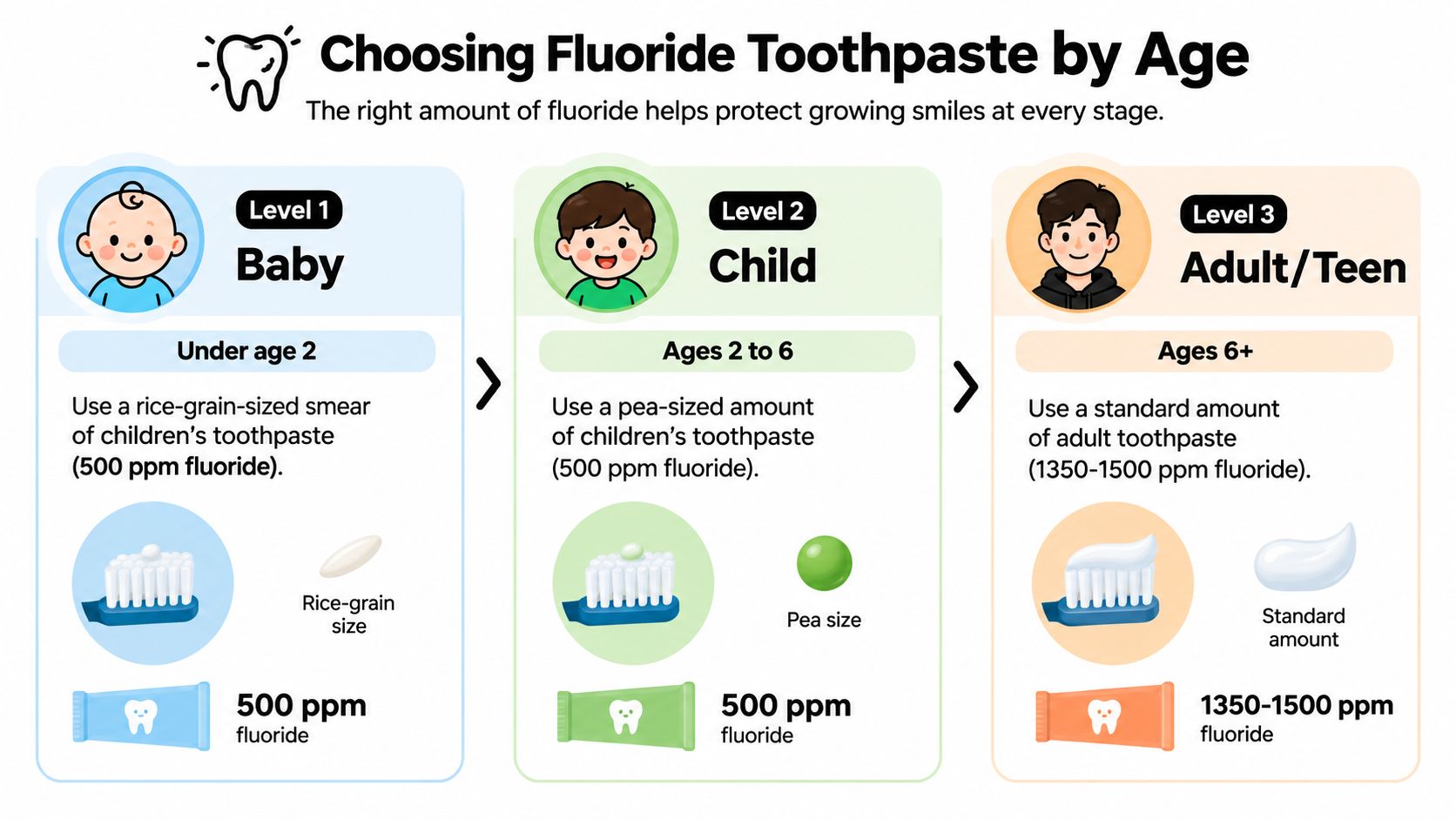
Start fluoride toothpaste when the first tooth appears. For a child under two, use a tiny smear, about the size of a grain of rice, and brush the teeth gently. The American Dental Association guidance summarized in clinical-practice evidence supports early brushing with fluoridated toothpaste and emphasizes limiting the amount so there's less to swallow.
The exact product strength should follow your dentist's or pediatric clinician's guidance. Many children's products are labeled around the lower range, while evidence for meaningful cavity protection becomes strongest at 1,000 ppm and above.
Young children who are learning to spit
Once a child can reliably spit, use a pea-sized amount of fluoride toothpaste. Keep supervising, because children often copy the amount they see an adult use and may treat toothpaste like a snack.
Don't turn rinsing into the goal. Spitting removes excess foam while leaving more fluoride on the teeth, which supports ongoing protection.
School-age children and teenagers
School-age children who can spit well may use a standard family toothpaste, often around 1,450 ppm, with an adult checking technique and coverage. Supervision can gradually decrease as the child demonstrates consistent brushing rather than only reaching a certain birthday.
Teens with braces, frequent sweet drinks, or missed brushing need closer attention. Brackets create plaque-retentive areas, so a standard formula may be appropriate but must reach around the wires and gumline. A dentist may recommend additional fluoride measures if decay risk rises.
Adults and older adults
Adults at average risk generally use a 1,450–1,500 ppm toothpaste. Older adults deserve a separate conversation because gum recession, exposed dentin, dry mouth, medications, and root caries can change the equation. In that setting, ask a dentist whether prescription-strength toothpaste, a fluoride rinse, or professional fluoride treatment belongs in the routine.
Match the ppm to the person's cavity risk, not just the age printed on the box.
Fluoride Myths Worth Putting to Rest
Fluoride conversations often become confusing because people mix up controlled topical use with uncontrolled ingestion. The important question is dose and route, not whether the word “fluoride” appears on a label.
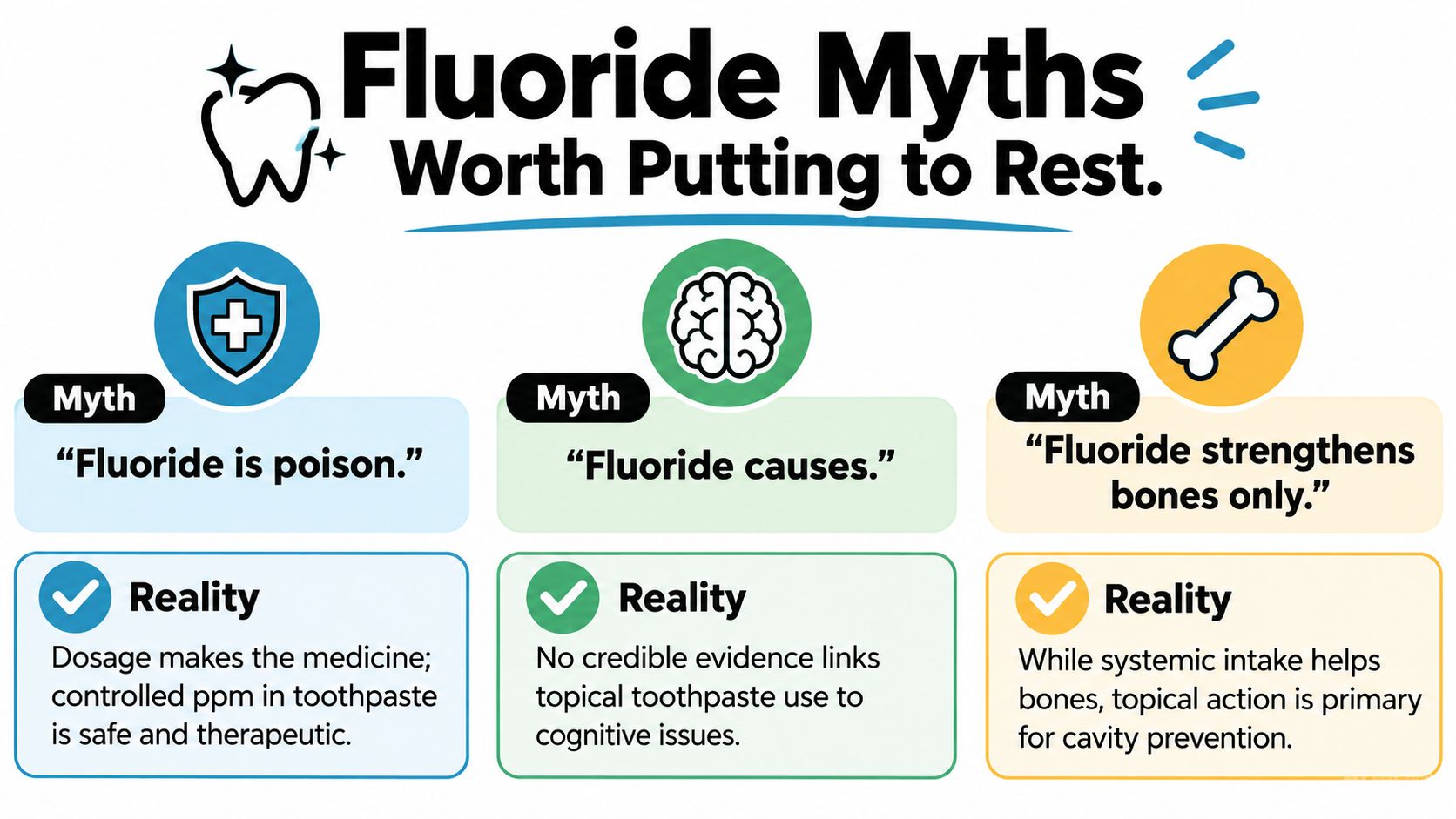
Myth one, fluoride is poison
Many useful substances become harmful at excessive doses. Fluoride toothpaste contains a controlled concentration intended for brushing, not drinking. Use a small, age-appropriate amount, supervise children, and keep the tube out of reach.
That doesn't mean swallowing toothpaste is a good habit. Children should learn to spit, and adults should contact a medical professional or poison service if a child swallows a concerning amount.
Myth two, fluoride-free toothpaste works just as well
A fluoride-free product may clean the teeth mechanically, but it doesn't provide the same cavity-prevention evidence. The systematic review of fluoride toothpaste trials found clinically meaningful reductions compared with non-fluoride toothpaste, as described in the review evidence on fluoride toothpaste.
“Natural” describes a marketing position or ingredient preference. It doesn't establish equal protection against acid-driven mineral loss.
Myth three, fluoride toothpaste causes the health problems listed online
Claims about cancer, thyroid disease, bone disease, or cognitive effects require careful attention to exposure, dose, and the quality of the evidence. The verified evidence here supports topical fluoride toothpaste for cavity prevention, but it doesn't justify making broad claims about every possible exposure route or medical condition.
Parents who have concerns about a child's total fluoride exposure should discuss toothpaste, drinking water, supplements, and swallowing habits with a dental professional. The practical goal isn't to chase an absolute “fluoride-free” label. It's to use a proven ingredient in the correct amount, at the correct age, with sensible supervision.
Brushing Habits That Maximize Fluoride
The tube can contain the right concentration and still underperform if brushing habits wash the ingredient away immediately. A few routine changes help fluoride stay in contact with the teeth longer.
- Brush twice each day. Use a fluoride toothpaste suited to the person's age and risk. Work gently along the gumline and around restorations, braces, and other areas that trap plaque.
- Brush thoroughly. Cover the outer, inner, and chewing surfaces. The goal is consistent coverage, not aggressive pressure that irritates the gums.
- Spit, then skip the water rinse. Clinical-practice guidance notes that fluoride toothpaste is less effective after rinsing with water and recommends brushing with fluoridated toothpaste, commonly 1,350–1,500 ppm, without immediate rinsing. The systematic review of fluoride toothpaste guidance explains this point.
- Separate other rinses from brushing. A mouthwash used immediately after brushing can dilute and remove the toothpaste residue. The guidance in this explanation of fluoride toothpaste and mouthwash covers why timing matters.
- Floss before brushing. Flossing or using an interdental cleaner loosens plaque between teeth, allowing the subsequent brushing step to spread fluoride over those newly exposed surfaces.
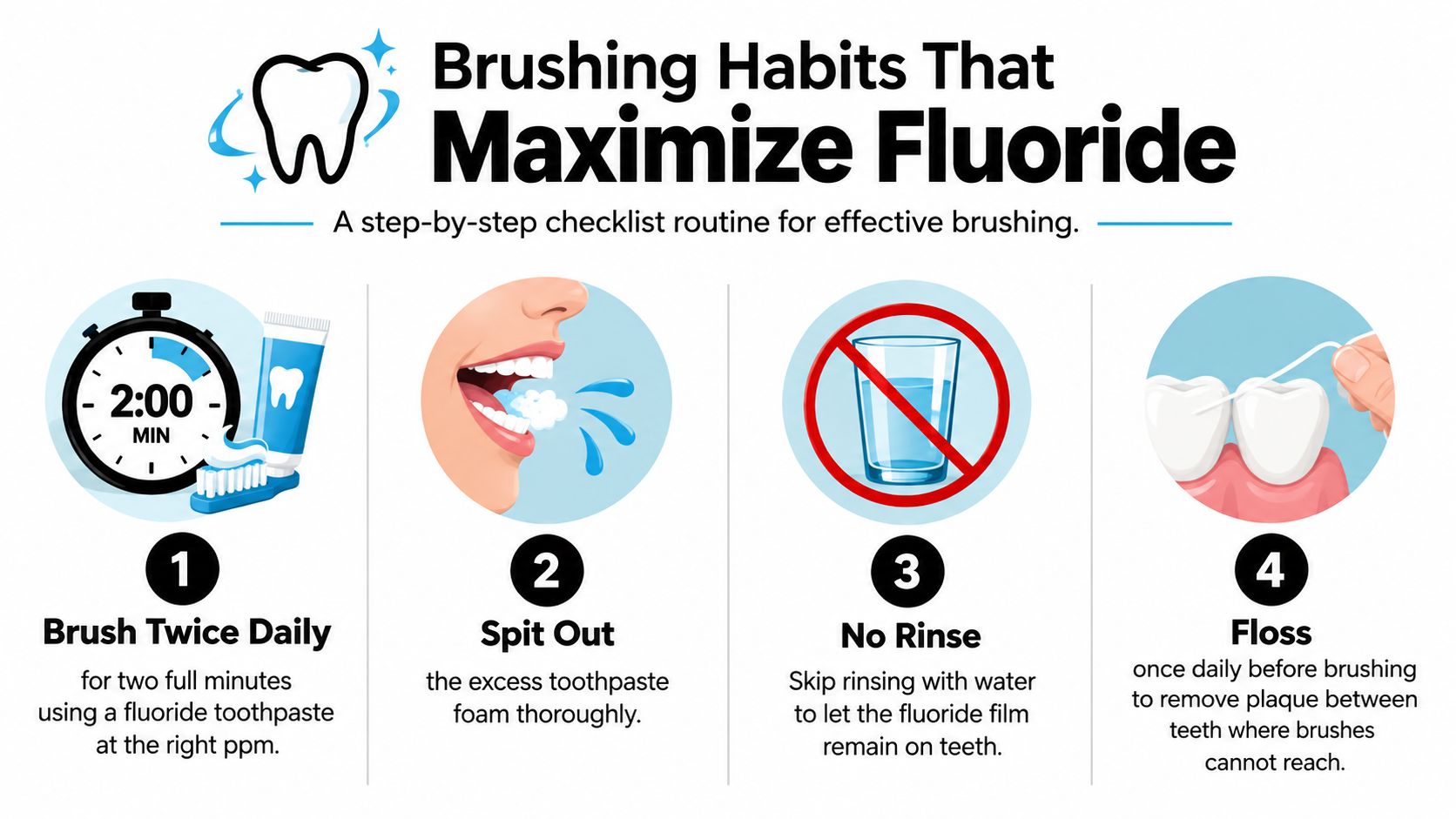
The night-time brush deserves special attention because saliva flow decreases during sleep. Finish the evening by brushing, spitting thoroughly, and leaving the remaining fluoride film in place rather than immediately rinsing it away.
If you've just eaten or drunk something acidic, give your mouth time before brushing when possible. Brushing immediately after an acid exposure may feel fresh, but a dental professional can help you choose timing that fits your diet and risk.
Putting It All Together for Your Next Tube
Choose fluoride toothpaste by asking four questions: Who will use it? What fluoride concentration does it contain? How high is that person's cavity risk? Will the brushing routine leave fluoride on the teeth?
For a young child, use a carefully measured smear and follow professional guidance on concentration. A child who can spit may use a pea-sized amount. Most average-risk adults and older children can choose a standard toothpaste in the 1,450–1,500 ppm range. Adults with recurrent decay, exposed roots, dry mouth, or other high-risk factors should ask a dentist whether 5,000 ppm toothpaste is appropriate.
Check the ppm on the package, look for a recognized fluoride ingredient such as sodium fluoride or stannous fluoride, and avoid treating “fluoride-free” as a cavity-prevention advantage. A dental association seal can provide another useful purchasing check, but the strongest product still needs to be used consistently and correctly.
DentalHealth.com offers professional-grade at-home dental-care products, including Fluoridex and other oral-care options, along with practical guidance for choosing products for cavity prevention and sensitivity. Visit DentalHealth.com to compare available fluoride toothpaste options and find a routine that fits your needs.