
Fluoride Toothpaste Good or Bad: What Science Says
Is fluoride toothpaste good or bad if you already drink fluoridated water, rarely swallow toothpaste, or have a higher risk of decay? That question is more useful than the usual yes-or-no debate because fluoride's benefits and risks depend on concentration, ingestion, age, and total exposure.
Online discussions often place fluoride into one of two camps. One side calls it a miracle ingredient, while the other treats any fluoride toothpaste as dangerous. The practical answer is more measured: fluoride toothpaste is generally beneficial when used correctly, but the right amount and concentration depend on who's brushing and how much paste they swallow.
Is Fluoride Toothpaste Actually Good or Bad
Is fluoride toothpaste good or bad for you? The answer depends less on the ingredient's name than on three practical details: the concentration in the toothpaste, how much is swallowed, and the other fluoride sources in daily life.
Toothpaste strength is measured in parts per million, or ppm. Products containing at least 1,000 to 1,250 ppm are more effective against decay than non-fluoride toothpaste, and adult guidance commonly recommends more than 1,000 ppm for caries prevention. The key question is not whether fluoride is present, but whether the dose reaches enamel during brushing without becoming a regular swallowed source.
Age changes the balance. A child who repeatedly swallows toothpaste while teeth are developing may develop dental fluorosis, usually a cosmetic change in enamel. That risk does not make normal brushing unsafe. It means caregivers should provide an age-appropriate amount, supervise brushing, and encourage spitting rather than swallowing.
Total exposure adds another layer. Fluoride may come from drinking water, food prepared with that water, toothpaste, professional treatments, and mouth rinses. These sources interact, but they do not serve the same role. Toothpaste places fluoride directly on enamel for a short period, while fluoridated water contributes a broader background exposure.
A person with fluoridated water and reliable brushing may still benefit from toothpaste because the local contact matters. Someone who swallows paste regularly needs more careful guidance, even if their water contains little fluoride.
Practical rule: Judge fluoride by the dose, age, ingestion habit, and total exposure, not by the ingredient name alone.
Used correctly, fluoride toothpaste remains a mainstream tool for preventing cavities. Choosing the concentration and controlling swallowing make the routine safer and more useful.
What Fluoride Does Inside Your Mouth
Why does fluoride help if tooth enamel is constantly exposed to acids? Each meal can start a small chemical cycle. Bacteria in plaque use fermentable carbohydrates and release acids, which pull minerals from enamel in a process called demineralization. Saliva supplies minerals that can replace some of what was lost. That repair process is remineralization.
Enamel works like a road surface. Acid creates microscopic potholes, while saliva brings repair materials. Fluoride helps those minerals set more effectively, leaving the repaired area better able to resist another acid attack.
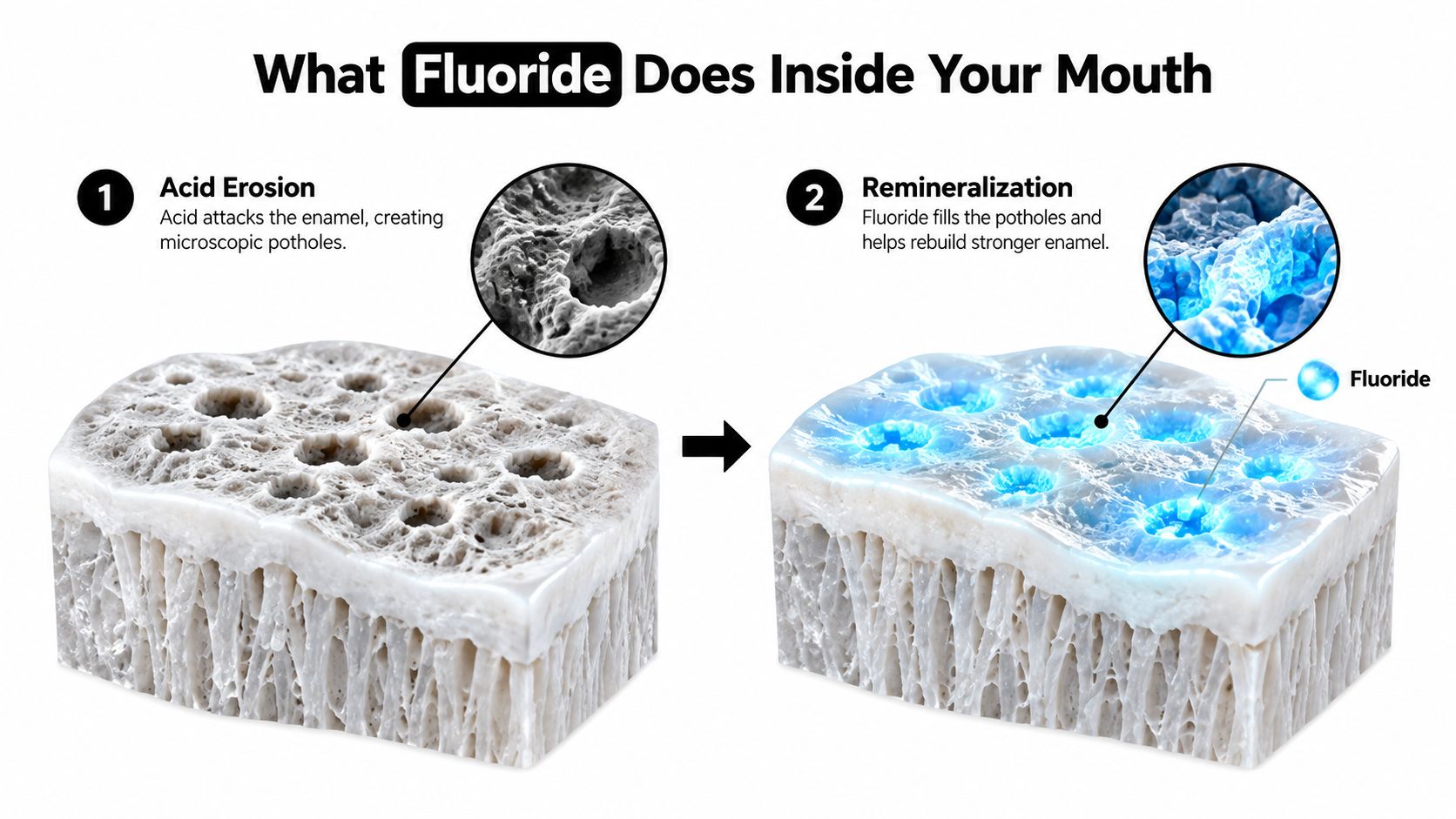
The main action is topical
Fluoride works mainly at the tooth surface. During brushing, it mixes with saliva and plaque, so it stays near enamel areas that face repeated acid exposure. It supports the formation of more acid-resistant mineral and can slow mineral loss.
Fluoride also changes bacterial activity. It can interfere with enzymes bacteria use to process sugars, which may reduce acid production in plaque. Enamel then has more time to recover between meals.
The local effect explains why brushing technique matters. Rinsing heavily with water immediately after brushing removes more fluoride. Spitting without a heavy rinse leaves more of the ingredient around the teeth. A patient-friendly explanation appears in this guide to how fluoride strengthens teeth.
Why frequency changes the result
Fluoride works through repeated contact, not a single permanent coating. Brushing creates a temporary rise in fluoride around the teeth. Reviews describe saliva levels increasing by 100- to 1,000-fold, then generally returning to baseline within 1 to 2 hours, according to the World Health Organization fluoride toothpaste summary.
That short window makes consistent brushing useful. Age, swallowing habits, and fluoride from water affect total exposure, while brushing determines how regularly enamel receives this local repair support.
What the Evidence Says About Cavity Prevention
Does fluoride toothpaste still help if you already get fluoride from drinking water? Clinical evidence suggests that it does. A systematic review of 70 clinical trials found about a 24% reduction in decayed, missing, and filled tooth surfaces in permanent teeth compared with non-fluoride toothpaste. The result was similar in settings with fluoridated and non-fluoridated water, according to the Cochrane-based review of fluoride toothpaste.
Water and toothpaste contribute fluoride in different ways. Drinking water provides ongoing exposure, while brushing places a more concentrated amount directly against the tooth surface. That helps explain why toothpaste can add protection rather than duplicate the fluoride already present in water.
Concentration creates a dose-response pattern
Fluoride strength also matters. Evidence reviews support toothpastes in the 1,000 to 1,500 ppm range for reducing caries increment in children and adults. In some comparisons, 1,500 ppm products prevent more decay than 1,000 ppm formulations. The higher concentration calls for more careful use when a child may swallow toothpaste.
The CDC review of fluoride toothpaste and caries prevention reports an additional roughly 14% lower caries risk associated with twice-daily brushing. Frequency therefore matters alongside concentration. A stronger toothpaste used inconsistently may provide less practical benefit than an age-appropriate product used regularly.
| Fluoride concentration | Relative cavity reduction | Best suited for |
|---|---|---|
| Non-fluoride toothpaste | Less effective than toothpaste containing at least 1,000 ppm fluoride | People advised to avoid fluoride, with professional guidance |
| 1,000 to 1,250 ppm | Effective cavity prevention compared with non-fluoride toothpaste | General daily use, including age-appropriate children's brushing |
| 1,000 to 1,500 ppm | Strong standard protection, with higher concentrations offering greater prevention in some comparisons | Older children and adults, selected according to risk |
| Higher-strength prescription products | Greater protection may help selected high-risk patients, but ingestion and supervision matter | Dentist-directed use only |
What the numbers don't mean
The 24% figure is a relative reduction across pooled clinical evidence. It does not predict the exact result for every person or promise that fluoride toothpaste will prevent every cavity.
Individual risk still depends on diet, plaque control, saliva flow, enamel development, medications, exposed roots, and dental attendance. Water fluoridation, swallowing habits, age, and toothpaste concentration should be considered together. A child who regularly swallows toothpaste has a different exposure pattern from an adult who brushes and spits.
The evidence on fluoride toothpaste preventing tooth decay supports a practical conclusion: regular use of an appropriate concentration provides measurable cavity protection, while a stronger product should match the person's risk and be chosen with dental guidance.
Real Risks and Why They Are Often Overstated
Could fluoride toothpaste cause harm? The clearest established risk is excessive swallowing during tooth development. If a young child repeatedly swallows toothpaste, developing enamel may develop flecking, discoloration, or, in more severe cases, pitting. This condition, dental fluorosis, is generally a cosmetic change rather than the tooth-destroying disease many parents fear.
Exposure depends on both concentration and habits. A child who treats the toothpaste tube like a snack receives a very different dose from an adult who brushes, spits, and uses toothpaste as directed. Age, swallowing frequency, toothpaste strength, and fluoridated water belong in the same calculation.
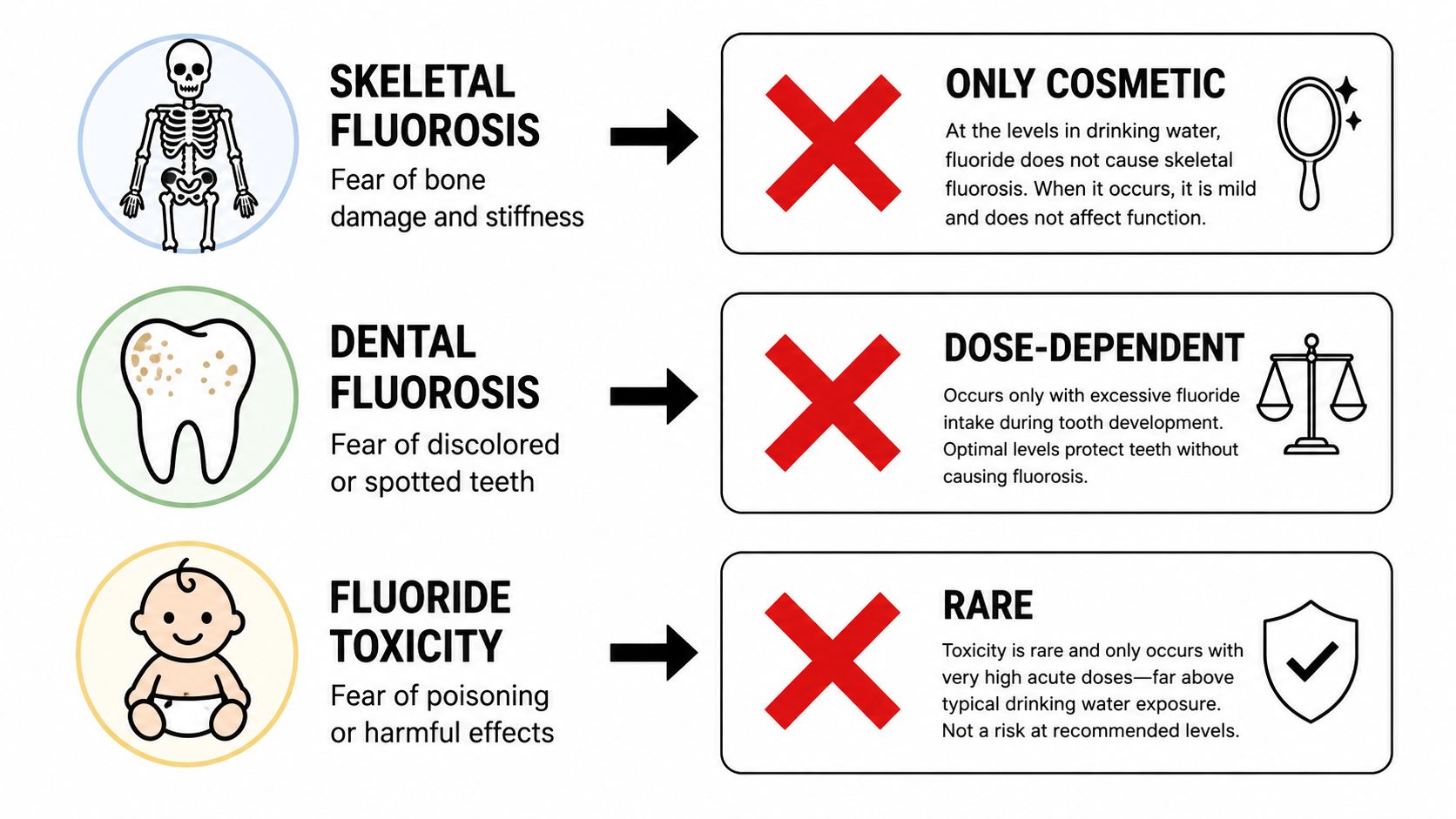
Separate ordinary use from excessive exposure
A label may warn against swallowing large amounts because fluoride is an active ingredient. That warning addresses misuse, especially taking a substantial quantity at once. It does not mean that a normal brushing routine, followed by spitting, is toxic.
The NHS guidance on fluoride and accidental toothpaste ingestion identifies the practical concern: young children can increase their fluorosis risk by swallowing toothpaste regularly, particularly without supervision.
Claims about systemic harm require careful interpretation. The evidence supports ordinary-use safety and identifies excessive ingestion during development as the main toothpaste-specific concern. It does not support presenting claims about IQ, thyroid disease, or cancer as established consequences of normal brushing.
Keep the useful fluoride in place
After brushing, fluoride in saliva can rise sharply and usually returns to baseline within 1 to 2 hours, according to the WHO summary discussed earlier. This temporary exposure keeps fluoride near enamel while early repair takes place.
Rinsing vigorously immediately after brushing can remove the ingredient you applied for protection.
Parents can reduce avoidable ingestion by supervising brushing, using a small age-appropriate amount, and storing toothpaste out of reach. Adults should spit rather than swallow. If a child ingests an unusually large quantity, seek advice promptly.
For a further discussion of the distinction between normal use and avoidable exposure, see fluoride toothpaste health risks.
Who Should Use Which Concentration
The ideal fluoride toothpaste isn't the strongest one available. It's the product that matches a person's age, decay risk, and ability to avoid swallowing.
For most adults, a standard toothpaste containing 1,000 to 1,500 ppm fluoride is a reasonable daily option. Someone with repeated decay, exposed roots, dry mouth, braces, or frequent acid and sugar exposure may need a stronger prescription product, but that decision belongs with a dentist.
Children need a smaller amount because their mouths are smaller and swallowing is more likely. The goal is to place enough fluoride on the teeth without turning brushing into a significant ingestion event.
| Age or condition | Recommended ppm | Amount | Supervision needed |
|---|---|---|---|
| Very young child | Around 1,000 ppm if advised by a dentist | Rice-grain smear | Direct adult supervision |
| Child in early childhood | Around 1,000 ppm | Pea-sized amount | Supervise and encourage spitting |
| Older child | 1,000 to 1,500 ppm | Pea-sized amount | Check technique and swallowing |
| Typical adult | 1,000 to 1,500 ppm | Pea-sized amount | Usually self-managed |
| High-risk adult | Dentist-selected strength, potentially prescription-strength | Dentist's instructions | Follow the prescription carefully |
| Adult with exposed roots or dry mouth | Dentist-selected standard or high strength | Product instructions | Professional review is important |
Risk can change the recommendation
A senior with gum recession may have exposed root surfaces that are more vulnerable than intact enamel. A person with xerostomia, or persistently reduced saliva, loses some of the natural buffering and repair that saliva provides. Orthodontic brackets create plaque-retaining areas, so a patient in braces may need a more deliberate prevention plan.
High-strength products, including 5,000 ppm prescriptions, are generally reserved for controlled, dentist-directed use. They aren't automatically better for everyone, and they shouldn't be shared with children or used casually.
The Cochrane review of different fluoride toothpaste strengths describes the central tradeoff: stronger toothpaste can provide greater decay protection, while also increasing fluorosis risk in developing teeth.
Match the product to the person
A healthy adult who brushes reliably may not need a prescription formula. A patient with repeated root cavities may benefit from one. A young child who swallows paste needs better supervision rather than a stronger tube.
Ask a dentist to review your toothpaste if you have recurring cavities, exposed roots, dry mouth, braces, medication-related saliva changes, or difficulty controlling swallowing during brushing.
How to Brush for the Best Results
Could your brushing technique change how much fluoride your teeth receive? It can. The goal is to place a small amount of toothpaste across every tooth surface, then leave a thin fluoride layer behind.
Choose a soft-bristled toothbrush and an age-appropriate amount of toothpaste. A young child needs the small smear recommended by a dental professional. An older child or adult should use a pea-sized amount. Supervise children who may swallow toothpaste, since the amount ingested matters more than the foam itself.
Use a repeatable brushing pattern
Angle the bristles toward the gumline. Clean the outer, inner, and chewing surfaces, moving through the mouth in the same order each time. A consistent route helps you reach the back molars and the inside surfaces of the lower front teeth.
Brush for 2 minutes, twice daily. Give the evening brushing extra attention because saliva flow decreases during sleep, leaving teeth with less natural buffering overnight.
- Place the toothpaste carefully. Keep the tube away from young children.
- Clean the gumline gently. Firm pressure can irritate or injure the gums.
- Cover every tooth surface. Divide the mouth into manageable areas.
- Spit out the foam. Do not swallow the toothpaste.
- Avoid a vigorous water rinse. A thin fluoride residue can continue working at the tooth surface.
The useful habit: Spit, do not rinse aggressively, unless your dental professional gives you different instructions.
Waiting before eating or drinking can help preserve the fluoride left after brushing. If you use a separate fluoride rinse, ask a dental professional when to use it so the rinse does not immediately wash away toothpaste residue.
Fluoridated tap water may work for a gentle rinse when it suits your household supply. If sensitivity makes brushing uncomfortable, choose a fluoride toothpaste formulated for sensitive teeth instead of stopping fluoride use. Fluoridex Sensitivity Relief Toothpaste and Opalescence Whitening Toothpaste are examples of fluoride toothpaste categories available through DentalHealth.com, but the concentration and formula should fit your needs.
Do You Still Need It If Your Water Is Fluoridated
Fluoridated water doesn't make fluoride toothpaste redundant. The two sources reach the mouth differently.
Water provides repeated low-level contact as you drink and prepare food. Toothpaste delivers a much more concentrated application directly to enamel during brushing. The toothpaste concentration is measured in 1,000 to 1,500 ppm, while water fluoridation is measured at a much lower concentration. Those figures shouldn't be compared as if they were interchangeable doses, because toothpaste is spat out and acts mainly at the tooth surface.
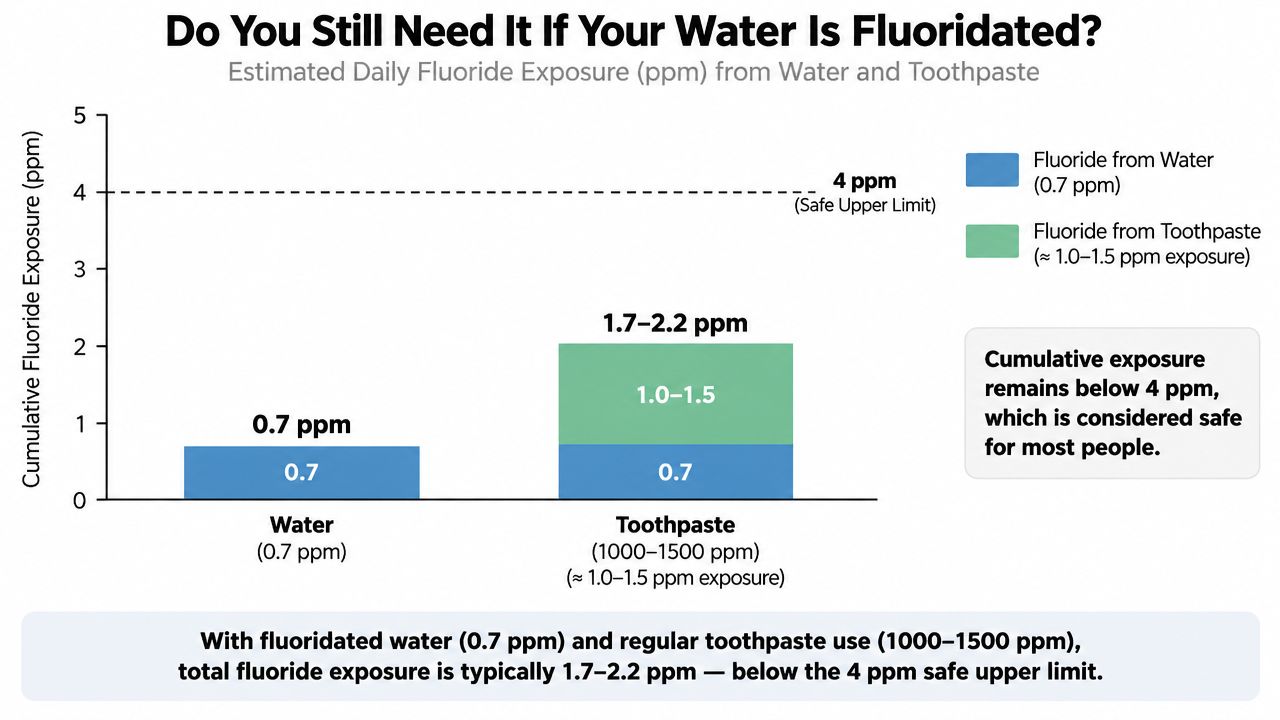
Use a simple exposure check
Ask yourself:
- Water source: Do you drink municipal water, bottled water, filtered water, or private-well water?
- Caries risk: Have you had recent cavities, root decay, braces, frequent snacking, or dry mouth?
- Swallowing habits: Does a child regularly swallow toothpaste?
- Extra products: Do you also use fluoride rinses, gels, or professional applications?
Someone with fluoridated water and low cavity risk will usually still benefit from regular fluoride toothpaste because brushing supplies topical protection. Someone on a private well may need water testing, while a person using bottled or filtered water should check whether fluoride is present rather than assume it is.
If you're investigating filtration because your household wants to control its water composition, a Melbourne fluoride filter solution may help you compare available options. Water changes should still be discussed with a dentist when a child or high-risk patient depends on fluoride for cavity prevention.
The key question isn't, “Do I already get fluoride?” It's, “Which sources do I receive, how much might I swallow, and what does my cavity risk require?”
Your Take-Home Checklist and Dentist Consensus
Is fluoride toothpaste good or bad for you? For many, it is a practical cavity-prevention tool when the product strength, amount, and swallowing habits match their age and risk. The decision depends on total exposure, not on toothpaste alone.
Use this checklist:
- Brush consistently: Clean your teeth twice daily, especially before bed.
- Choose the right strength: Use a standard product for routine care. Ask a dentist before using prescription-strength toothpaste.
- Control the amount: Young children need only a small smear or pea-sized amount, based on age and professional guidance.
- Supervise children: Watch for swallowing, chewing the tube, or repeatedly asking for more toothpaste.
- Spit instead of rinsing heavily: Leaving a small amount of fluoride around the enamel helps extend its protective contact.
- Review other sources: Consider drinking water, mouth rinses, professional treatments, and naturally high fluoride in private-well water.
- Ask for advice: Seek dental guidance for dry mouth, exposed roots, braces, recurrent cavities, or a child whose brushing and spitting you cannot yet supervise confidently.
The WHO guidance on fluoride toothpaste describes twice-daily use as effective across age groups when used as directed. The main concern is repeated ingestion during tooth development, rather than ordinary brushing followed by spitting.
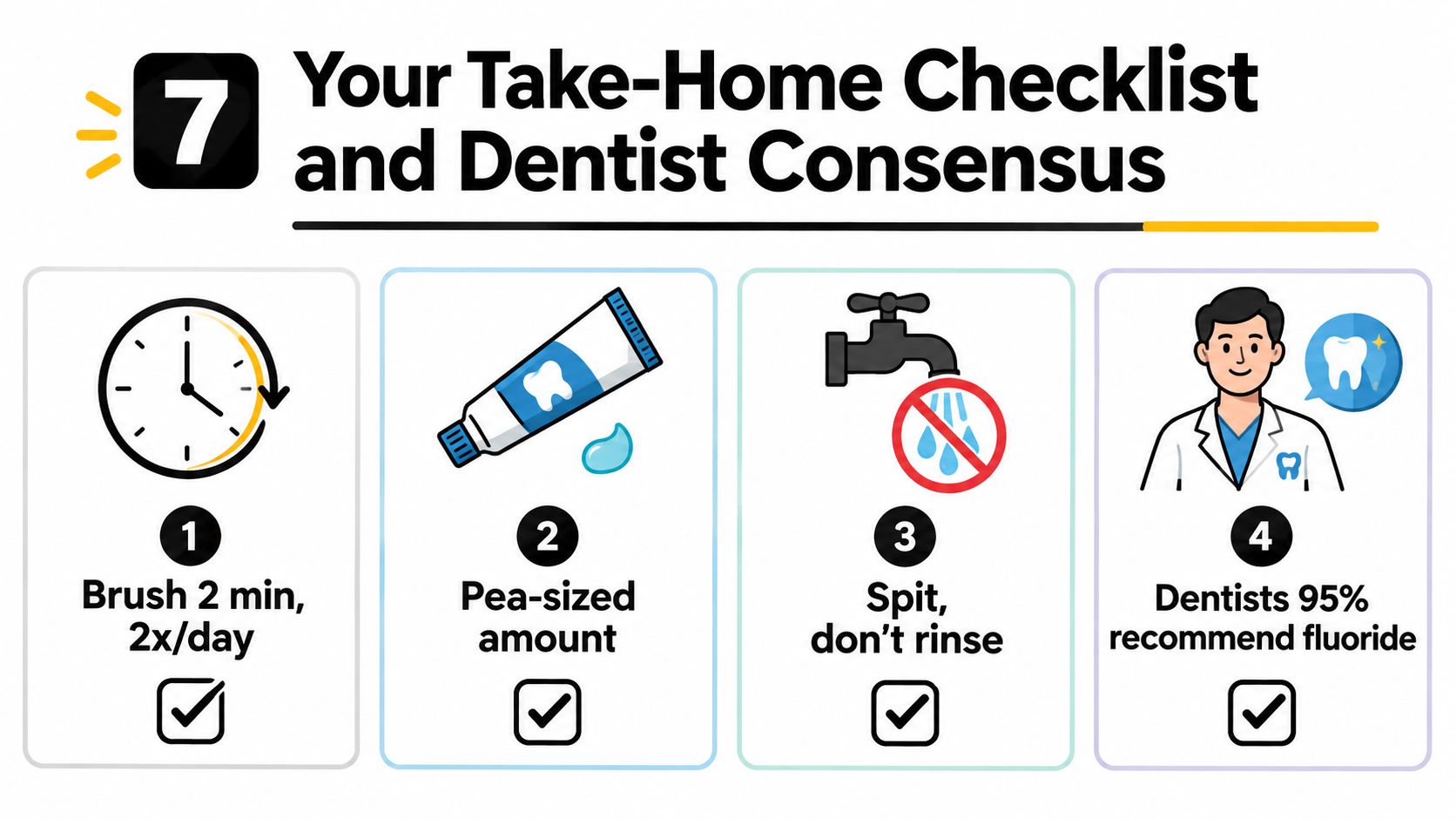
Check the label, use the recommended amount, and spit after brushing. If your water supply, age, swallowing habits, or cavity risk makes the choice less obvious, ask your dentist to review your combined exposure.
DentalHealth.com offers professional-grade oral care products, including fluoride toothpastes for sensitivity, enamel support, and everyday cavity prevention. Its product range can be reviewed as one option when choosing toothpaste for your routine and oral health needs.