
Fluoride Toothpaste Ingredients: What Each One Does
Two tubes can both say fluoride on the front and still deliver different cavity protection. One may sit below the concentration range where prevention is clearly supported, while another uses a fluoride compound that stays available during brushing. That's why reading fluoride toothpaste ingredients by job is more useful than reading them alphabetically. Start with the anticaries compound, then check its concentration, then look at the abrasives, detergents, and other ingredients that carry it, clean the tooth surface, and make the paste stable and usable. That order turns a crowded label into a practical comparison.
Fluoride Compounds That Define Each Toothpaste
A fluoride toothpaste is defined primarily by the type and concentration of its anticaries ingredient, rather than by flavor or abrasive. The World Health Organization fluoride concentration recommendation of 1,000-1,500 parts per million (ppm) applies across age groups, and 1,000 ppm equals 1.0 mg of fluoride per gram of toothpaste. A compound only counts if it releases biologically available fluoride during brushing.
| Compound | Typical Strength | Main Job | Practical Trade-off |
|---|---|---|---|
| Sodium fluoride | 1,000-1,500 ppm (OTC); 5,000 ppm (prescription) | Anticaries; the most common active | Availability can drop with some calcium-based abrasives |
| Sodium monofluorophosphate | 1,000-1,500 ppm (OTC) | Anticaries | Stable with calcium abrasives; releases fluoride more slowly |
| Stannous fluoride | 0.351-0.474% in the US monograph | Anticaries plus gum, plaque and sensitivity positioning | Can stain teeth and taste metallic; needs careful formulation |
| Sodium fluoride, prescription | 5,000 ppm | High-risk caries under professional direction | Not a stronger everyday version; use only as recommended |
Sodium Fluoride
Sodium fluoride is the straightforward label term you'll see on many standard pastes. Its strength is direct fluoride delivery, but the abrasive system matters. When a paste pairs sodium fluoride with certain calcium-based abrasives, fluoride availability can fall, so the fluoride figure shouldn't be read in isolation from the rest of the formula.
Sodium Monofluorophosphate
Sodium monofluorophosphate, often shortened to MFP, is another anticaries source. It's more stable with calcium abrasives than sodium fluoride, which makes it useful in those formulations. The trade-off is slower fluoride release, because the compound must break down before fluoride becomes available in the mouth.
Stannous Fluoride
Stannous fluoride supplies fluoride and is also positioned for plaque, gingivitis, sensitivity, or erosion concerns in some products. That wider role doesn't make every stannous fluoride paste automatically better for cavity prevention. It can taste metallic, staining is a known practical concern, and the formula must keep the ingredient stable and available.
Practical rule: Name the compound first, then check the ppm. A front-panel promise about whitening or freshness doesn't tell you either.
Prescription 5,000 ppm sodium fluoride belongs in a different category. The ADA topical fluoride guidance lists prescription products commonly at 5,000 ppm sodium fluoride, compared with ordinary over-the-counter ranges. It's intended for people at high caries risk under professional direction, not as a routine upgrade for everyone.
This distinction matters because fluoride type and concentration answer different questions. The compound tells you how fluoride is supplied and what compatibility issues to check. The ppm tells you whether the product sits inside the standard evidence-supported range. Used together, they form the first two checks you'll apply in the final buying checklist, before you judge flavor, foam, whitening claims, or extra ingredients.
Concentration Limits and What the Label Should Say
A toothpaste label can show a percentage of fluoride compound or a concentration in parts per million (ppm) of fluoride. Those numbers describe different things. Converting a percentage to ppm helps compare products, but the conversion must account for which substance the percentage measures.
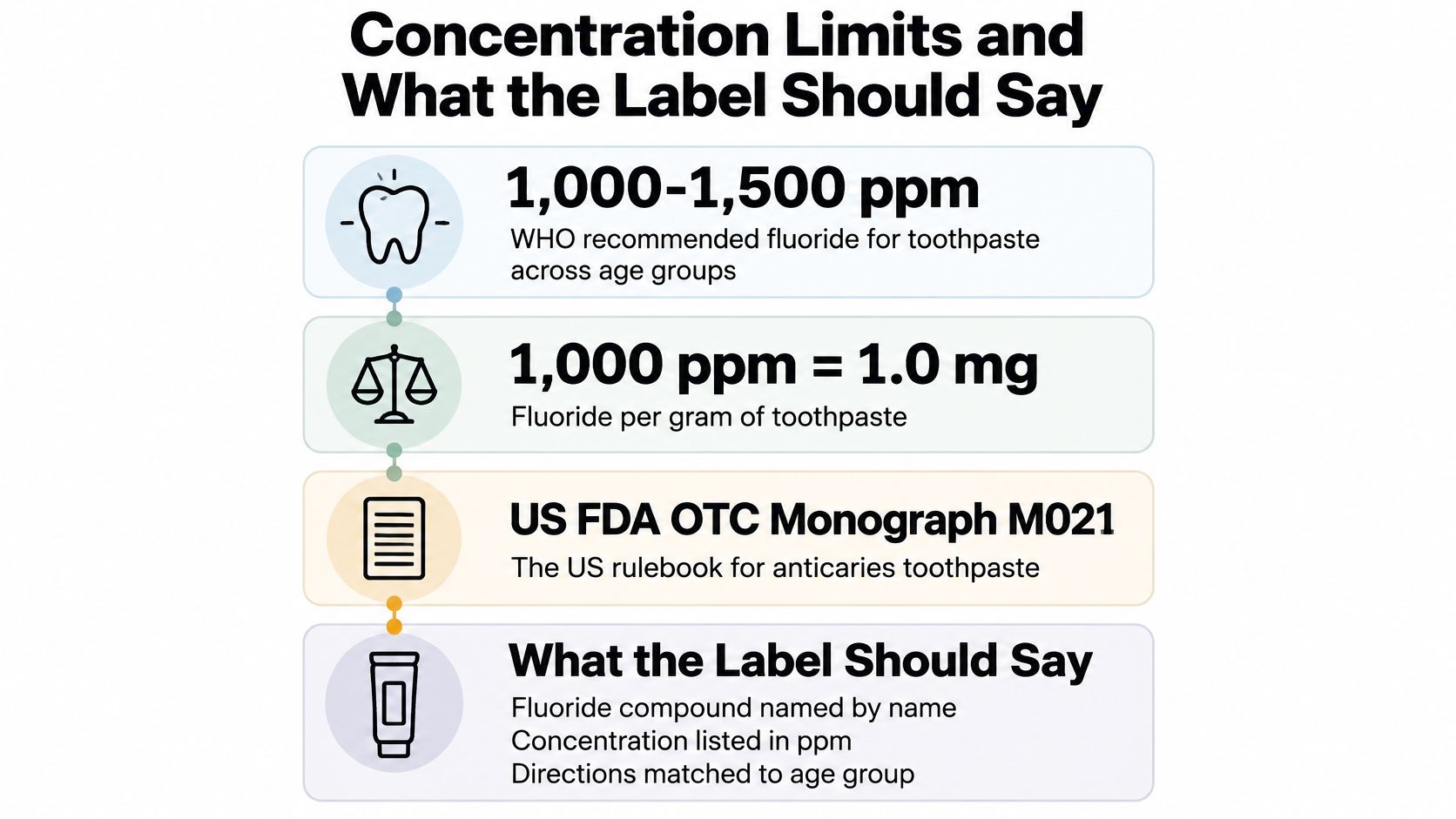
For sodium fluoride gel or paste, the FDA OTC Monograph M021 specifies 0.188% to 0.254% sodium fluoride, equivalent to 850 to 1,150 ppm theoretical total fluorine, with at least 650 ppm available fluoride ion. The percentage refers to the sodium fluoride compound; the ppm figure refers to fluoride. They are not interchangeable.
The same FDA monograph specifies 0.351% to 0.474% stannous fluoride. The available-fluoride minimum depends on the abrasive system: at least 700 ppm for most systems and 290 ppm for systems using calcium pyrophosphate. These different thresholds reflect the specific formulation categories in the monograph.
Total Fluoride Versus Available Fluoride
Total fluoride is the amount measured in the finished toothpaste. Available fluoride is the portion that remains chemically usable. Some abrasives and other ingredients can bind or complex fluoride, so total content alone does not show how much remains available.
| Standard or source | Sodium fluoride | Stannous fluoride | Available-fluoride reference |
|---|---|---|---|
| WHO recommendation | 1,000–1,500 ppm fluoride; the recommendation does not specify sodium fluoride alone | Included when used to provide fluoride in the recommended range | The recommendation concerns fluoride concentration, not a separate available-fluoride minimum |
| US FDA OTC Monograph M021 | 0.188%–0.254% (850–1,150 ppm theoretical total fluorine) | 0.351%–0.474% | 650 ppm for sodium fluoride; 700 ppm for most stannous systems; 290 ppm for calcium pyrophosphate systems |
| ADA, typical US OTC products | About 1,000–1,500 ppm fluoride across active types | Included among the principal US active ingredients | Product formulation must meet applicable requirements for available fluoride |
| ADA prescription reference | 5,000 ppm sodium fluoride | The ADA prescription reference cited here is for sodium fluoride, not stannous fluoride | Follow professional directions |
| 2025 European draft specification | Maximum 0.15% total fluoride; maximum 300 mg per single-unit container | The same total-fluoride limits apply | Availability depends on formulation compatibility |
The 2025 European draft dentifrice specification sets a maximum of 0.15% total fluoride and 300 mg per single-unit container. The container limit depends on both concentration and net mass, so checking the salt percentage alone does not establish how much fluoride the package contains.
A useful label identifies the fluoride compound, gives its concentration in a form that can be compared, and provides directions suited to the intended user. If available fluoride is listed, it offers a separate detail about the finished formulation.
What Fluoride Concentration Changes in Cavity Prevention
Fluoride concentration matters for cavity prevention, but the evidence does not establish a single cutoff that applies to every toothpaste label. In children and adolescents, the Cochrane review of 96 studies involving more than 74,000 participants found that toothpastes containing about 1,000 to 1,500 ppm fluoride reduced decay compared with fluoride-free toothpaste. In direct comparisons, 1,450 to 1,500 ppm products prevented more decay than products at 1,000 to 1,250 ppm.
The review supports 1,000 to 1,500 ppm as an effective range. Its findings for lower concentrations were weaker or less consistent, rather than evidence that every product below 1,000 ppm lacks preventive value. That distinction matters because the FDA monograph range cited earlier includes products with 850 to 1,150 ppm total fluoride. A monograph-permitted concentration and the concentration range best supported by comparative trial evidence are not the same measure.
For shoppers, the label's ppm figure helps compare anticaries fluoride across products. A percentage printed for a fluoride compound may describe the salt, not the amount of fluoride itself, so check whether the label specifies fluoride concentration or total fluoride. Fluoride prevents decay; the paste's abrasives, humectants, and other ingredients perform separate jobs.
Trial results describe groups, not individual outcomes. Brushing frequency, diet, saliva, existing lesions, and dental care also affect cavity risk. Higher concentration alone cannot make up for inconsistent brushing.
Abrasives, Humectants and Binders Explained
After fluoride, the largest part of the tube is the base that carries it. Mild abrasives remove deposits and surface stain. Humectants retain moisture so the paste doesn't dry out. Binders and thickeners stabilize texture, while the overall system keeps fluoride distributed through each ribbon you squeeze onto a brush.
| Ingredient | Class | Job in the Paste | Watch For |
|---|---|---|---|
| Hydrated silica | Abrasive and thickener | Removes surface stain and plaque | Abrasiveness varies by grade; check RDA |
| Calcium carbonate | Calcium abrasive | Gentle-to-moderate polishing at low cost | Can bind sodium fluoride and reduce availability |
| Dicalcium phosphate dihydrate | Calcium abrasive | Polishing with a calcium source | Compatibility depends on the fluoride compound |
| Calcium pyrophosphate | Calcium abrasive | Gentle polishing | Lower FDA minimum (290 ppm) applies only to this system |
| Glycerin and sorbitol | Humectants | Keep the paste moist | Large amounts of sorbitol can upset digestion |
| Xylitol | Humectant and sweetener | Moisture plus sweetness without sugar | Does not replace fluoride |
| Xanthan gum, carrageenan, cellulose gum | Binders and thickeners | Hold texture and stop separation | Affect mouthfeel and shelf stability |
Abrasives and RDA
Relative dentin abrasivity, or RDA, gives a rough measure of cleaning strength. Low-RDA formulas, often below about 70, suit sensitive teeth better, while most products sit under the 250 ceiling commonly cited as safe. RDA isn't printed on every consumer box, so you may need the manufacturer's product information.
A high-silica whitening paste illustrates the trade-off. It may polish away tea or coffee stain effectively, but a person with exposed roots should check its RDA before using it twice a day. Stronger polishing isn't the same as stronger cavity prevention.
Compatibility With Fluoride
Calcium carbonate is inexpensive and familiar, but calcium can bind sodium fluoride and reduce availability. Formulators manage that risk through compound choice, abrasive selection, and stability testing. Calcium pyrophosphate is a special case because its lower available-fluoride minimum is tied to that specific system, not to every calcium abrasive.
Humectants and binders rarely drive the therapeutic claim, but they affect whether you'll use the paste consistently. Glycerin and sorbitol prevent drying, xylitol adds sweetness and moisture, and gums such as xanthan or cellulose gum stop the paste from separating. A broken, gritty, or unpleasant texture can shorten brushing even when the active ingredient is sound.
If you're comparing simpler ingredient lists, it helps to see how one product explains its base ingredients, such as in this breakdown of Just Ingredients toothpaste formulation choices. Use that kind of resource to learn ingredient jobs, then return to the fluoride compound and ppm for the anticaries decision.
Detergents, Preservatives, Flavors and Sweeteners
These ingredients don't supply the main cavity-preventing mechanism. They spread the paste, protect it during storage, and make twice-daily use acceptable. Their importance is practical: irritation, allergy, or a taste you dislike can reduce adherence, while a comfortable paste supports a steady routine.
- Detergents: Sodium lauryl sulfate (SLS) foams and helps distribute toothpaste across teeth. Some people report mouth ulcers or irritation with SLS, so SLS-free products use alternatives such as cocamidopropyl betaine. A child or adult with recurrent canker sores is the clearest candidate for trying an SLS-free formula.
- Preservatives: Sodium benzoate, potassium sorbate, and methylparaben help keep the paste free of microbes through shelf life. Parabens remain debated in consumer discussion, and evidence at toothpaste concentrations is limited. People who prefer to avoid parabens should read the inactive list rather than rely on front-panel natural language.
- Flavors: Peppermint oil, spearmint, menthol, and cinnamon-type flavors improve acceptability and create a clean taste. Menthol gives cooling, but it can sting cracked or sensitive gums. Cinnamon flavoring is a common concern for people with a known cinnamon allergy or contact sensitivity.
- Sweeteners: Sodium saccharin, sucralose, xylitol, and sorbitol make the paste palatable without sugar. Xylitol can support a pleasant mouthfeel and saliva response, but sweetness doesn't replace fluoride. People who react to a specific sweetener should check the full list, since mint flavor alone doesn't reveal it.
A comfortable inactive system supports adherence, but comfort shouldn't be confused with anticaries strength.
Foam deserves a separate note. Heavy foam feels thorough, yet foam volume isn't a measure of fluoride delivery. A low-foam paste can carry the right fluoride compound at the right concentration, and a high-foam paste can still fall short if its ppm is low.
Flavor intensity works the same way. Strong mint may encourage one adult to brush longer and discourage a child who finds it hot or unpleasant. Choose the mildest flavor that supports regular use, then hold the fluoride requirement constant. For these supporting fluoride toothpaste ingredients, the main question is personal tolerance, not whether they add a second cavity-prevention mechanism.
How Formulations Differ for Sensitivity, Whitening and Children
Specialty labels can make products look wholly different. The shared rule is simpler: fluoride remains the anticaries core, and the formulation adjustment is what gets added around it. Sensitivity pastes add a desensitizing agent, whitening pastes emphasize polishing, and children's pastes adjust dose, foam, and flavor.
The comparison below shows those adjustments without changing the central fluoride check.
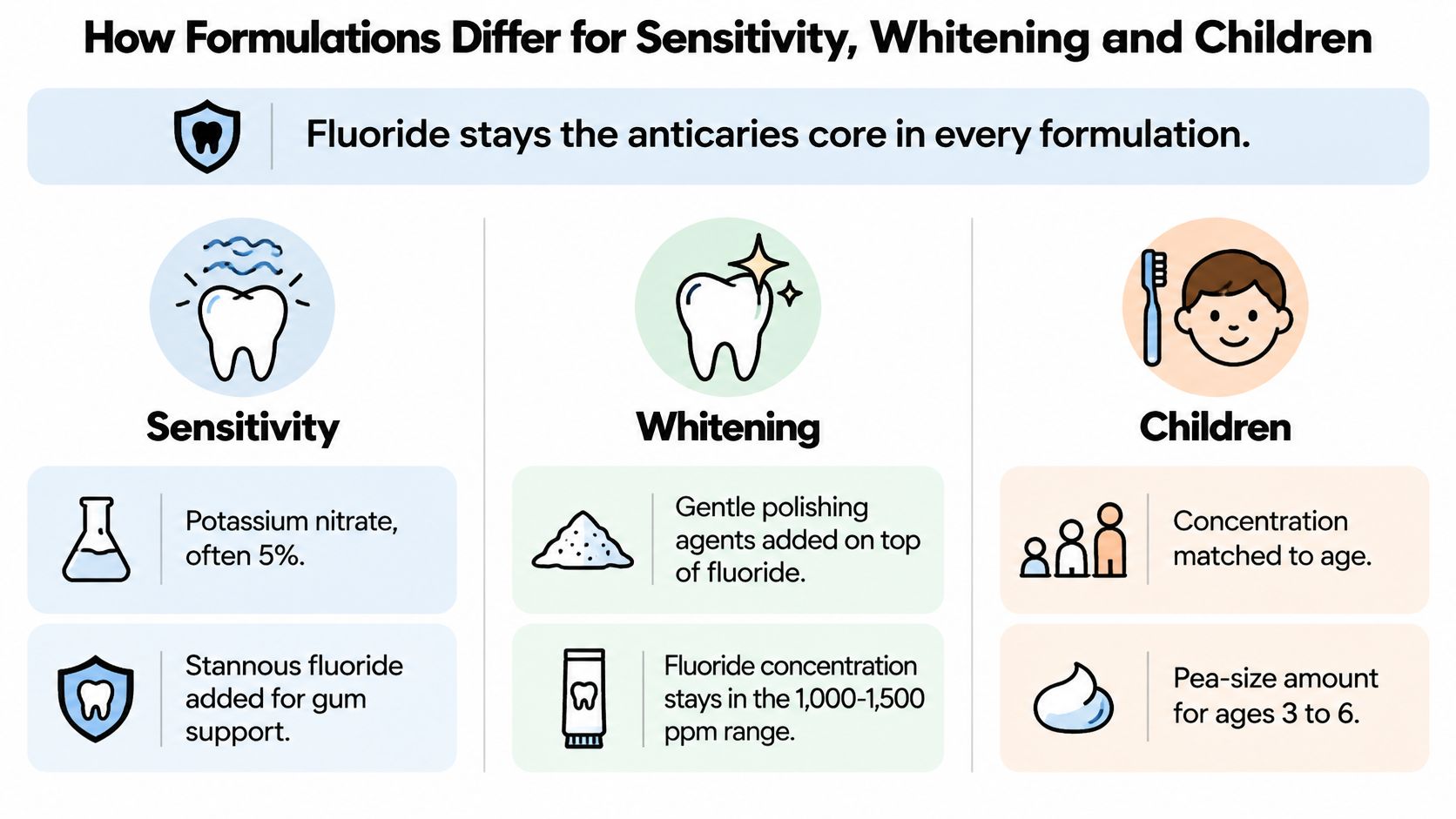
Sensitivity formulas may use potassium nitrate, often listed at 5%, stannous fluoride, or arginine with calcium carbonate, usually with a low RDA. Fluoridex is a concrete example because it combines sodium fluoride with 5% potassium nitrate. Convert any sodium fluoride percentage back to its stated ppm before comparing it with a standard tube.
Whitening formulas rely mainly on silica or other polishing agents to reduce extrinsic stain. The whitening effect comes from polishing, not fluoride. Some products add low-level peroxide, so sensitive users should check both the whitening agent and abrasiveness rather than assuming whitening means stronger protection.
The short video below adds a visual walkthrough of how these formulation choices appear on real products.
| Formulation | Key Ingredient or Adjustment | Typical Fluoride Level | What to Check |
|---|---|---|---|
| Sensitivity | Potassium nitrate (5%), stannous fluoride, or arginine with calcium carbonate; low RDA | Typically 1,000-1,500 ppm or a stated sodium fluoride percentage | Confirm the desensitizing agent and the fluoride figure |
| Whitening | Silica or other polishing agents; sometimes low-level peroxide | Typically 1,000-1,500 ppm | Whitening comes from polishing; check RDA if teeth are sensitive |
| Remineralizing (MI Paste family) | CPP-ACP combined with fluoride | Check the label for ppm | Confirm fluoride is listed, not only CPP-ACP |
| Children under 3 | Mild flavor, low foam | About 1,000 ppm | Rice-grain smear with supervised brushing |
| Children 3-6 | Mild flavor, low foam | About 1,000 ppm | Pea-sized amount with spitting rather than heavy rinsing |
MI Paste family products pair CPP-ACP with fluoride in the relevant formulations. Don't stop at the CPP-ACP name. Confirm that fluoride and its concentration are still listed, because a remineralizing extra doesn't answer the ppm question.
For children, dose control is part of the formulation decision. Under age 3, use a rice-grain smear with supervised brushing. From ages 3-6, use a pea-sized amount, with spitting rather than heavy rinsing. Parents comparing product names and dentist-based selection criteria can review pediatric dentist recommended toothpaste guidance alongside the ppm and amount directions on the box.
Swallowing is the main concern at this age, so keep the amount small and supervise brushing. Treat a child's toothpaste as a dose to measure rather than a flavor to enjoy, because repeated swallowing during the early years can cause dental fluorosis in developing enamel. The working rule stays constant for every row: identify the adjustment first, then confirm fluoride remains at the appropriate level.
Biomimetic and Fluoride-Free Ingredients to Check
A toothpaste ingredient can support one oral-health goal without matching fluoride's evidence for preventing cavities. Hydroxyapatite, CPP-ACP, calcium-phosphate compounds, calcium silicate, and bioactive glass have different intended uses and evidence profiles. Treat them as potential adjuncts or alternatives with specific claims to assess, not as interchangeable ingredients.
A 2025 umbrella review of toothpaste ingredients found that ingredients target different oral conditions, and only some showed significant benefits for their intended use. The endpoint matters: evidence of change in an early enamel lesion does not establish that an ingredient prevents new cavities.
Separate four kinds of claims:
- Preventing new cavities: Fluoride has the strongest evidence for this outcome.
- Changing early enamel lesions: Remineralization measures mineral changes in early lesions; it does not by itself show fewer new cavities.
- Reducing sensitivity: Relief may depend on tubule-blocking or nerve-related effects.
- Removing surface stain: Polishing may change appearance without changing cavity risk.
Quality Questions Behind a Claim
Ingredient names alone do not tell shoppers how a product will perform. Concentration, particle size, source material, formulation stability, and the measured outcome all affect how a claim should be interpreted. A label that names hydroxyapatite but gives no usable concentration or specific outcome offers little basis for comparison.
Natural positioning is not a substitute for quality testing. Products marketed as natural should be tested for contaminants, with sourcing and quality controls supporting any safety claims.
For a closer comparison of the evidence and claims, read about fluoride versus hydroxyapatite toothpaste. Apply these questions when assessing a biomimetic claim:
- Identify the intended outcome: Cavity prevention, lesion change, sensitivity relief, and stain removal are distinct results.
- Check what was measured: Look for evidence tied to the product's specific ingredient and claimed outcome.
- Read the product labeling: Ingredient identity, concentration, and directions are more informative than broad enamel-repair wording.
- Question vague repair claims: A useful claim should name the ingredient, the measured outcome, and the conditions of use.
Biomimetic ingredients may suit a specific goal or preference. Equivalence to fluoride for cavity prevention requires evidence for that outcome, not just a claim about enamel repair.
Confirm Fluoride and Concentration Before You Buy
Use this sequence in the store or on a product page. It takes less than a minute once you know where the Drug Facts panel and inactive ingredients sit.
The checklist graphic below condenses the same steps for a quick screen-side check.
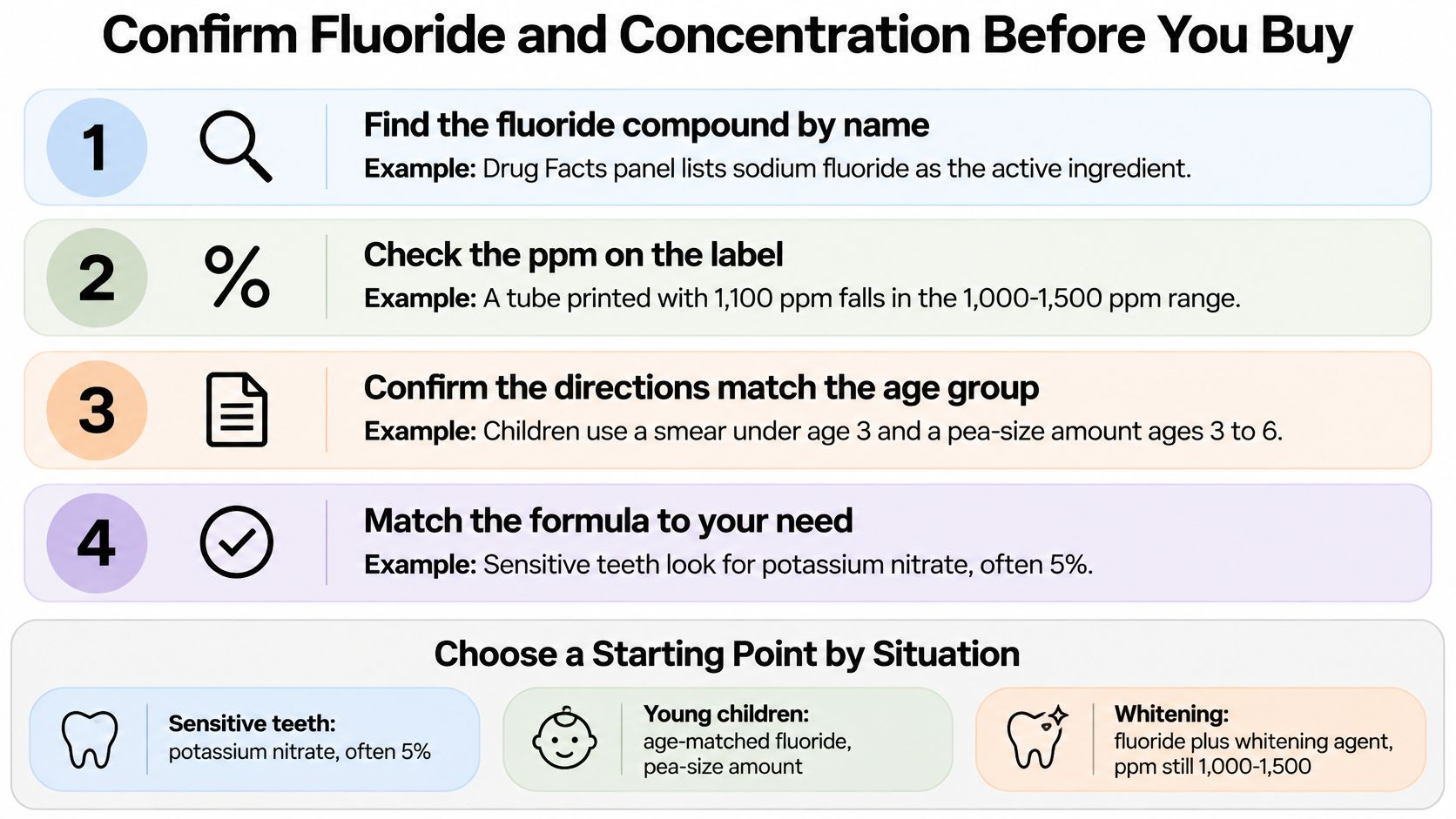
- Find the fluoride compound by name: Look for sodium fluoride, sodium monofluorophosphate, or stannous fluoride in the active ingredient panel. For example, sodium fluoride listed as the active ingredient tells you which compatibility checks apply.
- Confirm the ppm or percentage: Convert the label into a comparable fluoride figure. For example, 0.2% sodium fluoride is roughly 900 ppm fluoride, inside the FDA ingredient range but below the common 1,000 ppm benchmark discussed earlier.
- Check available fluoride when calcium abrasives appear: Calcium carbonate or another calcium abrasive should prompt a closer look. The concern is greatest when the active is sodium fluoride and no availability information is provided.
- Calculate fluoride per container for large or concentrated tubes: Multiply concentration by net mass in consistent units. For example, compare the result with the 300 mg single-unit limit in the 2025 European draft where that standard applies.
- Check the specialty agent and RDA for sensitivity: A sensitivity paste should name its desensitizing approach, such as potassium nitrate or stannous fluoride. Low abrasiveness matters if roots are exposed or gums have receded.
- Claim-check fluoride-free products: Apply the endpoint test from the previous section. If the claim is cavity prevention, ask what evidence supports that specific outcome rather than accepting remineralizing language at face value.
Starting points: Daily prevention usually calls for 1,000-1,500 ppm, sensitivity calls for a desensitizing agent plus fluoride, children call for about 1,000 ppm with supervised dosing, and 5,000 ppm belongs under professional advice.
If two products meet the same fluoride standard, then compare taste, foam, abrasiveness, and tolerance. Those details affect consistency, and consistency affects results. DentalHealth.com is one retailer where professional-grade options such as Fluoridex and MI Paste family products can be compared by ingredient and intended use, but the label checks above apply wherever you buy.
Don't let packaging order decide for you. Whitening, freshness, natural imagery, and sensitivity badges are secondary until the fluoride compound and concentration are clear.
Visit DentalHealth.com to compare professional-grade fluoride toothpastes, sensitivity formulas, and remineralizing products with ingredient details presented for label-by-label review. Bring the checklist with you, confirm the compound and ppm first, and choose the formula that matches your cavity risk, sensitivity, and household needs.