
Fluoride vs Hydroxyapatite Toothpaste: What to Choose
Are you choosing a toothpaste because it performed well in a study, or because it fits the conditions in your own mouth? That's the missing question in most discussions of fluoride vs hydroxyapatite toothpaste. A promising ingredient isn't automatically the right choice for someone with recurring cavities, dry mouth, or unexplained tooth pain.
Two Toothpastes, One Decision
You're standing in the toothpaste aisle holding familiar fluoride toothpaste in one hand and a fluoride-free hydroxyapatite formula in the other. Both packages promise stronger enamel. Both sound credible, but neither tells you whether its evidence applies to your teeth.
The useful question isn't which ingredient sounds more advanced. It's which formulation addresses your main problem without compromising another priority. Cavity prevention, sensitivity relief, and personal preferences overlap, but they aren't interchangeable goals.
| Decision point | Fluoride toothpaste | Hydroxyapatite toothpaste |
|---|---|---|
| Evidence for cavity prevention | More extensively established | Credible clinical evidence, but a smaller research base |
| Strongest practical starting point | People who need an established anticaries approach | Selected adults who prefer fluoride-free care |
| Sensitivity expectations | Depend on the complete formulation and symptom | Also depend on formulation, trigger, and treatment duration |
| Important label detail | Fluoride concentration | Hydroxyapatite concentration and formulation |
| Main mistake to avoid | Assuming every fluoride product serves the same purpose | Assuming every mineral-branded product matches a studied formula |
These distinctions reflect the adult randomized trial's findings and discussion of the comparative evidence. They're a starting framework, not a diagnosis.
Consider different shopping situations. Someone who wants fluoride-free care and has a stable dental history faces a different decision from someone whose dentist keeps finding new decay. A person seeking relief after whitening has another question altogether: what's causing the discomfort, and does the proposed toothpaste address it?
Practical rule: Decide what you need the toothpaste to do before deciding which ingredient you prefer.
Preferences still matter. You should be comfortable with your daily products. But a preference becomes an informed choice only when you understand the trade-off, including where evidence is convincing and where it remains limited.
How Fluoride and Hydroxyapatite Work
Remineralization means restoring mineral to areas of early enamel mineral loss. Both ingredients can support that process, so the common claim that fluoride merely protects while hydroxyapatite alone repairs is too simplistic.
The meaningful distinction is how researchers observe mineral changes within an early lesion. Fluoride primarily promotes remineralization near the enamel surface and helps limit demineralization. Hydroxyapatite is a biomimetic mineral material that can deposit mineral within affected enamel, including deeper lesion regions in experimental comparisons.
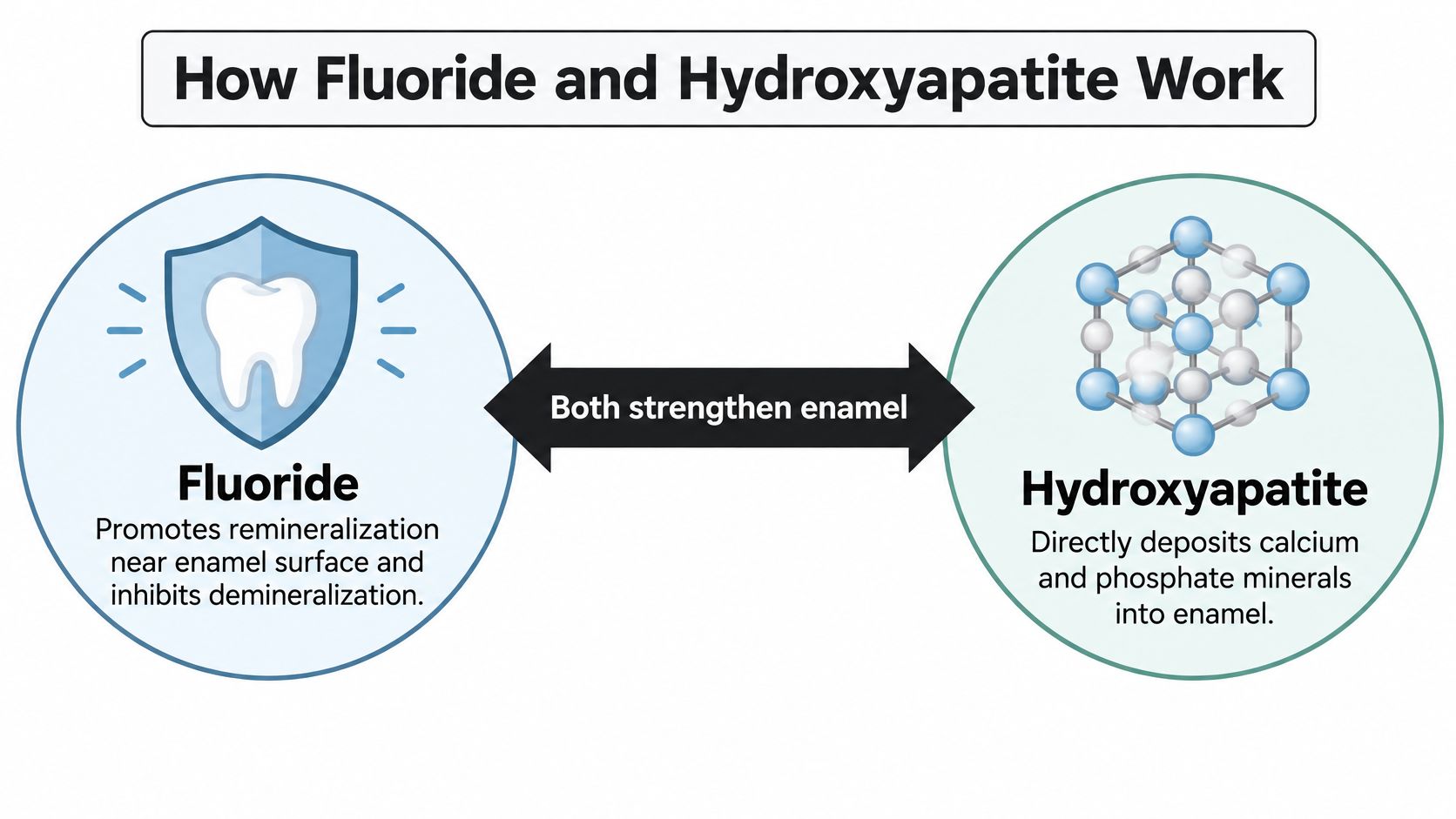
Mechanism is not a clinical verdict
A diagram can explain a plausible benefit. It can't establish that an ingredient prevents more cavities in everyday use. For a closer explanation of fluoride's role, see how fluoride helps strengthen teeth.
That distinction matters because terms such as biomimetic can sound like proof of superiority. They describe an approach, not a guaranteed outcome. The clinical question remains whether people using a particular formula experience less disease progression under the conditions studied.
A randomized trial in children aged 3–7 years compared 10% microcrystalline hydroxyapatite with 500 ppm fluoride over 336 days; early caries signs increased in 72.7% and 74.2% of the respective groups. Hydroxyapatite met the study's statistical criterion for non-inferiority, but that doesn't mean it was superior.
What this means for enamel claims
The children's findings support taking hydroxyapatite seriously as a clinically studied alternative. They also show why toothpaste shouldn't be described as complete protection: early disease signs progressed in both groups.
- Look beyond the mechanism. A convincing explanation of mineral deposition doesn't establish better cavity prevention.
- Keep the formulation attached to the claim. Evidence for a specified concentration doesn't automatically transfer to an unspecified product.
- Separate early mineral changes from treatment needs. Research on remineralization shouldn't be used to justify postponing assessment of active decay.
The practical interpretation is balanced: different mechanisms can produce comparable measured outcomes. Neither a familiar ingredient nor an appealing mineral-repair story removes the need to examine the actual evidence.
Comparing the Clinical Evidence
Non-inferiority is not the same as superiority or universal equivalence. Researchers design a non-inferiority trial to test whether a treatment falls within a predefined acceptable difference from its comparator. A successful result supports that specific comparison, not every product containing the ingredient.
The adult trial is particularly useful because it compared hydroxyapatite with a regular-strength adult fluoride formulation, rather than relying only on the lower-fluoride comparator used in the children's research.
Clinical Evidence at a Glance
| Study Population | Hydroxyapatite Result | Fluoride Result | Conclusion |
|---|---|---|---|
| Adults followed for 18 months | 89.3% had no increase in decayed, missing, and filled surfaces | 87.4% had no increase with 1,450 ppm fluoride | Hydroxyapatite was non-inferior for the primary endpoint in the double-blind adult randomized trial |
| Young children in the previously described trial | Met the non-inferiority criterion | Served as the low-fluoride comparator | Supports the tested comparison, not superiority |
| Adults wearing enamel-block appliances | Comparable early-lesion remineralization | Comparable early-lesion remineralization | A short experimental comparison, not long-term evidence for every risk group |
The adult trial's primary outcome used DMFS, an index of decayed, missing, and filled tooth surfaces. In practical terms, the investigators assessed whether that measure increased during follow-up. The numerical advantage in the hydroxyapatite group wasn't proof that hydroxyapatite prevents more cavities.
Read the result alongside its limits
The reported adult percentages came from the per-protocol analysis, meaning the analysis focused on participants who followed the trial protocol sufficiently. That's useful evidence, but it shouldn't be treated as an unconditional prediction for any shopper choosing any hydroxyapatite paste.
When evaluating a comparison, ask:
- Who participated? Adults, young children, and people with compromised saliva aren't interchangeable populations.
- What was tested? A finished toothpaste has a formulation, not just an ingredient name.
- What did researchers measure? Mineral changes in enamel blocks and changes in clinical caries indices answer different questions.
- How long did observation last? Short-term remineralization and sustained cavity prevention aren't identical outcomes.
Fluoride retains the deeper historical and population-level evidence base. Hydroxyapatite has credible randomized-trial support, but fewer studies across fewer circumstances.
That leaves a useful middle position. Dismissing hydroxyapatite as marketing ignores clinical evidence. Declaring fluoride obsolete goes beyond it. The sound conclusion is that hydroxyapatite can be a defensible option in selected circumstances, while uncertainty still matters when the consequences of another cavity are significant.
Sensitivity Relief and What the Evidence Shows
Hydroxyapatite isn't automatically the faster or stronger choice for sensitive teeth. The trigger and the treatment duration matter, and a product's cavity-prevention evidence doesn't establish its sensitivity performance.
A systematic review comparing nano-hydroxyapatite and fluoride for sensitivity reported better results for nano-hydroxyapatite in some short-term outcomes, while fluoride performed better for cold-air sensitivity at longer follow-up. That's a more qualified finding than a blanket claim that either ingredient wins.
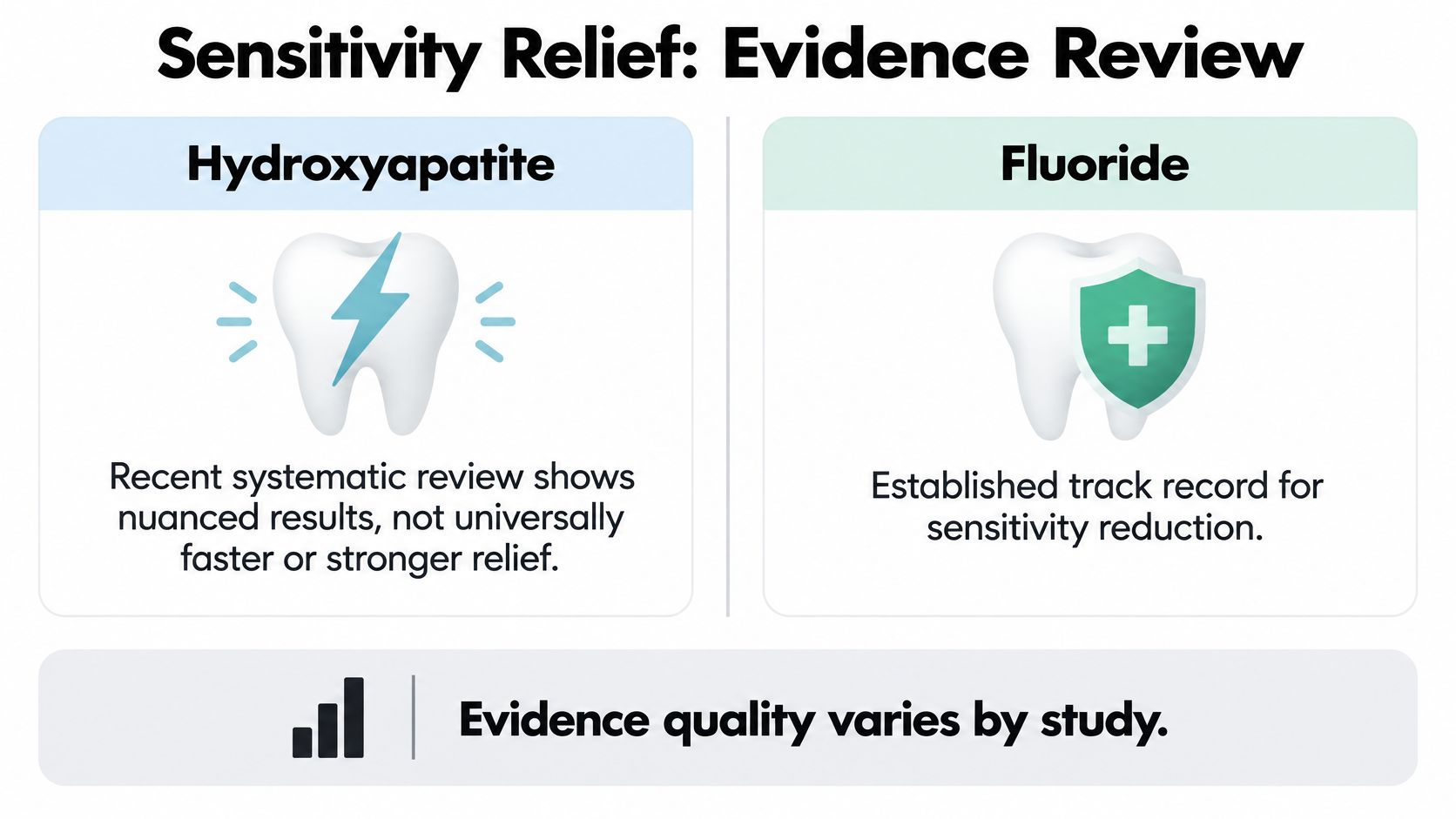
Describe the symptom before choosing treatment
“Sensitivity” can mean discomfort when brushing, a reaction to cold air, pain with hot drinks, or soreness during whitening. Those descriptions shouldn't be collapsed into a single product recommendation.
Useful details to bring to an appointment include:
- The trigger. Does brushing or touching the area hurt, or is the problem mainly cold or heat?
- The location. Is discomfort widespread, or can you identify a particular tooth?
- The pattern. Did it begin with whitening, or has it developed without an obvious explanation?
- The direction. Is it improving, staying unchanged, or becoming harder to ignore?
Exposed dentin, recession, erosive wear, whitening-related sensitivity, and an underlying lesion require different consideration. A comparison of toothpaste ingredients doesn't identify which explanation applies to you.
Don't sacrifice prevention to chase comfort
Someone with both sensitivity and substantial cavity concerns may need to preserve an established anticaries routine while addressing discomfort separately. A dentist can help select a desensitizing product or determine whether the symptom needs treatment rather than another toothpaste.
The guide to choosing toothpaste for sensitive teeth can help you compare product purposes. It shouldn't replace assessment of persistent, localized, spontaneous, or worsening pain.
Relief is useful, but feeling better doesn't establish that the cause has been treated.
Avoid judging a formula solely by its immediate sensation or expecting a universal relief timeline. Match the outcome you want to the symptom you have, and agree on when to reassess rather than switching products indefinitely.
Choosing Based on Your Caries Risk
Caries risk is the likelihood of developing or progressing tooth decay. For toothpaste selection, it's more useful than asking whether you identify with conventional or fluoride-free oral care.
Use the risk categories below as conversation prompts, not a self-diagnosis. The graphic is a broad orientation; it shouldn't be read as a reason to increase concentrations or add combination products without advice.
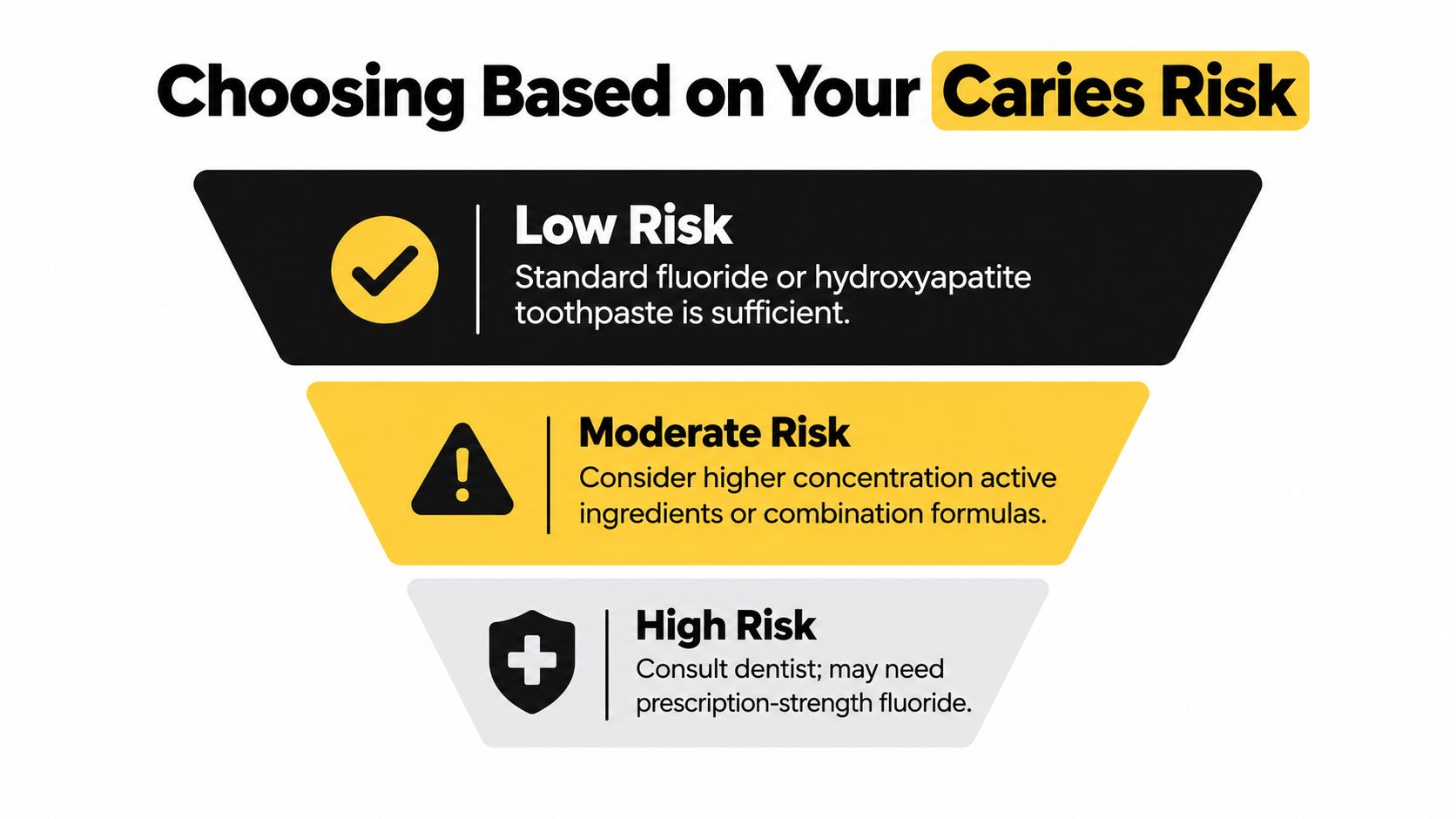
Lower risk leaves more room for preference
For a lower-risk adult who strongly prefers fluoride-free care, a hydroxyapatite formulation with relevant clinical support may be reasonable. That decision is stronger when a dentist has assessed the current condition of the teeth and can monitor whether the approach remains appropriate.
Lower risk doesn't mean no risk. Nor should you assume that an absence of pain confirms a stable dental situation. Ask for an explicit risk assessment rather than making the category depend on how your teeth feel.
Uncertain or elevated risk changes the balance
If your history is mixed, don't treat “moderate risk” as an instruction to buy the strongest-looking product. Ask which findings concern your dentist and what the toothpaste is expected to accomplish.
- Frequent cavities or active decay. Favor the more established fluoride approach unless your treating dentist recommends otherwise.
- Dry mouth or reduced saliva. Don't assume the average trial result applies to your circumstances.
- High sugar exposure. Discuss the broader prevention plan rather than treating an ingredient change as a complete solution.
- Unclear dental history. Get assessed before making a switch intended to replace an existing recommendation.
These cautions follow the limits of the adult evidence discussed earlier. They don't prove hydroxyapatite cannot help higher-risk people; they mean the available comparisons don't justify treating that question as settled.
For context on the established option, see how fluoride toothpaste helps prevent tooth decay. Keep your own examination findings central when considering any general educational material.
The accompanying video offers another format for considering the choice.
The practical decision isn't just whether switching is possible. It's whether the evidence and your clinical situation support switching without weakening the prevention plan you need.
How to Evaluate Toothpaste Labels
Start with the back of the package, not the enamel-repair promise on the front. Your task is to identify what's in the product, how much is present, and whether its claims match evidence for that formulation.
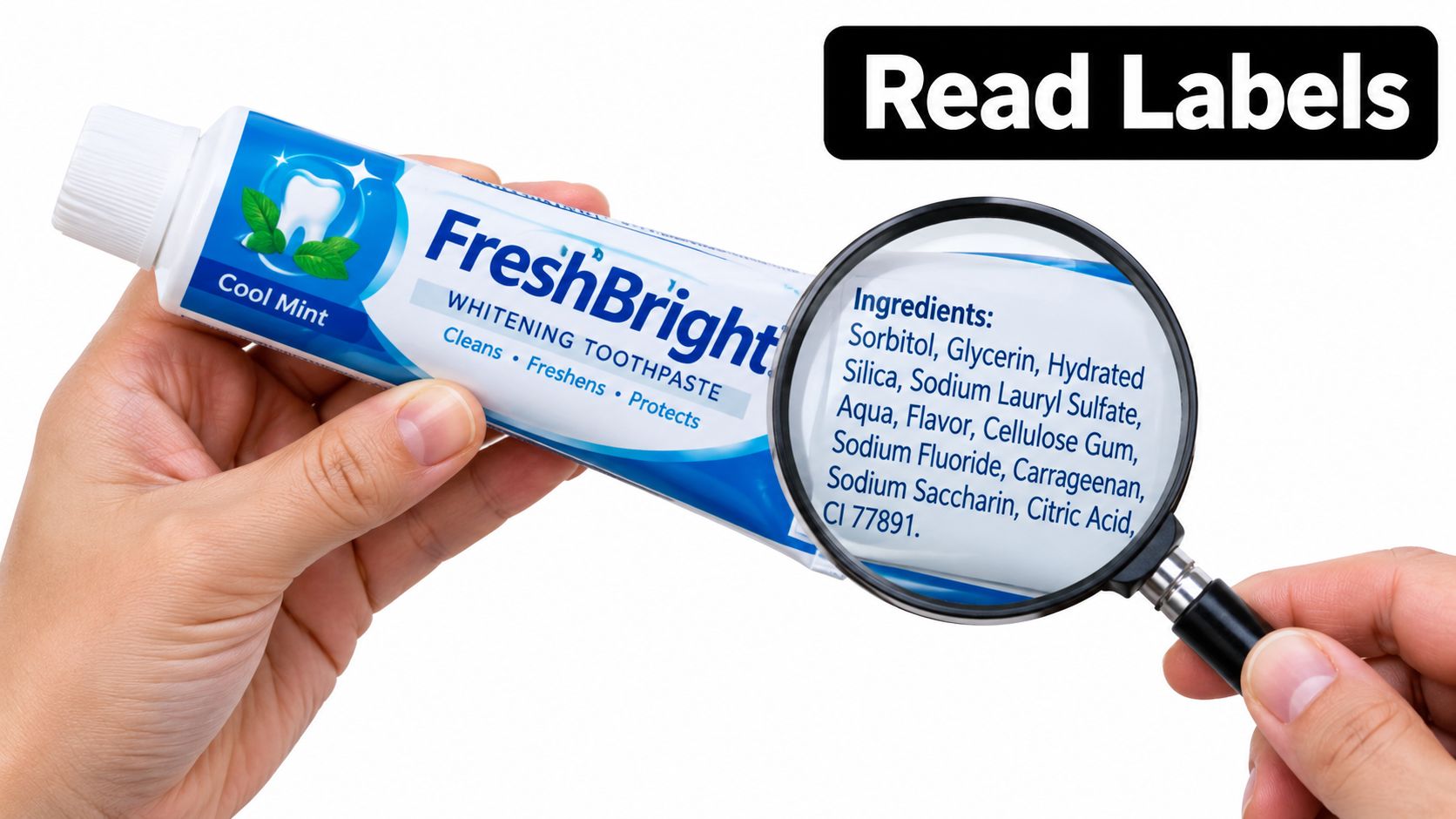
Verify the concentration before comparing claims
A double-blind randomized crossover study involving 30 adults compared 10% hydroxyapatite with 500 ppm fluoride during two 14-day treatment periods, finding significant remineralization with both and no significant difference between treatments. Participants wore appliances containing enamel blocks, so this was an in situ experiment, not a long-term trial of cavities developing in their own teeth.
That result supports a studied hydroxyapatite concentration. It doesn't establish a universal minimum effective dose, and it doesn't show that a product with a lower or undisclosed amount fails. The honest label-reading conclusion is narrower: you can't assume equivalent evidence when the concentration is unknown.
Use this shopping checklist:
- Identify the ingredient. Confirm whether the product contains fluoride, hydroxyapatite, or a combination, rather than inferring it from the product name.
- Find the amount. Look for a disclosed concentration and ask the manufacturer if it isn't clear.
- Request product-relevant evidence. A paper about an ingredient isn't necessarily a trial of the toothpaste being sold.
- Match the claim to the outcome. Sensitivity relief, enamel remineralization, and cavity prevention need different support.
Treat descriptive terms as descriptions
Biomimetic, mineral, and enamel support don't tell you whether a product matches a clinical trial. Neither does an attractive illustration of particles filling tooth defects.
For fluoride products, compare the disclosed concentration with the product your dentist recommended. Don't assume that a children's comparator from a study is a purchasing recommendation for every child.
For hydroxyapatite products, an undisclosed percentage is a reason to ask questions, not permission to fill the gap with marketing assumptions. If the manufacturer can't explain which evidence supports its finished formula, keep that uncertainty in your decision.
Label check: Buy the formulation you can evaluate, not the promise you can't verify.
Practical Recommendations for Different Situations
A parent, a frequent-cavity patient, and a whitening user may all ask which toothpaste is better. They shouldn't necessarily leave with the same answer.
A parent choosing for a young child
The pediatric research makes hydroxyapatite a legitimate subject for discussion with a child's dentist. It doesn't settle every question about product selection, use, or an individual child's decay risk.
Bring the actual tube or ingredient label to the appointment. Ask whether its formulation is appropriate for your child and whether the prevention plan needs anything beyond toothpaste. Don't turn a trial against a low-fluoride comparator into a blanket recommendation to replace whatever your child's dentist prescribed.
An adult who keeps developing cavities
If you've been advised to use Fluoridex or another fluoride product, ask what finding prompted that recommendation before changing it. The important conversation is about your treatment plan, not whether an alternative ingredient has any evidence at all.
Useful questions include:
- What are we trying to prevent? Ask whether the concern is new decay, progression of existing lesions, or another finding.
- How will we judge success? Agree on what your dentist will monitor.
- What would justify a change? Make the decision conditional on clinical findings rather than a package claim.
Someone with discomfort during whitening
If sensitivity started while using Opalescence or Zoom whitening products, tell your dental professional exactly what you're using and when symptoms occur. Don't assume switching to hydroxyapatite resolves the reason for the discomfort or makes continuing an unchanged routine appropriate.
A targeted sensitivity plan may make more sense than replacing the anticaries toothpaste. That separates the comfort question from the prevention question.
For the health-conscious shopper who prefers fluoride-free care, the reasonable position is neither dismissal nor unconditional reassurance. Choose an evaluable formulation, discuss the switch if your risk is uncertain, and keep professional monitoring in place.
Combining strategies can be sensible, but more products don't automatically mean better protection. Ask for a coherent routine rather than improvising an alternating schedule or assuming a combination formula has proven superiority.
The Bottom Line on Fluoride vs Hydroxyapatite
The practical answer is a match, not a winner. Fluoride remains the more extensively established anticaries option. Hydroxyapatite has earned consideration through clinical research, but its evidence shouldn't be stretched to cover every formulation, symptom, or risk profile.
Choose according to what would make the decision safe and assessable for you. That means knowing your cavity risk, understanding the purpose of the product, and being able to verify its ingredients. If sensitivity is the reason you're shopping, establish what's causing it rather than treating relief as proof that nothing else needs attention.
Make the next step concrete
Before replacing your current toothpaste, gather:
- Your current product label. Include any professionally recommended toothpaste or remineralizing paste.
- Your reason for switching. Be specific about fluoride avoidance, discomfort, or another concern.
- Your clinical questions. Ask what findings support the choice and how your dentist will monitor it.
You don't need to defend a brand or an ingredient. You need a plan that suits your mouth and can be reconsidered if circumstances change.
Persistent pain, suspected decay, or worsening symptoms should prompt dental assessment, not another round of product experimentation. For an otherwise stable situation, informed preference has a place. The goal is confidence based on a clear rationale, not certainty promised by packaging.
DentalHealth.com offers professional-grade at-home oral care products, including fluoride toothpastes, sensitivity products, and remineralizing pastes, alongside practical product guides. Visit to compare ingredient information and product descriptions, then use your dentist's recommendation to choose a routine that fits your cavity risk and sensitivity needs.