
Fluoride Toothpaste Without Artificial Sweeteners
You're standing in the bathroom, toothpaste tube in hand, when an unfamiliar ingredient catches your eye. Perhaps it's a sweetener you'd rather avoid, or perhaps the ingredient list is just longer and more technical than expected. You still want reliable cavity protection, but you also want to understand what you're putting into your daily routine.
Choosing fluoride toothpaste without artificial sweeteners doesn't have to be a decision driven by fear. It can be a practical preference, a response to taste or irritation, or a way to simplify your product choices. The important distinction is knowing which ingredients protect your teeth, which ones mainly affect flavor, and how to read the label with confidence.
Why This Question Matters Right Now
A toothpaste label can make a straightforward purchase feel surprisingly complicated. One product may highlight fluoride, another may promote natural ingredients, and a third may advertise that it contains no artificial sweeteners. Those claims describe different parts of a formula, so comparing them requires more than looking for the shortest ingredient list.
Consider a patient who likes the taste of a conventional mint toothpaste but wants to avoid saccharin or sucralose. That person may not need a fluoride-free product at all. They may just need a formula that keeps an evidence-based fluoride ingredient while using stevia, xylitol, a different flavor system, or no added sweetener.
Preference and clinical need are different
Avoiding an artificial sweetener may be reasonable if you prefer a simpler formulation, dislike a particular taste, or suspect that a flavoring or inactive ingredient irritates your mouth. That choice doesn't automatically mean the ingredient is causing cavities, and it doesn't mean fluoride is unsafe when used as directed.
The American Dental Association distinguishes between decay-causing sugars and non-caloric sweeteners used for flavor. ADA-Accepted toothpastes can't contain sugars or other ingredients that promote decay, while flavoring agents and non-caloric sweeteners remain common in oral care products. You can review the American Dental Association's toothpaste guidance for more detail on the roles these ingredients play.
What you should be able to decide
By the time you finish comparing products, you should be able to answer three practical questions:
- Does the formula contain an effective fluoride system?
- Which sweetener or flavoring ingredients does it use?
- Will the taste and texture make twice-daily brushing easy to maintain?
A sweetener-free choice can fit comfortably within a cavity-prevention routine. The key is to remove an optional formulation ingredient without accidentally removing the active ingredient that gives the toothpaste its strongest anticaries evidence.
What Fluoride Toothpaste Actually Does
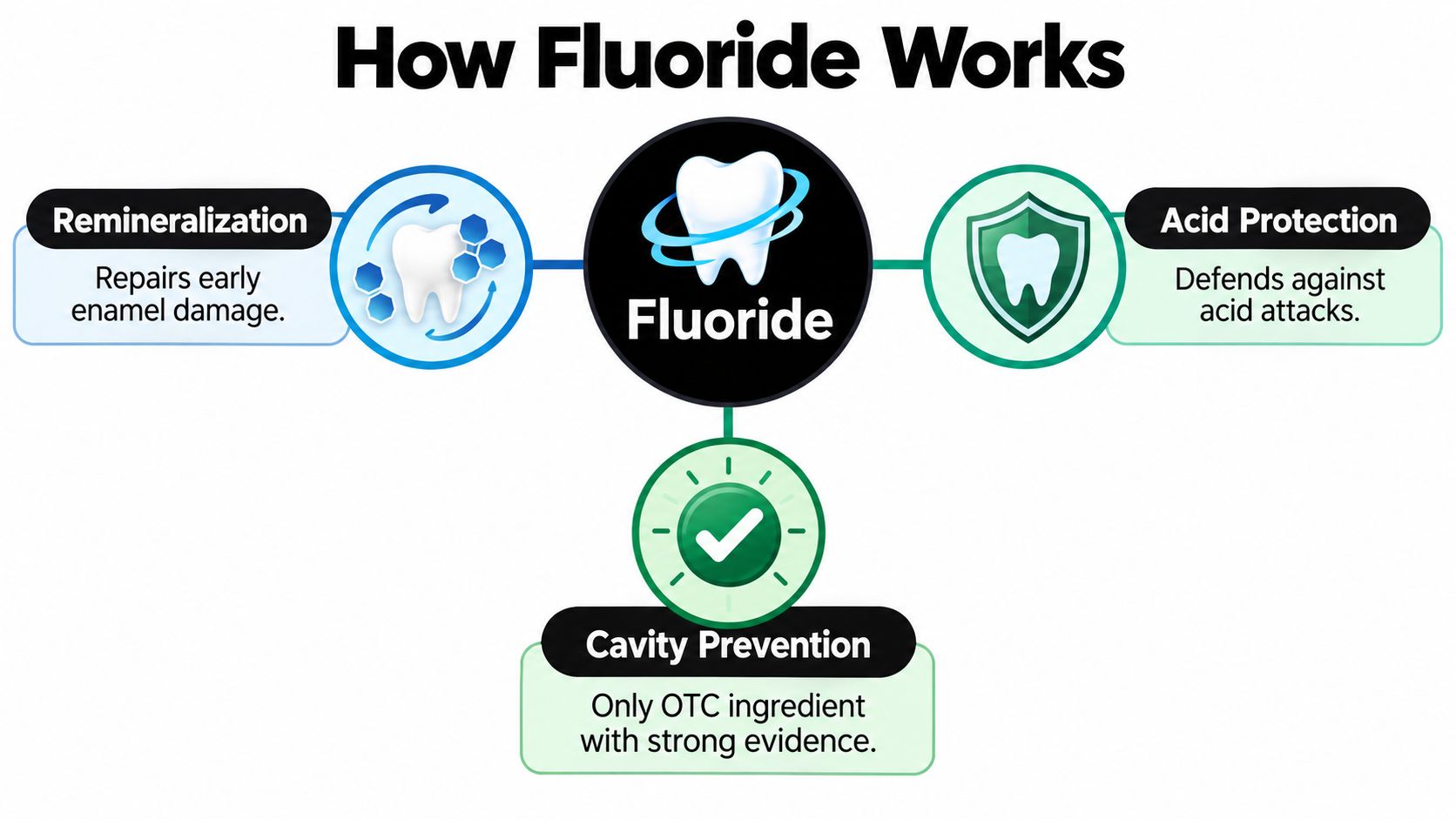
Fluoride works where tooth decay begins, at the interface between enamel, plaque, saliva, and dietary acids. Acid can pull minerals from enamel, a process called demineralization. Fluoride helps the tooth surface resist that process and supports remineralization, which restores minerals during the early stages of enamel damage.
That preventive role is separate from taste. Sweeteners make toothpaste more pleasant, while fluoride supplies the clinically important anticaries activity. Removing an artificial sweetener doesn't remove fluoride's ability to support enamel, as long as the product still contains an effective fluoride compound and you use it consistently.
A Cochrane review of randomized and quasi-randomized trials involving children aged 5 to 16 found fewer decayed, missing, and filled permanent tooth surfaces among children using fluoride toothpaste than among children using non-fluoride toothpaste over approximately three years. Across 70 studies contributing data from 42,300 children, the pooled prevented fraction was 24%, with a 95% confidence interval of 21% to 28% and P < 0.0001. These findings are reported in the Cochrane review of fluoride toothpastes for children and adolescents.
Why concentration and routine matter
The same review found that fluoride's benefit increased with higher fluoride concentration, more frequent brushing, and supervised brushing. The effect wasn't materially changed by exposure to fluoridated water. In practical terms, the fluoride system and brushing routine matter more for cavity prevention than whether the toothpaste tastes sweet.
For adults, the decision is usually straightforward. Look for an anticaries toothpaste with a recognized fluoride active ingredient, use it twice daily, and choose a formula you can tolerate comfortably. If you're unsure about swallowing, age-specific use, or a child's product, the Ultra Smile DentalSpa fluoride guide offers additional context.
You can also read DentalHealth.com's explanation of how fluoride toothpaste helps prevent tooth decay for a focused overview of its role in daily oral care.
Why Sweeteners Are Added to Toothpaste
Toothpaste sweeteners are usually there to improve the brushing experience. Fluoride compounds, abrasives, detergents, and certain flavor oils can taste bitter, sharp, or medicinal. A small amount of sweetener can make the formula more acceptable, especially for someone who is sensitive to strong flavors or for a child who resists brushing.
That function is easy to confuse with cavity protection. Sweeteners improve palatability, not fluoride's enamel effects. They don't replace remineralization, and they don't provide the same anticaries role as sodium fluoride, stannous fluoride, or sodium monofluorophosphate.
The main categories
Saccharin is an artificial, high-intensity sweetener commonly used to make toothpaste taste sweeter without adding decay-causing sugar. Some people prefer to avoid it as part of a broader ingredient preference.
Sucralose is another non-caloric artificial sweetener used for taste. A toothpaste containing it may still have an effective fluoride system, but someone who wants an artificial-sweetener-free formula will want to identify it in the inactive ingredient list.
Xylitol is a sugar alcohol used in some oral care products for sweetness and a different taste profile. It can appear in formulas that are marketed as more natural, but its presence doesn't change the need to check the fluoride active ingredient.
Stevia is a plant-derived sweetener used by manufacturers seeking a different label profile. “Plant-derived” describes its origin, not whether the toothpaste contains fluoride or whether the formula suits a particular mouth.
Unsweetened formulas may rely on mint, herbal flavors, or a mild neutral profile without adding a dedicated sweetener. They can be useful for people who prefer a shorter ingredient list, although taste remains important.
A useful distinction: avoiding a sweetener is a personal formulation choice. Avoiding an ingredient that causes burning, soreness, peeling, or another reaction is a tolerance issue and deserves a different conversation with a dental professional.
If a toothpaste irritates your mouth, don't assume the sweetener is responsible. Flavor oils, foaming agents, preservatives, and other inactive ingredients may also contribute. Change one factor at a time when possible, and pay attention to whether symptoms return with a particular product.
Comparing Sweetener Options
A label becomes easier to interpret when you assess each sweetener by its job rather than treating every unfamiliar name as a health threat. The table below compares common choices by origin, taste, and practical consideration.
Common Toothpaste Sweeteners Compared
| Sweetener | Origin | Taste Profile | Key Consideration |
|---|---|---|---|
| Saccharin | Artificial, non-caloric sweetener | Intense sweetness that can offset bitterness | Avoid it if your goal is to remove artificial sweeteners, but don't confuse its presence with the absence of fluoride protection |
| Sucralose | Artificial, non-caloric sweetener | Clean, pronounced sweetness | Check the inactive ingredient list if you're choosing an artificial-sweetener-free formula |
| Xylitol | Sugar alcohol used in oral care formulas | Mild sweetness with a cooling quality | It may suit shoppers who want an alternative sweetener, but it doesn't replace the fluoride active ingredient |
| Stevia | Plant-derived sweetener | Sweet, sometimes with a noticeable herbal or lingering note | “Natural” describes origin, so evaluate the complete formula rather than the sweetener alone |
| No added sweetener | No dedicated sweetening ingredient | Often more bitter, herbal, or flavor-forward | Taste and tolerance become especially important because an unpleasant product may be harder to use consistently |
Use a three-part label scan
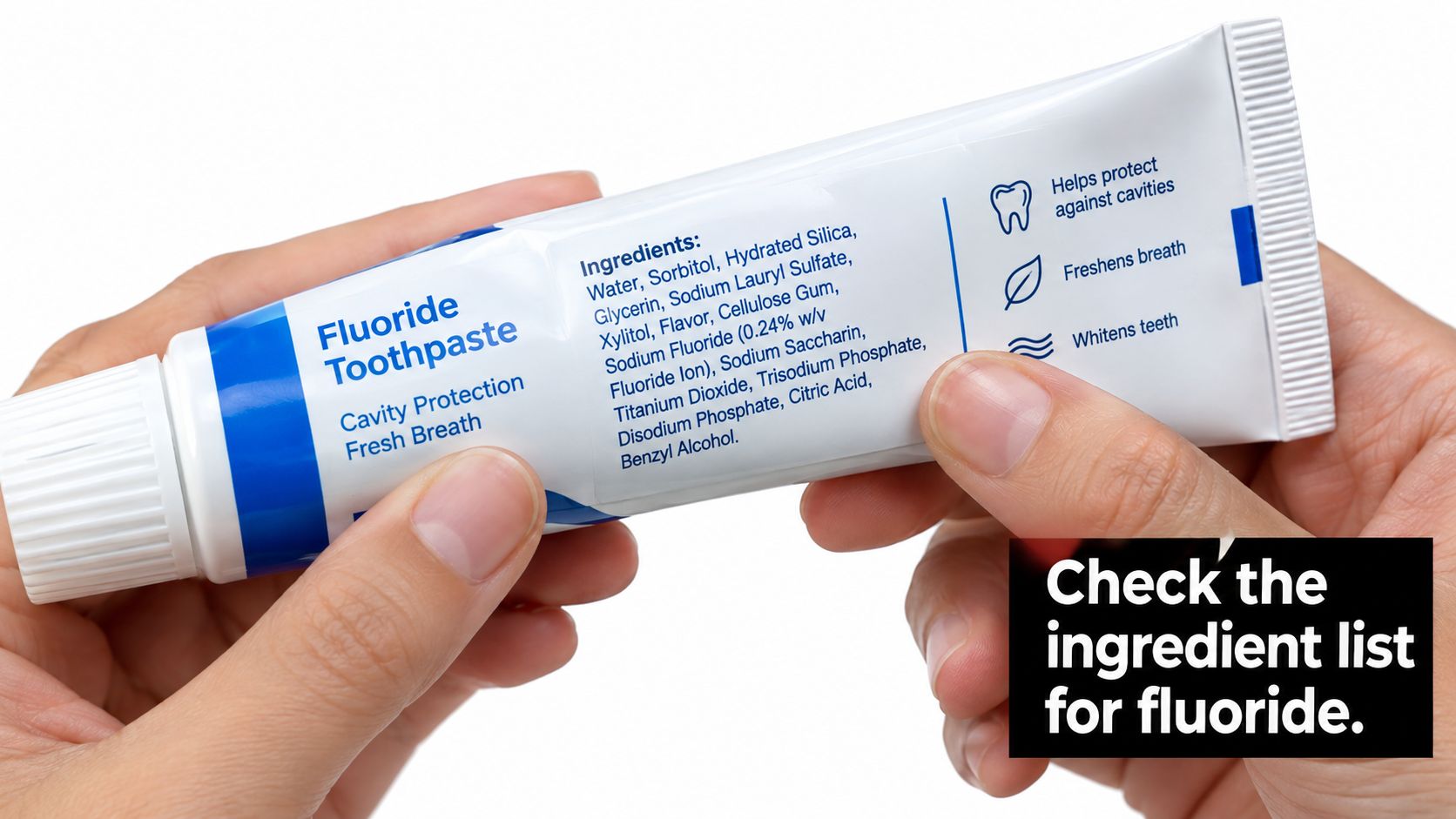
Start with the active ingredient panel. Look for sodium fluoride, stannous fluoride, or sodium monofluorophosphate. These are the fluoride systems recognized for anticaries use in the professional guidance summarized by the Association of State and Territorial Dental Directors fluoride toothpaste white paper.
Next, check the fluoride concentration. For most adults, the practical benchmark is 1,000 to 1,500 parts per million, used twice daily, as summarized in the same professional guidance. A product marketed as natural, clean, sugar-free, or sweetener-free still needs an appropriate fluoride system if cavity prevention is your priority.
Finally, scan inactive ingredients for the sweeteners you want to avoid or accept. If you're comparing xylitol-containing products specifically, DentalHealth.com's guide to toothpaste with xylitol and fluoride can help you understand how those two ingredients serve different purposes.
How to Read Your Toothpaste Label
A toothpaste label gives you two separate pieces of information. The active ingredient section tells you what the product is designed to do for your teeth. The inactive ingredient list tells you how the product tastes, feels, spreads, foams, and stays stable.
Begin with the active ingredient
Look first for a recognized fluoride compound:
- Sodium fluoride generally supplies readily available fluoride during brushing.
- Stannous fluoride provides fluoride and may offer additional therapeutic functions, although product stability, taste, and possible staining considerations matter.
- Sodium monofluorophosphate requires a compatible formulation so the fluoride remains chemically available during use.
The number printed on the package isn't the entire story. Compound identity, chemical stability, bioavailable fluoride, brushing frequency, and contact time all influence performance. A well-designed formula should keep the active ingredient available while also providing a texture and flavor you'll use reliably.
Then inspect the inactive ingredients
If you're avoiding artificial sweeteners, look for names such as saccharin or sucralose. You may instead see xylitol, stevia, or no dedicated sweetener. Also consider ingredients that affect comfort, including strong flavor oils, foaming agents, abrasives, and preservatives.
A short ingredient list can be appealing, but “short” doesn't automatically mean more protective or better tolerated. A longer formula may contain an effective fluoride system and a carefully balanced flavor that makes twice-daily brushing easier.
Match the formula to your mouth
Use this checklist when comparing products in a store or online:
- Confirm the purpose. Choose a product intended for anticaries use if cavity prevention is your objective.
- Identify the fluoride compound. Don't rely on front-label language alone.
- Review the concentration. Use the adult benchmark described earlier as a practical reference.
- Mark ingredients you wish to avoid. Separate personal preferences from ingredients that have caused you symptoms.
- Test comfort and consistency. A formula that burns or tastes unpleasant may undermine your routine.
DentalHealth.com's guide to toothpaste ingredients offers another useful way to approach ingredient lists without reducing every decision to a “good” or “bad” label.
Making Your Choice with Confidence
The best choice usually comes from balancing clinical function with daily usability. Start by confirming that your toothpaste contains a recognized fluoride system at an appropriate adult concentration. Then decide whether you want to avoid artificial sweeteners, choose an alternative such as xylitol or stevia, or use a formula with no added sweetener.
A product can meet your ingredient preferences and still fail as a practical choice if you dislike using it. Toothpaste has to fit into a routine you'll repeat every day. If an unsweetened formula tastes too bitter, a fluoride toothpaste using a preferred alternative sweetener may support better consistency. That isn't a compromise in dental care. It's a realistic way to choose a product you'll use.
Avoid these common mistakes
Mistaking “sugar-free” for “fluoride-free. Toothpaste should not rely on decay-causing sugar for flavor, but a sugar-free product may still contain artificial sweeteners. Read the inactive ingredient list rather than assuming the front of the package tells you everything.
Treating “natural” as a measure of cavity protection. A natural sweetener or botanical flavor can suit your preferences, but it doesn't establish anticaries efficacy. Check the fluoride system separately.
Choosing “sweetener-free” without considering taste. A harsh flavor may lead you to brush for less time, use less product, or skip brushing. The most elegant ingredient philosophy can't compensate for a routine that doesn't last.
Ignoring symptoms. Burning, soreness, peeling tissue, or recurring discomfort may point to an intolerance involving flavoring, foaming, preservative, or another ingredient. If symptoms continue after changing products, ask your dentist for an evaluation instead of repeatedly guessing.
For children, dose control and supervision deserve particular attention. Guidance summarized in the Federal Bureau of Prisons dental prevention guideline notes that a pea-sized amount of 1,000 ppm toothpaste contains approximately 0.25 mg of fluoride, while the same amount at 1,500 ppm contains approximately 0.38 mg. Supervised use helps balance cavity prevention with the risk of excessive ingestion during enamel development.
Your decision rule: verify the fluoride system first, choose the sweetener profile you're comfortable with second, and reject any formula you won't use consistently.
If you're switching products, take a photo of your current label and compare it with the new one. Confirm the active ingredient and concentration, then check whether the sweetener, flavor, and texture match your needs. If you have a history of mouth irritation, significant sensitivity, a high risk of cavities, or questions about a child's toothpaste, bring both labels to your dental appointment.
You don't need to choose between ingredient awareness and effective cavity prevention. A fluoride toothpaste without artificial sweeteners can provide a preference-based formulation while retaining fluoride's established role, provided the product is properly formulated and used consistently.
DentalHealth.com helps you compare professional-grade at-home dental care products and find practical guidance for sensitivity, remineralization, whitening, and everyday oral care. Visit DentalHealth.com to explore dentist-focused products and label-conscious solutions for your routine.