
Funk Off Teeth: Causes of Bad Breath and Real Fixes
Breath odor is not a modern problem with a modern solution. An Egyptian papyrus dated to roughly 1550 BCE records attempts to treat unpleasant breath with incense, cinnamon, myrrh and honey, and documented concern with how the mouth smells runs back at least 3,500 years, as Michigan Today's history of bad breath describes. The clinical word for it, halitosis, was coined in 1874 by physician Joseph William Howe.
Funk Off Teeth arrives at the end of that long line: a pocket-sized brush loaded with peppermint paste, aimed at the moment after lunch when your breath needs rescuing. It's a reasonable product for that moment. Trouble starts when a quick fix gets mistaken for a cure, because the smell almost always has a physical source in your mouth, sitting on a surface you can reach, clean and, in some cases, need a dentist to treat.
The distinction that matters is between masking and treating. One changes what your nose detects for a short while. The other changes what the bacteria have to feed on. Confuse the two and you'll buy a lot of peppermint while the underlying cause keeps growing.
What Causes Bad Breath and the Fix for Each Source
Persistent bad breath usually traces to one of four places in the mouth, and the split tells you where to spend your effort first. A literature review of identified oral causes put tongue coating behind roughly 51% of cases, gingivitis behind 17%, periodontitis behind 15%, and combinations of those factors behind another 17%.
| Source in the mouth | Share of identified oral causes | Fix that targets it |
|---|---|---|
| Tongue coating | about 51% | Daily tongue cleaning with a scraper or brush |
| Gingivitis | about 17% | Daily interdental cleaning and a professional cleaning |
| Periodontitis | about 15% | Periodontal evaluation and debridement when indicated |
| Combined gum and tongue factors | about 17% | Treat each source together |
| Dry mouth | Not counted in that review's four categories | Hydration and saliva support, reviewed by a dentist |
Every row is fixed by removal, not by flavor. Nothing on that list is solved by swallowing something pleasant.
Tongue coating dominates because that surface never gets cleaned by a toothbrush, sits toward the back where the mouth is driest, and renews itself faster than tooth surfaces do. Gingivitis and periodontitis together account for about a third of identified causes, and they behave differently from coating: the source is living tissue, not loose debris, so scraping never reaches it. When both are present, which is the fourth row, cleaning one and ignoring the other leaves half the supply in place.
Where the smell actually comes from
Anaerobic bacteria do the damage. They break down sulfur-containing amino acids and release volatile sulfur compounds (VSCs), mainly hydrogen sulfide, methyl mercaptan and dimethyl sulfide, as a review of breath measurement methods sets out. Expert consensus attributes roughly 80% to 90% of offensive breath odor to VSCs produced inside the mouth. These gases have very low odor thresholds, which is why a mouth can smell clearly bad when the visible plaque is barely worth mentioning.
Think of the back of the tongue as a sponge left in a warm bin. Its surface is porous and uneven, so it holds shed skin cells, saliva proteins and bacteria in a layer that oxygen barely reaches. That low-oxygen pocket is the bin; the coating is the sponge. Scraping the surface away is washing the bin. A mint is spraying air freshener over the lid.
Gums add a second supply line. Inflamed tissue leaks fluid and blood products, which are protein for the same bacteria, and deeper periodontal pockets hold that material where a brush never reaches. That's why a heavily coated tongue and puffy gums so often turn up in the same mouth.
Practical rule: anything you swallow changes how your breath smells for minutes. Anything you remove changes what the bacteria have to eat tomorrow.
Dry mouth earns its own row without belonging to that review's breakdown, because reduced saliva flow doesn't create a separate lesion so much as make every other row worse. It also has a mechanical cause worth knowing about. If you wake with a dry mouth because you sleep with it open, why mouth breathing worsens sleep apnea is worth reading, since the habit that dries your tongue overnight can affect your breathing too.
Why the prevalence numbers never agree
Halitosis is common enough to be a public health topic and inconsistent enough to keep the headlines confusing. The FDI World Dental Federation's halitosis report notes that a major review estimates roughly 30% of the general population experiences halitosis, while the worldwide range across studies runs from about 22% to 50%. The same report puts the share of people who experience it at some point at 50% to 65%.
The gaps come from different questions rather than sloppy work. A survey asking whether your breath is sometimes bad will report a higher rate than a clinic where a trained examiner scores the odor, and a sample of dental students isn't a household survey. Definitions differ too: some studies count any odor a trained nose can detect, others only odor strong enough to be socially noticeable, and self-reporting captures plenty of people who worry about breath nobody else can smell.
A prevalence range tells you this is common. It doesn't tell you which row of the table you're in. A mirror, a tongue scraper and one dental exam settle that better than any population figure.
Daily Routine for Fresher Breath
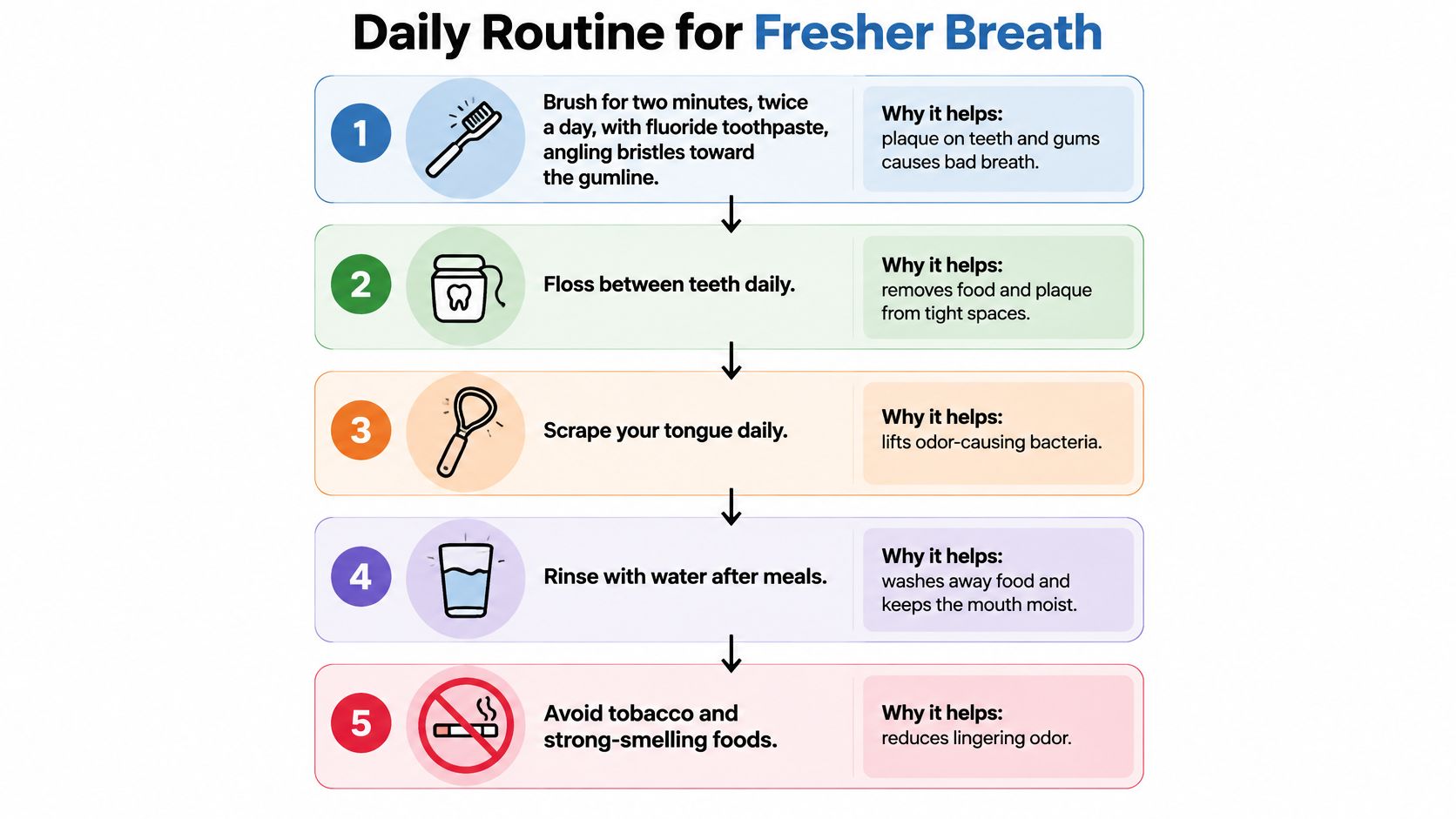
Five habits do nearly all of the work, and none of them needs a gadget. Start them tonight and you'll know within two weeks whether your breath problem is ordinary maintenance or something a dentist should look at.
This short walkthrough covers the same sequence if you'd rather watch than read.
The five steps and the reason behind each
- Brush for two minutes, twice a day, with fluoride toothpaste. Angle the bristles toward the gumline and sweep the margin where the gum meets the tooth, because that seam is where plaque sits undisturbed and where gas-producing bacteria find their protein. Two minutes is the part people skip, so set a timer or use a brush with a built-in one.
- Clean between the teeth once a day. Floss or interdental brushes reach the contact points and just under the gumline, the two places a brush head cannot enter. If floss shreds or snags, the contact is tight or a filling has a rough edge, and an interdental brush in the right size will do the job faster and with less fuss.
- Scrape or brush the back of the tongue, from back to front, in one or two gentle passes. Rinse the scraper after each pass instead of dragging the same loaded blade forward again. Press hard enough to lift the coat, not hard enough to make the surface bleed. A guide to tongue scrapers covers the shapes available and how to hold them without gagging.
- Rinse with plain water after meals you can't brush after, and drink water across the day. Water doesn't kill bacteria, but it dilutes the food residue they feed on and keeps saliva moving.
- Replace the brush or brush head about every three months, or sooner if the bristles splay. Worn bristles bend away from the gumline instead of sweeping it.
The routine in one view, in the order that works:
What progress looks like
Three signs tell you the routine is working. A thinner coat on the tongue, no pink in the sink when you floss, and breath that still feels clean at four in the afternoon rather than only for the minutes after a rinse. Those are what separate a working routine from a good intention.
If you want something for your bag between those sessions, a fresh breath therapy spray from Pumpernickel Health Foods belongs in the same category as a mint: useful before a meeting, no substitute for step three.
Does Funk Off Teeth Work and How to Keep It Hygienic
Funk Off Teeth will make your breath smell fresher. It will not treat the reason your breath needed freshening, and that gap is the whole story.
A compact brush with a peppermint paste does two useful things. It puts an abrasive and a surfactant across the tooth surface at a moment when you otherwise wouldn't brush at all, and it leaves a strong flavor behind. Flavor changes perception in seconds. What it doesn't do is remove the coating on the back of the tongue that clinical summaries of tongue cleaning link to both halitosis and periodontal disease, and the evidence for managing chronic halitosis with cleaning alone remains limited.
Read the Funk Off Teeth product page and the ingredient listing shows abrasives, humectants, peppermint oil, flavoring and preservatives, with no fluoride. That makes it a freshening supplement. It does not replace a fluoride paste, and the comparative evidence doesn't establish that an integrated pocket device outperforms an ordinary brush, fluoride toothpaste, floss and a separate scraper used properly. Convenience is the one place where it clearly wins, and convenience is worth something when it means you brush after lunch instead of not at all.
When a freshener is enough and when it isn't
- Fresh at the end of a meal, stale by the next one: that's ordinary bacterial load. Keep the routine, add tongue scraping, and stop worrying.
- Stale again within an hour of brushing: the reservoir is still there. Check the tongue and the gums before you blame the device.
- Bleeding when you floss, a loose tooth, pain on biting, or a tongue that recoats within hours despite scraping: book a dental exam. Freshening hides odor; it doesn't touch inflammation.
- Using the pocket brush instead of your fluoride paste: put the paste back in the routine and keep the device for the between-times.
Storing a pocket brush so it stays safe
Rinse the brush head under clean running water after every use, shake off the excess and stand it upright in open air to dry. Sealing a damp head in a pocket or bag invites the same bacteria you just cleaned off. Check the cap and the reservoir seal before you carry it, wipe the head so paste doesn't harden inside the mechanism, never share a head, and replace the unit once the cap no longer closes tightly or the bristles fray.
Hygiene, in one line: a brush that stays damp and sealed in a bag is a culture plate with a lid on it.
Habits and Non-Oral Triggers That Keep Breath Bad
Clearing the mouth comes first, because that's where the evidence points. A handful of habits and conditions keep odor going even when your cleaning is thorough, and each has its own next step.
Triggers that outlast brushing
Dry mouth. Saliva is the mouth's rinse cycle, and when flow drops, debris settles instead of being swept away. Drink water through the day, and if your mouth feels dry most of the time, ask a dentist to review the medications that reduce saliva rather than guessing. What causes dry mouth sorts the common culprits.
Tobacco. Cigarettes and smokeless tobacco leave residue on the tongue and dry the tissue, so the odor outlives the brushing that follows.
Garlic, onion and coffee. These leave odor that survives a rinse, because the compounds behind them pass into the blood and back out through the lungs while residue sits on soft tissue. Scrape and rinse after eating them and expect a few hours, not a few minutes.
Mouth breathing overnight. Sleeping with the mouth open dries the tongue and thickens the coat, which is why morning breath is often the worst. Water by the bed and a scrape before you talk to anyone handles the ordinary version.
Non-oral sources. Sinus infection, post-nasal drip, cryptic tonsils and reflux can all produce odor that oral care doesn't touch. These are the least quantified causes and the ones most often guessed at. If weeks of thorough cleaning haven't changed anything, the next appointment is with a doctor, not another mouthwash.
Order of operations: clear the mouth first, then look elsewhere. The exception is worth ruling in, not leading with.
Bring your two-week record to whichever appointment you book. "Worse in the morning, better after scraping, bleeding on the lower left when I floss" gives a clinician something to work with. "My breath is bad" doesn't.
When Bad Breath Points to a Dental Problem
One pattern in this territory isn't a breath problem at all. Swelling in the face or jaw, fever, and trouble swallowing or opening your mouth point to an infection that needs urgent dental or medical care, and the odor is a side effect of it. Handle that first.
The chart below sorts the signs that matter, from the urgent to the routine.
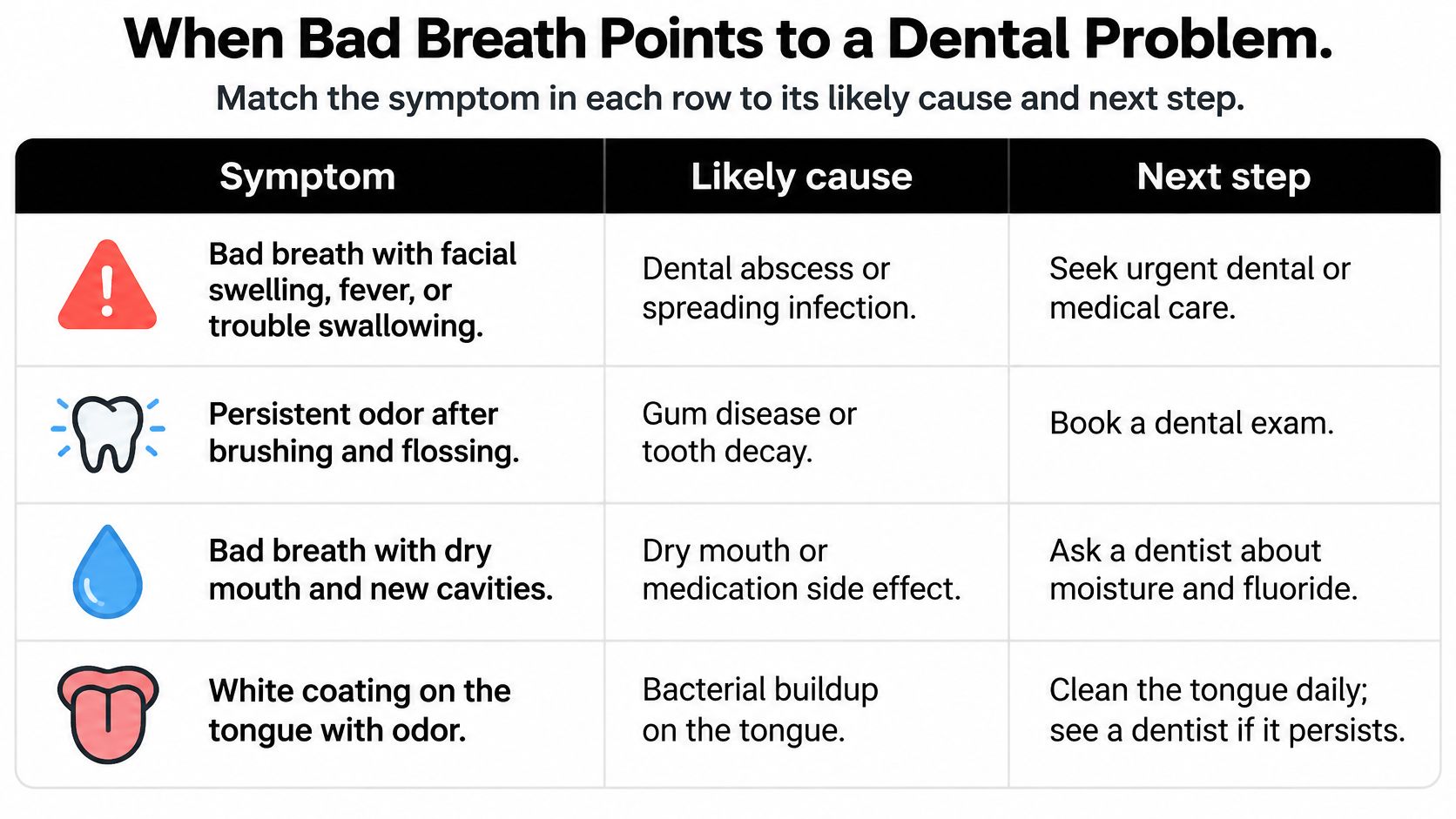
For everything short of an emergency, match your own pattern to a row and take the step in the third column. Time matters here: a coated tongue with healthy gums gets two weeks of daily cleaning before you judge it, while bleeding and mobility get an appointment rather than another fortnight of scraping.
| Symptom | Likely cause | Next step |
|---|---|---|
| Odor persists after several weeks of consistent cleaning | Gingivitis, periodontitis, caries, defective restorations, dry mouth or retained debris | Book a dental examination |
| Bleeding gums, loose teeth or deep gum pockets | Periodontal disease | Timely periodontal evaluation rather than more rinsing |
| Coated tongue with healthy gums | Tongue coating | Daily tongue cleaning for two weeks, then reassess |
| Dry mouth or sticky feeling on waking | Reduced saliva flow | Hydration and a dentist review of medications and saliva support |
| Odor remains after every oral step | Possible non-oral source | Ask a doctor or dentist to assess further |
What a dental exam adds
An exam looks for what a bathroom mirror can't show: pocket depth around each tooth, bleeding on gentle probing, decay under an old filling, a crown margin that traps plaque, saliva flow, and how much debris sits behind the lower front teeth. A trained examiner can also score the odor itself, and where a clinic is equipped, measure sulfide levels. That separates genuine malodor from worry about it, which are two very different problems with two very different treatments.
Masking an odor while inflammation continues is the one approach that reliably fails, because inflamed tissue keeps feeding the same bacteria. Bleeding that appears only when you floss is often the earliest sign, and what you can do about bleeding gums at home covers the parts you control while you wait for an appointment.
If the exam turns up dry mouth or a high cavity risk, a dentist may prescribe a high-fluoride paste, and safe dosing for prescription fluoride toothpaste from Courier Pharmacy explains how much to use and how often.
Decide Whether to Keep Using Funk Off Teeth After Two Weeks
Pick a date and write it on the log as day one. Mark day fourteen as a decision point rather than a vague intention.
Before you start: ask one person who will give you a straight answer to smell your breath on day one and again on day fourteen. Your nose adapts to your own mouth within minutes, so self-assessment is the least reliable measure you have.
If the log shows progress, meaning a lighter coat, no bleeding and odor that fades later in the day than it did on day one, keep the routine and keep the freshener as a supplement for after meals. Replace the brush head on the three-month schedule. Progress here means the cause is being managed, not that a product cured anything.
If day fourteen looks like day one, with odor as strong as ever, gums that bleed or a tongue that recoats within hours, stop buying fresheners to solve it and book a dental examination. Take the log and the symptom table with you.
The decision rests on cause, not on how fresh your mouth feels ten minutes after a peppermint strip. Confirm the next step with a dentist before you buy more product, and keep the fluoride paste in the routine either way.
Bad breath that keeps coming back usually means your routine is missing a piece, not that you need a stronger mint. DentalHealth.com stocks the professional-grade parts that fill those gaps, from tongue scrapers and BreathRX breath-freshening products to fluoride toothpastes and remineralizing pastes, with free shipping on all USA orders and phone support at +1-888-508-3375 if you're unsure what's missing. Visit DentalHealth.com to browse the catalog, pair one product with the two-week log, and hand the record to your dentist at your next visit.