
Opalescence Boost Bleaching: Speed Versus Comfort
Opalescence Boost is a dentist-only 40% hydrogen peroxide gel that whitens teeth in one supervised visit. Stronger peroxide hasn't been shown to guarantee a better long-term shade than a well-run at-home plan.
That challenges the most popular advice you'll hear about whitening, which is to chase the highest percentage you can get. With Opalescence Boost bleaching, what you're really buying is speed under supervision, not a proven longer-lasting result. The decision that matters more is whether the schedule and sensitivity plan fit your teeth.
Think of it as a trade you're making with your eyes open. You'll get a visible change without wearing trays for two weeks. In return, you're more likely to feel short, sharp zings during or after treatment.
Opalescence Boost Bleaching at a Glance
The contrarian verdict comes first. Opalescence Boost isn't proven to leave you whiter in the long run than a lower-strength tray plan. It's proven to work fast in the chair, and that distinction should drive your booking decision.
This is Ultradent's dentist-applied, in-office gel, not a take-home syringe you buy and squeeze into a tray yourself. Its active agent is 40% hydrogen peroxide at a neutral pH, and the PF formula adds potassium nitrate and fluoride for comfort and enamel support.
What the Head-to-Head Trial Actually Tested
A useful comparison for patients is the 2023 randomized controlled clinical trial on PubMed, which evaluated 48 participants divided into four groups of 12, including at-home treatment with 10% carbamide peroxide for 14 days and two in-office sessions using 40% hydrogen peroxide Opalescence Boost with a one-week interval. The other two groups combined at-home and in-office treatment in different sequences.
Every regimen produced a statistically significant improvement in whiteness, with all groups showing significant increases in whiteness-index values (p<0.05). Importantly, there were no statistically significant differences in whitening efficacy among the regimens at the measured time points, and changing the sequence didn't materially change the final result.
Comfort is where the groups separated. The at-home-only group had significantly lower tooth-sensitivity scores than the in-office Opalescence Boost group (p=0.006) and than the group receiving at-home treatment followed by in-office bleaching (p=0.001).
Boost Visit Versus a 14-Day Tray Plan
| What to compare | Opalescence Boost | At-home 10% carbamide peroxide |
|---|---|---|
| Active peroxide | 40% hydrogen peroxide | 10% carbamide peroxide |
| Where it is used | Dental office only | Custom trays at home |
| Schedule in the 2023 trial | Two sessions, one week apart | 14 days |
| Whitening result | Significant gain; not statistically better than the other regimens | Significant gain; similar to Boost at measured times |
| Tooth sensitivity | Higher than tray-only (p=0.006) | Lowest of the groups tested |
Read the first two rows together and you see the core trade. You're swapping a strong, fast-acting gel used once or twice in the office for a weaker gel used repeatedly at home.
Read the last two rows together and the trade sharpens. Both approaches whitened, but only one was gentlest, and it wasn't the 40% gel.
Pick Boost when a supervised same-day change matters, not because 40% has been proven to win the long game.
That's a fair reason to choose it. A work presentation next week, photos you can't reschedule, or a simple dislike of trays are all practical grounds for a chairside visit. Just don't book it expecting the higher number on the syringe to lock in a whiter shade months later. The evidence points to speed, not superiority over time.
How the 40 Percent Gel Changes Color
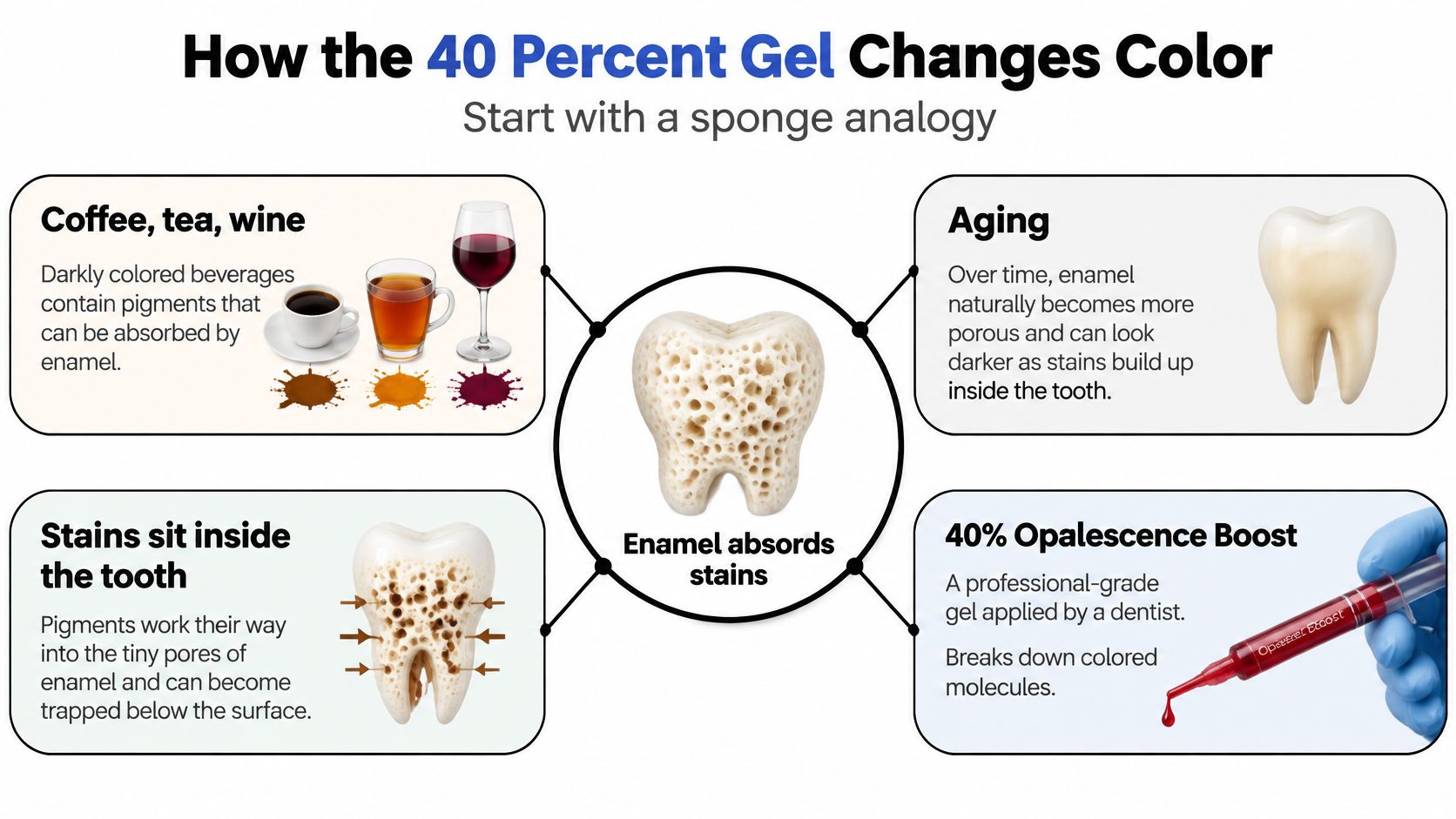
Start with a sponge. Your enamel isn't a solid sheet of glass. It's a porous mineral, a bit like a very hard sponge, and over years it has absorbed colored molecules from coffee, tea, red wine, and ordinary aging.
Because those molecules sit inside the tooth, brushing harder doesn't lift them. A polish at your cleaning can remove surface film, but the deeper color stays. That's why whitening gel has to travel inward rather than scrub outward.
The diagram below maps that sponge idea to what the gel does next.
What Each Ingredient Does
Hydrogen peroxide is the bleaching engine. According to the randomized clinical trial of Opalescence Boost PF on PubMed, it's a professionally applied, neutral-pH in-office gel containing 40% hydrogen peroxide, and its high concentration accelerates diffusion of reactive oxygen species through enamel and dentin, oxidizing chromogenic organic molecules responsible for intrinsic discoloration.
In plain terms, peroxide breaks down into reactive oxygen pieces. Those pieces slip through enamel into the dentin underneath and break up the colored molecules, so the tooth reflects light as a lighter shade.
The neutral pH has a separate job. It limits acid attack on enamel while the peroxide works, so you're bleaching rather than etching.
Potassium nitrate and fluoride, the PF part of the formula, aren't the whitening agents. Potassium nitrate is a comfort additive aimed at calming nerve response, and fluoride supports enamel. Don't credit them for the shade change, and don't expect them to cancel sensitivity entirely.
What Bleaching Can't Change
This is intrinsic stain work, meaning color inside natural tooth structure. It won't change a crown, veneer, or white filling, because those materials don't contain the same porous structure for peroxide to travel through.
Say you have a front filling matched to your current shade. After bleaching, your natural tooth lightens and the filling stays put, so it can suddenly look darker by contrast. Your dentist should flag that before you start, not after.
Why Handling Matters as Much as Strength
In the same trial of 40 participants, gel used one week after mixing matched freshly mixed gel on ΔEab, ΔE00, and whiteness-index change (p>0.72), with no significant difference in tooth-sensitivity or gingival-irritation risk or intensity. Under the tested conditions, delayed use didn't cost whitening performance.
Don't read that as permission for sloppy storage. Peroxide activity depends on formulation and time, so mixing, storage, and careful gum isolation by the dental team still matter. A well-handled gel and a well-sealed barrier protect your result and your gums.
One last caveat belongs here. Concentrations around 25 to 35% hydrogen peroxide can produce comparable whitening with less sensitivity, so choosing 40% is a risk and benefit decision. It isn't a simple ranking where the biggest number automatically wins.
What One Chairside Session Involves
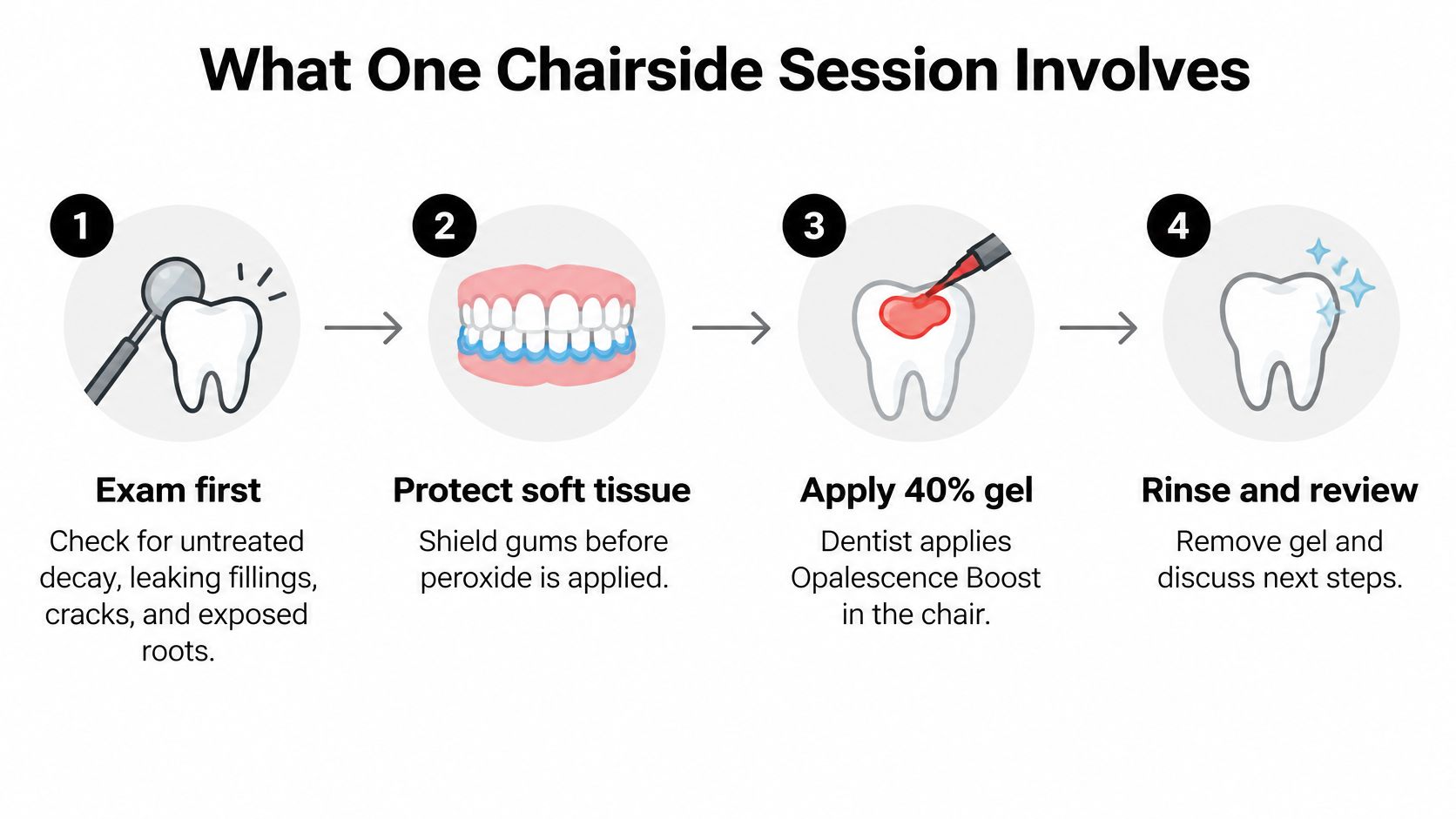
You'll experience the visit in a fixed order, and each step has a patient-facing reason. Knowing the sequence removes most of the mystery, and it helps you spot whether a practice is rushing the parts that keep you comfortable.
The flow below shows the visit from exam to final rinse.
The Six Steps in Order
- Exam first: Your dentist checks for untreated decay, leaking fillings, cracks, and exposed roots. Peroxide shouldn't be pushed into those defects, because an open pathway to the nerve turns a cosmetic visit into a painful one.
- Starting shade recorded: The team records your shade, often with a shade guide and a photo. That baseline makes later change real rather than a trick of operatory lighting.
- Soft tissue protected: Cheeks and lips are retracted, a barrier is painted or placed on your gums, and petroleum jelly may protect your lips. This step matters because 40% gel belongs on teeth only.
- Gel mixed and applied: The two components are mixed to activate the gel, then a thin layer is placed on the teeth. Mixing at the chair is what starts the chemical activity you'll rely on.
- Timed contact cycles: The gel stays on for a short timed cycle, commonly about 20 minutes, then it's suctioned off. Many protocols repeat the cycle two or three times in the same visit, for roughly 40 to 60 minutes of total contact.
- Barrier off and shade rechecked: The team removes the barrier, rinses your mouth, and checks the shade again. You leave with a same-day comparison against your starting photo.
You don't need a special light for this system. Boost is chemically activated when its components are mixed, so no lamp or laser has to sit in front of your face to make it work.
What to Expect After You Stand Up
A second visit a week later is one studied schedule, not a requirement for every mouth. Some patients stop at one session because they're happy, or because sensitivity tells them to pause.
Same-day rule: If your teeth zing, skip very hot or cold drinks that day and let the sensation settle before you judge the shade.
Don't book a second round just because the first afternoon looks a little uneven. Teeth often look patchy or extra bright right after treatment, partly because they've dried out during the visit with your mouth held open. Give the color a few days to settle as saliva rehydrates the enamel.
Bring lip balm and expect your jaw to feel tired from the retractor. Neither means anything went wrong. What should prompt a call is sharp pain that stays in one tooth, a gum area that looks blistered, or sensitivity that keeps getting worse instead of easing.
Shade Change From One Week to One Year
Put the seven-day versus one-month result first, because it corrects the biggest misunderstanding about chairside photos. The dramatic shade you see under the operatory light is real, but it isn't automatically your final shade.
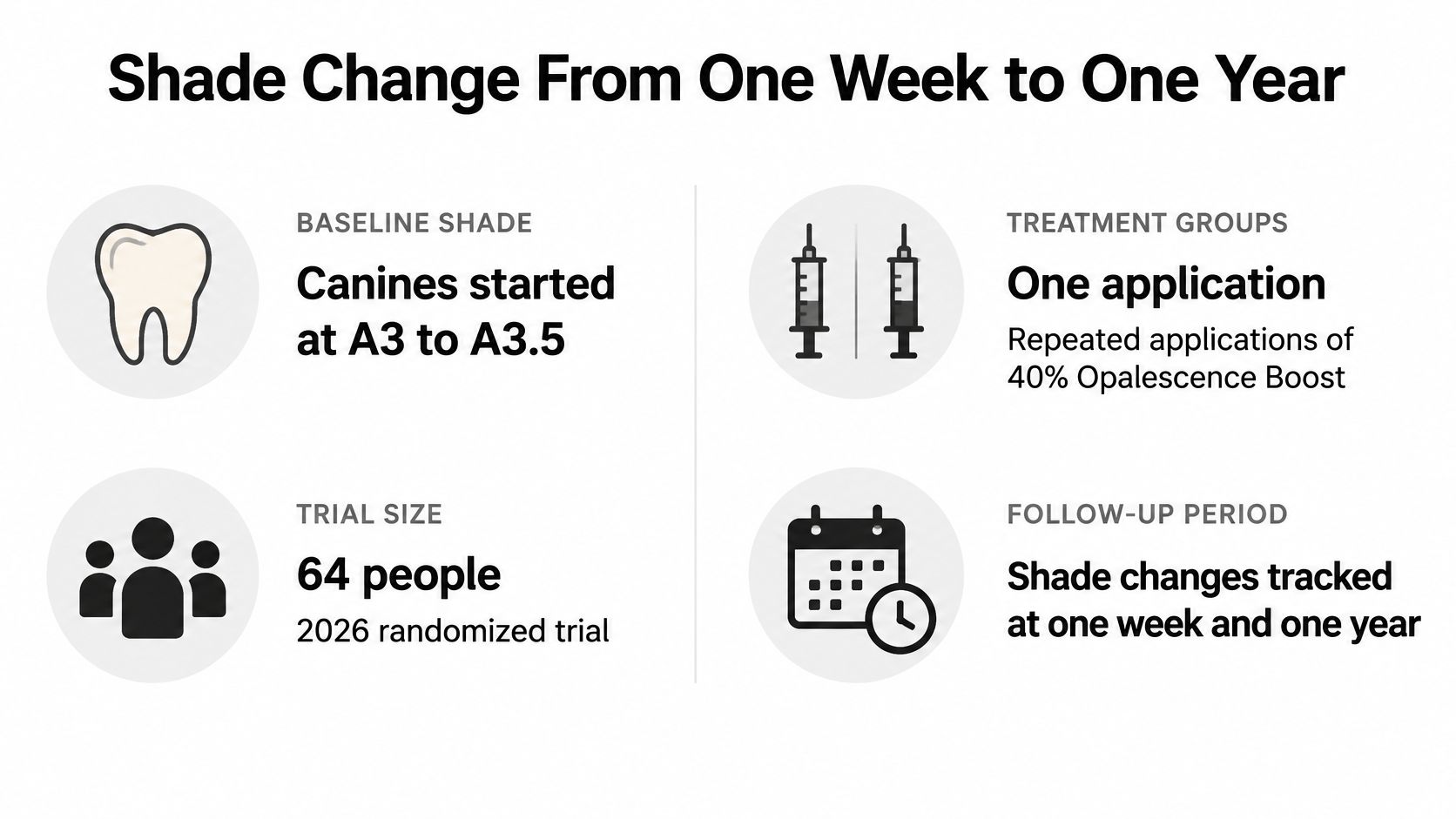
The 2026 randomized trial reported on PubMed compared one-session and multiple-application protocols using 40% hydrogen-peroxide Opalescence Boost in 64 participants with initial canine shades of A3 to A3.5. That's a mid-range starting shade, not an already white smile, so there was room to measure change.
A single-application protocol generated significantly greater seven-day color-change measurements than repeated applications, but that difference disappeared after one month, when color outcomes were no longer significantly different. Stacking more gel early didn't prove a lighter shade a month later.
The summary below lays out the trial size, starting shade, and follow-up points.
2026 Trial Single Versus Repeated Boost Applications
| Outcome | Finding |
|---|---|
| 7-day color change | Single application significantly greater than repeated applications |
| 1-month color change | Difference gone; no significant difference |
| Shade-guide scores | No significant difference at any assessment point |
| Tooth sensitivity responses | 93.3% with 40% Boost vs 100% with 37.5% hydrogen peroxide; intensity not significantly different |
Notice the shade-guide row. Standard shade-guide outcomes never differed significantly at any assessment point, even when instrument measurements showed a short-term gap at seven days. Your eye and a shade tab may not register a difference that a color instrument can detect.
Sensitivity was common in both arms. Responses were recorded in 93.3% of participants receiving Opalescence Boost, compared with 100% in the comparator 37.5% hydrogen-peroxide group, yet sensitivity intensity didn't differ significantly between products (p>0.05).
Who Still Values the Fast Change
Say your wedding is in ten days. A one-visit result you can see before the photos is worth more to you than a theoretical edge a year out, and that's a reasonable priority.
Say instead you know you won't wear trays. Two weeks of nightly homework sounds simple in the office and then doesn't happen at home. A supervised visit removes that adherence problem entirely.
Now take the counter-example. If you're happy whitening gradually overnight for a few weeks, moving up to 40% gives you no documented one-year advantage for your patience. You'd be accepting more short-term zing for speed you don't need.
The American Dental Association identifies sensitivity and oral irritation as the most common adverse effects of whitening, generally mild and transient, with higher concentrations associated with greater risk. Our guide to what professional whitening results realistically look like walks through that settling period in more detail.
Don't let a same-day photo set your expectations for next year. Let it tell you the gel worked quickly, then judge the lasting shade after a few weeks of normal eating, drinking, and brushing.
A Sensitivity Plan for Your Schedule
Start with the number you'll feel. Sensitivity responses showed up in 93.3% of Boost users in the protocol trial, even though intensity wasn't statistically different from a 37.5% gel. Planning for some zing isn't pessimism. It's honest preparation.
That zing happens when peroxide travels through tiny open tubules in the tooth toward the nerve. It usually peaks during the visit or just after, then fades over a few days. Cold air, cold water, and sweet foods tend to trigger it most.
Why Generic Toothpaste Advice Falls Short
You'll often hear a simple tip. Use any sensitivity toothpaste before and after, and you'll be fine.
The evidence is narrower than that. The 2024 systematic review in Clinical Oral Investigations found desensitizing toothpastes reduced sensitivity after single-session in-office bleaching with 35% hydrogen peroxide, but didn't show the same benefit across all protocols, including multiple sessions with 35% or 38% hydrogen peroxide.
So the right question isn't which paste fixes sensitivity. It's what plan fits your specific schedule, your history, and the condition of your teeth.
Match the Plan to Your Case
- No prior sensitivity and one session planned: A potassium nitrate or fluoride toothpaste before and after treatment may be worth trying. It lines up with the single-session setting where benefit was found.
- Teeth that already react to cold: Tell your dentist before gel goes on, not after the first zing. You may be better served by a lower concentration, strict gum isolation, and skipping extra applications in the same visit.
- Exposed roots, cracks, or untreated decay: Don't bleach over these and hope. Root surfaces and defects give peroxide an easier path inward, so get them assessed and treated first.
- Multiple sessions on the calendar: Don't assume a desensitizing paste will carry you through repeated high-strength visits. Space sessions out, reassess comfort between them, and stop if each round feels worse than the last.
- Pain that stays in one tooth: Stop and get that tooth examined before any more bleach. Localized, lingering pain points to a problem with that tooth, not ordinary temporary sensitivity.
Our article on managing tooth sensitivity after whitening covers day-by-day relief steps you can use at home. Use it as a comfort plan, not as a guarantee that 40% gel will feel like nothing.
A milder peroxide plan can look almost the same with a kinder week.
That idea has support, with a limit attached. Another systematic review reported that 37% carbamide peroxide may achieve whitening comparable to 35% hydrogen peroxide while causing less sensitivity, although the evidence was limited. Carbamide peroxide releases its peroxide more slowly, which is one reason tray treatment often feels gentler.
So weigh the milder option seriously if comfort outranks speed for you. Choosing a lower-strength plan isn't settling for a lesser result by default. It's choosing a different route to a similar visible shade, with less short-term payback.
What you shouldn't do is push through escalating pain to finish a prepaid package. Sensitivity products may help in some regimens, but they aren't a guarantee, and no shade gain is worth masking a cracked or decayed tooth. Tell your dentist exactly where it hurts, when it started, and what triggers it.
Boost Visit or Take-Home Tray Plan
These are two different families of treatment, and confusing them causes most bad purchases. Boost stays in the office because 40% hydrogen peroxide isn't a do-it-yourself gel. Your dentist owns the decision to use it, applies it, and removes it.
Take-home professional gels work differently. They use carbamide peroxide, which breaks down and releases hydrogen peroxide slowly. That's why a lower percentage can sit safely in a custom tray for 30 minutes to overnight, whitening a little more each session.
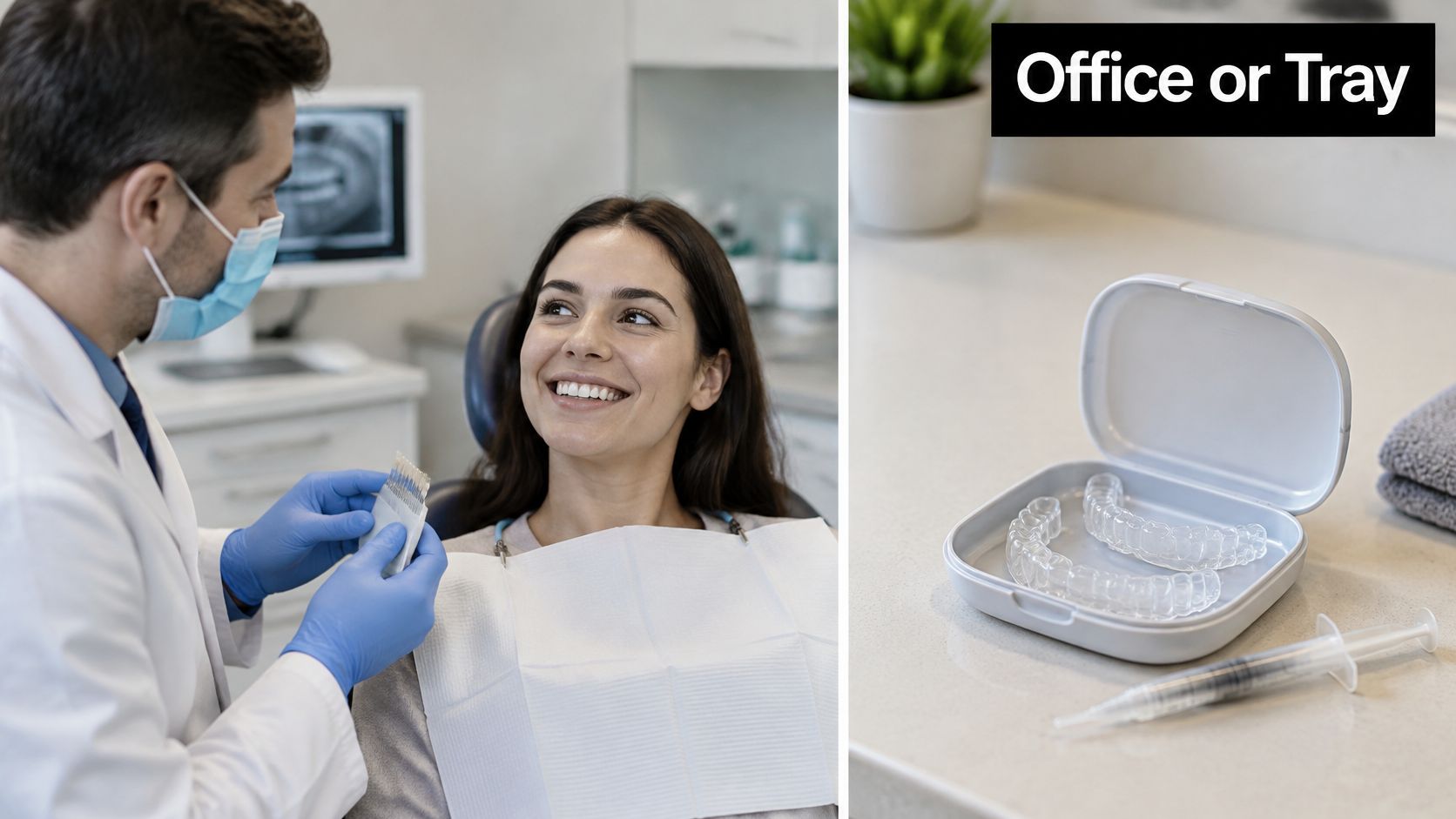
The photo below shows the practical fork in the road, a chairside shade discussion versus a tray kit you'll run yourself.
At-Home Gel Strengths Next to a Boost Visit
| Option | Peroxide | Typical wear | Best fit |
|---|---|---|---|
| Opalescence Boost | 40% hydrogen peroxide | One supervised office visit | Fast change with the dentist present |
| PolaNight 10 | 10% carbamide peroxide | About 2 hours, or overnight | Lowest tray strength when sensitivity is the worry |
| PolaNight 16 | 16% carbamide peroxide | About 90 minutes, or overnight | Middle speed with fluoride and a desensitizer in the gel |
| PolaNight 22 | 22% carbamide peroxide | One session, about 45 minutes | Shortest high-strength PolaNight wear |
| PolaDay 9.5 | Daytime carbamide peroxide gel | 30 minutes, or two 15-minute sessions | People who will not wear trays at night |
Walk the tray rows from gentle to brisk. PolaNight 10 is the softest start, and it can show a difference in as little as two hours, or you can wear the trays overnight for enhanced whitening. If a two-hour wear feels fine, overnight wear becomes a sensible next step.
PolaNight 16 sits in the middle, with fluoride and a desensitizer built into the gel. PolaNight 22 trades wear time for strength, at roughly 45 minutes a session. PolaDay 9.5 exists for people who won't sleep in trays and would rather whiten for half an hour in the morning.
Our step-by-step Opalescence tray instructions show how much gel to place and how to seat a tray without pushing gel onto your gums. That placement detail matters, because overfilled trays are a common, avoidable source of gum soreness.
The short video below demonstrates tray handling so you can see the amount of gel involved before you commit to a home plan.
Three Verdicts to Take With You
Choose a Boost appointment if a dentist has cleared your teeth and you need a visible change in one supervised visit. Accept that zinging is common and usually brief, and schedule it with a buffer day before your event rather than the morning of it.
Choose a tray plan if you can whiten over one to two weeks and you want the gentler experience. Start with PolaNight 10, test a short wear first, and step up in strength only if that wear was comfortable. When you shop with us, our lines span Teeth Whitening options including Opalescence, Zoom, PolaNight, and PolaDay, plus Tooth Sensitivity products like Fluoridex and MI Paste.
Pause all bleaching if one tooth hurts on its own, a filling feels loose, or your gums are inflamed. Get the cause treated first. Bleaching over a problem doesn't just hurt more, it can hide a diagnosis your dentist needs to make clearly.
Finally, know what no gel fixes. Gray tetracycline bands respond poorly and unevenly, white spots can look brighter against newly lightened enamel at first, and existing crowns, veneers, and fillings won't change color to match. If any of those sit in your smile zone, plan the cosmetic sequence with your dentist before you spend money on peroxide.
If a slower, gentler tray plan sounds like the better fit, browse our professional-grade at-home whitening gels, including PolaNight, PolaDay, and Opalescence options alongside sensitivity support from Fluoridex and MI Paste, at DentalHealth.com. You'll find the strengths compared above with clear wear times for each, so you can start low, test your comfort, and step up only if your teeth agree.