
Pro White Teeth Whitening Gel: A Complete Buyer's Guide
You're standing in the oral-care aisle with your phone open, comparing Pro White teeth whitening gel with Opalescence trays, a Zoom kit, and Pola formulas. One promises professional-style peroxide at a lower price. Another offers dentist-supervised branding, a different wear schedule, or a built-in sensitivity system. The difficult part isn't finding a whitening gel. It's choosing a strength you'll tolerate and use correctly.
Use four questions to make the decision: How much shade change do you want? How long can you wear a tray? Have your teeth reacted badly to whitening before? Can you afford refills without abandoning the routine? Pro White stays on shoppers' shortlists because it's available in several strengths, sometimes paired with an LED device, and sold as a flexible at-home option. Those features matter only after you match the gel to your enamel, stain type, and schedule.
Why Pro White Gel Is on Every Whitening Shopper's Shortlist
Pro White appeals to shoppers who want more control than strips provide without paying for every treatment in a dental office. The product category typically centers on carbamide peroxide, the same broad bleaching ingredient used in many professional take-home systems. That makes the comparison with Opalescence, Zoom, and Pola more useful than a generic comparison with supermarket whitening products.
The key distinction is not brand reputation. It's the relationship between peroxide concentration, contact time, tray fit, and sensitivity. Clinical comparisons found that 25% carbamide peroxide and 8.7% hydrogen peroxide produced significant shade improvement after two to three weeks, but neither delivered a superior final result when treatment ended, as reported in the clinical comparison indexed by PubMed. A separate trial found 10% and 16% carbamide peroxide were equally effective and safe over a three-week home protocol, while the higher-strength group caused more discomfort, according to the Operative Dentistry study.
That evidence changes the shopping question. Don't ask, “Which tube has the strongest number?” Ask which formula gives you enough exposure to whiten while keeping your gums and teeth comfortable.
Use this four-question filter
- Shade goal: Mild coffee staining doesn't automatically justify a high-strength gel. Deep or persistent discoloration may need a dentist's assessment before more peroxide.
- Wear tolerance: A short daytime session suits people who won't sleep in trays. Lower-strength products fit shoppers who prefer gradual, extended contact.
- Sensitivity history: Previous “zingers,” exposed roots, cracked teeth, or tender gums are reasons to start conservatively or skip self-treatment.
- Refill budget: Whitening is a maintenance habit, not a permanent repaint. A formula you can replace consistently may serve you better than a premium kit you use once.
Practical rule: Buy the strength that fits your routine, not the strength that looks most impressive on the label.
Pro White is worth considering when value and flexibility lead your priorities. It's a poor choice if you're trying to force fast results onto unhealthy teeth or expecting an LED accessory to solve an unsuitable concentration.
What Pro White Teeth Whitening Gel Is
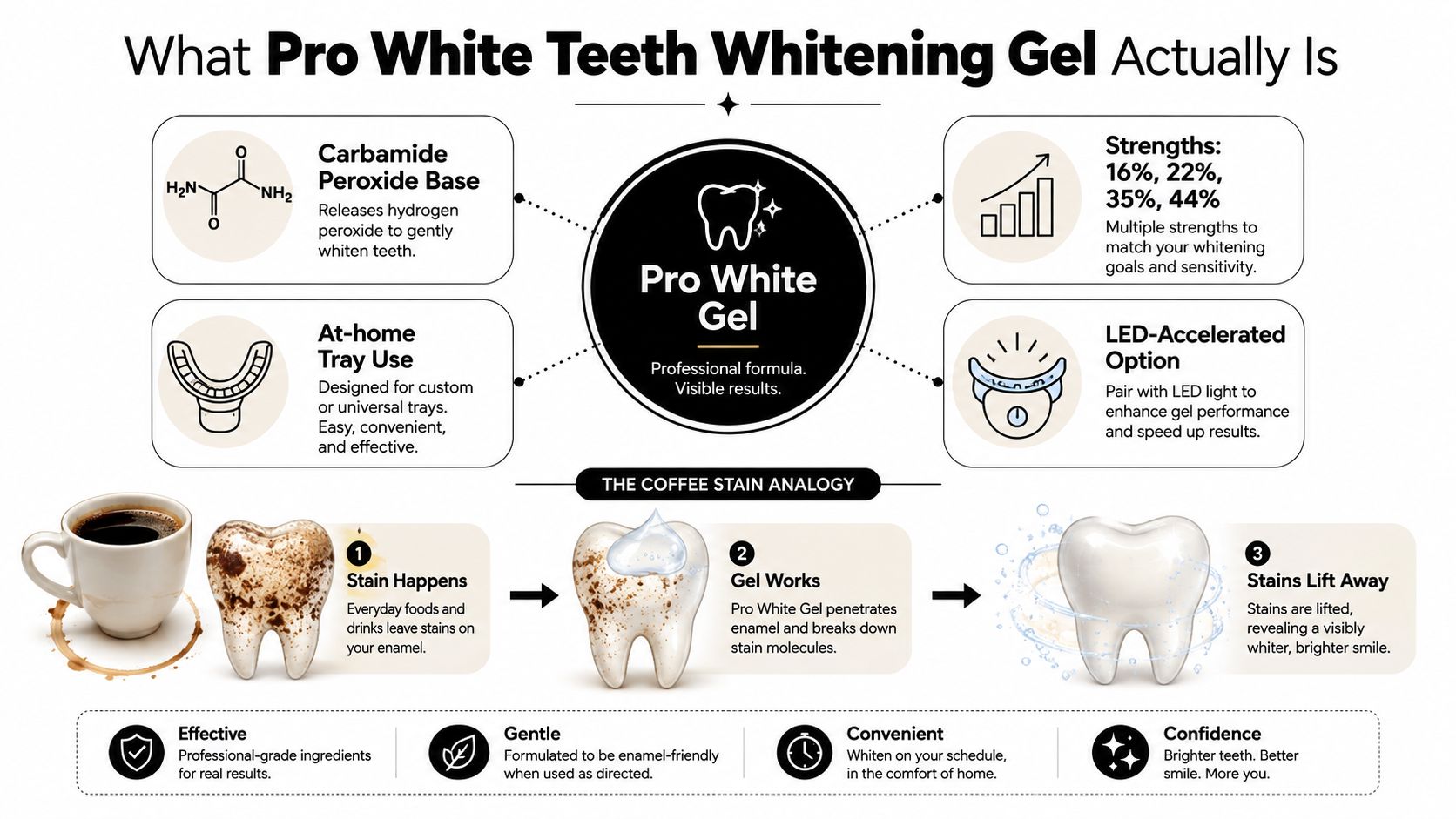
Pro White gel is an at-home peroxide whitening product intended for use with trays. Some kits also promote LED-assisted use. Product listings commonly show strengths of 16%, 22%, 35%, and 44% carbamide peroxide, but shoppers should confirm the exact concentration, instructions, expiration date, and seller before purchasing. The tube label matters more than the branding on the box.
Carbamide peroxide works through the same chemical principle as stain removers. It breaks down colored molecules, called chromogens, so the tooth appears lighter. The gel does not scrub discoloration away like a gritty polish. Its active chemistry can move through tooth structure, which explains both its whitening effect and its potential to cause sensitivity.
Carbamide peroxide in plain English
Carbamide peroxide breaks down into hydrogen peroxide and urea. A commonly used conversion is that 10% carbamide peroxide is equivalent to 3.6% hydrogen peroxide, as documented in this review of professional at-home whitening. By the same relationship, 22% carbamide peroxide is approximately 7% hydrogen peroxide equivalent. The formula and wear schedule still determine how that peroxide is delivered.
Higher concentrations generally support shorter applications, while lower concentrations require more patience and longer contact. Concentration alone does not predict the final shade. Tray adaptation, saliva, application frequency, and whether the discoloration responds to peroxide all affect the result.
That makes the tube's concentration a buying decision, not just a label detail. Compared with dentist-recommended names such as Opalescence, Zoom, and Pola, Pro White may offer useful flexibility across strengths, but shoppers must match the formula to the tray, schedule, and tolerance they can follow. A higher number is not automatically the better purchase.
A professional-style formula may include glycerin for texture, carbopol or another thickening agent to help the gel stay in place, and desensitizing ingredients such as potassium nitrate. These supporting ingredients improve handling or comfort, but they do not remove the need for correct dosing and proper tray seating.
Peroxide can move beyond the enamel surface. An in vitro spectrophotometric study of peroxide diffusion found that peroxide from strips and gel penetrated into the pulp chamber. Stronger or longer exposure therefore increases biological exposure without guaranteeing proportionally whiter teeth. For shoppers comparing Pro White with Opalescence, Zoom, or Pola, the practical choice is the concentration that provides adequate contact while remaining tolerable and appropriate for the tray system.
How to Use Pro White Gel Step by Step
Use Pro White gel as a controlled tray treatment. Excess product, a loose tray, and an improvised schedule are the main ways a whitening session turns into gum irritation.
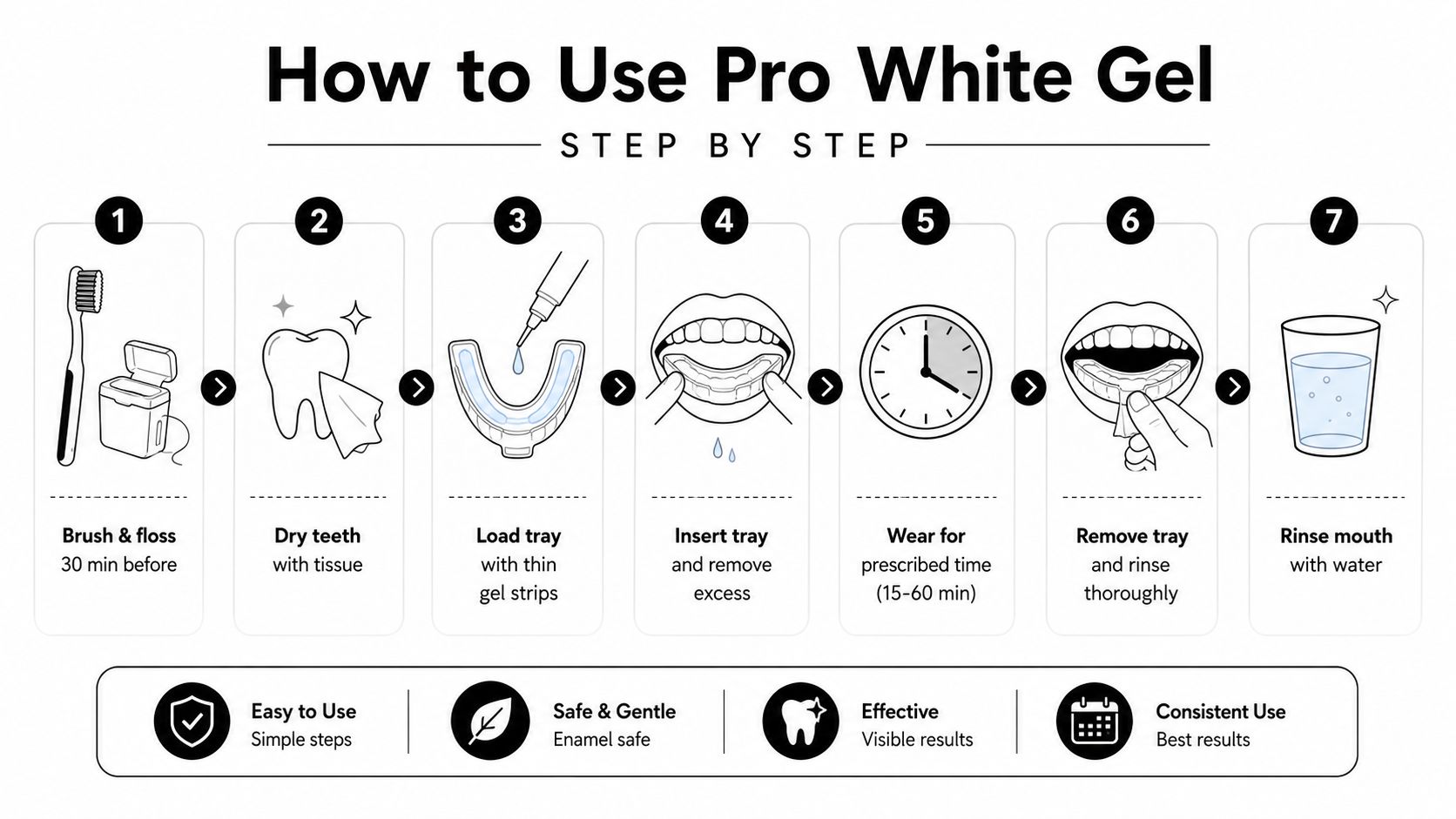
- Clean your teeth first. Brush and floss about 30 minutes before treatment. This removes plaque and gives your mouth time to settle. Avoid aggressive brushing immediately before applying peroxide.
- Dry the trays and teeth lightly. The gel does not become stronger on a dry surface, but a reasonably dry tray helps keep it from sliding toward the gums.
- Load a tiny amount. Place a thin, rice-grain-sized bead in each tooth compartment you plan to whiten. Filling the tray wastes gel and forces excess product onto soft tissue.
- Seat and inspect. Press the tray into position so it adapts around the teeth. Check the gumline, then remove overflow immediately with a dry finger or cotton swab.
- Follow the tube's wear time. Stronger formulas need shorter exposure. Do not improvise an overnight session with a high-strength formula such as 35% or 44% carbamide peroxide. If the label does not state a clear protocol, stop and ask a dental professional before using it.
- Remove and rinse. Rinse the tray and your mouth with lukewarm water. Brush gently later, rather than scrubbing your teeth immediately after treatment.
- Store the syringe correctly. Cap the tube, replace the tip, and keep it upright in a cool place. This limits drying and reduces contamination from repeated handling.
For a visual walkthrough, follow this guide to use teeth whitening gel correctly.
The following video shows proper tray placement and gel removal before your first session.
During a whitening cycle, avoid coffee, red wine, tobacco, and acidic drinks during the immediate post-treatment period. If you consume something staining, rinse with water instead of brushing hard straight away.
Safety, Sensitivity, and Enamel Reality Check
Peroxide whitening should not strip visible enamel when used according to the product instructions. The safety issue is chemical exposure. Increasing concentration, wear time, or treatment frequency without guidance raises the chance of sensitivity and soft-tissue irritation. Peroxide can move through the tooth structure, so “safe” means controlled use, not unlimited use.
The enamel-protein finding deserves a practical interpretation. A laboratory study described a recommended 10% carbamide peroxide application reducing enamel protein content by up to 50%. That result does not mean a correctly used gel will cause visible enamel loss. It does mean users should follow the stated dose and schedule, avoid leaving excess gel in the tray, and stop treating whitening as harmless because it is sold for home use.
Sensitivity develops when peroxide reaches the inner tooth tissues. Stronger formulas and longer exposure make that reaction more likely. Gum irritation usually points to a tray that does not fit closely or to gel spilling onto the gums. A custom-fitting tray and a small, even amount of gel matter more than covering the tray with extra product.
A Philips clinical safety report found mild to moderate reactions, including tooth sensitivity, gingival irritation, and examiner-observed redness, with no edema or sloughing: the Philips clinical safety report. Treat those effects as warning signals to adjust or pause treatment, not as a challenge to push through discomfort.
A straightforward strength comparison
| Concentration | Typical Sensitivity | Wear Time | Enamel Risk |
|---|---|---|---|
| 10% to 16% carbamide peroxide | Lower for many users, though sensitivity is still possible | Extended or overnight use only when the label allows it | Controlled exposure when used as directed |
| 22% carbamide peroxide | Moderate possibility of sensitivity | Shorter daytime sessions according to the product label | Greater exposure than low-strength formulas |
| 35% carbamide peroxide | Higher sensitivity and gum-irritation potential | Short sessions only, never improvised overnight | Requires strict protocol control |
| 44% carbamide peroxide | Highest caution level among these options | Use only exactly as directed | Not a sensible starting point for sensitive teeth |
If you have reacted to whitening before, begin with one short session. Sharp “zingers” mean stop, rinse, and switch to a sensitivity toothpaste. Persistent pain, a gum burn, or pain isolated to one tooth needs a dental examination. These sensitivity-reduction measures may improve comfort, but they cannot fix decay, cracks, recession, or a defective tray.
For most shoppers, 16% carbamide peroxide is the sensible starting point. Choose 22% only when you accept shorter sessions and closer monitoring. Skip 35% or 44% if your teeth are already sensitive, your tray fit is poor, or you want an overnight routine.
Pro White vs Opalescence, Zoom, and Pola
Brand comparisons become clearer when you separate active ingredient, exposure schedule, and comfort strategy. Pro White gives shoppers concentration flexibility and a value-oriented route. Opalescence is built around established professional take-home systems. Zoom spans in-office and take-home formats. Pola emphasizes daytime and night options with lower hydrogen peroxide concentrations.
The figures below come from the product ranges described in the brief. Check the individual box because brands sell multiple systems under the same family name.
| Brand | Active Ingredient | Concentration Range | Wear Time | Best For |
|---|---|---|---|---|
| Pro White | Carbamide peroxide | Commonly offered at 16%, 22%, 35%, and 44% | Short daytime use for stronger gels, longer use for lower strengths | Value, choice, and refill flexibility |
| Opalescence | Carbamide peroxide, with PF formulas using potassium nitrate and fluoride | 10% to 35% carbamide peroxide | Some systems support extended or overnight wear | Shoppers who prefer established tray protocols |
| Zoom | Hydrogen peroxide in in-office treatment, with lower-strength take-home systems | In-office treatment is commonly associated with 25% hydrogen peroxide | In-office treatment is brief, take-home kits follow their own schedule | Fast results with professional oversight |
| Pola | Hydrogen peroxide | Pola Day and Pola Night options range from 3% to 9.5% hydrogen peroxide | Commonly daytime or night use depending on the product | Lower-strength daytime or nighttime routines |
What the differences mean at checkout
Choose Pro White if you want a mid-range or high-strength carbamide option and you're prepared to manage dosing carefully. Its flexibility is useful, but it also places more responsibility on you. A poorly fitted tray can erase the advantage of a lower purchase price through wasted gel and irritated gums.
Choose Opalescence if you value a well-defined professional take-home routine and want a formula that may include potassium nitrate and fluoride. Its longer-wear options suit people who prefer gradual exposure, provided the specific product allows that schedule.
Choose Pola if your priority is a lower-strength hydrogen peroxide approach and a manageable daytime or nighttime routine. It's not the obvious pick for someone demanding the most aggressive concentration.
Choose Zoom if speed and professional supervision matter more than refill economy. In-office whitening has a different level of oversight from a direct-to-consumer tray routine, and its take-home kits shouldn't be treated as interchangeable with the in-office treatment.
For a broader product-by-product review, compare professional teeth whitening gel brands. The right choice depends less on the logo than on whether you'll follow the schedule without chasing extra exposure.
Who Should and Shouldn't Use Pro White Gel
Pro White suits adults with mild to moderate yellowing from coffee, tea, wine, tobacco, or gradual age-related discoloration. Choose it when the visible teeth are natural enamel, the gums are healthy, and you can follow the prescribed routine consistently. A tray gives heavy coffee drinkers, smokers, and people preparing for photographs or an event more control at home, but it cannot correct every form of staining.
Get a dental assessment first if a tooth darkened after trauma, staining may relate to medication, decay is possible, or one tooth looks substantially darker than its neighbors. Those signs call for diagnosis, not a stronger gel or a longer session.
Put the product back if any of these apply
- Pregnancy or breastfeeding: Skip elective peroxide whitening unless your dental and medical professionals specifically approve it.
- Young age: Do not use professional-strength whitening under 16 without direct clinical guidance.
- Active disease: Treat gum disease, cavities, ulcers, and other oral problems before whitening.
- Exposed roots or cracks: Peroxide can cause intense pain where dentin is exposed or tooth structure is compromised.
- Visible restorations: Veneers, crowns, and bonding do not lighten like natural enamel. Whitening can leave a visible mismatch around them.
- Severe sensitivity or peroxide allergy: Choose an examination and a personalized plan instead of testing strong gel at home.
Stop if burning, swelling, or sharp sensitivity develops. Persistent symptoms need dental evaluation, and adding gel will not solve an ill-fitting tray or untreated disease. People who cannot keep gel off their gums should also skip home treatment until a clinician provides a better-fitting tray or another option.
After treatment, limit staining exposure during the first 48 hours. Choose pale foods and drinks, rinse after meals, and avoid tobacco, coffee, tea, red wine, and strongly colored sauces. Resume maintenance only when your teeth feel comfortable, and do not extend the cycle because results seem slow. A top-up makes sense after visible shade drift, not on a fixed schedule or in response to sensitivity.
Buying, Using, and Maintaining Your Results
Buy from an authorized dental retailer or a seller that clearly identifies the manufacturer, concentration, expiration information, storage conditions, and instructions. Marketplace listings can be inconsistent, especially when syringes arrive without reliable labeling or with unclear handling history. If the packaging looks altered, the gel is separated, the tip is damaged, or the instructions conflict with the product page, return it.
A sensible starter kit includes:
- Whitening gel syringes: Select one clearly labeled concentration rather than mixing strengths.
- Fitted trays: Custom trays are preferable when available because they control gel placement.
- Shade guide: Record your starting shade under similar lighting instead of relying on memory.
- Desensitizing support: Keep potassium nitrate toothpaste or a dentist-approved desensitizing product available.
- Storage case: Protect trays from heat, pets, and contamination.
- LED accessory: Treat it as optional. Light doesn't compensate for poor tray fit or excessive peroxide exposure.
A disciplined first week
Use the label's prescribed session length, keep a simple shade record, and inspect your gums after each application. If sensitivity spikes, pause rather than shortening the interval and adding more gel. Alternating whitening with a remineralizing toothpaste can make the routine easier to tolerate, but it doesn't authorize longer sessions.
DentalHealth.com offers professional at-home products including Opalescence, Zoom, Pola, whitening gels, sensitivity products, and remineralizing pastes, with product descriptions and customer support for shoppers comparing these categories. It's one place to check individual formulas and accessories before ordering.
Checkout questions answered
Will Pro White whiten crowns or veneers? No. Peroxide lightens natural tooth structure, not most existing restorations. Whitening before replacing a visible restoration may help a dentist match the new shade more accurately.
How soon will I see results? Stronger formulas may show visible change sooner, while lower-strength protocols require consistent use. Clinical comparisons found significant improvement after two to three weeks for the tested carbamide and hydrogen peroxide gels, without a superior final result for the higher carbamide concentration, as reported in the PubMed clinical comparison.
What if my teeth whiten unevenly? Stop increasing the dose. Unevenness may reflect tray coverage, different enamel thickness, restorations, or stains that peroxide cannot treat. A dentist can identify the cause.
How long will one tube last? There isn't a reliable universal answer. It depends on syringe size, the number of teeth treated, tray design, and whether you use a thin bead or flood the tray. Follow the small-bead method and track applications rather than guessing.
Bottom line: Start with a clearly labeled, moderate-strength gel, use a properly fitting tray, and treat sensitivity as a stop signal rather than a challenge.
If you're comparing options, visit DentalHealth.com to review professional whitening gels, Opalescence, Zoom, Pola, sensitivity care, and remineralizing products in one place. Choose the formula that matches your wear-time tolerance and oral-health situation, then follow its instructions exactly instead of buying the strongest syringe available.