
Reach Flossers Refill
You're standing at the bathroom counter with an empty Reach flosser in one hand and a marketplace search open on your phone. The results show Reach, Listerine, Access, Ultraclean, assorted flavors, bundled handles, refill-only packs, and product photos that make every head look almost identical. One listing says the heads fit both brands, another barely explains the handle connection at all.
The confusion is real, but the purchase decision doesn't need to be. Match the refill to the handle platform first, then compare pack size and cost per use. The Reach and Listerine names overlap because the product family has been rebranded, while disposable snap-on heads sit beside spool-based refill systems that work completely differently. Here's how to separate them without buying the wrong pack.
Why Picking the Right Refill Feels Harder Than It Should
The biggest mistake shoppers make is treating every listing for Reach flossers refill as if it describes the same product. It doesn't. Some pages sell replacement heads for a snap-on Reach flosser, some refer to the angled Access platform, and others use “refill” for a spool that belongs inside a reusable dispenser. The word tells you that something is replaceable, but it doesn't tell you what attaches to your handle.
The naming problem
Reach-branded products also overlap with Listerine-branded listings. Current retail pages use names such as Reach Access Flosser Refill, Reach Ultraclean Access Flosser Mint Refill, and Listerine Ultraclean Access Flosser Refill Heads. Some marketplace descriptions say the line was rebranded and that the heads fit both Reach- and Listerine-branded handles, but that information can sit deep in the product copy rather than in the title or main image. Current retail listings show the Reach and Listerine naming overlap.
That leaves shoppers comparing packaging instead of attachment points. A flavor name, head color, or familiar logo isn't enough to confirm fit.
Three traps to avoid
- Bundled versus refill-only packs: A bundle may include a handle and heads, while a refill-only listing contains replacement heads alone. Don't compare the front price until you know what's in the box.
- Mixed-generation listings: Sellers sometimes combine older Reach wording with newer Listerine branding. Treat compatibility language as more important than the product title.
- Generic-looking photographs: A head can look close enough online but still fail to lock securely. The connector, prong spacing, and handle family matter more than the silhouette.
Practical rule: If the listing doesn't identify the handle family clearly, don't buy it based on the flavor or the lowest visible price.
A reliable purchase takes three checks: identify the handle, choose the matching head or spool format, and divide the pack price by the number of usable replacements. That last step gives you a real cost-per-use figure instead of a misleading “cheap multipack” impression.
The Main Reach Refill Types You Will Find Today
A refill that looks right online can still be the wrong format. Sort the listing into snap-on replacement heads or spool refills first, then check the handle family. Flavor, packaging, and a low headline price come later.
Snap-on Reach heads
The standard Reach flosser uses a reusable handle and a disposable head that snaps into place. The head arrives with floss already held between its prongs, so you do not need to measure, cut, or tension a loose strand. Listings may describe the floss as mint, gentle, or intended for a deeper-cleaning feel.
Use flavor only as a preference. A mint head and an unflavored head may fit the same handle family. A similar-looking head from another platform may not lock securely.
Access and Ultraclean Access heads
Reach Access Flosser listings identify the angled, longer-handle format. Current product pages may use Listerine Ultraclean Access Flosser for the same broader family. That naming shift creates the main shopping problem: an older handle can say Reach, while a newer refill listing can say Listerine.
Read the compatibility line before buying. The title alone does not settle the fit, especially on marketplace listings that combine older Reach wording with newer Listerine branding.
A product page in this broader refill category identifies a Professional Refill as a 200-yard spool, showing that some refill products supply a continuous length of floss rather than a set of snap-on heads. The independently indexed refill product page describes the 200-yard Professional Refill spool. Keep that product type separate from an Access head pack.
Spool refills for reusable dispensers
A spool refill goes inside a reusable dispenser, not onto an Access handle. Remove the empty spool, seat the replacement so it turns freely, thread the floss through the outlet, and close the housing. Spool dimensions and the internal guide are usually product-specific, so a loose fit is a reason to stop and verify the dispenser model.
| Refill Type | Compatible Handle | Flavor Options | Typical Pack Count |
|---|---|---|---|
| Reach snap-on head | Matching Reach snap-on handle | Mint, gentle, or other listing-specific options | Varies by listing |
| Reach Access head | Reach Access handle family | Mint and unflavored options appear in listings | Varies by listing |
| Listerine Ultraclean Access head | Listerine-branded Access handle, with some listings stating Reach compatibility | Mint and unflavored options appear in listings | Varies by listing |
| Spool refill | Matching reusable dispenser | Depends on spool product | Sold as spool or cartridge |
Check the format before comparing pack counts or prices. A larger box of incompatible heads is not a bargain. For a real cost-per-use figure, divide the price by the number of usable heads, or by the number of spool replacements when the product is sold as a cartridge.
Reach vs Listerine Handles and Refill Heads
The Reach and Listerine names are best understood as overlapping labels on an evolving product family, not as an automatic sign that every head fits every handle. Older shoppers may still own a Reach Access handle, while current listings may use Listerine Ultraclean Access in the product name. Some listings explicitly describe the heads as fitting both brands, but that statement needs to appear in the seller's compatibility details, not just be assumed from similar packaging.
What determines fit
Look at the neck angle, the Y-shaped head, and the small connector slots where the refill meets the handle. The head should sit flush, lock firmly, and remain stable when you apply light tension to the floss. If it wobbles, partially clicks, or requires force, stop using that combination.
The rebrand is documented in marketplace copy, but clear manufacturer guidance is harder to find. For a useful overview of the naming issue, see this guide to Listerine flosser refill compatibility. Use the guide as context, then verify the exact listing you intend to purchase.
| Handle Version | Year Range on Shelf | Accepts Legacy Reach Heads | Accepts Current Listerine Reach Heads |
|---|---|---|---|
| Older Reach Access handle | Earlier retail generation | Usually the relevant starting point | Some current listings state that they fit |
| Current Listerine Ultraclean Access handle | Current retail naming | Don't assume without a fit statement | Designed for the current platform |
| Unidentified or generic flosser handle | Unclear | No reliable assumption | No reliable assumption |
The “year range on shelf” column is intentionally broad. Retail stock overlaps, old inventory remains online, and seller descriptions don't consistently identify manufacturing generations. The handle's physical connector and the listing's explicit compatibility statement are stronger evidence than a date estimate.
The at-home fit check
Put the old head beside the replacement shown in the listing. Compare the distance between the two prongs, the shape of the base, and the position of the alignment notch. Then test one head on the handle before opening or discarding the rest of the pack.
Fit test: A correct head should click into place, sit straight, and stay firm during a gentle pull. Similar appearance isn't enough.
How to Replace a Reach Refill Step by Step
Replacing a snap-on head should be controlled, not forceful. Hold the handle near the Y-junction, where you can stabilize the connector, and remove the old head along the direction it naturally releases.
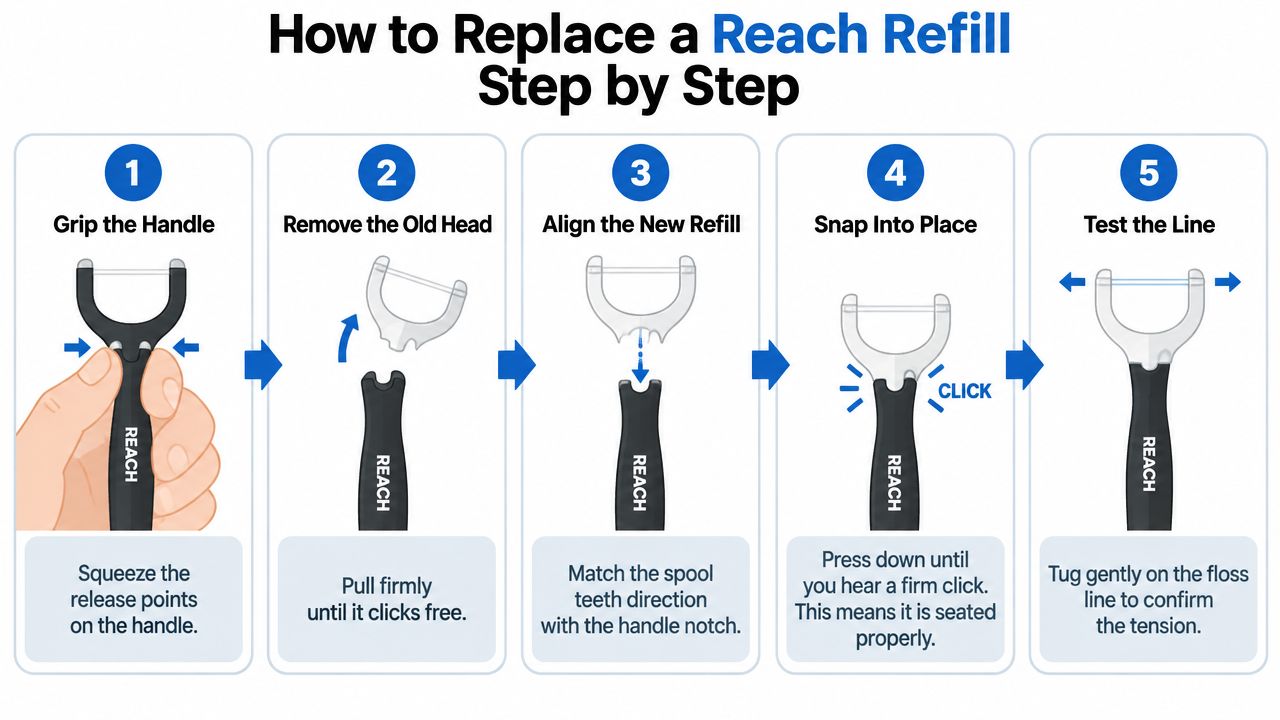
Snap-on head replacement
- Grip the handle near the Y. Squeeze the release points or thumb tab if your handle has one. Keep your fingers away from the used floss.
- Pull the old head straight off. Don't twist aggressively. If it resists, inspect the connector for debris or a damaged locking tab.
- Align the new refill. Match the head's base with the handle notch. The floss should face the usable side of the fork rather than turning into the handle.
- Press until it clicks. A firm click indicates that the connector has seated. A head that looks attached but rocks from side to side isn't ready for use.
- Test the line. Tug gently on the floss and confirm that it stays taut between the prongs.
For the Reach Access and similar long-handle formats, the release may involve turning the head a quarter turn counterclockwise before pulling. Don't force a straight pull if the connector clearly uses a twist release.
Spool replacement
With a spool dispenser, remove the cover and take out the empty spool. Cut or release the remaining floss near the eyelet, place the new spool so it rotates freely, thread the strand through the guide, and close the housing. If the spool binds, reopen the case and check its orientation before pulling harder.
After every replacement, run three checks:
- Free movement: The floss advances without drag or sticking.
- Stable seating: The head or cover sits flush and doesn't wobble.
- Clean delivery: The strand leaves the eyelet without fraying or snapping.
Refillable systems commonly fail because the spool is backwards, the floss is pinched, or the cutter and cover no longer meet cleanly. Maintenance guidance for refillable dispensers emphasizes free spool rotation and correct threading. Replace a snap-on head when it becomes worn, unstable, or unhygienic, and follow the product's stated replacement guidance rather than stretching a damaged head.
When a Refill Head Beats Spool Floss
A snap-on head earns its place when speed and repeatable handling matter more than minimizing consumable cost. The fork keeps the strand tensioned and gives the user a fixed grip, which helps beginners and people who struggle to control loose string floss.
Cost changes the decision. A refill-head system can run at roughly 40 to 60 cents per use, while spool floss can run at roughly 15 to 20 cents per use, according to the assigned comparison basis in the product brief. Those figures are useful as decision examples, but your actual result depends on pack price, head count, and how much spool floss you use per session. Calculate the total purchase price divided by the number of sessions the pack supports.
Where snap-on heads win
People with braces, bridgework, or limited dexterity may prefer a head that keeps the floss taut and positioned at a consistent angle. The same structure helps anyone who skips flossing because cutting and tensioning string feels fiddly. If a snap-on head makes you floss regularly, its higher session cost can be justified by actual use.
Where spool floss wins
Spool floss gives you control over length and usually produces less plastic waste than a disposable head system. It also costs less per session in the comparison above. For a confident user who already flosses consistently, the cheaper and lower-waste format is the better default.
Reusable dispensers offer a middle path. They keep a durable housing in service while replacing the internal spool, although compatibility still depends on the dispenser and cartridge dimensions. Retailers now place reusable and refillable floss formats beside Reach-style refills, making waste and convenience part of the same purchase decision. Retail category listings show disposable flossers alongside refillable floss options.
| Format | Cost per Use | Time per Session | Plastic Waste |
|---|---|---|---|
| Disposable refill head | Roughly 40 to 60 cents | Fast, with no cutting or tensioning | Higher than spool formats |
| Spool floss | Roughly 15 to 20 cents | Requires measuring, cutting, and tensioning | Lower than disposable heads |
| Refillable dispenser | Depends on cartridge price and usage | Fast once loaded | Lower than replacing a complete head |
For related guidance on pre-threaded alternatives, see these advanced soft picks. Choose the format that removes your biggest barrier, then use cost and waste to confirm that choice.
Choosing the Right Pack Size and Price Tier
Start with compatibility, then choose quantity. Buying the largest Reach refill pack only because its sticker price looks lower can leave you with unusable heads if the listing mixes branding eras or fits a different handle. Decide whether you are testing fit, maintaining one handle, or supplying several people.
A practical price ladder
The assigned pack-size framework provides these price and quantity ranges for trial, mid-size, and bulk packs. Trial packs generally contain 3 to 6 heads and cost around $3. Mid-size packs commonly contain 18 to 24 heads and cost around $6 to $9, while bulk boxes may contain 40 to 75 heads and cost around $12 to $18.
Use those ranges to compare value, not to predict every seller's checkout price. Marketplace availability and pricing change, and the market is concentrated. As of June 2026, an Amazon-market analysis tracked 137 products for “reach flosser refills.” The leading product was estimated at about 50,000 monthly units, the top three products held 63.3% of click share and 46.4% of conversion share, and 43% of tracked products fell in the $0.00 to $10.00 price range. The Amazon-market analysis provides the tracked product, sales, share, and price data.
| User Profile | Recommended Pack | Price Range | Heads per Head |
|---|---|---|---|
| First-time buyer testing fit | 3 to 6 heads | Around $3 | One head per use |
| One daily flosser | 18 to 24 heads | Around $6 to $9 | One head per use |
| Two or more regular users | 40 to 75 heads | Around $12 to $18 | One head per use |
| Occasional user | Trial pack | Around $3 | One head per use |
A 28-count pack also appears regularly for the Access family. Count alone does not prove fit. Divide the total price by the number of heads, then compare the result with how often the handle will be used. A pack that costs more upfront can still offer the better cost per use if every head fits and gets used.
Two traps that waste money
- Mixed-generation bundles: Marketplace listings can combine heads linked to different branding eras. Check the compatibility text and confirm that every head fits your handle before ordering.
- Subscription pricing: A recurring discount becomes poor value if you replace the handle or discover that the listing overstated compatibility. Buy one small pack first when the platform is unclear.
Buy one head for each expected session, then keep only enough reserve to avoid an urgent reorder. Occasional users should stay with trial quantities. Households with multiple compatible handles can move to bulk packs after one head passes the fit test.
For another pre-threaded option, compare these waxed dental floss picks when Reach refill compatibility remains uncertain.
Quick Fixes and What to Do Next
Most Reach flosser refill problems come from three sources: the wrong platform, poor alignment, or a damaged connector. Fix the physical issue before blaming the floss itself.
Fast troubleshooting checklist
- Floss is pinched or shredding: Check the spool teeth, guide path, and head for cracks. Re-seat the floss or replace the damaged head.
- Floss won't advance: Rewind the spool slightly, then close the cover again so the strand isn't trapped beneath the housing.
- Head won't click: Find the alignment tab, clean and dry the locking area, and press the refill straight into the connector.
- Head pops off during use: Stop using it. Inspect the connector for a crack and replace the head rather than trying to tighten it with force.
- Floss feels too tight or slack: Adjust spool tension and confirm that the line passes cleanly through the guide.
- No refill seems to fit: Check whether the handle says Reach or Listerine, then return to the matching Access or snap-on platform.
A loose head isn't a minor annoyance. It changes control and can make the floss snap against the gum. A damaged cutter or cover can also create drag, so replacing the failing component is usually smarter than repeatedly forcing the mechanism.
Your buying decision comes down to three lines:
- Confirm the handle brand and platform.
- Choose the refill SKU that explicitly matches it.
- Calculate pack price per head and compare that cost with how often you floss.
If you're still unsure, buy the smallest compatible trial pack, test one head, and only then commit to a larger box.
DentalHealth.com helps shoppers find professional-grade at-home dental care products, from sensitivity support and remineralizing pastes to whitening systems and everyday oral-care essentials. Visit DentalHealth.com to browse practical product guidance and trusted dental brands, then choose the care products that fit your routine with clearer buying information.