
Remineralizing Toothpaste Natural: What the Evidence Shows
If a toothpaste is labeled natural, what tells you whether it prevents cavities rather than leaving a mineral coating on enamel? Those are different outcomes, and a plant-based label doesn't distinguish between them.
For shoppers searching for natural remineralizing toothpaste, the useful question isn't how natural the packaging looks. It's whether the named ingredient, in the actual formulation, has been tested for the problem you want to address. Hydroxyapatite deserves serious consideration, but fluoride remains the benchmark, and neither an herbal ingredient list nor a laboratory image can substitute for clinical evidence.
Which Natural Ingredients Have Real Clinical Evidence
Clinical evidence separates ingredients by what researchers measured: cavity prevention in people, mineral deposition in laboratory models, or the presence of a recognizable compound on a label.
Natural remineralizing actives compared with fluoride
| Ingredient | How it may work | Human evidence | Evidence strength |
|---|---|---|---|
| Hydroxyapatite | Biomimetic calcium-phosphate mineral that deposits on damaged enamel | Randomized clinical caries trials, although the clinical evidence base remains relatively small | Strongest natural option |
| Xylitol | Non-fermentable sweetener that may support mineral-ion retention | Laboratory-based enamel-repair evidence, without a human cavity-prevention trial cited here | Complementary only |
| Botanical extracts, including Juniperus communis and Camellia sinensis | Plant-containing formulations evaluated for enamel repair in laboratory models | No consumer clinical trial cited for these formulations | Limited |
| Generic calcium or mineral claims | No defined mechanism without identifying the compound and formulation | No shared clinical evidence base established by the category name | Unverified |
| Fluoride | Established caries prevention | Long-established clinical evidence and use as a comparator in toothpaste trials | Established benchmark |
The table ranks evidence for caries prevention. Taste, texture, price, and ingredient preferences may affect whether you use a toothpaste consistently, yet those factors do not demonstrate effectiveness.
Hydroxyapatite, often abbreviated HAP, leads the natural or biomimetic group because investigators have tested HAP toothpastes in people rather than only on enamel samples. That makes it a more credible starting point than an unspecified mineral blend. It still leaves product-level differences unresolved: one HAP formulation's results cannot automatically be assigned to every toothpaste containing HAP.
Xylitol occupies a different position. Its presence may support a preventive formulation, although the evidence described here does not make it interchangeable with a primary remineralizing active. Botanical ingredients require the same distinction. A recognizable plant name identifies an ingredient; it does not show that the finished toothpaste prevents cavities.
Match the label to the right category
A generic calcium claim is especially difficult to interpret. Calcium is relevant to tooth mineral, yet a calcium-containing ingredient is not automatically a clinically validated delivery system. Identify the named compound, the formulation, and the outcome tested before assuming that mineral pastes perform alike.
A five-step label check follows from that evidence hierarchy:
- Find the active compound on the ingredient list.
- Assign it to a category: biomimetic mineral, complementary ingredient, botanical extract, generic mineral claim, or fluoride.
- Check whether the cited outcome is cavity prevention in people or mineral deposition in a laboratory model.
- Look for evidence on the finished formulation rather than the ingredient family alone.
- Compare the result with fluoride, which remains the established benchmark.
Fluoride provides the comparison standard. The practical choice is between formulations with different mechanisms, clinical support, and suitability for your mouth. Our comparison of fluoride and hydroxyapatite toothpaste explains that ingredient-level distinction.
Shopping rule: Match the active ingredient on the back of the package to an evidence category before judging the claims on the front.
Retail categories help shoppers locate products, though they do not establish enamel repair. The same rule applies when a retail page invites you to find bamboo charcoal dental care: a charcoal product listing alone does not show a clinically tested remineralizing active, so apply the ingredient check to whatever product page you are reading.
What Remineralizing Actually Repairs in Enamel
Say you notice a chalky patch near your gumline and want a toothpaste that will repair it. Think of remineralization as patching a plaster wall with matching plaster while the underlying structure remains intact. That's different from rebuilding a hole that has broken through the wall.
The mineral-repair process is illustrated below.
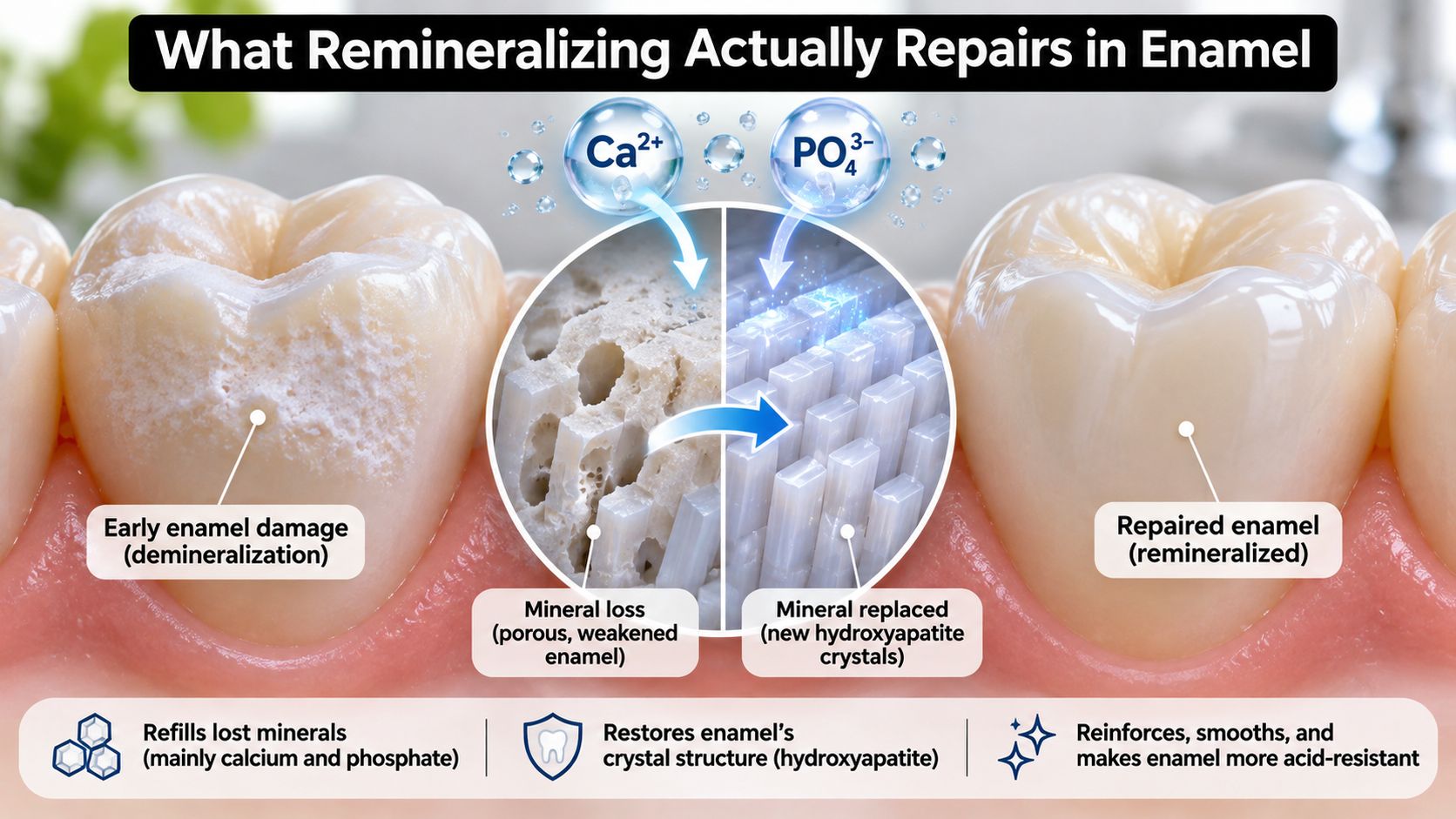
Acids from bacterial sugar metabolism or acidic foods and drinks can dissolve calcium and phosphate from enamel. Remineralization means depositing mineral back into or onto damaged tooth surfaces. It's mineral repair, not the biological regrowth of a whole tooth structure.
In laboratory testing of bioactive calcium-phosphate formulations, repeated application for one week produced a newly deposited mineral layer directly contacting the original enamel; formulations containing ion-substituted HAP also showed remineralization of eroded enamel and exposed dentinal tubules. That establishes a plausible repair mechanism under laboratory conditions, not a promise about how quickly your teeth will respond.
Identify the problem before choosing the paste
The plaster analogy helps separate several concerns that advertisements often combine:
- Early enamel erosion: Mineral deposition may help a damaged surface, but it doesn't restore the original tooth contour after substantial tissue loss.
- White-spot lesions: These need assessment to establish whether they represent active demineralization and whether the surface remains intact.
- Sensitivity: A formulation that affects exposed dentinal tubules addresses a different problem from a study measuring new cavities.
- Established cavities: A structural defect requires dental evaluation. Toothpaste isn't a replacement for necessary restorative treatment.
A dentist can tell you which problem you're trying to manage. Our explanation of what tooth remineralization means offers additional context for that conversation.
For a visual explanation alongside the mineral diagram, watch the following video.
The useful purchase decision starts with a diagnosis, not a promise to rebuild enamel. Ask whether you need surface mineral support, lesion control, sensitivity management, or treatment of a cavity.
What the Trials Show
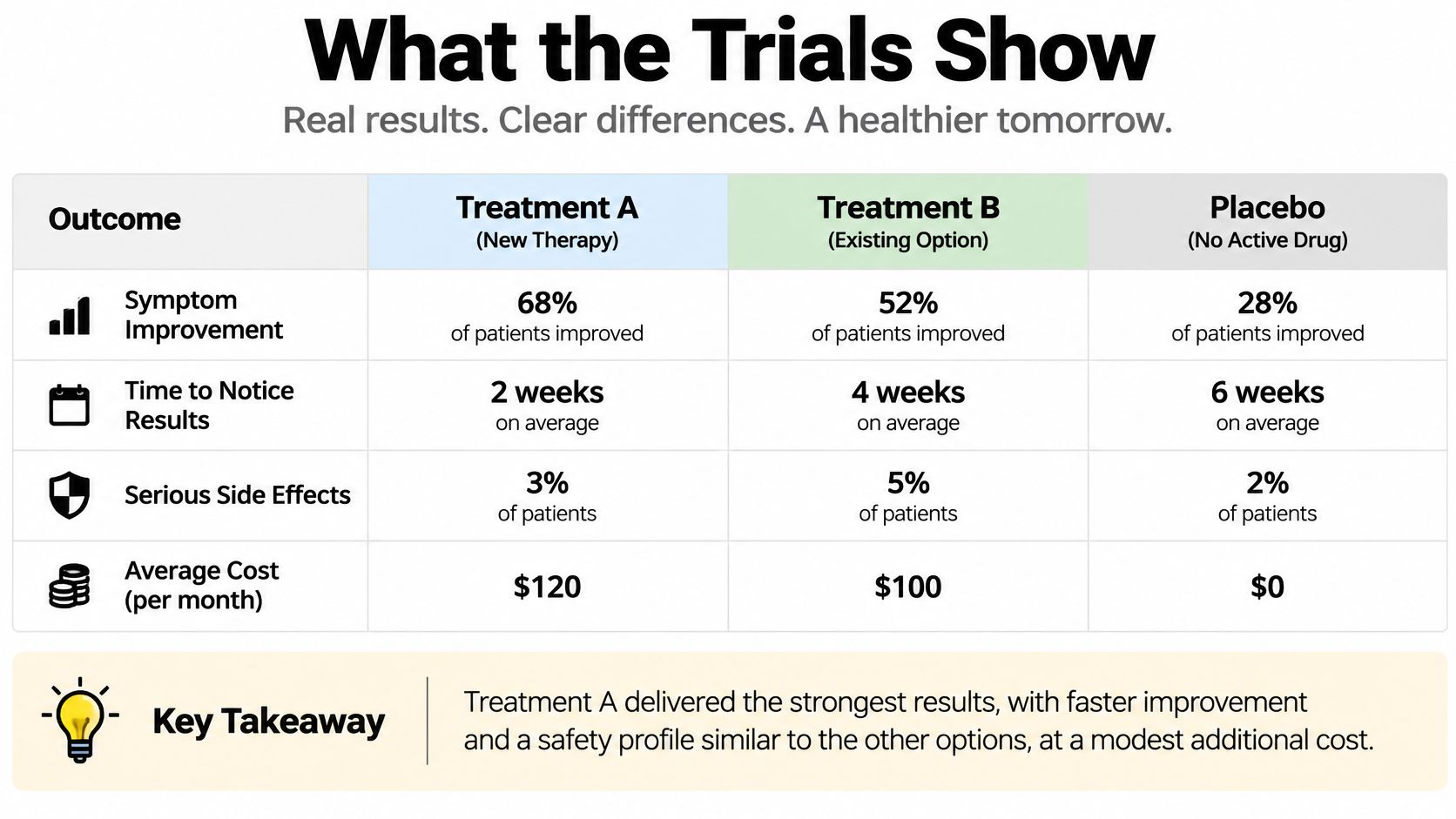
The evidence pool is narrower than the search count suggests. A systematic review published in 2021 screened 291 studies, found 22 that met its criteria, and ended with 5 clinical caries trials, including 4 randomized controlled trials; its meta-analysis of 3 randomized trials estimated 17% protection against caries with hydroxyapatite toothpaste. That makes HAP credible for prevention, and it still leaves a gap between an ingredient signal and any single tube.
The gap comes from what gets filtered out. Laboratory studies can show calcium-phosphate deposition on enamel, yet pooled clinical inference depends on the smaller set that measured decay in people over time. For a shopper trying to avoid cavities, that clinical layer carries more weight than images of mineral gain.
A pooled result isn't a guarantee for your tube
Formulation decides whether a trial is relevant to the product in hand. Particle size, HAP concentration, and the other ingredients can differ between pastes, while brushing frequency, diet, and participants' starting risk shape the conditions being tested. A strong average result can coexist with weak performance in a formula that does not match the tested one.
HAP supplies biomimetic calcium-phosphate material that can deposit on damaged surfaces, and a fluoride-free version reaches that mechanism without fluoride. Fluoride holds the broader, longer caries-prevention record and a standardized concentration framework for ordinary preventive toothpaste. The review also cites the World Health Organization recommendation to brush twice daily with toothpaste containing 1,000 to 1,500 ppm fluoride, a concentration benchmark rather than proof that a fluoride-free mineral paste performs the same way.
An ingredient can have a convincing repair mechanism without every product containing it having convincing cavity-prevention evidence.
The reading is conditional. For a fluoride-avoidant shopper, HAP is a serious option to discuss with a dentist. For someone with higher caries risk, fluoride remains the benchmark. Choose an evidence-relevant formula, brush thoroughly, and keep monitoring risk instead of treating the word “natural” as a caries result.
The 18-Month Trial That Tested Fluoride-Free Toothpaste
The most useful adult comparison asked a practical question: could a fluoride-free HAP toothpaste prevent worsening on a clinical caries measure comparably to a conventional fluoride toothpaste?
The double-blind randomized adult trial enrolled 194 adults, assigned 97 to each group, and compared HAP toothpaste with 1,450 ppm fluoride toothpaste over 18 months; the arm-level results appear below.
Results of the 18-month fluoride-free trial
| Measure | Hydroxyapatite toothpaste | 1,450 ppm fluoride toothpaste |
|---|---|---|
| Adults enrolled | 97 | 97 |
| Withdrew early | 11 | 9 |
| DMFS did not increase, per-protocol | 89.3% | 87.4% |
Investigators used the DMFS index, which records decayed, missing, and filled tooth surfaces. Unlike a microscope image of mineral deposition, this endpoint follows a clinically relevant measure of caries experience. An unchanged score means the index didn't worsen during the observation period, not that every tooth became fully repaired.
Read the outcome and the withdrawals together
Among participants included in the per-protocol analysis, the proportions whose DMFS index didn't increase were similar. Per-protocol results concern participants analyzed according to the trial protocol; they shouldn't be described as though every enrolled participant completed the study.
The trial ended early for 20 participants, or 10.3% of the sample, with withdrawals in both groups. Attrition matters because results among people who complete a protocol don't necessarily capture what would happen among everyone who starts using a product.
The investigators concluded that the tested HAP toothpaste was non-inferior for the primary caries endpoint. In plain English, the trial met its statistical criterion for the HAP toothpaste not being unacceptably worse than the fluoride comparator. Non-inferiority isn't proof that the products are identical, and the numerical difference doesn't establish that HAP was superior.
Clinical interpretation: This supports the tested fluoride-free formulation under the study conditions, not all toothpastes sold as natural.
The adult population also sets an important boundary. You can't automatically transfer the outcome to young children, a person with uncontrolled decay, or a product with a different formulation. Nor does the observation window establish lifelong performance.
For a shopper, the finding changes the conversation from whether fluoride-free HAP can have clinical value to whether a particular HAP product is appropriate for a particular mouth. That's a meaningful advance, but it still requires product-level scrutiny and professional risk assessment.
Why Xylitol and Botanicals Are Supporting Actors
The relevant enamel comparison took place in a laboratory, not in a consumer cavity-prevention trial. In the in-vitro study of xylitol, Juniperus communis, and Camellia sinensis formulations, the xylitol toothpaste performed best in scanning electron microscopy and energy-dispersive spectroscopy assessments, and calcium-ion gain exceeded the control group with p<0.01.
That finding supports further interest in the formulation. It doesn't demonstrate that a shopper using a xylitol toothpaste will reverse an established cavity. Statistical significance in an enamel model also doesn't tell you the size of a clinical benefit in everyday use.
Why the role is complementary
Xylitol's rationale is largely indirect. As a non-fermentable sweetener, it doesn't supply the same acid-generating substrate as fermentable sugars, and it may support mineral-ion retention during early enamel repair. That's different from showing that xylitol alone provides sufficient anticaries protection.
The botanical comparison needs the same restraint. Testing toothpastes containing plant extracts doesn't isolate a universal benefit for those plants, establish an effective concentration for every product, or demonstrate long-term cavity prevention.
Use these practical rules when comparing formulas:
- Choose a primary active first. Look for fluoride or a clinically supported HAP formulation rather than relying on xylitol as the principal repair claim.
- Don't equate plants with proven protection. Botanical ingredients can be part of a formulation without being its validated anticaries component.
- Keep the preventive routine. Brush twice daily and seek assessment for persistent sensitivity, white-spot lesions, or suspected decay.
Our discussion of whether xylitol prevents cavities helps distinguish its possible supporting role from claims about a complete toothpaste.
The purchasing implication is straightforward: xylitol can be a useful additional feature, but it shouldn't compensate for an unidentified active or missing clinical evidence.
What a 2024 Trial in Children Adds
Evidence involving children needs especially careful ingredient reading. A 2024 randomized clinical trial published in the International Dental Journal enrolled 610 children aged 4–7 years and compared fluoride-substituted hydroxyapatite toothpastes with standard fluoridated toothpaste. The tested HAP approach contained fluoride.
That ingredient detail determines what the study can support. A child's trial involving fluoride-containing HAP cannot establish that removing fluoride produces the same outcome. The word hydroxyapatite in a study title isn't enough to classify the tested toothpaste as fluoride-free.
Lesion inactivity isn't tooth replacement
The University of Milan-led trial report recorded that 58 of 78 active enamel lesions in the hydroxyapatite-fluoride group were inactive after 24 months, approximately 74%. This describes lesion activity within that treatment group, not the percentage of children who became cavity-free.
An inactive lesion is a different endpoint from replacement of missing tooth structure. It's also different from a change in sensitivity or the visual fading of a white spot. These outcomes may all matter, but they answer different clinical questions.
The result should therefore be read with clear boundaries:
- The formula included fluoride. It isn't evidence for a fluoride-free children's toothpaste.
- The unit was the lesion. Don't convert a lesion-level outcome into a child-level success rate.
- A within-group result isn't a head-to-head effect. Without a corresponding control-arm lesion figure in this summary, no comparative percentage can responsibly be calculated.
For a child, match the evidence to the complete formula, not just the mineral named on the package.
The useful conclusion is that a fluoride-containing HAP formulation controlled lesion activity under the trial conditions. It doesn't resolve whether your child should replace their current toothpaste with a fluoride-free natural product.
Bring the proposed product to a pediatric or family dentist. Ask them to consider caries history, diet, brushing supervision, and age-appropriate fluoride use, including the possibility of swallowing toothpaste. A formula chosen for an adult's preferences shouldn't automatically become the household toothpaste for children.
Who Should Not Switch and How to Check a Label
The practical caution is that studies use different formulations, populations, and outcomes, so promising biomaterial findings don't validate an entire retail category. The adult HAP trial's clinical report supports a formulation-specific decision, not blanket approval of fluoride-free or herbal toothpaste.
Don't switch without professional advice if you have frequent cavities, dry mouth, orthodontic appliances, exposed roots, or high sugar and acid exposure. An improvement in surface appearance or sensitivity doesn't establish adequate disease prevention in a high-risk mouth.
Use a five-step label check
- Identify the active and concentration. Find hydroxyapatite or fluoride by name. For HAP, look for the declared concentration and particle form; if those details aren't disclosed, don't assume the product matches a clinical trial.
- Match the human trial to your problem. Ask whether investigators measured erosion, white-spot lesions, sensitivity, or cavities. A laboratory mineral-deposition result isn't a substitute for a human caries endpoint.
- Check fluoride status against your risk. HAP products may contain fluoride or omit it. Read the ingredient panel rather than relying on natural branding, and ask your dentist which approach fits your preventive needs.
- Check that the claim matches the measured outcome. A systematic review comparing HAP and fluoride toothpastes found no significant overall difference in preventing or arresting caries, with a pooled risk ratio of 0.98 and a 95% confidence interval of 0.85–1.12, while reporting significant differences in lesion size and fluorescence after six months. Those are distinct endpoints, not interchangeable definitions of effectiveness.
- Confirm whether decay is active. Take the package or a clear label photograph to your dentist. Ask whether you need routine prevention, monitored lesion management, or treatment that toothpaste can't provide.
The decision is simple even when the evidence isn't: keep your fluoride toothpaste until your risk has been assessed, and switch only when the label passes these checks and your dentist agrees. Ingredient preferences matter, but they shouldn't replace a plan for preventing disease.
We offer professional-grade at-home dental care, including Tooth Sensitivity products such as Fluoridex and MI Paste, alongside whitening and retainer-care lines. Visit DentalHealth.com to compare product descriptions and bring a specific formula to your dentist before changing your enamel-care routine.