
Teeth Whitening Kit Smile: Buyer Guide
You bought a whitening kit expecting a brighter, more even smile, but the first session left you with sharp electric zings. Or perhaps the opposite happened: the gel felt comfortable, yet your teeth looked almost exactly the same. Both outcomes are common when the kit's delivery format, peroxide concentration, and fit don't match your teeth.
A successful teeth whitening kit smile isn't created by choosing the strongest-looking box. It comes from getting enough active gel onto the enamel, keeping it away from vulnerable gum tissue, and following a schedule your teeth can tolerate. Use the comparison below as a practical starting point.
| Format Type | Gel Contact Quality | Sensitivity Risk | Best For |
|---|---|---|---|
| Custom or dentist-supervised trays | Even contact across the tooth surface, with better control around the gumline | Moderate, depending on gel and wear time | Noticeable, uniform whitening and ongoing touch-ups |
| Boil-and-bite trays | More adaptable than flat strips, but fit and gel placement vary | Moderate to high if the tray presses gel onto the gums | Buyers who want tray coverage without a custom dental impression |
| Whitening strips | Convenient contact on front-facing surfaces, less reliable around contours and spaces | Low to moderate, though irritation can occur with poor placement | Mild surface staining and simple routines |
| Paint-on gel | Inconsistent coverage and limited control over contact time | Variable | Small touch-ups or convenience-first use |
| LED kits with gel | The light is only useful if the gel makes adequate contact | Determined mainly by the gel and exposure schedule | Users who will follow a complete gel routine, not gadget-only buyers |
Why Your Teeth Whitening Kit Smile Results Vary
Two people can use the same whitening kit and get very different results. One may see a gradual, even change. The other may develop gum irritation along the edges of a strip or feel sensitivity in only a few teeth. The difference often has less to do with motivation than with how the product sits against the dental anatomy.
A flat strip can fold over a rounded tooth or leave a narrow area uncovered near the gumline. A loose tray can allow gel to pool against soft tissue. A custom tray, by contrast, can be shaped to hold a controlled layer of gel against the teeth while reducing unnecessary overflow. That doesn't make every tray automatically safe or effective, because the formula, amount of gel, and wear schedule still matter.
Practical rule: If a kit spreads gel onto your gums, adding more gel won't improve the result. It usually increases irritation.
Fit changes the treatment
Consider a customer with mild coffee staining and fairly regular tooth surfaces. Strips may be adequate if they stay in place, cover the visible enamel, and don't curl onto the gums. Another customer may have rotated teeth, small gaps, recession, or restorations that create uneven surfaces. That person needs more control over placement and contact, not just a stronger peroxide label.
The same logic applies to lifestyle. A person who forgets short daily sessions may abandon strips after a few attempts. Someone who prefers a planned evening routine may use a tray more consistently. Compliance is part of efficacy, because a theoretically powerful product produces little change if the user can't wear it as directed.
Why shelf appeal can mislead
LED mouthpieces, colorful syringes, and dramatic shade claims make kits easy to compare visually, but those features don't tell you whether the gel will contact the right surfaces. The active formula needs enough uninterrupted contact with the enamel, and the tray or strip needs to keep that contact reasonably consistent.
Stains also differ. Surface discoloration may respond to a gentler routine, while deeper or uneven discoloration can expose the limitations of a convenience format. Whitening won't make crowns, veneers, or fillings change color in the same way as natural enamel, so a visibly mixed smile may need dental assessment before treatment.
The right question isn't “Which kit has the highest number on the box?” Ask instead: Can this format cover my teeth evenly, protect my gums, and fit a routine I can maintain without pushing through pain?
The Evolution of At-Home Whitening Formats
Modern home whitening grew from a clinical delivery concept rather than a gadget. In 1989, Dr. Van B. Haywood introduced nightguard vital bleaching with 10% carbamide peroxide in thin custom trays, an approach that helped establish dentist-supervised home whitening. A related review describes OTC bleaching agents launching in the United States in the 1990s, generally using lower concentrations of hydrogen peroxide or carbamide peroxide for consumer use, as outlined in this review of nightguard vital bleaching and at-home whitening.
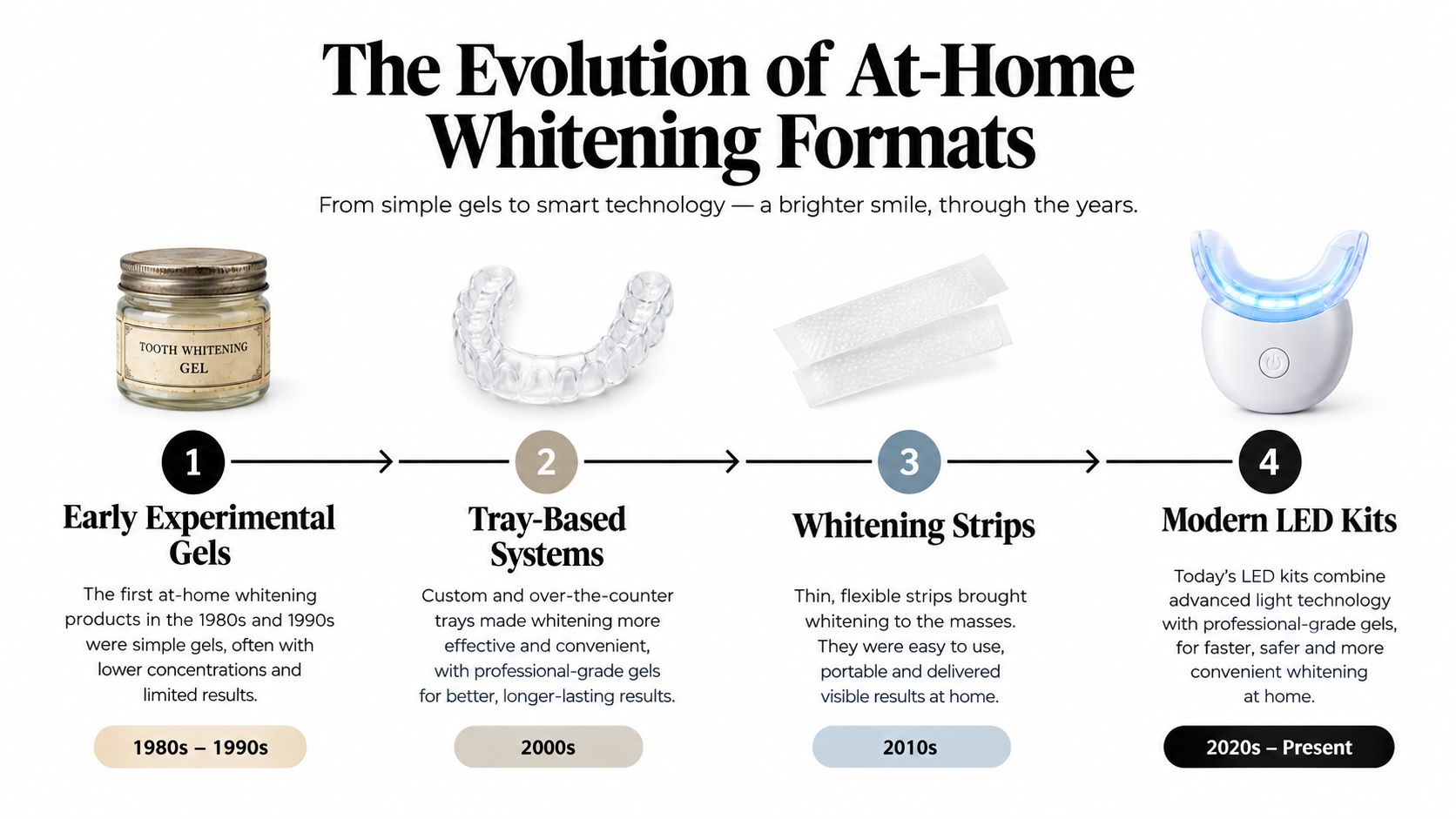
That milestone matters because it established a principle buyers still need today: delivery control can be as important as the bleaching agent itself. Thin trays keep the gel close to the tooth surface for a planned period, while limiting the amount that spreads beyond the intended area. Consumer formats later made whitening easier to purchase and use, but convenience introduced more variation in fit and application.
Why the at-home category became dominant
The category has grown into a multi-billion-dollar market. One 2026 market estimate values the global teeth whitening market at USD 8.93 billion in 2025, USD 9.37 billion in 2026, and a projected USD 14.31 billion by 2034, with a projected CAGR of 5.44%, according to Fortune Business Insights' teeth whitening market analysis. The same analysis says the at-home segment represented 68.67% of the market in 2025, showing how strongly consumers favor self-care formats.
That adoption doesn't prove every home kit works equally well. It shows that people value privacy, flexible timing, and the ability to repeat treatment without arranging an appointment. Product makers have responded with strips, prefilled trays, boil-and-bite systems, paint-on gels, and LED accessories.
The clinical lesson remains straightforward. A professional-style home protocol aims to make the gel's contact predictable. An OTC product may prioritize low handling effort, compact packaging, or a fast application. Those are legitimate advantages, but they can come at the cost of coverage, stability, and gum control.
What the evolution teaches buyers
Older doesn't mean better, and newer doesn't mean more effective. The strongest buying signal is whether the entire system supports controlled application. A well-designed tray with a measured amount of a suitable gel can be more useful than an advanced-looking device that produces poor contact.
For a durable routine, judge the system, not only the peroxide. Look at fit, instructions, replacement gel availability, sensitivity guidance, and whether the format suits the shape of your smile.
Comparing Trays, Strips, and LED Systems
Trays, strips, and LED kits solve different problems. Strips reduce preparation. Trays improve coverage and control. LED systems add a device that may make the routine feel more complete, but the light doesn't remove the need for suitable gel contact or sensible wear instructions.
Trays
A custom or carefully adapted tray can hold gel across more of the tooth surface than a narrow strip. It also gives the user more control over where the gel goes, especially when the tray has been made or adjusted with gum contours in mind. That makes trays the strongest option for shoppers who prioritize uniform shade change, have uneven tooth surfaces, or want a repeatable touch-up system.
Boil-and-bite trays sit between strips and custom trays. They can conform more closely than a flat strip, but the final fit depends on how well the user shapes the material. A poor fit can still create overflow, pressure points, or areas with little gel contact.
Strips
Strips are useful when the main barrier is routine friction. They're quick to apply and easy to store, which can help a user complete treatment consistently. Their limitations become more obvious around crowded teeth, gaps, curved surfaces, and the edges near the gumline.
A strip also gives you less control over local gel volume. If one area is sensitive, you can't always adjust coverage as precisely as you can with a tray. For mild surface discoloration, that trade-off may be acceptable. For a patchy smile or a stronger shade goal, it can become frustrating.
LED systems
An LED mouthpiece shouldn't be treated as the active whitening ingredient. The gel performs the chemical work, while the device may help standardize the session or improve the user's sense of routine. If the kit uses weak or poorly distributed gel, adding a light won't correct inadequate contact.
A randomized controlled clinical trial found that conventional at-home whitening produced significantly greater color change than OTC paint-on gel and OTC ready-to-use gel tray systems, supporting the importance of delivery format in the comparative clinical study of home whitening systems. The practical conclusion is not that every strip or LED kit fails. It's that convenience alone isn't a reliable substitute for controlled coverage.
| Format | Main advantage | Main compromise | Buying priority |
|---|---|---|---|
| Trays | Consistent gel placement and broader coverage | More preparation and cleaning | Fit and instructions |
| Strips | Simple, portable routine | Less control over contours and gumline | Adhesion and coverage |
| LED kits | Adds structure and a device to the routine | Can distract from the gel's actual performance | Formula, fit, and credible directions |
Choose a tray when measurable, even improvement matters most. Choose strips when ease of use is the factor most likely to keep you consistent. Choose an LED kit only when the underlying gel and mouthpiece make sense without relying on the light as a miracle feature.
Decoding Peroxide Concentrations and Wear Times
The active ingredient label gives you only part of the answer. Hydrogen peroxide generally acts more quickly, while carbamide peroxide breaks down more gradually, which can suit longer, controlled wear protocols. The right choice depends on the product's instructions, the tray fit, your stain pattern, and your sensitivity history.
Don't compare percentages across hydrogen peroxide and carbamide peroxide as though they were interchangeable. They release peroxide differently, and a product's intended wear time is part of its design. A stronger gel worn too often can create an uncomfortable routine that you stop using, while a gentler gel in a well-fitting tray may produce more useful progress over time.
Read the label as a treatment plan
Use this sequence before buying:
- Identify the peroxide type. Note whether the formula uses hydrogen peroxide or carbamide peroxide.
- Check the concentration and directions together. Never select a product by concentration alone.
- Match the session to your sensitivity. A sensitive user should favor a conservative schedule and avoid extending wear time to chase faster results.
- Inspect the delivery system. A measured tray application can reduce waste and overflow compared with uncontrolled gel placement.
- Plan spacing between sessions. If sensitivity appears after treatment, give the teeth time to settle rather than automatically increasing exposure.
A lower concentration isn't automatically ineffective. In a randomized clinical trial of combined in-office and at-home whitening, a prefilled tray with 6% hydrogen peroxide produced greater whitening ability than in-office whitening alone, while overall sensitivity was similar. Sensitivity peaked up to 24 hours after whitening, as reported in the clinical trial of combined whitening with a prefilled tray.
Choose comfort before speed
For practical product education, compare the main types of teeth whitening gel with attention to formula, contact time, and intended use. Don't assume that a fast-acting gel belongs in a long session, or that an overnight product should be treated like a short-session hydrogen peroxide formula.
If your teeth are already reactive, start with the least aggressive schedule the manufacturer allows. If your stains are stubborn, ask a dentist whether the issue is suitable for home bleaching before escalating concentration. The best routine is the one that provides gradual, visible change while keeping you willing and able to continue.
Managing Sensitivity and Knowing When to Pause
Sensitivity isn't a personal failure, and a painless first session doesn't guarantee that the next session will feel the same. Whitening can temporarily irritate the tooth nerve, particularly when the gel reaches exposed root surfaces or when the concentration and wear time exceed what your smile tolerates.
Clinical evidence shows that mild sensitivity is common with home whitening. In one randomized study, 54% of users reported mild sensitivity, 10% reported moderate sensitivity, and 4% reported severe sensitivity, while participants with gingival recession were more likely to experience sensitivity, according to the clinical evidence on home bleaching sensitivity. Broader reviews identify tooth sensitivity and oral irritation as the most common adverse effects, with greater frequency at higher peroxide concentrations.
Separate a brief twinge from a warning
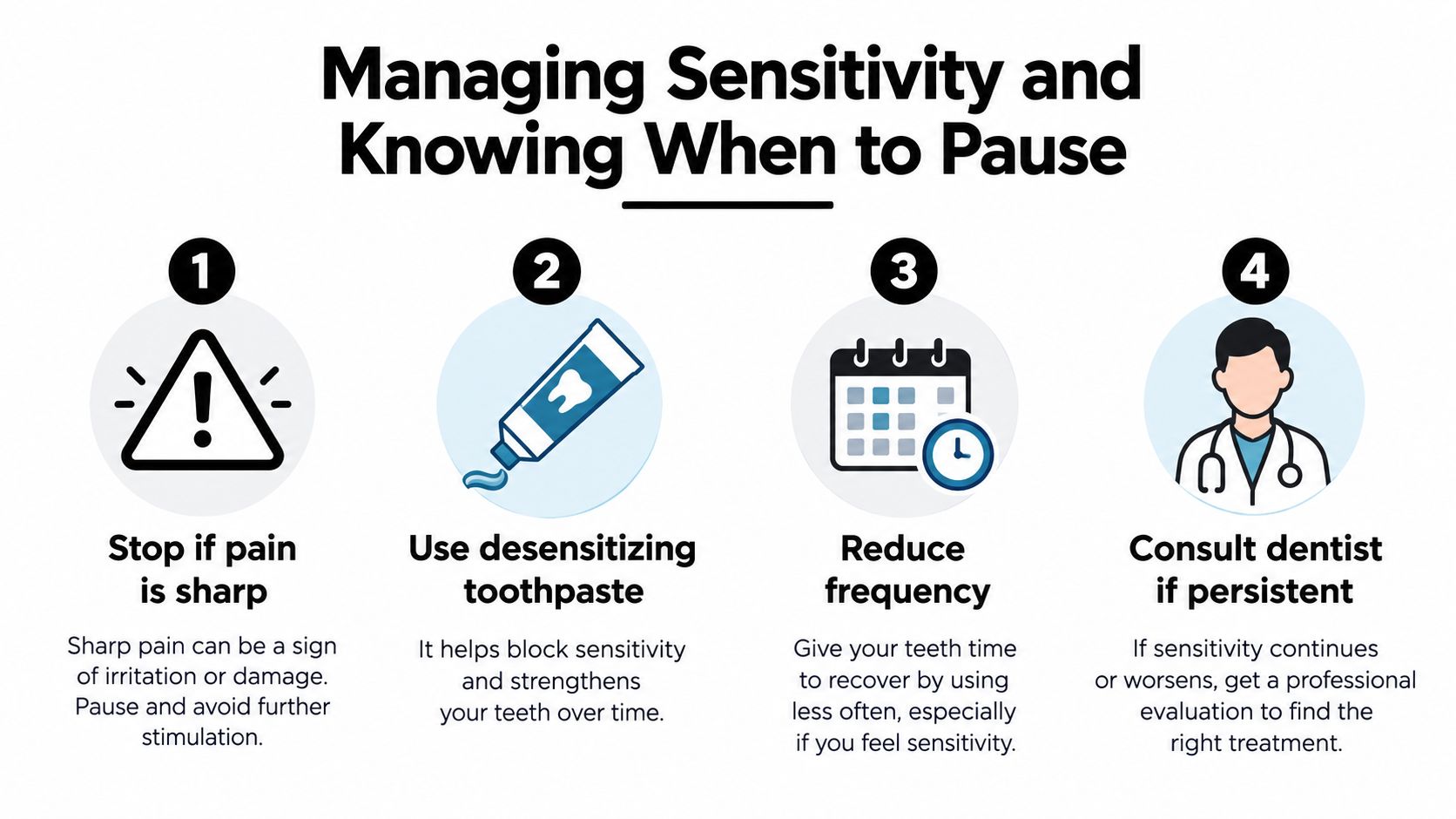
A short, mild zing can occur after whitening. Sharp pain that continues, pain focused on one tooth, or burning and whitening of the gum tissue deserves more caution. Don't treat severe discomfort as evidence that the gel is working better.
Reduce exposure by shortening the session only when the product instructions allow it, spacing treatments farther apart, or pausing until symptoms settle. If a tray leaves visible gel on the gums, use less gel and reassess the fit. If the irritation persists, stop the product and arrange a dental evaluation.
Stop rather than push through: Severe or persistent pain isn't a target outcome. It may indicate exposed dentin, recession, a defective restoration, decay, or excessive soft-tissue contact.
People with gingival recession, uneven enamel, cracks, untreated cavities, or active gum inflammation should be especially cautious. Whitening can make existing problems more noticeable, and bleaching won't correct structural causes of color variation. A dentist can determine whether the sensitivity comes from the product or from an underlying dental issue.
For shoppers who want a gentler approach, Mouthology's whitening guidance for sensitive teeth offers another resource for thinking through product choice and treatment comfort. You can also review practical steps for reducing tooth sensitivity after whitening before beginning a new routine.
A non-peroxide formula may be worth considering when comfort is the main concern. In a 2023 double-blinded clinical study, a peroxide strip caused significantly more sensitivity, oral burning, and soreness than a non-peroxide formulation, while the study found no significant difference in whitening effect between the two formulations, as described in the randomized study of peroxide and non-peroxide whitening strips. That result doesn't make non-peroxide products universally superior, but it does challenge the assumption that more peroxide always creates a better practical outcome.
Watch the video below for a visual reminder of how sensitivity can affect treatment decisions.
The Role of Remineralization and Aftercare
A whitening routine shouldn't end when the tray comes out. The immediate aftercare phase is when many users make avoidable mistakes, such as repeating treatment too soon, ignoring sensitivity, or returning to habits that quickly reintroduce surface staining.
Use a sensitivity toothpaste as part of the routine if your teeth react easily. Products built around ingredients such as potassium nitrate may help manage sensitivity for some users, while calcium and phosphate technologies are used in remineralizing products to support the mineral environment around enamel. These products don't erase the need for correct whitening instructions, but they can make a cautious routine easier to tolerate.
Protect the result you worked for
After each session, rinse away residual gel and follow the product's directions. Keep brushing and cleaning between the teeth, because plaque and surface deposits can make the smile look dull even after bleaching. A clean tooth surface also makes it easier to judge whether the whitening is producing an even result.
Don't use a whitening toothpaste as a substitute for bleaching if your goal is a substantial shade change. Abrasive polishing can remove some surface discoloration, but it doesn't solve every type of intrinsic color change. When sensitivity is present, aggressive scrubbing can make the experience worse.
A useful aftercare routine includes:
- Gentle cleaning: Use a soft brush and avoid force around receding gumlines.
- Sensitivity support: Select a toothpaste or rinse designed for reactive teeth when needed.
- Treatment spacing: Wait until discomfort has resolved before resuming, following professional or product guidance.
- Shade monitoring: Stop escalating if the change becomes uneven or a restoration becomes more obvious.
Learn how enamel mineral support fits into a broader oral-care routine with this guide to remineralization of teeth. The central point is simple: a brighter smile is only a successful result if the teeth and gums remain comfortable enough for normal daily care.
Choosing the Right Professional-Grade Kit
The right kit depends on the problem you're trying to solve. A busy buyer who wants a manageable routine may prefer a prefilled tray or a short-session hydrogen peroxide product. A sensitive-smile user may be better served by a lower-intensity protocol, careful fit, and a desensitizing toothpaste. Someone with heavy or persistent discoloration may need a dental assessment before spending more on increasingly strong home gels.
Match the format to the user
For a schedule-driven buyer, a prefilled tray can reduce measuring and cleanup. The benefit is not glamour or extra technology. It's a lower number of decisions between opening the package and completing the session.
For a sensitivity-prone buyer, look for clear wear-time instructions, a controlled tray, and a formula that doesn't force you to use the strongest available concentration. Brands such as Opalescence and PolaDay offer professional-oriented home whitening products, but the product name doesn't remove the need to follow the specific directions for that formulation.
For a buyer seeking a faster visible change, a hydrogen peroxide option may suit a short-session routine, provided the user accepts that sensitivity can follow treatment. A lower-concentration tray product can still contribute meaningful whitening, as the clinical evidence discussed earlier demonstrates. Speed should never be judged separately from whether you can repeat the routine comfortably.
For a buyer with uneven enamel or recession, fit comes first. A boil-and-bite tray may offer more coverage than strips, but it still needs to sit comfortably and keep gel away from vulnerable areas. If one tooth repeatedly hurts or the gums burn, stop experimenting with stronger products and seek dental advice.
What to check before adding a kit
- Active ingredient: Confirm the peroxide type and concentration.
- Application method: Look for a tray or strip that can contact the visible enamel evenly.
- Sensitivity instructions: Avoid products that leave you guessing how to modify treatment.
- Replacement supply: A repeatable gel system is more practical than a one-time gadget if you expect maintenance.
- Dental condition: Don't bleach over untreated pain, gum inflammation, or suspected decay.
Professional-grade options available through DentalHealth.com include Opalescence, Zoom, PolaDay, and PolaNight products, along with whitening trays, sensitivity care, and remineralizing products. The useful choice is the one that matches your anatomy and tolerance, not necessarily the one with the most aggressive specification.
A good teeth whitening kit smile comes from controlled contact, sensible exposure, and consistent aftercare. Start conservatively, monitor how your teeth respond, and change the format before just increasing the peroxide.
DentalHealth.com offers professional-grade at-home whitening gels and kits, including tray-based options, alongside sensitivity toothpastes and remineralizing products for a more complete routine. Visit DentalHealth.com to compare products from brands such as Opalescence, Zoom, and PolaDay and choose a format that fits your smile and sensitivity needs.