
Teeth Whitening Kit UV Light vs LED Kits That Work
If you're shopping for a teeth whitening kit UV light, you're probably asking the wrong first question.
A better question is, what in the kit is doing the whitening? That distinction matters because the glowing mouthpiece gets the attention, while the gel usually does most of the work.
The confusion starts with labeling. Many kits are marketed as “UV” even when they use blue or violet LED light, not true UV in the way many people imagine it. That marketing shortcut makes light sound more clinical and more powerful than it often is. It also leads shoppers to overvalue the device and overlook the parts that affect results more directly, like peroxide type, peroxide strength, tray fit, and how long the gel stays in contact with the teeth.
Early whitening systems helped build the idea that light activation was a breakthrough. A controlled clinical study from 2005 found that a lamp used with peroxide gel produced about 26% better immediate shade improvement, averaging 7.7 shade changes versus 6.1 for gel alone right after treatment, as summarized in this clinical evaluation of a whitening lamp and peroxide gel. That result helped popularize the whitening-plus-light model.
But the longer story is less dramatic. More recent reviews have questioned whether light adds a durable whitening benefit beyond the bleaching gel itself.
That's why it helps to compare UV-labeled kits, LED kits, and plain gel systems side by side instead of treating the light as the main event.
Introduction to Teeth Whitening Kits With Light
The appeal of a lighted whitening kit is easy to understand. A tray with a glowing blue mouthpiece looks advanced. A syringe of gel or a simple tray looks ordinary. Shoppers often assume the high-tech part must be the effective part.
That assumption doesn't hold up well once you separate appearance, chemistry, and evidence.
The feature people notice isn't always the feature that matters
Whitening happens when peroxide-based gel interacts with stain molecules in the tooth. The light is sold as an “activator,” but that doesn't automatically mean it creates a better end result. In many kits, the device mainly changes the ritual of treatment, not the core whitening chemistry.
Practical rule: If a product talks more about the lamp than the gel, pause and look closer at the actual whitening ingredient.
That doesn't mean every lighted kit is useless. It means you shouldn't treat “includes UV light” as proof of stronger whitening.
Why UV claims confuse shoppers
A second problem is language. Many consumers use “UV light” as a catch-all term for any whitening light, but consumer kits often use blue or violet LED light rather than true ultraviolet output. That makes online comparisons messy. You may think you're choosing between UV and non-UV, when you're really choosing between LED plus gel and gel alone.
Here's a quick buying view before we go deeper:
| Feature | UV Labeled Kits | Blue LED Kits | Non Light Gel and Tray Kits |
|---|---|---|---|
| Main whitening driver | Peroxide gel | Peroxide gel | Peroxide gel |
| Light source | Often marketed as UV, may not be true UV | Blue or violet LED | None |
| Why people buy it | Faster-looking results, gadget appeal | Convenience, modern kit format | Simplicity, focus on gel and fit |
| What matters most | Gel formula and safe use | Gel formula and safe use | Gel formula, wear time, tray fit |
| Key caution | Labeling can be misleading | Light benefit may be limited | Less flashy, but often straightforward |
What this article will help you decide
If you're trying to buy wisely, the useful questions are practical:
- Does light improve whitening at all
- When does peroxide strength matter more than the light
- Does a lighted kit raise sensitivity or safety concerns
- Who should skip the device and choose a plain tray-and-gel approach
Those answers are much more useful than a generic “UV whitening works” or “UV whitening is a scam” headline. Answer is narrower, and more helpful.
How Teeth Whitening Kits With UV Light Actually Work
Teeth whitening sounds mysterious until you break it into parts. A lighted kit usually has two components: the whitening gel and the light device. They don't play equal roles.
The gel does the chemical work
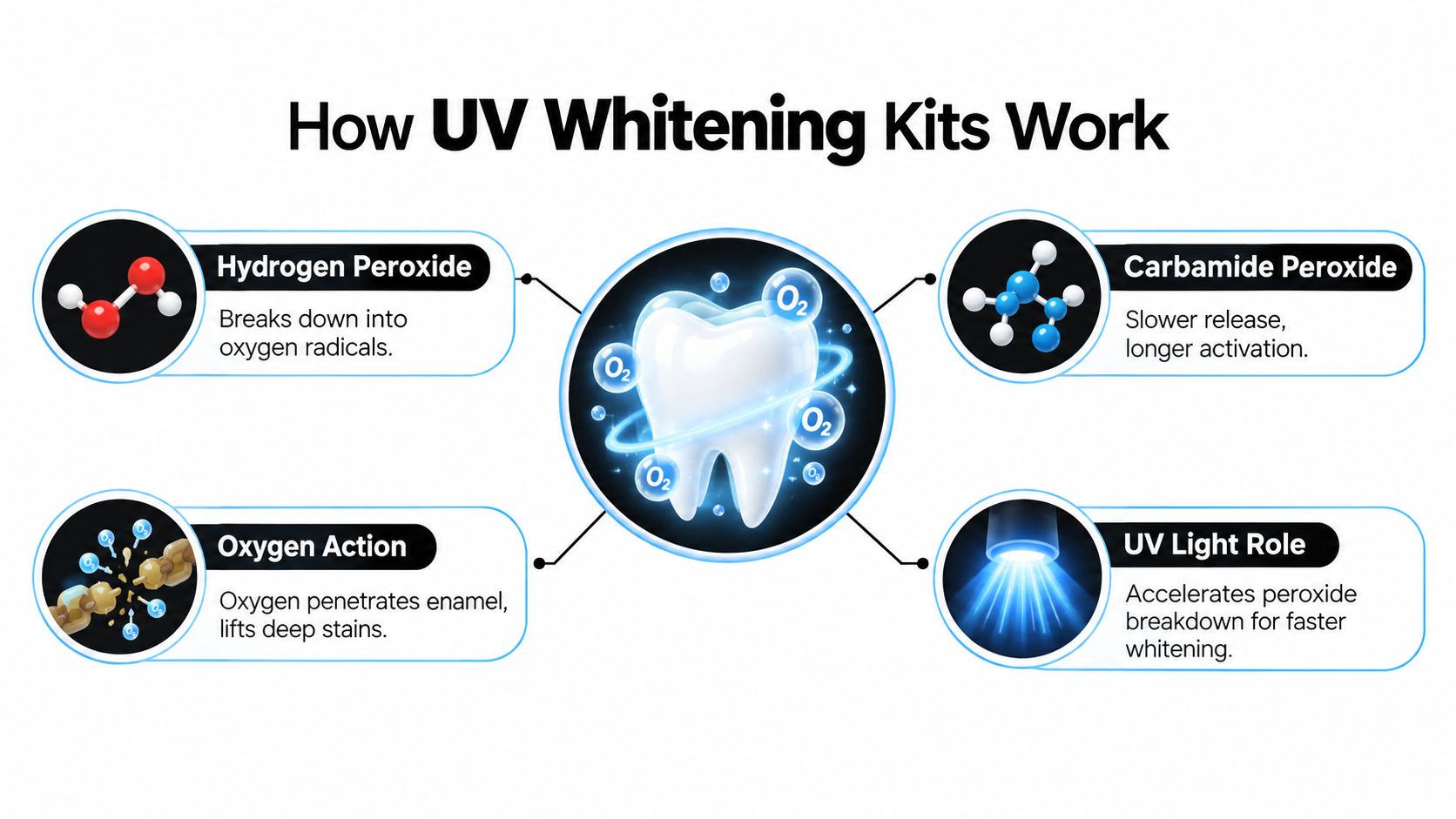
Most effective whitening kits use hydrogen peroxide or carbamide peroxide. Carbamide peroxide breaks down more slowly and releases hydrogen peroxide over time. In plain language, both are stain-lifting chemicals.
They work by releasing oxygen that interacts with discoloration inside the outer tooth structure. Think of stain molecules as dark tangles caught in tiny spaces. Peroxide helps break those tangles apart so the tooth looks lighter.
If you want a broader background on the science and common marketing claims around at-home light kits, this guide on at-home teeth whitening UV light is a helpful companion read.
What the light is supposed to do
Manufacturers usually present the light as a catalyst. The pitch is simple: the gel whitens, and the light helps it work faster by activating or accelerating the reaction.
That idea sounds plausible. It's also why many people assume the light is the reason a kit works. But chemically, the peroxide is still the active treatment. The light is an add-on, not the engine.
A useful shopping mindset is to separate these roles:
- Active ingredient: The peroxide gel changes tooth color.
- Delivery system: The tray, strip, or applicator keeps gel against enamel.
- Accessory feature: The light may try to speed the process, but it isn't the core bleaching agent.
Why tray fit and contact time matter more than the gadget
A whitening system only works well if the gel stays where it should. If the tray fits poorly, gel can miss parts of the tooth or spill onto the gums. If contact time is too short, even a decent formula may underperform.
That's why a plain tray-and-gel setup can sometimes outperform a flashy device. Better gel placement and steady wear time often matter more than whether the mouthpiece lights up.
The device may look like the treatment. The gel is usually the treatment.
The UV label often isn't literal
Many buyers get tripped up. A kit may be sold under the language of “UV whitening,” but most consumer systems are better described as visible-light LED devices, often in the blue or violet range. That doesn't automatically make them unsafe, but it does mean the label can exaggerate what you're getting.
So when you see a teeth whitening kit UV light, read it as a marketing category first, not a precise technical description.
Do UV and LED Lights Really Improve Whitening Results
If the light is the star of the ads, does it change the result on your teeth?
Sometimes a little. Often less than buyers expect.
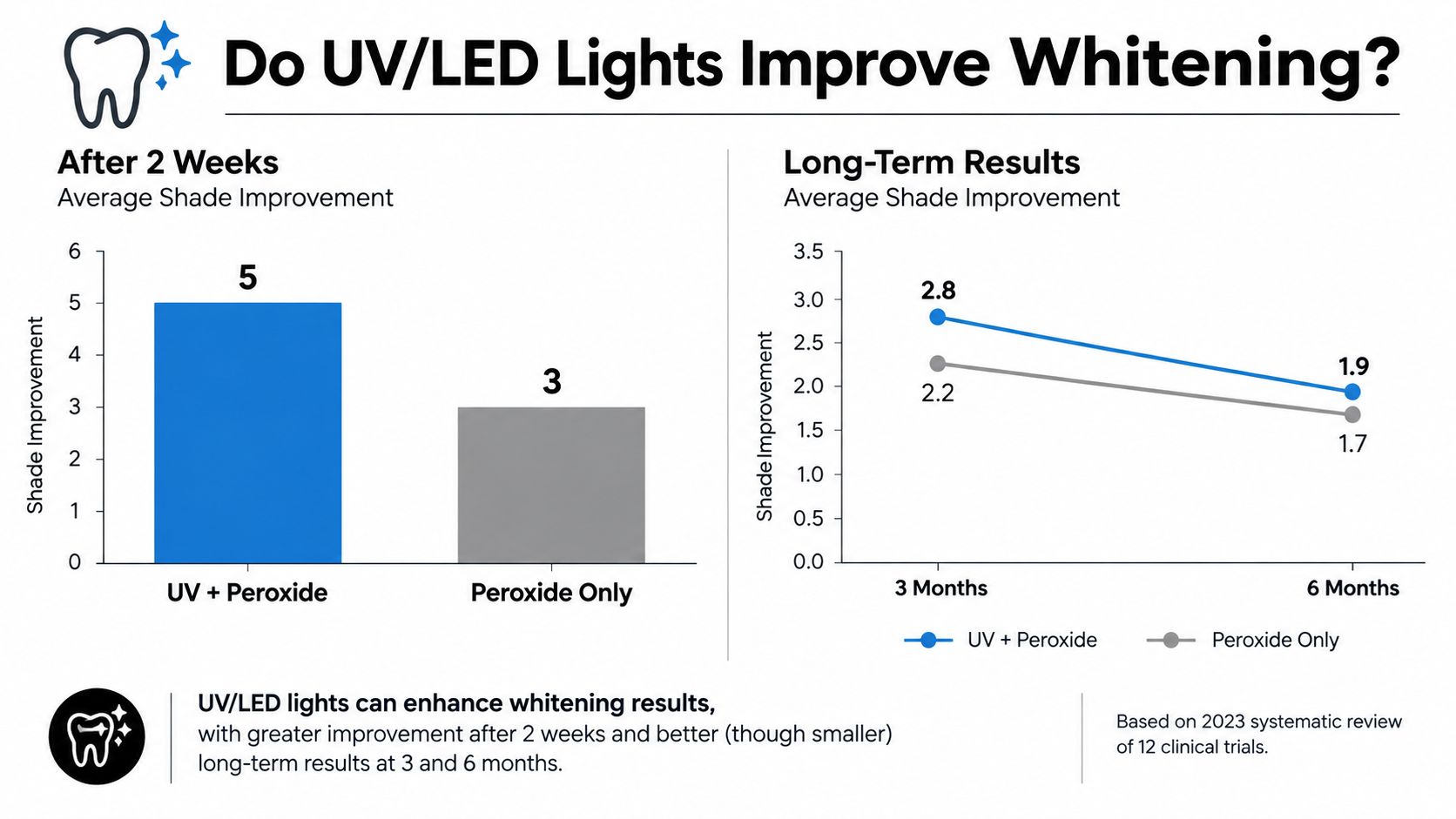
Clinical research points to a narrower role for light than marketing suggests. The main pattern is simple: peroxide does the bleaching, and light may change how quickly the teeth look brighter in some setups, especially right after treatment. It does not reliably turn a weak gel into a strong one, and it does not consistently produce a better long-term finish.
What the earlier clinical studies suggested
An often-cited early trial helped build interest in light-assisted whitening. In that study, the light-plus-gel group showed greater immediate shade change than gel alone, according to this PubMed record of the 2005 clinical evaluation.
That finding matters, but the timing matters just as much. Immediate improvement is not the same as a stronger end result a few weeks later. Whitening is a bit like drying paint with a fan. The fan can change the speed of what you notice first, but it does not change the paint itself.
What later reviews changed
Later reviews took a more cautious view. They found that any added whitening from light is often small, inconsistent, or short-lived, while tooth sensitivity may increase. A useful plain-language summary appears in this systematic review discussion of light-activated tooth whitening.
For a shopper, the practical question is not "Can light work at all?" It is "What am I paying extra for?" If the brighter look mainly shows up right after a session and fades as the teeth rehydrate and settle, the device may be adding theater more than lasting value.
Peroxide strength changes the answer
The buying advice gets more useful.
A review discussed in the source above found a pattern: with lower hydrogen peroxide concentrations, light may improve the immediate look after treatment. With higher peroxide concentrations, the added benefit from light becomes much less clear because the gel is already doing most of the work.
That helps explain why two kits can both advertise a light and still perform very differently. The better question is not whether a mouthpiece glows. The better question is how strong the peroxide is, how evenly it contacts the teeth, and how long it stays there.
What newer lab evidence says about the core claim
A later laboratory analysis tested the basic premise behind light-assisted bleaching across a broad optical range and found no improvement in bleaching efficacy from irradiation itself compared with bleaching without light, as described in this Royal Society of Chemistry paper on light-assisted tooth bleaching.
That does not prove every lighted kit is useless. It does narrow the claim. A blue LED device may support the treatment ritual, the timer, or the perception of a faster session. It is less convincing as the reason whitening happens.
If you want a closer look at the blue-light side of the category, this guide on whether LED teeth whitening kits work examines that question directly.
A short video can also help make the distinction between marketing and mechanism easier to grasp:
The practical takeaway
Most "UV" kits sold online are LED kits, and the light usually plays a supporting role.
For many buyers, the most realistic view is this:
- Light may help some lower-peroxide systems look brighter right away.
- Higher-peroxide gels often rely far more on chemistry than on light.
- Lasting results usually depend more on formula, tray fit, contact time, and how your teeth respond.
- If you are prone to sensitivity, extra light exposure is not a reason by itself to expect a better payoff.
The shopping lesson is straightforward. Treat the light as an accessory feature, not the core treatment.
UV Light vs LED vs Non Light Kits Compared Side by Side
The easiest way to compare kits is to stop grouping them by hype and start grouping them by how they deliver peroxide.
UV Light vs LED vs Non Light Whitening Kits at a Glance
| Feature | UV Labeled Kits | Blue LED Kits | Non Light Gel and Tray Kits |
|---|---|---|---|
| Whitening mechanism | Peroxide gel plus marketed light activation | Peroxide gel plus visible-light LED | Peroxide gel alone |
| What the label often means | “UV” may be a marketing label rather than true UV output | Usually a more accurate description of the device | No light claim at all |
| Evidence for added whitening from light | Mixed and often short-term | Similar limitation. Light often adds little beyond gel | Depends on gel quality, fit, and wear time |
| Simplicity | Extra device, charging or battery steps | Extra device, usually simpler than UV-labeled formats | Straightforward routine |
| Portability | Less convenient | Moderately convenient | Often easiest for travel if tray-based |
| Sensitivity concerns | Depends on gel and protocol, plus added exposure concerns | Depends on gel and protocol | Mostly tied to peroxide strength and fit |
| Best fit for | Buyers drawn to gadget-style kits | Buyers who like a guided ritual | Buyers who care more about chemistry than accessories |
What actually separates these categories
The biggest difference isn't mystical light technology. It's often how much attention the product gives to the right variables.
A non-light tray system with a solid peroxide gel and better fit can produce a more predictable result than a weaker gel packaged with a dramatic-looking mouthpiece. Many shoppers miss that because the device is visible and the gel details are small-print.
The glow tells you how the kit is marketed. The gel tells you how the kit whitens.
Buying trade-offs that matter in real life
When people use whitening kits at home, these practical issues usually matter more than whether the box says UV:
- Tray quality: A better fit means better gel contact and less gum spill.
- Routine friction: If you have to charge, sync, or add multiple steps, you're less likely to use the kit consistently.
- Storage and travel: Plain syringes, strips, or trays are often easier to keep in a bathroom drawer or pack for a trip.
- Maintenance use: For occasional touch-ups, a simple system may be easier to repeat.
If you're comparing actual product formats rather than just light claims, this roundup of teeth whitening product options can help narrow the field.
Where a gel-only kit can be the smarter choice
A lot of people assume non-light means old-fashioned or less effective. That's not necessarily true. If the peroxide is appropriate and the application is controlled, a gel-and-tray kit can be the more rational purchase.
That's especially true for someone who wants:
- consistent wear time
- fewer device steps
- less dependence on marketing language
- more control over sensitivity management
In other words, simple doesn't mean weak. Sometimes it means the product is focused on the part that matters.
Safety Sensitivity and UV Exposure What to Watch For
Should a whitening light make you worry about safety, or just make you read the label more carefully?
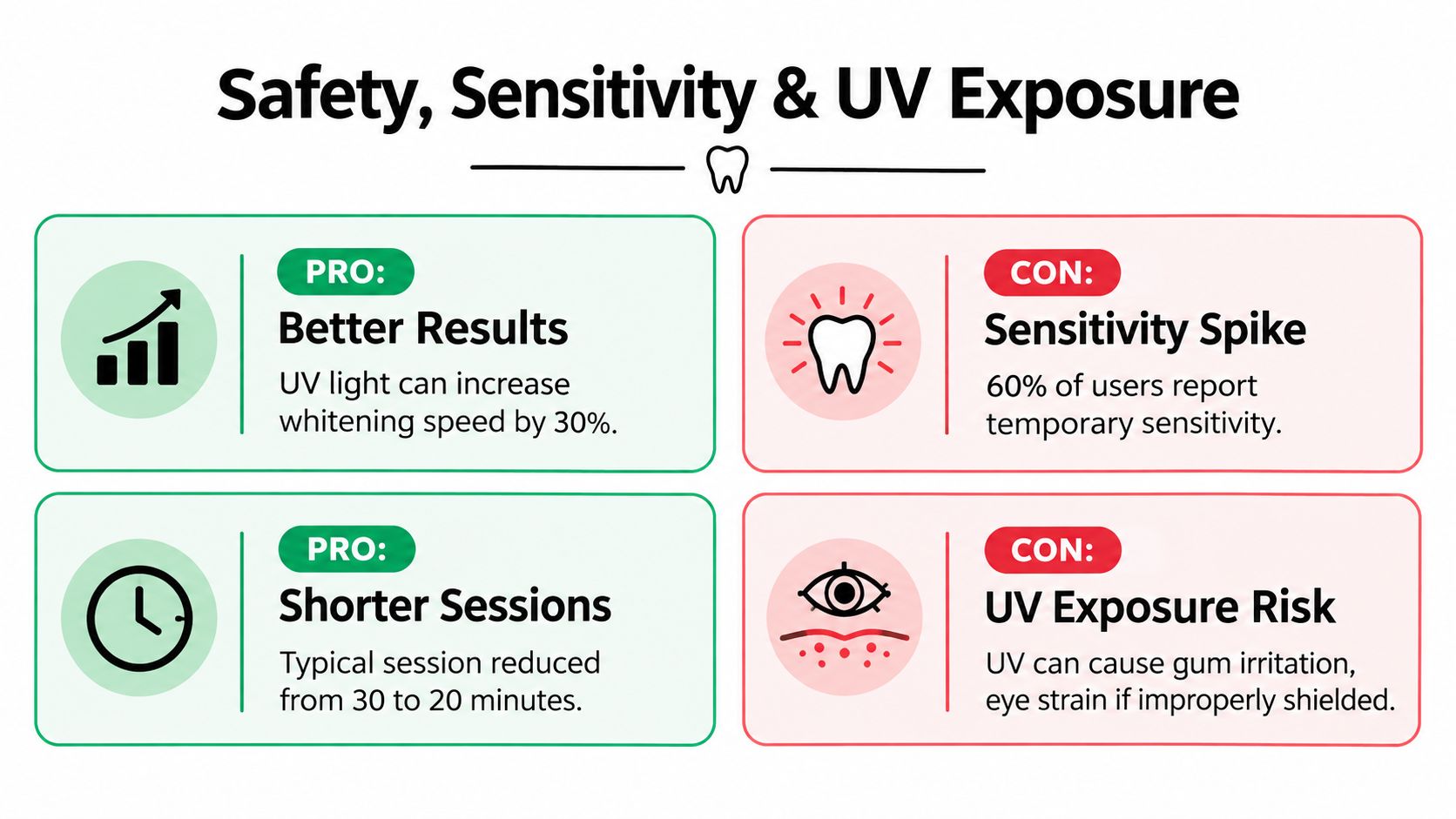
For most at-home kits, the bigger issue is not dramatic UV danger. It is whether the product combines peroxide, tray fit, wear time, and light in a way your teeth can tolerate. That distinction matters because many kits marketed as "UV" use blue LED light, and those are not the same thing.
Sensitivity usually comes from the whitening chemistry first. Peroxide can pass through enamel and temporarily irritate the nerve inside the tooth, which is why zingers, cold sensitivity, or a dull ache can show up during a whitening cycle. Light may add heat or extra exposure time in some systems, but it does not automatically make a kit stronger or better.
As noted earlier, research on light-assisted whitening has not shown a consistent whitening advantage, while sensitivity can still increase in some protocols. A more recent clinical review also found that light type, peroxide formula, and treatment setup all affect comfort, which is why two "light" kits can feel very different in real use. You can read that review here: review of sensitivity and light-based protocols.
The light question is separate from the chemistry question.
If a company says "UV" but does not clearly state the wavelength, device type, or eye protection guidance, read that as a labeling problem. Many consumer kits use visible blue light, not true ultraviolet light. That does not mean the product is unsafe by default. It does mean you should be careful with brands that use UV language mainly as a marketing shortcut, especially if they are vague about what the light is doing.
A simple way to judge risk is to separate the parts of the kit like you would separate ingredients from packaging on a food label. The gel does the bleaching. The tray controls where the gel sits. The light is an add-on that may change the experience more than the result.
Use extra caution if any of these apply:
- You already have sensitive teeth: Start with a lower-intensity routine and shorter wear times.
- Your gums get irritated easily: Overflowing gel and poorly fitting trays are common causes.
- You have untreated cavities, cracked teeth, or gum inflammation: Whitening can make those problems hurt more.
- The brand is vague about its "UV" claim: Clear device details matter more than glowing product photos.
- You have light sensitivity or take photosensitizing medications: Ask your dentist before using a lighted system.
A patient-friendly overview like Is teeth whitening safe can help if you want a broader safety checklist before starting.
Lowering risk is usually straightforward.
- Use the smallest amount of gel that still covers the tooth surface.
- Stop or shorten sessions if sensitivity starts building day to day.
- Keep gel off the gums as much as possible.
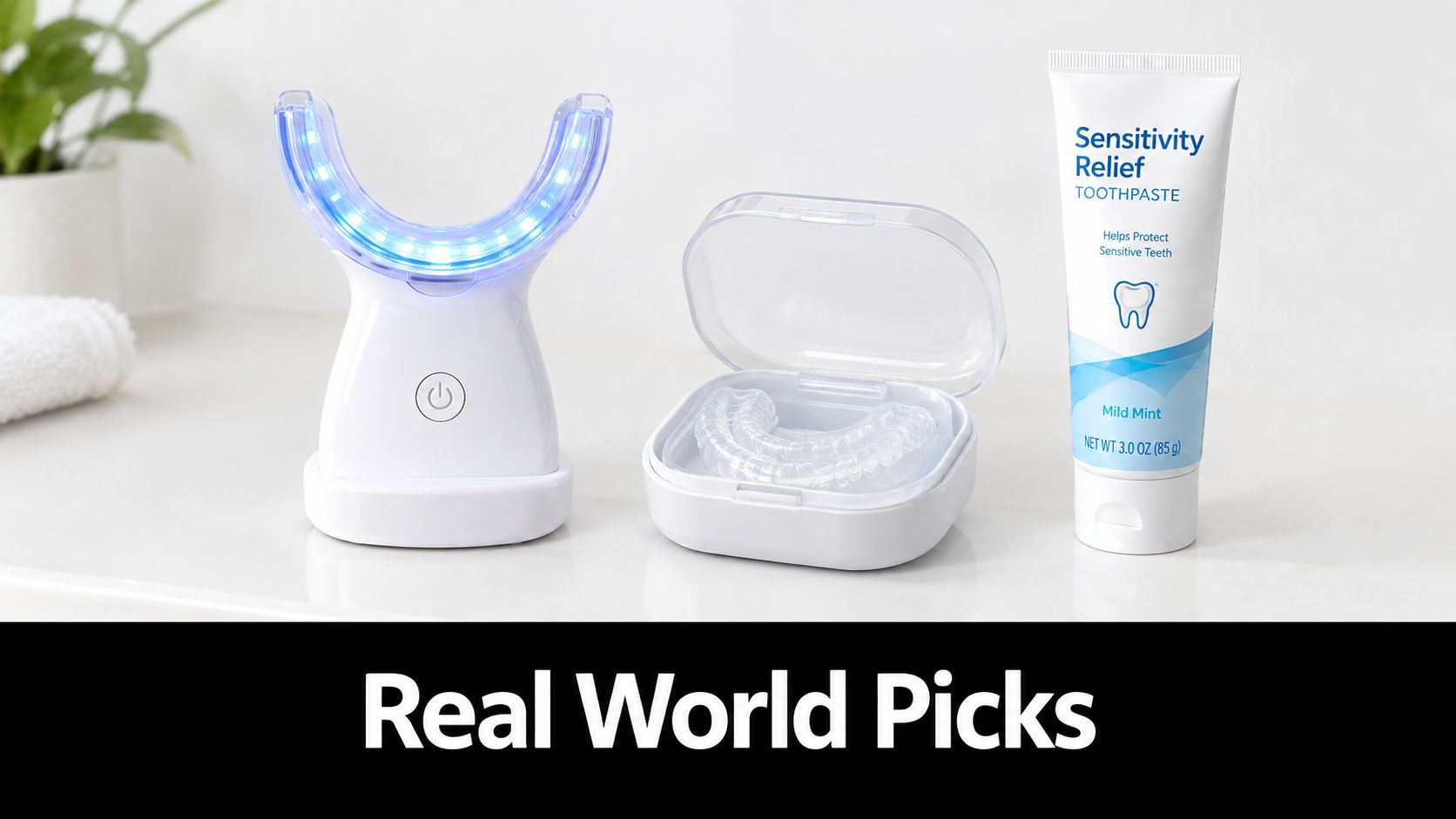
- Use a sensitivity toothpaste with potassium nitrate or fluoride during the whitening period.
- Skip unclear "UV" devices if the brand cannot explain the light source plainly.
The practical takeaway is simple. If your teeth whiten well with peroxide alone, a light is often optional. If your teeth are already reactive, adding a poorly explained light feature is usually the first thing to question, not the last.
Which Kit Fits Your Needs Real World Use Cases
The right whitening kit depends less on trends and more on what you're trying to solve.
First-time whitener with sensitive teeth
If you've never whitened before and your teeth already react to cold, a simple non-light system usually makes more sense than a gadget-heavy kit. You're trying to learn how your teeth respond. Adding a light at the same time makes that harder to judge.
A slower tray-based or strip-based approach also gives you more room to pause, shorten wear time, or switch to a sensitivity toothpaste if needed.
Coffee or wine stain maintenance
For routine touch-ups, convenience matters. A blue LED kit can fit this kind of user if they like the ritual and understand the light may add little. A plain gel or tray can work just as well for many people if they care more about repeatable maintenance than the device experience.
This is one place where product ecosystems can help. DentalHealth.com carries professional-grade at-home options such as whitening gels, tray-based systems, and sensitivity-support products like MI Paste Plus, which can be relevant for people who want a simpler maintenance setup rather than a UV-style gadget.
Fast cosmetic refresh before an event
If you want a brighter look for photos, a reunion, or a wedding, the appeal of light is strongest here. Some people do see a more dramatic immediate appearance right after treatment, which is part of why these kits remain popular.
The trade-off is that a quick visual pop isn't the same as a clearly stronger lasting result. If speed matters more than elegance of evidence, a lighted kit may still feel worthwhile to you. Just go in with realistic expectations.
Someone who already trusts professional gels
If you already use dentist-recommended gels or know you do well with tray whitening, you may not gain much by adding a lamp. Many experienced users prefer to control the variables they know matter: gel type, amount, tray fit, and timing.
That group often gets the most value from keeping the routine plain and consistent.
How to Choose and Use Your Whitening Kit Safely
A good buying decision comes from checking a few variables in the right order.
What to check before you buy
Start with the parts that affect results most:
- Peroxide ingredient: Look for hydrogen peroxide or carbamide peroxide.
- Delivery method: Strips, trays, or pens should keep gel where it belongs.
- Light description: If a kit says UV, verify whether it's LED.
- Your sensitivity history: If your teeth are reactive, don't choose the most aggressive-looking system by default.
- Instruction clarity: Clear wear times and dosing matter more than dramatic packaging.
How to use the kit without making it harsher
Keep the routine controlled and boring. That's usually the safest path.
- Brush gently first so the teeth are clean.
- Apply only the amount of gel directed for the tray or applicator.
- Keep gel off the gums as much as possible.
- If the kit includes a light, use it only for the stated session length.
- After whitening, give your teeth a break from very hot or very cold foods if they feel reactive.
When to pause and when to ask a dentist
Stop the course if you get lingering pain, marked gum irritation, or sensitivity that keeps building from one session to the next. Whitening should be temporarily annoying at most, not something you push through blindly.
The clearest decision rule is simple. If you like the ritual of a blue-light device and understand that the gel is still doing most of the work, a lighted kit can be a reasonable choice. If you want the most straightforward evidence-based purchase, a well-designed non-light peroxide system is often the cleaner answer.
If you want to shop this category without getting lost in gadget marketing, DentalHealth.com offers professional-grade at-home whitening gels, kits, and sensitivity-care products from brands commonly used in dentist-directed routines. It's a practical place to compare tray-based systems and lighted options side by side, especially if you want to focus on peroxide formula, comfort, and maintenance rather than just the glow of the device.