
Toothpaste with Fluoride: How to Choose the Right One
In a 2024 survey of parents published in the Journal of the Korean Academy of Pediatric Dentistry, 40.5% of children used low-fluoride formulations, even though most used fluoride toothpaste. That distinction matters: choosing toothpaste with fluoride isn't just a yes-or-no decision. The strength on the label, the amount on the brush, and what happens after brushing all deserve attention.
A household can often share a toothpaste, but not everyone should use it in the same way. An adult choosing everyday cavity protection, a child who hasn't learned to spit, and someone whose dentist keeps finding decay need different practical instructions.
Fluoride Levels on the Label and What They Deliver
Choose by fluoride concentration, not by flavor, foam, or the size of the word “protection” on the packaging. Look for parts per million, usually shortened to ppm. This describes the fluoride concentration, not how much toothpaste to squeeze onto the brush.
A Cochrane review of fluoride toothpaste concentrations found reduced caries increments with 1,000 to 1,250 ppm toothpaste, with a standardized mean difference of −0.28 across 55 studies, and with 1,450 to 1,500 ppm, with a standardized mean difference of −0.36 across four studies. It also found a modest additional benefit for the higher of those everyday concentration bands.
Fluoride concentration bands and their evidence
| Fluoride level (ppm) | Reported caries effect | Practical use |
|---|---|---|
| 550 or below | No statistically significant benefit over placebo in the concentration analysis | Not a dependable cavity defense on its own |
| 1,000 to 1,250 | Demonstrated cavity-prevention benefit; standardized mean difference −0.28 | An evidence-supported everyday fluoride concentration |
| 1,450 to 1,500 | Standardized mean difference −0.36; modest extra benefit over the lower everyday band | Adult benchmark for daily brushing |
| 2,400 to 2,800 | Greater preventive effect reported in the higher-concentration analysis | Higher-risk mouths, under dentist advice |
The table isn't a scorecard in which the largest number automatically wins. Your age, ability to spit, and recent history of decay help determine which product makes sense.
What the evidence numbers mean
A standardized mean difference, or SMD, lets reviewers combine results measured on different scales. It isn't a percentage reduction in cavities. A negative value here means less new decay in the fluoride group than in the comparison group.
A prevented fraction, used in other toothpaste analyses, describes a proportional reduction in caries. Don't compare an SMD directly with a prevented-fraction percentage. They're different ways of reporting an effect, not interchangeable units.
Shopping rule: Check the strength before comparing whitening claims, flavors, or packaging. A product can sound protective without containing the fluoride concentration you're looking for.
Match the tube to the person
Start by finding the fluoride concentration on the back of the tube or carton. Then check who will use it and whether a dentist has recommended a particular strength.
Don't assume “children's toothpaste” identifies the concentration. That wording may tell you more about flavor and packaging than about cavity protection. Likewise, a product marketed for adults isn't automatically appropriate for someone who needs a dentist-directed regimen.
If the label lists an active ingredient but you can't find a clear fluoride concentration, don't guess from the ingredient name alone. Ask a pharmacist or dental professional to help identify the strength before buying.
How Fluoride Works Inside Your Mouth
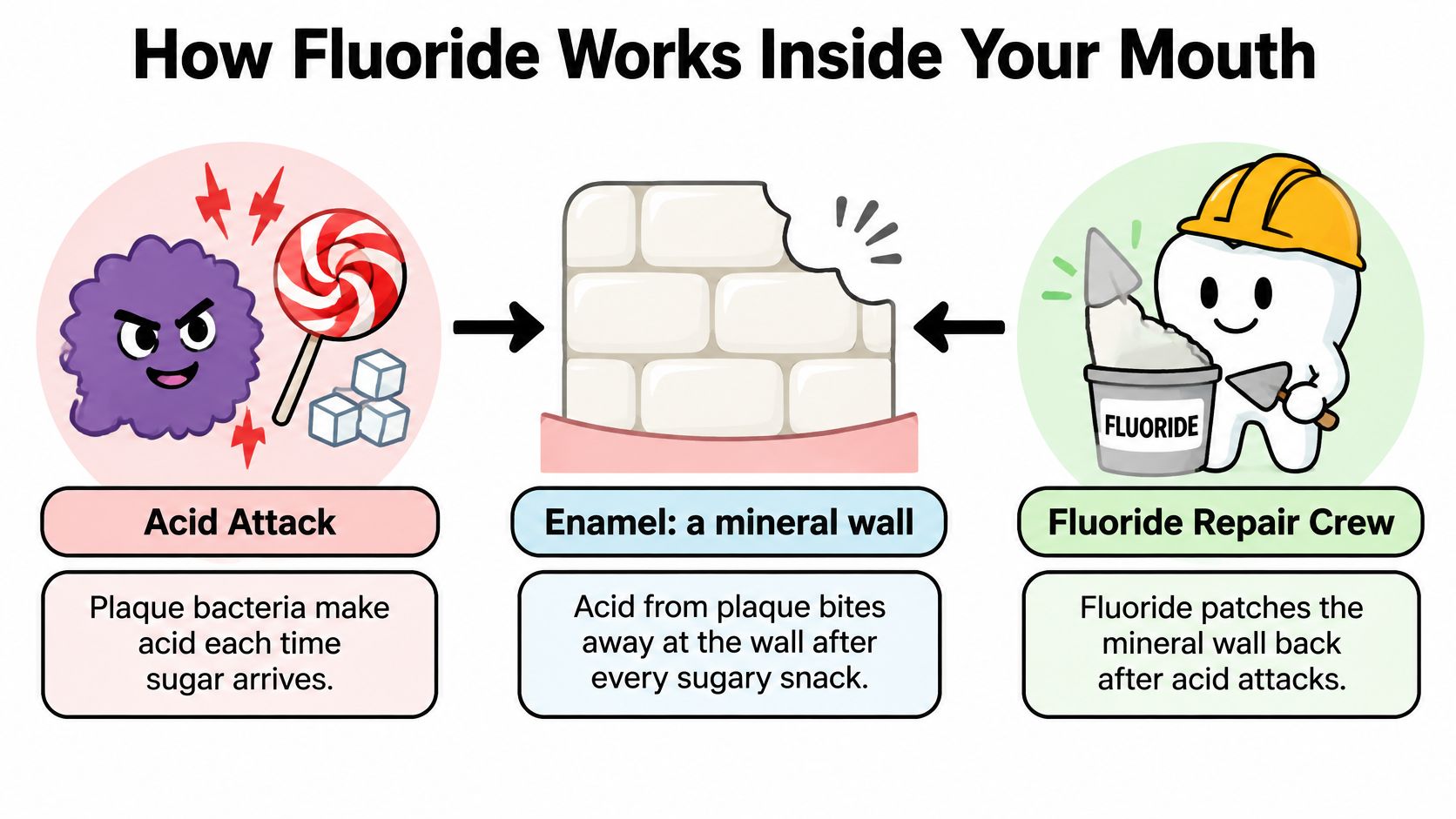
Say you eat a sugary snack. Plaque bacteria use the sugar and produce acids, which can dissolve minerals from the outer surface of your teeth. This process can start before there's a visible hole or any pain.
Think of enamel as a mineral wall. Acid removes some of its building material, while saliva and fluoride help create conditions for mineral repair. The useful part of the analogy is the ongoing exchange: enamel isn't protected once and then left unchanged.
The illustration shows that acid-and-repair cycle.
From mineral loss to early repair
During brushing, toothpaste releases fluoride into the mouth. Some remains available in saliva and plaque, where it supports remineralization, the replacement of minerals in early weakened enamel.
Fluoride also inhibits acid-driven mineral loss and affects bacterial metabolism. That doesn't make sugary snacks harmless, and it doesn't mean toothpaste can fill an established cavity. Early mineral damage and a hole that needs dental treatment aren't the same problem.
This distinction explains why prevention can be happening even when you don't feel anything. You shouldn't expect a sensation that tells you fluoride is working. For a closer explanation of that process, see how fluoride strengthens teeth.
Fluoride toothpaste supports early enamel repair. It isn't a substitute for treating a tooth that has already developed a cavity.
Why the ingredient name isn't the strength
The active ingredient may look different from one tube to another:
- Sodium fluoride supplies fluoride through a sodium-containing compound. Check the separate fluoride concentration rather than treating the ingredient name as a dose.
- Stannous fluoride is a tin-containing fluoride compound. Its presence identifies the formulation, but you still need to check the product's intended use and strength.
- Sodium monofluorophosphate is another fluoride-containing compound used in toothpaste. Its full chemical name doesn't mean the toothpaste is stronger than one with a shorter ingredient name.
The ppm figure refers to fluoride, not the total weight of whichever compound carries it. That matters when one carton emphasizes an ingredient percentage and another displays ppm prominently. Those labels aren't necessarily describing the same measurement.
The practical aim is regular topical exposure, meaning contact with the teeth. Swallowing toothpaste isn't how you obtain that local benefit, and loading the brush heavily doesn't turn a single brushing session into lasting protection. What you leave available on the tooth surfaces matters more than how much foam you make.
How Much Fluoride Toothpaste Prevents Cavities
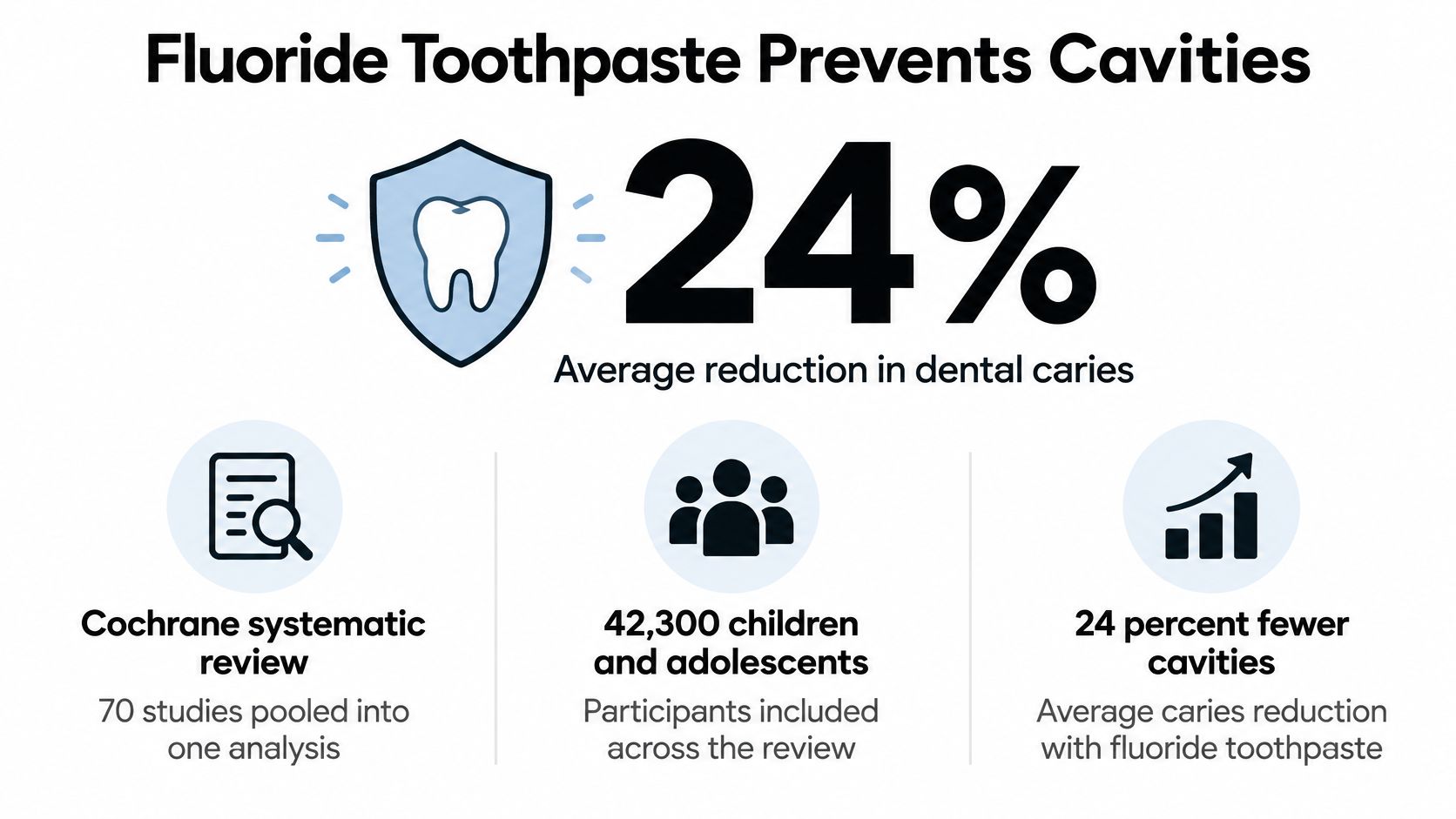
Fluoride toothpaste reduced dental caries by an average of 24% compared with non-fluoride toothpaste in children and adolescents in a Cochrane systematic review, whose main analysis included 70 studies involving 42,300 children. The pooled estimate had a 95% confidence interval of 21% to 28%, with P < 0.0001.
That's a meaningful prevention finding, but it doesn't mean every child will have exactly that much less decay. Nor does it mean that percentage of children will avoid cavities altogether. The finding describes an average reduction in the review's caries outcome across groups.
The headline result is summarized below.
Why baseline cavity risk changes the benefit
The review translated the findings into an estimate based on how much decay children were developing without the intervention. Where the average annual increase was 2.6 decayed, missing, or filled tooth surfaces, approximately 1.6 children needed to use fluoride rather than non-fluoride toothpaste to prevent an additional affected surface. Where the annual increase was 1.1 surfaces, the corresponding estimate was 3.7 children.
These are group-level calculations, not instructions involving fractions of a child. They express how many children would need the intervention, on average, to prevent an additional affected tooth surface under those conditions.
A tooth surface also isn't the same thing as an entire tooth. Teeth have multiple surfaces, and research can count affected surfaces rather than counting only teeth with cavities.
- Higher underlying disease means there's more decay available to prevent, so the absolute benefit can be greater.
- Lower underlying disease doesn't make prevention pointless. It changes the amount of additional disease prevented.
- An average benefit doesn't guarantee a particular outcome for an individual child.
What the finding can and can't tell an adult
The headline analysis covers children and adolescents. Applying that exact percentage to an adult would go beyond the population studied.
An adult can still use fluoride toothpaste as part of preventive care without claiming that the same numerical result has been established for their mouth. The important distinction is between the reason to use a product and a promise about its precise effect.
For a family, the useful conclusion is straightforward: toothpaste with fluoride offers protection beyond brushing with non-fluoride toothpaste. Choose an evidence-supported concentration, then make its use a dependable daily habit. Occasional use before a dental appointment isn't equivalent to a routine that continues between appointments.
How Much to Use at Each Age
The same tube may serve different family members, but the amount and supervision should change with the user. A young child's difficulty spitting is a reason to control the dose carefully, not a reason to cover the brush and hope they manage.
Set out the right brush and dispense the toothpaste yourself when a child can't yet judge the amount.
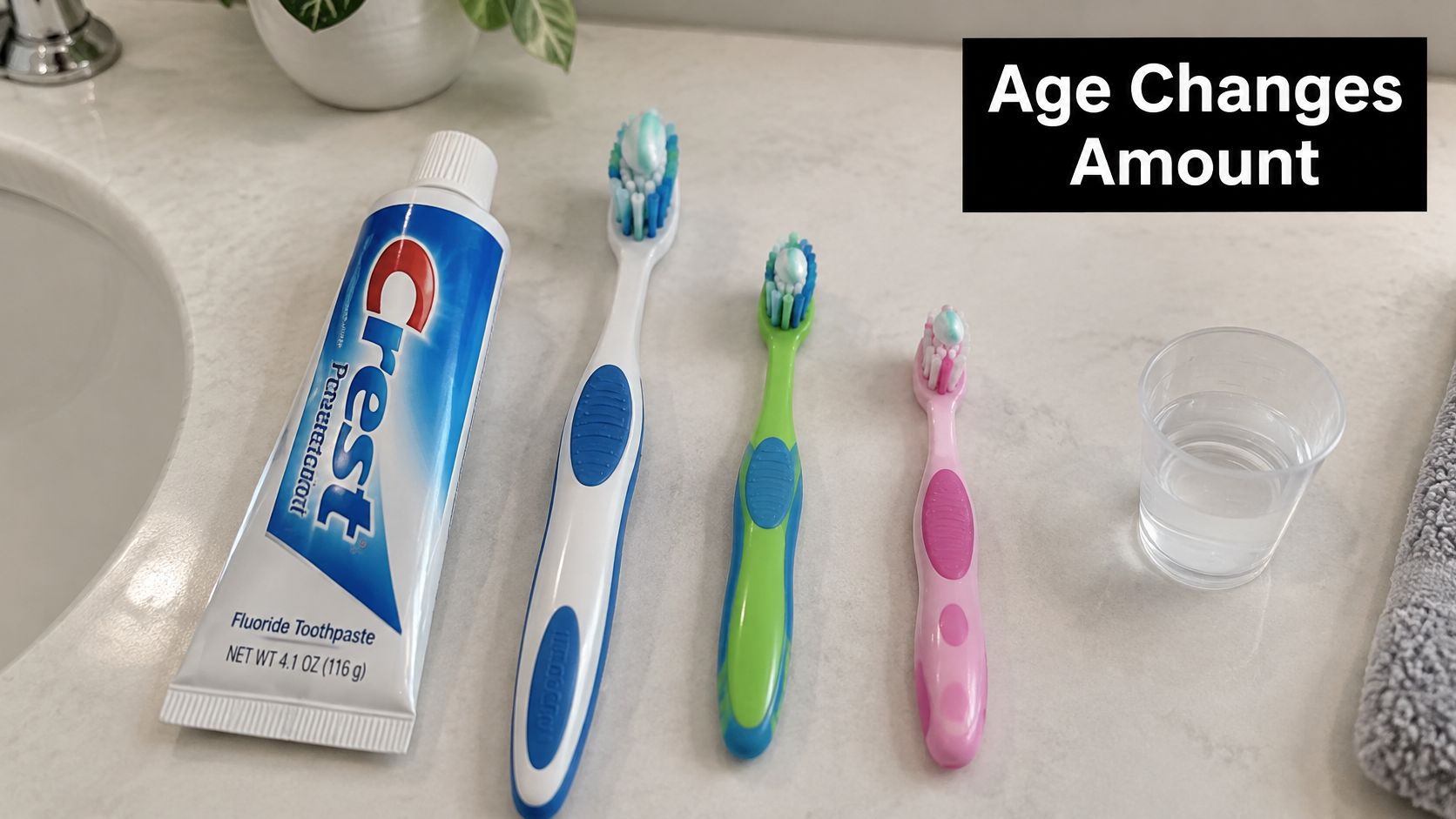
The WHO fluoride-toothpaste document recommends 1,000 to 1,500 ppm fluoride toothpaste and twice-daily brushing, with a small amount for children under 6 and avoidance of post-brushing rinsing for older children and adults.
Toothpaste amount, rinsing and supervision by age
| Age group | Amount to use | Rinse or spit | Supervision |
|---|---|---|---|
| Under 3 years | Smear, about a grain of rice | Encourage spitting when able; don't require rinsing | Adult brushes and watches every time |
| 3 to 6 years | Pea-sized | Spit; keep any rinsing minimal | Adult supervises and helps |
| 7 years and older | Pea-sized | Spit, avoid rinsing | Child brushes; adult checks |
| Adults | Pea-sized | Spit, avoid rinsing | Independent brushing unless assistance is needed |
Supervision means more than watching
For a young child, the adult should control the tube and do the brushing. As the child takes over, check that they reach the back teeth and the tooth surfaces near the gums instead of moving the brush across the front teeth.
Don't make swallowing control a test the child has to pass immediately. Use a small, controlled amount, demonstrate spitting, and keep practice calm. A child who enjoys the flavor may need the tube kept out of reach between brushing sessions.
For help comparing child-focused options, use the guide to pediatric dentist-recommended toothpaste. Product selection should support the routine, not replace hands-on help.
This video offers another way to review the brushing routine together.
If your child routinely swallows toothpaste
The concern is repeated excessive ingestion during tooth development, which can contribute to dental fluorosis. That's different from the intended topical use of toothpaste.
For parents: Dispense the toothpaste before handing over the brush. Controlling the amount is more reliable than repeatedly telling a young child not to swallow.
Reduce an overfilled brush to the appropriate small amount, supervise every session, and ask the dentist to review the child's fluoride plan. Mention other fluoride products the child uses so the advice accounts for the whole routine.
For older children and adults, finish by spitting rather than washing the mouth thoroughly with water. You don't need a mouthful of foam to remain. The goal is to avoid immediately washing away the fluoride left after brushing.
Choosing Fluoride Toothpaste for Your Mouth
Choose the toothpaste for the problem you're trying to manage, not for the longest list of claims on the carton. Sensitivity, recurrent decay, and enamel erosion can overlap, but they're not interchangeable diagnoses.
A sharp response to cold might lead you toward a sensitivity toothpaste. A dentist finding repeated new cavities may lead to a different concentration. If you're unsure which problem you have, a stronger product isn't a substitute for finding out.
Fluoride approach by oral-care need
| Oral-care need | Fluoride approach | What to check |
|---|---|---|
| Sensitive teeth | Fluoride paste with a desensitizing agent | Named desensitizer and specific sensitivity directions on the label |
| Enamel erosion or early white spots | Everyday adult-strength fluoride paste, with stronger products only if advised | Dentist assessment of erosion or early lesions |
| Dry mouth | Fluoride paste, possibly higher strength | Dentist advice on dry-mouth cavity risk |
| Braces or other appliances | Fluoride paste with careful cleaning around brackets | Orthodontist advice on the cleaning routine |
| High cavity risk | Higher-strength fluoride when indicated | Dentist-directed concentration and instructions |
| Preference for fluoride-free | No topical fluoride from that toothpaste | Dentist review before switching |
Match the claim to the ingredient
A sensitivity toothpaste combines cavity protection with an ingredient intended to reduce discomfort. Look for a named desensitizing active ingredient rather than assuming that “gentle,” “enamel care,” or a mild flavor means the same thing.
Don't keep treating unexplained pain by changing toothpastes. Pain when biting, persistent sensitivity in a particular tooth, or discomfort that doesn't settle deserves an examination.
White spots also need interpretation. An early area of mineral loss isn't the same as established erosion, and neither should be diagnosed from a bathroom mirror alone. A dentist can distinguish these changes and decide whether your toothpaste needs changing.
Toothpaste can't do every cleaning job
With braces, angle the brush carefully around brackets and along the gumline instead of relying on a protective product to compensate for missed plaque. With dry mouth, tell the dentist about the dryness itself, including when it started and any medicines you're taking.
Hardened deposits need a different approach from soft plaque. Dr. Michael's Dental Clinic explains professional care to remove plaque and tartar buildup, a useful distinction when teeth still feel rough despite regular brushing.
- For recurrent cavities, bring your current toothpaste or a photograph of its label to the appointment.
- For dry mouth, ask whether your current prevention routine matches the change in your mouth.
- For a fluoride-free preference, discuss what protection you're removing and how your dentist assesses your risk.
Don't add a stronger toothpaste because a family member uses one. If your need doesn't fit a clear category, arrange a dental check before buying a high-strength or fluoride-free replacement.
Fluoride Toothpaste Myths to Drop
A toothpaste label gives two useful clues: fluoride concentration and the directions for use. Neither should be read alone. The ppm figure helps identify a product's strength, while the amount dispensed, rinsing routine, and the user's age and cavity risk determine how it fits into everyday brushing.
Fluoride toothpaste is widely used for prevention, but a higher concentration is not automatically a better match for everyone. Children and adults need different guidance on amount and supervision, and products prescribed for stronger protection should be used as directed.
Common assumptions worth correcting
- Higher ppm is always better. Concentration is one part of the choice, not a reason to pick the strongest product by default. Match it to cavity risk and the user's ability to avoid swallowing toothpaste. Follow the dentist's directions for products intended for higher-risk patients.
- Fluoride matters only for children. Adults can benefit from fluoride as part of a preventive routine, too. Choosing toothpaste only for breath or stain removal overlooks the role of fluoride in everyday brushing.
- Rinsing thoroughly makes brushing more effective. A completely rinsed-out feeling is not the goal. Spit as directed, and follow age-appropriate advice about rinsing rather than treating all remaining toothpaste as dirt.
The point is sensible use, not worry. A suitable amount and routine matter more than making brushing feel stronger or cleaner.
Separate a sensible precaution from a warning sign
Parents may hear about fluorosis and worry that any fluoride exposure is harmful. Focus instead on controlling the amount, helping children brush, and asking their dentist about repeated swallowing. For readers who want to understand the concerns, this guide to fluoride toothpaste health risks can help shape questions about an individual routine.
Adults can also mistake a product marketed for stronger protection as an automatic upgrade. If a dentist has not identified increased cavity risk, do not choose the highest concentration by default.
A suitable fluoride toothpaste is one you can use correctly, consistently, and for a clear reason.
Keep the decision practical: check the strength, dispense an appropriate amount, and supervise children as needed. If cavities continue despite a reliable routine, ask a dentist to review the overall prevention plan instead of repeatedly switching brands.
DentalHealth.com offers at-home oral-care products, including sensitivity-care options, alongside practical guides for comparing labels and routines. Visit DentalHealth.com to explore its resources and shop for toothpaste that fits your dentist's recommendations.