
What Does Remineralizing Toothpaste Do? Benefits and Limits
Remineralizing toothpaste puts calcium and phosphate back into enamel that acids have softened, so it can reverse early white spots, but it cannot rebuild a cavity that has already formed a hole. Most over-the-counter tubes carry 1,000 to 1,500 parts per million fluoride, and that concentration is where the great majority of the proven repair comes from.
The packages blur two very different events under one word. "Repair" can mean a mineral top-up inside enamel that's still structurally intact, or it can mean a hole that needs a dentist. Those aren't the same problem, and they don't have the same answer.
So what does remineralizing toothpaste do, exactly, and where does the effect stop? The honest answer starts with the state of your tooth surface, not with the tube in your hand.
What Remineralizing Toothpaste Does to Early Enamel Damage
What separates an early enamel lesion that toothpaste may help from a cavity that needs dental treatment? The key is whether the tooth's surface is still intact. Fluoride can reduce mineral loss and help calcium and phosphate return to acid-softened enamel. The topical fluoride position statement identifies fluoride as the best-established active ingredient for this purpose and notes that untreated tooth decay is widespread worldwide.
A remineralizing toothpaste supports repair at the enamel surface; it does not replace tooth structure that has already disappeared. The American Dental Association's guidance on topical fluoride describes fluoride's role in strengthening teeth and helping remineralize enamel during early decay. An anticaries claim on an ADA-Accepted toothpaste rests on fluoride.
The lesion stage decides everything
Two spots can look similar in a bathroom mirror yet need different care. One may be softened enamel with its outer surface intact. The other may have a hole, meaning some tooth structure is gone.
| Condition | Can it help? | Why |
|---|---|---|
| Early white spot, enamel surface still intact | Yes, may reverse or arrest early damage | Calcium and phosphate can redeposit into softened enamel |
| Surface demineralization without a hole | Yes, may reverse or arrest early damage | Fluoride reduces enamel solubility and supports repair |
| Cavity with a physical hole | No, cannot rebuild the hole | Lost structure needs a dentist to restore it |
| Exposed dentin with sensitivity | Limited, symptom relief only | Desensitizing agents may calm sensitivity but do not rebuild the tooth |
| Surface staining | Not its main role | Whitening products or professional cleaning address stains |
The useful distinction is lesion stage, not how dramatic a spot looks. When enamel remains intact, minerals can be added back into the softened area. If the surface has collapsed into a pit, toothpaste cannot fill the gap with new tooth structure. Regular exposure may still help arrest or repair some early, non-cavitated mineral loss, while a formed cavity needs professional care.
A toothpaste can support repair, but the visible result is not always obvious at home. A chalky white area may be an early sign of mineral loss, yet appearance alone cannot confirm whether the surface is intact. And a spot that feels smooth is not proof that it is safe to manage without an exam.
If a spot feels rough or catches your fingernail, arrange a dental appointment rather than relying on toothpaste to fill it. If it looks chalky white and the surface appears intact, remineralizing toothpaste can be part of daily care. A dentist can determine whether the lesion is still early or has become a cavity.
How Enamel Gains and Loses Minerals Every Day
Enamel works like a checking account with no overdraft protection. Every acid attack is a withdrawal of calcium and phosphate. Saliva and fluoride are the deposits. What matters is the overall running balance, not any single transaction.
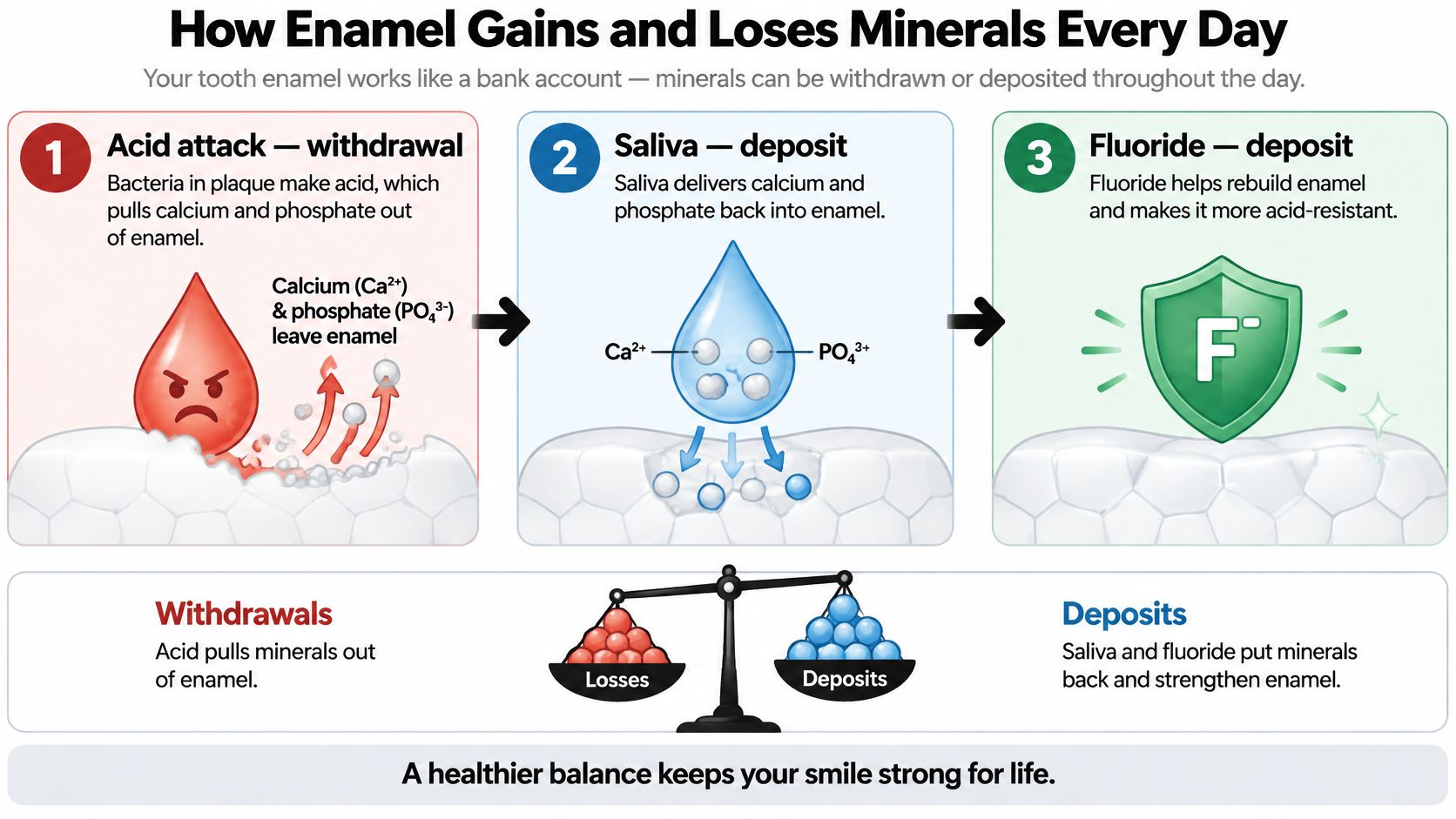
- A sugary or starchy food or drink goes in. Starch counts, because salivary enzymes break it into sugars that plaque bacteria can use.
- Plaque bacteria make acid. They convert those sugars fast, and the pH at the tooth surface drops within minutes.
- The acid dissolves mineral from the surface. Calcium and phosphate leave the enamel crystal, and the area turns soft and chalky, which is what a white spot is.
- Saliva neutralizes the acid and pays minerals back. It rinses the acid away and bathes the tooth in calcium and phosphate, and given enough time it rebuilds most of what was lost.
- Fluoride changes the material that gets rebuilt. It helps deposit calcium and phosphate and favors fluorapatite, a crystal that resists acid better than ordinary hydroxyapatite, so the next withdrawal costs the acid more.
The weak point in that cycle isn't the deposit side. It's the clock. Each acid challenge needs recovery time, and snacking compresses the recovery window.
Consider a soft drink. Finished with lunch in ten minutes, it's one withdrawal followed by hours of saliva deposits. Sipped from 1 p.m. to 5 p.m., it's a long series of withdrawals with barely a break, and the balance never gets back above zero. Same drink, very different enamel outcome.
Every sip resets the clock. Enamel doesn't care how much you drink, only how often the acid lands.
Understanding what remineralization of teeth really involves makes the daily habits easier to sequence, and the practical guidance on preventing enamel erosion covers the timing details around acidic food and brushing.
Count your acid exposures tomorrow. Coffee with sugar, a mid-morning pastry, a soda at your desk, a glass of wine at night. If that number is high, the product on your brush is competing against arithmetic.
The Ingredients That Do the Work
Four ingredients appear on remineralizing labels, and they aren't interchangeable. Each one does a different job, and the evidence behind each sits at a different level of confidence.
Fluoride is the benchmark. In the United States, over-the-counter fluoride toothpastes typically contain 1,000 to 1,500 ppm fluoride, and professional guidance supports routine twice-daily use at those concentrations, as the American Dental Association's guidance on topical fluoride sets out. It reduces enamel solubility and drives calcium and phosphate back into softened enamel, forming fluorapatite that holds up better under acid than ordinary hydroxyapatite.
Hydroxyapatite takes a different route. These particles are chemically similar to the mineral that forms most of natural enamel and dentin, and they can deposit at enamel prisms and dentinal tubules, potentially filling microscopic surface defects. A 2025 meta-analysis comparing hydroxyapatite and fluoride toothpastes found no statistically significant difference in caries progression, with a pooled risk ratio of 0.98 (95% confidence interval 0.85 to 1.12) and a pooled odds ratio of 0.90 (95% confidence interval 0.57 to 1.42), and it reported significant differences in lesion size and fluorescence after six months, according to the comparison published in the Journal of Clinical Pediatric Dentistry. That's promising, and still less settled than fluoride's decades of population data.
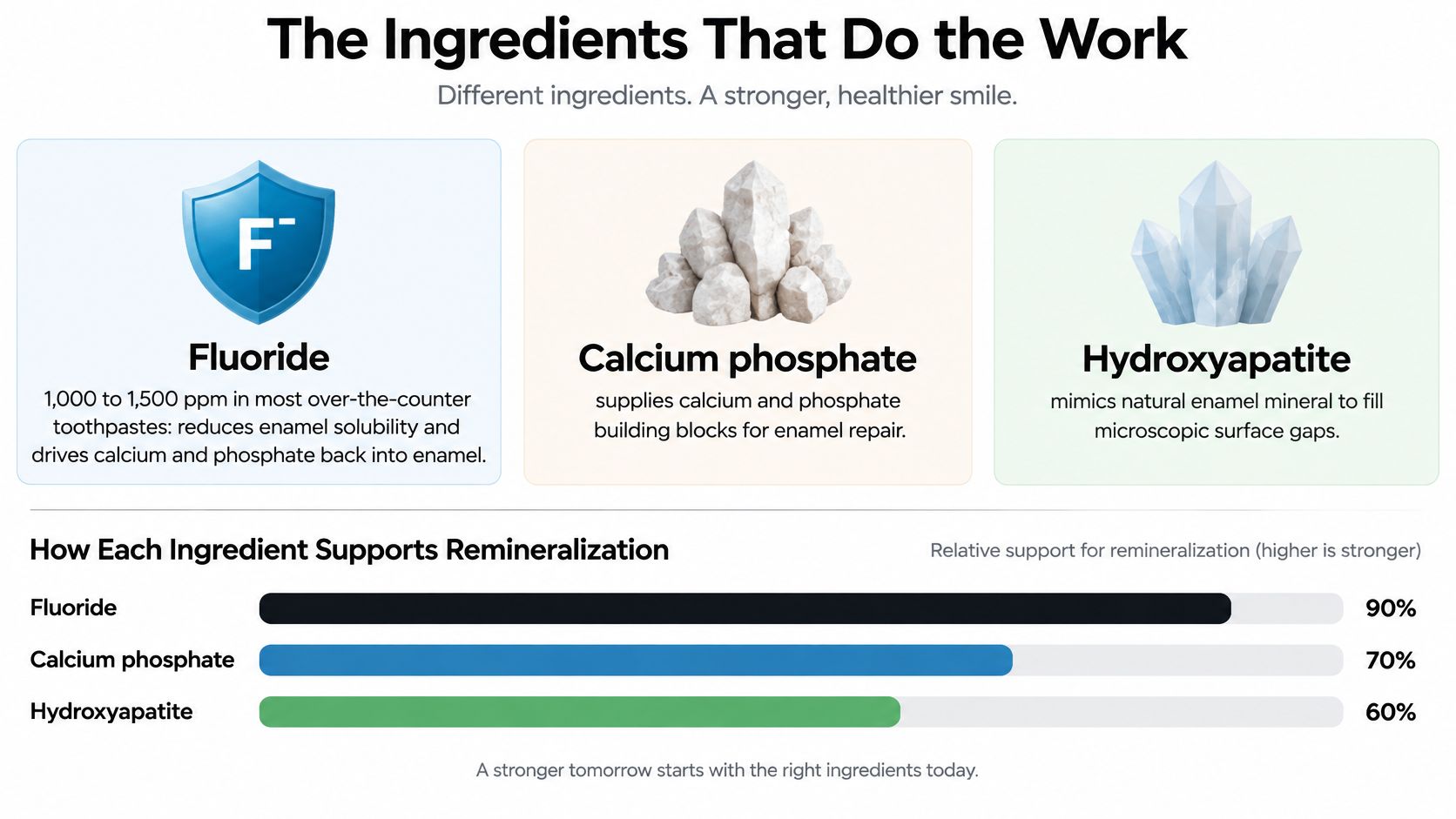
CPP-ACP (casein phosphopeptide with amorphous calcium phosphate) binds calcium and phosphate and holds them near the tooth in a soluble state, releasing them during an acid challenge. The lab and in-situ data are strong. The clinical results are more qualified, which is why it works best as a partner to fluoride rather than a swap.
Bioactive glass releases ions that can form a mineral layer on the enamel surface. It has the thinnest evidence base of the four, mostly laboratory and short-term work, so treat it as an adjunct your dentist confirms rather than a primary choice.
| Ingredient | How it works | Evidence strength | Best fit |
|---|---|---|---|
| Fluoride (1,000 to 1,500 ppm) | Reduces enamel solubility and drives calcium and phosphate back into enamel | Strongest; the ADA-Accepted anticaries benchmark | Default choice for most people |
| Hydroxyapatite | Deposits mineral-like particles at enamel prisms and dentinal tubules | Promising; 2025 meta-analysis found no significant difference in caries progression from fluoride | Readers seeking fluoride-free care |
| CPP-ACP | Stabilizes calcium and phosphate near the tooth surface to support repair during acid challenges | Lab and in-situ data are strong; clinical results are qualified | Early white spots or frequent acid exposure |
| Bioactive glass | Releases ions that can form a mineral layer on enamel | Thinnest of the four, mostly laboratory data | Adjunct use, confirmed with a dentist |
Reading a label comes down to two checks. Look for the ADA-Accepted seal if an anticaries claim matters to you, then find the active ingredient and its concentration printed on the back. A front label can say "enamel repair" with no active ingredient at all. The back panel can't.
What the Research Shows About Its Results
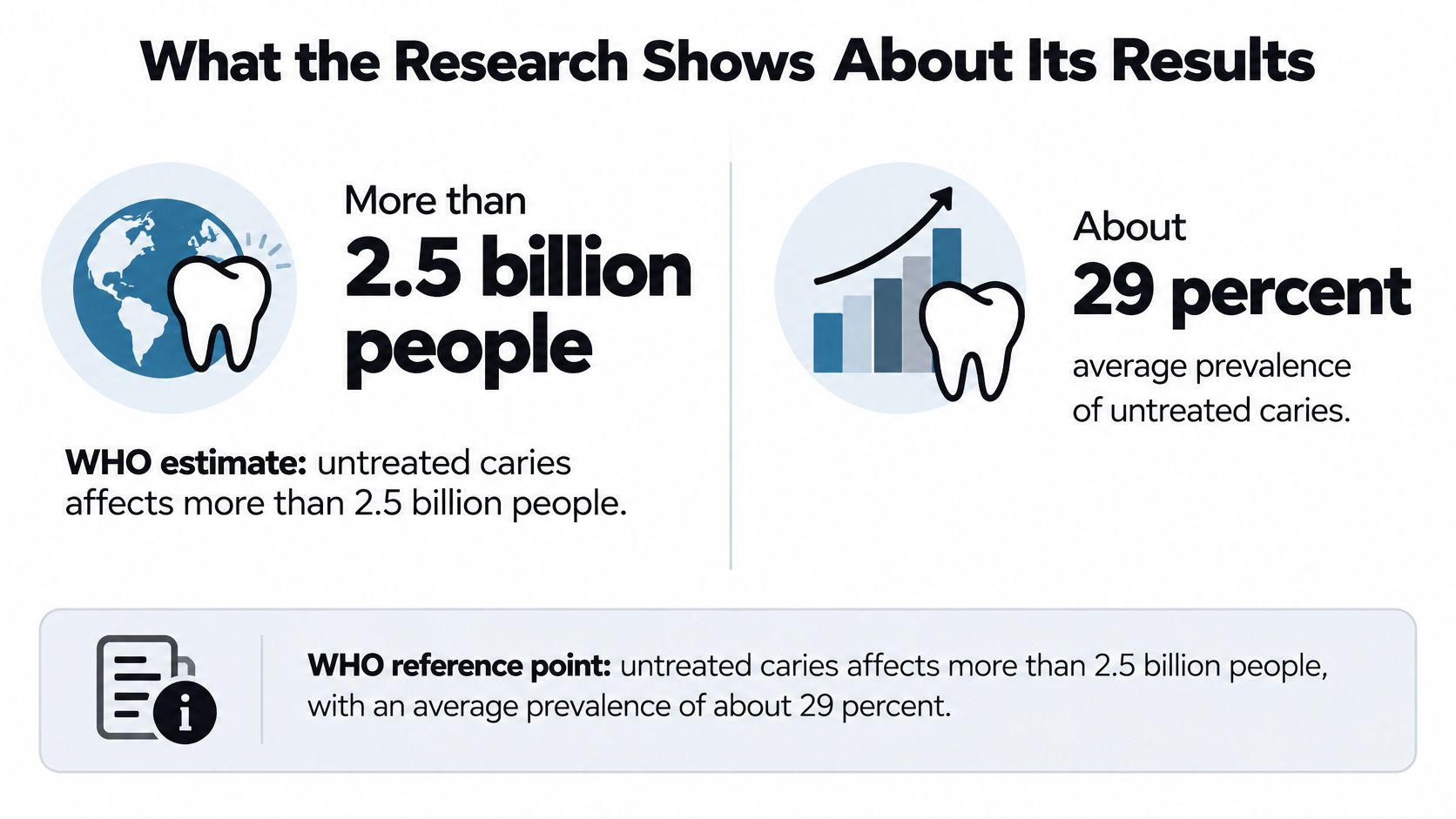
Does a toothpaste's ability to add minerals back to enamel mean it prevents cavities? The answer depends on what researchers measure. Studies of early enamel changes and studies of actual cavities do not provide the same kind of evidence.
A fluoride toothpaste brushed with twice daily is the usual comparator in these trials. That gives researchers a familiar benchmark, rather than asking whether a new ingredient performs better than no treatment.
In a 12-month randomized trial, fluoride toothpaste alone, fluoride toothpaste combined with CPP-ACP and fluoride, and fluoride varnish all promoted remineralization to approximately 250 microns. Researchers found no statistically significant difference between the groups, according to the clinical study on calcium-phosphate remineralization. The result does not show that the added ingredient outperformed fluoride. It shows that the measured changes were similar across the treatment groups.
Controlled laboratory research offers a different kind of clue. In an in-situ study, sugar-free lozenges containing CPP-ACP increased remineralization in subsurface lesions compared with a sugar-free control lozenge. This suggests that CPP-ACP can support mineral gain under controlled conditions. It does not establish that toothpaste will produce the same effect, because a paste does not deliver the ingredient in the same way as a lozenge dissolving against a tooth.
A 2025 evidence review reported that hydroxyapatite toothpaste was associated with an overall reduction in bacterial load in in-situ studies, as described in the International Journal of Oral Science review of hydroxyapatite toothpaste. That measure concerns bacteria, not cavity prevention. A lower bacterial load should not be treated as proof that fewer cavities will develop.
A rule for reading trials: ask how many real cavities were prevented, not how much better a lesion looked under a lamp.
A product may improve laboratory measures of mineral change without showing that it prevents cavities. When results differ, give greater weight to clinical outcomes than to readings of how a lesion appears under a lamp.
What Remineralizing Toothpaste Cannot Repair
Someone notices a dark spot on a lower molar and decides a remineralizing paste will rebuild it over a few weeks. Three months later the spot is deeper, and the filling is bigger than it would have been. The mistake wasn't the toothpaste. It was the assumption that a home product could reverse structural loss.
The practical test is texture, not color. Chalky white spots can be early demineralization, and those may respond to consistent daily use. A spot that feels rough or sticky to the touch, or any visible defect, means the surface has already collapsed and minerals have nowhere to land.
Watch for these signs and book an exam rather than another tube:
- A rough or sticky patch that your tongue keeps finding in the same place.
- Pain when biting, or a sharp response to hot and cold that lingers.
- Swelling or a gum boil near a tooth, which points to infection rather than mineral loss.
- A dark lesion that's deepening or changing shape over weeks.
- Sensitivity that lasts beyond a few weeks despite consistent home care.
Risk level changes the math too. Frequent sugar or starch exposure, a dry mouth, or low saliva flow can produce acid faster than any toothpaste replaces minerals, which caps the benefit no matter how good the product is. Someone sipping sweetened coffee all morning is fighting a losing balance.
What a dentist can measure is different from what you can see. Lesion activity, diet pattern, saliva flow, and total fluoride exposure all go into the decision, and general dental treatments cover everything from monitoring a quiet white spot to restoring a tooth that's already broken through. High-risk patients may be moved to prescription-strength fluoride rather than a stronger over-the-counter paste. If you're trying to work out whether a spot is active or arrested, this guide to white spot lesion treatment explains what changes on the surface as a lesion settles.
How to Use Remineralizing Toothpaste for Best Results
Technique decides how much of the ingredient stays on the enamel long enough to matter. The routine below is the same one dental professionals give patients, and each step has a reason behind it.
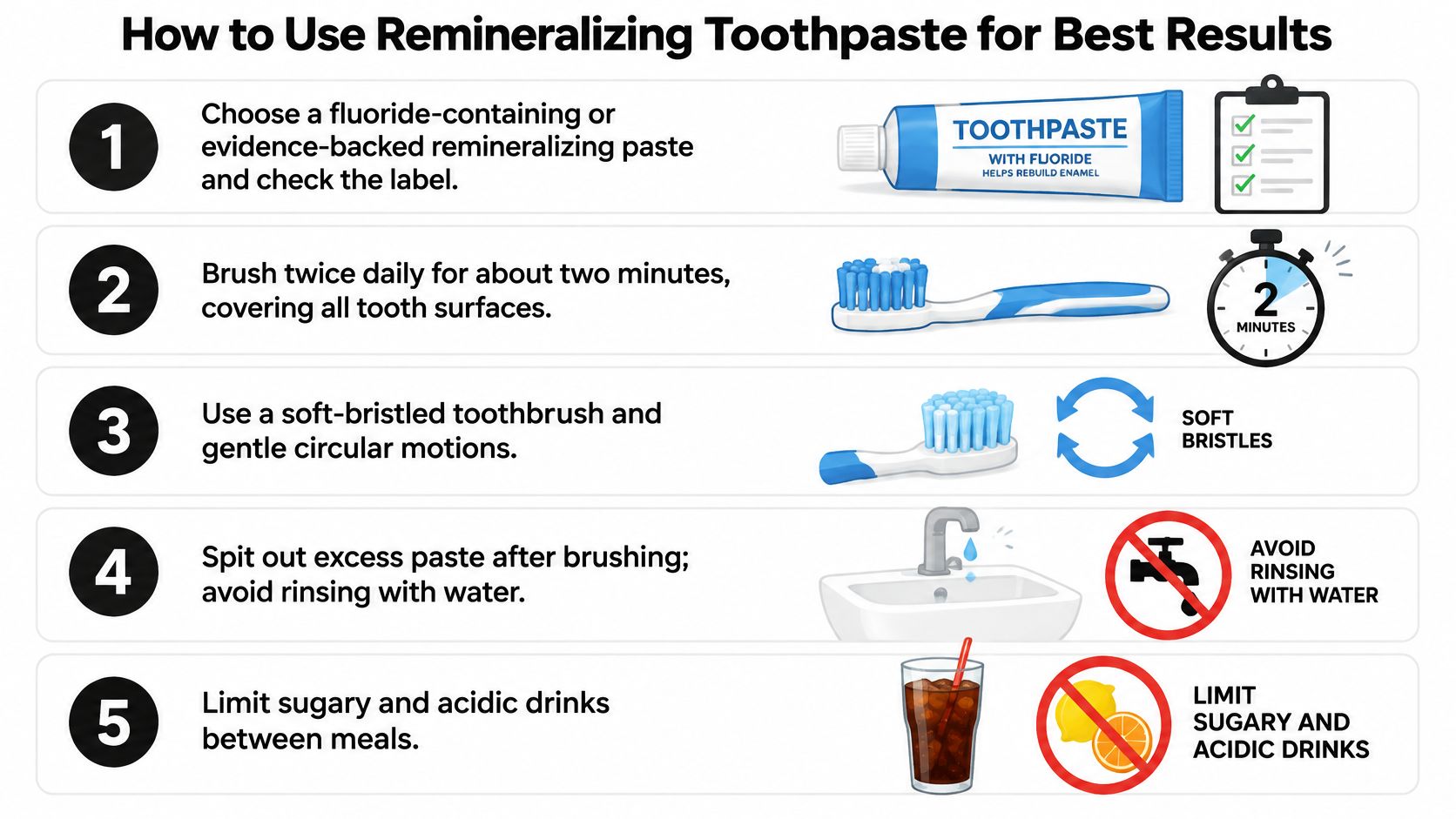
- Choose a paste matched to your situation. Check the back panel for the active ingredient and its concentration. A front label tells you nothing about what's inside.
- Brush twice daily for about two minutes. Frequency and contact time drive mineral uptake, and a rushed 30-second pass leaves most surfaces untouched.
- Use a pea-sized amount. More paste doesn't mean more repair, and it makes rinsing temptation harder to resist.
- Spit out the excess but don't rinse heavily. A small amount of fluoride left on the enamel keeps working after you leave the sink.
- Don't swallow the paste, and supervise young children. Children need only a small smear, and swallowing habitually delivers more fluoride than a growing body should get from toothpaste.
- Skip acidic or sugary snacks right after brushing. The enamel is still recovering, and adding acid immediately undoes the deposit you just made.
- Book a routine check-up to confirm the spots are stable. Only a clinician can tell whether a lesion has arrested or is still active.
The reasoning behind step 4 surprises people most. Rinsing with water after brushing washes away the ingredient you just spent two minutes applying, which is why the advice is spit, don't rinse.
Here's a short walkthrough of the brushing mechanics that make the biggest difference.
Give it a few months of consistency. What you're looking for is fewer chalky patches and no new ones forming, plus a dentist who finds the enamel stable rather than active.
Choose the Right Toothpaste for Your Enamel Risk
Match the product to the situation instead of to the packaging, because the right answer differs from person to person.
Intact enamel and an ordinary diet. A fluoride remineralizing toothpaste is the default, and it has the strongest evidence behind it of anything on the shelf. You don't need a specialty product to maintain a healthy balance.
Chalky white spots or frequent acid exposure. Add a CPP-ACP product as a supplement to fluoride rather than a replacement. It's the scenario where the mineral reservoir approach makes the most sense.
You'd rather avoid fluoride. A hydroxyapatite product is a reasonable choice, understood as promising and less established in long-term clinical terms than fluoride. It's a defensible preference, not a free upgrade.
A hole, pain, swelling, or a dark spot that's deepening. Book an exam before you shop. No toothpaste closes a defect, and delaying just lets the restoration get larger. If you want the head-to-head breakdown before deciding, this comparison of fluoride versus hydroxyapatite toothpaste lays out the trade-offs.
Then check the label. Confirm the active ingredient and its concentration, and look for the ADA-Accepted seal if an anticaries claim matters to you. Our own Tooth Sensitivity line carries Fluoridex and MI Paste, which cover the fluoride and CPP-ACP routes respectively, so you can match the ingredient to the situation you're in. Whichever route you take, scheduling regular teeth cleanings keeps a professional eye on whether the spots are stabilizing.
Do one thing this week: turn over the tube you're using now and read the active ingredient panel. Then decide whether it matches your situation or whether a warning sign from the list above means it's time for an exam.
Matching the paste to the state of your enamel is the whole game here, and DentalHealth.com makes that easier by stocking the professional-grade options dentists recommend, from Fluoridex for a fluoride-first routine to MI Paste for early white spots. Every order ships free within the USA, and our team is available by phone if you're unsure which ingredient fits your situation. Visit DentalHealth.com to browse the Tooth Sensitivity line and put together a routine your enamel will notice.