
What Is Teeth Whitening Gel and How Does It Work
Teeth whitening gel is a peroxide-based bleaching material that lightens natural enamel and dentin by breaking down the pigmented molecules that cause many stains.
If a higher percentage promises faster whitening, why wouldn't everyone choose the strongest gel? Because concentration isn't a power rating. It's part of a treatment schedule, and the useful question is how the ingredient, contact time, and delivery method fit your teeth.
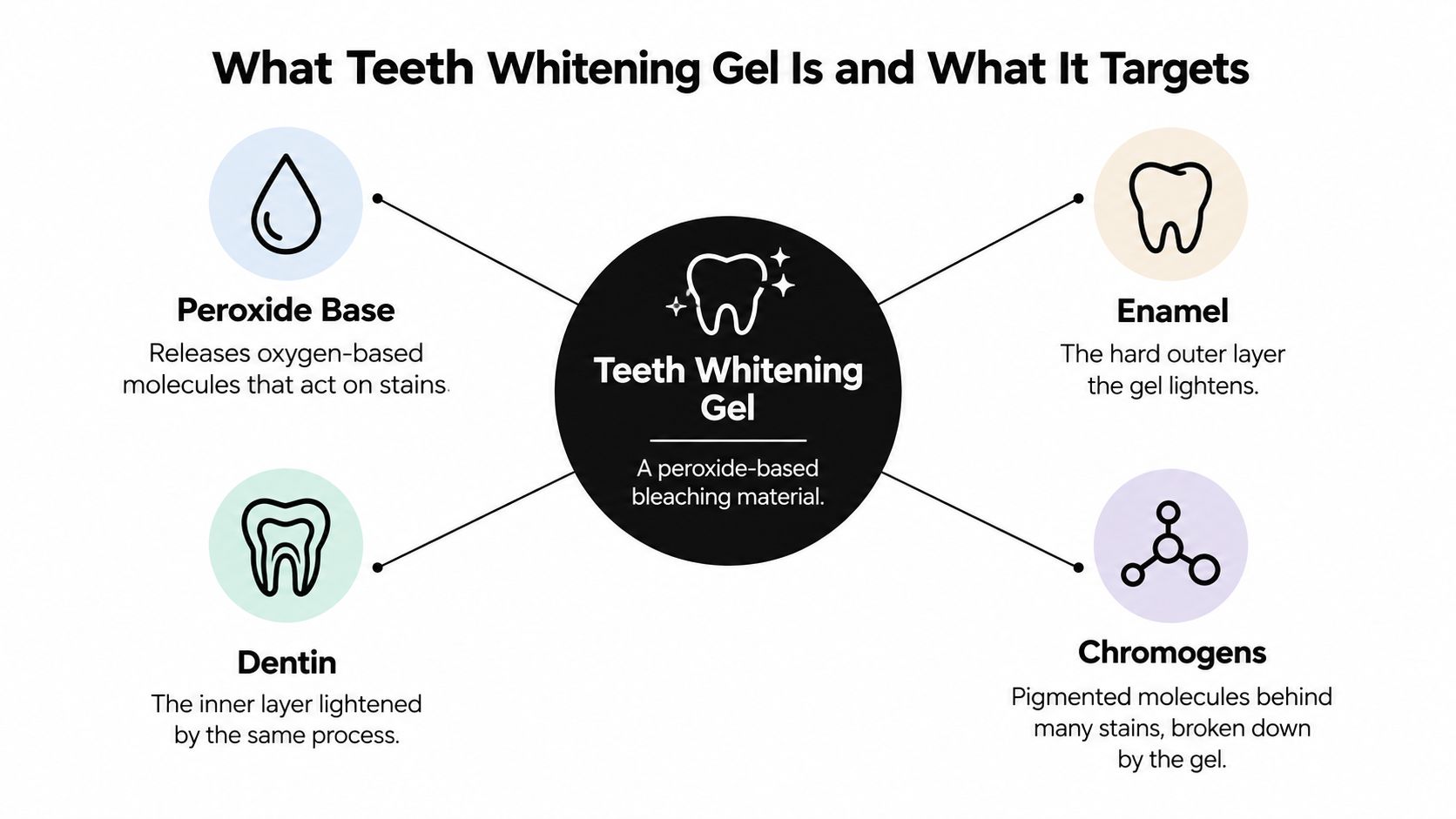
What Teeth Whitening Gel Is and What It Targets
Whitening gel changes tooth color through a chemical reaction rather than scrubbing. The pigmented molecules it targets are called chromogens. Breaking them down makes discoloration less visible.
Think of brushing as dusting a windowsill and bleaching as lifting a stain out of fabric. Whitening toothpaste mainly cleans the outside of a tooth; peroxide gel can act on discoloration within natural tooth structure. The analogy describes the difference, not a reason to use household bleach in your mouth.
Coffee, tea, red wine, and tobacco can leave stains on teeth. Ageing also changes their appearance, including how much of the underlying dentin shows through the enamel.
What the gel can reach
The American Dental Association's whitening guidance reports that at-home bleaching systems commonly contain approximately 10% to 38% carbamide peroxide; a systematic review it cites found daily use ranging from 2 to 10 hours over 6 to 28 days.
Those are descriptions of different treatment protocols, not interchangeable instructions. You shouldn't choose a wear time from that range without checking the directions for your particular formulation.
This diagram shows the tooth layers and stain molecules involved.
What it won't whiten evenly
Crowns, veneers, fillings, and bonding don't bleach like natural teeth. Whitening the surrounding enamel can therefore create a visible mismatch, particularly across the front of your smile.
Before you start: Healthy teeth with yellowing or stains may be candidates for bleaching. Pain, cracks, or bleeding gums call for a dental examination first.
Answering “what is teeth whitening gel?” is only the starting point. Identifying what's actually discolored helps determine whether bleaching is an appropriate solution.
Carbamide Peroxide Versus Hydrogen Peroxide
Hydrogen peroxide acts directly; carbamide peroxide releases the active bleaching ingredient more gradually. The practical difference is speed versus duration, not stronger versus weaker.
Hydrogen peroxide is already available to take part in the bleaching reaction. Carbamide peroxide first breaks down into hydrogen peroxide and urea, giving it a slower release pattern that suits longer tray wear.
Active ingredients compared
| Ingredient | What It Breaks Down Into | Speed of Action | Typical Use |
|---|---|---|---|
| Hydrogen peroxide | Produces reactive oxygen species directly | Faster action during the prescribed session | Professional gels and shorter-wear home products |
| Carbamide peroxide | Hydrogen peroxide plus urea | Slower, sustained release | Take-home trays designed for longer wear |
| Lower-concentration hydrogen peroxide | The same active bleaching chemistry at a lower concentration | More gradual change with repeated applications | Consumer gels and some strips |
| Lower-concentration carbamide peroxide | Hydrogen peroxide plus urea | Gradual release during prescribed tray wear | Dentist-guided take-home treatment |
Start with the ingredient row, not the marketing language. A hydrogen peroxide product can be intended for home use, while a carbamide peroxide product may require professional supervision. Neither chemical name alone tells you where or how to use it.
Next, look at the delivery method. A tray keeps gel against the teeth, while a paint-on product relies on its formulation to stay in place. Those formats can feel different even when their active ingredients are related.
Why percentages aren't directly comparable
A percentage describes how much of the named ingredient is present. It doesn't tell you that two different peroxide compounds provide the same amount of active bleaching agent.
Think of instant coffee and coffee concentrate: a spoonful of each isn't an equivalent serving. Likewise, matching percentage numbers on different peroxide ingredients doesn't establish matching activity or matching wear times.
For more detail on the slower-release ingredient, see this explanation of what carbamide peroxide is.
Compare the chemical name before comparing the percentage. Then compare the prescribed contact time.
A slow-release formulation can suit someone comfortable wearing a tray for longer. A fast-acting formulation can suit a shorter appointment or a shorter home session when specifically designed for that purpose.
Neither option gives you permission to improvise. Don't substitute one gel into another product's schedule, and don't assume an overnight tray routine applies to every take-home syringe. The full formulation, not just the active ingredient, determines the instructions.
Gel Strengths From Store Shelf to Dental Chair
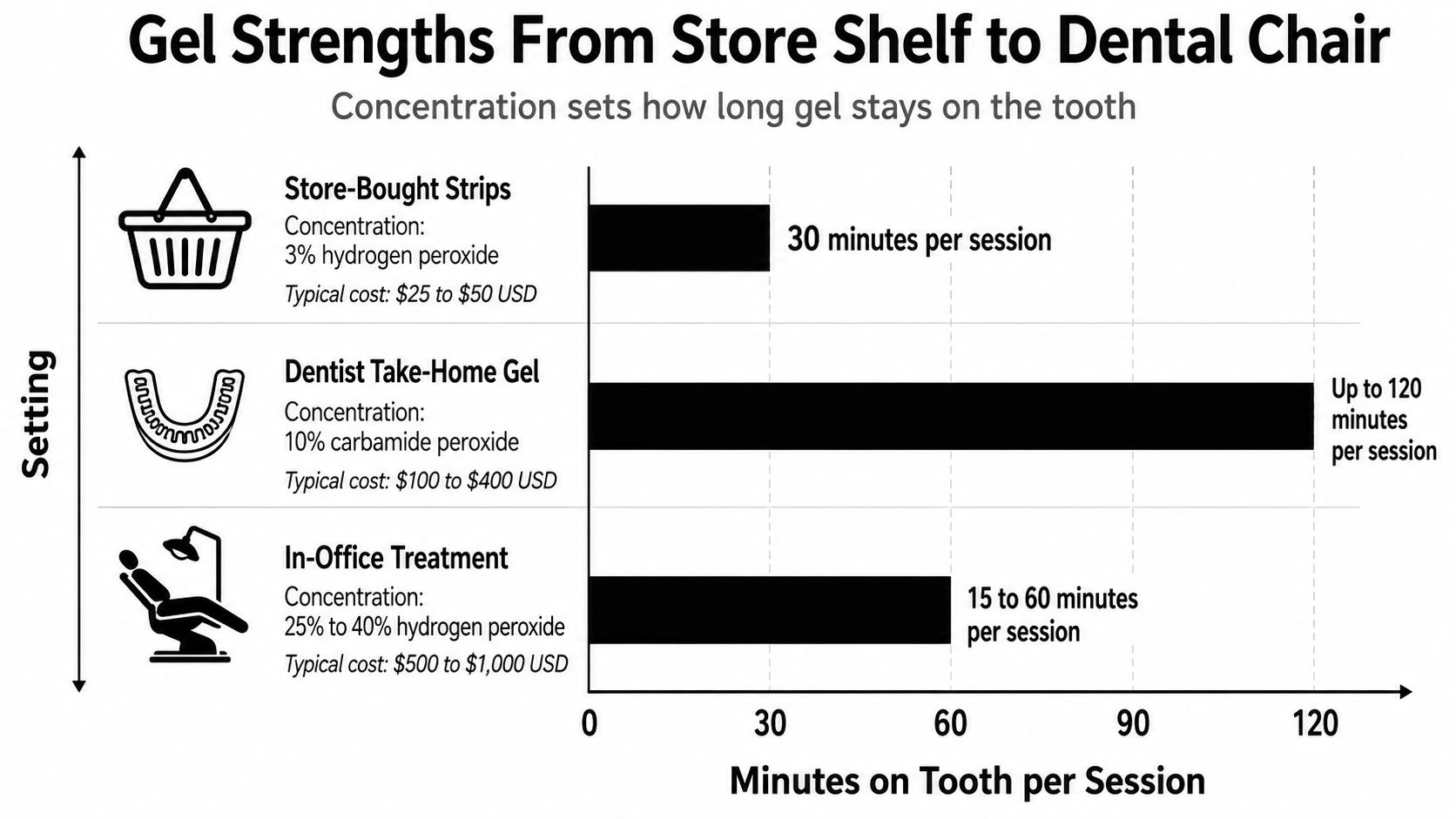
The percentage on a whitening label is the concentration of a specific chemical. It helps determine the appropriate contact time, but concentration and wear time must be considered together.
Think of strength as one half of a dosage equation. A concentrated gel works like a higher oven temperature: it can shorten the session, but it narrows your margin for error. More intensity per minute raises the chance of sensitivity, and it doesn't guarantee a better final shade. A gentler product worn for the prescribed time isn't automatically ineffective either.
Gel strength and wear time by setting
| Setting | Typical Strength | Wear Pattern | Typical Duration |
|---|---|---|---|
| Over-the-counter gel or strip | Lower peroxide concentrations, below the typical take-home range | Short applications according to package directions | A daily session repeated over a set course |
| Dentist-prescribed take-home tray | Carbamide peroxide, roughly 10% to 38% | Scheduled tray wear with a checked fit | A defined course, with daily wear time set by the specific product |
| In-office professional session | The highest peroxide strengths, selected for the patient | Supervised application with soft-tissue protection; some systems use a light | An appointment-based protocol, sometimes followed by home treatment |
Read each row as a matched pair, not a power rating. Store products trade lower strength for short, frequent sessions you manage yourself. Take-home trays occupy the middle ground, pairing a moderate concentration with longer tray wear spread across a prescribed course. In-office treatment concentrates the most strength into the shortest window, with a clinician controlling the exposure the whole time.
The setting comparison below provides a visual overview. For an actual purchase or treatment, use the product's current directions and a dentist's advice rather than treating chart examples as a prescription.
Read strength as a scheduling decision
Say you're choosing between a shorter session with a more concentrated gel and longer wear with a gentler formulation. If cold drinks already make your teeth uncomfortable, saving time may not be the most useful priority. Sensitivity-prone teeth often do better with a milder gel worn consistently than a strong one endured briefly.
A dentist may recommend a lower concentration, adjusted application frequency, or sensitivity management before bleaching. Your ability to follow the schedule matters too. A long-wear routine isn't practical if you repeatedly remove the tray early, and a skipped day costs more than a shortened session ever saves.
The opposite mistake is leaving a stronger gel on longer to accelerate results. That adds exposure without establishing that you'll reach a better outcome.
Check the whole label
- Active ingredient: Confirm whether the percentage refers to hydrogen peroxide or carbamide peroxide.
- Delivery system: Check whether the gel belongs in a fitted tray, a supplied applicator, or another specific system.
- Contact time: Follow the instructions for that exact formulation, not a different syringe you used previously.
- Storage and expiry: Keep the product as directed and check its expiry before starting a course.
Professional treatment also involves more than stronger gel. A clinician checks the teeth, protects soft tissue, controls application, and monitors your response, which is part of why the highest strengths stay in the chair.
Compare strengths within the same chemical before comparing brands. Then ask whether the proposed schedule is realistic and comfortable enough for you to finish, because a course you complete at moderate strength beats a strong one you abandon.
How the Gel Works Inside the Tooth and What to Expect
Whitening is more like sunlight gradually fading a poster than tearing away its colored surface. The pigment changes chemically; you aren't supposed to scrape off tooth material.
A professional application illustrates how carefully gel can be placed.
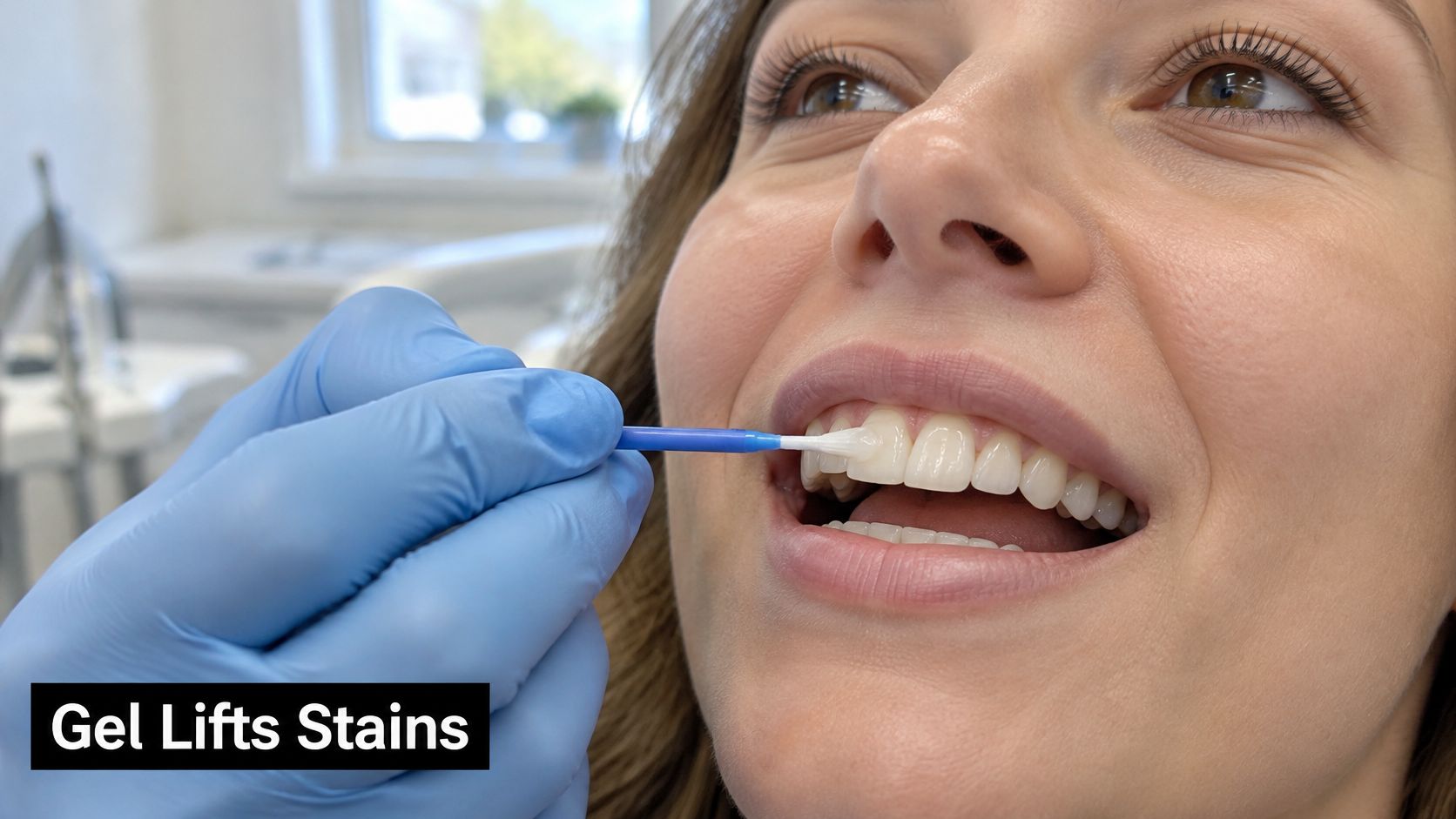
After application, peroxide penetrates the tooth's microscopic structure. Reactive oxygen-based species act on chromogens, changing the chemical structures responsible for their color. Repeated prescribed applications can produce cumulative lightening.
Delivery deserves attention: a 2024 randomized controlled trial in BDJ Open compared conventional at-home whitening with 20% carbamide peroxide, ready-to-use gel trays, and paint-on gel in 39 participants, with 13 in each group. That comparison doesn't establish a winner here, but it illustrates that whitening systems differ in how they deliver gel, not just in the ingredient on the label.
A careful application routine
- Brush gently and floss, following any product-specific preparation instructions. Dry the tooth surfaces if directed.
- Apply the prescribed small amount. For trays, load the intended tooth compartments rather than filling the tray to its edges.
- Wear the product for its assigned contact time. Wipe away overflow from the gums and never extend the session to compensate for a missed application.
- Remove the tray or gel, rinse as directed, and follow the product's instructions about brushing afterward.
This video provides another view of the whitening process.
Judge the completed course
Age-related yellowing often responds more readily than difficult gray or deep brown discoloration. A tooth darkened after injury needs assessment rather than repeated unsupervised bleaching.
Progress can slow as treatment continues, and new staining can return afterward. For practical expectations, consult this guide to teeth whitening gel results. Judge the completed prescribed course, not the first application, without extending treatment indefinitely when the shade stops changing.
Safety Limits and Common Side Effects
Whitening doesn't automatically damage teeth, but that doesn't make every product or application safe. Used appropriately, peroxide bleaching is generally well tolerated; temporary tooth sensitivity and gum irritation are the common problems.
Peroxide can travel through tooth structure and irritate tissues near the pulp, where the nerves are. That can produce cold sensitivity or brief sharp sensations. Gum discomfort is different: it often reflects direct contact between bleaching gel and soft tissue.
The safety controls you can influence
- Tray fit: A tray should hold gel against the intended tooth surfaces without sharp edges or substantial overflow onto the gums.
- Exposure time: Set a timer. Don't sleep in a product unless its specific instructions permit overnight use.
- Concentration: Don't increase strength just because progress seems slow.
- Gentle cleaning: Use a soft toothbrush and avoid aggressive scrubbing or abrasive DIY whitening mixtures.
Pain isn't evidence that the gel is working. Don't push through it to finish a session.
Professional protocols are evaluated under controlled conditions. A 2024 clinical study in Frontiers in Dental Medicine included 40 participants divided into groups of 20, comparing violet LED alone with violet LED plus 37% carbamide peroxide gel. That study description isn't a home-use recommendation or proof that adding a light improves every whitening treatment.
When to stop
Stop treatment and contact a dentist for sharp or persistent pain, bleeding gums, swelling, or white patches on the gums. Don't reapply gel to irritated tissue. Seek urgent care for facial swelling accompanied by trouble swallowing or breathing.
For help distinguishing common discomfort from warning signs, read about teeth whitening gel side effects.
Before starting, check that you have no untreated cavities, cracked teeth, or active gum disease. Children and teens need an individual dental assessment; during pregnancy or breastfeeding, defer elective whitening and discuss timing with your dental and medical clinicians. Don't interpret the availability of a product online as confirmation that it's appropriate for you.
Confirm Your Whitening Plan With a Dentist
Confirm the plan before starting, particularly if you have existing sensitivity, visible restorations, or gum problems. A dentist can distinguish removable surface stain from discoloration that needs bleaching, restorative treatment, or investigation.
Gel approach by situation
| Situation | Gel Approach to Discuss | Ask the Dentist About |
|---|---|---|
| Surface stains from coffee, tea, or tobacco | Professional cleaning, whitening toothpaste, or an appropriate over-the-counter gel | Whether the stain is only on the surface |
| Yellowing from ageing or deeper stains | A dentist-supplied take-home tray with an individually selected formulation | Tray fit and the daily wear schedule |
| Sensitivity already present | Desensitising toothpaste first, followed by a suitably gentle plan | Pre-treatment steps and when to pause |
| Crowns, veneers, or large fillings | A coordinated shade plan, with replacement considered only if needed | Whether a mismatch would remain after whitening |
| Pregnancy, breastfeeding, children, or teens | Postpone self-directed treatment pending professional advice | Appropriate timing and individual safety considerations |
A concrete example of a defined protocol comes from a 2024 study in the Journal of Conservative Dentistry, which used 10% carbamide peroxide for daily four-hour applications over 14 days. That's an example of a studied schedule, not a default prescription for every patient or product.
Leave with clear instructions
Ask your dentist:
- Strength and timing: Which formulation and wear schedule fit my teeth and the cause of the discoloration?
- Tray fit: Can you check the edges, demonstrate loading, and show me what excess gel looks like?
- Sensitivity response: Should I use a desensitising toothpaste first, and what symptoms mean I should pause or stop?
If sensitivity already exists, a toothpaste containing potassium nitrate or another dentist-recommended desensitising ingredient may be part of preparation. Existing pain still needs a diagnosis rather than being covered up with a sensitivity product.
Book a whitening consultation and take a baseline shade photo in consistent light. Start with a fixed end date and reassess when the prescribed course finishes. The aim is a comfortable, realistic improvement, not chasing an ever-whiter shade through continuous bleaching.
DentalHealth.com offers at-home whitening gels and kits, sensitivity-care products, and practical articles on whitening routines. Visit DentalHealth.com to compare product descriptions and discuss a suitable formulation and wear schedule with your dentist before ordering.