
White Oral B 3d
You catch your smile in the bathroom mirror after your morning coffee and notice a dull, yellowish tint. A search for White Oral-B 3D brings up whitening brush heads, electric toothbrushes, and toothpaste, all sounding like possible shortcuts to a brighter smile. Before you buy, there's a useful distinction to understand: removing a stain from a tooth isn't the same as changing the tooth's underlying color.
Why You Are Seeing the White Oral-B 3D
The appeal is easy to understand. You already need to brush your teeth, so a product that promises cleaning and whitening seems more convenient than adding trays, gels, or another treatment to your routine.
But the search results can blur several different products together. A white toothbrush handle, a 3D White replacement head, and a tube of whitening toothpaste aren't interchangeable. They may belong in the same daily routine, but you shouldn't assume they deliver the same result.
Start with the result you actually want
Think about what prompted your search. Perhaps your teeth looked brighter before coffee and tea became daily habits. Or perhaps they've always had a warm, creamy shade, even when they feel clean.
Those situations can look similar in a mirror, yet they lead to different buying decisions.
- You want a cleaner-looking surface. A stain-focused brushing routine may fit that goal.
- You want a lighter overall tooth shade. You're asking a different question, one that may involve a whitening treatment rather than a different brush.
- You're concerned about a particular patch or tooth. A dental assessment is a better starting point than experimenting with stronger polishing.
The important question isn't whether a package uses the word whitening. It's what the product is designed to change.
Buying rule: Choose the product by the problem you want to solve, not by the brightest smile on the packaging.
It's also helpful to separate appearance from cleaning performance. A toothbrush can be a worthwhile oral-care purchase without producing a dramatic cosmetic transformation. Conversely, a whitening treatment doesn't replace the need for everyday cleaning.
My practical recommendation is to treat the White Oral-B 3D range as a possible maintenance choice first, then decide whether your cosmetic goal calls for something else. That approach avoids paying for a cleaning tool while expecting it to behave like a bleaching treatment.
What the White Oral-B 3D Products Are
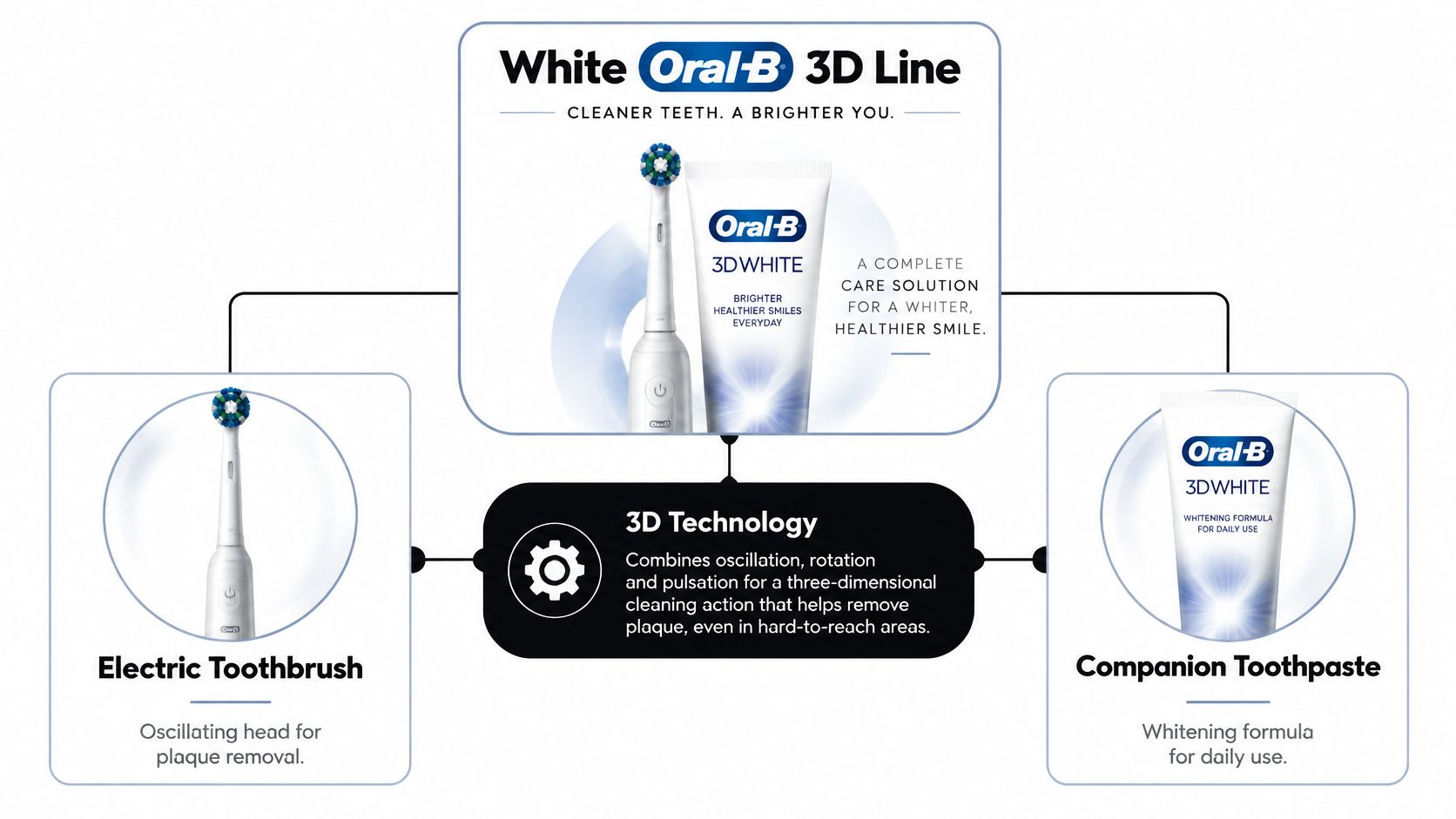
The name White Oral-B 3D is better understood as a search phrase than as a precise product specification. Before comparing prices, identify whether the listing is for a powered toothbrush, a replacement brush head, or toothpaste.
The product-family diagram helps separate those categories.
A cleaning tool versus a whitening treatment
Think of a stained plate. A sponge can lift residue from its surface and reveal the original finish underneath. It doesn't turn the material of the plate into a different color.
That's a useful analogy for mechanical surface-stain removal. A brush and polishing toothpaste work through physical cleaning. Chemical bleaching is a separate process, so don't extend the analogy into using household cleaners on teeth.
The practical distinction is between revealing the color already there and treating discoloration within the tooth. Both can make a smile look brighter, but they're not equivalent outcomes.
| Product category | What to check before buying |
|---|---|
| Electric toothbrush | The specific handle, cleaning technology, and compatible heads |
| 3D White replacement head | Whether it fits your handle and suits your cleaning needs |
| 3D White toothpaste | The ingredients and directions on the particular tube |
| Whitening gel | The whitening agent, instructions, and suitability for your teeth |
Don't let similar names replace label reading
The “3D” terminology associated with the powered brush describes a mechanical cleaning action, not a three-dimensional whitening chemical. Likewise, a toothpaste carrying whitening language shouldn't automatically be treated as the equivalent of a whitening gel.
For a closer look at the toothpaste category, the guide to 3D White Brilliance toothpaste provides a useful companion to checking the actual packaging.
Keep the shopping task simple: identify the item, confirm compatibility where relevant, and read the stated purpose. A replacement head won't help if it doesn't fit your brush, and a stain-polishing toothpaste won't meet a goal that requires a different treatment category.
Key Ingredients and Technology Claims Explained
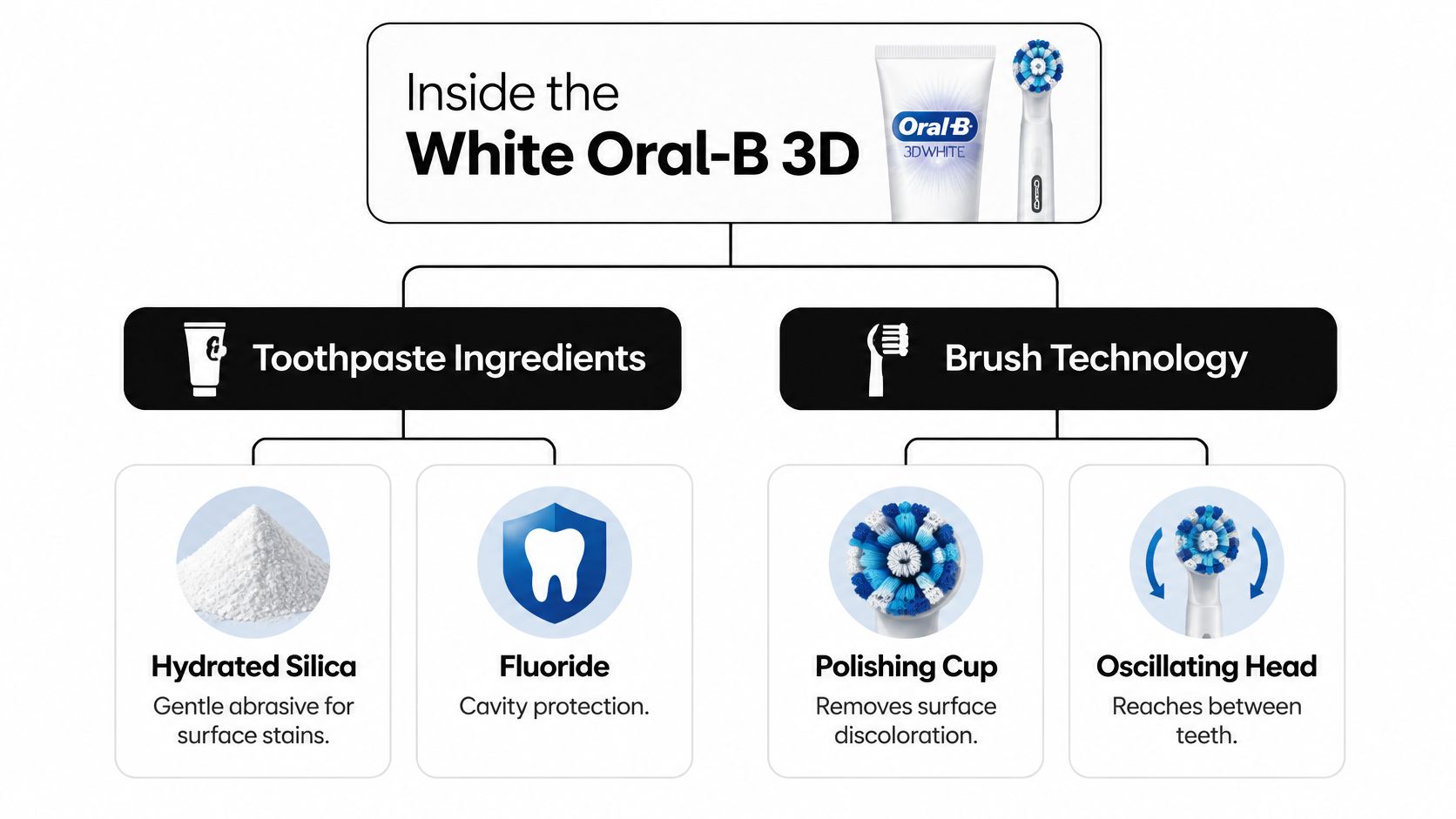
The most useful information is on the ingredient list and in the cleaning mechanism, not in the size of the whitening claim on the front of the box.
This diagram separates the toothpaste ingredients from the brush components.
What the toothpaste evidence actually shows
A randomized study evaluated Oral-B 3D White toothpaste in 15 participants over 15 days, with participants brushing three times daily for 2–3 minutes, according to the clinical study published in the Brazilian Dental Journal. The tested formulation contained 1,450 ppm fluoride and hydrated silica, as reported in that same study.
Hydrated silica is an abrasive used for mechanical surface-stain removal. Fluoride serves the cavity-protection side of the toothpaste rather than acting as the whitening ingredient. For help distinguishing those roles across products, consult the guide to ingredients in teeth-whitening products.
The researchers measured tooth color with a spectrophotometer rather than relying only on participants' impressions. The tested toothpaste didn't produce a statistically meaningful change in luminosity, and the measured color difference wasn't visibly perceptible under the study's interpretation.
That's a reason to keep expectations modest, not proof that every formulation or user will have an identical experience. The trial evaluated a particular toothpaste under a particular schedule.
What the powered brush evidence supports
The oscillating-rotating mechanism combines pulsation to disrupt plaque with rotation to sweep it away. Across eight clinical trials, the reported difference in standardized plaque scores was −1.51, statistically significant at P<0.001, while five gingivitis trials reported approximately 50% greater reduction in bleeding sites, according to the Oral-B clinical evidence compendium.
Those findings support plaque and gum-health benefits. They don't establish that the brushing mechanism bleaches the inside of a tooth.
- Read the outcome. Plaque reduction isn't a tooth-shade measurement.
- Check the tested product. Evidence for a brush mechanism doesn't automatically validate every toothpaste claim.
- Separate the functions. Cleaning, cavity protection, and bleaching are different jobs.
How to Use the White Oral-B 3D for Best Results
A useful routine starts with restraint. Follow the instructions for your specific handle, brush head, and toothpaste rather than treating the toothpaste study's schedule as a personal prescription.
Use the image below as a general positioning reference, not a substitute for your brush's instructions.
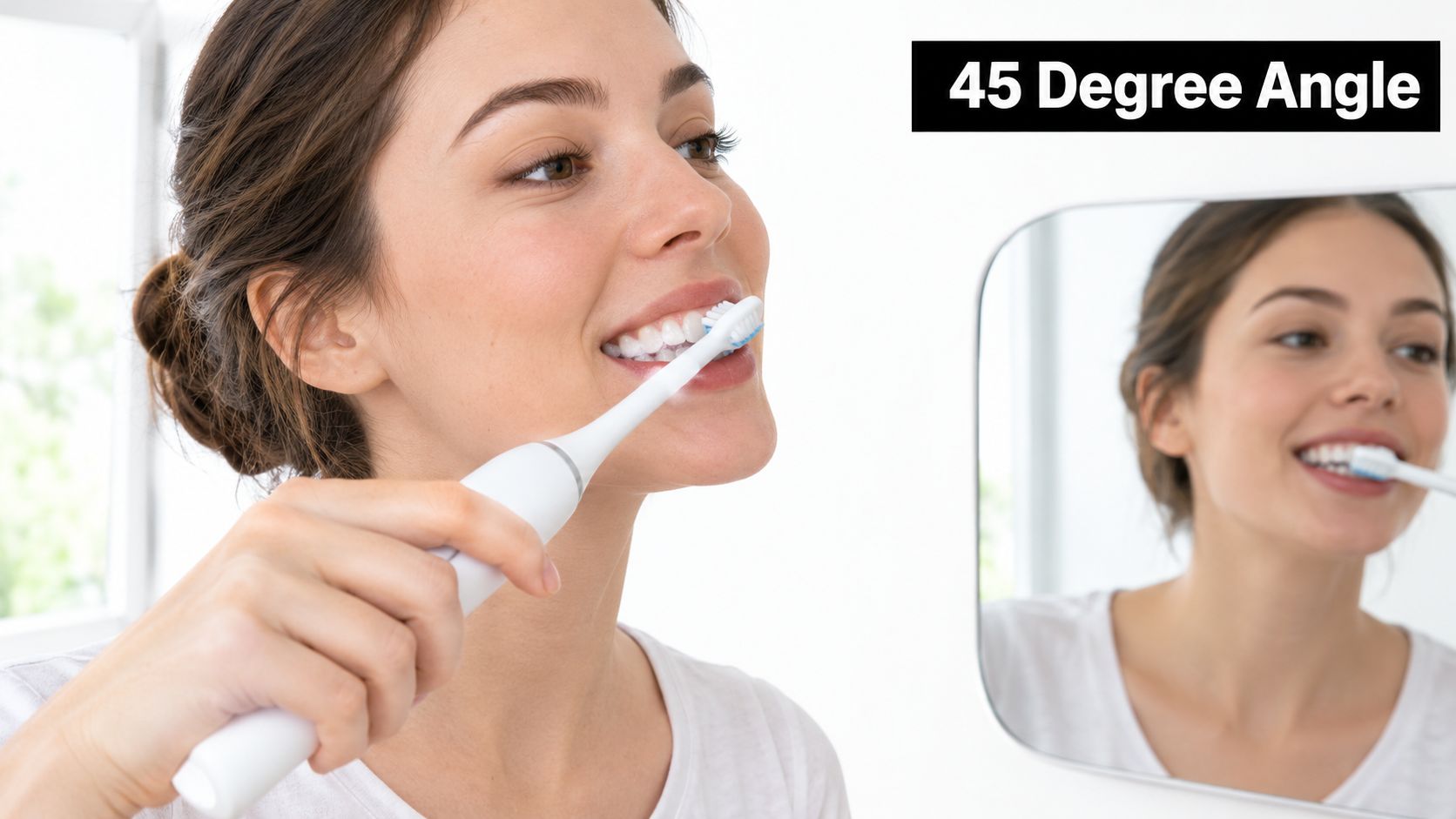
Guide the brush instead of scrubbing
Let the powered head perform its cleaning movement. Guide it deliberately around the tooth surfaces rather than adding forceful back-and-forth scrubbing because an area looks stained.
Pay attention to your gumline and any areas your dentist has asked you to clean more carefully. If your model has a pressure sensor, use its feedback instead of assuming firmer contact means better cleaning.
- Follow the recommended schedule. Use the brushing duration and frequency specified for your routine by your dentist and product instructions.
- Keep pressure light. Don't turn a cosmetic goal into a reason to press harder.
- Choose comfort over intensity. If a whitening toothpaste feels uncomfortable, ask about a sensitivity-focused alternative.
- Keep treatment instructions separate. A peroxide product may have its own brushing and application requirements.
Track the right kind of progress
Look for whether your teeth appear cleaner, not whether they match a heavily edited product photograph. If you take comparison photos, try to use similar lighting so you're not confusing a lighting change with a treatment result.
Avoid setting yourself an unsupported deadline. The toothpaste findings discussed above don't justify promising a visible transformation after a particular number of uses.
For a visual reference alongside the written guidance, you can watch this demonstration.
Don't respond to disappointing whitening results by brushing harder or extending every session.
If you're also using a dentist-selected whitening gel, ask which toothpaste and brushing approach to use during treatment. A stain-maintenance routine should support the plan, not add unnecessary polishing when your teeth already feel sensitive.
The sensible next step for persistent discoloration is to reassess its cause. Buying another brush head or increasing pressure doesn't answer that question.
White Oral-B 3D vs Dentist-Recommended Whitening Options
The choice isn't necessarily “electric toothbrush or whitening gel.” They serve different purposes, and you may need either or both depending on your starting point.
Products such as Opalescence, Zoom, and Pola belong in a whitening discussion, but a brand name alone doesn't determine the right treatment. The specific formulation, application method, and your dental circumstances matter.
White Oral-B 3D vs Peroxide Whitening Gels
| Feature | White Oral-B 3D | Peroxide Whitening Gels |
|---|---|---|
| Main purpose | Daily cleaning and surface-stain maintenance | Chemical whitening of natural teeth |
| How it works | Mechanical brushing and polishing | Peroxide-based bleaching |
| Most relevant goal | Managing external discoloration alongside oral hygiene | Seeking a change beyond surface cleaning |
| Role in a routine | Ongoing maintenance | A defined treatment used as directed |
| Selection priority | Compatibility, comfort, and cleaning needs | Suitability, formulation, and treatment instructions |
| When to seek advice | Stains persist or brushing is uncomfortable | Before treating unexplained discoloration or planning around restorations |
Consider a coffee drinker whose main concern is a surface film. Starting with an appropriate cleaning routine is a different decision from treating teeth that remain the same shade after their surfaces are clean.
For someone seeking a broader color change, a whitening consultation can establish whether peroxide treatment fits the goal. The guide to dentist-recommended teeth whitening can help frame the product questions to bring to that conversation.
Choose a treatment plan, not just a product
Don't choose a gel because its label sounds stronger. Ask what you're treating, how the product should be used, and what to do if discomfort develops.
A useful consultation checklist includes:
- Your starting point. Are you concerned about general shade, scattered stains, or a particular tooth?
- Your existing dental work. Tell the dentist about visible crowns, veneers, bonding, or implant restorations.
- Your maintenance plan. Decide how you'll care for your teeth after the treatment rather than repeatedly restarting it without guidance.
If your plans include implant restorations, color decisions belong within a wider discussion of the finished smile. The resource on smile design for implant cases from 3D DDS is relevant to that planning conversation, rather than a substitute for advice about a whitening product.
My recommendation is to make the treatment decision before buying the maintenance accessories. That helps you avoid collecting products with overlapping marketing claims but no clear role in your routine.
What the White Oral-B 3D Cannot Do
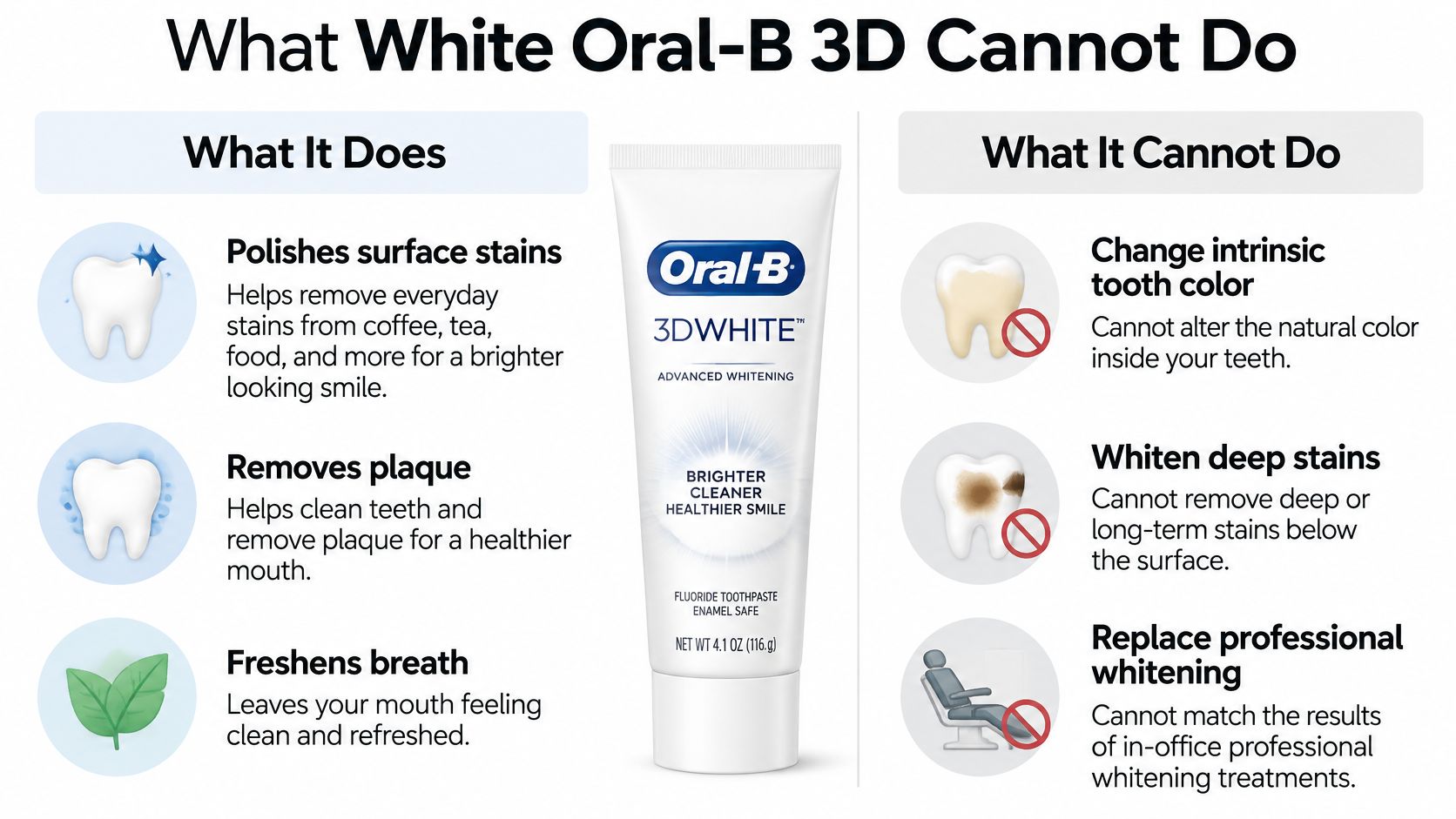
A whitening label doesn't mean the brush can correct every reason a tooth looks dark. The critical limitation is the difference between polishing something off the surface and treating a color change that isn't on the surface.
The manufacturer describes the 3D White head in terms of surface-stain removal, not intrinsic bleaching, in its explanation of whitening toothbrush heads.
This visual summarizes the boundary between cleaning and deeper whitening.
It can't bleach restorations or repair dental problems
The polishing action won't change the underlying shade of crowns, veneers, fillings, or bonding. Removing a surface deposit from dental work is different from whitening the material itself.
That distinction matters if your smile includes natural teeth beside restorations. Don't assume that making the natural teeth lighter will automatically produce a uniform match.
Aggressive polishing also isn't a treatment for:
- Fluorosis. This needs assessment rather than an attempt to scrub away the appearance.
- Tetracycline-related discoloration. A stain-focused brush isn't a solution for this type of deeper color concern.
- Decay or enamel erosion. These are dental problems, not cosmetic residue to remove.
Know the limit: If the cause isn't a removable surface stain, more polishing isn't the answer.
Don't assume peroxide is automatically the next step
Reaching the limit of a toothbrush doesn't establish that every remaining discoloration will respond to a whitening gel. A dentist needs to identify what you're seeing before recommending how to address it.
Describe the concern specifically: whether it's widespread or localized, whether it has changed, and whether there's discomfort. That conversation is more useful than asking only for the strongest available whitener.
The honest limitation of White Oral-B 3D is also its clearest buying guide. Choose it for the cleaning role it can perform. Don't ask it to diagnose discoloration, replace damaged tooth structure, or change restorative materials.
Pros and Cons of Choosing the White Oral-B 3D
The strongest reason to choose this range isn't a dramatic before-and-after promise. It's the possibility of fitting stain-focused maintenance into a cleaning routine you already need.
The trade-off is that a familiar whitening label can encourage expectations that the product category can't reliably meet.
Where it makes practical sense
- Cleaning remains the priority. The powered-brush evidence discussed earlier supports a useful oral-hygiene role independently of cosmetic expectations.
- Maintenance is your goal. A stain-focused head or toothpaste gives you a defined option for ongoing care.
- You prefer an integrated routine. You can select a compatible head and suitable toothpaste without treating every purchase as a separate cosmetic procedure.
There's no need to dismiss a product because its cosmetic effect is limited. A cleaning tool can be useful on its own terms, provided you understand what you're buying.
Where you may be disappointed
- You expect a substantial shade change. The toothpaste evidence doesn't support treating it as an equivalent to peroxide whitening.
- You're buying by the name alone. Similar packaging can obscure differences between a handle, head, and toothpaste.
- You react by doing more. Extra pressure or repeated polishing is a poor response to an unmet cosmetic goal.
My verdict: White Oral-B 3D is a reasonable category to consider when your aim is stain maintenance alongside everyday cleaning. It's less appropriate as your main purchase when you already know you want a broader change in tooth shade.
Before ordering, check what's included, whether the head fits your handle, and whether the toothpaste suits your comfort needs. If those basics are unclear, resolve them before comparing whitening claims.
A good purchase should have a clear job in your routine. If you can't describe that job without repeating the wording on the package, pause and clarify your goal.
Frequently Asked Questions About the White Oral-B 3D
Will it whiten yellow teeth, fillings, or crowns?
That depends on what's causing the yellow appearance. Surface staining is the relevant target, while naturally deeper color needs a different assessment. As explained above, brushing won't bleach the underlying material of fillings or crowns, so include visible dental work in any whitening consultation.
How long should I wait for visible results?
There isn't a dependable universal deadline. The toothpaste trial discussed earlier didn't establish a visibly perceptible change under its study conditions. If consistent, correctly performed cleaning doesn't meet your goal, reassess the treatment category rather than extending brushing sessions.
Is it suitable for sensitive teeth?
Don't assume every whitening toothpaste or polishing head will suit your sensitivity. Ask your dentist about the particular product, use light pressure, and avoid adding several whitening products at once. If you develop discomfort, stop the cosmetic experiment and get advice rather than pushing through it.
DentalHealth.com offers professional-grade at-home whitening gels, sensitivity-care products, and practical product guides to help you distinguish treatment from maintenance. Visit DentalHealth.com to compare whitening and sensitivity options, then use your dentist's advice to choose a routine that matches your teeth and your goal.