
Whitening Strips for Teeth That Actually Work
You know the moment. You brush in the morning, catch your smile in the bathroom mirror, and it looks a little flatter than you expected. Maybe it's the coffee you sip every day, the tea you lean on in the afternoon, or just the slow buildup of surface stain that makes enamel look tired even when your brushing is solid.
That's where whitening strips for teeth enter the picture, and where a lot of confusion starts too. They're simple enough to look harmless, but there's a real difference between a strip that lightens natural enamel, a product that just irritates gums, and a routine that works well for one mouth but not another. If you're trying to decide whether strips are worth it, this guide will help you sort out what they can realistically do, how to use them well, and when another option makes more sense.
Why Your Smile Looks Dull Even With Good Brushing
You can do a decent job brushing and still feel like your teeth don't match how careful you are. That's because some discoloration builds slowly on the outside of the tooth, where coffee, tea, berries, wine, and smoking leave color behind that toothpaste can't fully erase. Brushing helps a lot, but it doesn't always reset the shade.
The problem is usually gradual, not dramatic
Few people wake up one day with a yellow smile. The change creeps in, which makes it easy to blame one drink or one bad habit when it is usually a mix of daily exposure and time. Even people with strong oral hygiene can end up with teeth that look dull in photos or under bright bathroom lighting.
That's why whitening can feel confusing. One product promises quick brightness, another talks about trays, another about strips, and they all sound like they should do the same thing. They don't.
What whitening strips are good at
Whitening strips are made for people who want a straightforward at-home option for natural tooth color, especially when surface staining is the main issue. They're not magic, and they won't change crowns, fillings, or veneers, but they can be a useful fit when the problem is mostly on the tooth itself. A good strip should be judged on whether it lightens enamel safely, not whether it delivers a movie-star smile overnight.
Practical rule: if your teeth look dull but otherwise healthy, strips may be reasonable. If the color difference is tied to dental work, damage, or deep internal staining, you'll want a different plan.
That's the mental filter to keep in mind. Don't shop for the fastest promise, shop for the method that matches the reason your smile looks darker in the first place.
How Whitening Strips Actually Lift Tooth Color
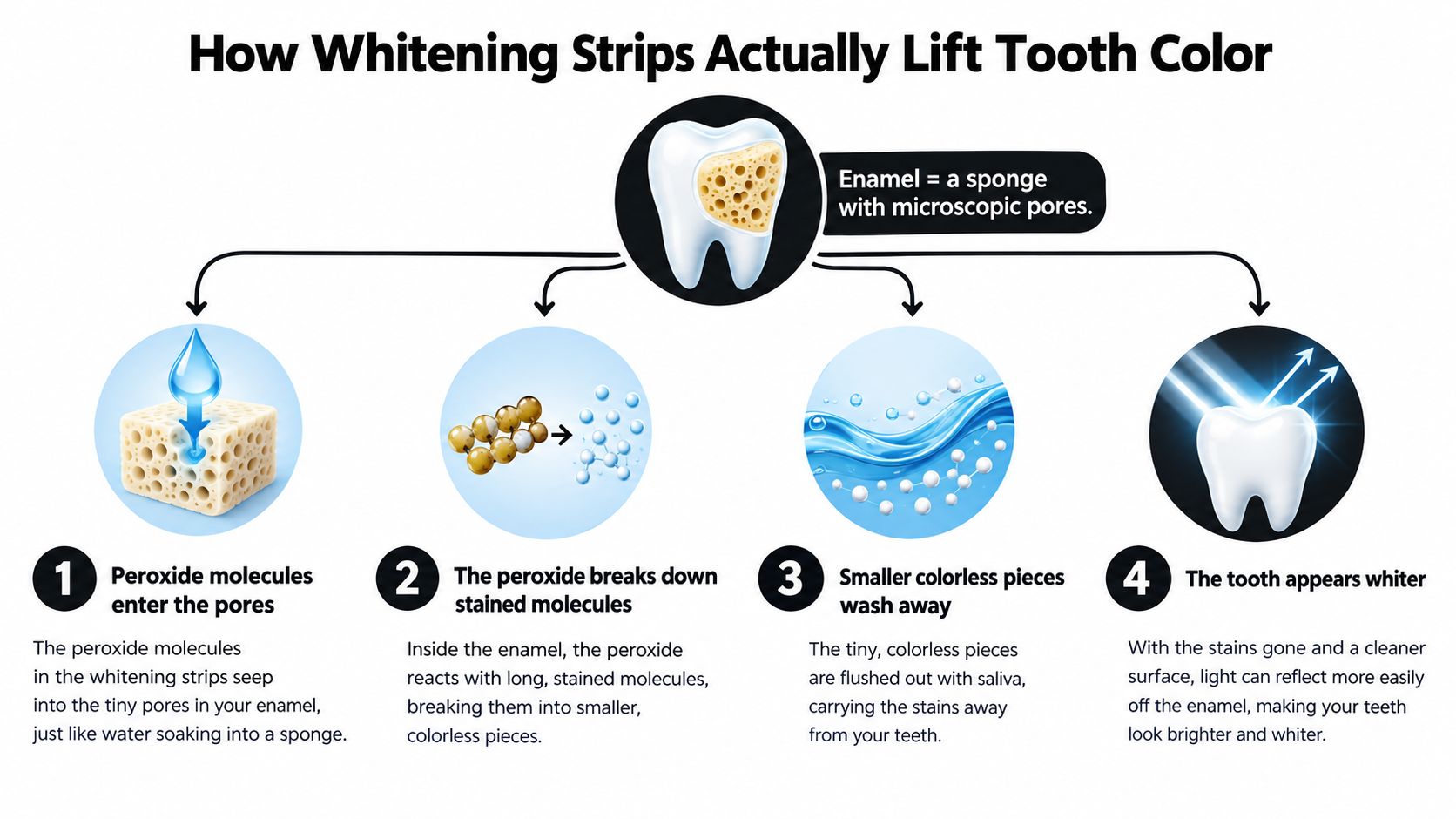
Tooth enamel is a solid surface with microscopic spaces, and peroxide moves into those spaces instead of just cleaning the outside. That matters because whitening strips change stain chemistry inside the tooth, while brushing mainly removes debris from the surface.
Peroxide does the whitening, not scrubbing
Whitening strips use hydrogen peroxide or similar peroxide chemistry to break stain molecules apart. The strip is not scraping away discoloration, it is changing the compounds that make teeth look yellower. In a randomized, double-blind clinical trial, a strip-based system with 5.3% hydrogen peroxide produced a highly significant reduction in yellowness, with Δb = −2.0* from baseline and −1.95 versus placebo, both at P<0.0001 (trial details).
That trial measured color with instruments, not just with “looks better” impressions. It also found that most of the improvement was still present at six months, again with highly significant differences at P<0.0001.
Why contact time matters
Strips work because they keep peroxide against the tooth long enough to do its job. A paste can clean, but a strip creates a controlled contact period, so timing matters more than aggressive brushing.
Peroxide whitening is a chemistry problem, not a scrubbing contest.
For a clear explanation of how carbamide peroxide works, see this overview from DentalHealth.com. The key point is simple. Teeth get lighter because stain molecules are broken down, not because the enamel is sanded away.
Peroxide Strength Treatment Time and Real Results
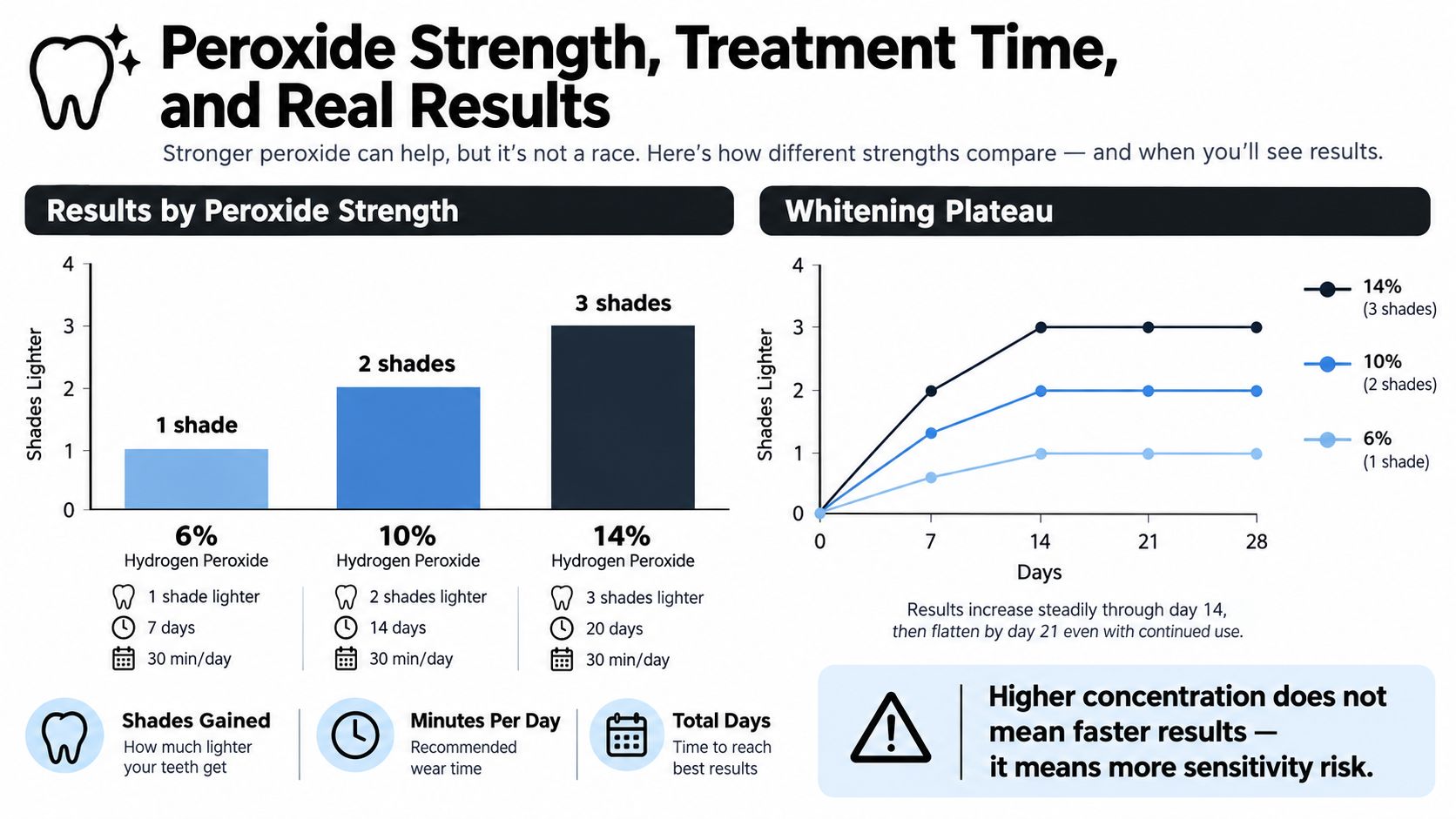
People often shop for whitening strips as if peroxide percentage tells the whole story. It does not. Concentration matters, but so do wear time, total days of use, and how sensitive your teeth already are. Whitening works a bit like cooking. Heat matters, but time and technique shape the final result too.
Stronger can mean faster early change, not automatically better results
A randomized, double-blind trial tested strips with 1.8%, 3.3%, and 5.3% hydrogen peroxide worn 30 minutes twice daily for 28 days. All three concentrations improved color by day 7. The higher concentrations produced greater early reductions in yellowness and greater increases in lightness at each check, with the clearest gap early in treatment (trial details). All regimens were well tolerated, and no one stopped because of a treatment-related adverse event.
That does not mean the strongest strip is always the right choice. Lower-peroxide strips can still whiten when used steadily, while stronger formulas may raise the chance of sensitivity. For someone whose teeth already react easily, a slower plan often makes more sense than forcing a faster one.
Read the label as a full exposure plan
Compare the whole package, not just the percentage.
- Peroxide percentage tells you the chemical strength.
- Minutes worn each session tells you how long the teeth stay exposed.
- Number of treatment days tells you the total whitening exposure.
- Your baseline sensitivity tells you how aggressive the plan should be.
A lower-strength strip used consistently can be a better fit than a stronger strip that makes your teeth zing.
Whitening also tends to improve gradually rather than all at once. In the trial, the higher concentrations showed their biggest advantage early, then continued as smaller gains through day 28. A practical way to judge strips is to ask three questions together: how strong is the peroxide, how long is each wear time, and how many days am I using it? If sensitivity is already a concern, a DentalHealth.com style professional-grade pathway usually means choosing a gentler formula or a supervised plan that matches the tooth-restoration pattern before pushing strength.
How to Apply Whitening Strips for Even Bright Results
Good whitening often comes down to boring details done well. If the strip slips, folds, or gets too close to gum tissue, you don't just lose evenness, you increase the chance of irritation. The goal is steady contact with the front surfaces, not a perfect cosmetic performance.
A simple routine that actually helps
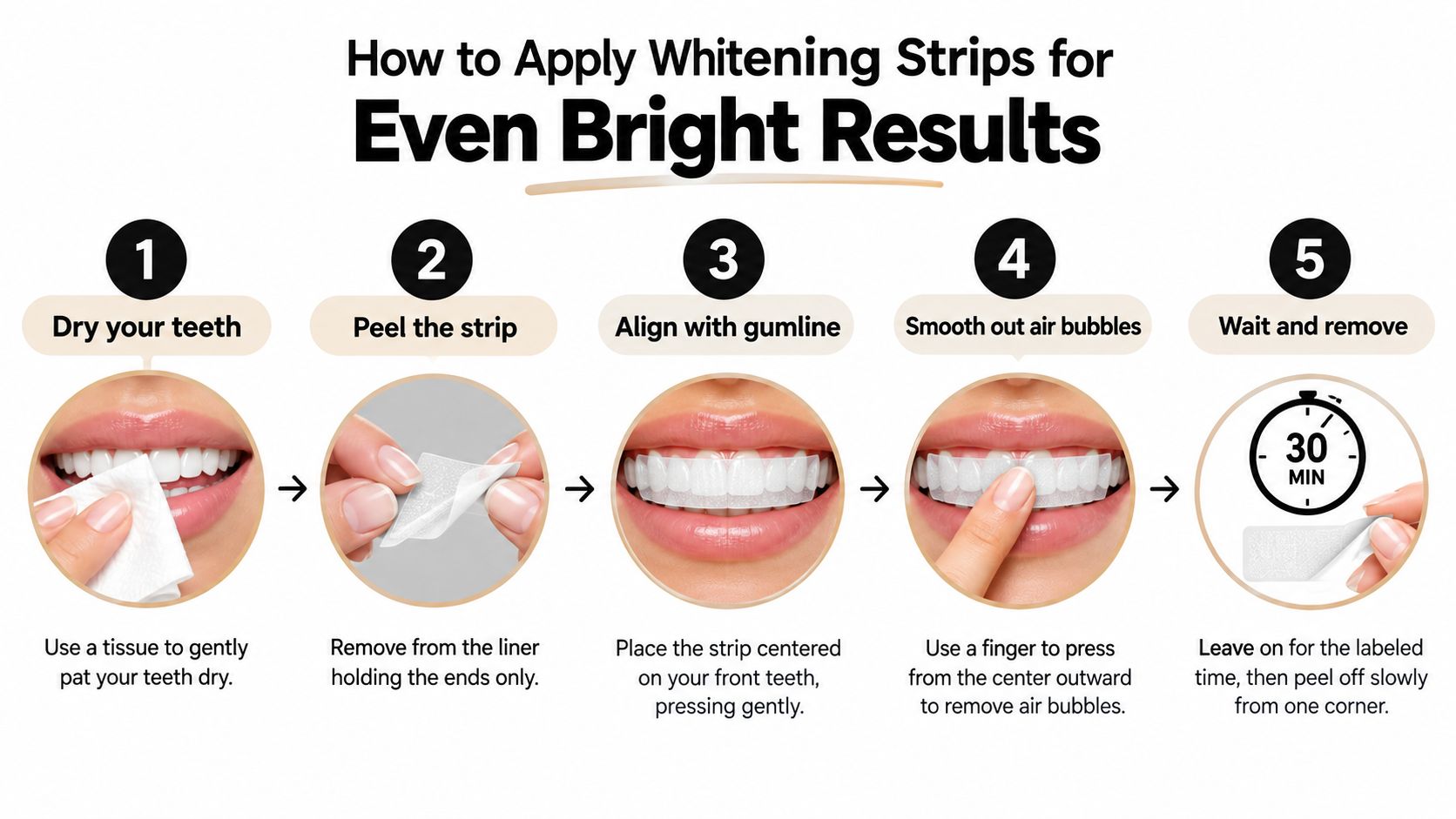
Dry teeth first. A dry surface helps the strip grip instead of sliding around, which is why a quick tissue blot can make the application cleaner. Then peel the strip from the liner with dry fingers and aim it at the visible front teeth only.
The strip should sit along the tooth line without climbing onto the gums. Press it gently from the center outward so you flatten any bubbles, then fold or trim any excess according to the product's shape. If it moves while you're wearing it, press it back into place rather than tugging it forward.
Timing and aftercare matter more than people think
Follow the labeled time, not your hunch. Leaving the strip on longer doesn't turn it into a better product, it usually just increases the odds of gum irritation or tooth sensitivity. After removal, rinse gently if needed and avoid immediately stacking on a lot of staining food or drink during the treatment window.
The wear-side habit matters too. If you're sipping coffee all day, whitening can feel slower because new stain keeps landing while you're trying to lift old stain. That doesn't mean you need a perfect diet, it just means whitening works best when you give the strip a fair shot.
If you want a practical placement guide, this which strip goes on top article is a useful reference for keeping the routine simple and symmetrical.
Whitening Strips Gels and Trays Compared Honestly
A lot of people ask which whitening method is strongest, but the better question is which one fits the shape of their smile, their patience, and their sensitivity level. A 2015 review comparing over-the-counter strips with home tray whitening using 10% carbamide-peroxide gel found no statistically significant difference in whitening efficacy, with ΔE mean difference = −0.53, 95% CI −1.72 to 0.66, and P=0.38. It also found no meaningful difference in lightness change or sensitivity outcomes, including tooth and gingival sensitivity, so the evidence does not support a simple “strips are weaker” story (review details).
Side by side, the tradeoffs are clearer than the marketing
The differences are practical. Strips are pre-dosed and easy to place on the front teeth, which makes them a good fit for people who want a straightforward routine. Gels give more placement control, which helps when a person wants to target specific areas or work around uneven staining. Trays can spread gel more evenly across the smile when they fit well, though they also depend more on technique and can get messy if overfilled.
| Feature | Whitening strips | Whitening gels | Whitening trays |
|---|---|---|---|
| Fit | Easy on front teeth, less custom | Depends on how it's applied | Usually more even when fitted well |
| Control | Pre-dosed and simple | More room to target specific areas | Good control if the tray fits properly |
| Coverage | Best for visible front teeth | Can be adapted to broader coverage | Often better across the whole smile |
| Mess | Usually low | Can be more variable | Can be messy if the tray overfills |
| Lifestyle fit | Fast and familiar | Good for people who like routines | Better for patients who do not mind equipment |
Where each format tends to suit real people
Whitening strips often suit someone who wants the least fussy routine. Paint-on gels appeal to people who want more placement control. Trays can be a better match when even coverage matters more than convenience, especially if a person already knows they can tolerate peroxide well.
A professional-grade home pathway also exists in the gel and tray category. DentalHealth.com stocks products such as Opalescence, PolaDay, and Zoom gels, and those formulas are usually chosen by people who want a more structured whitening route than strips alone can provide. That is not a claim that one format is better for everyone. It is a reminder that the right choice depends on the mouth, the stain pattern, and how much control the user wants.
Preventing and Calming Whitening Sensitivity Safely
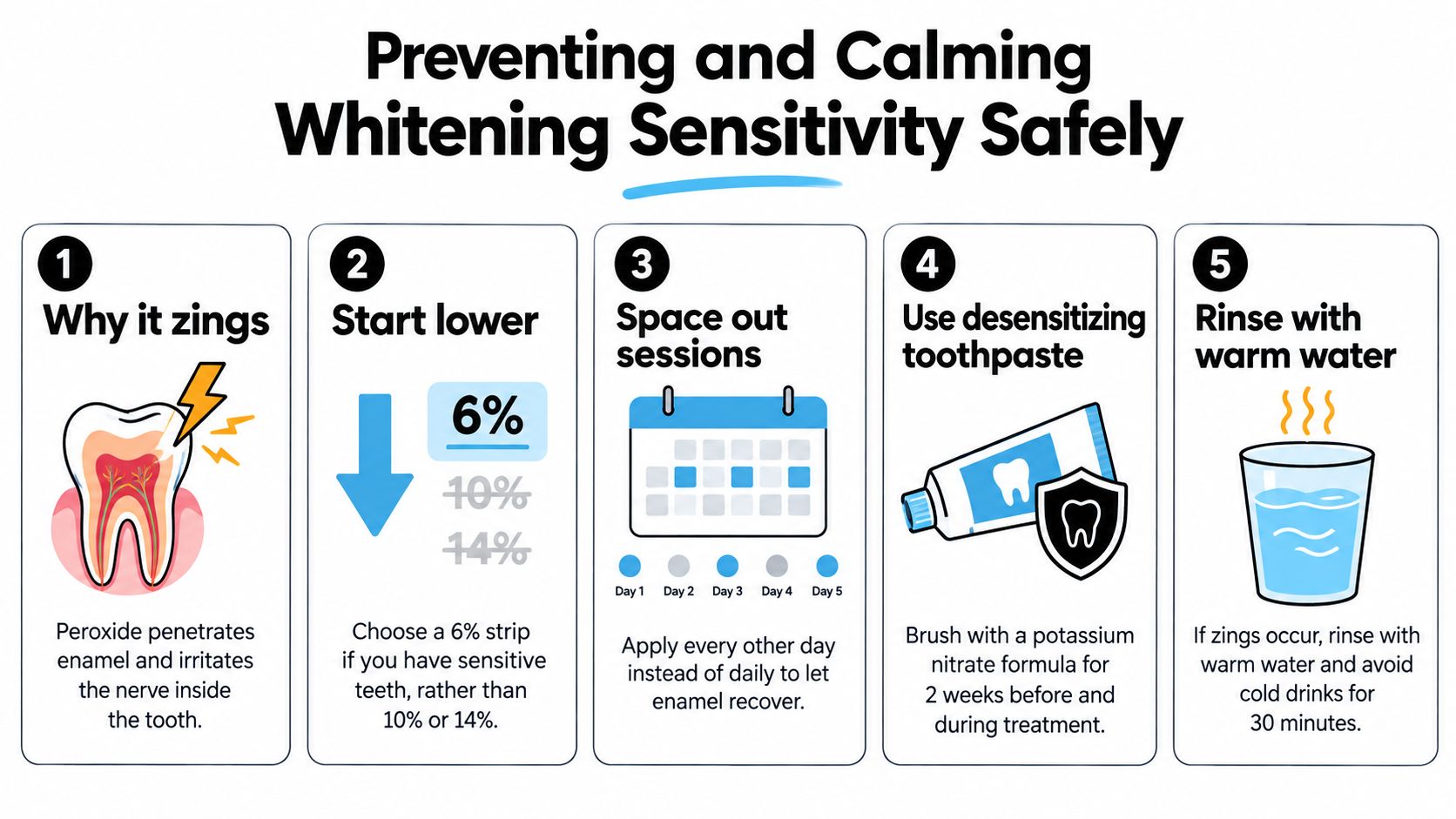
Sensitivity is easy to underestimate. It does not always mean damage, and it does not always mean the strip was used incorrectly. Usually, peroxide has reached a nerve-sensitive area of the tooth, or the strip has stayed on gum tissue longer than it should.
Why the zings happen
European Commission safety summaries report that 6% hydrogen peroxide strips caused sensitivity in 44% of users and 9.5% strips caused sensitivity in 59%, with oral soft-tissue effects reported in 6% of subjects in both groups and one severe sensitivity event in the 9.5% group. The ADA also identifies tooth sensitivity and oral irritation as the most common home-whitening side effects, more common at higher concentrations and usually mild and transient (ADA whitening overview).
How to make treatment easier on your mouth
Lower peroxide can be the smarter starting point if your teeth already react to cold or brushing. Wear time matters too, because longer contact does not help once the mouth starts signaling distress. If needed, leave rest days between sessions instead of stacking applications back to back.
A desensitizing toothpaste can act like a buffer before whitening starts, much like putting a thin coat on a rough surface before painting. Less gel at the gumline also helps, since soft tissue irritation often comes from excess contact rather than the whitening itself. Small fit issues add up quickly, especially when strips drift onto the gums.
For users who want a more comfort-focused route, DentalHealth.com's guidance on how to reduce teeth sensitivity after whitening gives a practical next step before pushing through pain. If the sensitivity lingers or gets worse, pause the whitening and speak with a dental professional instead of trying to force another application.
Safety first: temporary tingling is common, persistent pain is not.
When Whitening Strips Are Not the Right Choice
Whitening strips can brighten natural enamel, but they can also expose a problem you didn't have before. If you have crowns, veneers, fillings, sealants, or other visible dental work, peroxide won't whiten those materials the way it whitens tooth structure. That can leave you with a mismatch, where the natural teeth lighten and the restorations stay the same shade or react differently.
First check the visible smile zone
Before buying strips, look at the front teeth you show when you talk and smile.
- Visible restorations: If you have old fillings, crowns, or veneers in that area, think about the final color balance, not just the whitening itself.
- Untreated cavities or gum inflammation: Those should be addressed first, because whitening over active problems isn't a good shortcut.
- Cracks or exposed roots: These can increase discomfort and make whitening less predictable.
- Deep intrinsic discoloration: This is often harder for strips to change and may need professional evaluation.
The American Dental Association notes that peroxide products may react with dental restorations and recommends dental evaluation before whitening (ADA News guidance). That's especially important if you've got aging cosmetic work and want a uniform result, because “whiter teeth” does not always equal a whiter-looking smile.
Choose the right path instead of the strongest strip
If you're unsure, a short dental assessment can save you from buying the wrong product and ending up with a shade mismatch. A practice that handles a lot of patient questions may also use support resources like Dental Virtual Assistants for Practices and DSOs to help route whitening questions, sensitivity concerns, and appointment scheduling more efficiently.
Whitening is only one part of the decision. Sometimes the right choice is to whiten first, then replace visible restorations to match the new shade. Sometimes the right choice is to skip strips and choose a gel or tray system that better fits your mouth and your comfort level.
If you want a more comfortable at-home whitening plan, DentalHealth.com carries professional-grade oral care products that fit this kind of decision, including whitening gels and sensitivity-focused items. Visit DentalHealth.com to compare options for whitening, sensitivity relief, and maintenance products that fit your smile and your routine.