
Xylitol Tooth Sensitivity: Does It Help or Hurt?
You take a sip of iced coffee and wince. Then you notice xylitol on a gum wrapper or toothpaste label and wonder whether that sweet-tasting ingredient could make your teeth less sensitive. It's a reasonable question, but cavity prevention, dry-mouth support, and sensitivity relief are different jobs. Understanding which job xylitol can help with keeps you from buying the right ingredient for the wrong problem.
What Sensitive Teeth Feel Like
A sip of iced water can cause a sudden, sharp jolt. That reaction is a symptom, not a diagnosis: exposed dentin is one possible cause, while a crack, decay, or a problem inside the tooth can also produce discomfort. The cause matters because these problems may need different treatment.
Dentin hypersensitivity refers to brief discomfort when exposed dentin reacts to a trigger. Cold, moving air, or something sweet may set it off. The sensation often fades when the trigger is gone, unlike a steady ache, though symptoms alone cannot confirm the cause.
If cold sensitivity is part of your concern, this guide to what causes tooth sensitivity to cold can help you describe what you notice to a dental professional.
Describe the pain before choosing a product
Start with the pattern, not the ingredient. A specific description gives a dental professional more useful clues than saying only that your teeth feel sensitive.
- Identify the trigger. Does discomfort follow cold drinks, air, sweets, or something else?
- Locate the sensation. Is it hard to pinpoint, or does it seem to come from one tooth?
- Describe the pattern. Does it stop when the trigger disappears, linger afterward, or occur without an obvious trigger?
Persistent sharp pain from cold, air, or sweets can be linked to recession, abrasion, erosion, cracks, or pulpal disease. Arrange a dental evaluation rather than repeatedly trying over-the-counter products. A dentist can assess the cause and recommend treatment suited to it.
Set the right standard for relief
A fresh feeling after using a product does not show that the cold-triggered pain has changed. Likewise, reducing cavity risk is a separate goal from controlling dentinal hypersensitivity. Fluoride is used for cavity prevention, while sensitivity-focused treatments, such as potassium nitrate, address a different concern. Xylitol may have a role in oral-health support, but that alone does not establish that it relieves sensitivity.
Maintenance and repair are different jobs: supporting overall oral health does not prove that a painful tooth has been treated. When judging xylitol tooth sensitivity claims, check whether the evidence measures the pain response itself, rather than a separate outcome such as cavity risk or dry-mouth comfort.
How Xylitol Works in the Mouth
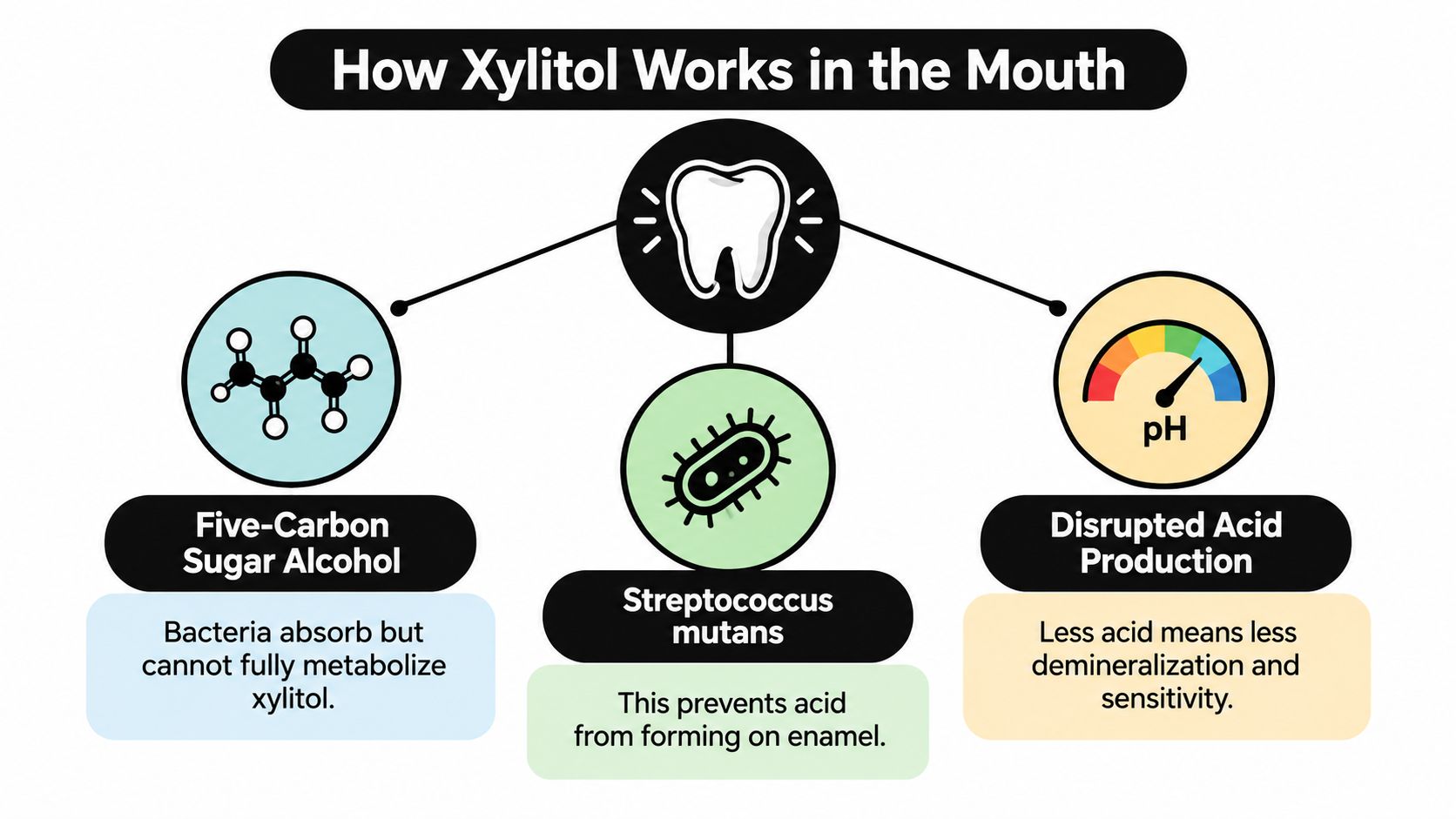
Xylitol's potential contribution is mostly about the oral environment, not a demonstrated direct effect on the painful trigger. It may support saliva flow and reduce acid-producing oral bacteria. Those benefits are relevant to oral-health maintenance, but they shouldn't be translated automatically into a promise of desensitization.
A useful analogy is reducing the conditions that damage a surface rather than repairing every existing defect in that surface. Less bacterial acid activity may help protect vulnerable tooth areas. It doesn't establish that xylitol can close exposed dentinal tubules or stop a tooth from reacting to cold.
The concept map below illustrates the proposed connection between xylitol, bacteria, and acid production. Read its sensitivity-related wording as an indirect possibility, not proof that xylitol prevents or treats tooth pain.
Separate the mouth environment from the pain response
The distinction becomes clearer when you give each treatment goal its own place:
- Cavity prevention concerns whether vulnerable tooth surfaces develop decay.
- Dry-mouth support concerns whether a product helps with saliva-related comfort and oral conditions.
- Hypersensitivity control concerns whether treatment reduces the specific response to triggers such as cold or air.
These goals can overlap without being interchangeable. A person might appreciate the saliva stimulation associated with chewing gum yet still need a dedicated sensitivity treatment. Another person might have a cavity-prevention reason to use xylitol even if their teeth aren't sensitive.
What gum research measures
A 2025 systematic review of xylitol chewing gum reported beneficial effects on dental caries, mutans streptococci, and plaque, with plaque decreasing in 6 of 10 studies and caries occurrence decreasing in 3 of 5 trials, but it didn't report comparable benefits for sorbitol gum.
Those outcomes support interest in xylitol as an adjunct. They don't establish a predictable reduction in hot-or-cold pain.
Practical distinction: Helping create a less cavity-prone mouth isn't the same as treating an already sensitive tooth.
Fluoride-based preventive care and potassium-nitrate-based sensitivity care therefore have different roles from xylitol. Ingredient names shouldn't be treated as interchangeable just because they appear together on an oral-care label.
What the Research Actually Shows
For a person with exposed dentin, research on root cavities is relevant. Exposed dentin is vulnerable to plaque acids and demineralization, so limiting caries activity may help address a pathway that can worsen discomfort. But relevance isn't the same as proof of pain relief.
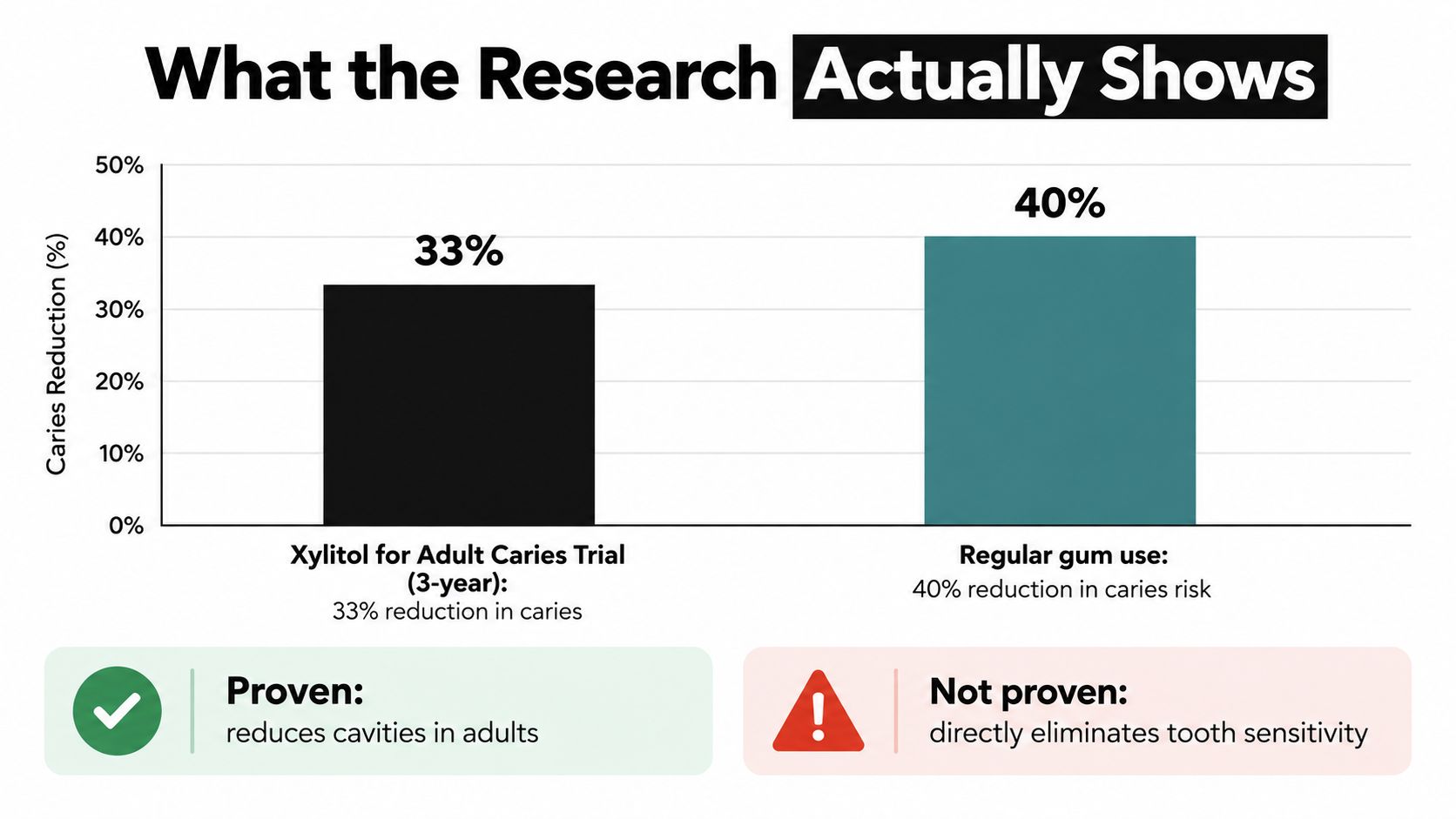
The adult research illustrates that distinction. The three-year, double-blind, multicenter Xylitol for Adult Caries Trial randomized 691 adults, and a related analysis reported root-caries incidence over 33 months of 29.52% overall, with 24.03% in the xylitol group versus 34.94% in the placebo group, an absolute difference of 10.91 percentage points and a relative reduction of approximately 31%, as described in the adult xylitol caries trial evidence.
Understand what the comparison means
The absolute difference compares the reported incidence in the groups directly. The relative reduction expresses that difference in relation to the placebo group's incidence. Neither measure describes how much a person's tooth pain improved.
That's an important safeguard against an easy misunderstanding. A cavity outcome and a sensitivity score answer different questions, even when the same tooth surfaces are involved.
- The measured outcome concerned root caries.
- The reasonable implication is potential support for protecting vulnerable surfaces.
- The unsupported leap would be promising a matching reduction in sensitivity or saying xylitol seals dentin.
The supplied graphic below uses cavity-reduction labels that don't match the clinical figures described above. Use the sourced text, not the chart's numerical claims, when judging the evidence.
Look for evidence that answers your question
If your question is whether xylitol can help prevent cavities, caries studies are appropriate evidence to consider. If your question is whether it will stop the sting from iced coffee, you need studies measuring sensitivity with a design that can isolate xylitol's contribution.
The adult trial didn't establish direct sealing of dentinal tubules or a specific reduction in sensitivity scores. The gum review also centered on preventive outcomes and risk indicators rather than establishing xylitol as a stand-alone desensitizer.
My practical interpretation is that xylitol belongs in the adjunct category. It may help with oral-health maintenance, but the evidence doesn't justify selling it as a direct solution to the painful trigger that brought you to the toothpaste aisle.
Why Xylitol Rarely Works Alone
Suppose a toothpaste contains xylitol, fluoride, and potassium nitrate, and your teeth feel better after using it. You've learned something useful about that toothpaste. You haven't learned which ingredient produced the improvement.
A clinical comparison makes this attribution problem concrete. Researchers tested a toothpaste and a mouthwash that both contained xylitol alongside other ingredients used in sensitivity care.
Read the formulation, not just the highlighted ingredient
In the randomized study of xylitol-containing sensitivity formulations, 30 patients were divided into groups of 15, using either toothpaste with 5% potassium nitrate or mouthwash with 3% potassium nitrate, both also containing sodium fluoride, xylitol, and triclosan; air and thermal sensitivity were assessed at baseline, two weeks, and four weeks, with the baseline results and reported post-treatment significance summarized below.
Sensitivity Scores in the 30-Patient Study
| Group | Baseline Air Score | Baseline Thermal Score | Post-Treatment Significance |
|---|---|---|---|
| Toothpaste | 6.3 ± 2.7 | 7.2 ± 1.2 | p < 0.001 |
| Mouthwash | 5.5 ± 2.3 | 6.3 ± 2.1 | p < 0.001 |
Both groups improved, and the researchers found no statistically significant difference between the toothpaste and mouthwash. That finding supports the tested formulations, not xylitol in isolation.
The study didn't compare xylitol alone with an otherwise identical product lacking xylitol. Without that kind of comparison, it's difficult to separate xylitol's contribution from potassium nitrate, fluoride, or the formulation as a whole.
Apply that lesson when shopping
A front label might emphasize xylitol because shoppers recognize the ingredient. Turn the package over and look for the ingredients and directions relevant to sensitivity relief, not merely sweetness or freshness.
A guide to choosing the best toothpaste for sensitive teeth can help you compare products by their intended function. Your dental professional can also help you decide whether a toothpaste, rinse, or another treatment fits your symptoms.
A combination product can be useful without every ingredient having an independently proven desensitizing effect.
This isn't a reason to avoid xylitol-containing formulas. It's a reason to keep expectations tied to the whole product and its evidence. Don't assume a xylitol-only gum or rinse will reproduce the results of a product that also includes established sensitivity-care ingredients.
Smart Ways to Use Xylitol Products
Start with the problem you're trying to address, then choose the product category. Gum, toothpaste, and mouthwash aren't interchangeable delivery systems for sensitivity treatment.
The everyday products pictured below illustrate familiar categories, not proof that a particular brand or pictured pack contains xylitol. Check the current ingredient label rather than relying on packaging appearance.
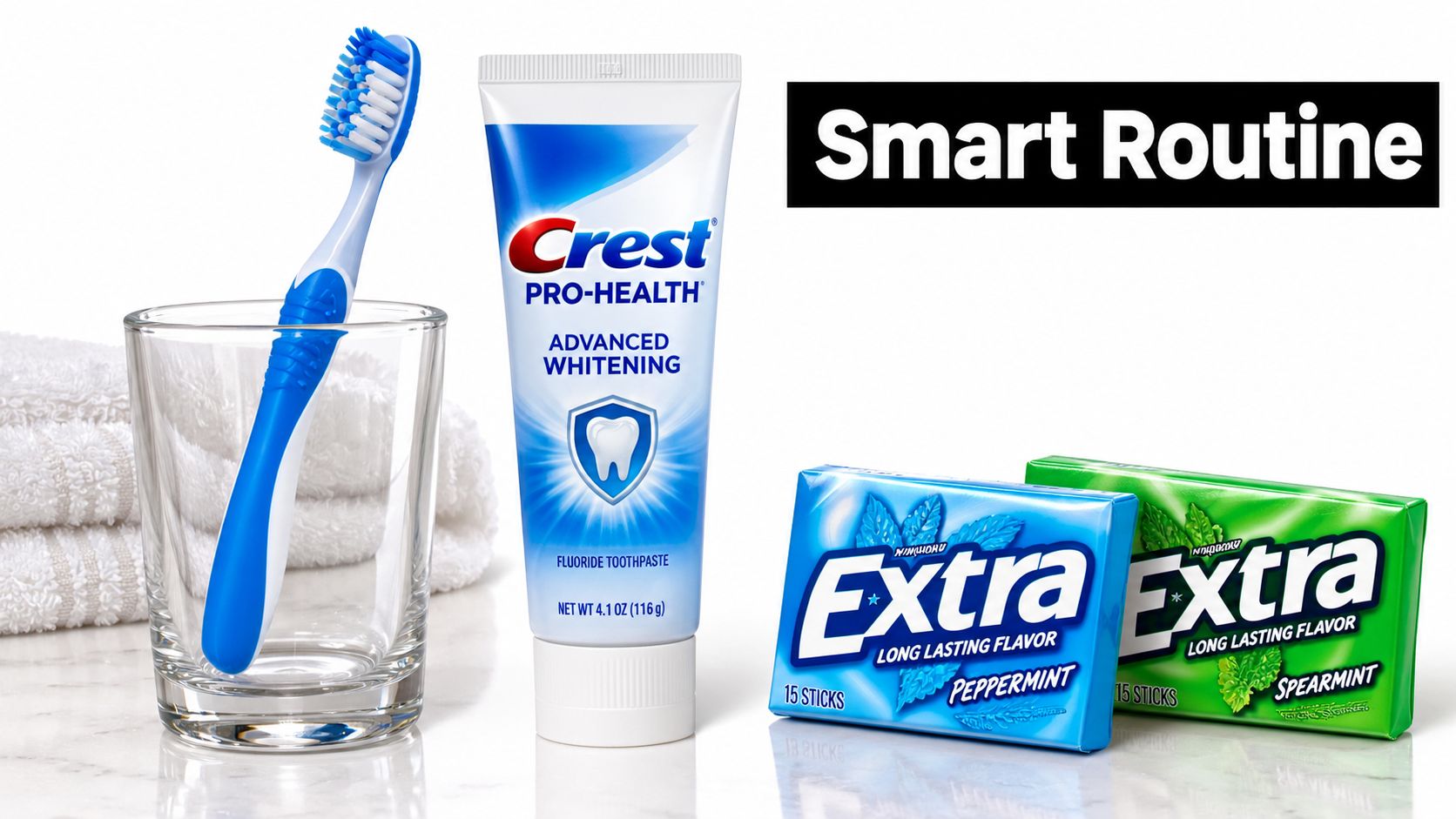
Match the product to its purpose
For a post-meal habit, sugar-free xylitol gum is an option to discuss with your dental professional, especially if saliva support is part of your goal. Don't treat chewing time or the number of pieces as a proven sensitivity dose. The review discussed earlier notes the need for better evidence establishing precise dosage and efficacy.
If you're comparing familiar gum brands, the guide to xylitol and Extra gum offers a starting point for checking what you're buying. The relevant question is what the specific product contains, not whether its brand appears in a photograph.
For brushing, select a product whose stated purpose matches your needs. A xylitol-containing toothpaste may fit your routine, but don't drop fluoride-based preventive care to obtain xylitol.
- Read the active-ingredient information. Look for a sensitivity-care formulation rather than assuming that xylitol alone provides that function.
- Follow the product directions. Use the instructions for that formula instead of borrowing a routine from a gum or mouthwash study.
- Ask about professional-care products. If you're considering Fluoridex, MI Paste Plus, or a desensitizing gel, ask your dentist which product fits your situation and how to use it.
Keep rinses in a supporting role
A xylitol-containing mouthwash can be an addition to your routine, but its presence doesn't establish that it replaces a fluoride rinse or a sensitivity toothpaste. Check whether the rinse contains the ingredients needed for the job you expect it to do.
Saliva stimulation and remineralization also shouldn't be treated as synonyms. A more comfortable mouth is a useful experience, but it isn't proof that a vulnerable surface has been repaired.
This video provides an additional oral-care resource; use product labels and individualized dental advice for treatment decisions.
Before starting, ask a pharmacist or dental professional about age suitability, tolerance, and household storage precautions. If a product irritates you or your tooth pain worsens, don't respond by using more of it. Reassess the product and arrange an evaluation.
Common Myths Worth Clearing Up
A helpful adjunct isn't a cure-all. Much of the confusion around xylitol comes from transferring evidence about one outcome to another, or assuming that a combination product proves every ingredient works independently.
Claims that overstate the evidence
- Xylitol seals exposed dentin. The evidence discussed here doesn't establish that action. A preventive benefit shouldn't be described as physical sealing of a sensitive surface.
- Xylitol toothpaste replaces fluoride toothpaste. Treat xylitol as a possible addition to established preventive care, not a reason to remove fluoride from a routine your dentist recommends.
- More xylitol means better results. There isn't a validated xylitol-only sensitivity dose in the research described above. Increasing use doesn't resolve that evidence gap.
These distinctions aren't merely technical. They determine whether you're choosing a product for a supported purpose or expecting it to do something that hasn't been demonstrated.
Assumptions about speed and suitability
- Children can use any xylitol product at any dose. Adult research doesn't establish unrestricted use for children. Follow age-specific product directions and ask the child's dental professional.
- Xylitol works as fast as potassium nitrate. The combination-product study can't establish a xylitol-only onset of relief. It didn't isolate the ingredient.
- Natural means safer or more effective. That description doesn't establish suitability, treatment effectiveness, or correct use. Judge the actual formulation and instructions.
The gum review's framing of xylitol as a promising adjunct is more useful than an all-purpose claim. It leaves room for preventive benefits while acknowledging the questions that still need well-designed studies.
Bottom line: Choose xylitol for a realistic supporting role, not because a label makes it sound like a substitute for diagnosis or proven sensitivity care.
You don't need to feel guilty about choosing a product with xylitol. You need a clear reason for using it and a separate plan for pain that doesn't improve.
When to Use Xylitol and When to See a Dentist
A sensible decision starts with the symptom, not the shopping cart. Your options fall into daily supporting care, dentist-guided treatment, and evaluation of concerning pain.
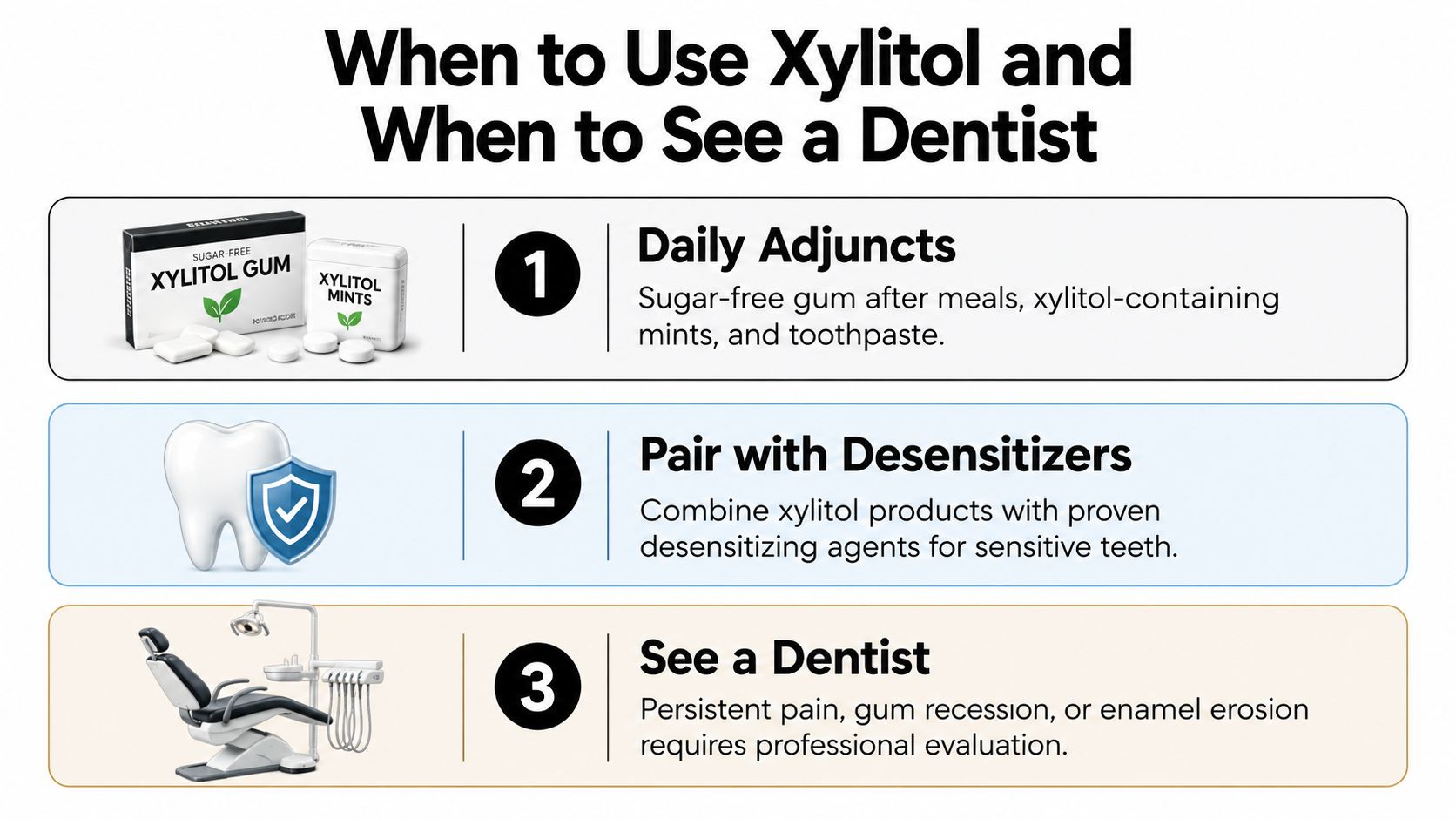
The framework below summarizes those roles. It's a decision aid, not a way to diagnose a sensitive tooth at home.
Choose the appropriate level of care
Daily adjuncts make sense when you have a clear preventive goal and understand the limits. Xylitol gum or a xylitol-containing oral-care product can sit alongside your established routine rather than replacing it.
Dentist-guided sensitivity care is the next step when your current approach isn't addressing the problem. Bring your product names or ingredient-label photographs to the appointment so your dentist can assess what you're already using and recommend targeted care.
Prompt dental evaluation takes priority when pain is localized, spontaneous, worsening, or persistent. Don't keep switching sweeteners or increasing product use while assuming that every painful tooth has ordinary hypersensitivity.
- For the appointment, explain the triggers and identify the tooth if you can.
- For the product discussion, say whether your main goal is cavity prevention, dry-mouth support, or pain relief.
- For follow-up, ask what improvement to expect and when unresolved symptoms should be reassessed.
Quick answers before you choose
Can xylitol help sensitivity indirectly?
Possibly, through its supporting role in the oral environment. That's different from a demonstrated direct desensitizing effect.
Does xylitol hurt sensitive teeth?
The research described here doesn't establish it as a cause of hypersensitivity. If a specific product provokes discomfort, stop using it and ask for advice rather than assuming the ingredient is responsible.
Should I choose gum or sensitivity toothpaste?
Choose according to the job. Gum is a potential adjunct; a sensitivity-care formulation addresses a different need.
What if the pain keeps returning?
Arrange a dental evaluation. Recurrent symptoms deserve an explanation, not an indefinite cycle of trying new products.
DentalHealth.com offers sensitivity toothpastes and rinses, remineralizing pastes such as MI Paste Plus, and practical guides for comparing at-home care options. Visit DentalHealth.com to review product descriptions and prepare questions for your dentist about which formula fits your sensitivity and prevention goals.