
Zoom Teeth Whitening Gel Reviews: What the Evidence Shows
Nearly every participant who received the strongest Zoom protocol in a controlled trial reported tooth sensitivity, even as their teeth got measurably whiter on day one. That tension, between a fast visible change and a treatment you can finish comfortably, is what useful Zoom teeth whitening gel reviews have to capture. A review that only tells you teeth looked brighter, without naming the gel, its strength, the wear schedule, or whether discomfort cut treatment short, doesn't tell you whether you'd get the same result. Read for the protocol behind the photo, not the photo alone.
Zoom Gel Options Compared at a Glance
The product name and peroxide percentage do not tell the whole story: setting, active ingredient, and evidence differ across these options.
| Product | Active peroxide | Strength | Setting | Evidence on record |
|---|---|---|---|---|
| Zoom DayWhite 6% | Hydrogen peroxide | 6% | Take-home trays | 4.8 of 5 from 33 reviews on the manufacturer page |
| Zoom DayWhite 14% | Hydrogen or carbamide peroxide type to confirm on the product page before ordering | 14% | Take-home trays | Listed at $27.99 at DentalHealth.com; no clinical trial for this strength is covered here |
| Zoom in-office gel 25% | Hydrogen peroxide | 25% | Dentist-applied, with or without light | Randomized trial of 33 adults from 2009 |
Take-home trays first
Zoom DayWhite 6% is the lowest-strength option in this comparison, a hydrogen peroxide gel used at home in trays. Philips reported a 4.8-out-of-5 rating based on 33 reviews for Zoom DayWhite 6% hydrogen peroxide take-home whitening gel on its Philips Finland product page. The rating reflects reviewers' overall satisfaction, not a measured shade change, wear schedule, or sensitivity rate.
Zoom DayWhite 14% is also a take-home tray option, listed at $27.99 at DentalHealth.com. Confirm whether its active ingredient is hydrogen peroxide or carbamide peroxide before ordering. Until the peroxide type is known, its 14% concentration cannot be compared directly with the 6% hydrogen peroxide or 25% hydrogen peroxide options in the table.
Dentist-applied treatment
The 25% in-office gel belongs to a different category. A dentist applies it and protects the gums; treatment may include a light. The cited randomized trial concerns an in-office Zoom protocol, so its findings do not establish what to expect from a take-home syringe used on a different schedule.
Buying rule: Strength may help indicate how quickly whitening occurs and the potential for sensitivity, but it does not predict your final shade.
A stronger gel may change tooth color faster at first, but discomfort that interrupts treatment can affect the result. Tray fit and contact time also shape the experience: leakage onto the gums or uneven gel distribution can affect comfort and exposure. Choose a product by matching its setting and active ingredient to your needs, then compare reviews for that specific formulation.
What Zoom Gel Reviews Can and Cannot Tell You
A 4.8-star rating from 33 reviews says a gel was liked. It doesn't say how much it whitened, how quickly, or at what cost in discomfort. That gap is the central problem with most Zoom teeth whitening gel reviews, and it's why the source of a review matters as much as its score.
You'll meet three kinds of evidence when you shop. Manufacturer pages show aggregate ratings and selected study results for a specific formulation. Retailer customer reviews capture satisfaction, convenience, taste, tray comfort, and sensitivity during the days someone used the gel, but almost never a standard shade measurement. Controlled clinical trials measure shade at set times with instruments or shade guides, usually over a short window, and often with small samples using one formulation. Each source answers a different question, so none of them substitutes for the others.
A three-part reading checklist
- Product and strength named: The review identifies the exact gel and percentage, not just the Zoom name.
- Shade method stated: The reviewer says how color was judged, whether by shade guide, photo in consistent light, or impression alone.
- Results beyond two weeks: The reviewer reports what the shade looked like after treatment ended, not only on the final day.
A review that fails the first item can't be matched to a product you'd buy. A review that fails the second gives you an opinion about brightness, not a measurement. A review that fails the third can't tell you anything about durability. Run any Zoom review through this checklist before you weigh its star rating, and you'll discard most of the noise in a minute.
Whitening Speed and Rebound in the Clinical Trial
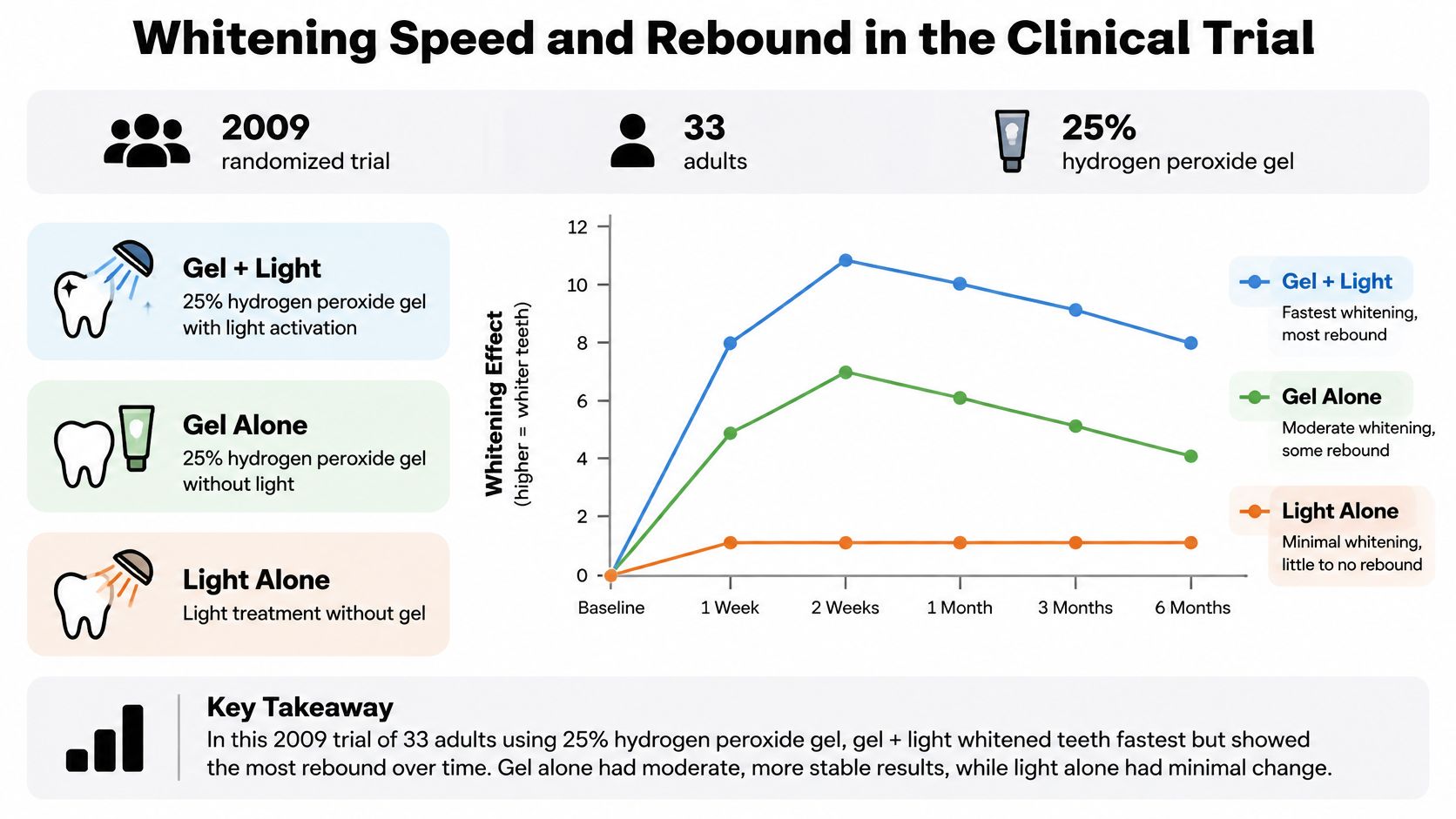
Immediately after treatment, the strongest protocol produced a mean reduction in yellowness of 3.1 units. By day 30, that same group's reduction had fallen to 1.7 units. Both numbers come from a randomized clinical trial published in 2009, which evaluated Philips Zoom in-office whitening using a 25% hydrogen-peroxide gel in 33 adults assigned to gel plus light, gel alone, or light alone without peroxide, as reported in the 2009 randomized trial record on PubMed.
The chart below tracks how the three groups moved over time.
What the yellowness numbers mean
A lower yellowness value means a whiter looking tooth, so a bigger reduction is a bigger visible change. Right after treatment, gel plus light led at 3.1 units, light alone came next at 2.4 units, and gel alone trailed at 2.0 units. If you stopped reading there, you'd conclude the light was doing substantial work and that the combined protocol was clearly superior.
Shade change by treatment group in the 2009 trial
| Treatment group | Immediate reduction (units) | Day 30 reduction (units) | Sensitivity reported |
|---|---|---|---|
| Gel plus light | 3.1 | 1.7 | 91% |
| Gel alone | 2.0 | 1.1 | Not reported |
| Light alone, no peroxide | 2.4 | 0.5 | Not reported |
Rebound changes the ranking
The initial improvement wasn't fully maintained. Statistically significant color rebound appeared by day 7, and by day 30 the mean reductions had declined to 1.7, 1.1, and 0.5 units for gel plus light, gel alone, and light alone. In plain terms, the gel-plus-light group kept a little over half its immediate gain after a month. The light-only group kept the least, which suggests much of its early change was temporary, likely surface dehydration and optical effect rather than durable bleaching of the tooth.
An after photo taken in the dental chair is the least reliable evidence in whitening, because it's captured at the moment of maximum temporary effect.
Sensitivity was the other major finding. In the gel-plus-light group, 91% of participants reported tooth sensitivity, and most cases were moderate or severe. That's a supervised, high-strength protocol, so it doesn't predict what you'll feel with a 6% tray gel at home. It does establish that sensitivity at the top end of the Zoom range isn't a rare complaint from a few unhappy reviewers. It's the expected experience under that protocol.
Two limits keep this trial in perspective. The sample was small, with 33 adults split across three groups, so each arm held roughly eleven people. And the product was an in-office gel applied by a professional, not a take-home syringe. The trial benchmarks what's possible and what rebound looks like. It doesn't certify any retail gel. When a review claims a shade result, check whether it was measured at day 7, day 14, or day 30, because those three answers describe three different products in effect.
Peroxide Type and Concentration Trade-offs
Stronger doesn't automatically mean whiter at the end. That's the claim most product pages invite you to make, and it's where the evidence splits speed of change from final shade.
Two chemicals, two release patterns
Hydrogen peroxide acts relatively quickly once it's on the tooth. Carbamide peroxide breaks down more gradually, releasing its bleaching effect over a longer window, which suits tray-based take-home protocols where the gel sits against enamel for an extended session. A recent systematic review found that both agents significantly bleach stained teeth, that carbamide-peroxide products showed better performance on measured color difference (ΔE) while conventional shade-guide improvement (ΔSGU) was comparable, and that there's moderate-certainty evidence higher-concentration carbamide-peroxide gel can produce less sensitivity than higher-concentration hydrogen-peroxide gel, according to the systematic review indexed on PubMed.
That split between instrument readings and shade-guide scores is worth understanding. An instrument can detect color shifts your eye won't register as a full shade step. So one chemistry can win on a lab measurement while both look the same in a mirror. For a shopper, the shade-guide result is closer to what you'll notice, and on that measure the two peroxides performed comparably.
Four benchmarks that beat a percentage
- Objective shade change: A shade-guide or instrument result, not a brightness impression.
- Time to visible improvement: How many days or sessions before a change you'd notice.
- Sensitivity intensity: Mild, moderate, or severe, and how long it lasted.
- Completion rate: The share of planned treatment days finished without interruption.
The fourth benchmark does the most work and gets reported least often. A gel that produces a strong result in people who finish, but drives a third of users to quit early, is a worse buy for many shoppers than a slower gel nearly everyone completes. When you compare products, our guide to whitening gel ingredients explains how to read what's in a syringe before you compare percentages across brands.
Where a product page omits the peroxide type, mark it unknown rather than assuming. Percentages aren't interchangeable across different chemicals, and a tray schedule written for one shouldn't be borrowed for the other. Compare two gels on the same four benchmarks before you decide the stronger one is better.
Sensitivity Reports and What Counts as Normal
Sensitivity is the most common adverse effect associated with dentist-dispensed or over-the-counter tray-based whitening, according to the ADA whitening topic summary. The ADA notes that transient mild-to-moderate sensitivity can affect up to two-thirds of users during early treatment. It may begin two to three days after whitening starts and commonly resolves by about the fourth day after treatment ends. Higher concentrations of active peroxide generally increase sensitivity risk.
Reported sensitivity rates vary widely across bleaching studies. Peroxide strength, delivery method, treatment length, and the people enrolled can all affect the results, so rates from one protocol may not predict what happens with another.
Separating normal from a warning sign
- Fits the expected pattern: Brief sensitivity to cold or air that starts during treatment and settles within a few days of stopping.
- Outside the pattern: Severe pain, pain that worsens, or discomfort that persists well beyond the usual recovery window.
- Worth discussing with a dentist: Sharp pain in one specific tooth. Whitening may have drawn attention to a crack, decay, or a leaking filling.
Interpretation rule: Frequency shows that sensitivity is common. Its duration and whether it is improving help indicate whether it needs attention.
Practical adjustments to discuss with your dentist include shortening wear time, spacing sessions farther apart, choosing a lower strength, or using desensitizing toothpaste before and during treatment. Stop if pain escalates rather than pushing through to finish a syringe. Keep a record of when sensitivity starts, which treatment day it occurs on, its severity, and whether you skipped a session. That gives your dentist a clearer basis for advising you.
Durability and Restorations
Philips reports figures such as 98% of participants experiencing little-to-no sensitivity. That's a strong headline. It also answers a narrower question than the one most shoppers are asking.
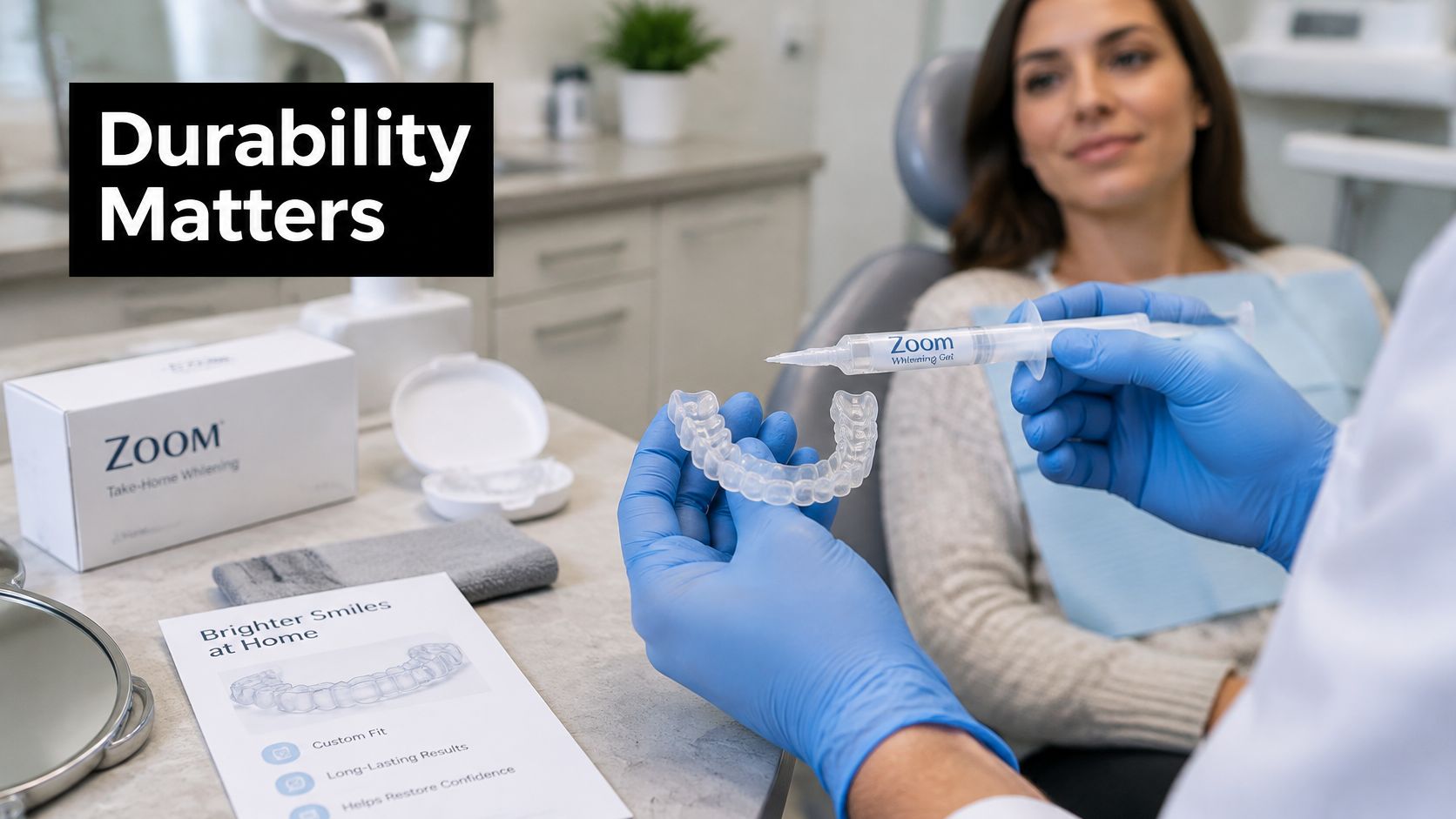
The image below shows the tray application those take-home results depend on, since gel placement and tray fit shape both comfort and coverage.
What a 14-day window leaves out
A 2026 randomized study reported mild-to-moderate adverse events and included participants who experienced moderate sensitivity during treatment, even though the overall conclusion was that products were safe and associated with little to no sensitivity, and Philips also reports results such as 94% or 98% of participants experiencing little-to-no sensitivity from studies that used small samples for particular formulations and controlled 14-day regimens, according to the Philips study document.
Those are tolerability results for a defined two-week course in selected participants. They don't tell you how long the shade lasts, whether repeated touch-ups increase sensitivity, or how coffee, tea, smoking, and aging erode the result over the following year. They also don't tell you what happens when someone with existing sensitivity, exposed roots, or a mouthful of restorations uses the same gel without supervision. Little-to-no sensitivity isn't the same as zero risk for every user. It's an average from a controlled group.
The video below walks through what a Zoom treatment involves, which helps set expectations before you judge durability claims.
The restoration problem reviews skip
Whitening changes natural tooth structure. Crowns, veneers, fillings, and bonding don't lighten along with it, so they can end up looking darker by comparison once the surrounding enamel brightens. That mismatch is the most common reason a technically successful whitening leaves someone unhappy with their smile. If you have visible dental work, our guide to teeth whitening with fillings covers the questions to raise before you start. Higher peroxide exposure also raises concerns about enamel alterations and soft-tissue irritation, which is another reason repeat use deserves more caution than a single short course.
Ask your dentist to check any restorations before your first tray, and to tell you which visible surfaces are natural enamel and which aren't.
Choosing a Zoom Gel and Checking It Before You Order
Zoom gel choice by situation
| Situation | Strength to consider | Why | Watch for |
|---|---|---|---|
| First use with sensitive teeth | Zoom DayWhite 6% | Lowest strength in the range, least peroxide exposure | Sensitivity may still start within two to three days |
| Faster take-home result | Zoom DayWhite 14% | Higher strength for a shorter timeline | Higher concentrations raise sensitivity risk, confirm the peroxide type |
| Fastest result under supervision | Zoom 25% in-office gel | Dentist-applied, with trial evidence | 91% sensitivity reported in the gel-plus-light trial group |
| Crowns, veneers or fillings present | Any Zoom gel, after a dentist check | Gel changes natural tooth only | Restorations may not match the new shade |
Reading the four situations
If it's your first use and your teeth already react to cold, the 6% gel is the sensible starting point because it gives you the lowest peroxide exposure in this range and the most room to stop. Don't mistake lowest for risk-free. Sensitivity can still begin a few days in, and your first course is partly a test of how your teeth respond.
If you want a faster take-home result and you've whitened before without trouble, the 14% option fits a shorter timeline. Confirm the peroxide type on the syringe or product page first, since that determines which schedule is appropriate. Higher strength buys speed, and it also raises the chance you'll need to skip days, which can erase the time you hoped to save.
The 25% in-office gel suits someone who wants the fastest change and is willing to have it done under supervision, with gum protection and a clinician watching for problems. With sensitivity reported in the great majority of the trial's combined group, your dentist's plan for managing discomfort matters more than the strength itself. Ask what they'd do if pain becomes severe mid-appointment.
If you have crowns, veneers, or fillings on front teeth, the product choice is secondary. Any Zoom gel lightens natural tooth only, so the decision is whether whitening improves or worsens the overall match. Book the check first, then choose a strength.
Three checks before you pay
- Confirm strength and peroxide type: Read both on the label or product page, and don't order if either is missing.
- Review sensitivity history and restorations: Raise past whitening pain, gum recession, untreated decay, and visible dental work with your dentist.
- Compare price and returns: Check the listed price against your dentist's price for the same product, and read the return policy before you open anything.
Our store's product lines include Teeth Whitening (Opalescence, Zoom, PolaNight, PolaDay), Tooth Sensitivity (Fluoridex, MI Paste), Pro DenRX, Retainer Brite, and Skin Care, so you can compare a Zoom gel against alternatives in the same place. If you're planning maintenance after an initial course, our article on Zoom teeth whitening gel refills covers what to check before reordering.
Track your own result
- Record shade on day 0, day 7, and day 14: Use the same room, same lighting, same camera distance, and no filter.
- Note sensitivity daily: Rate it, note what triggered it, and record how long it lasted.
- Log tray minutes and missed days: Write down the treatment you completed, not the one you planned.
- Add a day 30 photo: This is the measurement that tells you what you kept, and it's the one almost no reviewer takes.
Don't overload trays or push gel firmly into your teeth. Excess gel ends up on your gums, where it irritates soft tissue without whitening anything. If gel escapes, wipe it away, use less next session, and check whether the tray still fits properly. After treatment, rinse with tepid water, brush gently, and let the trays dry fully before storing them.
Stop rule: Call your dentist if sensitivity persists or worsens beyond the usual few days after your last session, or if one tooth hurts sharply.
Buy the strength that matches your situation, then judge it by your own recorded shade, comfort, and completion rate. That record is worth more than any star rating attached to a product name.
Compare Zoom DayWhite strengths alongside our wider Teeth Whitening range, including Opalescence, PolaNight, and PolaDay, and pair your gel with Tooth Sensitivity options such as Fluoridex and MI Paste if discomfort is your main concern. Visit DentalHealth.com to check the exact formulation, strength, and price of the gel you're considering before you order.