
Zoom Whitening Reviews: Real Results and Safety Insights
Coffee stains can creep into your smile gradually. One day your teeth look fine in the mirror, and the next, they seem noticeably darker in photographs, video calls, or bright bathroom light. If you're reading Zoom whitening reviews, you probably want a direct answer: will professional whitening create a visible change, and will the sensitivity be worth it?
The honest answer depends on what your teeth look like before treatment, whether you have restorations, and how your mouth responds to peroxide. Clinical studies show rapid shade changes under controlled conditions, while patient reviews reveal a less uniform experience. Some people love the immediate brightness. Others feel the treatment was too uncomfortable or didn't address the type of discoloration they had.
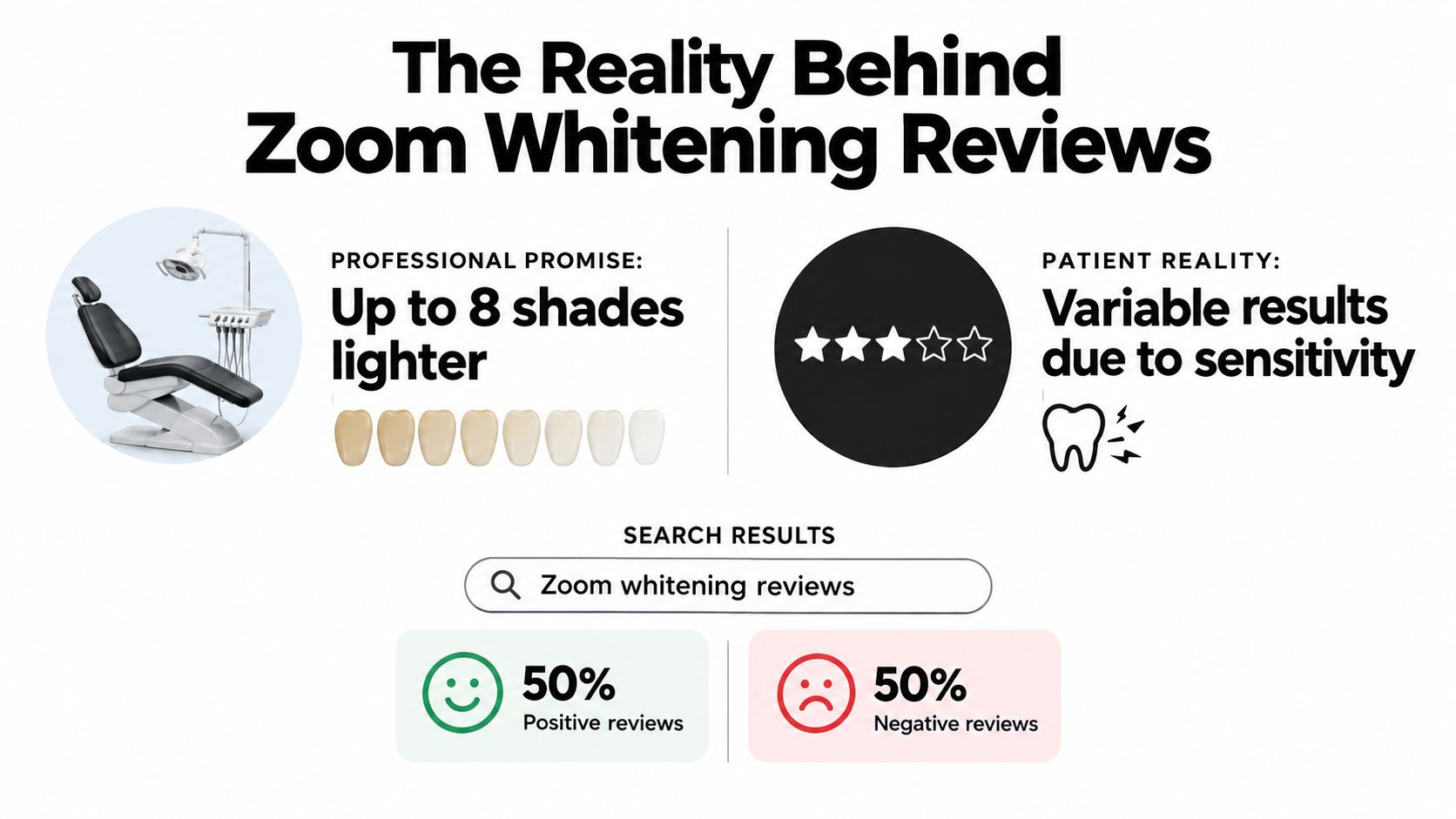
The Reality Behind Zoom Whitening Reviews
A patient may arrive before a wedding with a clear goal: a visibly brighter smile without spending the evening managing pain. Philips Zoom can produce a substantial change, but the review that follows depends on more than the shade reached in the dental chair. Starting color, sensitivity, expectations, and existing dental work all shape satisfaction.
Philips Zoom has been used as a professional whitening system since its launch in 2001 by Discus Dental, a company founded in 1989 by dentist Bill Dorfman. Its promise is straightforward, noticeable whitening under professional supervision. Clinical results support that promise, while patient experiences show why the same treatment can earn very different ratings.
In a study of Zoom! Take-Home gel containing 6% hydrogen peroxide, researchers recorded a mean improvement of 6.49 shades by day 4 and 7.72 shades by day 7 on the VITA scale, according to clinical information about Zoom whitening. Those findings explain the appeal for patients seeking a fast cosmetic change or preparing for an important event.
A trial result still describes a controlled group, not a guarantee for every smile. Yellow surface staining may respond differently from gray internal discoloration. Natural enamel can lighten while front crowns, veneers, or fillings remain the same color, leaving a mismatch that the patient may interpret as treatment failure. A patient with a history of sensitivity may also judge the result less favorably than someone who experiences little discomfort.
What positive reviews usually mean
Positive reviews commonly mention speed, visible contrast, and convenience. Patients may value a supervised appointment because a dental professional can examine the teeth, protect the gums, identify restorations, and adjust treatment if sensitivity develops.
“Whiter” does not describe one uniform outcome. For one patient, it means a dramatic shade change. For another, it means a cleaner and brighter appearance that still looks natural. The most informative reviews explain the starting shade, treatment type, sensitivity afterward, and presence of fillings, veneers, or crowns.
Why negative reviews matter
Negative reviews can reveal an expectation problem rather than a failure of peroxide itself. Philips materials emphasize low sensitivity and fast whitening, yet the RealSelf feedback summarized in Philips' Zoom WhiteSpeed treatment information includes more than a third of reviewers rating Zoom “Not Worth It”, commonly because the result fell short or sensitivity was too high.
That difference between clinical performance and patient satisfaction is the hidden gap in Zoom whitening reviews. A strong shade result may still feel unsuccessful if the patient expected porcelain-white teeth, has restorations that cannot change color, or cannot comfortably drink cold liquids afterward.
For a broader view of patient concerns outside clinic marketing, review professional teeth whitening discussions on Reddit. The practical conclusion is not that Zoom is unreliable. A useful review should explain who benefits, who may be disappointed, and how the appointment is managed.
Understanding How Professional Whitening Works
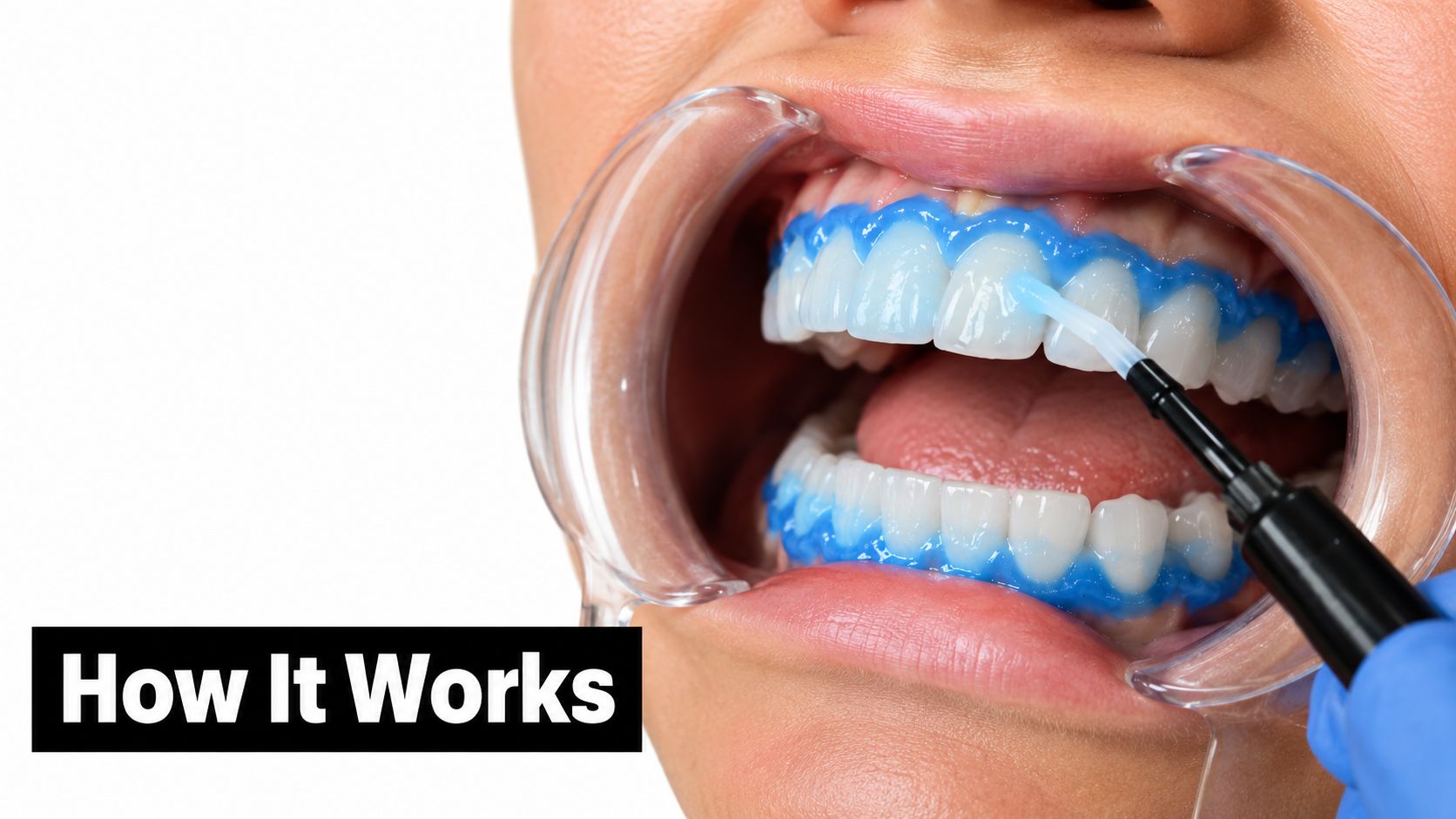
Professional whitening doesn't scrub color off the tooth. The active ingredient, usually hydrogen peroxide or carbamide peroxide, moves through the enamel and breaks down stain molecules. Those molecules can come from foods, drinks, tobacco, aging, or changes within the tooth itself.
The gel needs controlled contact with the tooth surface, while the dental team protects the gums and checks for problems that could make whitening uncomfortable. The light used with Philips Zoom WhiteSpeed doesn't “burn” stains away. It supports the whitening process by accelerating the chemical activity of the peroxide under the treatment protocol.
What the LED changes
A randomized study with 77 completers compared in-office whitening using 6% hydrogen peroxide with Philips Zoom WhiteSpeed LED against the same peroxide treatment without LED acceleration. The LED group had a mean immediate shade reduction of 6.9 SGU, compared with 5.3 SGU without the light, a statistically significant difference documented in the clinical study report.
That result supports a measured conclusion. The light can improve the speed or magnitude of whitening under the tested conditions, but it doesn't override the biology of the tooth. If the discoloration comes from a deep internal source, or if restorations account for much of the visible color, additional activation won't make those materials change shade.
The peroxide concentration also matters, but concentration isn't the only factor. Fit, exposure time, gum protection, treatment intervals, enamel condition, and the patient's sensitivity history all affect the experience. Professional systems offer clinical oversight and product selection, while over-the-counter products leave more of those decisions to the consumer.
Where comparisons become useful
People often compare light-activated in-office systems with custom trays and other professional options. The sensible comparison isn't just “light versus no light.” It includes active ingredient, wearing schedule, supervision, comfort, expected speed, and how well the method fits the person's daily routine. A useful overview of in-office teeth whitening options can help patients frame those questions before choosing a procedure.
Practical rule: The lamp is only one part of the treatment. The diagnosis of the stain and the condition of the teeth usually matter more than the marketing label on the light.
The following video can help visual learners understand how a professional whitening appointment is presented, although it shouldn't replace a dental examination.
In-Office Treatments vs. Take-Home Kits
A patient with a photo session next week may value a supervised in-office appointment. Someone managing sensitivity or a busy schedule may prefer trays used at home. The decision usually comes down to speed, control, and tolerance, not a simple question of which system produces the whitest smile.
Take-home whitening can produce substantial change when used as directed. In the 25-subject Zoom! Take-Home gel trial, the mean VITA improvement developed over several days rather than appearing entirely during one appointment, according to published clinical data. That timing matters in reviews because patients often judge the experience by comfort, convenience, and whether the result fits their expectations, not by shade change alone.
In-office treatment offers a faster, supervised process. Philips' WhiteSpeed clinical data reports a mean shade reduction of 6.9 SGU immediately after LED-accelerated treatment, compared with 5.3 SGU without LED acceleration. At day 7, the LED group still showed a greater overall change, 4.92 versus 4.19, as reported in Philips' WhiteSpeed clinical study summary.
Clinical efficacy comparison
| Method | Immediate Shade Change | Day 7 Result |
|---|---|---|
| In-office, 6% hydrogen peroxide with LED | 6.9 SGU mean reduction | 4.92 VCS LS mean reduction |
| In-office, 6% hydrogen peroxide without LED | 5.3 SGU mean reduction | 4.19 VCS LS mean reduction |
| Zoom! Take-Home gel, 6% hydrogen peroxide | Not reported as an immediate in-office result | Meaningful change over the treatment period |
These figures do not create a direct ranking. The studies used different protocols, outcome scales, and treatment settings. They show that both routes can whiten effectively, while the timing, supervision, and patient experience differ.
Choosing the pace that suits you
In-office whitening suits patients who want rapid, supervised change and accept the possibility of temporary sensitivity. It can work before a specific occasion, but schedule treatment early enough to assess the response rather than immediately before the event. A clear explanation of how in office whitening works helps set expectations about the chairside process.
Take-home treatment suits patients who prefer gradual control or want to adjust applications around comfort. Custom trays may also support later maintenance, provided the patient follows instructions and does not use whitening to avoid treating decay, gum disease, or another dental problem.
Reviews often hide the most useful distinction: clinical results describe controlled protocols, while satisfaction depends on fit, routine, comfort, and expectations. Patients with restorations should also understand that whitening changes natural tooth structure, not existing crowns, veneers, or fillings. The difference between at-home and professional teeth whitening can help frame those trade-offs before discussing options with a dentist.
In-office whitening prioritizes immediacy. Take-home whitening prioritizes pacing and control. The suitable choice depends on the patient's stain type, schedule, restoration status, and sensitivity threshold.
Managing Sensitivity and Aftercare
Sensitivity is the complaint most likely to change a favorable whitening review into a negative one. It can appear as brief sharp sensations, discomfort with cold air or drinks, or a general feeling that the teeth are unusually reactive after treatment. The risk isn't identical for every patient, and preparation can make the experience easier to manage.
Philips' cited clinical trial reported that 98.5% of subjects reported no sensitivity immediately after whitening, as shown in the randomized clinical trial report. That finding describes the study group and its protocol. It shouldn't be read as a promise that every patient will have the same response, particularly when preparation, enamel condition, or treatment planning differs.
Prepare before the appointment
Tell the dental team if cold foods already cause a sharp response, if brushing is uncomfortable, or if previous whitening caused pain. The clinician may recommend a desensitizing toothpaste before treatment and may use a product containing potassium nitrate or fluoride, depending on the patient's needs.
Philips guidance also refers to Relief ACP protocols. Acidulated Calcium Phosphate, commonly called ACP, is used in remineralizing and desensitizing products to support comfort around the whitening process. The exact product and timing should come from the treating dental professional rather than from a generic online schedule.
A practical preparation routine includes:
- Report existing sensitivity. Don't wait until the gel is already applied. The clinician needs that information when selecting the protocol.
- Use the recommended desensitizer consistently. Irregular preparation makes it harder to judge whether the product helped.
- Address cavities, gum inflammation, or exposed roots first. Whitening gel can feel harsher when it contacts vulnerable areas.
- Ask how long to pause between applications. More whitening gel isn't automatically a better result.
Protect the result afterward
For the first period after whitening, follow the clinic's instructions about food, drinks, brushing, and touch-ups. Avoid testing the newly whitened teeth with very cold or acidic drinks if they feel reactive. Gentle brushing and a sensitivity-focused toothpaste can be more comfortable than aggressive polishing products.
A maintenance plan should also account for the habits that caused the staining. Rinsing after dark drinks, maintaining regular hygiene, and using clinician-approved touch-up trays can help preserve the appearance. Guidance on Zoom whitening aftercare can supplement, but not replace, the instructions provided for your specific treatment.
Sensitivity is a treatment variable to plan for, not a test of whether you have to endure pain.
If discomfort is severe, persists, or feels different from the brief sensitivity expected after whitening, contact the dental office. A patient shouldn't continue applying whitening gel while ignoring significant pain.
Identifying Candidates for Professional Whitening
The best candidate for Zoom isn't just the person who wants the whitest possible smile. It's the person whose natural teeth are healthy, whose discoloration is likely to respond, and whose expectations match what bleaching can change.
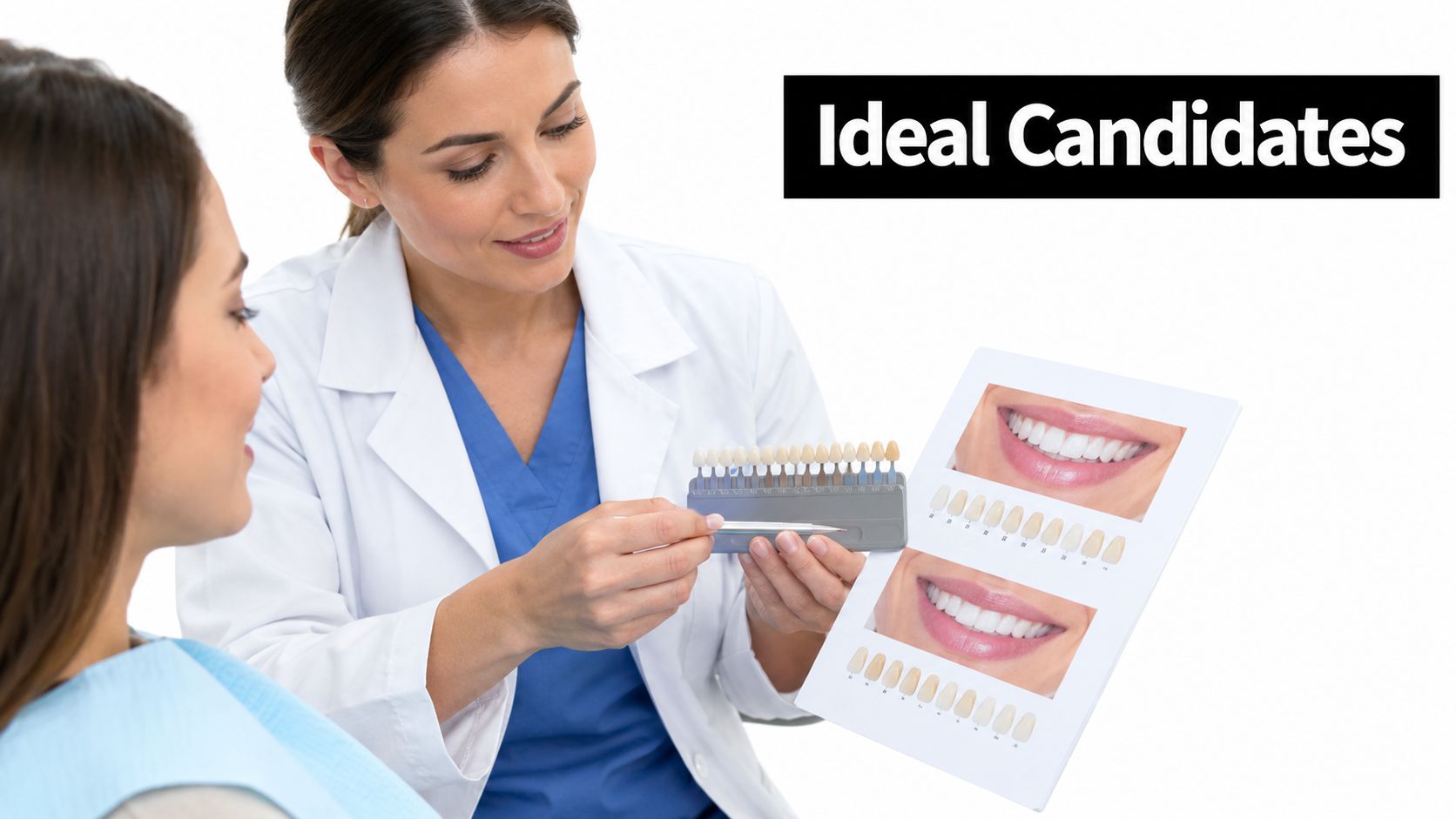
Yellow or yellow-brown external staining often gives whitening a clearer target than gray or purple undertones caused by changes within the tooth. Deep discoloration associated with trauma, medication, fluorosis, or aging may respond unevenly or less dramatically. A consultation helps distinguish surface stain from internal color before the patient commits to a treatment plan.
Restorations create a hard limit
Whitening changes natural tooth structure. It doesn't change the color of crowns, veneers, fillings, or other restorations. That limitation explains many disappointing reviews. A patient may achieve a pleasing shade change in the natural enamel while a front crown remains the older color, creating a visible mismatch.
The sequence matters if restorations are visible. A dentist may recommend whitening the natural teeth first, allowing the final shade to settle, and then discussing whether an existing restoration should be replaced or modified. Whitening the restoration itself isn't the solution because bleaching agents don't recolor ceramic or composite in the same way they alter natural tooth stain.
Use the consultation as a filter
Before treatment, ask the clinician to assess:
- Visible dental work: Identify crowns, veneers, fillings, and bonding that may remain unchanged.
- The source of discoloration: Separate removable surface stain from deeper intrinsic color.
- Gum and tooth health: Treat decay, inflammation, or exposed sensitive areas before cosmetic whitening.
- The target shade: Discuss a realistic improvement rather than promising a uniform result across every tooth.
- Future dental work: Plan the timing if a restoration may need to match the whitened enamel.
A person whose main concern is chips, spacing, tooth shape, or mismatched dental work may need more than whitening. In that situation, Zoom can be one part of a cosmetic plan, but it won't correct the underlying structural issue.
Making the Final Decision on Your Whitening System
A useful whitening decision starts with the problem, not the brand. Ask what you want to change: surface staining, overall dullness, a fast event-ready improvement, or a mismatch caused by old dental work. The answer often makes the treatment choice clearer than a long list of product features.
If speed is your priority
In-office Zoom WhiteSpeed is the more logical path for someone who wants a professionally supervised change concentrated into one appointment. The published data supports faster visible whitening with LED activation under the tested protocol, but speed comes with a greater need for sensitivity planning and realistic expectations.
Don't schedule the appointment without discussing your starting shade. If your teeth have deep gray discoloration or visible restorations, the result may be less uniform than the before-and-after images suggest. A dental assessment can prevent you from paying for a treatment that won't address the main reason you dislike your smile.
If control matters more
A take-home system may suit someone who prefers to control the pace. Zoom! Take-Home gel produced rapid early whitening in the cited clinical trial, but the process gives the patient more responsibility for following the wearing instructions and responding appropriately to sensitivity.
This route can work well for patients who don't need a same-day change and would rather make progress in stages. It also gives the dental team an opportunity to adjust the schedule if the teeth become uncomfortable. The trade-off is that the patient must remain consistent, and a take-home kit won't solve discoloration from restorations.
If sensitivity is your main concern
A sensitivity-prone patient shouldn't choose solely by looking for the strongest advertised result. Start with a dental examination, report prior reactions, and ask about desensitizing toothpaste, fluoride support, ACP products, tray fit, and treatment intervals. A slower or modified protocol may provide a more satisfying outcome than an aggressive session followed by pain.
The phrase “low sensitivity” also needs context. It may describe a study protocol with careful screening and professional management, while a consumer may apply too much gel, allow it to contact the gums, or ignore an underlying cavity. Technique and preparation can affect comfort as much as the product name.
If restorations are visible
Whitening natural teeth before evaluating the color of crowns, veneers, or fillings is often the more sensible order. If you whiten after replacing a restoration, the new material may be selected to match the current shade. If you whiten after the restoration is already in place, the natural teeth may become lighter while the restoration stays unchanged.
My clinical recommendation: Choose the treatment that solves your actual cosmetic concern, not the one with the most dramatic advertising claim.
The evidence supports Zoom as a capable professional whitening system, particularly for patients seeking a rapid change and willing to plan for sensitivity. It doesn't support treating every review as a prediction of your own result. The most reliable decision combines a stain assessment, restoration check, sensitivity history, and a clear conversation about what “white enough” means to you.
DentalHealth.com offers professional-grade at-home options, including Philips Zoom whitening gels, along with sensitivity toothpastes and remineralizing products for patients following a dentist-guided routine. Visit DentalHealth.com to compare whitening and aftercare products, then discuss the option that fits your teeth and treatment plan with your dental professional.