
Zoom Whitening Trays: How They Work and What to Expect
Zoom whitening trays are custom or prefilled trays that hold professional-grade peroxide gel against the teeth during scheduled wear sessions, and they can produce visible shade improvement over days to weeks. The question isn't whether they work, it's whether you want a professional bridge between in-office power and patient-controlled wear time.
Many people think of Zoom as a lamp in a dental chair, but that's only part of the story. The tray-based version lives in a different lane, one built for consistency, comfort, and maintenance.
What a Zoom Tray System Delivers
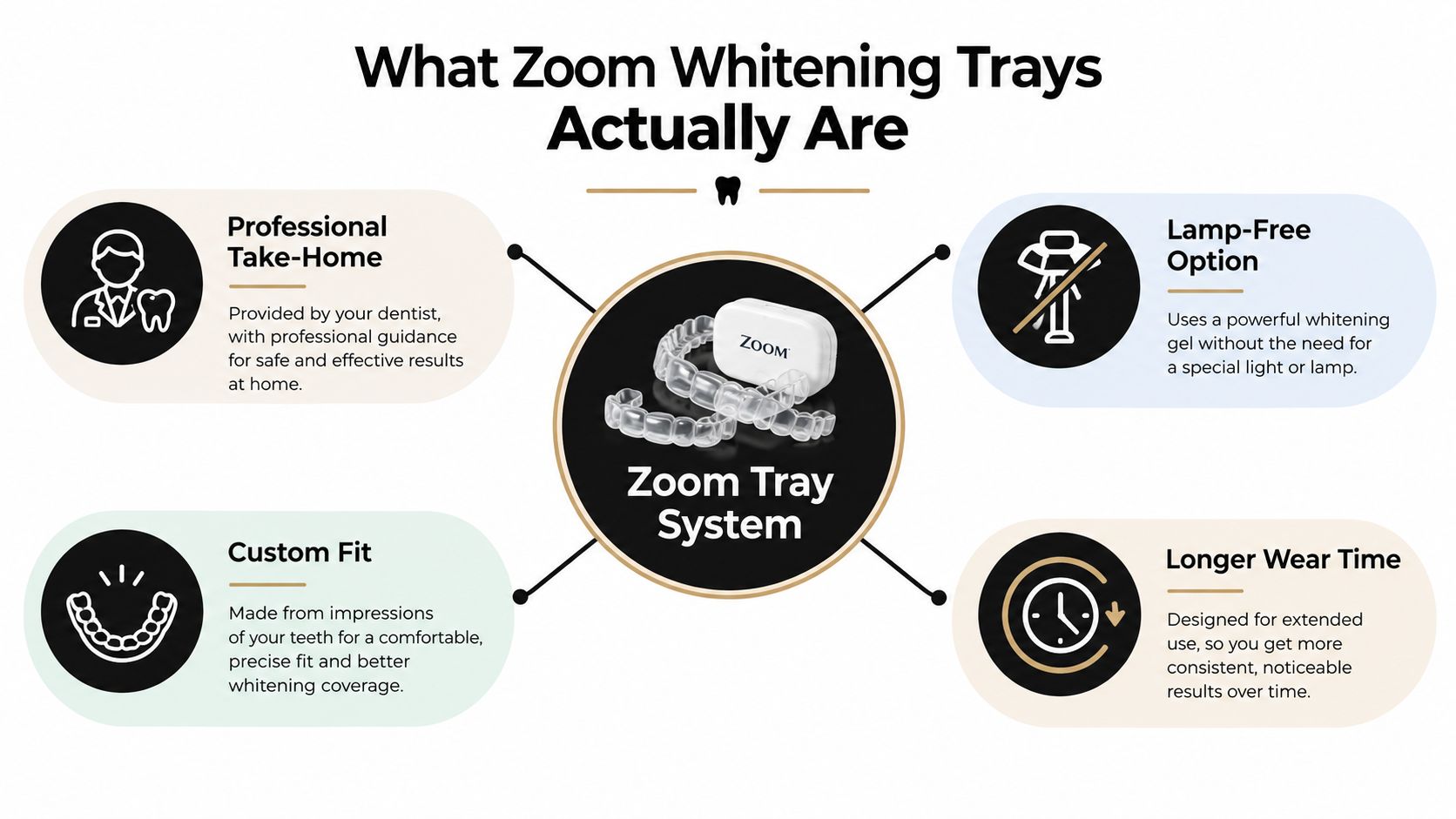
What does a patient get from a Zoom tray system that an in-office light procedure cannot provide? Control over the delivery method and wear schedule. A Zoom tray system is a professional take-home approach: the tray holds whitening gel against the tooth surface for a planned session, creating a practical bridge between office treatment and patient-managed use.
The tray is the delivery device
The gel provides the whitening action. The tray controls where the gel sits, how evenly it contacts the teeth, and how consistently the treatment can be repeated. Tray design and gel compatibility therefore affect the experience as much as the brand name.
Custom tray bleaching became widely used through the nightguard vital bleaching method, first described in 1989 with 10% carbamide peroxide in custom trays as documented in the Philips Zoom case study. Modern Zoom take-home systems follow the same basic delivery principle, pairing fitted trays with peroxide gels in the single-digit to mid-teens range.
That history explains why Zoom trays are better understood as a clinical protocol adapted for home use than as a gadget. A well-made tray should stay seated, distribute gel predictably, and support a repeatable routine. Prefilled and custom options can differ in handling, fit, and how much control the user has over gel placement.
The typical tray candidate wants gradual whitening that fits around work, travel, or sensitivity concerns. Patients comparing cosmetic whitening with broader treatment plans may also review regenerative dental treatments Mexico, a different care category from routine take-home whitening.
Practical rule: if the tray cannot keep gel in stable contact, the system is not delivering its intended value, regardless of the packaging.
How Zoom Whitening Trays Work
The mechanism is simple enough to explain without turning it into a chemistry lecture. Peroxide breaks down and releases oxygen species that interact with stain molecules inside and on the surface of the tooth, and the tray's job is to keep that gel where it can work consistently.
Contact time is the real lever
That's why wear time matters so much. A tray worn for the right interval gives the gel repeated access to the enamel surface, while a thin smear or sloppy placement can leave some teeth under-treated and others irritated. The same principle shows up in clinical evidence, where tray-based home bleaching with 10% carbamide peroxide can perform comparably to in-office 35% hydrogen peroxide in some settings per the clinical review and randomized trial summary.
The practical takeaway is straightforward. Concentration matters, but it isn't the whole story. Fit, retention, and the actual minutes or hours the tray stays in place are what decide whether a kit feels controlled or random.
That's also why tray systems appeal to people who want a predictable routine. You put the gel in, seat the tray properly, and let time do the work. It's less dramatic than an office session, but it's a cleaner way to manage exposure at home.
For readers who want to understand the chemistry behind carbamide peroxide in more depth, this internal overview on how carbamide peroxide whitens teeth is a useful companion.
Whitening doesn't happen because the tray is “strong.” It happens because the tray keeps the gel in steady contact long enough to matter.
Why wear time changes the outcome
Wear time can increase whitening effect, but it also changes tolerability. Expert guidance notes that tray and strip regimens often bring transient sensitivity within 2–3 days that usually subsides after treatment ends as summarized in the clinical review. That's not a flaw in the system, it's the cost of exposure, and it's why patient instructions matter as much as the product itself.
Zoom Trays vs Other At-Home Whitening Methods
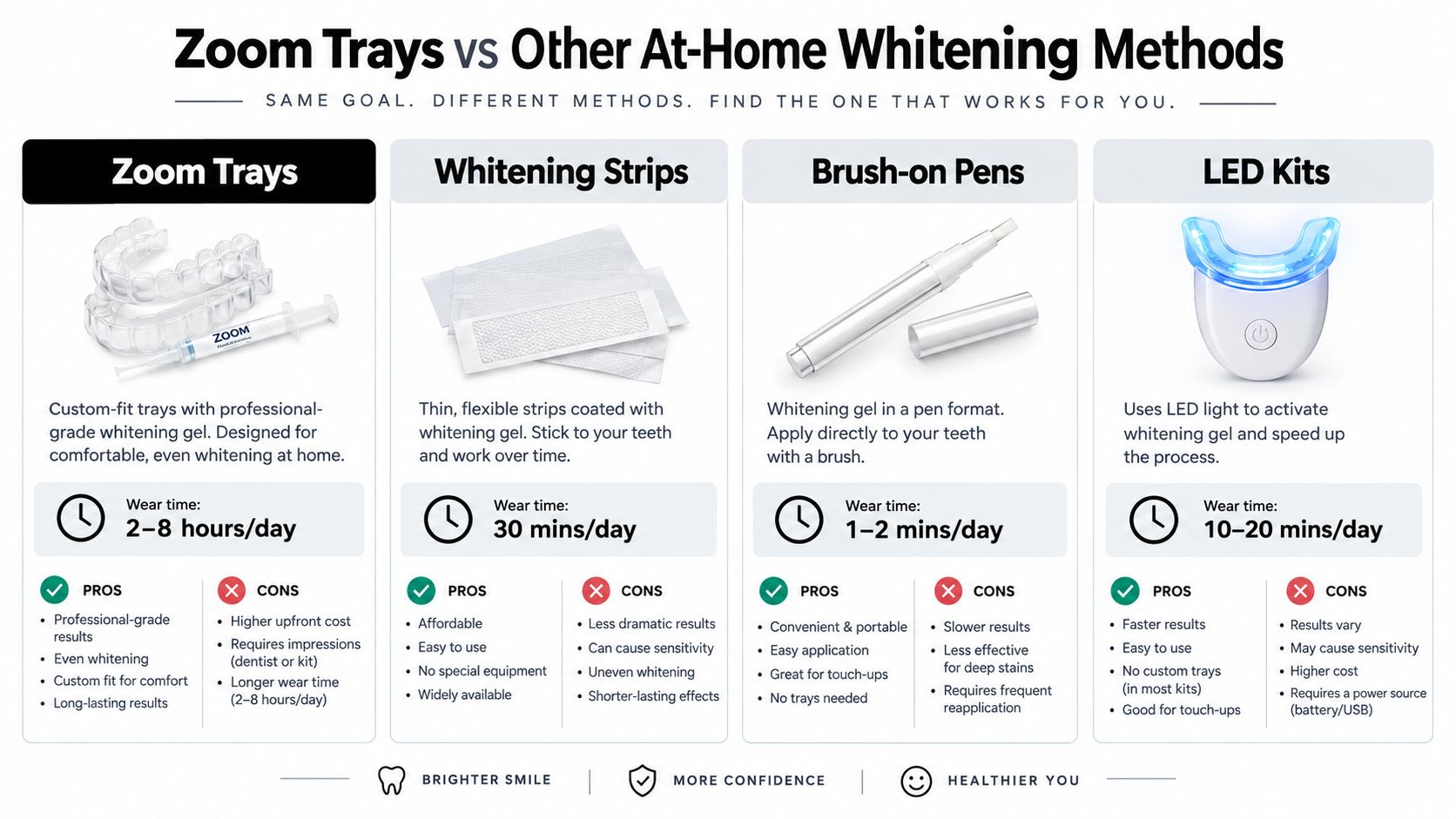
Tray-based whitening gets compared with strips, pens, and LED kits because buyers usually aren't shopping for chemistry, they're shopping for convenience. The right choice depends on whether you care most about even coverage, speed, sensitivity, or how much discipline you're willing to bring to the routine.
Where trays usually win
Zoom trays are strongest when the teeth aren't perfectly uniform. Because the tray follows the arch, it can cover more of the visible surfaces than a strip that only lays flat on the front. That matters for people with minor rotations, uneven tooth shape, or gaps where a flat adhesive strip can miss edges.
Strips still have a place. For minor surface staining and short-term convenience, they're easy to use, and many people prefer the lower-friction routine. Brush-on pens are even more situational, they're helpful for spot correction, but they're rarely the best choice for a full arch result.
LED kits deserve a careful read. The light often gets the marketing spotlight, but the gel and wear pattern are usually what drive the result. If the tray or applicator is poor, a lamp doesn't fix the contact problem.
The trade-off is control
Zoom tray systems generally demand more discipline than strips. You have to load the tray correctly, wear it as instructed, and avoid turning the session into a guessing game. That extra effort is why trays often feel more “professional” to the user, because the method is controlled rather than casual.
If your main problem is uneven coverage, a tray system usually makes more sense than a method that only touches the front surface.
If you already know you'll stick to a routine and want a more even delivery method, trays usually fit that goal better. If your main goal is a quick cosmetic boost and you're not ready for a repeated schedule, another format may be sufficient.
Fit, Customization, and Tray Design
Tray fit is the part most buyers underestimate, then blame the gel when the core issue is geometry. A tray that sits poorly can leak, irritate gum tissue, and leave teeth with patchy whitening because the product isn't staying where it should.
Custom fit changes the contact pattern
A well-made tray keeps gel on the tooth surface and limits spillover onto soft tissue. That's the actual value of customization, not branding. In tray-based whitening, retention matters more than how the packaging looks, because gel migration is what usually creates the burning sensation people complain about.
Clinical evidence backs up a few important realities here. One study found that an extended tray design didn't provide a meaningful advantage in shade change or sensitivity over a non-extended design, which is a useful reminder that bigger doesn't automatically mean better as reported in the PubMed summary. Another study found that adding 5% potassium nitrate-fluoride reduced sensitivity in most patients who used it, which helped them continue bleaching to completion same source.
What good fit actually looks like
A good tray feels stable without feeling bulky. It shouldn't rock, pinch, or demand constant adjustment. If it does, the problem can be retention, arch shape, or a mismatch between the tray design and the person using it.
Many shoppers confuse “prefilled” with “better.” Prefilled trays may be convenient, but convenience doesn't guarantee a better fit. For tooth anatomy that's crowded, rotated, or irregular, a custom-style tray usually gives the gel a more predictable path.
The internal guide on custom fit teeth bleaching trays is worth reading if you're trying to decide whether tray shape will make or break your results.
A tray that fits cleanly often does more for comfort than any add-on ingredient in the gel.
Gels, Compatibility, and What to Use with Zoom Trays
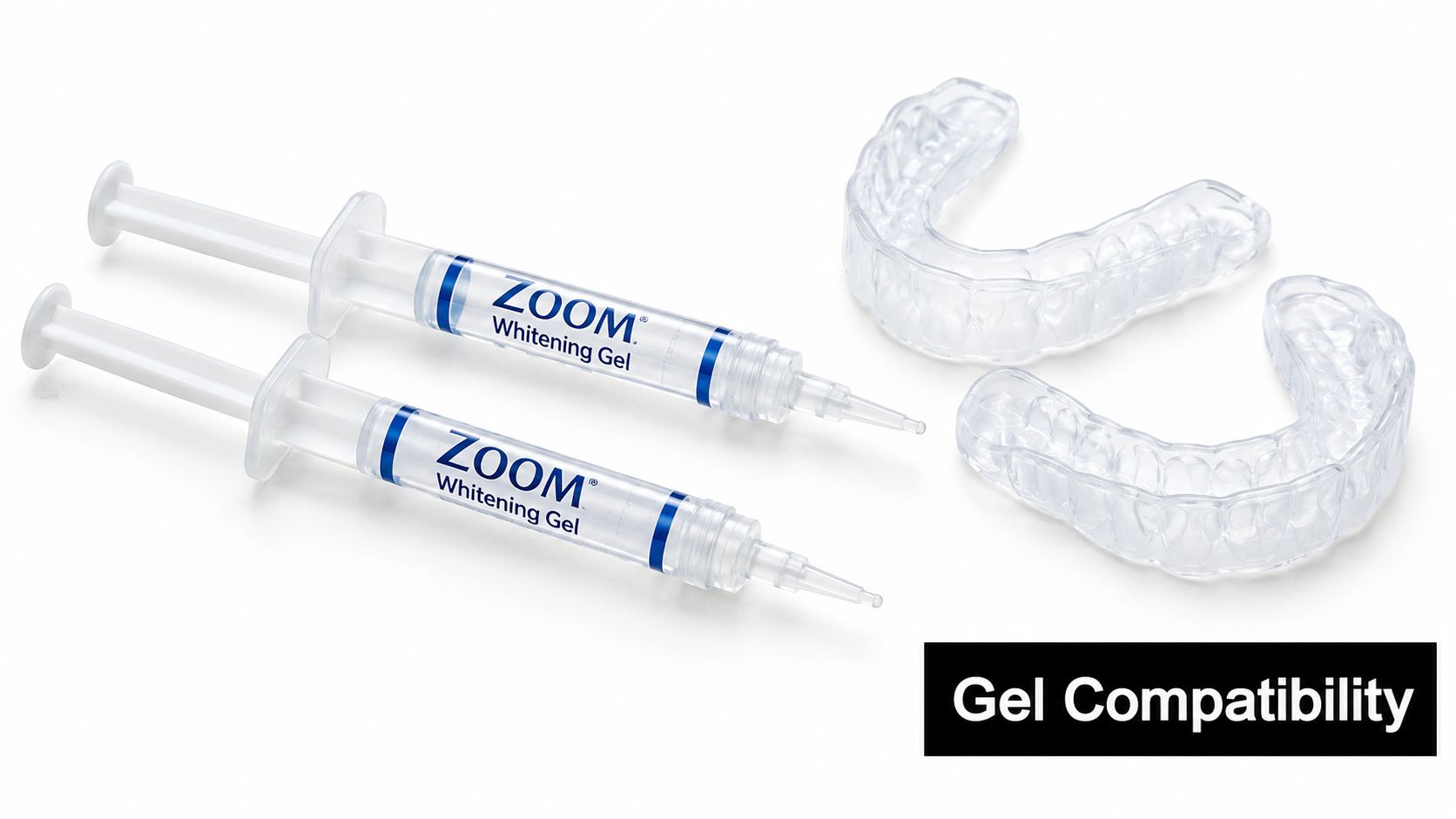
The gel matters, but not in the way marketing copy suggests. What counts is whether the formula matches the tray, the wear schedule, and your sensitivity tolerance. A strong gel used badly is just an irritating gel.
What compatibility really means
Recent Philips materials say whitening efficacy depends not only on peroxide concentration but also on pH and contact time, and that take-home formulas can deliver strong results with little-to-no sensitivity. That lines up with how tray systems behave in practice, because the tray is only useful when the gel is stable, spread appropriately, and easy to wear consistently.
For most users, compatibility comes down to three things:
- Gel consistency: Thick enough to stay in the tray, not so heavy that it bunches or spills.
- Wear tolerance: A formula you can complete, because a theoretical ideal means nothing if you quit halfway.
- Tray match: The gel needs a tray that seats evenly, or you'll get uneven whitening and sore gums.
The 2020 retrospective Zoom study is notable here because it used individual trays with 6% hydrogen peroxide gel for 12 days after four 15-minute in-office applications, and 99.1% of participants reached the lightest recorded shade endpoint, with 80.2% at B1 and 18.9% at A1 study record. Those numbers don't mean every user will have the same result, but they do show how a tray-based professional protocol can be documented when the fit and gel are aligned.
Don't overcomplicate the formula choice
In real use, the goal is not to chase the most aggressive product. It's to choose a peroxide gel you can wear on schedule without chewing through tolerance. That's why sensitivity-friendly formulas matter, especially for patients who've had irritation with other bleaching systems.
If you're shopping for a tray-compatible option, DentalHealth.com carries Philips Zoom DayWhite 14% and Philips Zoom NiteWhite 22%, both relevant to tray-based whitening. Those kinds of products are useful because they sit in the same professional take-home lane as the tray systems discussed here, rather than trying to mimic office whitening at home.
Care, Cleaning, and Safe Usage Guidance
Tray care is boring, which is exactly why people skip it and then wonder why the kit gets sticky or uncomfortable. A clean tray seats better, smells less, and makes the next session feel normal instead of gross.
Keep the routine simple
After each use, rinse the tray with cool water and store it dry in its case. Warm water can distort some tray materials, so it's not a harmless shortcut. If residue builds up, a gentle cleaning method is better than scrubbing aggressively and altering the fit.
A practical at-home routine looks like this:
- Load lightly: Use the smallest amount of gel that still contacts the tooth surface.
- Seat once: Press the tray into place and avoid repeated removal and reseating.
- Watch the gums: If gel squeezes out, the tray is overfilled or poorly seated.
- Rinse after wear: Clean the tray and your mouth before moving on with the day.
- Pause if irritated: Don't force a session through soreness that's getting worse.
Know when to slow down
Transient sensitivity is common, but escalating irritation is a sign to adjust the routine. That may mean shorter wear time, less gel, or a break before the next session. The point of a take-home system is control, so using it responsibly is part of the method, not an optional extra.
Tray-based whitening works best when the user treats it like a protocol rather than a cosmetic experiment. That means following the schedule, storing the trays properly, and resisting the urge to overload the wells with more gel than needed.
More gel doesn't equal more whitening, it usually equals more mess.
Sensitivity, Longevity, and Whether Zoom Trays Are Worth It
The case for Zoom whitening trays gets stronger when you care about what happens after the first bright result. A fast jump in shade is nice, but many people care more about what holds up over months, not days.
The durability question matters
A 2026 systematic review found lower recurrence with at-home tray whitening using carbamide peroxide gel and no clear winner on sensitivity overall systematic review. That's the part most consumer content skips. People often ask which method looks brightest immediately, but the more useful question is which one stays useful long enough to justify the routine.
The broader clinical picture points in the same direction. In-office and combined protocols can deliver quick change, but sensitivity risk tends to be higher with professional in-office or combined bleaching, while tray-based care often gives patients more room to manage timing and comfort as reflected in the Philips materials. Results also vary with anatomy, age, tooth condition, and starting shade, which is why two people can use similar products and walk away with different experiences.
Who benefits most from trays
Trays make the most sense for users who want a controlled, repeatable system and don't mind slower wear-based progress. They're also a smart fit for people who want a method they can revisit later, because the same tray logic supports maintenance better than one-off cosmetic bursts.
There's a trade-off, of course. Tray systems ask for discipline, they're slower than an office session, and the upfront effort is more involved. But if your priority is a professional take-home protocol that you can manage on your schedule, that trade-off is often worth it.
For practical sensitivity management, this internal guide on how long sensitivity lasts after whitening is a useful read before you start.
DentalHealth.com helps shoppers compare professional-grade at-home whitening products, including tray-compatible Zoom gels, sensitivity support, and maintenance items that fit real routines. If you want to match a tray system to your timeline and comfort level, visit DentalHealth.com and review the options with a practical eye before you buy.