
At Home Teeth Whitening Kit from Dentist: A Practical Guide
You're probably doing what most whitening shoppers do. You've got drugstore strips in one tab, a dentist's office number in your phone, and a deadline on your calendar. Maybe it's photos, a wedding, a work event, or you're just tired of seeing coffee color every time you catch your smile in the mirror.
Here's the blunt version. An at-home teeth whitening kit from a dentist usually makes the most sense when you want stronger guidance, a tray that fits, and results that last longer than a quick retail fix. It is not always the cheapest option, and it is not always the fastest. But for a lot of people, it's the smartest middle ground between weak convenience and expensive chair time.
Why Shoppers Compare Dentist Kits to Other Whitening Options
They aren't asking one question. They're asking three at once.
They want to know if a dentist-provided kit works better than strips. They want to know if it's worth paying more for custom trays. And they want to know whether they should skip the whole at-home process and just book an in-office treatment instead.
That's the comparison. Not “which whitening is best” in the abstract. Which option fits your teeth, your timeline, and your tolerance for sensitivity.
What actually matters when you compare
Forget marketing language for a minute. These are the criteria that separate one whitening path from another:
- Peroxide concentration determines how aggressive the gel is, but higher numbers don't automatically mean better outcomes.
- Tray fit affects how well the gel stays on enamel instead of leaking onto gums.
- Professional supervision matters when you have fillings, recession, enamel wear, or sensitivity that needs adjustment.
- Wear time changes the commitment. Some systems rely on shorter stronger sessions, others on lower strength used longer.
- Expected shade lift is important, but only if you connect it to your stain type.
- Sensitivity risk matters more than shoppers admit until treatment starts.
- Longevity often comes down to the protocol and follow-up, not just the gel.
Practical rule: Don't buy the highest percentage on the label until you know whether your teeth can tolerate it and whether the tray can hold it where it belongs.
Why this comparison gets messy
Retail products are built for convenience. In-office whitening is built for speed. Dentist take-home kits sit in the middle and get underrated because they don't sound dramatic.
That's a mistake.
Dentist-supervised home whitening has been around for decades, and 10% carbamide peroxide tray systems became a standard professional approach by the 1990s. A meta-analysis covering trials from 1989 to 1999 found that about 73% of people using 10% carbamide peroxide home bleaching achieved a color change of two units or greater, while about 50% needed retreatment to keep the effect beyond 6 months in the clinical review on home bleaching evidence.
If you're deciding between strips, a dentist kit, and a chairside session, that matters. It means the older benchmark system still holds up. The better choice usually comes down to fit, supervision, and whether your teeth need a careful plan instead of a generic box.
What Makes a Dentist At-Home Whitening Kit Different
A dentist-provided kit isn't just “stronger whitening you use at home.” That's too simple. Three things separate it from what you grab off a shelf: the tray, the protocol, and the screening before you start.
The tray changes more than people think
Custom trays are the biggest upgrade.
A dentist takes an impression or scan, then a tray is made to match your teeth. That fit matters because whitening gel works best when it stays pressed against enamel instead of floating around inside a generic tray or lifting at the edges like a strip that doesn't fully adapt.
A better tray also cuts down on two common problems:
- Gel dilution from saliva getting into loose spaces
- Soft tissue contact when whitening material slides onto the gums
That's why many people get cleaner, more even results from a dentist tray even when they obsess over peroxide percentages.
The protocol is adjusted to your mouth
A real whitening plan starts before the gel touches your teeth.
A dentist checks for things retail packaging can't warn you about clearly enough. Front fillings and crowns won't whiten like natural enamel. Gum recession can make sensitivity more likely. Existing enamel wear changes how aggressive your plan should be.
That supervision is what shoppers are paying for. Not just gel syringes.
If you've got visible bonding, veneers, front crowns, or exposed root surfaces, don't self-prescribe the strongest whitening kit you can find.
It's still at home, but not unsupervised
You still use the kit on your own schedule. That's the appeal. But the wear time, concentration, and follow-up are usually set by a professional instead of guessed from the side of a carton.
Common dentist-home systems use carbamide peroxide in custom trays, often with a wear schedule adjusted to how reactive your teeth are. In a randomized clinical trial, 10% and 16% carbamide peroxide used over a 3-week at-home course were judged equally effective and safe, but the 16% group had more sensitivity in weeks 1 and 3 in the PubMed trial on 10% versus 16% carbamide peroxide.
That trade-off is the whole point. A higher concentration may push faster early change, but it can also make the process less comfortable. A good dentist kit doesn't just hand you stronger gel. It matches the gel to your teeth.
Peroxide Concentration, Trays, and What the Evidence Shows
You're staring at two whitening kits. One says 10%. One says 16%. The easy mistake is buying the higher number and calling it the better kit.
That's not how whitening works.
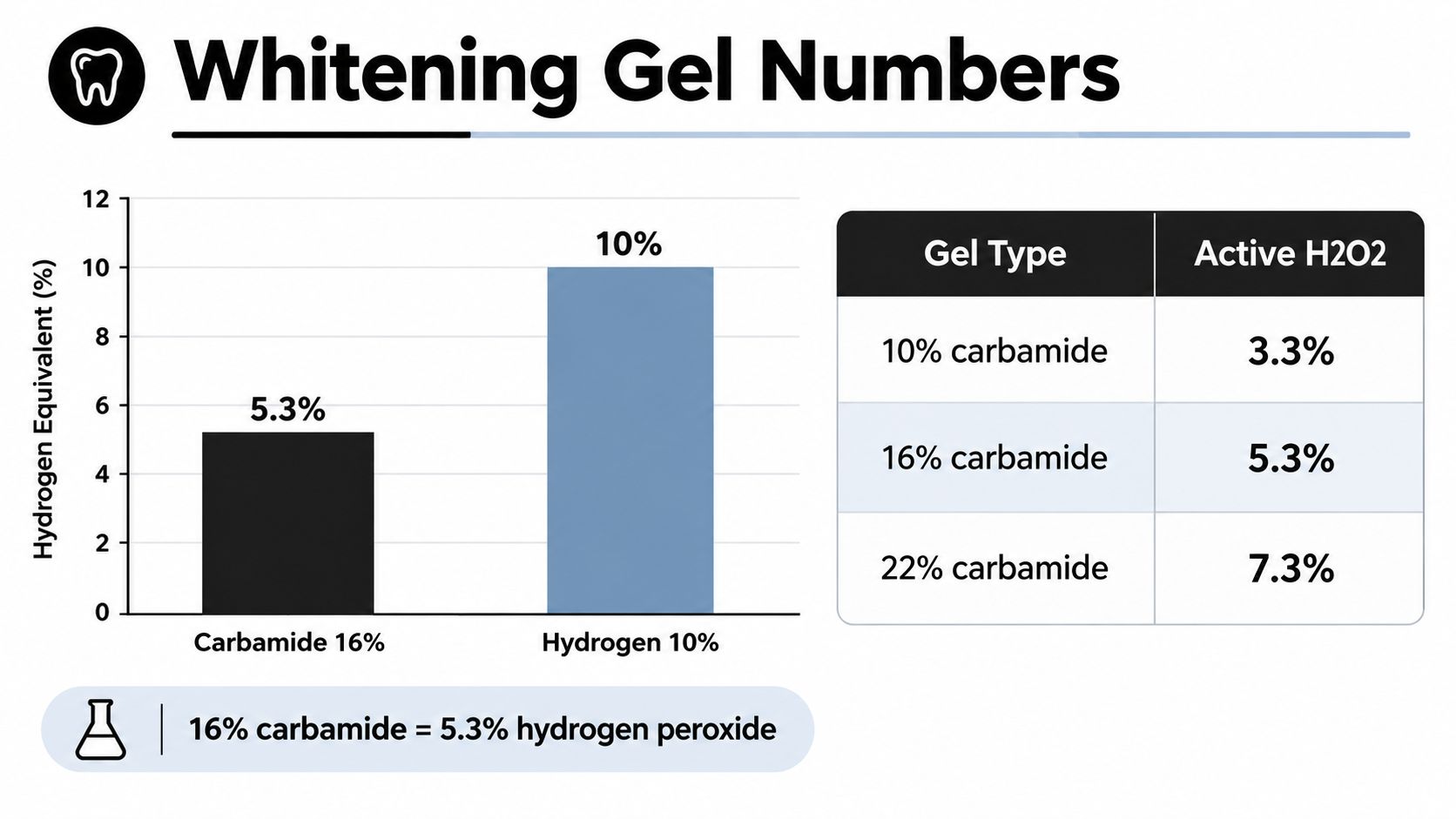
Carbamide peroxide and hydrogen peroxide are different ingredients, so the label only means something when you pair it with tray fit, wear time, and supervision. Carbamide peroxide releases hydrogen peroxide over time, which is why a dentist kit can whiten effectively without looking extreme on the box.
What the clinical evidence actually supports
A well-fitted tray with a sensible peroxide level usually beats a stronger gel used in a sloppy setup.
In a randomized clinical trial, 10% and 16% carbamide peroxide used once daily for 3 weeks were equally effective and safe in the Operative Dentistry study on efficacy and safety. The practical takeaway is simple. If two concentrations can reach a similar result, the better buying decision is the one your teeth can tolerate consistently.
That matters because shoppers often chase speed and end up with more sensitivity, shorter wear times, or skipped sessions. A dentist-provided kit is stronger as a system, not just as a gel percentage. The tray fits better, the contact is more controlled, and the protocol is chosen for your teeth instead of a generic mouth.
Why tray fit matters as much as gel strength
Gel has to stay on enamel long enough to do its job. Poor fit gets in the way fast.
Loose stock trays and one-size mouthpieces let saliva dilute the gel and let peroxide spread onto the gums. That wastes product and raises the chance of irritation. Custom trays keep the gel where you want it and make moderate concentrations perform the way they should.
If you want to compare formats before buying, this page on teeth whitening trays and gel products shows the difference between tray-based systems and simpler retail applicators.
Faster results and better results are not the same thing
A higher concentration can whiten faster at the start. That does not guarantee a better final shade.
In a randomized clinical trial, 37% carbamide peroxide used for 30 minutes per day whitened faster than 10% carbamide peroxide during weeks 1 through 3, but both regimens reached equivalent bleaching by 1 month after treatment ended in the PubMed trial on 37% versus 10% carbamide peroxide.
That's the trade-off shoppers should care about. Higher percent gels make the most sense when a dentist is controlling the protocol and your teeth can handle it. For many buyers, a moderate-strength gel in a custom tray is the smarter option because it balances shade change, comfort, and follow-through.
Dentist Kit vs OTC vs In-Office at a Glance
Use this table like a buying checklist, not a winner-takes-all scorecard.
| Criterion | Dentist At-Home Kit | OTC Strips/Trays | In-Office Treatment |
|---|---|---|---|
| Peroxide approach | Professional-grade gel selected for home use | Lower-strength retail formulas | Strong in-office system applied under supervision |
| Tray or applicator fit | Custom tray made from your teeth | Standard strip or stock tray | Dentist-controlled in the chair |
| Supervision | Dentist evaluates suitability and can adjust plan | Self-directed | Full professional application |
| Time commitment | Repeated home sessions over days or weeks | Repeated home sessions | Single office visit or short course |
| Comfort control | Easier to modify wear time or concentration | Limited customization | Immediate oversight during treatment |
| Best use case | Balanced option for fit, control, and home convenience | Mild stains and lowest upfront commitment | Tight deadlines and immediate change |
| Longevity potential | Strong when used as directed with touch-ups | Depends heavily on product consistency and habits | Strong, but maintenance still matters |
| Main drawback | More effort and cost than OTC | Less precise fit and less guidance | Highest cost and office time |
A dentist at-home kit usually wins when fit and supervision matter. OTC wins when your stains are mild and you want the lowest barrier to entry. In-office wins when time is the problem and money isn't the first filter.
How to read the table the right way
Start with your mouth, not the product.
If you've got sensitivity history, uneven stain patterns, or visible dental work, move straight to the supervision row. That's where the dentist kit separates itself. If your teeth are healthy and you just want a small boost, the OTC column may be enough.
If speed is critical, the in-office column rises fast. But don't confuse speed with simplicity. A lot of people still need maintenance after chairside whitening, and some would've been better served by a steadier take-home system.
The rows that matter most for real shoppers
These matter more than the rest:
- Fit: If the tray or strip doesn't adapt well, the chemistry won't save it.
- Comfort control: Being able to shorten wear time or step down gel strength matters once sensitivity starts.
- Use case: Match the system to stain depth and deadline, not hype.
If you want a broader side-by-side breakdown before choosing, this comparison of at-home teeth whitening vs professional options is useful for sorting the trade-offs in plain language.
Don't ask which whitening method is best in general. Ask which one fails the least for your specific teeth.
Matching the Right Option to Your Situation
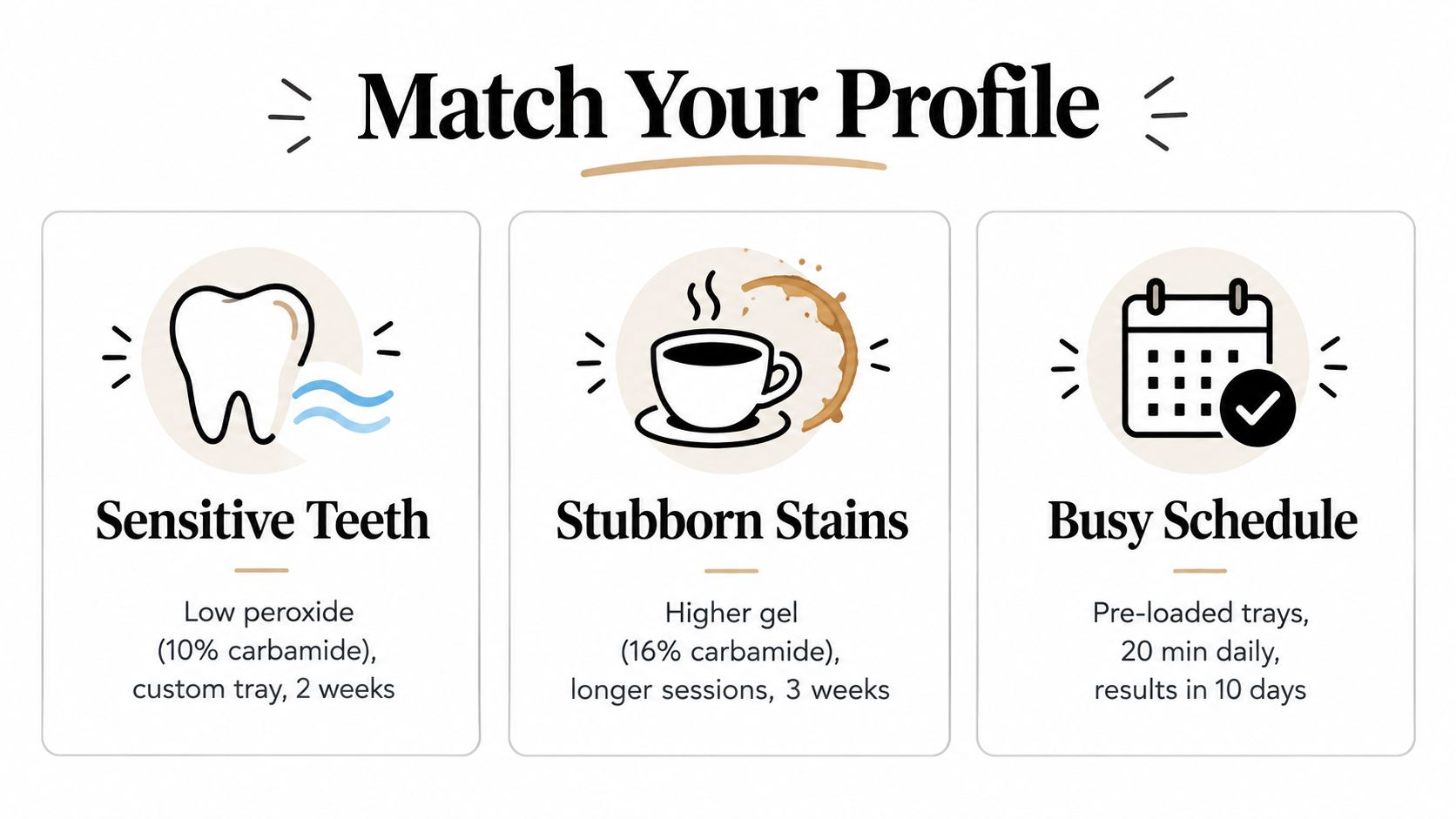
One reason whitening advice feels useless is that it treats every shopper the same. That's not how this decision works. Change the stain type or the timeline and the right answer changes with it.
If your teeth are sensitive
Don't start with the strongest kit you can tolerate for one day. Start with the kit you can finish.
A lower-strength dentist-supervised tray system is usually the sensible move here, especially if you already have enamel wear or recession. The custom tray helps limit stray gel on the gums, and the wear time can be shortened if your teeth get reactive.
If your stains are older or deeper
OTC strips struggle with stubborn discoloration.
If you're dealing with long-standing staining, especially the kind that sits deeper than surface film, a dentist-guided plan is the better path. That may mean a longer tray-based course or moving straight to in-office treatment if you want stronger intervention and a dentist's direct oversight.
If your budget matters most
A dentist kit can make financial sense when you think beyond the first purchase.
You keep the trays. That means future touch-ups can be simpler if your dentist recommends refills instead of rebuilding the whole system from scratch. If you're deciding between repeatedly buying retail products or investing once in a tray system, custom fit has long-term value.
If you need results on a deadline
When you've got photos or an event coming up soon, convenience stops mattering and timing takes over.
For the shortest runway, in-office whitening is the obvious choice. If you've got a little more room and want more control, a dentist at-home kit from a dentist can still work well, especially when the wear schedule is set around your timeline.
The same person can get a different recommendation just by changing one variable. Sensitive teeth with no deadline points one way. A fast event with deeper stains points another.
What the Process Looks Like Start to Finish
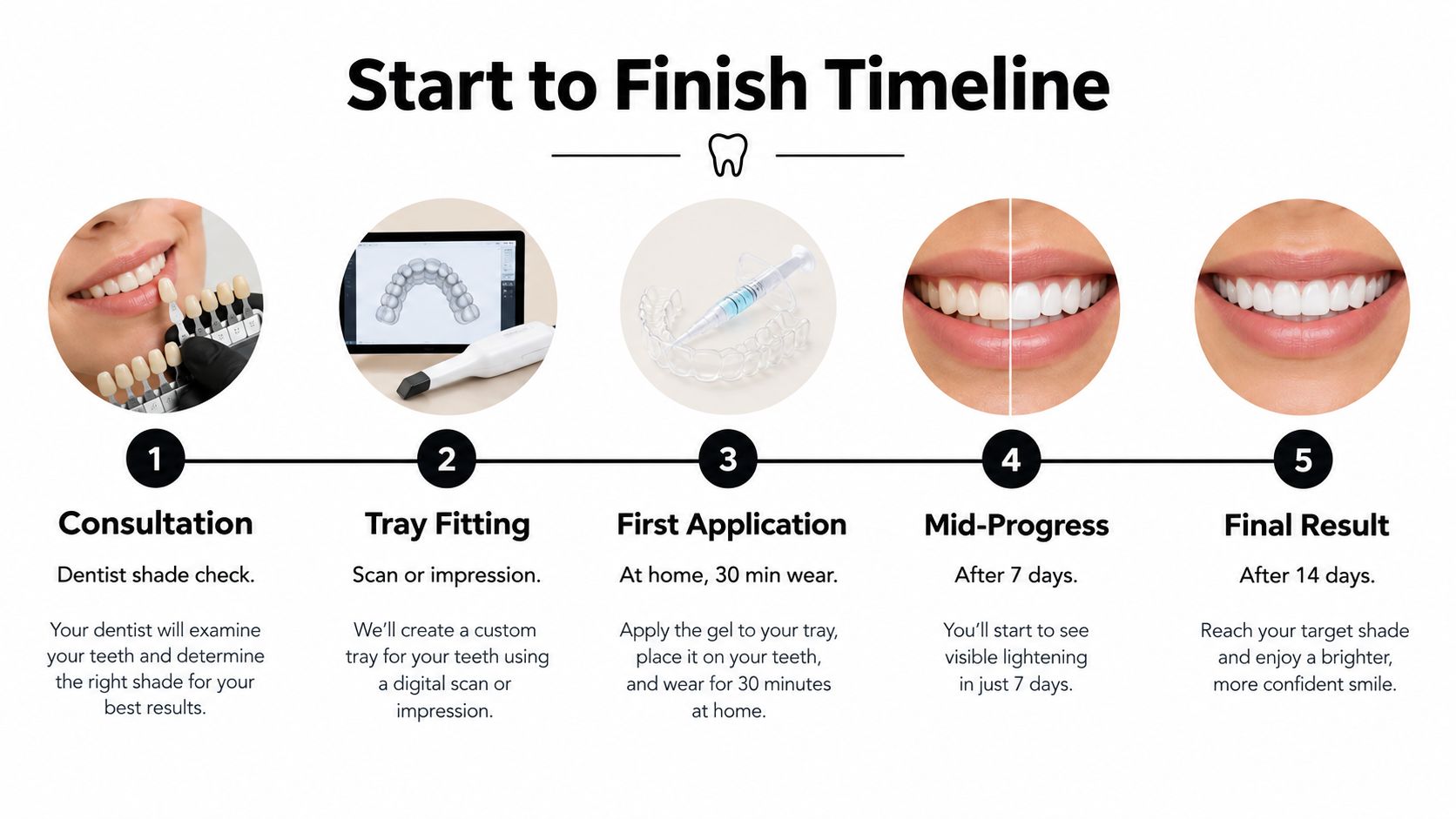
A dentist whitening kit feels less intimidating when you know the sequence. The process is straightforward. What matters is following it in order instead of improvising halfway through.
Here's the visual version first.
The usual steps
-
Consultation
Your dentist checks your teeth and gums, looks at existing dental work, and decides whether whitening makes sense before you spend money on products that won't fix the issue. -
Impressions or scan
The office captures your teeth so a tray can be made to fit your mouth instead of a generic average. -
Tray delivery and fit check
You try the trays, learn how much gel to use, and make sure the edges don't hit the gumline awkwardly.
After that, you begin the at-home phase. The wear schedule depends on the gel and the plan you were given. The important part is consistency, not random overuse.
A quick walkthrough can help if you've never handled whitening trays before.
What to expect once you start
Notice some change before the course is finished, but don't treat day-to-day mirror checks as the verdict. Small shifts can be hard to judge in bathroom lighting.
Use the trays exactly as directed. If your teeth start to zing, don't power through because you think discomfort proves it's working. Contact the office if the reaction feels stronger than expected, if the tray is rubbing tissue, or if the whitening looks uneven.
Good whitening plans include a way to slow down, not just a way to go harder.
At the end, you'll usually have the trays for future touch-ups. That's one of the practical advantages of a dentist-based home system over single-use retail formats.
Sensitivity, Safety, and Why Stronger Isn't Always Better
Sensitivity is the part shoppers underestimate most. Not because it's rare. Because people assume they'll know how to manage it once it starts.
You shouldn't have to guess.
What sensitivity actually looks like
Independent clinical evidence shows sensitivity is common with home whitening. About 54% of participants reported mild sensitivity, 10% moderate sensitivity, and 4% severe sensitivity, with severe sensitivity disappearing by week 2 and moderate sensitivity by week 4 in the PubMed evidence summary on home bleaching sensitivity.
That's the kind of information shoppers deserve upfront. Not vague “may cause temporary sensitivity” language.
Another useful detail from that same evidence summary: patients with gingival recession appear more likely to experience sensitivity. So if you've got exposed root surfaces, stop treating this like a generic cosmetics purchase.
Why stronger can backfire
The big drivers of irritation are concentration, contact time, pH, and tray fit. Not just the printed percentage.
That's one reason regulation puts limits around stronger peroxide products outside supervised use. The European Commission states that products with more than 0.1% hydrogen peroxide should be administered only under dentist supervision, and peroxide content in tooth-whitening products should not exceed 3.6% hydrogen peroxide equivalent, which corresponds to 10% carbamide peroxide in the European Commission clarification on peroxide tooth-whitening products.
That doesn't mean every stronger formula is reckless. It means supervision matters more as potency rises.
My rule for shoppers
Choose the lowest strength that can realistically handle your stain pattern, then increase only if the plan calls for it.
If your teeth are reactive, ask for a lower-percent gel or shorter wear time instead of quitting whitening entirely. If sensitivity is already part of your history, practical guidance like these tips on reducing teeth sensitivity after whitening is worth reading before you start, not after you're in pain.
Final Recommendation and Common Questions Answered
Here's my opinion. If you have visible stains, gum recession, front-tooth fillings, or you want a result that feels more controlled and more durable, book a consultation for an at-home teeth whitening kit from a dentist. That's the cleanest middle ground for most serious shoppers.
If your teeth are healthy, your staining is mild, and you're mainly trying to brighten a little without spending much, start with OTC strips. Just keep your expectations in check. Cheap and easy is not the same as precise.
Common questions
How long do whitening trays last
Custom trays can last for repeat use if you keep them clean and store them properly. That reusability is one of the biggest practical advantages of the dentist-home route.
When do touch-ups happen
Touch-ups depend on your habits, stain exposure, and how stable your result is. Some people need them sooner, others can wait longer.
Will whitening kits work on crowns or veneers
No, not the same way they work on natural enamel. Restorations usually won't whiten to match surrounding teeth, so color mismatch is a real concern.
How white will my teeth get
That depends on your starting shade and the type of stain. Natural yellowing often responds better than deeper, more stubborn discoloration.
What should you do if sensitivity hits mid-treatment
Pause and contact your dentist instead of pushing through it. Adjusting wear time or concentration is smarter than trying to tough it out.
DentalHealth.com carries professional-grade whitening gels, trays, sensitivity products, and brands commonly used in dentist-guided home whitening routines, including options for shoppers comparing concentrations and tray-based systems. If you want to see the types of products that fit this approach, visit DentalHealth.com and compare the whitening and sensitivity categories before you buy blindly.