
Can Whitening Toothpaste Cause Sensitivity? the Real Answer
You switched to a toothpaste promising a brighter smile, and now cold water sends a quick zing through your teeth. But can whitening toothpaste cause sensitivity because it whitens, or because of the specific ingredients and habits surrounding it? That distinction matters. The label alone doesn't tell you how your teeth will respond.
Whitening toothpaste can cause sensitivity, but the reaction is usually mild and temporary. The likelihood depends on whether the formula relies mainly on abrasive stain removal, peroxide-based chemistry, or both, and whether you combine it with other whitening products. Understanding those differences makes it easier to whiten more cautiously, recognize when to pause, and know when discomfort may point to a dental problem unrelated to toothpaste.
The Short Answer and Why It Matters
Yes, whitening toothpaste can cause tooth sensitivity. A person may notice a sharp response to cold drinks, air, sweet foods, or brushing after changing products. For many users, the sensation settles after stopping or adjusting the routine, rather than indicating permanent damage.
The important question isn't just whether a tube says “whitening.” It's what the toothpaste does to stains. Some formulas use abrasive particles to polish discoloration from the tooth surface. Others include peroxide-based ingredients that chemically break down stains. A formula can also combine both approaches, creating a different experience from a paste that only polishes.
The American Dental Association's overview of tooth whitening identifies tooth sensitivity and oral irritation as the most common adverse effects reported with home whitening products. The effects are more prevalent at higher concentrations, but are generally mild and transient. That evidence comes from home whitening products broadly, so it doesn't mean every whitening toothpaste produces the same response.
The practical answer: whitening toothpaste can cause a temporary zing, but the risk isn't identical across products or routines.
Four questions help you judge your own situation:
- Which ingredient is involved? Abrasives and peroxide can affect teeth through different pathways.
- How often does it happen? Toothpaste-only use appears to produce less reported sensitivity than more intensive combinations.
- Are your teeth already vulnerable? Gum recession, enamel wear, cracks, or recent dental work can change the response.
- What should you change first? Gentler brushing, a sensitivity-focused paste, and avoiding stacked whitening products can reduce unnecessary exposure.
Mild discomfort that appears after a product change is often manageable. Persistent, worsening, spontaneous, or localized pain deserves a dental assessment because whitening may be revealing an existing issue rather than causing the whole problem.
How Whitening Toothpaste Actually Works on Your Teeth
Whitening toothpaste generally works in one of two ways. Chemical action targets stains with whitening agents, while abrasive action removes discoloration sitting on the outer surface. The ingredients and the way you brush determine which pathway has the greatest influence on sensitivity.
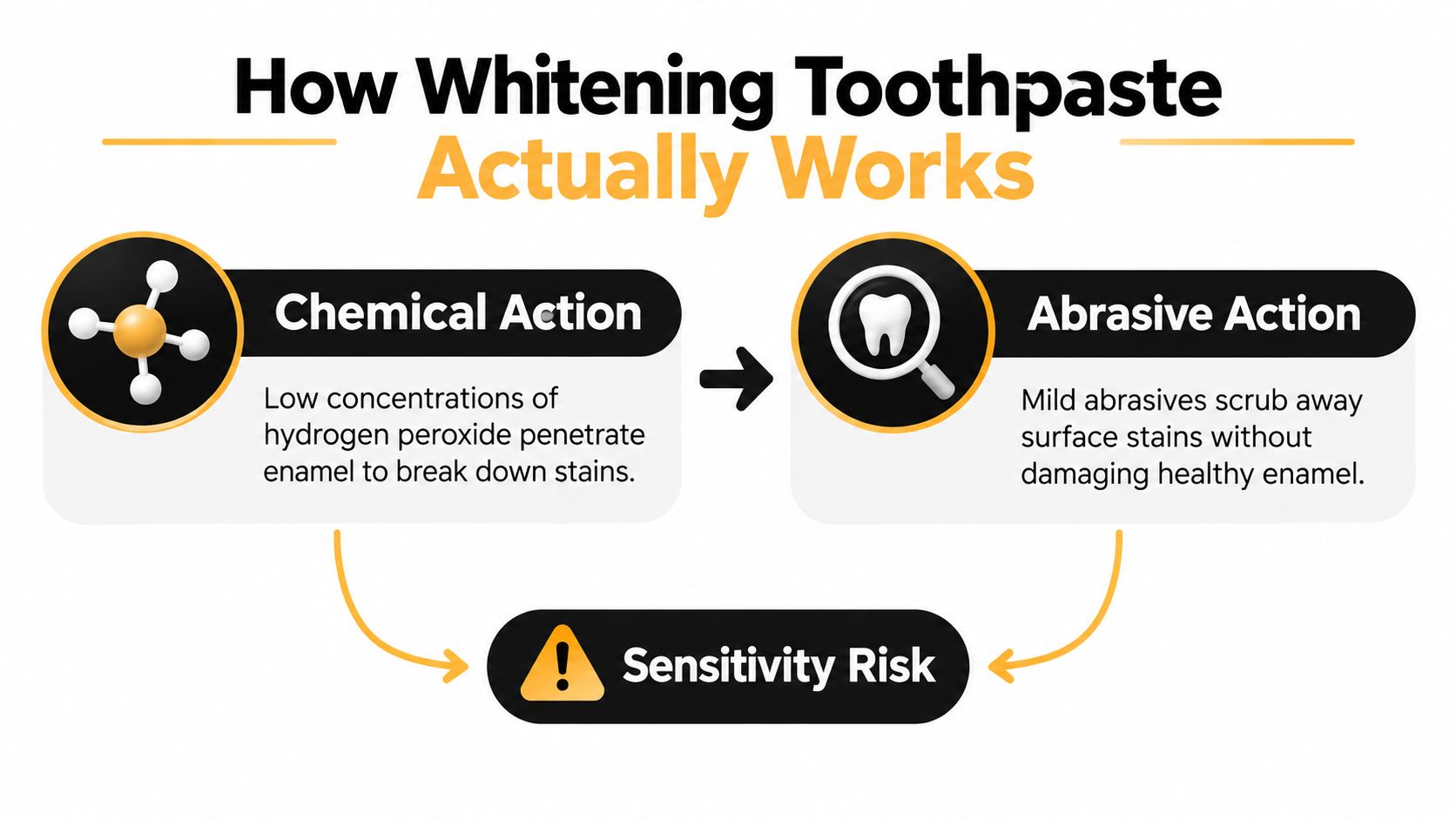
Chemical whitening and the tooth interior
Peroxide-based formulas can include hydrogen peroxide or related peroxide chemistry. Peroxide molecules move through enamel and dentin, where they help break apart stain molecules. That movement is part of how chemical whitening works, but it can also briefly irritate the pulp, the living tissue at the centre of the tooth.
Think of dentin as a layer containing microscopic fluid-filled channels. Those channels lead toward the nerve. When whitening chemistry makes the internal tooth structure more reactive, cold, heat, pressure, or air can trigger a quick signal that you experience as a “zing.”
This doesn't mean peroxide has permanently harmed the nerve. The American Dental Association notes that sensitivity associated with home whitening is generally mild and transient, although stronger concentrations tend to create more discomfort. Comparative evidence involving carbamide peroxide gels and hydrogen peroxide products also found relatively similar levels of sensitivity and gum irritation, so no major whitening chemistry should be treated as automatically free of this side effect.
Abrasive polishing and exposed dentin
Abrasive formulas take a physical approach. Ingredients such as silica can help polish away surface stains from coffee, tea, tobacco, or richly coloured foods. Used with a light touch, this can improve the appearance of the tooth without changing its internal colour.
The risk rises when a person presses hard, uses a firm brush, brushes too often, or chooses a highly abrasive formula. In that situation, the protective outer surface and exposed root areas may receive more mechanical irritation. Dentin is softer and more reactive than enamel, so once it is exposed, ordinary temperature changes can feel sharper.
A simple analogy helps. Peroxide acts like a chemical key that reaches stain pathways inside the tooth. Abrasion acts like repeated wiping across the surface. Either pathway can make an already vulnerable tooth more reactive, especially when a person combines whitening products or uses force while brushing. For a plain-language ingredient guide, see what is in teeth whitening products.
How Often Sensitivity Actually Happens
Can whitening toothpaste cause sensitivity every time? No. The answer depends on both the product and the routine around it. Toothpaste used by itself produced far less reported sensitivity in one clinical study than routines that added a whitening pen.
The study recorded tooth sensitivity in 5.2% of participants using whitening toothpaste alone, compared with 21.1% of participants using whitening toothpaste with a pen and 27.8% of those using a whitening pen alone. These figures describe self-reported symptoms in that study, not a fixed prediction for every person or every formula. Its review of earlier research found reported sensitivity ranging from 0% to 100%, with many studies landing between 15% and 80%. The full clinical paper is available through PubMed Central.
| Whitening Method | Reported Sensitivity Rate | Typical Duration |
|---|---|---|
| Whitening toothpaste alone | 5.2% | Usually temporary and often subsides within a few days after treatment ends |
| Whitening toothpaste combined with a pen | 21.1% | Usually temporary, but the combined routine produces more reported sensitivity |
| Whitening pen alone | 27.8% | Usually temporary, with symptoms commonly easing after treatment ends |
Why stacking changes the experience
The comparison points to a practical distinction: toothpaste alone and a layered whitening routine are not equivalent. A toothpaste may polish surface stains with abrasives such as silica, while a pen may add peroxide-based whitening chemistry. Each approach can place a different kind of demand on the teeth.
A person might brush with whitening toothpaste in the morning, apply a pen later, and then use strips, trays, or another kit. The teeth receive repeated exposure, even if each product seems mild on its own. Combining products can therefore make sensitivity more likely than using toothpaste alone.
This does not mean every combined routine will harm the teeth. It means the full routine matters more than the toothpaste label by itself. Looking at one product in isolation can miss the added exposure created by several whitening steps.
What temporary sensitivity feels like
Whitening sensitivity often feels like a quick zing from cold water, air, or touch. It may appear and disappear rather than continue as a steady ache, and it commonly improves when treatment ends or the routine is reduced. The clinical paper describes whitening-related hypersensitivity as temporary in most cases, usually easing within a few days after treatment ends.
Discomfort that continues, intensifies, occurs without a clear trigger, or stays focused on one tooth deserves dental evaluation. A whitening product may not be the only possible cause.
Who Is Most Likely to Feel That Zing
Sensitivity doesn't strike entirely at random. It tends to appear more readily when whitening ingredients meet exposed dentin, worn enamel, existing sensitivity, or aggressive brushing.
Consider someone with gum recession around the canine teeth. The exposed root area doesn't have the same enamel covering as the crown. When abrasive particles contact that surface, or whitening chemistry reaches the underlying dentin, cold water may produce a sharper response than it does on a fully protected tooth.
Now consider a person who grips a firm-bristled brush tightly and scrubs back and forth. The toothpaste may not be the sole cause of the problem. Mechanical pressure can irritate the gum margin and increase wear on areas that are already vulnerable. When that person adds a whitening paste, the polishing action may make the existing sensitivity more noticeable.
A third example is someone who already uses a sensitivity toothpaste, then switches abruptly to a stronger whitening formula. The change removes a product that was helping manage reactive teeth and replaces it with a formula designed to target stains. That doesn't prove the new paste is unsafe, but it can expose how dependent the existing routine was on sensitivity control.
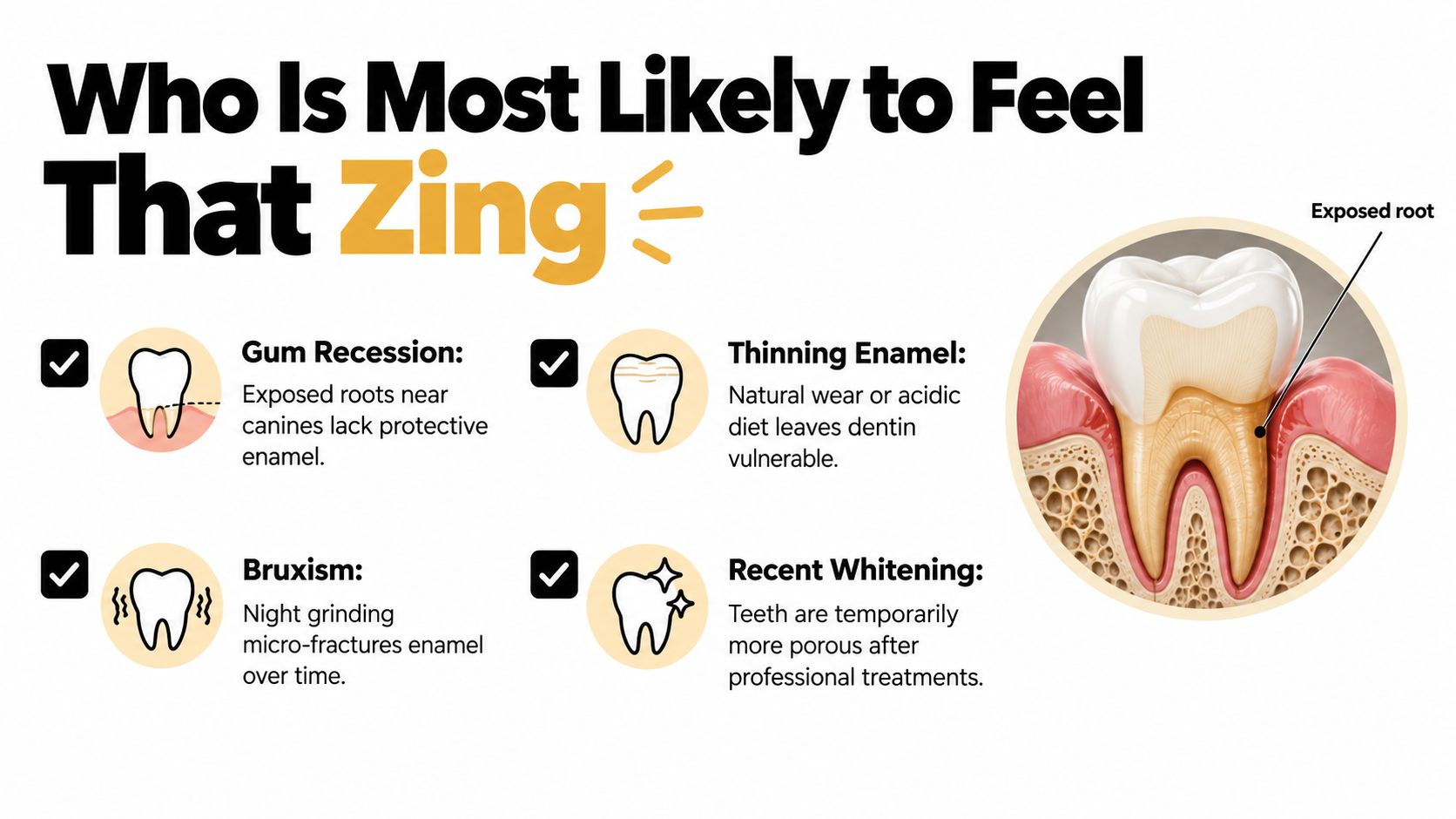
Patterns that call for caution
A person may want to be more conservative with whitening if they have:
- Gum recession: Exposed root surfaces can react strongly to cold and mechanical contact.
- Enamel wear: Acid exposure, tooth grinding, or forceful brushing can leave dentin less protected.
- Existing sensitivity: A whitening paste may add irritation to teeth that already respond to ordinary foods and drinks.
- Cracks or recent dental work: A cracked tooth, new filling, crown, or other restoration can create sensitivity that needs individual evaluation.
- Acid erosion: Frequent acidic exposure can soften the tooth surface and make brushing more irritating.
- A stacked whitening routine: Several whitening products may expose the teeth to more combined irritation than a single toothpaste.
The combination matters more than one label. A low-abrasion paste used gently may feel comfortable for one reader, while the same category may feel unpleasant for someone with recession who also uses a whitening pen.
Sensitivity-Friendly Alternatives Worth Considering
You don't have to choose between a brighter-looking smile and comfortable teeth. The better choice depends on whether your priority is surface stain removal, nerve desensitization, enamel support, or a more noticeable colour change under professional guidance.
For teeth that already react
Potassium nitrate formulas are designed to reduce the nerve response behind the familiar zing. They can be useful when sensitivity is the main concern, especially during a pause from whitening or when alternating with a milder stain-removing paste.
Stannous fluoride takes a different approach. It can help protect exposed dentin by reducing the movement of stimuli through dentin channels, while also supporting everyday fluoride protection and gum care. It isn't a bleaching ingredient, so its role is comfort and protection rather than dramatic shade change.
For product-selection context, compare options in this guide to toothpaste for sensitive teeth.
For gradual enamel support
Remineralizing pastes containing hydroxyapatite or calcium phosphate are another option for people who want to support the tooth surface while reducing the intensity of whitening. They don't function like peroxide bleaching. Instead, they fit a routine focused on maintaining the surface and managing sensitivity between whitening sessions.
A practical pattern is to use a stain-removing paste at one brushing and a sensitivity or remineralizing formula at another. That gives you a way to address surface discoloration without making every brushing session a whitening session.
For gentler stain removal
Peroxide-free whitening pastes may rely on abrasives, optical effects such as blue colour correction, or stain-lifting chemical agents. Their results are usually more subtle than peroxide bleaching, but avoiding peroxide may reduce one possible source of chemical irritation. Abrasive intensity still matters, so “peroxide-free” doesn't automatically mean “risk-free.”
| Option | Active Mechanism | Typical Sensitivity Risk |
|---|---|---|
| Potassium nitrate toothpaste | Helps reduce nerve signalling associated with sensitivity | Generally suited to sensitivity management, though individual response varies |
| Stannous fluoride toothpaste | Supports fluoride protection and helps reduce dentin reactivity | Often considered a practical choice for reactive teeth |
| Remineralizing paste | Supports the tooth surface with ingredients such as hydroxyapatite or calcium phosphate | Usually chosen for comfort and surface support rather than intensive whitening |
| Peroxide-free whitening paste | Uses surface stain removal, optical effects, or stain-lifting agents | May avoid peroxide-related irritation, but abrasive use can still bother exposed dentin |
| Shorter, lower-intensity whitening treatment | Reduces the duration or strength of whitening exposure | Can still cause sensitivity, but controlled use may be more comfortable |
| Dentist-supervised whitening | Uses professional assessment, controlled application, and desensitizing support when appropriate | Allows the clinician to adjust treatment for vulnerable teeth |
Professional treatment can be useful when a reader wants a larger shade change and already knows sensitivity is an issue. A dentist can assess the teeth first, isolate the gums where appropriate, and adjust the whitening plan rather than asking the patient to guess at product combinations.
A Practical Routine to Whiten Without the Sting
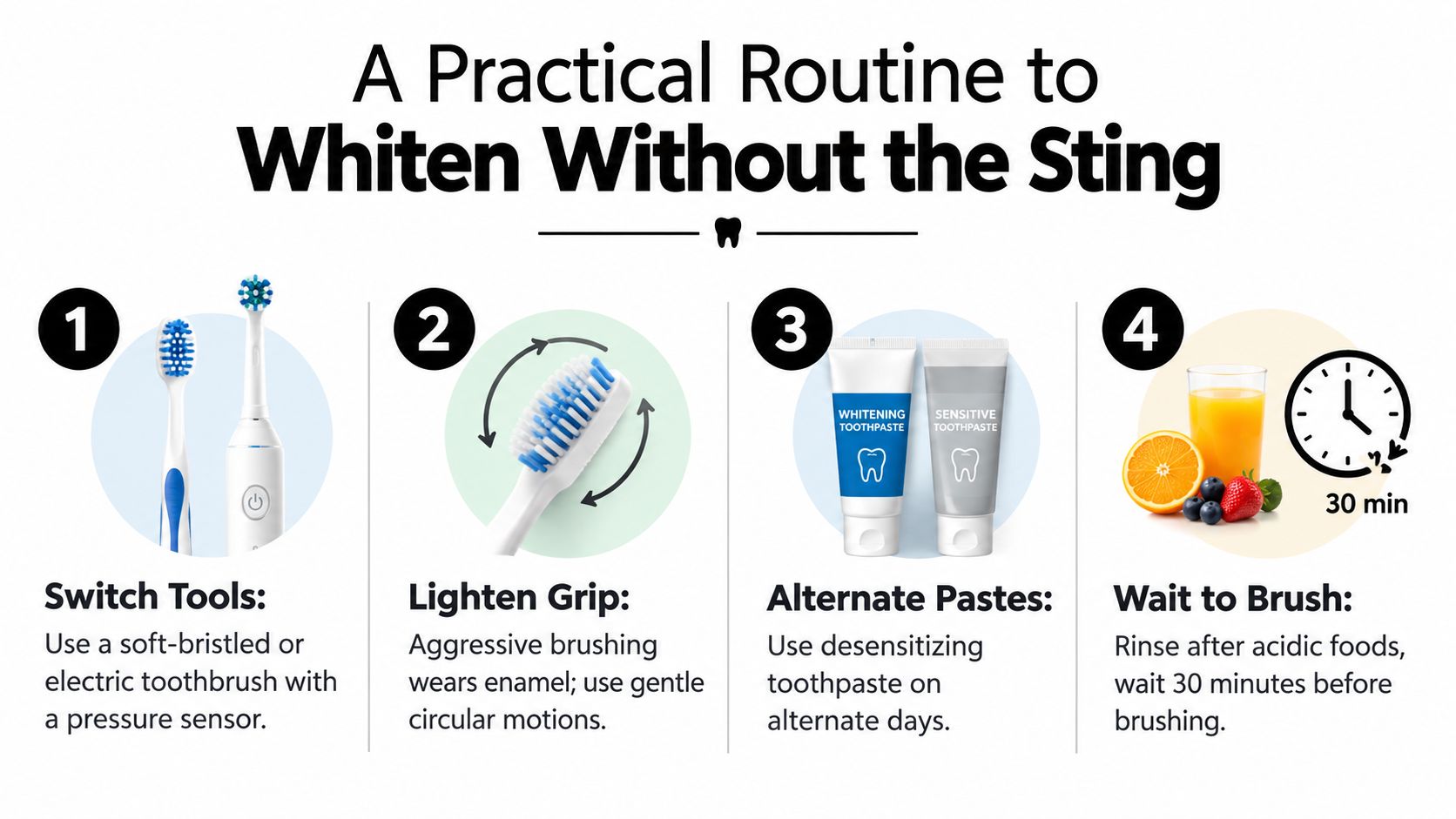
Start with the brush, not the whitening ingredient. Use a soft-bristled toothbrush or an electric toothbrush with a pressure sensor, and let the tool do the work. A lighter grip and gentle circular movements reduce the mechanical irritation that can make abrasive toothpaste feel harsher.
Use a small amount of toothpaste and follow the product directions. Brushing harder doesn't make stains disappear faster. It can instead irritate the gum edge and expose areas that react to cold.
Make the routine less intense
A simple approach is to use whitening toothpaste for one brushing and a sensitivity-focused or remineralizing paste for the other. This avoids turning every daily cleaning into another whitening exposure. If your teeth are already reactive, you can make the non-whitening paste the regular choice and use whitening less often.
Avoid building a routine from several whitening formats at once. Combining toothpaste with a pen, strips, trays, or an LED kit can make it difficult to identify the product causing discomfort and may increase total exposure.
Acidic foods and drinks also deserve attention. Rinse with water after acidic beverages or meals, then give your mouth time before brushing rather than scrubbing immediately over a softened surface. This matters especially for people who already notice sensitivity from citrus drinks, fizzy beverages, reflux, or other sources of acid exposure.
Know when to pause
If sharp zings begin, stop the whitening paste temporarily and switch to a sensitivity formula. Once the reaction has settled, you can decide whether to try the whitening product less frequently, choose a less abrasive option, or stop using it altogether.
Don't whiten immediately around a dental cleaning, new filling, crown, or other dental procedure without asking your dental professional. Teeth and gums can be temporarily more reactive after treatment, and restorations don't whiten in the same way as natural tooth structure.
For additional practical guidance, read how to reduce teeth sensitivity after whitening.
Common Myths Worth Putting to Rest
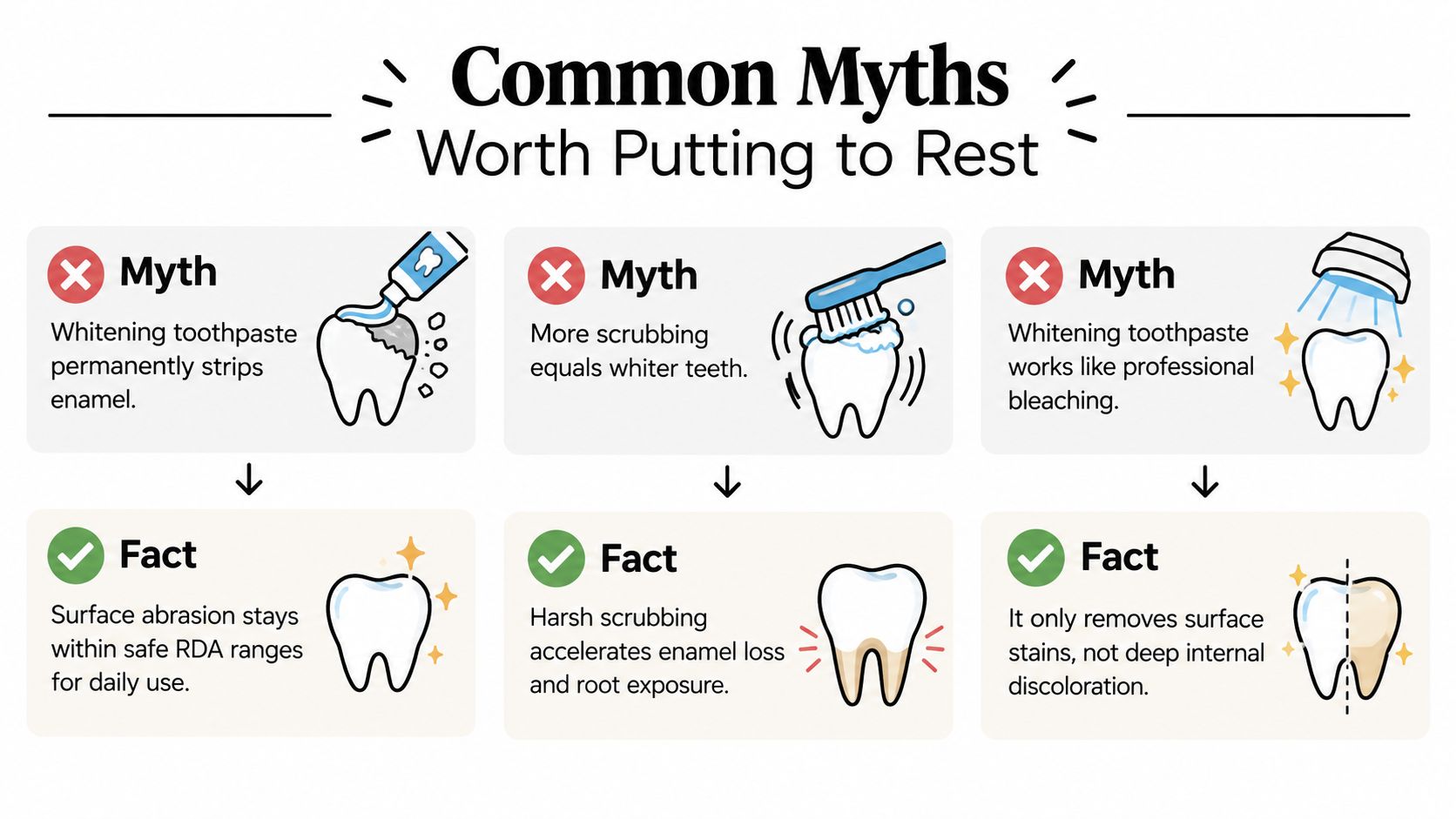
Myth one says whitening toothpaste always damages enamel
A whitening label doesn't prove that a product will permanently strip enamel. Abrasive formulas are intended to remove surface stain, and the outcome depends on the formula, brushing pressure, frequency of use, and the condition of the tooth surface.
The safer takeaway isn't “all whitening toothpaste is harmless.” It's use the product as directed and avoid aggressive brushing. A person with enamel wear or exposed roots may need a different formula or professional advice, even if another person uses the same paste comfortably.
Myth two says every twinge means permanent nerve damage
A brief cold-triggered zing after whitening is not automatically evidence of irreversible nerve injury. The American Dental Association describes sensitivity from home whitening products as generally mild and transient, and the clinical evidence discussed earlier indicates that whitening-related hypersensitivity usually subsides within a few days after treatment ends.
The pattern still matters. Pain that lingers, begins spontaneously, appears with heat, hurts when biting, wakes you at night, or stays focused on one tooth shouldn't be dismissed as ordinary whitening sensitivity. Those features can point to decay, a crack, a failing restoration, gum recession, or another condition that needs assessment.
Myth three says natural or charcoal formulas are always gentler
“Natural” describes a marketing position, not a guaranteed sensitivity profile. A peroxide-free or charcoal product can still contain abrasive particles, and harsh brushing can irritate exposed dentin regardless of whether the ingredient sounds familiar.
Better question: Does this formula remove surface stain gently, or am I combining strong products with forceful brushing?
Whitening toothpaste also isn't the same as professional bleaching. Toothpaste mainly addresses surface discoloration, while more intensive treatments are designed to change deeper colour. Choosing a gentler toothpaste may mean accepting more gradual or modest results, but that trade-off can be worthwhile for sensitive teeth.
The Bottom Line for Your Daily Routine
So, can whitening toothpaste cause sensitivity? Yes, but the useful question is what is causing it. Peroxide can briefly irritate the tooth from within, while abrasive ingredients may bother exposed dentin when you brush forcefully or use them too often. “Whitening” covers several formulas, so the label alone does not reveal your personal risk.
The study comparison offers a practical rule: if you already use whitening toothpaste, avoid adding a whitening pen or strips at the same time. Combining products produced markedly more reported sensitivity than toothpaste alone, suggesting that stacking treatments can increase exposure beyond what your teeth tolerate comfortably.
Mild sensitivity may settle after you reduce or pause the trigger. If your teeth are reactive, choose a potassium nitrate, stannous fluoride, or remineralizing formula for regular brushing. Introduce whitening gradually, use a soft brush, and reduce pressure. Discomfort is a signal to adjust the routine, not something to push through. Sharp, persistent, spontaneous, or one-tooth pain deserves a dentist's assessment.
A simple routine is often safer than a crowded one. Choose the toothpaste by its active system, then review the rest of your whitening products. If you cannot tell whether the sensitivity comes from whitening, recession, erosion, a crack, or recent dental work, get an evaluation before continuing.
DentalHealth.com offers at-home whitening products alongside sensitivity toothpastes, rinses, and remineralizing options. Visit DentalHealth.com to compare products and find guidance for a more comfortable routine.