
Do at Home Teeth Whitening Kits Work Evidence Guide
Yes, peroxide-based at-home whitening kits can work, with measurable improvement often appearing within 2 to 4 weeks, but they don't work equally well for every stain or every person. The outcome depends on the stain's origin, the product's concentration and contact time, and whether you follow the routine consistently.
Why do some whitening strips brighten coffee stains while barely changing a single dark tooth? That gap is the part most product pages leave out. “Do at home teeth whitening kits work” isn't a simple yes-or-no question because whitening depends on what caused the discoloration, where the stain sits, and how evenly the bleaching agent reaches the tooth.
Peroxide-based strips, gels, and trays can lighten many extrinsic stains, including discoloration linked to foods, drinks, and tobacco. They're less predictable for intrinsic stains, which develop inside the tooth, and they can't change the color of crowns, veneers, fillings, or bonding.
The practical choice usually comes down to three questions:
- What kind of stain do you have?
- How quickly do you want a visible change?
- How much sensitivity are you willing to tolerate?
Dentist-supervised trays generally give more controlled contact with the teeth, while over-the-counter strips prioritize convenience. Neither format automatically guarantees a better final shade. The evidence suggests that a carefully followed, slower protocol can work well, even when it uses a lower peroxide concentration. A Cochrane review of home bleaching methods found that the evidence quality is low to very low for declaring one concentration, application time, or home method universally superior.
This guide separates the promise from the limitations. You'll learn how peroxide works, what timeline is realistic, which stains respond best, why sensitivity happens, and when a dental examination makes more sense than another kit.
Introduction Do At Home Whitening Kits Really Work
Do at-home teeth whitening kits really work, or do they mainly create a short-lived change? The answer depends on the stain, the product, and how consistently you use it. Whitening usually works best when discoloration is on or near the outer tooth surface. Peroxide changes stain molecules as it passes through enamel, allowing teeth to appear lighter without removing enamel through harsh scrubbing.
Results build over repeated applications rather than appearing all at once. In a placebo-controlled clinical trial, Crest Whitestrips Supreme used twice daily produced greater reductions in yellowness and increases in brightness after 3 weeks, with further improvement by 6 weeks. The findings appear in a clinical trial analysis of whitening strips.
The same outcome should not be expected from every strip or tray. Products vary in peroxide type and concentration, while fit, tooth coverage, instructions, and daily use affect how evenly the agent reaches each tooth. Your enamel thickness, stain depth, restorations, and sensitivity also shape the result.
The most useful distinction
Whitening is a stain-matching decision, not simply a product choice. A peroxide strip may suit surface discoloration from coffee or tea. It cannot recolor a porcelain crown, veneer, filling, or bonding. A dentist-made tray can improve fit and coverage, but it still cannot remove every type of internal discoloration.
Speed and comfort often pull in opposite directions. Some home carbamide peroxide systems show measurable improvement within 2 to 4 weeks. A faster or stronger approach may also make sensitivity more noticeable, while a slower routine can be easier to tolerate. Randomized clinical data found that 10% and 16% carbamide peroxide both lightened teeth during a three-week treatment, with similar effectiveness and safety. Most of the whitening benefit remained at six months. The linked study is reserved for the Results section, where the treatment timeline is examined in detail.
What a successful result looks like
A successful home treatment usually means a visibly lighter shade in natural teeth and less surface staining. It does not guarantee an unnaturally bright smile, identical color across restorations, or complete correction of gray, brown, banded, or white-spot discoloration.
Before using a kit, match your expectations to the type of stain you have. Untreated cavities, gum problems, cracks, pronounced sensitivity, or visible restorations justify professional guidance first. A dental assessment can reduce the risk of pain and help prevent uneven color.
How At Home Whitening Works Inside Your Teeth
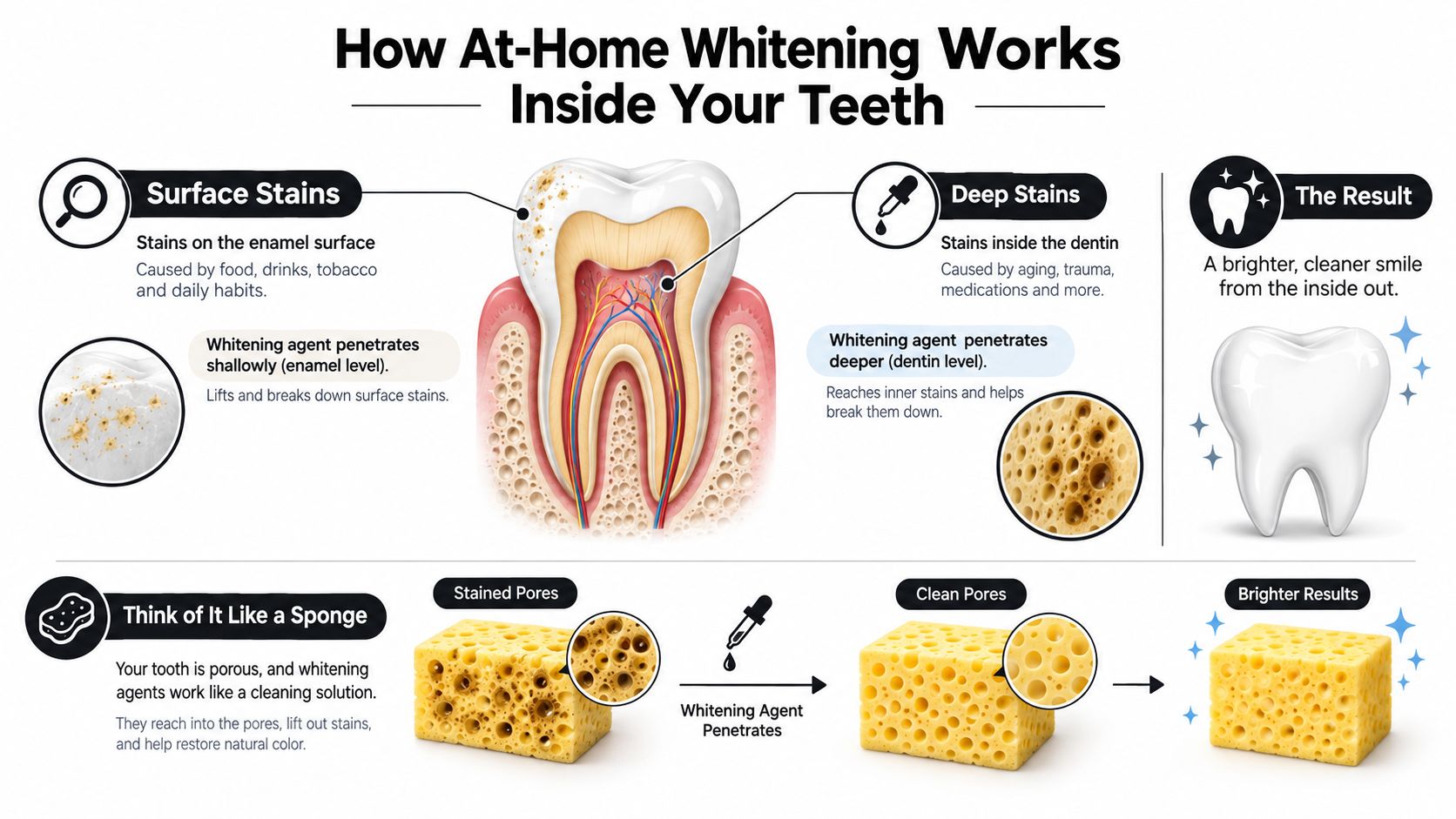
Your tooth is not a solid, sealed block. Enamel contains microscopic pathways, and peroxide can travel through them toward stain molecules. A simple analogy is a sponge. A clean sponge has open spaces, while a stained sponge has colored material held inside those spaces. A whitening agent helps break down the colored compounds so the sponge appears cleaner.
Hydrogen peroxide is already in its active form. Carbamide peroxide releases hydrogen peroxide more slowly, which gives it a longer, gentler contact pattern in many home systems. Both approaches rely on peroxide chemistry, not on the light, tray color, or packaging around the product.
Concentration is only one part of the equation
A stronger gel can deliver peroxide more quickly, but strength alone doesn't determine the final result. The agent must remain in contact with the tooth for the directed period, cover the stained surfaces, and be used often enough to complete the protocol.
That's why two people can use products with similar labels and see different outcomes. One person may have a well-fitting tray and a stable routine. Another may apply too little gel, miss several sessions, or stop early because of sensitivity.
Practical rule: The delivery device is the key to consistent contact. A tray or strip that sits evenly on the tooth can be more useful than a stronger formula that touches only part of the surface.
Strips adhere directly to the front of the teeth and can work well on relatively even surfaces. A tray holds gel around the teeth, but a loose or poorly shaped tray can press gel onto the gums or leave areas with limited contact. Custom trays made under dental supervision can improve fit and dosing control.
For a clear explanation of how light-assisted products fit into the process, see how LED teeth whitening kits work. The central concept remains the same: the peroxide gel does the bleaching work, while the device determines how consistently that gel reaches the teeth.
Why contact time changes the experience
Short exposure with a suitable product may produce a gradual change. Longer exposure can increase the amount of peroxide reaching the tooth, but extending treatment beyond the instructions can also irritate gums and make sensitivity more likely.
This creates the speed-versus-comfort tradeoff. A lower-carbamide-peroxide routine may take longer while still reaching a comparable final whitening outcome, whereas a higher concentration may produce a faster visible shift for some users. The safest choice is the product and schedule you can follow accurately without pushing past the directions.
What Results to Expect and How Long They Take
How quickly will an at-home whitening kit change your smile? For many users, a visible difference develops over 2 to 4 weeks, but the pace depends on the product, stain type, contact time, and how consistently the routine is followed. Surface coffee staining may respond sooner than discoloration that formed within the tooth.
Results usually build gradually rather than appearing after one use. In a strip trial, twice-daily treatment for 3 weeks produced measurable improvement, while continuing through 6 weeks led to larger average changes in yellowness and brightness than placebo. The practical lesson is simple: early improvement is a progress point, not necessarily the final shade. This guide to how to whiten teeth at home fast can help you compare faster routines with schedules that may be easier to tolerate.
Comparing common formats
| Product Format | Active Agent and Strength | Typical Timeline | Evidence on Effectiveness |
|---|---|---|---|
| Whitening strips | Hydrogen peroxide, with strength varying by product | Measurable change can develop over a few weeks | A placebo-controlled trial found that twice-daily Crest Whitestrips Supreme use produced cumulative improvement over three to six weeks. |
| Home bleaching trays | Carbamide peroxide, including 10% and 16% regimens studied clinically | Often around 2 to 4 weeks | Clinical data found that 10% and 16% carbamide peroxide both significantly lightened teeth during a three-week treatment and were equally effective and safe. Clinical evidence |
| Hydrogen peroxide strips | A tested 6% hydrogen peroxide strip option | Gradual improvement with completed use | In a randomized trial, 6% hydrogen peroxide strips produced the greatest color change among the tested options, outperforming gel and placebo on brightness, yellowness, and redness measures. Trial report |
| Dentist-guided home tray | Carbamide peroxide or hydrogen peroxide under professional direction | The schedule varies by formulation | A clinical summary involving 90 patients reported similar bleaching between a 10% carbamide peroxide home tray and an in-office 35% hydrogen peroxide treatment in that setting. Suitability still depends on the individual and should be discussed with a dentist. |
The comparison also explains why the strongest formula is not automatically the best choice. A tested 6% hydrogen peroxide strip produced the greatest color change among its trial options, yet broader evidence has not established one home concentration or method as consistently superior for everyone.
Speed versus final shade
A higher concentration may produce a visible change sooner, but faster does not reliably mean a lighter final shade. The evidence reviewed by Cochrane could not identify one best concentration, application time, or method. Comparative findings also suggest that higher- and lower-concentration products can achieve similar final shade changes.
A dentist-supervised tray may suit someone seeking even coverage, measured dosing, or help managing sensitivity. It is different from a convenience product used at home. Both involve home treatment, but their fit, instructions, and professional monitoring can differ.
How long the result lasts
Whitening is temporary. New stains can collect on the tooth surface, and the natural color within the tooth continues to show through the enamel. In the carbamide peroxide trial, most of the whitening benefit remained at 6 months, indicating that results can continue after treatment ends when the protocol is completed.
That finding does not create a universal maintenance calendar. Follow the product instructions for touch-ups, or ask a dentist to recommend a schedule based on your teeth, stain type, and sensitivity.
Which Stains Respond Best and Which Do Not
The most important question isn't “How strong is this kit?” It's “Where is the discoloration?” Extrinsic stains sit on the outer tooth surfaces or close to them. Intrinsic stains develop within the tooth structure, where ordinary home bleaching may have limited reach or produce an uneven result.
Extrinsic discoloration commonly comes from coffee, tea, wine, tobacco, and other staining exposures. These are the situations in which peroxide-based strips and trays have the clearest practical appeal. A review of home whitening evidence found that results depend on concentration, protocol, and stain origin, rather than on concentration alone. It also reported that conventional at-home carbamide peroxide systems outperformed some paint-on and ready-to-use tray products in a randomized trial. The comparative review of at-home whitening systems helps explain why product format matters.
A quick stain self-check
- Coffee, tea, wine, and tobacco staining: These are usually extrinsic and more likely to improve with a completed peroxide routine.
- Tetracycline discoloration: This is intrinsic and may respond poorly or unevenly to standard home products.
- Fluorosis: White, brown, or mottled changes need assessment because bleaching may not create a uniform appearance.
- Trauma-related discoloration: A single dark tooth can have an internal cause that a surface whitening kit won't correct.
- Crowns, veneers, fillings, and bonding: These restorations don't change color when natural enamel is bleached, so whitening can expose a mismatch.
Age-related yellowing is more complicated. It can include surface staining, but changes inside the tooth and the gradual visibility of naturally yellow dentin may limit how uniform the result looks. A cleaning may help if buildup is contributing, while deeper discoloration may require a dentist's evaluation.
Why marketing claims need context
A product can produce statistically significant shade improvement in a study and still disappoint someone whose discoloration is intrinsic or whose front teeth include restorations. Recent ADA Seal requirements described in the evidence brief require two independent six-week clinical studies showing statistically significant stain reduction versus placebo. That standard highlights the difference between controlled clinical evidence and a dramatic photograph with no information about stain type, lighting, treatment duration, or restorations.
If the stain is visibly uneven, affects one tooth, or sits beside dental work, an examination is more useful than buying a stronger kit.
Common Side Effects and How to Manage Sensitivity
Peroxide whitening most often causes temporary tooth sensitivity. Cold air, drinks, or foods may feel sharper because peroxide can move through enamel and briefly make the inner tooth more responsive. Gel touching the gums may also create localized irritation or pale-looking tissue.
The risk increases with too much gel, excessive wear time, a stronger protocol than you can tolerate, or whitening over cracks, decay, exposed roots, or gum problems. Severe or ongoing symptoms need a dental evaluation rather than being treated as a routine inconvenience.
What the comparative evidence suggests
A 2026 systematic review found no meaningful difference in shade-guide whitening between at-home and in-office bleaching. At-home bleaching produced lower sensitivity intensity and possibly greater color change by ΔE, though the evidence quality was low. The systematic review comparing at-home and in-office bleaching explains the limits of these findings.
The treatment setting alone does not determine comfort. Concentration, tray fit, exposure time, tooth condition, and adherence to instructions all influence the experience. A dentist-supervised tray may offer a better fit and more controlled use, while an OTC strip can still work when the stain is suitable and the product is used correctly.
Results and comfort involve a tradeoff. Stronger or longer exposure may speed visible change, but it can also increase sensitivity and gum irritation. Slower treatment is often easier to complete.
Ways to make whitening more comfortable
- Reduce exposure: If sensitivity starts, pause or space sessions. Do not compensate with extra gel or longer wear.
- Use sensitivity toothpaste: A toothpaste formulated for sensitivity may support comfort before and during treatment. See these step-by-step tips for reducing teeth sensitivity after whitening.
- Protect the gums: Use only the directed amount and wipe away gel that escapes the tray or strip.
- Avoid temperature triggers: Very hot or cold foods and drinks may feel more painful during treatment.
- Stop for warning signs: Persistent pain, spontaneous toothache, gum sores, or sensitivity that does not settle warrants dental attention.
An LED mouthpiece does not remove these precautions. An umbrella review reported no clear advantage for light-activation systems in efficacy or sensitivity. Do not extend wear time or ignore discomfort because a kit includes a light.
Best Practices to Maximize Results and Minimize Risks
A safer whitening routine is controlled and repeatable. Clean teeth help the gel reach the intended surfaces, while accurate timing limits unnecessary exposure. The goal is a course you can complete, not the fastest possible change followed by irritation.
Before applying the product
- Inspect your mouth: Delay whitening if you have active dental pain, untreated cavities, bleeding gums, or unexplained sensitivity. Peroxide may make an existing problem more noticeable.
- Brush and floss gently: Remove plaque and trapped debris, but avoid vigorous scrubbing immediately before applying peroxide.
- Read the label: Check whether the active ingredient is hydrogen peroxide or carbamide peroxide, then follow the stated wear time for that product.
- Check the fit: A tray should stay secure without pushing gel onto the gumline. Strips should cover the intended front surfaces without folding into the gums.
During treatment
Apply the smallest directed amount that covers the teeth. Extra gel does not automatically create a lighter final shade, and overflow can irritate soft tissue.
Set a timer and follow the instructions. Contact time is part of the dose, so wearing a product longer changes the exposure rather than reliably improving the result. The Cochrane review of home bleaching methods found low- to very low-certainty evidence and could not establish one universally superior concentration, application time, or method. Careful adherence therefore matters more than guessing that a stronger or longer treatment will work better.
A slower routine you can finish is often more useful than a stronger routine you abandon because your teeth hurt.
After each session
Rinse away residue and clean reusable trays as directed. Continue ordinary brushing and flossing, and ask a dentist or pharmacist about suitable sensitivity or fluoride products if your teeth react.
During treatment, pay attention to foods and drinks that visibly stain teeth. You do not need to make eating punitive, but limiting obvious staining exposures can help preserve the change while the course is underway.
The speed of whitening and the comfort of the routine can pull in opposite directions. More exposure may produce a quicker visible shift, while shorter or more widely spaced sessions may be easier to tolerate and complete. A well-fitting dentist-supervised tray can control where gel goes, whereas OTC strips depend more on careful placement and may suit mild surface staining.
DentalHealth.com offers home whitening systems and gels, including products from brands such as Opalescence, Philips Zoom, PolaNight, and GLO, along with sensitivity and remineralizing products. Compare the active ingredient, delivery format, wear instructions, and available guidance before choosing.
When to Choose At Home Kits and When to See a Dentist
At-home kits make the most sense when you have healthy teeth and gums, mostly surface staining, and enough patience to follow the instructions consistently. Strips can suit mild extrinsic discoloration and convenience-focused routines. Dentist-supervised trays may be preferable when you want more controlled coverage or guidance about concentration and sensitivity.
Book a dental assessment before whitening if you have:
- A single dark tooth, especially after trauma or dental treatment.
- Crowns, veneers, fillings, or bonding in the visible smile area.
- White spots, brown bands, or mottled fluorosis-like changes.
- Cavities, cracked teeth, gum disease, or unexplained pain.
- Sensitivity that persists or worsens during treatment.
Results can remain noticeable after treatment. In randomized clinical data, both 10% and 16% carbamide peroxide significantly lightened teeth during a three-week course, and most of the whitening benefit was sustained at six months. The result still depends on stain exposure, oral care, and the suitability of the original treatment for your teeth.
Choose based on stain type, fit, tolerability, and evidence, not just peroxide strength or an LED feature.
DentalHealth.com provides professional-grade at-home whitening systems and gels, plus sensitivity and remineralizing products that can support a more comfortable routine. Visit DentalHealth.com to compare home-use options, review product instructions, and choose a whitening approach that matches your teeth and your treatment goals.