
Does Fluoride Toothpaste Whiten Teeth? What Science Shows
Fluoride toothpaste can make teeth look brighter by removing surface stains, but fluoride itself doesn't bleach teeth, and whitening toothpastes typically lighten teeth by about one to two shades rather than producing a dramatic change.
If the fluoride isn't doing the whitening, what are you buying when a tube promises a brighter smile? The answer starts with separating cleaning away stains, bleaching tooth color, and protecting enamel. Those are different jobs, even when the packaging puts them together.
Fluoride Toothpaste Whitens Only the Surface
Fluoride toothpaste can restore brightness lost to surface staining, but its cleaning ingredients, not the fluoride, do most of that cosmetic work. The American Dental Association's whitening guidance distinguishes extrinsic stains, which sit on the tooth's surface, from intrinsic discoloration, which lies within the tooth.
Coffee, tea, tobacco, and plaque can leave discoloration on enamel. Abrasives such as hydrated silica, calcium carbonate, and phosphates help remove these deposits during brushing. Think of cleaning a stained ceramic cup: removing the coating reveals the original surface rather than changing the material's underlying color.
That distinction explains why someone with noticeable coffee stains may see an improvement while someone with naturally darker teeth sees little difference. A cleaner tooth isn't necessarily a bleached tooth.
Three outcomes that aren't interchangeable
Surface stain removal is a polishing process. Some formulas also contain pyrophosphates, proteases, or other chemical stain-control ingredients that help disrupt deposits or discourage their return. An ingredient can contribute to a whitening claim without bleaching the tooth.
Enamel strengthening is fluoride's main role. Fluoride supports resistance to decay and the repair of early mineral loss. Those are important health benefits, but they don't mean fluoride changes your natural tooth shade.
True bleaching uses peroxide to chemically change colored molecules. Peroxide-based treatments can address certain internal discolorations that an ordinary cleaning paste can't reach. Even then, the cause of the discoloration matters, and some conditions need professional treatment rather than a stronger toothpaste.
Practical rule: Choose fluoride for protection, a suitable cleaning system for surface stains, and dentist-guided bleaching when the goal is changing underlying color.
What each toothpaste ingredient does to tooth color
| Outcome | Responsible ingredient | Changes tooth color? | Typical result |
|---|---|---|---|
| Surface stain removal | Abrasives such as hydrated silica, calcium carbonate, phosphates | Brightness only, by removing surface deposits | Cleaner, brighter-looking enamel |
| Stain control | Pyrophosphates, proteases, other chemical stain-control agents | Indirectly, by limiting stain attachment | Slower return of surface stains |
| Enamel strengthening | Fluoride | No direct color change | Less enamel loss and fewer cavities |
| True bleaching | Hydrogen or carbamide peroxide | Yes, including certain intrinsic discolorations | Potentially larger shade change, not the action of standard fluoride toothpaste |
How Much Brighter Whitening Toothpaste Makes Teeth
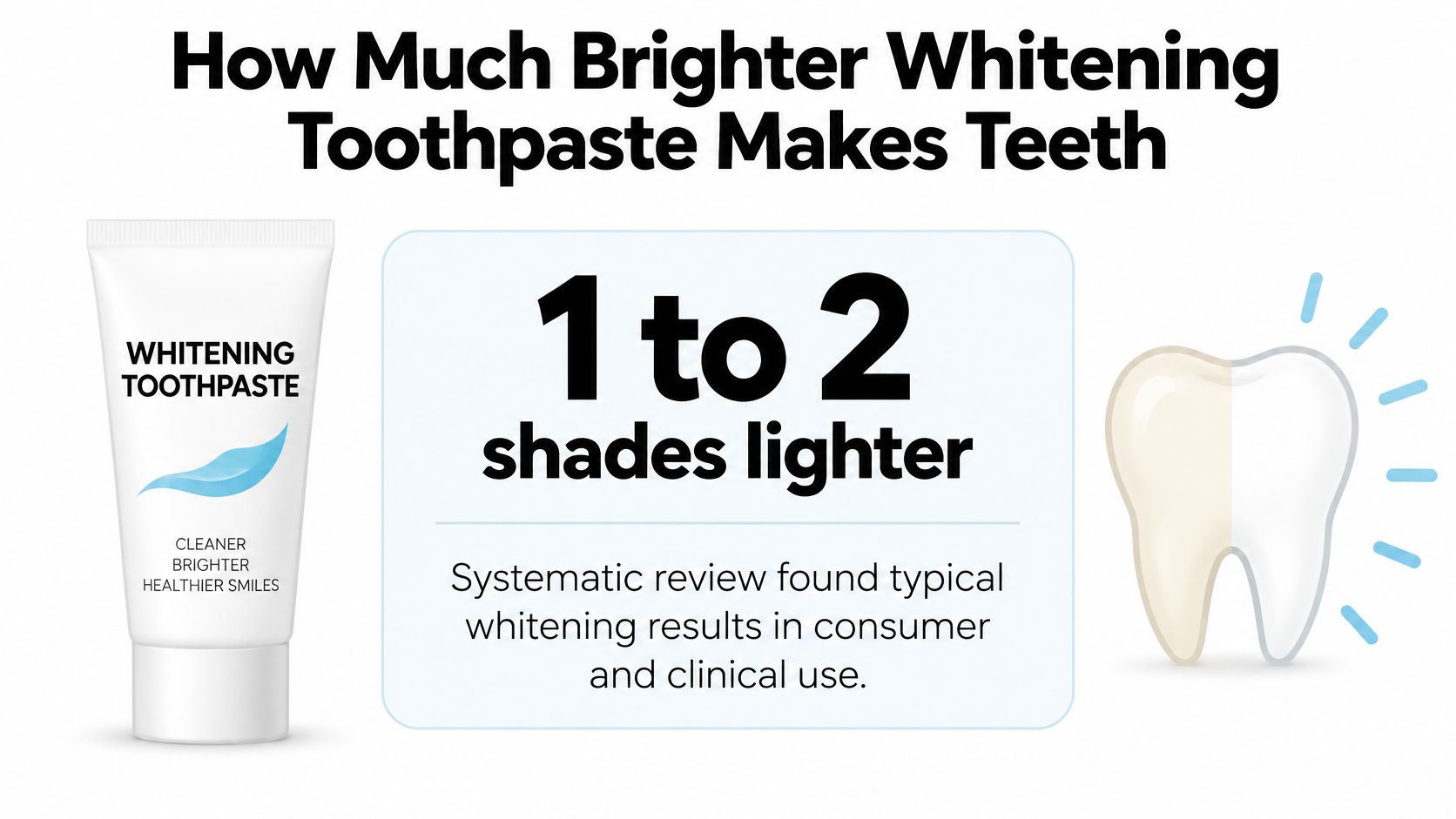
About one to two shades is the typical improvement described in a systematic review of whitening toothpastes, which also reported increased measured surface roughness without reduced tooth hardness. That's a modest cosmetic benefit, not a promise that every user will reach a particular shade.
The infographic puts that expectation into perspective.
Why the improvement has a ceiling
A toothpaste can remove only the removable discoloration available to it. If your teeth already have little surface staining, there may not be much brightness to recover. More polishing won't automatically produce progressively whiter teeth.
Abrasive composition matters, too. Whitening formulations may use harder abrasive particles or more abrasive material than conventional pastes. That can improve deposit removal, but greater cleaning power isn't equivalent to greater bleaching power.
Nor does every successful stain-removing toothpaste need a special chemical whitening agent. Ordinary mechanical cleaning contributes substantially to the result, so a dramatic ingredient name isn't enough to establish that a product will work better.
A tooth can look cleaner without its surface becoming microscopically smoother. Visible brightness and measured surface roughness are different outcomes.
The roughness finding doesn't establish that every whitening toothpaste damages teeth in everyday use. It does give you a reason to avoid treating abrasiveness as a benefit without limits.
Use a soft brush and gentle pressure rather than trying to accelerate results through scrubbing. Judge success by whether existing surface discoloration becomes less noticeable, not whether toothpaste produces the appearance of a professionally bleached smile.
Why Formulation Matters More Than Fluoride
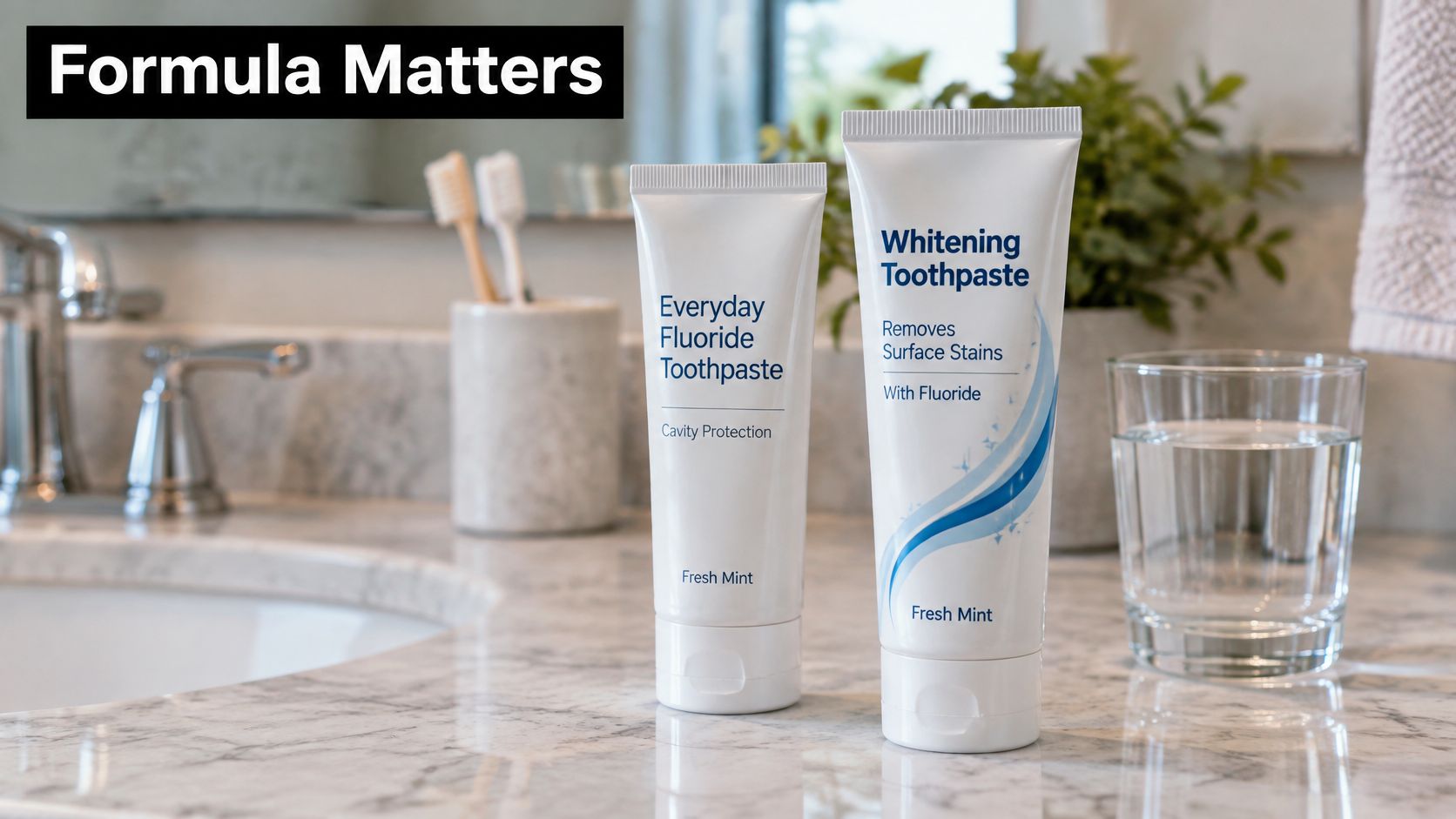
Two tubes can both contain fluoride and still perform differently on stains. The useful comparison is the complete stain-removal system, not just whether fluoride appears on the label.
The packaging may look similar even when the formulas aren't.
In a six-week double-blind clinical trial, an enhanced fluoride whitening formula reduced extrinsic stain area by 49.4% and intensity by 52.4%, compared with 14.0% and 15.5% for another fluoride whitening formula. These measurements describe stain coverage and darkness, not the percentage by which teeth became whiter.
Stain reduction in fluoride toothpaste trials
| Formula | Time | Stain area | Stain intensity | Who improved |
|---|---|---|---|---|
| Fluoride whitening paste with enhanced stain removal | Six-week trial described above | Reduction reported above | Reduction reported above | Treatment group overall; individual response proportion not specified |
| Second fluoride whitening formula | Same trial period | Smaller reduction reported above | Smaller reduction reported above | Treatment group overall; individual response proportion not specified |
| Regular sodium fluoride with silica | Same trial period | Small increase | Small increase | No group-level stain improvement |
| Stannous fluoride with sodium hexametaphosphate and high-cleaning silica | Follow-up visits in controlled trials | Significant reduction | Significant reduction | Clinically meaningful improvement reported among participants |
The regular sodium-fluoride/silica comparison is instructive. Fluoride presence alone didn't predict stain improvement. Likewise, a successful stannous-fluoride formula shouldn't be treated as proof that the fluoride ingredient, isolated from its cleaning system, bleaches teeth.
Label checks that help
- Look for a stated purpose. A whitening or stain-removal claim is more relevant to external discoloration than cavity protection alone.
- Read the supporting ingredients. Look for the abrasive system and ingredients such as sodium hexametaphosphate. Don't assume that every stannous-fluoride toothpaste has the same cosmetic performance.
- Check the evidence matches the product. A clinical study should evaluate the actual formula or clearly explain its relevance, rather than merely discussing whitening ingredients in general.
Our guide to fluoride toothpaste ingredients can help you distinguish protective ingredients from the rest of the formula.
For another explanation of the topic, the accompanying video is available below.
Whitening Toothpaste or Fluoride Toothpaste
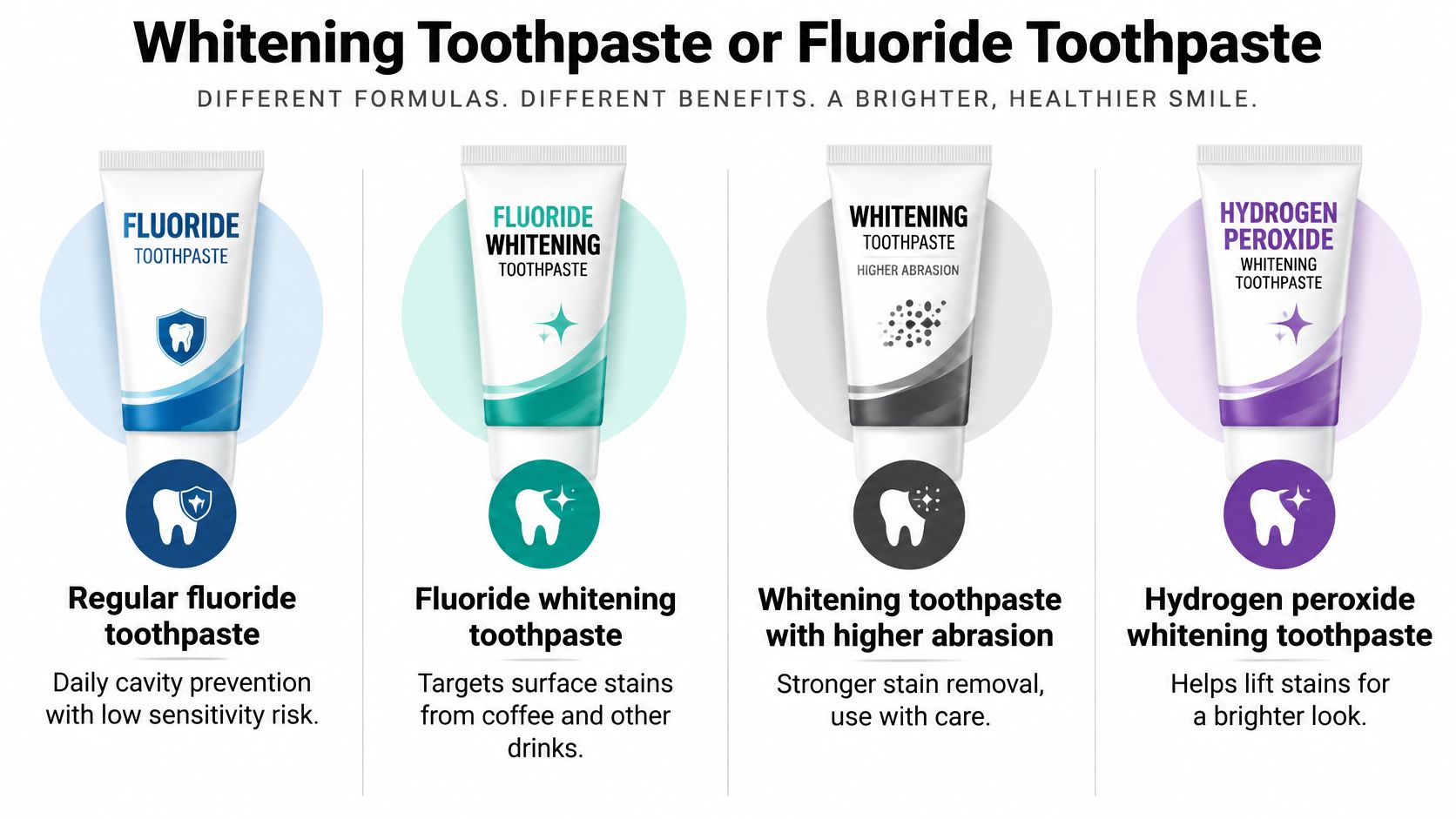
Whitening toothpaste and fluoride toothpaste aren't opposing categories. A product can provide fluoride protection and target external stains at the same time. The more useful question is whether you need everyday cleaning, additional stain control, or a separate bleaching treatment.
For a plain-language explanation of the protective side of that choice, Loul Dental Studio's fluoride toothpaste guide provides context about fluoride's role in enamel care. Keep that health goal separate from the cosmetic result you're hoping to achieve.
This comparison illustrates the broad product categories.
Compare purpose before strength
Start with the best-for column, then consider sensitivity and restorations. The sensitivity descriptions below are practical cautions, not validated rankings for every formulation or every person. A product category alone can't establish your individual risk.
Toothpaste types compared on the same criteria
| Product type | Main active ingredients | Best for | Sensitivity risk | Restorations |
|---|---|---|---|---|
| Regular fluoride toothpaste | Fluoride, mild abrasives | Daily cavity prevention and maintenance | Usually a conservative starting choice; irritation is still possible | Generally suitable for routine cleaning |
| Fluoride whitening toothpaste | Fluoride plus stain-control abrasives | Coffee, tea, and tobacco surface stains | Sensitivity or irritation can occur | Check suitability if restorations are present |
| Peroxide or charcoal whitening toothpaste | Peroxide or charcoal plus abrasives | Surface stain removal; stronger performance isn't assured | Product-specific risk is unknown without supporting evidence | Use caution with aggressive formulas |
| Peroxide whitening gel or tray kit | Carbamide or hydrogen peroxide | Selected intrinsic and deeper discoloration | Sensitivity can occur; individual risk needs assessment | Discuss shade matching with a dentist |
Regular fluoride toothpaste is a reasonable default when cavity prevention matters more than changing appearance. If recurring drink stains are your concern, a fluoride whitening formula may be a better match without moving immediately to bleaching.
Peroxide and charcoal toothpastes shouldn't automatically occupy a higher rung on a whitening ladder. Charcoal isn't another name for bleaching, and the presence of peroxide doesn't tell you how much color change a toothpaste will produce.
A gel or tray kit is a different treatment category, not stronger toothpaste. Before choosing it, establish whether the discoloration can respond to bleaching and whether visible dental work could remain a different shade.
Choose by Stain Type Restorations and Sensitivity
If your concern is a darkened tooth after an injury, longstanding tetracycline staining, or a crown that no longer matches, toothpaste is the wrong place to expect a substantial color correction. Start with a dental assessment rather than escalating your abrasive strength.
Restorations deserve particular care. A laboratory study of restorative materials found that charcoal- and hydrogen-peroxide-containing toothpastes caused surface degradation and chemical changes, while fluoride-containing toothpaste better preserved surface integrity. Laboratory findings support caution, but they don't prove that every peroxide or charcoal toothpaste causes clinical damage.
Match your situation to a next step
What fluoride toothpaste can and cannot change
| Situation | Does fluoride toothpaste help? | Next step |
|---|---|---|
| Coffee, tea, or tobacco surface stains | Yes, partly, through the cleaning formula | Use a suitable fluoride whitening toothpaste |
| Plaque-related staining | Yes, partly | Maintain regular brushing and professional cleanings |
| Age-related yellowing within the tooth | Little effect on underlying color | Ask a dentist about peroxide-based whitening |
| Tetracycline staining | Little effect | Get a dentist's assessment before whitening |
| Fluorosis | Little effect on color | Have a dentist identify appropriate options |
| Trauma-related color | Little effect | Have the tooth assessed |
| Fillings, crowns, veneers, bonding | Doesn't bleach the restoration to a new shade | Discuss shade mismatch before whitening |
| Sensitive teeth during whitening | Individual response is unclear | Reduce whitening frequency and choose a desensitizing product |
For surface discoloration, start with consistent cleaning rather than combining several whitening products. Use the ADA's toothpaste guidance as a reference for twice-daily brushing with a soft brush, and avoid aggressive scrubbing.
If you have visible restorations, plan the final shade before bleaching natural teeth. Our guide to teeth whitening with fillings explains why existing dental work changes the decision. A brighter natural tooth beside an unchanged filling can make a mismatch more obvious.
Before combining treatments: Tell your dentist about whitening toothpaste, gels, and trays you already use. Consider the whole routine, not each product separately.
Let sensitivity influence the choice
Sensitivity isn't evidence that a product is whitening successfully. If whitening causes discomfort, reduce its frequency or pause it, and consider a desensitizing fluoride toothpaste rather than pushing through pain. Persistent or localized pain needs dental assessment.
Our product lines include Teeth Whitening options such as Opalescence, Zoom, PolaNight, and PolaDay, alongside Tooth Sensitivity products including Fluoridex and MI Paste. PolaDay 9.5 reduces tooth sensitivity and prevents plaque formation and tooth decay, but those benefits don't replace checking whether bleaching is appropriate for your teeth.
Take a daylight photograph before changing your routine. At your planned review, compare it with a new photograph taken under similar conditions, and assess comfort as carefully as appearance.
Keep the Brighter Look Without Rougher Enamel
Once you've chosen a suitable toothpaste, don't try to improve its performance by brushing harder. Gentle, consistent cleaning is more useful than chasing an increasingly polished feeling with additional abrasive products.
Keep the routine simple. Use a soft-bristled brush, a small amount of toothpaste, and light pressure that doesn't flatten the bristles against your teeth. Clean all accessible surfaces rather than concentrating force on the front teeth because they're most visible.
A maintenance routine with a stopping point
- Keep protection in the routine. Use an appropriate fluoride toothpaste for everyday care, whether or not it includes a whitening claim.
- Avoid unnecessary stacking. Don't add charcoal toothpaste or another whitening paste because your current result has plateaued, particularly around crowns, veneers, fillings, or bonding.
- Respond to discomfort. If hot or cold starts to hurt, pause cosmetic whitening and consider a desensitizing fluoride product. Arrange an assessment if symptoms persist.
- Compare fairly. Use similar daylight, camera position, and exposure for progress photographs. Different lighting can make an unchanged smile appear brighter.
Protecting enamel also means recognizing problems that a whitening routine can't solve. Our guide to how to prevent enamel erosion can help you keep daily care focused on preservation rather than appearance alone.
Set a review point instead of continuing indefinitely without a clear benefit. If the surface looks clean but the underlying shade remains disappointing, stop escalating the polishing and ask a dentist whether bleaching is suitable. The right next step may be a different treatment, not a harsher toothpaste.
We offer professional-grade at-home whitening gels and kits, sensitivity care, and practical guidance for choosing between them. Visit DentalHealth.com to compare options that fit your stain type and comfort needs, and use your dentist's assessment to guide any move from surface cleaning to bleaching.